Overview
Unit conversion equations are a critical component of the SAT Math section, appearing regularly in both calculator and no-calculator portions of the exam. These problems require students to translate measurements from one unit system to another—such as converting miles to kilometers, hours to minutes, or pounds to ounces—using algebraic equations and proportional reasoning. Mastery of unit conversion is essential because these questions test not only computational skills but also the ability to set up equations correctly, track units systematically, and apply dimensional analysis to solve real-world problems.
On the SAT, unit conversion problems frequently appear disguised within word problems involving rates, proportions, and real-world scenarios. Students might encounter questions about travel distances, recipe scaling, currency exchange, or scientific measurements. The College Board uses these questions to assess whether students can translate between different measurement systems and maintain mathematical accuracy while doing so. Understanding sat unit conversion equations is particularly important because errors in unit conversion often cascade through multi-step problems, making this skill foundational for success across multiple math domains.
Unit conversion equations connect directly to broader mathematical concepts including proportional relationships, linear equations, and dimensional analysis. They serve as practical applications of algebraic thinking and reinforce the importance of maintaining mathematical consistency throughout problem-solving. Students who master this topic develop stronger analytical skills that extend beyond simple conversions to complex multi-step problems involving rates, ratios, and scientific notation—all high-yield areas on the SAT.
Learning Objectives
- [ ] Identify key features of unit conversion equations
- [ ] Explain how unit conversion equations appears on the SAT
- [ ] Apply unit conversion equations to answer SAT-style questions
- [ ] Set up conversion factors correctly using dimensional analysis
- [ ] Solve multi-step conversion problems involving compound units (e.g., miles per hour to meters per second)
- [ ] Recognize and correct common unit conversion errors in algebraic contexts
- [ ] Apply unit conversion strategies to optimize time management on test day
Prerequisites
- Basic algebraic manipulation: Students must solve for variables and manipulate equations, as unit conversions often require isolating specific quantities
- Understanding of ratios and proportions: Conversion factors are fundamentally ratios, and setting up proportional relationships is essential for accurate conversions
- Familiarity with common measurement units: Knowledge of standard units (meters, feet, seconds, hours, etc.) and their relationships provides the foundation for conversion work
- Fraction multiplication and division: Converting units requires multiplying and dividing by conversion factors expressed as fractions
- Order of operations: Multi-step conversions demand careful attention to the sequence of mathematical operations
Why This Topic Matters
Unit conversion equations represent one of the most practical applications of mathematics that students encounter on the SAT. In real-world contexts, professionals in engineering, medicine, science, business, and international trade regularly convert between measurement systems. Whether calculating medication dosages, determining fuel efficiency, or comparing international product specifications, the ability to convert units accurately is indispensable. The SAT tests this skill because it reflects genuine mathematical literacy required for college-level coursework and professional success.
From an exam perspective, unit conversion questions appear in approximately 8-12% of SAT Math questions, making them a high-yield topic for focused study. These problems typically appear as medium-difficulty questions worth the same points as easier problems, making them excellent opportunities for score improvement. The College Board frequently embeds unit conversions within larger problem contexts, including:
- Rate problems: Converting speeds between miles per hour and feet per second
- Geometry applications: Converting area or volume measurements between metric and imperial systems
- Scientific contexts: Converting between units in physics or chemistry scenarios
- Real-world modeling: Problems involving currency exchange, recipe scaling, or construction measurements
- Data interpretation: Questions requiring conversion to compare values in tables or graphs
The SAT particularly favors questions that combine unit conversion with other mathematical skills, such as solving linear equations or interpreting functions. Students who can quickly and accurately handle conversions gain significant time advantages and avoid the cascading errors that unit mistakes create in multi-step problems.
Core Concepts
Understanding Conversion Factors
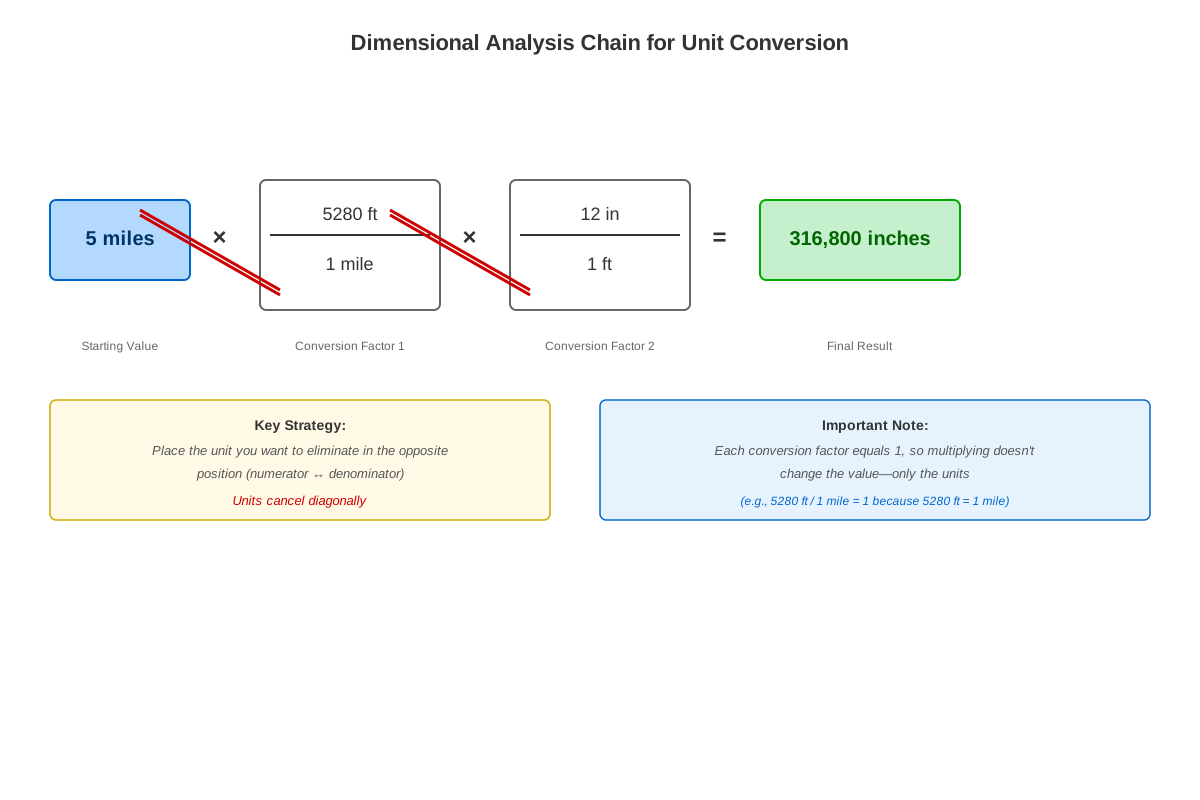
A conversion factor is a ratio that expresses how many of one unit equal another unit. For example, since 1 foot equals 12 inches, the conversion factor can be written as either 12 inches/1 foot or 1 foot/12 inches. The key principle is that multiplying by a conversion factor is equivalent to multiplying by 1, since the numerator and denominator represent equal quantities. This means the value doesn't change—only the units change.
When setting up conversion factors, always write them as fractions where:
- The numerator contains the unit you want to convert TO
- The denominator contains the unit you want to convert FROM
This arrangement ensures that unwanted units cancel out through dimensional analysis, leaving only the desired units in the final answer.
Dimensional Analysis Method
Dimensional analysis (also called the factor-label method) is the systematic approach to unit conversion that ensures mathematical accuracy. The process involves:
- Write the starting value with its units
- Multiply by conversion factor(s) arranged so units cancel
- Perform the arithmetic
- Verify that final units match the desired result
For example, to convert 5 feet to inches:
5 feet × (12 inches / 1 foot) = 60 inchesNotice how "feet" appears in both the numerator (original value) and denominator (conversion factor), allowing cancellation. This systematic cancellation is the hallmark of proper dimensional analysis and prevents the common error of multiplying when division is needed, or vice versa.
Single-Step Conversions
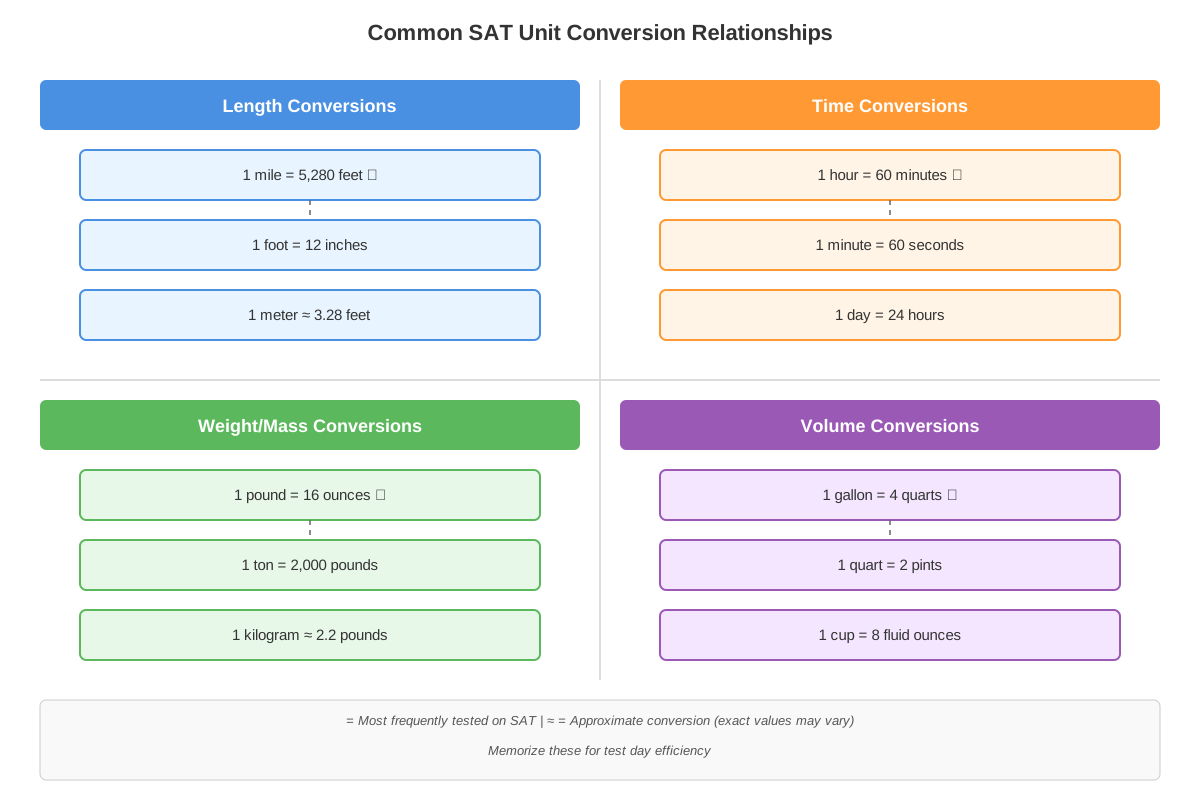
Single-step conversions involve one conversion factor and represent the simplest form of unit conversion equations. Common single-step conversions on the SAT include:
| From | To | Conversion Factor |
|---|---|---|
| Feet | Inches | 12 inches = 1 foot |
| Yards | Feet | 3 feet = 1 yard |
| Miles | Feet | 5,280 feet = 1 mile |
| Hours | Minutes | 60 minutes = 1 hour |
| Minutes | Seconds | 60 seconds = 1 minute |
| Kilograms | Grams | 1,000 grams = 1 kilogram |
| Meters | Centimeters | 100 centimeters = 1 meter |
| Pounds | Ounces | 16 ounces = 1 pound |
The SAT provides necessary conversion factors when they involve less common relationships (like miles to kilometers), but expects students to know standard conversions within the imperial and metric systems.
Multi-Step Conversions
Multi-step conversions require chaining multiple conversion factors together. The dimensional analysis method becomes especially powerful here, as each conversion factor is multiplied in sequence, with intermediate units canceling systematically.
For example, converting 2 miles to inches requires two steps:
2 miles × (5,280 feet / 1 mile) × (12 inches / 1 foot) = 126,720 inchesThe strategy is to create a "bridge" of conversion factors connecting the starting unit to the ending unit. Each factor must be oriented correctly so that units cancel progressively, leaving only the desired final unit.
Compound Unit Conversions
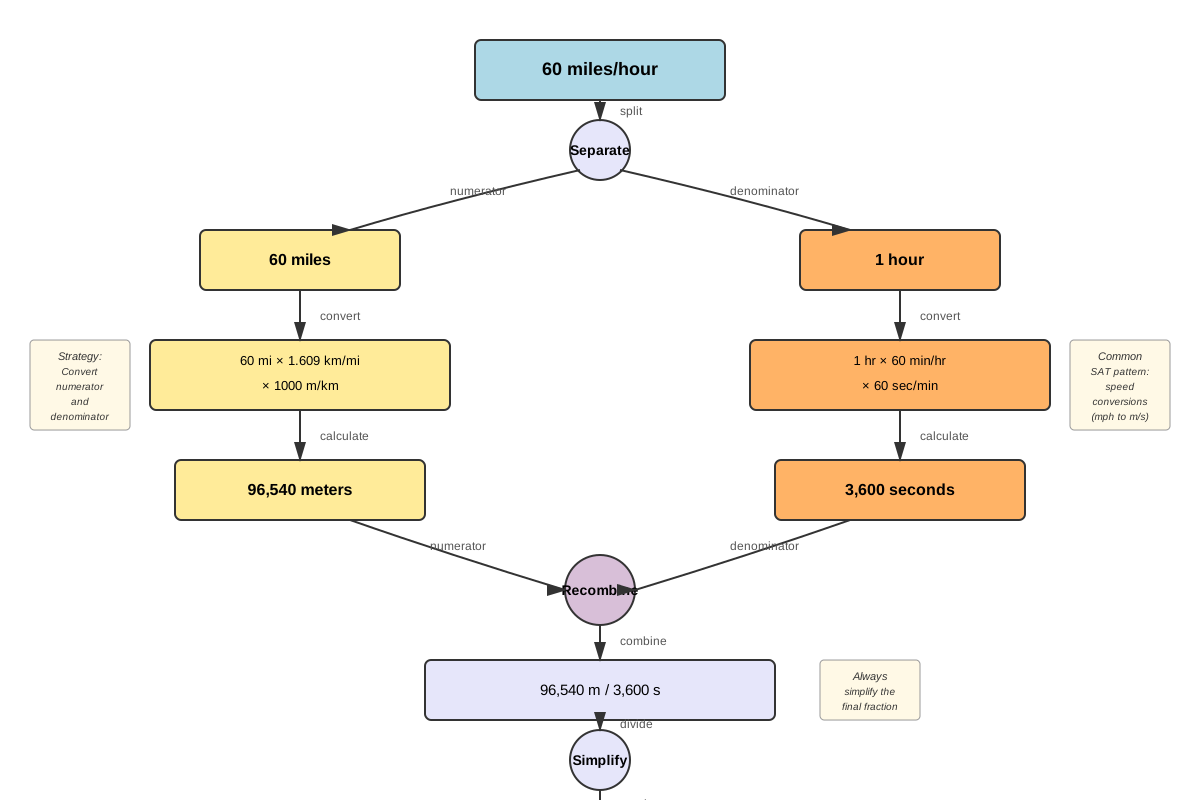
Compound units involve rates or ratios where units appear in both numerator and denominator, such as miles per hour (miles/hour) or dollars per pound ($/lb). Converting compound units requires converting both the numerator and denominator separately.
For example, converting 60 miles per hour to feet per second:
60 miles/hour × (5,280 feet / 1 mile) × (1 hour / 60 minutes) × (1 minute / 60 seconds) = 88 feet/secondNotice that the hour unit in the denominator requires its conversion factor to be inverted (1 hour in the numerator) so it cancels properly. This is a frequent source of errors—students must pay careful attention to whether a unit is in the numerator or denominator of the original rate.
Setting Up Unit Conversion Equations
When SAT problems ask students to write equations involving unit conversions, the key is to represent the conversion process algebraically. If a problem states "There are 2.54 centimeters in 1 inch," and asks for an equation to convert c centimeters to i inches, the equation would be:
c = 2.54iThis equation captures the relationship: the number of centimeters equals 2.54 times the number of inches. Students must carefully identify which variable represents which unit and ensure the coefficient reflects the correct conversion factor orientation.
Inverse Conversions
Understanding inverse relationships is crucial. If 1 inch = 2.54 centimeters, then 1 centimeter = 1/2.54 inches (approximately 0.394 inches). When converting in the opposite direction, students must use the reciprocal of the original conversion factor. This relationship can be expressed algebraically: if the equation converting inches to centimeters is c = 2.54i, then converting centimeters to inches requires solving for i, yielding i = c/2.54.
Concept Relationships
Unit conversion equations build directly on foundational concepts of ratios and proportions. The conversion factor itself is a ratio expressing equivalence between two units. When students multiply by conversion factors, they're applying proportional reasoning: if 1 foot equals 12 inches, then 5 feet equals 5 times 12 inches. This proportional relationship → enables dimensional analysis → which provides the systematic method for unit conversion.
Within the topic itself, single-step conversions → serve as building blocks for multi-step conversions. Once students master the principle of unit cancellation in simple conversions, they can chain multiple factors together for complex conversions. Similarly, understanding simple unit conversions → prepares students for compound unit conversions, where the same principles apply but require more careful tracking of numerator and denominator units.
Unit conversion equations connect forward to numerous SAT Math topics. They're essential for rate problems (distance = rate × time), where students must ensure all units are compatible before calculating. They appear in geometry problems involving area and volume, where converting linear measurements requires squaring or cubing the conversion factor. They're also fundamental to interpreting scientific data, understanding function notation in real-world contexts, and solving systems of equations where different equations use different units.
The algebraic representation of unit conversions → reinforces understanding of linear equations in one variable. Writing conversion equations helps students see that unit conversion is fundamentally about expressing relationships between variables, which → connects to the broader concept of mathematical modeling. This relationship between concrete conversions and abstract algebraic thinking strengthens overall mathematical reasoning.
Quick check — test yourself on Unit conversion equations so far.
Try Flashcards →High-Yield Facts
⭐ Conversion factors are ratios equal to 1: Multiplying by a conversion factor doesn't change the value, only the units
⭐ Always arrange conversion factors so unwanted units cancel: Place the unit you're converting FROM in the opposite position (numerator vs. denominator) from where it appears in the original value
⭐ The SAT provides unusual conversion factors: Common conversions (feet to inches, hours to minutes) must be memorized, but exotic conversions (miles to kilometers) will be given
⭐ Compound unit conversions require converting numerator AND denominator: When converting rates like miles/hour, address both units separately
⭐ Multi-step conversions use multiplication of sequential conversion factors: Chain factors together, ensuring intermediate units cancel
- When converting squared or cubed units (area or volume), the conversion factor must be squared or cubed: 1 foot = 12 inches, so 1 square foot = 144 square inches
- Inverse conversions use reciprocal conversion factors: if converting A to B uses factor x, converting B to A uses factor 1/x
- Unit conversion errors compound in multi-step problems: A mistake in conversion affects all subsequent calculations
- The SAT often embeds unit conversions within word problems rather than asking for conversions directly
- Dimensional analysis serves as a self-checking mechanism: if units don't cancel to produce the desired result, the setup is incorrect
Common Misconceptions
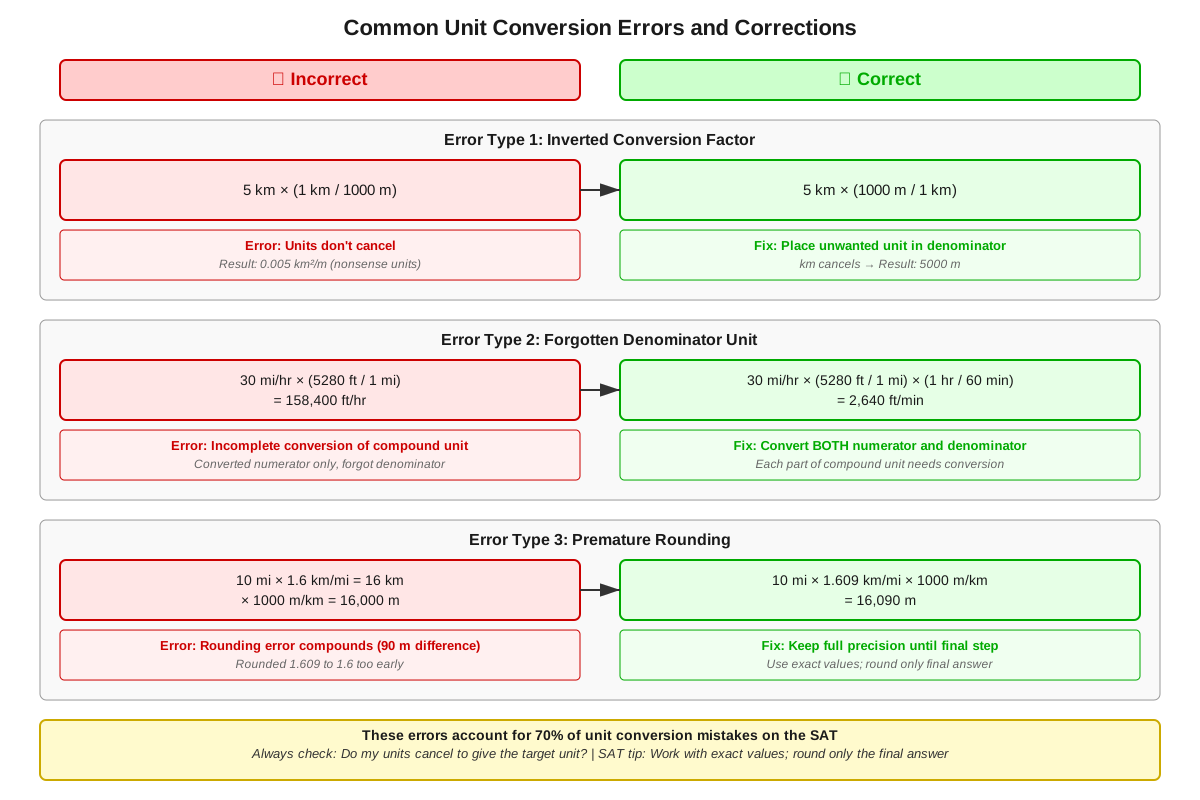
Misconception: Conversion factors can be applied in either direction without changing the fraction orientation → Correction: The conversion factor must be written as a fraction with the target unit in the numerator and the starting unit in the denominator. Using the factor upside-down produces the reciprocal of the correct answer.
Misconception: When converting compound units like miles per hour, only the numerator needs conversion → Correction: Both the numerator and denominator must be converted independently. Converting 60 miles/hour to feet/second requires converting both miles to feet AND hours to seconds.
Misconception: Converting area or volume uses the same conversion factor as converting length → Correction: When converting area, the linear conversion factor must be squared. When converting volume, it must be cubed. For example, since 1 foot = 12 inches, 1 square foot = 144 square inches (12²), not 12 square inches.
Misconception: Multiplying by a conversion factor changes the actual quantity being measured → Correction: Conversion factors equal 1 (since numerator and denominator represent equal amounts), so multiplying by them only changes the units of expression, not the actual physical quantity.
Misconception: All unit conversions require multiplication → Correction: While the dimensional analysis method uses multiplication of conversion factors, the algebraic setup sometimes requires division. For example, if c = 2.54i, then solving for i requires dividing: i = c/2.54.
Misconception: Conversion factors are always greater than 1 → Correction: Conversion factors can be less than 1 when converting from smaller to larger units. For example, converting inches to feet uses the factor 1 foot/12 inches, which equals approximately 0.083.
Misconception: The order of conversion factors doesn't matter in multi-step conversions → Correction: While the final result is the same regardless of order (due to the commutative property of multiplication), organizing conversions logically from starting unit to ending unit reduces errors and makes the work easier to check.
Worked Examples
Example 1: Multi-Step Conversion with Rates
Problem: A car travels at 45 miles per hour. What is this speed in feet per second? (Use 1 mile = 5,280 feet)
Solution:
Step 1: Identify starting units (miles/hour) and target units (feet/second)
Step 2: Set up conversion factors for the numerator (miles to feet) and denominator (hours to seconds)
Step 3: Apply dimensional analysis:
45 miles/hour × (5,280 feet / 1 mile) × (1 hour / 60 minutes) × (1 minute / 60 seconds)Step 4: Cancel units systematically:
- "miles" cancels between numerator and denominator
- "hour" cancels between numerator and denominator
- "minutes" cancels between numerator and denominator
Step 5: Perform arithmetic:
45 × 5,280 / (60 × 60) = 237,600 / 3,600 = 66 feet/secondAnswer: 66 feet per second
Connection to Learning Objectives: This problem demonstrates applying unit conversion equations to compound units, a common SAT question type. It requires identifying the correct conversion factors and arranging them properly—key features of unit conversion equations.
Example 2: Setting Up a Conversion Equation
Problem: A recipe calls for ingredients measured in ounces, but a student only has a scale that measures in grams. If there are approximately 28.35 grams in 1 ounce, which equation correctly converts g grams to z ounces?
A) z = 28.35g
B) g = 28.35z
C) z = g/28.35
D) z = g + 28.35
Solution:
Step 1: Identify what each variable represents:
- g = number of grams
- z = number of ounces
Step 2: Understand the given relationship: 1 ounce = 28.35 grams
Step 3: Determine the direction of conversion: We're converting FROM grams TO ounces
Step 4: Set up the proportional relationship:
- If 28.35 grams = 1 ounce
- Then g grams = g/28.35 ounces
Step 5: Write the equation: z = g/28.35
Step 6: Verify by testing: If g = 28.35 grams, then z = 28.35/28.35 = 1 ounce ✓
Answer: C) z = g/28.35
Connection to Learning Objectives: This problem tests the ability to identify key features of unit conversion equations (the coefficient represents the conversion factor) and explain how they appear on the SAT (as algebraic equations rather than pure arithmetic). Students must recognize that converting from a smaller unit (grams) to a larger unit (ounces) requires division.
Exam Strategy
When approaching unit conversion questions on the SAT, begin by carefully identifying what units you're starting with and what units the question asks for in the answer. Circle or underline these units in the problem to maintain focus. Many students lose points not because they can't do the conversion, but because they convert in the wrong direction or stop one step short of the required final units.
Trigger words and phrases that signal unit conversion problems include:
- "Convert," "express in terms of," "what is the equivalent"
- "How many [unit A] are in [unit B]"
- Rate expressions: "per hour," "per gallon," "per square foot"
- Comparison phrases: "compared to," "in relation to"
- "Write an equation" or "which equation represents" (algebraic conversion setup)
For multiple-choice questions, use process of elimination by checking units first. If an answer choice has incorrect units, eliminate it immediately without calculating. For example, if the question asks for a speed in meters per second and an answer choice is just a number without units or has units of meters per hour, it cannot be correct.
Time-Saving Tip: On calculator-permitted sections, set up the entire conversion as one calculation before entering it into your calculator. This reduces rounding errors and saves time compared to calculating each step separately.
When the SAT asks you to set up an equation rather than calculate a final answer, test the equation with simple numbers. If the problem states that 1 inch = 2.54 centimeters and asks for an equation converting inches to centimeters, plug in i = 1 inch into each answer choice. The correct equation should yield c = 2.54 centimeters.
Time allocation: Simple single-step conversions should take 30-45 seconds. Multi-step conversions or compound unit conversions may require 60-90 seconds. If you're spending more than 2 minutes on a conversion problem, mark it and return later—you may be overcomplicating the approach.
Always write out your dimensional analysis setup, even briefly. This serves two purposes: it helps you track unit cancellation, and it allows you to check your work if time permits. Many students try to do conversions mentally and make orientation errors (multiplying instead of dividing or vice versa).
Memory Techniques
"FUTON" for Conversion Factor Setup:
- Fraction form (always write as a fraction)
- Unit you want (goes in numerator)
- Target unit on top
- Original unit on bottom
- Numerator and denominator equal (conversion factor = 1)
Visualization Strategy: Picture conversion factors as bridges. You're standing on one side (starting unit) and need to cross to the other side (target unit). Each conversion factor is a bridge segment. You can only cross if the bridge connects properly—the unit you're leaving must match the unit at the start of the bridge.
"King Henry Died By Drinking Chocolate Milk" for metric system conversions:
- Kilo
- Hecto
- Deka
- Base unit (meter, liter, gram)
- Deci
- Centi
- Milli
Each step represents a factor of 10. Moving right means dividing by 10; moving left means multiplying by 10.
Compound Unit Acronym - "NUDE":
- Numerator first (convert the top unit)
- Unit check (verify what you're converting)
- Denominator second (convert the bottom unit)
- Evaluate (calculate the final answer)
The "Cancel Culture" Rule: In dimensional analysis, be aggressive about canceling units. If a unit appears in both numerator and denominator, it must cancel. If it doesn't, your setup is wrong. Think of unit cancellation as the "culture" of proper conversion—it's non-negotiable.
Summary
Unit conversion equations represent a high-yield SAT Math topic that combines algebraic thinking with practical problem-solving. The fundamental principle is that conversion factors are ratios equal to 1, allowing students to change units without changing values. Mastery requires understanding dimensional analysis—the systematic method of arranging conversion factors so units cancel properly, leaving only the desired final units. Single-step conversions form the foundation, while multi-step conversions chain multiple factors together. Compound unit conversions, involving rates or ratios, require converting both numerator and denominator independently. The SAT tests this topic through direct conversion calculations, algebraic equation setup, and embedded conversions within word problems. Success depends on careful unit tracking, proper conversion factor orientation, and systematic application of dimensional analysis. Students must memorize common conversion factors within imperial and metric systems while recognizing that unusual conversions will be provided. The ability to convert units accurately is essential not only for dedicated conversion questions but also for success across multiple SAT Math domains including rates, proportions, geometry, and scientific reasoning.
Key Takeaways
- Conversion factors are ratios equal to 1; multiplying by them changes units but not values
- Always arrange conversion factors with the target unit in the numerator and starting unit in the denominator to ensure proper cancellation
- Dimensional analysis provides a systematic, self-checking method for all unit conversions
- Compound unit conversions (rates) require converting both numerator and denominator units separately
- Multi-step conversions chain multiple conversion factors together through multiplication
- When converting area or volume, the linear conversion factor must be squared or cubed respectively
- The SAT expects memorization of common conversions but provides unusual conversion factors in the problem
Related Topics
Rate Problems and Distance-Rate-Time Relationships: Unit conversion is essential for rate problems where different units must be reconciled before applying d = rt. Mastering conversions enables efficient solving of motion problems, work-rate problems, and other SAT rate applications.
Proportional Relationships and Direct Variation: Conversion factors are special cases of proportional relationships. Understanding unit conversion deepens comprehension of how quantities vary proportionally and prepares students for more complex ratio and proportion problems.
Scientific Notation and Measurement: Many unit conversions involve very large or very small numbers, making scientific notation relevant. This connection appears in SAT science-based math problems involving physics or chemistry contexts.
Geometry Applications: Converting between measurement systems is crucial for geometry problems involving area, volume, and perimeter. Mastering unit conversion enables students to handle problems that mix imperial and metric measurements.
Function Notation and Mathematical Modeling: Writing unit conversion equations as functions (e.g., f(x) = 2.54x to convert inches to centimeters) connects this topic to broader function concepts and real-world mathematical modeling.
Practice CTA
Now that you've mastered the core concepts of unit conversion equations, it's time to solidify your understanding through practice. Attempt the practice questions to apply dimensional analysis, test your ability to set up conversion equations, and build speed with multi-step conversions. Use the flashcards to memorize essential conversion factors and reinforce the systematic approach to unit cancellation. Remember: unit conversion appears throughout the SAT Math section, so investing time in this topic yields returns across multiple question types. Every practice problem you complete builds the automaticity and confidence you need to handle these questions quickly and accurately on test day. You've got this!
Sign up free to keep reading
Create a free AnvayaPrep account to finish this SAT guide on Unit conversion equations — plus flashcards and practice questions.