Overview
Decreasing linear functions represent one of the most fundamental concepts tested in the SAT math section, appearing in multiple question formats across both calculator and no-calculator portions. A decreasing linear function is characterized by a negative slope, meaning that as the input (x-value) increases, the output (y-value) decreases at a constant rate. This consistent downward trend creates a straight line that falls from left to right when graphed on a coordinate plane.
Understanding decreasing linear functions is essential for SAT success because these functions appear in approximately 10-15% of all algebra questions on the exam. Students encounter them in various contexts: interpreting graphs, analyzing real-world scenarios involving depreciation or consumption, solving systems of equations, and working with function notation. The College Board frequently embeds decreasing linear functions within word problems about rates of change, such as water draining from tanks, temperatures cooling over time, or account balances decreasing with regular withdrawals.
Mastery of decreasing linear functions builds directly upon foundational algebra skills and serves as a gateway to more complex topics. This concept connects to slope-intercept form, point-slope form, parallel and perpendicular lines, systems of equations, and inequalities. Furthermore, understanding how negative slopes behave prepares students for analyzing more sophisticated functions, including piecewise functions and transformations. The ability to quickly identify, interpret, and manipulate decreasing linear functions often determines whether students can efficiently navigate multi-step problems within the SAT's time constraints.
Learning Objectives
- [ ] Identify key features of decreasing linear functions, including negative slope, y-intercept, and domain/range characteristics
- [ ] Explain how decreasing linear functions appears on the SAT in various question formats and real-world contexts
- [ ] Apply decreasing linear functions to answer SAT-style questions involving graphs, equations, and word problems
- [ ] Determine whether a given function is decreasing by analyzing its equation, graph, or table of values
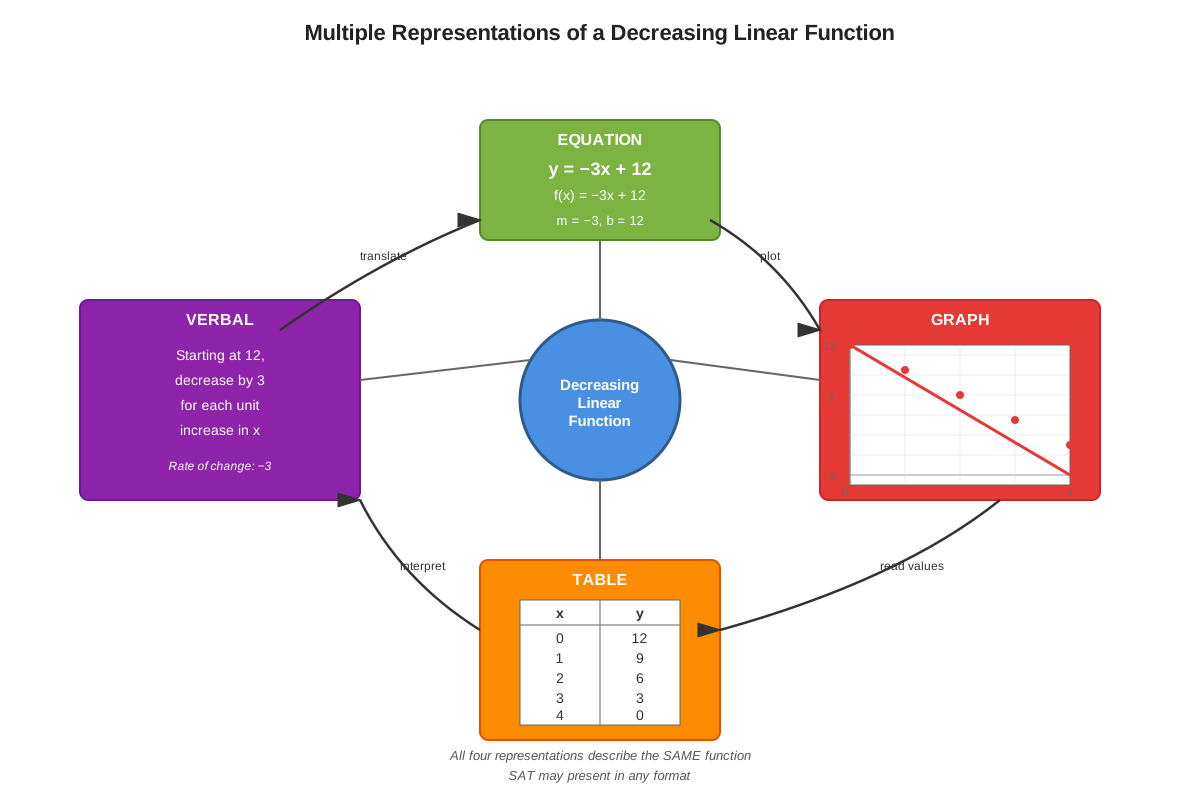
- [ ] Convert between different representations of decreasing linear functions (equation, graph, table, verbal description)
- [ ] Calculate the rate of decrease and interpret its meaning in context-based problems
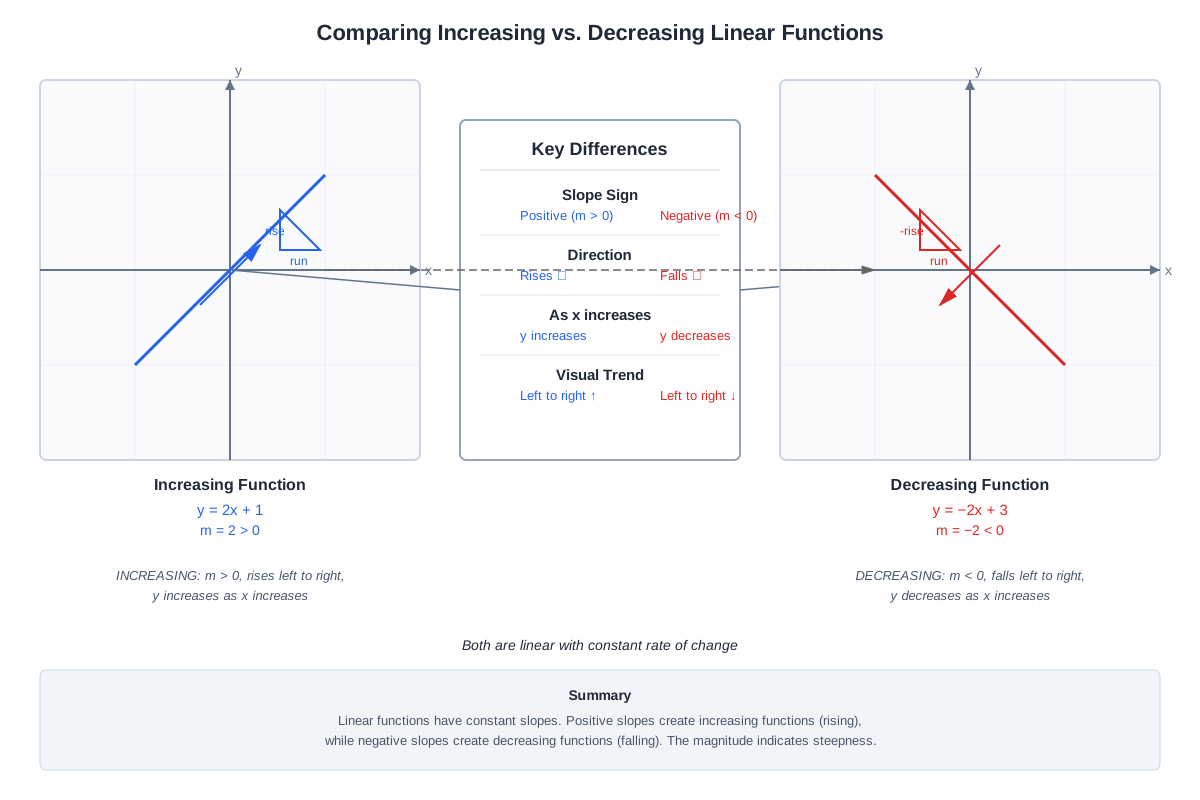
- [ ] Compare and contrast decreasing linear functions with increasing linear functions and identify their distinguishing characteristics
Prerequisites
- Coordinate plane basics: Understanding x and y axes, plotting points, and reading coordinates is essential for graphing and interpreting linear functions
- Slope concept: Knowledge of rise over run and how to calculate slope from two points provides the foundation for recognizing decreasing functions
- Linear equation forms: Familiarity with y = mx + b (slope-intercept form) enables quick identification of function characteristics
- Function notation: Understanding f(x) notation and input-output relationships is necessary for evaluating and interpreting functions
- Negative numbers: Comfort with negative values and their operations is crucial since decreasing functions have negative slopes
- Rate of change: Recognizing that slope represents rate of change helps interpret real-world applications
Why This Topic Matters
Decreasing linear functions model countless real-world phenomena that students encounter daily. When a smartphone battery percentage drops over time, when a car's value depreciates annually, when water drains from a bathtub, or when elevation decreases during a descent—all these situations involve decreasing linear relationships. Understanding these functions enables students to make predictions, solve practical problems, and interpret data in fields ranging from economics to engineering.
On the SAT, decreasing linear functions appear in approximately 3-5 questions per test, accounting for roughly 5-10% of the total math score. These questions span multiple difficulty levels and appear in various formats: multiple-choice, student-produced response (grid-ins), and within multi-part problems. The College Board tests this concept through direct questions about slope and y-intercept, interpretation of graphs showing negative trends, word problems requiring equation setup, and questions asking students to identify which function models a decreasing relationship.
Common SAT question types include: identifying the correct graph from an equation with negative slope, determining which real-world scenario matches a decreasing function, calculating how long until a quantity reaches zero given a constant rate of decrease, comparing rates of decrease between two functions, and finding the equation of a line parallel or perpendicular to a given decreasing function. The topic also appears integrated within more complex problems involving systems of equations where one or both functions are decreasing, or in questions about transformations and function composition.
Core Concepts
Definition and Characteristics of Decreasing Linear Functions
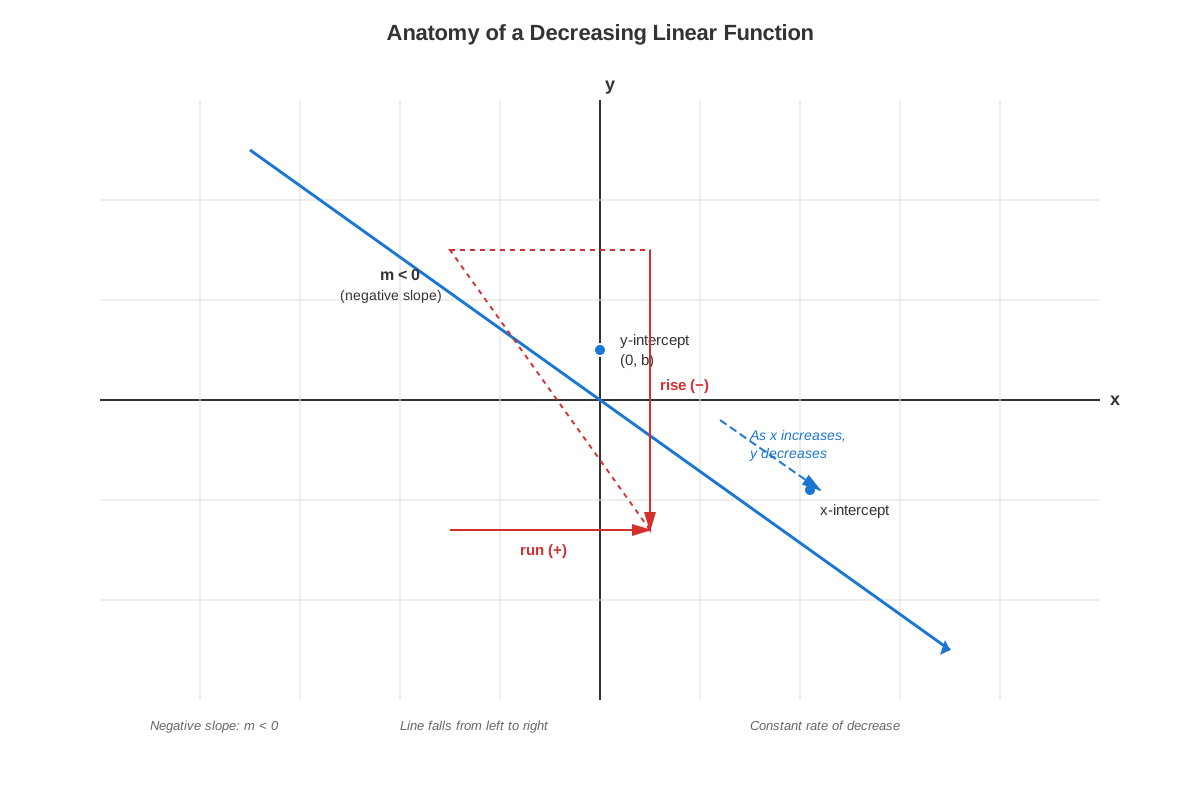
A decreasing linear function is a function whose output values decrease as input values increase, creating a straight line with a negative slope when graphed. The general form is f(x) = mx + b, where m < 0 (the slope is negative) and b represents the y-intercept. The negative slope indicates that for every unit increase in x, the y-value decreases by |m| units.
Key characteristics include:
- Negative slope: The coefficient of x is always negative
- Constant rate of decrease: The function decreases by the same amount for each unit increase in x
- Downward direction: The graph falls from left to right
- Linear relationship: The graph forms a straight line with no curves or breaks
- Unbounded behavior: Unless domain restrictions apply, the function continues decreasing indefinitely
Slope as Rate of Decrease
The slope m in a decreasing linear function represents the rate of decrease. If m = -3, the function decreases by 3 units for every 1-unit increase in x. This rate remains constant throughout the entire function, which distinguishes linear functions from nonlinear ones.
To calculate slope from two points (x₁, y₁) and (x₂, y₂):
m = (y₂ - y₁)/(x₂ - x₁)For a decreasing function, this calculation always yields a negative result. The magnitude of the slope indicates how steeply the function decreases: a slope of -5 decreases more rapidly than a slope of -2.
Identifying Decreasing Functions from Different Representations
From an equation: Examine the coefficient of x in slope-intercept form (y = mx + b). If this coefficient is negative, the function is decreasing. For example, y = -2x + 7 is decreasing because m = -2.
From a graph: Observe the direction of the line. If the line falls as you move from left to right, the function is decreasing. The steeper the downward angle, the more negative the slope.
From a table: Calculate the change in y-values as x-values increase. If y-values consistently decrease by the same amount, the function is linear and decreasing.
| x | y | Change in y |
|---|---|---|
| 0 | 10 | — |
| 1 | 7 | -3 |
| 2 | 4 | -3 |
| 3 | 1 | -3 |
This table shows a decreasing linear function with slope m = -3.
From a verbal description: Look for keywords indicating decrease: "falls," "drops," "decreases," "declines," "loses," "drains," "cools," "depreciates," or "reduces." If the rate is constant, the function is linear.
Y-Intercept in Decreasing Functions
The y-intercept (b in y = mx + b) represents the starting value when x = 0. In decreasing functions, this is typically the maximum value the function achieves within its natural domain. For real-world problems, the y-intercept often represents an initial quantity before decrease begins: initial account balance, starting temperature, full tank capacity, or original price.
For example, in the function f(x) = -5x + 100, the y-intercept is 100, meaning the function starts at 100 when x = 0 and decreases by 5 units for each unit increase in x.
X-Intercept and Zero Points
The x-intercept is where the function crosses the x-axis (where y = 0). For decreasing linear functions, this represents when the quantity reaches zero. To find it, set y = 0 and solve for x:
0 = mx + b
x = -b/m
Since m is negative and b is typically positive in real-world contexts, -b/m yields a positive x-value, indicating when the decreasing quantity reaches zero. This is particularly important in SAT word problems asking "when will the tank be empty?" or "after how many years will the value reach zero?"
Domain and Range Considerations
For mathematical decreasing linear functions without restrictions, the domain (all possible x-values) and range (all possible y-values) are both all real numbers. However, SAT problems often involve real-world contexts that impose restrictions.
For example, if x represents time in hours and cannot be negative, the domain might be x ≥ 0. If the function models a quantity that cannot go below zero (like volume of water), the range might be restricted to y ≥ 0, and the practical domain ends at the x-intercept.
Comparing Decreasing Functions
When comparing two decreasing linear functions, consider:
- Which decreases faster: The function with the more negative slope (larger absolute value) decreases more rapidly
- Which starts higher: Compare y-intercepts to determine initial values
- Which reaches zero first: The function with the smaller ratio of y-intercept to absolute value of slope reaches zero sooner
For example, comparing f(x) = -3x + 60 and g(x) = -4x + 80:
- g(x) decreases faster (slope of -4 vs -3)
- g(x) starts higher (y-intercept of 80 vs 60)
- f(x) reaches zero at x = 20, while g(x) reaches zero at x = 20 (same time in this case)
Concept Relationships
Decreasing linear functions connect intimately with multiple algebraic concepts, forming a web of mathematical relationships. The negative slope serves as the defining characteristic that distinguishes decreasing functions from increasing functions (positive slope) and constant functions (zero slope). This slope concept → leads to → understanding rate of change, which → applies to → real-world modeling scenarios.
The relationship between slope and y-intercept → determines → the complete behavior of the function. Together, these two parameters → define → the unique line representing the function. When students understand how changing the slope makes the line steeper or shallower while maintaining the same y-intercept, they → develop → deeper insight into function transformations.
Decreasing linear functions → connect to → systems of equations, particularly when one function is increasing and another is decreasing, guaranteeing an intersection point. This intersection → represents → equilibrium points in real-world scenarios, such as when two quantities that start at different values and change at different rates become equal.
The concept also → relates to → inequalities, as regions above or below a decreasing line represent solution sets for linear inequalities. Understanding that a decreasing function → creates → a boundary line helps students visualize solution regions and interpret constraint problems.
Furthermore, decreasing linear functions → serve as → building blocks for piecewise functions, where different linear pieces (some increasing, some decreasing) → combine to → model more complex real-world situations. This foundational understanding → enables → progression to quadratic functions, exponential decay, and other advanced function types that also exhibit decreasing behavior but with non-constant rates.
High-Yield Facts
⭐ A linear function is decreasing if and only if its slope m is negative (m < 0)
⭐ The slope of a decreasing linear function represents the constant rate of decrease per unit increase in the independent variable
⭐ In the equation y = mx + b for a decreasing function, b represents the y-intercept (starting value) and is typically the maximum value in practical contexts
⭐ The x-intercept of a decreasing linear function can be found using x = -b/m, representing when the function value reaches zero
⭐ A steeper downward slope (more negative value) indicates a faster rate of decrease
- The graph of a decreasing linear function always falls from left to right
- Two decreasing linear functions with the same slope are parallel and never intersect
- A decreasing linear function and an increasing linear function will always intersect at exactly one point (unless they're the same line)
- In a table of values for a decreasing linear function, the y-values decrease by a constant amount as x-values increase by a constant amount
- The domain and range of a decreasing linear function are both all real numbers unless context imposes restrictions
- Perpendicular lines have slopes that are negative reciprocals; a line perpendicular to a decreasing line may be increasing or decreasing depending on the original slope
- The average rate of change over any interval for a linear function equals the slope
Quick check — test yourself on Decreasing linear functions so far.
Try Flashcards →Common Misconceptions
Misconception: All functions with negative numbers are decreasing functions → Correction: A function is decreasing based on its slope (the coefficient of x), not whether it contains negative numbers. The function y = 3x - 10 is increasing (positive slope of 3) even though it contains -10. Only when the coefficient of x is negative is the function decreasing.
Misconception: A decreasing function must eventually reach zero → Correction: Mathematically, a decreasing linear function continues decreasing indefinitely and may pass through zero into negative values. While real-world contexts often impose restrictions (you can't have negative volume of water), the mathematical function itself has no such limitation unless explicitly stated.
Misconception: A steeper-looking line always has a more negative slope → Correction: The visual steepness depends on the scale of the axes. A line with slope -2 might appear steeper than a line with slope -5 if the axes use different scales. Always calculate or identify the actual slope value rather than relying solely on visual appearance.
Misconception: The y-intercept of a decreasing function must be positive → Correction: While many real-world problems feature positive y-intercepts (starting amounts), a decreasing function can have any y-intercept value—positive, negative, or zero. For example, y = -2x - 5 is a decreasing function with a negative y-intercept of -5.
Misconception: If a function decreases, its x-values must also decrease → Correction: The independent variable (x) can increase, decrease, or vary in any way. A function is classified as decreasing when increasing x-values produce decreasing y-values. The behavior of the output (y) in response to the input (x) determines whether the function is decreasing.
Misconception: All decreasing functions decrease at the same rate → Correction: Different decreasing linear functions have different slopes and therefore different rates of decrease. A function with slope -10 decreases ten times faster than a function with slope -1. The magnitude of the negative slope determines the rate of decrease.
Misconception: The point where a decreasing function crosses the x-axis is always the endpoint → Correction: The x-intercept is only an endpoint if the context restricts the domain. Mathematically, the function continues beyond this point into negative y-values. Context determines whether the x-intercept represents a meaningful boundary.
Worked Examples
Example 1: Identifying and Interpreting a Decreasing Function
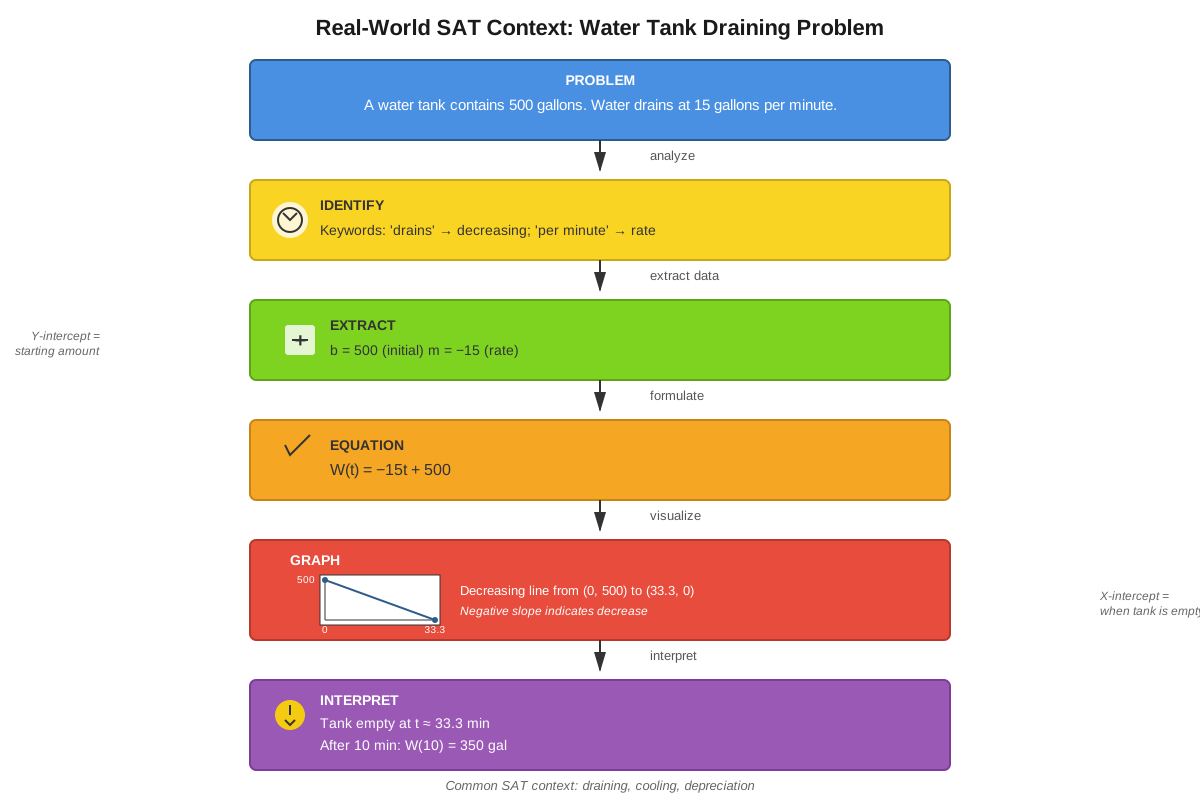
Problem: A water tank contains 500 gallons of water. Water drains from the tank at a constant rate of 15 gallons per hour. Write a function W(t) that represents the amount of water in the tank after t hours. Determine when the tank will be empty and identify the practical domain and range.
Solution:
Step 1: Identify the components
- Initial amount (y-intercept): b = 500 gallons
- Rate of decrease (slope): m = -15 gallons per hour (negative because water is draining)
- Independent variable: t (time in hours)
- Dependent variable: W(t) (water amount in gallons)
Step 2: Write the function in slope-intercept form
W(t) = -15t + 500This is a decreasing linear function because the slope (-15) is negative.
Step 3: Find when the tank is empty (x-intercept)
Set W(t) = 0:
0 = -15t + 500
15t = 500
t = 500/15 = 33.33... hours
The tank will be empty after approximately 33.33 hours (or 33 hours and 20 minutes).
Step 4: Determine practical domain and range
- Domain: 0 ≤ t ≤ 33.33 (time cannot be negative, and the tank is empty after 33.33 hours)
- Range: 0 ≤ W(t) ≤ 500 (water amount cannot be negative or exceed initial capacity)
Connection to learning objectives: This example demonstrates identifying key features (negative slope, y-intercept), applying the concept to a real-world SAT-style scenario, and interpreting the meaning of the x-intercept in context.
Example 2: Comparing Two Decreasing Functions
Problem: Company A's stock value can be modeled by f(x) = -2x + 80, where x represents weeks since January 1 and f(x) represents stock price in dollars. Company B's stock value is modeled by g(x) = -3x + 75. Which company's stock is decreasing faster? Which stock has a higher initial value? After how many weeks will the stocks have equal value?
Solution:
Step 1: Compare rates of decrease (slopes)
- Company A: slope = -2 (decreases $2 per week)
- Company B: slope = -3 (decreases $3 per week)
Company B's stock is decreasing faster because -3 < -2 (more negative slope means faster decrease).
Step 2: Compare initial values (y-intercepts)
- Company A: y-intercept = 80 (starts at $80)
- Company B: y-intercept = 75 (starts at $75)
Company A has a higher initial stock value ($80 vs $75).
Step 3: Find when stocks have equal value (intersection point)
Set f(x) = g(x):
-2x + 80 = -3x + 75
-2x + 3x = 75 - 80
x = -5
Wait—this gives a negative answer! This means the stocks were equal 5 weeks before January 1 (in the past). Since Company A starts higher and decreases slower, it will always remain higher than Company B after January 1.
Alternative interpretation: Let's verify by checking a specific week:
- Week 10: f(10) = -2(10) + 80 = 60; g(10) = -3(10) + 75 = 45
- Company A's stock ($60) is indeed higher than Company B's ($75)
Step 4: Determine when each reaches zero
- Company A: 0 = -2x + 80 → x = 40 weeks
- Company B: 0 = -3x + 75 → x = 25 weeks
Company B's stock reaches zero first (after 25 weeks vs 40 weeks).
Connection to learning objectives: This example applies decreasing linear functions to compare rates, interpret multiple representations, and solve systems—all common SAT question types.
Exam Strategy
When approaching SAT decreasing linear functions questions, implement this systematic strategy:
Step 1: Identify the question type
- Is it asking for an equation, a graph interpretation, a rate of change, or a real-world application?
- Look for trigger words: "decreases," "falls," "drains," "loses," "depreciates," "declines," "reduces"
Step 2: Determine what makes the function decreasing
- Immediately check the sign of the slope
- In word problems, identify what quantity is decreasing and at what rate
- Remember: negative slope = decreasing function
Step 3: Extract key information systematically
- Initial value → y-intercept (b)
- Rate of decrease → slope (m, which must be negative)
- Time or input variable → x
- Quantity being measured → y or f(x)
Exam Tip: When a problem states "decreases by X units per Y," the slope is -X/Y. The negative sign is crucial and often the source of errors.
Step 4: Use process of elimination effectively
- Eliminate any answer choices with positive slopes immediately
- For graph questions, eliminate any lines that rise from left to right
- For equation questions, eliminate any where the coefficient of x is positive
- Check y-intercepts against the problem context (initial values)
Step 5: Verify your answer makes contextual sense
- Does the slope sign match the described behavior?
- Is the y-intercept reasonable for the starting value?
- Do calculated values make sense in context (no negative volumes, times, etc.)?
Time allocation advice:
- Simple identification questions (is this function decreasing?): 30-45 seconds
- Equation writing from word problems: 1-1.5 minutes
- Multi-step problems involving comparisons or systems: 2-3 minutes
- Always leave 15-20 seconds to verify your answer makes sense
Common trigger phrases to watch for:
- "Decreases at a constant rate" → linear function with negative slope
- "Loses X per Y" → slope is -X/Y
- "Starts at A and decreases by B" → equation is y = -Bx + A
- "Falls from left to right" → negative slope
- "Which function decreases faster?" → compare absolute values of slopes
Memory Techniques
Mnemonic for identifying decreasing functions: "Negative Nancy Goes Down"
- Negative slope
- Negative coefficient of x
- Goes down (left to right)
- Decreasing function
Visualization strategy: Picture a ski slope going downhill. The skier (representing the function) always moves down as they go forward (left to right). The steeper the slope, the faster they descend (more negative slope = faster decrease).
Acronym for analyzing decreasing functions: SIR
- Slope (must be negative)
- Intercept (y-intercept is starting value)
- Rate (slope magnitude shows rate of decrease)
Memory device for x-intercept formula: "Negative B over M" sounds like "Negative Bee Over Me" → imagine a bee flying down (negative) over your head. The formula x = -b/m tells you when the function reaches zero.
Finger trick for slope sign: Point your right index finger in the direction the line goes (left to right). If your finger points downward, the slope is negative (decreasing). If it points upward, the slope is positive (increasing).
Comparison memory aid: "More negative = More rapid decrease." When comparing slopes like -2 and -5, remember that -5 is "more negative" (further from zero) and therefore represents a faster rate of decrease.
Summary
Decreasing linear functions are characterized by negative slopes and represent relationships where output values decrease at a constant rate as input values increase. These functions appear throughout the SAT math section in various formats, from direct graph interpretation to complex word problems involving real-world scenarios like depreciation, drainage, and cooling. The key to mastering this topic lies in recognizing that the negative coefficient of x defines the function as decreasing, understanding that this coefficient represents the constant rate of decrease, and being able to translate between equations, graphs, tables, and verbal descriptions. Students must identify y-intercepts as starting values, calculate x-intercepts to determine when quantities reach zero, and compare different decreasing functions by analyzing their slopes and intercepts. Success on SAT questions requires not only computational accuracy but also contextual interpretation—understanding what the mathematical features mean in real-world situations and recognizing when domain and range restrictions apply based on practical constraints.
Key Takeaways
- A linear function is decreasing if and only if its slope (the coefficient of x) is negative
- The slope represents the constant rate of decrease: a slope of -5 means the function decreases by 5 units for every 1-unit increase in x
- The y-intercept represents the starting value and is typically the maximum value in real-world contexts with natural restrictions
- Decreasing linear functions graph as straight lines falling from left to right; steeper downward angles indicate more negative slopes
- The x-intercept (found using x = -b/m) represents when the function value reaches zero, often marking practical domain boundaries
- When comparing decreasing functions, the one with the more negative slope decreases faster
- Always verify that your answer makes contextual sense, especially regarding domain and range restrictions in real-world problems
Related Topics
Increasing Linear Functions: Understanding decreasing functions naturally leads to studying their opposite—increasing linear functions with positive slopes. Mastering both types enables students to analyze any linear relationship and compare different rates of change.
Systems of Linear Equations: Decreasing linear functions frequently appear in systems where two functions intersect. Understanding how a decreasing function interacts with an increasing function or another decreasing function is essential for solving real-world optimization problems.
Linear Inequalities: Once students master decreasing linear functions, they can progress to inequalities involving these functions, determining regions where one quantity exceeds another and solving constraint problems.
Absolute Value Functions: These functions often incorporate linear pieces, some increasing and some decreasing, requiring students to apply their understanding of decreasing linear functions within more complex contexts.
Exponential Decay: While exponential functions decrease at non-constant rates, understanding linear decrease provides a foundation for comparing constant versus variable rates of change, a sophisticated skill tested on advanced SAT questions.
Practice CTA
Now that you've mastered the core concepts of decreasing linear functions, it's time to solidify your understanding through practice! Attempt the practice questions to test your ability to identify, interpret, and apply these functions in various SAT-style scenarios. Use the flashcards to reinforce key definitions and formulas until they become second nature. Remember, the difference between knowing these concepts and scoring points on test day lies in repeated, focused practice. Each problem you solve strengthens your pattern recognition and builds the confidence you need to tackle any decreasing linear function question the SAT throws at you. You've got this!
Sign up free to keep reading
Create a free AnvayaPrep account to finish this SAT guide on Decreasing linear functions — plus flashcards and practice questions.