Overview
Increasing linear functions represent one of the most fundamental and frequently tested concepts in SAT math. These functions describe relationships where the output value consistently grows as the input value increases, creating a predictable upward pattern when graphed on a coordinate plane. Understanding increasing linear functions is not merely about recognizing an upward-sloping line; it requires mastery of multiple representations including equations, graphs, tables, and verbal descriptions, as well as the ability to translate fluidly between these forms.
On the SAT, sat increasing linear functions appear across multiple question types and difficulty levels, from straightforward identification problems to complex multi-step applications involving real-world scenarios. Students encounter these functions in contexts ranging from business profit models and distance-time relationships to population growth and pricing structures. The College Board consistently includes 3-5 questions per test that directly assess understanding of increasing linear functions, with many additional questions incorporating this concept as a foundational element of more complex problems.
Mastery of increasing linear functions serves as a gateway to understanding broader mathematical relationships tested on the SAT. This topic connects directly to concepts such as slope, rate of change, function notation, systems of equations, and inequalities. Students who thoroughly understand increasing linear functions gain the analytical tools necessary to interpret data presentations, solve optimization problems, and make predictions based on linear models—skills that appear throughout both the calculator and no-calculator portions of the SAT Math section.
Learning Objectives
- [ ] Identify key features of increasing linear functions from equations, graphs, and tables
- [ ] Explain how increasing linear functions appears on the SAT across different question formats
- [ ] Apply increasing linear functions to answer SAT-style questions efficiently and accurately
- [ ] Determine whether a linear function is increasing by analyzing its slope or rate of change
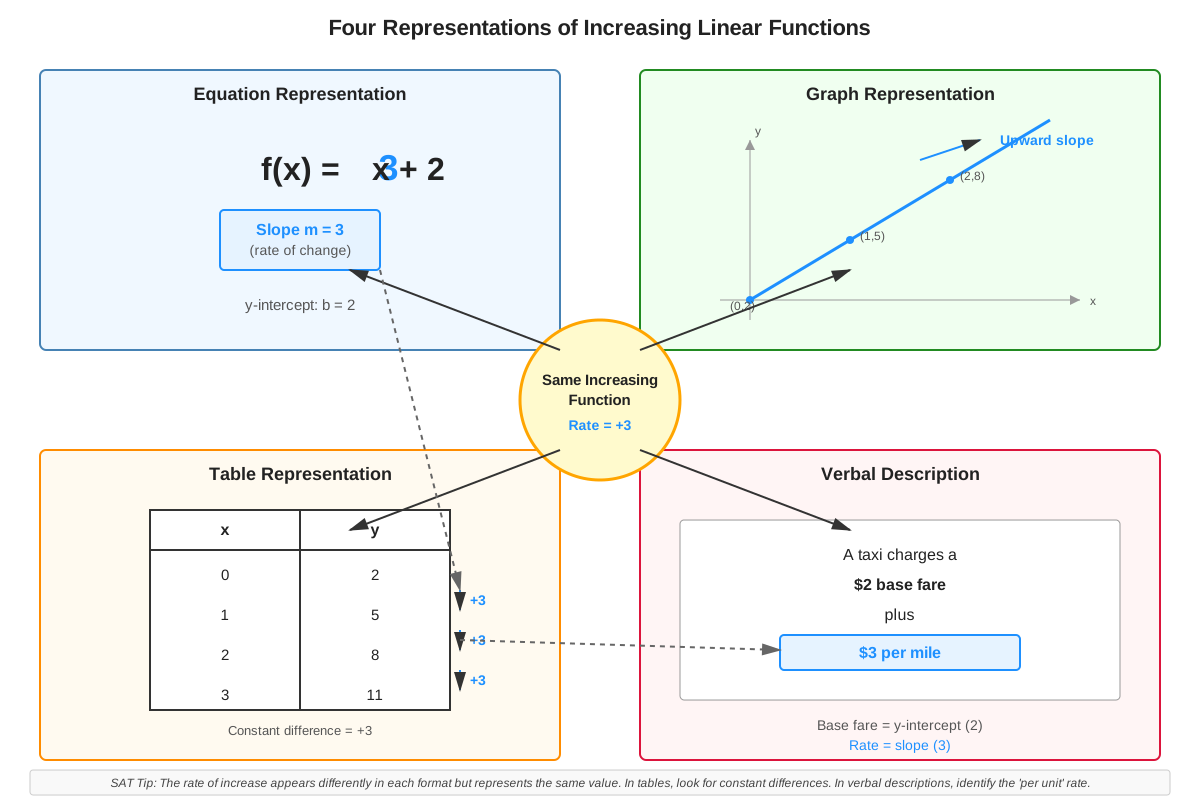
- [ ] Convert between different representations of increasing linear functions (equation, graph, table, verbal description)
- [ ] Compare multiple increasing linear functions to determine which increases more rapidly
- [ ] Solve real-world SAT problems involving increasing linear relationships
Prerequisites
- Basic algebraic manipulation: Essential for rearranging linear equations into different forms and solving for variables
- Coordinate plane fundamentals: Required to plot points and interpret graphs of linear functions
- Understanding of variables and constants: Necessary to distinguish between changing quantities and fixed values in function notation
- Slope concept: Critical foundation for determining whether a function increases, decreases, or remains constant
- Function notation (f(x) and y): Needed to read and interpret function equations as they appear on the SAT
Why This Topic Matters
Increasing linear functions model countless real-world phenomena that students encounter daily. When a rideshare service charges a base fee plus a per-mile rate, when a phone plan includes a monthly charge plus per-gigabyte costs, or when a savings account grows through regular deposits—all these scenarios involve increasing linear functions. Understanding these relationships empowers students to make informed decisions about finances, interpret data in news articles, and analyze trends in various fields from economics to environmental science.
On the SAT, increasing linear functions appear with remarkable consistency. Approximately 15-20% of all Math section questions involve linear functions in some capacity, with roughly half of these specifically testing understanding of increasing functions. Questions appear in multiple formats: multiple-choice problems requiring identification of increasing functions from graphs or equations, grid-in questions asking for specific values or slopes, and multi-part questions embedded in real-world contexts. The College Board particularly favors questions that require students to interpret the meaning of slope in context or compare rates of change between different increasing functions.
Common SAT question types include: identifying which of four graphed functions is increasing; determining the slope of an increasing linear function from a table of values; writing an equation for an increasing linear relationship described verbally; comparing two increasing functions presented in different formats to determine which has a greater rate of increase; and solving for unknown parameters that would make a function increasing. These questions typically appear in both calculator and no-calculator sections, with context-heavy applications more common in calculator-permitted portions.
Core Concepts
Definition and Characteristics
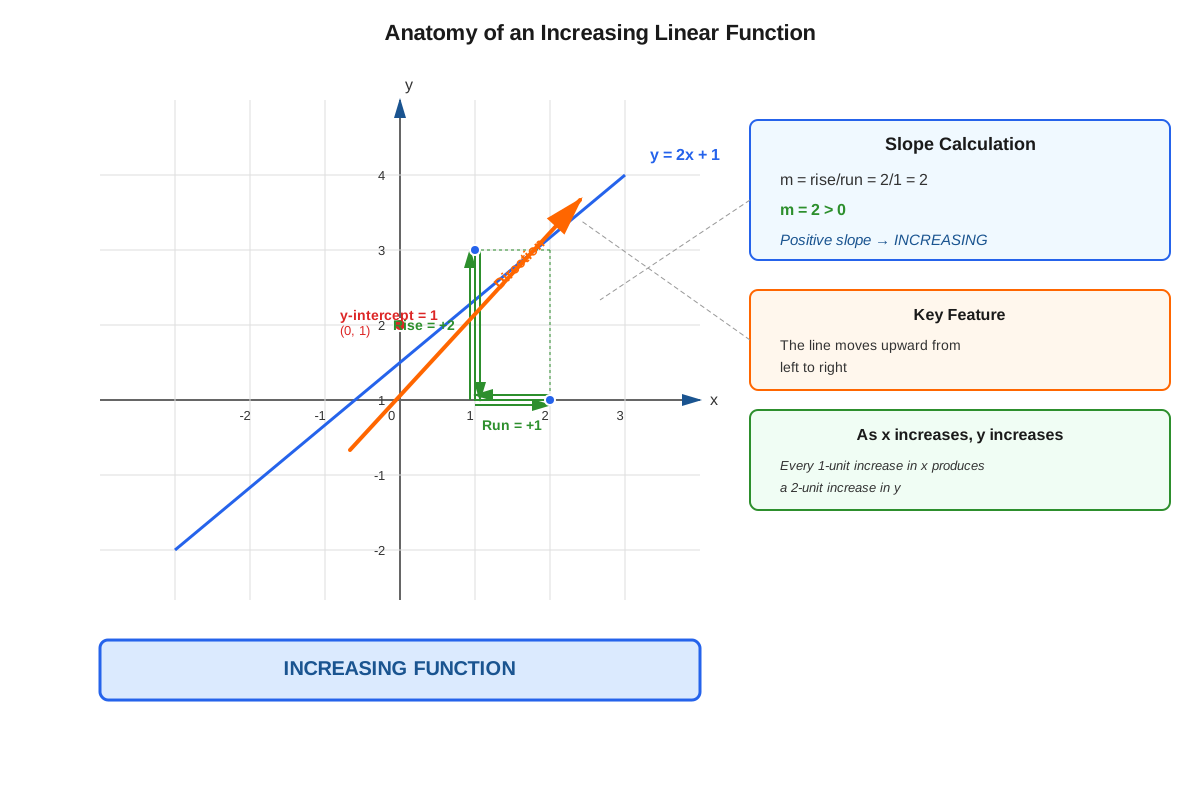
An increasing linear function is a function whose output values consistently grow larger as input values increase. Mathematically, a linear function f(x) = mx + b is increasing when its slope m is positive (m > 0). The term "linear" indicates that the rate of increase remains constant—the function rises by the same amount for each unit increase in the input variable.
The standard form of a linear function is f(x) = mx + b, where:
- m represents the slope (rate of change)
- b represents the y-intercept (initial value when x = 0)
- x represents the independent variable (input)
- f(x) or y represents the dependent variable (output)
For a function to be increasing, the critical requirement is m > 0. The y-intercept b can be any real number—positive, negative, or zero—without affecting whether the function increases.
Identifying Increasing Functions from Equations
When examining an equation to determine if it represents an increasing linear function, focus on isolating the coefficient of the independent variable. Consider these examples:
Example 1: f(x) = 3x + 7
The coefficient of x is 3, which is positive, so this function is increasing.
Example 2: y = -2x + 10
The coefficient of x is -2, which is negative, so this function is decreasing, not increasing.
Example 3: g(x) = 0.5x - 4
The coefficient of x is 0.5, which is positive, so this function is increasing despite the negative y-intercept.
Sometimes equations require rearrangement. If given 2y = 6x + 8, divide all terms by 2 to get y = 3x + 4, revealing a positive slope of 3.
Identifying Increasing Functions from Graphs
On a coordinate plane, an increasing linear function appears as a straight line that rises from left to right. As you trace the line from left to right (following increasing x-values), the y-values consistently increase. The steeper the upward slope, the faster the function increases.
Key visual indicators:
- The line moves upward as you scan from left to right
- Any two points on the line satisfy: if x₂ > x₁, then f(x₂) > f(x₁)
- The line makes an acute angle (less than 90°) with the positive x-axis
Identifying Increasing Functions from Tables
When presented with a table of values, calculate the rate of change between consecutive points. For an increasing linear function, this rate must be positive and constant.
| x | f(x) | Change in f(x) |
|---|---|---|
| 0 | 5 | — |
| 1 | 8 | +3 |
| 2 | 11 | +3 |
| 3 | 14 | +3 |
This table shows an increasing linear function because f(x) consistently increases by 3 for each unit increase in x. The constant positive change confirms both that the function is linear and that it is increasing.
Slope as Rate of Increase
The slope quantifies how rapidly an increasing linear function grows. Calculate slope using any two points (x₁, y₁) and (x₂, y₂):
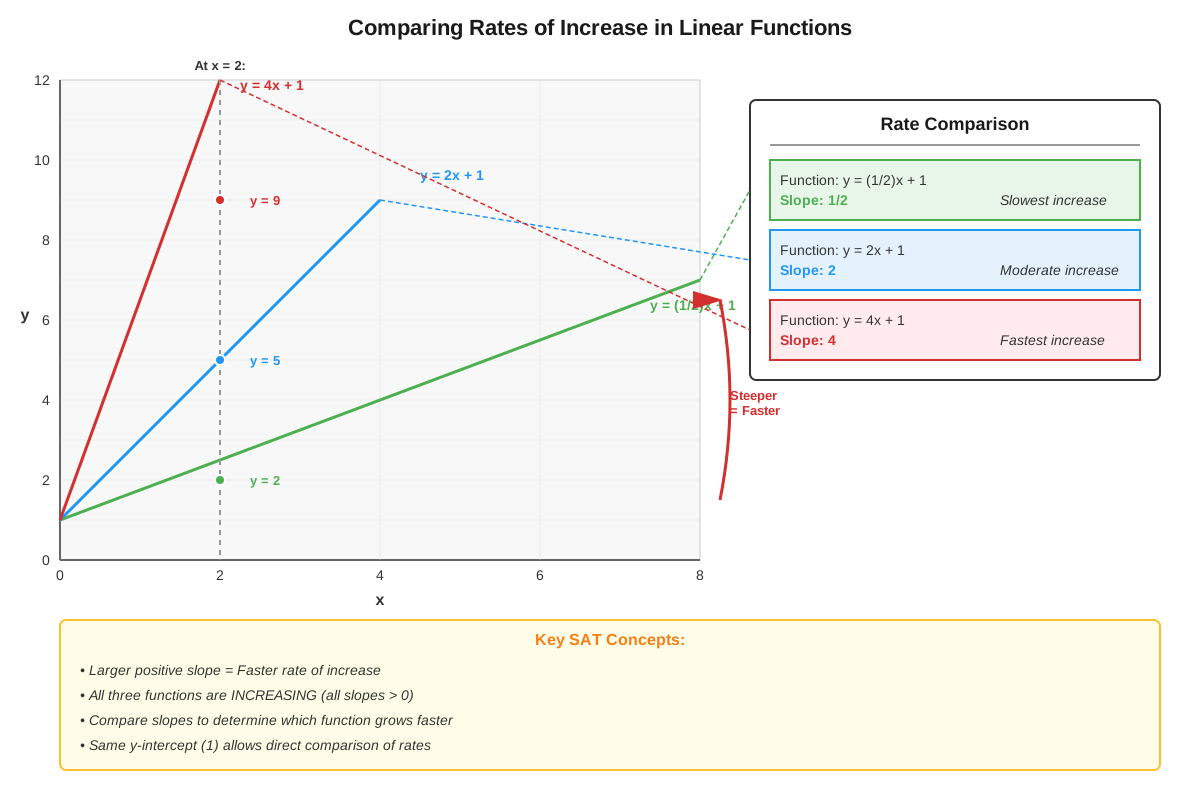
m = (y₂ - y₁)/(x₂ - x₁)A larger positive slope indicates faster increase. For example:
- Function A: f(x) = 5x + 2 (slope = 5)
- Function B: g(x) = 2x + 10 (slope = 2)
Function A increases more rapidly than Function B, even though Function B has a higher y-intercept. After sufficient x-values, Function A will always produce larger outputs than Function B.
Contextual Interpretation
SAT questions frequently present increasing linear functions in real-world contexts. The slope represents the rate of change of the dependent variable with respect to the independent variable, while the y-intercept represents the initial value or starting amount.
Example Context: A water tank contains 50 gallons and is being filled at a rate of 8 gallons per minute.
- Equation: W(t) = 8t + 50
- Slope (8): The tank gains 8 gallons per minute
- Y-intercept (50): The tank initially contained 50 gallons
- This is an increasing function because water is being added (positive rate)
Comparing Increasing Functions
The SAT often asks students to compare two or more increasing linear functions presented in different formats. The function with the larger slope increases more rapidly.
Comparison Strategy:
- Convert all functions to slope-intercept form (y = mx + b) if given as equations
- Calculate slope from two points if given as a table or graph
- Compare the slope values
- The function with the largest positive slope increases fastest
Concept Relationships
The concept of increasing linear functions builds directly upon understanding of slope, which measures the steepness and direction of a line. Slope serves as the determining factor: positive slope → increasing function. This relationship is fundamental and absolute for linear functions.
Increasing linear functions connect to function notation through the representation f(x) = mx + b, where the function name f and input variable x allow precise mathematical communication. Understanding that f(x) and y are interchangeable helps students translate between different problem presentations.
The relationship flows as follows: Coordinate plane basics → Slope calculation → Linear equations → Increasing linear functions → Systems of equations and Linear inequalities. Each concept builds upon the previous, with increasing linear functions serving as a central hub connecting multiple mathematical ideas.
Within the topic itself, the concepts interconnect: Equation form ↔ Graphical representation ↔ Table of values ↔ Verbal description. Mastery requires fluid translation between these representations. For example, recognizing that the equation y = 3x + 2, a table showing y-values increasing by 3 for each unit increase in x, a line rising from left to right with slope 3, and a description of "a quantity starting at 2 and increasing by 3 per unit" all represent the same increasing linear function.
The concept also connects forward to more advanced topics: exponential functions (which increase at changing rates rather than constant rates), quadratic functions (which may increase over some intervals and decrease over others), and piecewise functions (which may be increasing over certain domains). Understanding increasing linear functions provides the foundation for analyzing more complex function behaviors.
High-Yield Facts
⭐ A linear function f(x) = mx + b is increasing if and only if m > 0
⭐ The slope of an increasing linear function represents its constant rate of increase
⭐ On a graph, increasing linear functions rise from left to right
⭐ In a table of values, an increasing linear function shows consistent positive changes in output for equal changes in input
⭐ When comparing two increasing linear functions, the one with the larger slope increases more rapidly
- The y-intercept (b value) does not determine whether a function is increasing; only the slope matters
- An increasing linear function will eventually exceed any decreasing or constant function if the domain extends far enough
- The slope of an increasing linear function can be any positive number: whole numbers, fractions, decimals, or irrational numbers
- In real-world contexts, the slope's units are (output units)/(input units), such as dollars per hour or miles per gallon
- Two different increasing linear functions with the same slope are parallel lines that never intersect
- The steeper an increasing line appears on a standard coordinate plane, the larger its slope value
Quick check — test yourself on Increasing linear functions so far.
Try Flashcards →Common Misconceptions
Misconception: A function with a negative y-intercept cannot be increasing.
Correction: The y-intercept has no effect on whether a function increases or decreases. Only the slope determines this. The function f(x) = 5x - 100 is increasing because its slope (5) is positive, even though it starts at -100 when x = 0.
Misconception: A function that starts with lower values than another function increases more slowly.
Correction: The rate of increase depends solely on slope, not on initial values. The function f(x) = 10x + 1 increases much faster than g(x) = 2x + 1000, even though g(x) starts at a much higher value. Eventually, f(x) will surpass g(x).
Misconception: If a table shows all positive y-values, the function must be increasing.
Correction: A function is increasing only if y-values grow as x-values grow. The function could have all positive outputs but still be decreasing. For example, f(x) = -2x + 100 produces positive outputs for small x-values but is a decreasing function.
Misconception: The steepness of a line on a graph always accurately represents how fast the function increases.
Correction: Visual steepness depends on the scale of the axes. A function with slope 2 might appear steeper than one with slope 5 if the axes use different scales. Always calculate the numerical slope rather than relying on visual appearance alone.
Misconception: An increasing function must increase forever without bound.
Correction: While the mathematical definition of an increasing linear function implies it continues increasing across its entire domain, SAT problems often restrict the domain to realistic values. A function can be increasing over its relevant domain even if that domain is limited (e.g., time from 0 to 10 hours).
Misconception: If two points on a line show an increase, the entire function is increasing.
Correction: For linear functions, this is actually true—if any two points show an increase, the function is increasing everywhere. However, students must verify the function is truly linear first. Non-linear functions can increase over some intervals and decrease over others.
Worked Examples
Example 1: Multi-Representation Identification
Problem: A student is analyzing four different functions to determine which are increasing linear functions:
Function A: f(x) = -3x + 7
Function B: Shown in the table below
Function C: A line passing through points (2, 5) and (6, 13)
Function D: g(x) = 4 - 2x
| x | Function B |
|---|---|
| 0 | 3 |
| 2 | 7 |
| 4 | 11 |
| 6 | 15 |
Which functions are increasing?
Solution:
Function A: f(x) = -3x + 7
The coefficient of x is -3, which is negative. This function is decreasing, not increasing.
Verdict: Not increasing
Function B: Examine the table
- From x = 0 to x = 2: output changes from 3 to 7 (increase of 4)
- From x = 2 to x = 4: output changes from 7 to 11 (increase of 4)
- From x = 4 to x = 6: output changes from 11 to 15 (increase of 4)
The output consistently increases by 4 for each increase of 2 in x. The slope is 4/2 = 2, which is positive.
Verdict: Increasing
Function C: Calculate slope using points (2, 5) and (6, 13)
m = (13 - 5)/(6 - 2) = 8/4 = 2The slope is 2, which is positive.
Verdict: Increasing
Function D: g(x) = 4 - 2x
Rewrite in standard form: g(x) = -2x + 4
The coefficient of x is -2, which is negative. This function is decreasing.
Verdict: Not increasing
Answer: Functions B and C are increasing linear functions.
Connection to Learning Objectives: This example demonstrates identification of increasing linear functions across multiple representations (equations, tables, and graphs with points), addressing the first and third learning objectives.
Example 2: Real-World Application and Comparison
Problem: Two different phone plans are available:
Plan A: Charges $25 per month plus $0.10 per text message
Plan B: The monthly cost is shown in the table below
| Text Messages | Plan B Cost |
|---|---|
| 0 | $15 |
| 50 | $20 |
| 100 | $25 |
| 150 | $30 |
a) Write an equation for Plan A's monthly cost as a function of text messages sent.
b) Determine if both plans represent increasing linear functions.
c) Which plan's cost increases more rapidly with additional text messages?
d) For what number of text messages do the plans cost the same?
Solution:
Part a: Let C(t) represent the cost and t represent the number of text messages.
Plan A has a fixed charge of $25 (y-intercept) and adds $0.10 per message (slope).
Equation: C(t) = 0.10t + 25
Part b:
Plan A: The slope is 0.10, which is positive, so Plan A is an increasing linear function.
Plan B: Calculate the rate of change from the table:
- From 0 to 50 messages: cost increases from $15 to $20 (change of $5 for 50 messages)
- From 50 to 100 messages: cost increases from $20 to $25 (change of $5 for 50 messages)
- From 100 to 150 messages: cost increases from $25 to $30 (change of $5 for 50 messages)
Slope = 5/50 = 0.10 per message. This is positive, so Plan B is also an increasing linear function.
Plan B equation: C(t) = 0.10t + 15
Answer: Both plans represent increasing linear functions.
Part c: Compare slopes:
- Plan A slope: 0.10
- Plan B slope: 0.10
Both plans have identical slopes, meaning they increase at exactly the same rate. Each additional text message adds $0.10 to the monthly cost for both plans.
Answer: Both plans' costs increase at the same rate.
Part d: Set the equations equal:
0.10t + 25 = 0.10t + 15
25 = 15
This equation has no solution because 25 ≠ 15. Since both functions have the same slope but different y-intercepts, they are parallel lines that never intersect.
Answer: The plans never cost the same amount. Plan A always costs $10 more than Plan B for any number of text messages.
Connection to Learning Objectives: This example applies increasing linear functions to a real-world SAT-style scenario, requires converting verbal descriptions to equations, involves comparing rates of increase, and demonstrates how to analyze increasing functions in context—addressing learning objectives 2, 3, 5, and 6.
Exam Strategy
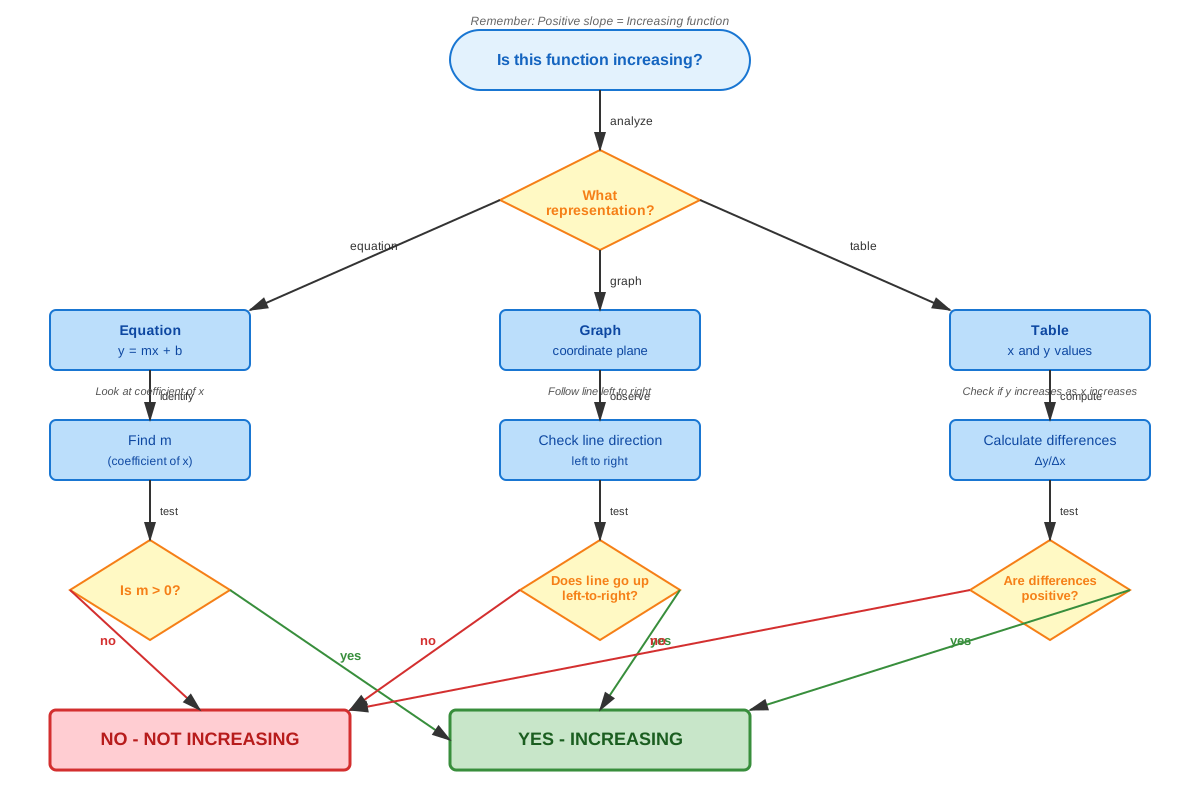
When approaching SAT questions on increasing linear functions, begin by identifying what format the function is presented in: equation, graph, table, or verbal description. This determines your first analytical step.
For equation-based questions: Immediately isolate the coefficient of the independent variable. If the equation isn't in slope-intercept form (y = mx + b), rearrange it. Watch for equations written as ax + by = c, which require solving for y. Remember that only the sign of the slope coefficient matters for determining if the function increases—ignore the y-intercept for this determination.
For graph-based questions: Use the left-to-right scan technique. Place your finger on the left side of the graph and trace rightward. If the line moves upward, it's increasing. Be cautious with axis scales—they can make slopes appear different than their actual values. If you need the exact slope, identify two clear points and calculate rather than estimating visually.
For table-based questions: Calculate the change in output values for equal changes in input values. SAT tables typically use evenly spaced input values to make this easier. If the output consistently increases by the same amount, you have an increasing linear function. The amount of increase divided by the input interval gives you the slope.
Trigger words and phrases that signal increasing linear functions:
- "grows by," "increases by," "gains," "rises"
- "per" (as in "dollars per hour" or "miles per gallon")—indicates slope
- "starting at," "initial," "when x = 0"—indicates y-intercept
- "at a constant rate"—confirms linearity
- "which function increases faster/more rapidly"—requires slope comparison
Process-of-elimination strategies:
- Immediately eliminate any option with a negative slope if the question asks for an increasing function
- Eliminate graphs that slope downward from left to right
- Eliminate tables where output values decrease as input values increase
- When comparing rates of increase, eliminate options with smaller slopes
- For context questions, eliminate answers that contradict the real-world scenario (e.g., if something is being added, the function must be increasing)
Time allocation: Most increasing linear function questions should take 45-90 seconds. If you're spending more than 2 minutes, you may be overcomplicating the problem. These questions test fundamental understanding, not complex calculations. If stuck, convert everything to slope-intercept form—this standard format makes comparisons and analysis straightforward.
Common trap answers: The SAT often includes distractors that confuse slope with y-intercept. An answer choice might feature the function with the highest y-intercept when the question asks for the fastest-increasing function (which requires the largest slope). Always verify you're analyzing the correct feature.
Memory Techniques
Mnemonic for increasing functions: "Positive Slope Goes Up" (PSGU)
- Positive slope
- Slope determines increase/decrease
- Graph rises left to right
- Upward trend in tables
Visual memory technique: Picture climbing a hill from left to right. An increasing function is like walking uphill—you're always going up as you move forward (rightward). The steeper the hill, the larger the slope. This physical metaphor helps cement the left-to-right rising pattern.
Slope sign memory: Use the acronym "PIN" for Positive Increasing, Negative decreasing. If the slope is positive, the function is increasing; if negative, it's decreasing.
Y-intercept irrelevance reminder: "Y-intercept Is Irrelevant for Increasing" (YIII). The y-intercept doesn't determine whether a function increases—only where it starts. This helps avoid the common misconception about negative y-intercepts.
Comparison memory aid: When comparing increasing functions, remember "Bigger slope, Bigger increase" (BB). The function with the larger slope value increases more rapidly, regardless of y-intercepts.
Summary
Increasing linear functions are linear relationships where output values consistently grow as input values increase, characterized by positive slopes (m > 0) in the standard form f(x) = mx + b. These functions appear as upward-sloping lines on graphs, show consistent positive changes in tables, and describe real-world scenarios involving constant growth rates. The slope quantifies the rate of increase and determines how rapidly the function grows, while the y-intercept indicates the starting value but doesn't affect whether the function increases. Students must master identifying increasing linear functions across multiple representations—equations, graphs, tables, and verbal descriptions—and be able to translate fluidly between these forms. Comparing increasing functions requires analyzing their slopes, with larger slopes indicating faster rates of increase. On the SAT, these concepts appear in both straightforward identification questions and complex real-world applications, making them essential for achieving a strong Math section score.
Key Takeaways
- A linear function is increasing if and only if its slope is positive (m > 0); the y-intercept is irrelevant to this determination
- Increasing linear functions rise from left to right on graphs, show consistent positive output changes in tables, and have positive coefficients on the independent variable in equations
- The slope represents the constant rate of increase and determines how rapidly the function grows
- When comparing increasing linear functions, the one with the larger slope increases more rapidly, regardless of starting values
- SAT questions require translating between different representations (equations, graphs, tables, verbal descriptions) of increasing linear functions
- In real-world contexts, slope represents rate of change with specific units, while y-intercept represents initial value
- Master the skill of quickly identifying slope from any representation to efficiently answer SAT questions on this high-yield topic
Related Topics
Linear Inequalities: After mastering increasing linear functions, students can extend their understanding to linear inequalities, which describe ranges of values rather than specific relationships. Increasing linear functions form the boundary lines for many inequality problems.
Systems of Linear Equations: Understanding individual increasing linear functions prepares students to analyze multiple functions simultaneously, finding points of intersection and comparing different linear relationships—a frequent SAT question type.
Absolute Value Functions: These functions build on linear function concepts but introduce non-linear behavior. Understanding increasing linear functions provides the foundation for analyzing the linear pieces of absolute value functions.
Exponential Functions: While linear functions increase at constant rates, exponential functions increase at rates that themselves increase. Comparing these function types requires solid understanding of linear increase patterns.
Rate of Change and Derivatives: For students continuing to calculus, the constant slope of linear functions represents the simplest case of derivatives, making mastery of increasing linear functions essential preparation for advanced mathematics.
Practice CTA
Now that you've mastered the core concepts of increasing linear functions, it's time to cement your understanding through active practice. Attempt the practice questions to apply these concepts in SAT-style scenarios, and use the flashcards to reinforce key definitions and properties. Remember, the difference between understanding a concept and mastering it for test day lies in deliberate practice. Each problem you solve strengthens your pattern recognition and builds the confidence you need to tackle any increasing linear function question the SAT presents. You've built a strong foundation—now make it unshakeable through practice!
Sign up free to keep reading
Create a free AnvayaPrep account to finish this SAT guide on Increasing linear functions — plus flashcards and practice questions.