Overview
Evaluating functions is a foundational skill in algebra that appears frequently on the SAT Math section. This concept involves substituting specific values into a function's formula and calculating the resulting output. While the mechanical process may seem straightforward, the SAT tests this skill in increasingly sophisticated ways—embedding function evaluation within word problems, combining it with other algebraic concepts, or presenting functions in non-standard notation. Mastering function evaluation is not merely about performing arithmetic; it requires understanding what functions represent, how they transform inputs into outputs, and how to interpret the results in context.
On the SAT, sat evaluating functions questions typically appear 3-5 times per test, making this a high-yield topic that directly impacts your score. These questions range from straightforward substitution problems worth quick points to complex multi-step problems that combine function evaluation with systems of equations, function composition, or real-world modeling scenarios. The College Board frequently uses function notation as a gateway to test deeper mathematical reasoning, so fluency with evaluation techniques provides access to a broader range of problem types.
Understanding function evaluation connects directly to the broader landscape of math concepts tested on the SAT. Functions serve as the language through which relationships between quantities are expressed, making them central to linear functions, quadratic functions, exponential growth, and data interpretation. When you evaluate a function, you're essentially asking "what happens when this specific input enters this mathematical relationship?" This question-and-answer framework underlies everything from calculating profit based on sales volume to determining the height of a projectile at a given time. Mastery of function evaluation therefore opens doors to success across multiple SAT Math domains.
Learning Objectives
- [ ] Identify key features of evaluating functions, including function notation and the input-output relationship
- [ ] Explain how evaluating functions appears on the SAT, including common question formats and difficulty patterns
- [ ] Apply evaluating functions to answer SAT-style questions with accuracy and efficiency
- [ ] Evaluate functions with numerical inputs, algebraic expressions, and other functions as inputs
- [ ] Interpret the meaning of function evaluation results within real-world contexts
- [ ] Recognize and avoid common errors in function notation and substitution procedures
Prerequisites
- Basic algebraic manipulation: Necessary for simplifying expressions after substitution and combining like terms
- Order of operations (PEMDAS): Essential for correctly evaluating complex expressions with multiple operations
- Understanding of variables: Required to comprehend how variables serve as placeholders for specific values
- Equation solving fundamentals: Helpful when working backward from function outputs to find inputs
- Exponent rules: Needed when evaluating functions containing powers and exponential expressions
Why This Topic Matters
Function evaluation represents a critical bridge between abstract mathematical notation and practical problem-solving. In real-world applications, functions model countless relationships: cost as a function of quantity produced, temperature as a function of time, or distance as a function of speed and duration. When engineers design bridges, economists forecast market trends, or scientists predict population growth, they're constantly evaluating functions with specific inputs to generate actionable outputs. This mathematical skill translates directly to data-driven decision-making across virtually every professional field.
On the SAT specifically, function evaluation questions appear with remarkable consistency. Statistical analysis of recent SAT administrations reveals that approximately 8-12% of Math section questions involve function notation and evaluation, with roughly 3-5 questions per test directly testing this skill. These questions appear in both the calculator and no-calculator sections, spanning difficulty levels from easy to hard. The College Board particularly favors questions that combine function evaluation with other concepts—you might need to evaluate a function and then use that result in an equation, or evaluate a function at multiple points to identify patterns.
Common SAT question formats include: direct evaluation problems where you substitute a given value into a function; inverse problems where you're given the output and must find the input; composition problems where one function's output becomes another function's input; and application problems where functions model real-world scenarios like business revenue, physics motion, or geometric relationships. The test also frequently presents functions in non-standard notation (like f(x) = 2x + 3, then asking for f(a + 1)) to assess whether students truly understand the substitution process rather than just memorizing procedures.
Core Concepts
Function Notation and Structure
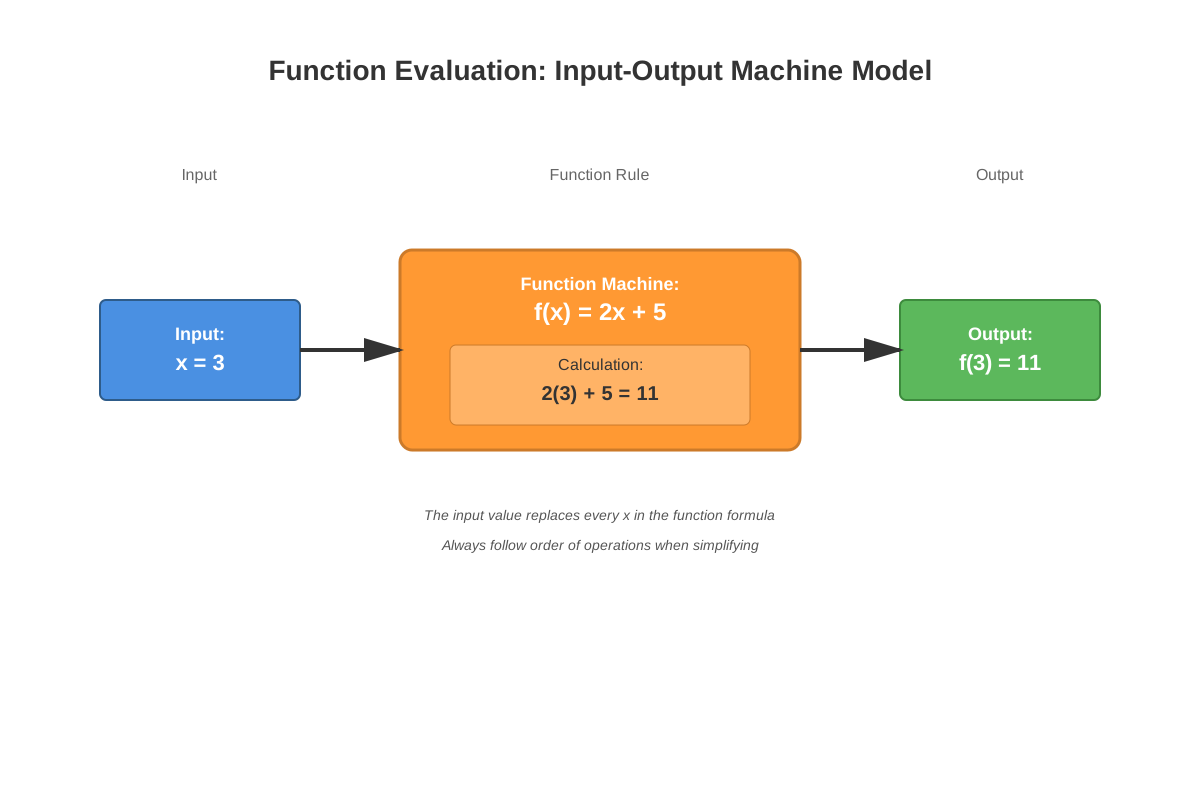
Function notation provides a standardized way to express mathematical relationships. The expression f(x) = 2x + 5 defines a function named "f" where "x" represents the input variable. The notation f(3) means "evaluate function f when x equals 3." This notation is more than symbolic convenience—it clearly identifies which variable is the input and provides a compact way to reference specific evaluations. On the SAT, you'll encounter various function names (f, g, h, C, P, etc.) and different input variables (x, t, n, etc.), but the underlying structure remains consistent.
The anatomy of a function includes three essential components: the function name (like f), the input variable in parentheses (like x), and the rule or formula that transforms inputs into outputs (like 2x + 5). Understanding this structure prevents confusion when functions are presented in unfamiliar contexts. For instance, if you see P(n) = 15n + 200, you should immediately recognize that P is the function name, n is the input, and 15n + 200 is the transformation rule.
Basic Function Evaluation
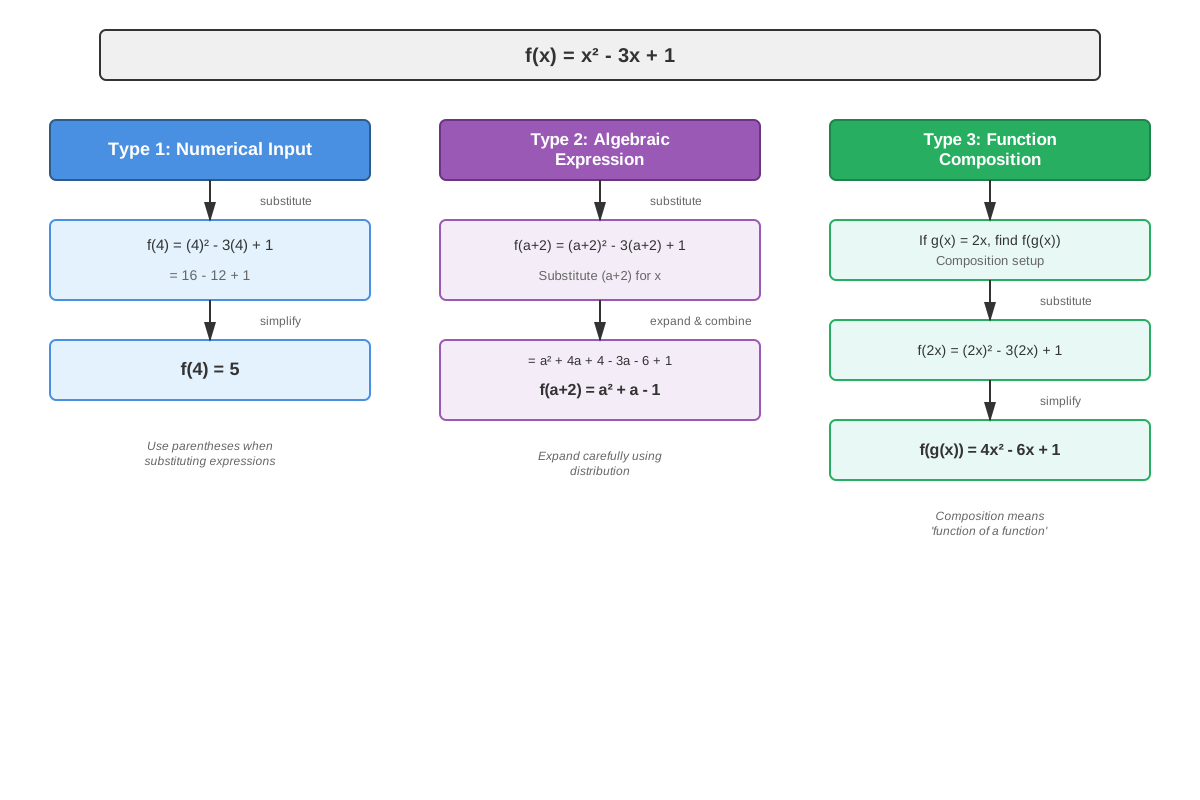
The fundamental process of evaluating functions follows a simple substitution procedure:
- Identify the input value you're substituting
- Locate every instance of the input variable in the function formula
- Replace each instance with the given value (using parentheses around the substituted value)
- Simplify using order of operations
For example, given f(x) = 3x² - 2x + 7, to find f(4):
- Replace every x with 4: f(4) = 3(4)² - 2(4) + 7
- Evaluate exponents: f(4) = 3(16) - 2(4) + 7
- Multiply: f(4) = 48 - 8 + 7
- Add/subtract left to right: f(4) = 47
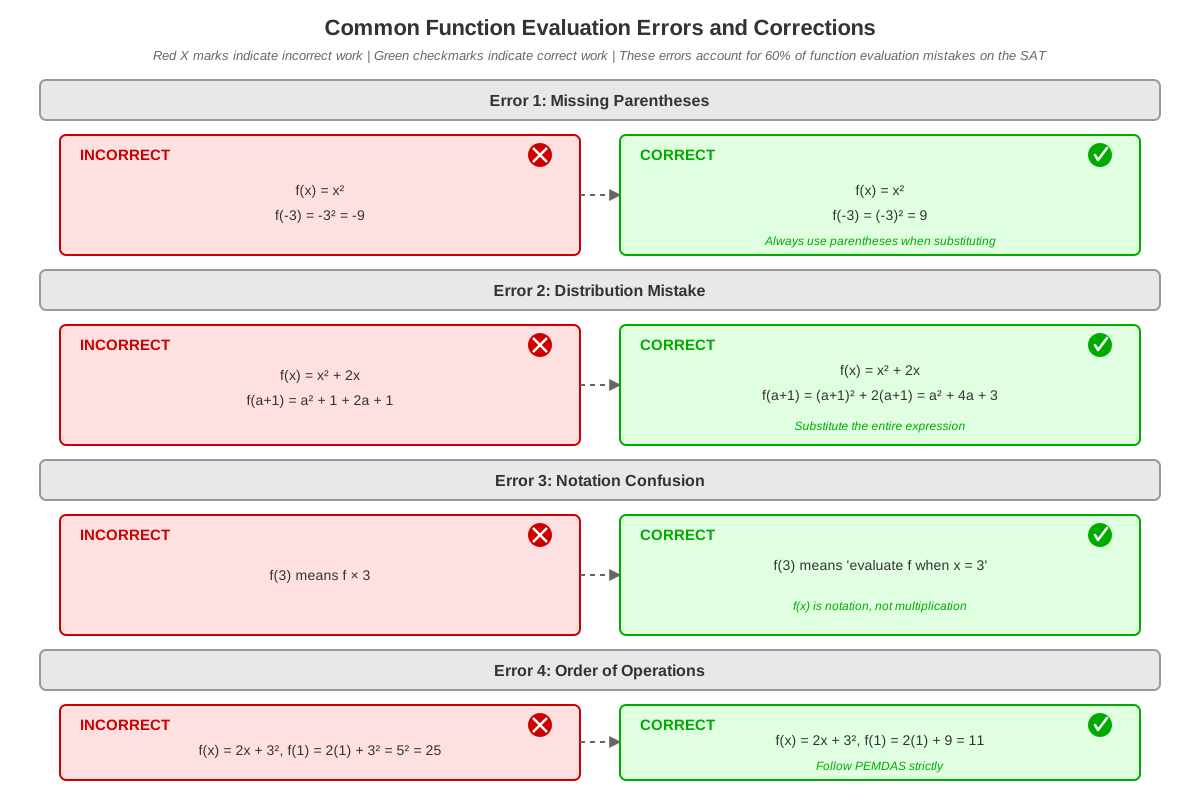
The parentheses around substituted values are crucial, especially with negative numbers or complex expressions. Without them, you risk sign errors and order-of-operations mistakes.
Evaluating with Algebraic Expressions
SAT questions frequently require evaluating functions with algebraic expressions rather than simple numbers. If f(x) = x² + 3x and you need to find f(2a), you substitute 2a for every x:
f(2a) = (2a)² + 3(2a) = 4a² + 6a
This requires careful attention to exponent rules and distribution. When the input is an expression like (x + 1), you must substitute the entire expression as a unit: f(x + 1) = (x + 1)² + 3(x + 1), which then requires expanding and simplifying.
Function Composition
Function composition involves using one function's output as another function's input. The notation (f ∘ g)(x) or f(g(x)) means "evaluate g first, then use that result as the input for f." This creates a chain of operations that the SAT tests regularly.
For example, if f(x) = 2x + 1 and g(x) = x² - 3:
- To find f(g(2)), first evaluate g(2) = (2)² - 3 = 1
- Then use that result: f(1) = 2(1) + 1 = 3
Composition questions test whether students understand the order of operations and can track intermediate results accurately.
Inverse Operations: Finding Inputs from Outputs
Some SAT questions provide the function output and ask you to find the input—essentially solving an equation. If f(x) = 4x - 7 and f(x) = 13, you solve:
- 4x - 7 = 13
- 4x = 20
- x = 5
This reverses the typical evaluation process and requires equation-solving skills. The SAT may present this as "For what value of x does f(x) = 13?" or "If f(a) = 13, what is the value of a?"
Functions in Context
The SAT frequently embeds function evaluation within real-world scenarios. A function might represent cost C(n) = 25n + 150, where n is the number of items and C(n) is total cost in dollars. Evaluating C(10) = 25(10) + 150 = 400 means that 10 items cost $400. Understanding what the input and output represent in context is essential for interpreting results and answering questions correctly.
| Function Component | Mathematical Meaning | Contextual Meaning (Cost Example) |
|---|---|---|
| Function name C | Identifies the relationship | Represents "Cost" |
| Input variable n | Independent variable | Number of items purchased |
| Output C(n) | Dependent variable | Total cost in dollars |
| Formula 25n + 150 | Transformation rule | $25 per item plus $150 fixed fee |
Concept Relationships
Function evaluation serves as the foundation for understanding how functions behave and interact. The core substitution process → enables function composition → which leads to understanding transformations and inverse functions. Each evaluation produces a single input-output pair, and collecting multiple evaluations → reveals patterns → that help identify function types (linear, quadratic, exponential).
The relationship between function evaluation and equation solving is bidirectional: evaluating functions requires solving expressions, while finding inputs from outputs requires solving equations. This connection → extends to systems of equations, where you might evaluate two functions and set them equal to find intersection points.
Function evaluation connects backward to prerequisite topics like algebraic manipulation (needed for simplification) and order of operations (essential for accuracy). It connects forward to more advanced topics like function transformations (where you evaluate f(x + 2) or 2f(x)), domain and range analysis (where you evaluate functions at boundary points), and modeling (where evaluation produces meaningful predictions).
The relationship map: Basic substitution → Algebraic expression inputs → Function composition → Inverse operations → Contextual applications. Each level builds on the previous, with composition requiring mastery of basic evaluation, and contextual problems requiring understanding of what inputs and outputs represent.
Quick check — test yourself on Evaluating functions so far.
Try Flashcards →High-Yield Facts
⭐ Function notation f(a) means substitute the value a for every instance of the input variable in the function formula
⭐ When substituting expressions or negative numbers, always use parentheses around the substituted value to avoid errors
⭐ For function composition f(g(x)), always evaluate the inner function g(x) first, then use that result as input for f
⭐ If f(x) = k for some constant k, you're solving an equation to find which input produces output k
⭐ In context problems, the input variable represents the independent quantity and the output represents the dependent quantity
- The expression f(3) represents a single number—the output when x = 3—not a multiplication
- Evaluating f(x²) is different from [f(x)]²; the first squares the input before applying the function, the second squares the output
- When a function contains multiple terms, you must substitute the input value into every term where the variable appears
- The domain of a function determines which inputs are valid; attempting to evaluate outside the domain is undefined
- Linear functions produce constant rates of change; evaluating at two points and finding the difference reveals this rate
Common Misconceptions
Misconception: f(x + 2) means add 2 to the function output → Correction: f(x + 2) means substitute (x + 2) for the input variable throughout the entire function formula. If f(x) = x², then f(x + 2) = (x + 2)², not x² + 2.
Misconception: f(3) means f times 3, so it's multiplication → Correction: Function notation f(3) is not multiplication; it's an instruction to evaluate the function when the input equals 3. The parentheses indicate function evaluation, not multiplication.
Misconception: When evaluating f(-2), you can ignore the negative sign if it's inconvenient → Correction: The sign of the input is crucial. For f(x) = x², f(-2) = (-2)² = 4, but if you incorrectly use 2, you'd still get 4 by coincidence. However, for f(x) = x³, f(-2) = -8 while f(2) = 8—completely different results.
Misconception: For f(g(x)), you can evaluate f first or g first—the order doesn't matter → Correction: Order is critical in function composition. f(g(x)) means evaluate g first, then apply f to that result. Reversing the order gives g(f(x)), which typically produces a different result.
Misconception: If f(x) = 2x + 3, then f(a + b) = 2a + 3 + b → Correction: You must substitute the entire expression (a + b) for x: f(a + b) = 2(a + b) + 3 = 2a + 2b + 3. Every instance of x gets replaced by the complete input expression.
Misconception: When a function is given in context, you can ignore the units → Correction: Units provide essential information for interpreting results. If C(n) = 50n represents cost in dollars when n is the number of items, then C(5) = 250 means $250, not 250 items or 250 of some other unit.
Worked Examples
Example 1: Multi-Step Function Evaluation with Algebraic Input
Problem: If f(x) = 3x² - 2x + 5, find f(2a - 1).
Solution:
Step 1: Identify what we're substituting. We need to replace every x with (2a - 1).
Step 2: Write the function with the substitution, using parentheses carefully:
f(2a - 1) = 3(2a - 1)² - 2(2a - 1) + 5
Step 3: Expand (2a - 1)²:
(2a - 1)² = (2a - 1)(2a - 1) = 4a² - 2a - 2a + 1 = 4a² - 4a + 1
Step 4: Substitute this expansion back:
f(2a - 1) = 3(4a² - 4a + 1) - 2(2a - 1) + 5
Step 5: Distribute:
= 12a² - 12a + 3 - 4a + 2 + 5
Step 6: Combine like terms:
= 12a² - 16a + 10
Answer: f(2a - 1) = 12a² - 16a + 10
This problem demonstrates the learning objective of evaluating functions with algebraic expressions as inputs. The key is treating (2a - 1) as a single unit and substituting it completely before simplifying.
Example 2: Function Composition in Context
Problem: A company's revenue R (in thousands of dollars) depends on the number of units sold n according to R(n) = 8n - 0.5n². The number of units sold depends on the advertising budget b (in thousands of dollars) according to n(b) = 5b + 10. What is the revenue when the advertising budget is $3,000?
Solution:
Step 1: Identify what we're finding. We need R when b = 3 (since b is in thousands).
Step 2: Recognize this is function composition: R(n(b)). We need to find n first, then use that to find R.
Step 3: Evaluate n(3):
n(3) = 5(3) + 10 = 15 + 10 = 25 units
Step 4: Now evaluate R(25):
R(25) = 8(25) - 0.5(25)²
= 200 - 0.5(625)
= 200 - 312.5
= -112.5
Step 5: Interpret the result. Since R is in thousands of dollars, R(25) = -112.5 means -$112,500, indicating a loss.
Answer: The revenue is -$112,500 (a loss of $112,500) when the advertising budget is $3,000.
This problem illustrates how function evaluation appears in real-world contexts on the SAT, requiring both computational accuracy and interpretation of results. It also demonstrates function composition where one function's output becomes another's input.
Exam Strategy
When approaching SAT function evaluation questions, begin by identifying what type of evaluation is required: direct substitution, algebraic input, composition, or inverse operation. This classification determines your solution strategy and helps you avoid common traps.
Trigger words and phrases to watch for include:
- "Find f(3)" or "What is f(3)?" → direct numerical evaluation
- "If f(x) = 10, what is x?" → inverse operation requiring equation solving
- "Find f(g(2))" or "Find (f ∘ g)(2)" → function composition
- "In terms of a" or "in terms of n" → algebraic expression input
- "What does f(5) represent?" → contextual interpretation question
For process of elimination, remember that:
- If you're evaluating f(negative number) and the function contains even powers, the result cannot be negative (eliminates some choices)
- For linear functions, outputs increase or decrease consistently; if f(2) = 5 and f(3) = 8, then f(4) cannot be 7
- In composition problems, if g(x) produces a negative result and f only accepts positive inputs, the composition is undefined
- Context problems have answers that make practical sense; negative quantities for things that can't be negative (like number of items) indicate wrong answers
Time allocation: Simple direct evaluation questions should take 30-45 seconds. Composition problems typically require 60-90 seconds. Context problems with multiple steps may need 90-120 seconds. If you're spending more than 2 minutes on a function evaluation question, mark it and return later—you may be missing a simpler approach.
Exam Tip: Always write out the substitution step explicitly, even if you think you can do it mentally. Writing f(3) = 2(3)² - 5(3) + 1 before calculating prevents errors and provides a clear path to check your work if time permits.
Memory Techniques
SIRS - The function evaluation process:
- Substitute the input value
- Insert parentheses around substituted values
- Replace every instance of the variable
- Simplify using order of operations
"Inside Out" - For function composition f(g(x)), remember to work from the inside function out to the outside function. Visualize peeling an onion: the innermost layer (g) must be revealed before you can access the outer layer (f).
"Parentheses are Protection" - When substituting negative numbers or expressions, parentheses protect against sign errors. Visualize wrapping the substituted value in protective parentheses like bubble wrap protecting a fragile item.
The Function Machine - Visualize a function as a machine: you drop an input into the top, the machine performs its operations (the formula), and an output emerges from the bottom. This mental model helps distinguish between input and output, especially in context problems.
For remembering that f(x + 2) ≠ f(x) + 2, use the phrase: "Transform the input, not the output" - when you see operations inside the parentheses, they transform what goes into the function, not what comes out.
Summary
Evaluating functions is a fundamental SAT Math skill that involves substituting specific values into function formulas and calculating outputs. The process requires careful attention to substitution mechanics, particularly using parentheses around substituted values to prevent errors. SAT questions test this skill through direct numerical evaluation, algebraic expression inputs, function composition, inverse operations, and real-world contextual applications. Success requires understanding function notation (where f(x) represents the output when x is the input), mastering the substitution-and-simplify procedure, and recognizing that order matters in composition problems. The most common errors stem from incorrect substitution of negative numbers or expressions, confusion about notation (treating f(3) as multiplication), and reversing the order in composition. Strong performance on function evaluation questions provides access to points across multiple SAT Math domains, as functions serve as the language for expressing mathematical relationships throughout the test.
Key Takeaways
- Function notation f(a) is an instruction to substitute a for the input variable throughout the entire function formula, not a multiplication operation
- Always use parentheses when substituting negative numbers or algebraic expressions to prevent sign errors and order-of-operations mistakes
- Function composition f(g(x)) requires evaluating the inner function g first, then using that result as input for the outer function f
- When given f(x) = k, you're solving an equation to find which input produces the specified output k
- In context problems, identify what the input and output variables represent to correctly interpret numerical results
- The expression f(x + 2) means substitute (x + 2) for the input variable, which is fundamentally different from f(x) + 2
- Practice with algebraic inputs like f(2a) or f(x - 3) builds the flexibility needed for harder SAT questions
Related Topics
Function Transformations: Building on evaluation skills, transformations explore how f(x + 2), f(x) + 2, 2f(x), and f(2x) shift and stretch function graphs. Mastering evaluation provides the foundation for understanding these modifications.
Domain and Range: Determining which inputs are valid (domain) and which outputs are possible (range) requires evaluating functions at critical points and boundaries, making evaluation skills essential.
Systems of Functions: Finding where two functions intersect involves evaluating both functions and setting them equal, combining evaluation with equation-solving techniques.
Quadratic and Exponential Functions: While this guide focuses on the evaluation process generally, the same techniques apply to more complex function types that appear frequently on the SAT.
Function Modeling: Real-world problems often require creating function models and then evaluating them at specific inputs to make predictions or decisions, representing the practical application of evaluation skills.
Practice CTA
Now that you've mastered the concepts and strategies for evaluating functions, it's time to solidify your understanding through practice. Attempt the practice questions designed specifically for this topic, starting with straightforward substitution problems and progressing to complex composition and context questions. Use the flashcards to reinforce key definitions and common error patterns. Remember, function evaluation is a high-yield SAT topic—every minute you invest in practice translates directly to points on test day. Approach each practice problem as an opportunity to refine your technique and build the automaticity that leads to both speed and accuracy. You've got this!
Sign up free to keep reading
Create a free AnvayaPrep account to finish this SAT guide on Evaluating functions — plus flashcards and practice questions.