Overview
Graphing lines is one of the most fundamental and frequently tested concepts in the SAT math section. This topic encompasses the visual representation of linear equations on the coordinate plane, including understanding slope, intercepts, and the various forms of linear equations. Mastery of graphing lines is not merely about plotting points; it requires a deep understanding of how algebraic representations translate into geometric visualizations and vice versa.
The SAT consistently features multiple questions on graphing lines in both the calculator and no-calculator sections, making this a high-yield topic that can significantly impact overall math scores. Questions may ask students to identify the equation of a graphed line, determine key features from an equation, or interpret the meaning of slope and intercepts in real-world contexts. The ability to quickly and accurately work with linear graphs is essential for success on approximately 15-20% of SAT math questions.
Understanding graphing lines serves as the foundation for more advanced mathematical concepts tested on the SAT, including systems of equations, linear inequalities, and even quadratic functions. The skills developed here—translating between algebraic and geometric representations, identifying key features, and interpreting mathematical relationships—extend far beyond linear functions and form the backbone of mathematical reasoning required throughout the exam.
Learning Objectives
- [ ] Identify key features of graphing lines including slope, y-intercept, x-intercept, and direction
- [ ] Explain how graphing lines appears on the SAT in various question formats and contexts
- [ ] Apply graphing lines concepts to answer SAT-style questions efficiently and accurately
- [ ] Convert between different forms of linear equations (slope-intercept, point-slope, and standard form)
- [ ] Determine the equation of a line from a graph or from given information
- [ ] Interpret the meaning of slope and intercepts in real-world application problems
- [ ] Recognize parallel and perpendicular lines through their slopes and equations
Prerequisites
- Basic coordinate plane understanding: Familiarity with the x-axis, y-axis, quadrants, and ordered pairs (x, y) is essential for plotting and interpreting points on a graph
- Algebraic manipulation skills: The ability to solve equations for a variable and simplify expressions is necessary for converting between equation forms
- Understanding of variables and constants: Recognizing the difference between variables (x, y) and constants (numbers, parameters like m and b) enables proper interpretation of linear equations
- Fraction and decimal operations: Many slope calculations and intercept values involve fractions and decimals that must be computed accurately
Why This Topic Matters
In real-world applications, linear relationships appear everywhere: calculating costs based on usage rates, determining distance traveled over time, analyzing business profit margins, and predicting trends from data. The ability to graph and interpret lines translates directly to understanding rates of change, making predictions, and analyzing relationships between variables in fields ranging from economics to physics to social sciences.
On the SAT, graphing lines appears with remarkable frequency and consistency. Approximately 4-6 questions per test directly assess this topic, accounting for roughly 7-11% of the total math score. Questions appear in multiple formats: multiple-choice problems asking for equations of graphed lines, grid-in questions requiring calculation of specific values, and word problems requiring interpretation of slope and intercepts in context. The College Board particularly favors questions that combine algebraic manipulation with graphical interpretation, testing whether students can move fluidly between representations.
Common SAT question types include: identifying which equation matches a given graph; determining the y-intercept or slope from a table, graph, or description; finding where two lines intersect; interpreting the meaning of slope in a real-world scenario (such as dollars per hour or miles per gallon); and determining whether lines are parallel or perpendicular. The topic also appears integrated into more complex problems involving systems of equations, data analysis, and function interpretation.
Core Concepts
The Coordinate Plane and Plotting Points
The foundation of graphing lines begins with the coordinate plane, a two-dimensional grid formed by a horizontal x-axis and vertical y-axis intersecting at the origin (0, 0). Every point on this plane is represented by an ordered pair (x, y), where x indicates horizontal position and y indicates vertical position. Lines on the coordinate plane represent all points (x, y) that satisfy a particular linear equation.
Slope: The Rate of Change
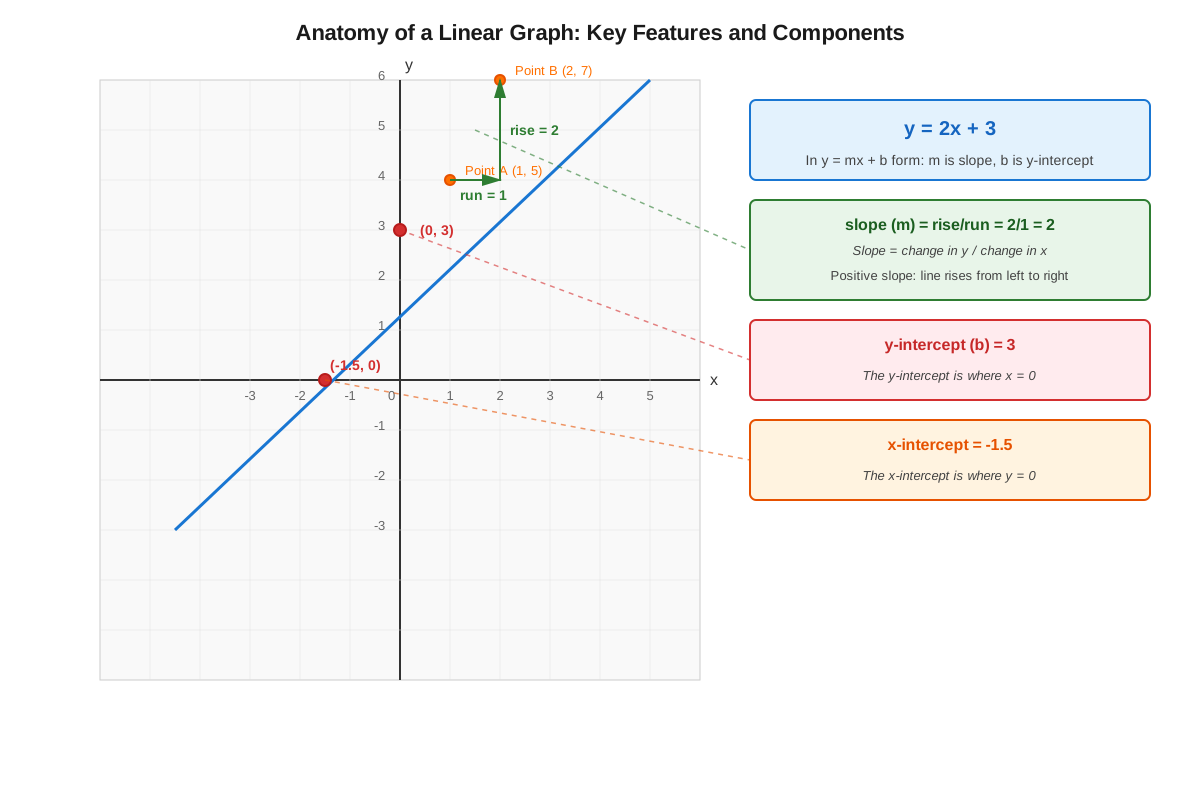
Slope is the most critical feature of any line, representing the rate at which y changes relative to x. The slope m is calculated using any two points (x₁, y₁) and (x₂, y₂) on the line:
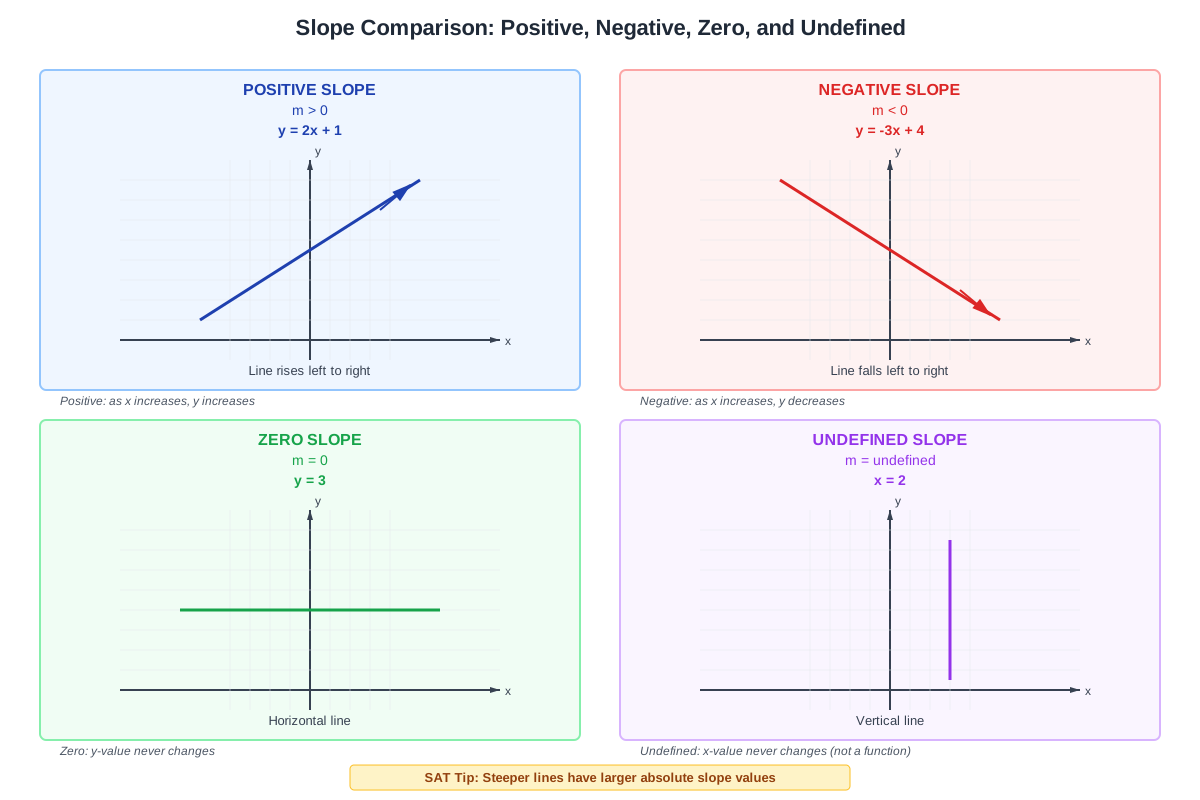
m = (y₂ - y₁)/(x₂ - x₁) = rise/runThe slope tells us both the steepness and direction of a line:
- Positive slope: Line rises from left to right (as x increases, y increases)
- Negative slope: Line falls from left to right (as x increases, y decreases)
- Zero slope: Horizontal line (y remains constant regardless of x)
- Undefined slope: Vertical line (x remains constant regardless of y)
Understanding slope as "rise over run" provides an intuitive method for graphing: from any point on the line, move vertically by the rise amount and horizontally by the run amount to find another point on the line.
Forms of Linear Equations
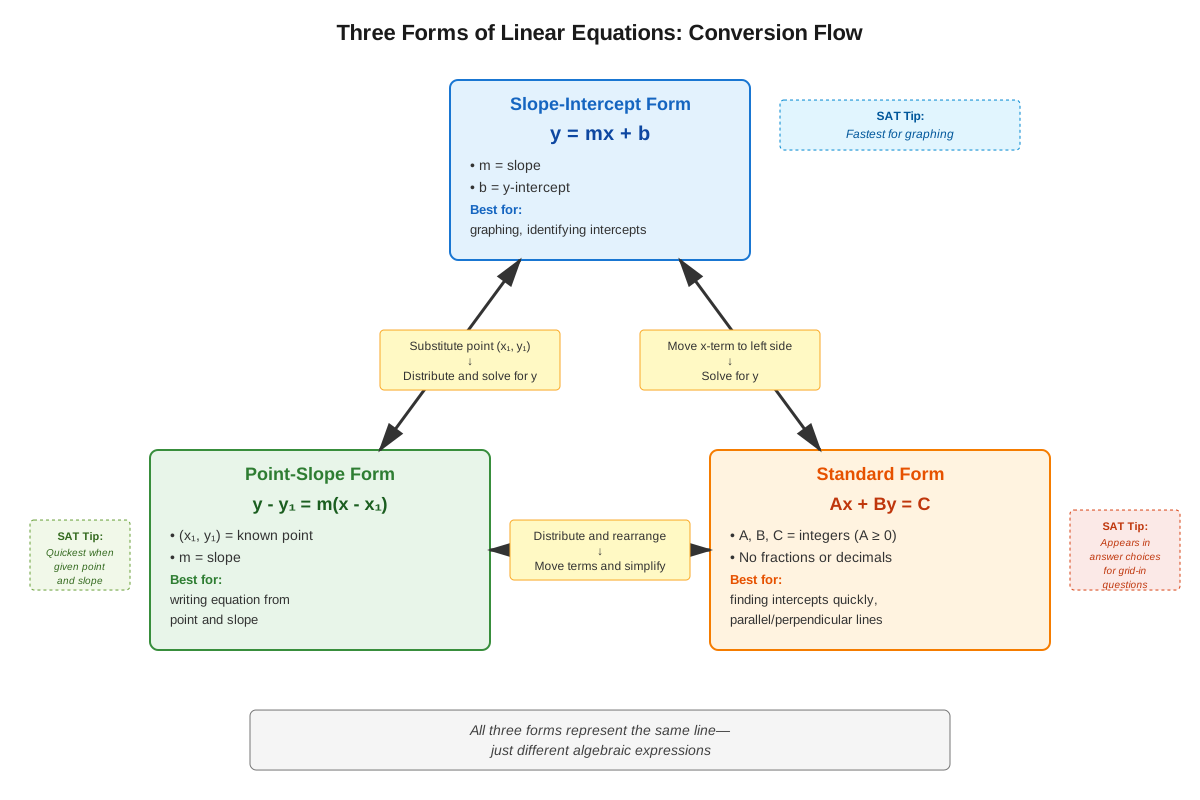
Linear equations can be expressed in multiple forms, each offering different advantages:
| Form | Equation | Key Features | Best Used When |
|---|---|---|---|
| Slope-Intercept | y = mx + b | m = slope, b = y-intercept | Graphing quickly or identifying slope/y-intercept |
| Point-Slope | y - y₁ = m(x - x₁) | m = slope, (x₁, y₁) = point on line | Given a point and slope |
| Standard Form | Ax + By = C | A, B, C are integers; A ≥ 0 | Finding intercepts or working with systems |
Slope-intercept form (y = mx + b) is the most commonly used form on the SAT because it immediately reveals the slope (m) and y-intercept (b). The y-intercept is where the line crosses the y-axis, occurring when x = 0. To graph a line in this form: plot the y-intercept (0, b), then use the slope to find additional points.
Point-slope form is particularly useful when you know one point on the line and the slope but don't immediately know the y-intercept. This form can be converted to slope-intercept form through algebraic manipulation.
Standard form (Ax + By = C) is useful for finding both intercepts quickly. The x-intercept (where y = 0) is found by setting y = 0 and solving for x, giving (C/A, 0). The y-intercept (where x = 0) is found by setting x = 0 and solving for y, giving (0, C/B).
Intercepts: Where Lines Cross Axes
Intercepts are the points where a line crosses the coordinate axes:
- Y-intercept: The point (0, b) where the line crosses the y-axis; found by setting x = 0 in the equation
- X-intercept: The point (a, 0) where the line crosses the x-axis; found by setting y = 0 in the equation
Both intercepts provide valuable information for graphing and are frequently tested on the SAT. The intercept method of graphing involves plotting both intercepts and drawing a line through them.
Parallel and Perpendicular Lines
Two lines have a special relationship when their slopes are related in specific ways:
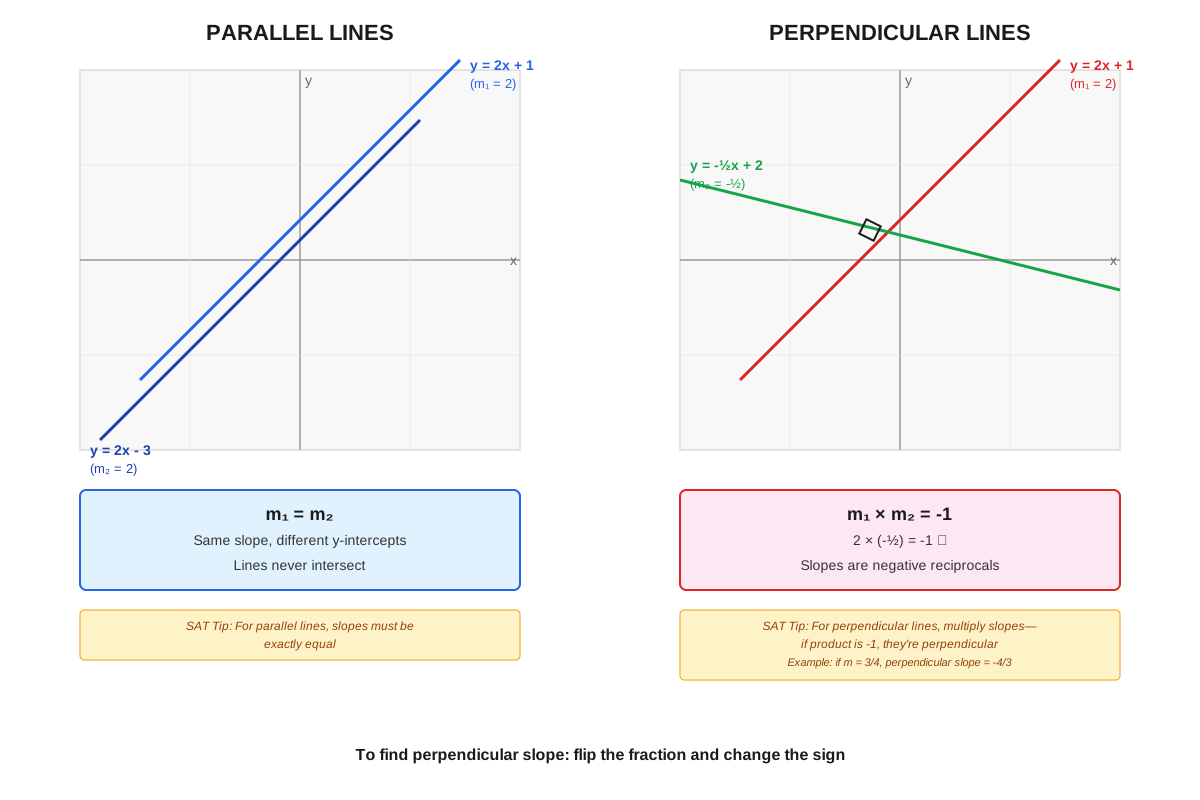
Parallel lines have identical slopes but different y-intercepts. If line 1 has equation y = m₁x + b₁ and line 2 has equation y = m₂x + b₂, the lines are parallel when m₁ = m₂ and b₁ ≠ b₂. Parallel lines never intersect.
Perpendicular lines have slopes that are negative reciprocals of each other. If m₁ and m₂ are the slopes of perpendicular lines, then m₁ × m₂ = -1, or equivalently, m₂ = -1/m₁. Perpendicular lines intersect at right angles (90 degrees).
Graphing Techniques
To graph a line efficiently:
- From slope-intercept form: Plot the y-intercept, then use slope (rise/run) to find a second point
- From standard form: Find both intercepts and connect them
- From two points: Plot both points and draw a line through them
- From point-slope form: Plot the given point, then use slope to find additional points
Interpreting Graphs in Context
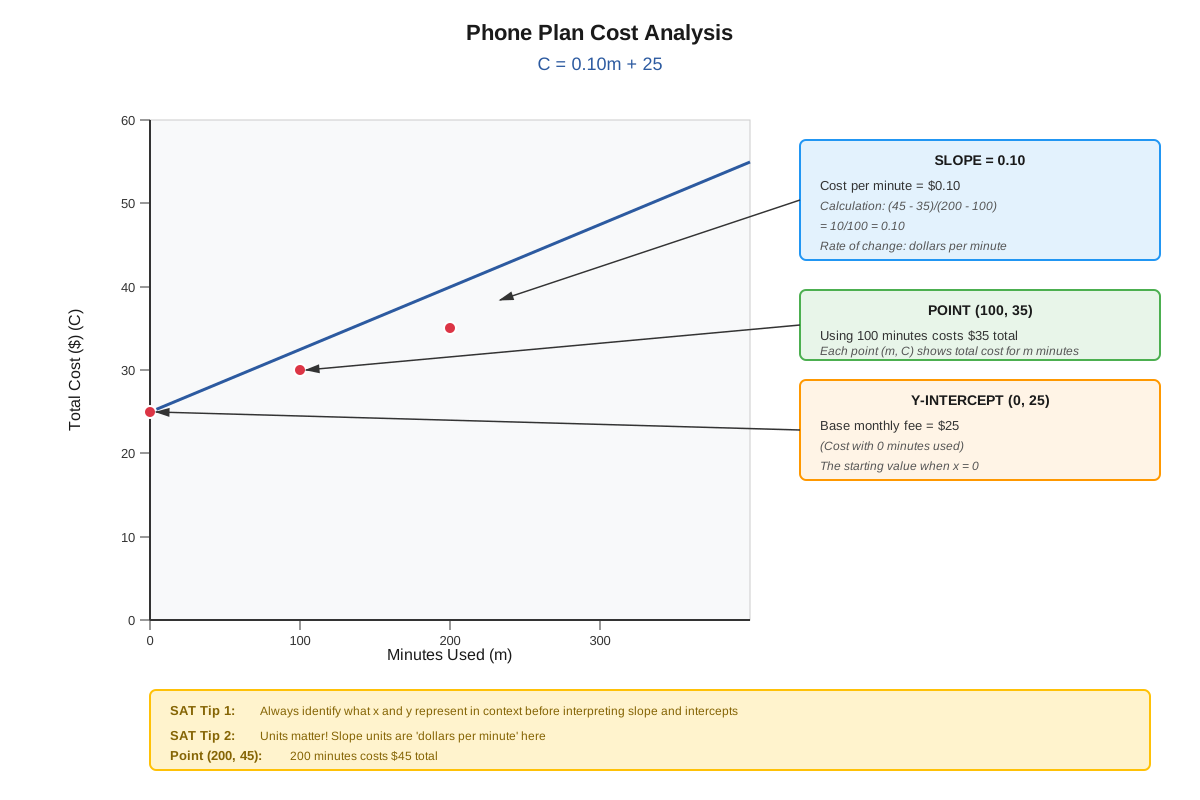
On the SAT, many graphing problems present real-world scenarios where the slope and intercepts have specific meanings. For example, in an equation representing total cost C = 50 + 20h (where h is hours):
- The slope (20) represents the rate: $20 per hour
- The y-intercept (50) represents the initial value: $50 starting fee
- The x-intercept would represent when cost equals zero (if applicable to the context)
Concept Relationships
The concepts within graphing lines form an interconnected web of relationships. Slope serves as the central concept, connecting to nearly every other aspect of the topic. Understanding slope enables recognition of parallel lines (equal slopes) and perpendicular lines (negative reciprocal slopes), which in turn connects to geometric properties and systems of equations.
The three forms of linear equations are algebraically equivalent but emphasize different features: slope-intercept form → highlights slope and y-intercept → enables quick graphing; point-slope form → emphasizes a specific point and slope → facilitates writing equations from given information; standard form → emphasizes both intercepts → simplifies finding where lines cross axes.
Intercepts connect directly to the coordinate plane structure and provide alternative graphing methods. The y-intercept appears explicitly in slope-intercept form (the b value), while both intercepts can be found efficiently from standard form. This relationship demonstrates how choosing the appropriate equation form depends on what information is needed.
The progression flows: coordinate plane basics → plotting points → understanding slope as rate of change → recognizing equation forms → identifying key features (slope, intercepts) → applying to parallel/perpendicular relationships → interpreting in real-world contexts. Each concept builds upon previous understanding, creating a comprehensive framework for working with linear relationships.
Quick check — test yourself on Graphing lines so far.
Try Flashcards →High-Yield Facts
⭐ The slope-intercept form y = mx + b immediately reveals slope (m) and y-intercept (b), making it the fastest form for graphing and identifying key features
⭐ Slope is calculated as (y₂ - y₁)/(x₂ - x₁) and represents the rate of change; positive slopes rise left to right, negative slopes fall left to right
⭐ Parallel lines have equal slopes; perpendicular lines have slopes that are negative reciprocals (their product equals -1)
⭐ The y-intercept occurs where x = 0; the x-intercept occurs where y = 0
⭐ In real-world problems, slope represents a rate (such as dollars per hour, miles per gallon, or degrees per minute) and the y-intercept represents an initial value or starting amount
- Horizontal lines have slope = 0 and equation y = k (where k is a constant); vertical lines have undefined slope and equation x = k
- To convert from standard form (Ax + By = C) to slope-intercept form, solve for y: y = (-A/B)x + (C/B), where slope = -A/B
- A line with slope 3/4 rises 3 units for every 4 units it moves to the right; this can be used to plot additional points from any known point
- Two points determine exactly one line; knowing any two points allows calculation of slope and determination of the complete equation
- The steeper a line appears on a standard coordinate plane, the greater the absolute value of its slope
- When graphing from a table of values, consistent differences in y-values divided by consistent differences in x-values give the slope
Common Misconceptions
Misconception: Slope is calculated as (x₂ - x₁)/(y₂ - y₁) → Correction: Slope is always rise over run, which means change in y over change in x: (y₂ - y₁)/(x₂ - x₁). Reversing this formula is one of the most common errors in calculating slope.
Misconception: The y-intercept is just the number b, not a point → Correction: The y-intercept is the point (0, b) where the line crosses the y-axis. While we often refer to "b" as the y-intercept, technically it's the y-coordinate of the intercept point. On the SAT, questions may ask for the y-intercept as a point or as a value, so read carefully.
Misconception: A steeper line always has a larger slope → Correction: A steeper line has a larger absolute value of slope, but a line with slope -5 is steeper than a line with slope 2, even though -5 < 2. Steepness relates to |m|, not m itself.
Misconception: Perpendicular lines have slopes that are opposite signs of each other → Correction: Perpendicular lines have slopes that are negative reciprocals. If one line has slope 2/3, a perpendicular line has slope -3/2 (flip the fraction and change the sign). Simply changing the sign (2/3 to -2/3) creates neither parallel nor perpendicular lines.
Misconception: All lines have both an x-intercept and a y-intercept → Correction: Horizontal lines (except y = 0) have a y-intercept but no x-intercept. Vertical lines (except x = 0) have an x-intercept but no y-intercept. The line y = 0 (the x-axis) and x = 0 (the y-axis) are special cases where the line lies on an axis.
Misconception: In standard form Ax + By = C, you can read the slope directly as A/B → Correction: The slope in standard form is -A/B (negative A divided by B), not A/B. To find slope from standard form, either solve for y to get slope-intercept form, or remember the formula m = -A/B.
Misconception: When a line passes through the origin, it has no y-intercept → Correction: When a line passes through the origin (0, 0), the y-intercept is 0, not nonexistent. The equation would be y = mx + 0, or simply y = mx. Zero is a valid y-intercept value.
Worked Examples
Example 1: Finding the Equation from a Graph
Problem: A line passes through points (-2, 5) and (4, -1) as shown on a coordinate plane. What is the equation of this line in slope-intercept form?
Solution:
Step 1: Calculate the slope using the two given points.
m = (y₂ - y₁)/(x₂ - x₁) = (-1 - 5)/(4 - (-2)) = -6/6 = -1Step 2: Use point-slope form with either point. Using (-2, 5):
y - 5 = -1(x - (-2))
y - 5 = -1(x + 2)
Step 3: Convert to slope-intercept form by solving for y:
y - 5 = -x - 2
y = -x - 2 + 5
y = -x + 3
Step 4: Verify using the other point (4, -1):
y = -x + 3
-1 = -(4) + 3
-1 = -4 + 3
-1 = -1 ✓Answer: y = -x + 3
This problem demonstrates the complete process of finding a line's equation from two points, addressing the learning objective of applying graphing lines concepts to SAT-style questions. The verification step is crucial for catching calculation errors.
Example 2: Real-World Interpretation
Problem: A water tank contains 500 gallons of water. Water is being drained at a constant rate of 25 gallons per minute. Which equation represents the amount of water W (in gallons) remaining in the tank after t minutes?
A) W = 25t + 500
B) W = -25t + 500
C) W = 500t + 25
D) W = 500t - 25
Solution:
Step 1: Identify the initial value (y-intercept). At t = 0 (before any draining), the tank contains 500 gallons. This is the y-intercept: b = 500.
Step 2: Identify the rate of change (slope). Water is being drained (removed) at 25 gallons per minute, so the amount is decreasing. The slope must be negative: m = -25.
Step 3: Write the equation in slope-intercept form:
W = mt + b
W = -25t + 500
Step 4: Verify the equation makes sense:
- At t = 0: W = -25(0) + 500 = 500 gallons ✓
- At t = 10: W = -25(10) + 500 = 250 gallons (half drained after 10 minutes) ✓
- The slope is negative because water is decreasing ✓
Answer: B) W = -25t + 500
This example illustrates how slope represents a rate in context (gallons per minute) and how the sign of the slope indicates whether a quantity is increasing or decreasing. This addresses the learning objective of explaining how graphing lines appears on the SAT, particularly in word problems requiring interpretation of linear relationships.
Exam Strategy
When approaching SAT questions on graphing lines, begin by identifying what form the information is presented in: a graph, an equation, a table, or a word problem. This determines your strategy. For graph-to-equation questions, immediately identify the y-intercept (where the line crosses the y-axis) to eliminate answer choices, then calculate or estimate the slope using two clear points on the line.
Trigger words and phrases to watch for include: "rate of change" (indicates slope), "initial value" or "starting amount" (indicates y-intercept), "for each" or "per" (indicates slope in context), "when x = 0" (asking for y-intercept), "when y = 0" (asking for x-intercept), "parallel to" (same slope), and "perpendicular to" (negative reciprocal slope).
For process-of-elimination, use these strategies:
- If a line rises left to right, eliminate any equations with negative slope
- If a line falls left to right, eliminate any equations with positive slope
- Check the y-intercept first—it's the easiest feature to identify and can often eliminate 2-3 answer choices immediately
- For parallel/perpendicular questions, focus only on slopes; ignore y-intercepts until you've narrowed down based on slope relationships
- When given a table, calculate the slope between the first two points; if answer choices have different slopes, you don't need to check the y-intercept
Time allocation: Most graphing lines questions should take 45-90 seconds. If you're spending more than 90 seconds, you may be overcomplicating the problem. Simple identification questions (matching a graph to an equation) should take 30-45 seconds. Word problems requiring interpretation may take up to 2 minutes but shouldn't exceed this. If stuck, mark the question and return to it—these questions often become clearer on a second look.
Calculator usage: For the calculator section, use your calculator to verify slope calculations and solve for y when converting forms, but don't rely on graphing calculator functions unless absolutely necessary—they consume too much time. Mental math and estimation are faster for most graphing lines questions.
Memory Techniques
Slope Formula Mnemonic: "You Really Ought to Run" → Y₂ - Y₁ / X₂ - X₁ (the order of subtraction in the slope formula)
Slope Direction Mnemonic: "Positive = Point Up" (positive slope rises to the right, like pointing upward) and "Negative = Nose Dive" (negative slope falls to the right, like a plane diving down)
Perpendicular Slopes Mnemonic: "Flip and Nip" → Flip the fraction (take the reciprocal) and Nip the sign (change positive to negative or vice versa)
Forms Acronym: SIP your drink while graphing:
- Slope-intercept: y = mx + b (shows slope and y-intercept)
- Intermediate (Point-slope): y - y₁ = m(x - x₁) (uses a point)
- Plain (Standard): Ax + By = C (plain form with no isolated y)
Visualization Strategy: When memorizing that parallel lines have equal slopes, visualize railroad tracks—they have the same steepness and never meet. For perpendicular lines, visualize a plus sign (+) or the corner of a square—the lines meet at right angles.
Y-intercept Memory Aid: "Y-intercept happens when X is Zero" (Y when X = 0)
Summary
Graphing lines is a cornerstone topic for SAT math success, requiring fluency in multiple representations of linear relationships. The essential skills include calculating slope as rise over run using (y₂ - y₁)/(x₂ - x₁), recognizing that slope represents rate of change in context, and identifying y-intercepts as initial values. Students must master three equation forms—slope-intercept (y = mx + b), point-slope (y - y₁ = m(x - x₁)), and standard form (Ax + By = C)—and convert between them efficiently. Understanding that parallel lines share identical slopes while perpendicular lines have slopes that are negative reciprocals is crucial for relationship questions. The ability to move fluidly between algebraic equations and geometric graphs, interpreting slope and intercepts in real-world contexts, and quickly identifying key features from any representation form the foundation for success on the 4-6 questions per test that directly assess this topic.
Key Takeaways
- Slope (m) represents rate of change and is calculated as rise over run: (y₂ - y₁)/(x₂ - x₁); positive slopes rise right, negative slopes fall right
- Slope-intercept form (y = mx + b) is the most efficient form for graphing and immediately reveals slope and y-intercept
- The y-intercept (b) is where the line crosses the y-axis (when x = 0) and often represents an initial value in word problems
- Parallel lines have equal slopes (m₁ = m₂); perpendicular lines have slopes that are negative reciprocals (m₁ × m₂ = -1)
- To find a line's equation from two points: calculate slope, then use point-slope form or substitute into y = mx + b
- In real-world contexts, always identify what the slope represents (rate) and what the y-intercept represents (starting value)
- Intercepts provide an alternative graphing method: find where the line crosses both axes and connect those points
Related Topics
Systems of Linear Equations: Building on graphing lines, systems involve finding where two or more lines intersect, requiring understanding of how different slopes and intercepts create different intersection scenarios (one solution, no solution, or infinitely many solutions).
Linear Inequalities: Extends graphing lines to include regions above or below a line, using the same slope and intercept concepts but adding shading and boundary line considerations.
Functions and Function Notation: Linear functions are the simplest type of function, and mastering graphing lines provides the foundation for understanding function notation, domain, range, and function transformations.
Quadratic Functions: While quadratic graphs are parabolas rather than lines, understanding linear graphs provides a reference point for comparing rates of change and introduces concepts like intercepts that extend to quadratic functions.
Data Analysis and Scatterplots: Linear models and lines of best fit apply graphing lines concepts to real data, requiring interpretation of slope and intercepts in statistical contexts.
Practice CTA
Now that you've mastered the core concepts of graphing lines, it's time to solidify your understanding through practice. Attempt the practice questions to test your ability to identify key features, convert between equation forms, and interpret linear relationships in context. Use the flashcards to reinforce high-yield facts and formulas until they become automatic. Remember, graphing lines appears on virtually every SAT, and mastery of this topic will boost your confidence and score. Each practice problem you complete strengthens your pattern recognition and speed—two critical factors for SAT success. You've built the foundation; now make it unshakeable through deliberate practice!
Sign up free to keep reading
Create a free AnvayaPrep account to finish this SAT guide on Graphing lines — plus flashcards and practice questions.