Overview
Horizontal lines represent one of the most fundamental yet frequently tested concepts in the SAT math section. These special linear functions appear in coordinate geometry, systems of equations, and data interpretation questions. Understanding horizontal lines is essential because they serve as a bridge between algebraic representations and geometric visualizations, a connection that the SAT consistently evaluates across multiple question formats.
On the SAT, horizontal lines appear in approximately 3-5 questions per test, either directly or as part of more complex problems involving systems of equations, graphical analysis, or real-world modeling scenarios. The College Board specifically tests whether students can recognize that horizontal lines have a slope of zero, write their equations in the form y = k (where k is a constant), and interpret their meaning in context. These questions often appear in both the calculator and no-calculator sections, making mastery non-negotiable for achieving a competitive score.
The concept of horizontal lines connects deeply to broader mathematical principles including slope, rate of change, linear functions, and coordinate geometry. When students understand that a horizontal line represents a constant y-value regardless of x-value changes, they gain insight into zero rates of change, constant functions, and the relationship between algebraic equations and their graphical representations. This foundational knowledge enables students to tackle more advanced topics such as parallel and perpendicular lines, systems of linear equations, and function transformations—all high-yield areas on the SAT.
Learning Objectives
- [ ] Identify key features of horizontal lines including slope, equation form, and graphical appearance
- [ ] Explain how horizontal lines appears on the SAT in various question formats and contexts
- [ ] Apply horizontal lines to answer SAT-style questions involving equations, graphs, and real-world scenarios
- [ ] Distinguish horizontal lines from vertical lines and other linear functions based on their equations and properties
- [ ] Write equations of horizontal lines given a point, graph, or contextual description
- [ ] Interpret the meaning of horizontal lines in real-world contexts and data representations
Prerequisites
- Coordinate plane basics: Understanding x and y axes, ordered pairs (x, y), and plotting points is essential for visualizing horizontal lines
- Slope concept: Familiarity with slope as "rise over run" or rate of change helps explain why horizontal lines have zero slope
- Linear equations: Basic knowledge of equation forms (y = mx + b) provides the foundation for recognizing horizontal line equations
- Function notation: Understanding y as a function of x helps interpret horizontal lines as constant functions
Why This Topic Matters
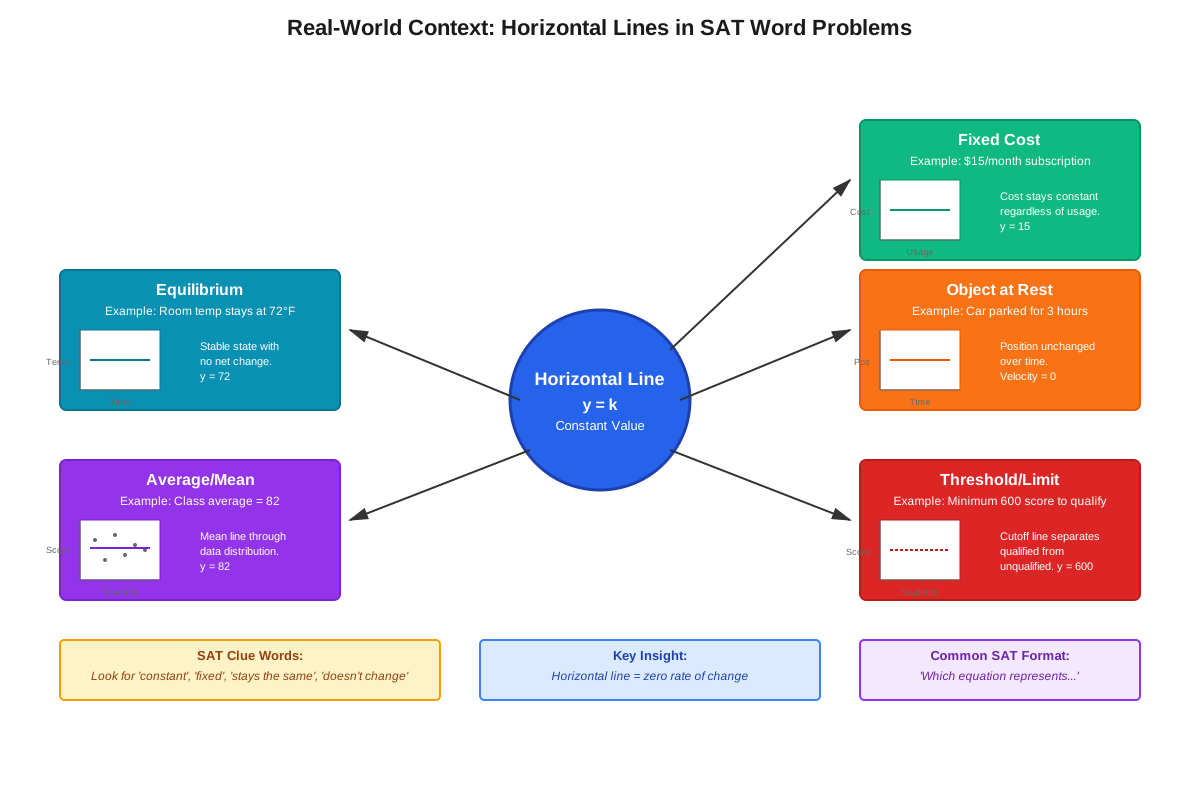
Horizontal lines appear throughout mathematics and real-world applications. In physics, a horizontal line on a position-time graph represents an object at rest—zero velocity. In economics, a horizontal line might represent a fixed cost that doesn't change with production quantity. In statistics, horizontal lines mark means, medians, or threshold values on data visualizations. Understanding horizontal lines enables students to interpret these constant relationships across disciplines.
On the SAT, horizontal lines appear in approximately 8-12% of linear function questions, making them a high-yield topic relative to study time investment. The College Board tests this concept through multiple question types: identifying equations from graphs, writing equations given conditions, solving systems of equations where one equation represents a horizontal line, and interpreting horizontal lines in real-world contexts. Questions range from straightforward identification (worth 1 point) to multi-step problems embedded in data analysis scenarios (worth 2-3 points in grid-in format).
Common SAT question formats include: graphing calculator questions showing data with horizontal trend lines, word problems describing constant rates or fixed values, coordinate geometry problems asking for equations of lines through specific points, and systems of equations where recognizing a horizontal line immediately reveals the y-coordinate of the solution. The topic frequently appears in questions 10-20 of each math section, positioned as medium-difficulty problems that separate mid-range scorers from high achievers.
Core Concepts
Definition and Equation Form
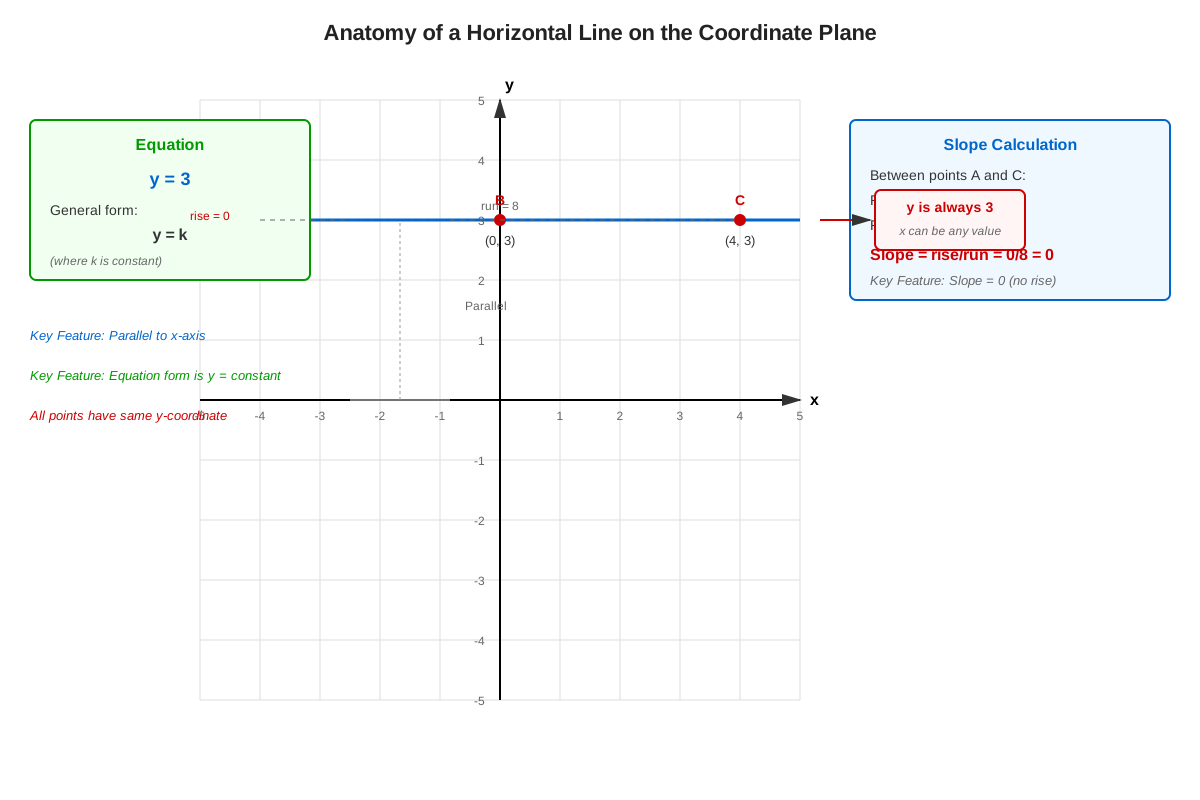
A horizontal line is a straight line in the coordinate plane where all points share the same y-coordinate. The defining characteristic is that no matter what x-value you choose, the y-value remains constant. This creates a line parallel to the x-axis.
The standard equation of a horizontal line is:
y = kwhere k is any real number constant representing the y-coordinate of every point on the line. For example, y = 3 represents a horizontal line passing through all points with y-coordinate 3, such as (0, 3), (5, 3), (-2, 3), and (100, 3).
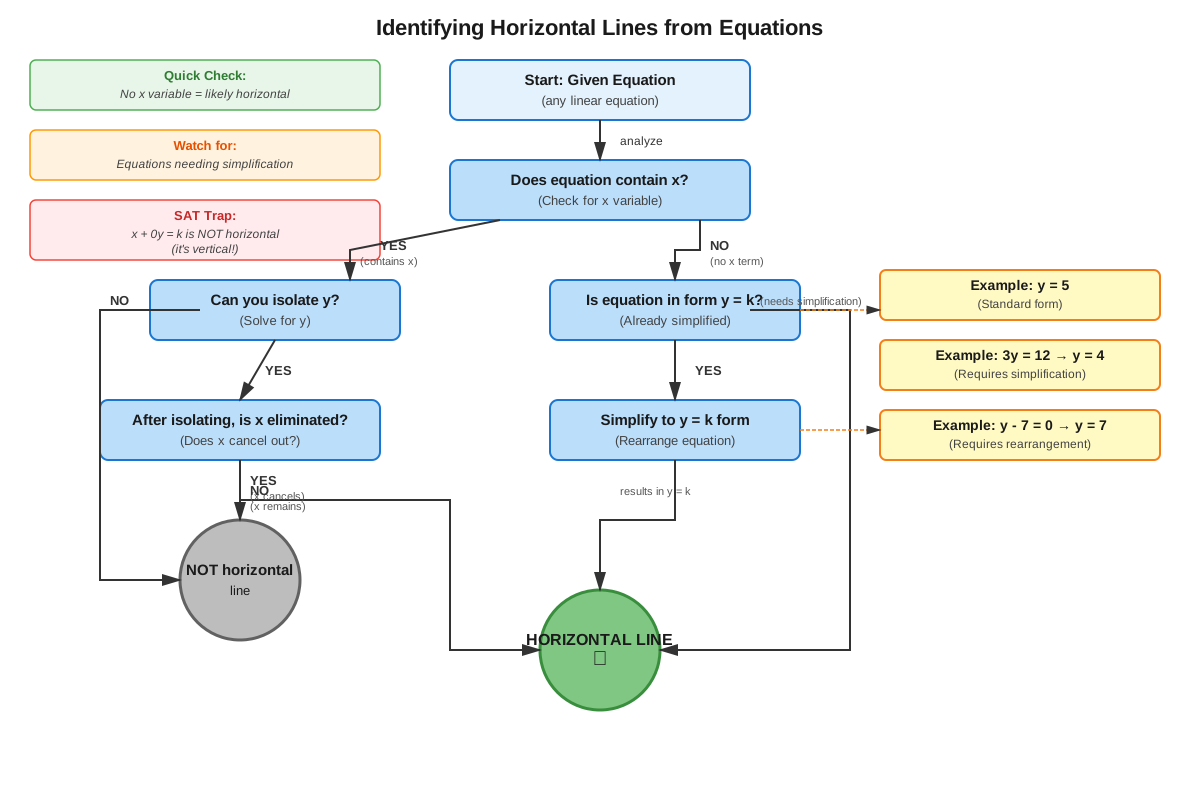
This equation form differs fundamentally from the slope-intercept form y = mx + b. For horizontal lines, we can think of m = 0, giving us y = 0x + b, which simplifies to y = b. The absence of an x-term in the equation is the algebraic signature of a horizontal line.
Slope of Horizontal Lines
The slope of any horizontal line is always zero. This is the most tested property on the SAT. Understanding why requires examining the slope formula:
slope = m = (y₂ - y₁)/(x₂ - x₁)For any two points on a horizontal line, such as (x₁, k) and (x₂, k), the y-coordinates are identical. Therefore:
m = (k - k)/(x₂ - x₁) = 0/(x₂ - x₁) = 0Zero slope means zero rate of change—the y-value doesn't change as x changes. This connects to real-world scenarios where a quantity remains constant over time or across different conditions.
Graphical Characteristics
On a coordinate plane, horizontal lines exhibit these visual features:
- Run parallel to the x-axis
- Perpendicular to the y-axis
- Extend infinitely in both left and right directions
- Cross the y-axis at exactly one point (0, k)
- Never cross the x-axis unless k = 0 (in which case the horizontal line IS the x-axis)
The y-intercept of a horizontal line y = k is simply k. Horizontal lines (except y = 0) have no x-intercept because they never cross the x-axis.
Comparison with Other Lines
Understanding horizontal lines requires distinguishing them from other line types:
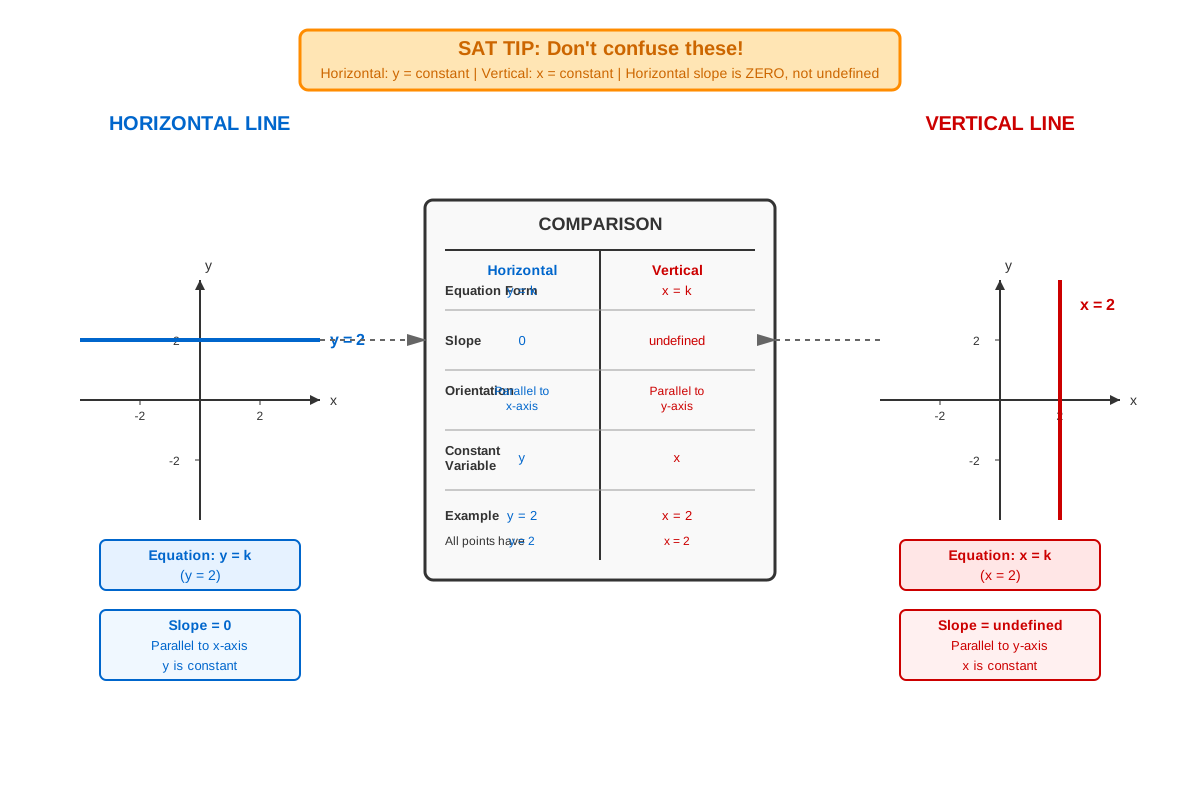
| Line Type | Equation Form | Slope | Visual Orientation |
|---|---|---|---|
| Horizontal | y = k | 0 | Parallel to x-axis |
| Vertical | x = h | Undefined | Parallel to y-axis |
| Positive slope | y = mx + b (m > 0) | Positive | Rises left to right |
| Negative slope | y = mx + b (m < 0) | Negative | Falls left to right |
The SAT frequently tests whether students confuse horizontal lines (y = k) with vertical lines (x = h). Remember: horizontal lines have equations with only y, vertical lines have equations with only x.
Writing Equations of Horizontal Lines
To write the equation of a horizontal line, identify the y-coordinate that remains constant:
- Given a point: If a horizontal line passes through (a, b), the equation is y = b
- Given a graph: Identify where the line crosses the y-axis; if it crosses at (0, k), the equation is y = k
- Given a description: If told "a horizontal line 5 units above the x-axis," the equation is y = 5
- Given two points: If both points have the same y-coordinate, such as (2, 7) and (9, 7), the equation is y = 7
Horizontal Lines in Systems of Equations
When a horizontal line appears in a system of equations, it immediately tells you the y-coordinate of any solution. For example:
System: y = 3 and 2x + y = 11Since y must equal 3, substitute into the second equation: 2x + 3 = 11, so x = 4. The solution is (4, 3).
This property makes horizontal lines powerful tools for solving systems efficiently on the SAT, where time management is crucial.
Domain and Range
For a horizontal line y = k:
- Domain: All real numbers (-∞, ∞) because x can be any value
- Range: Only the single value {k} because y is always k
This restricted range makes horizontal lines fail the vertical line test for being one-to-one functions, though they still qualify as functions (they pass the vertical line test for being functions).
Concept Relationships
The concept of horizontal lines connects to multiple mathematical ideas in a hierarchical structure:
Foundation Level: Coordinate plane → Points and ordered pairs → Plotting points
Core Level: Linear equations → Slope concept → Horizontal lines (slope = 0)
Application Level: Systems of equations → Parallel lines → Perpendicular lines → Function analysis
Horizontal lines serve as the bridge between understanding slope as a general concept and recognizing special cases. The zero slope of horizontal lines contrasts with the undefined slope of vertical lines, creating a complementary pair of special cases. This relationship extends to perpendicular lines: any vertical line is perpendicular to any horizontal line.
Within linear functions, horizontal lines represent constant functions where f(x) = k for all x. This connects to the broader concept of rate of change—horizontal lines model situations with zero rate of change, while other linear functions model constant non-zero rates of change.
The equation form y = k relates to the slope-intercept form y = mx + b by setting m = 0. This connection helps students understand that horizontal lines aren't exceptions to linear function rules but rather special cases within the broader framework.
High-Yield Facts
⭐ The slope of every horizontal line is exactly zero, never undefined (that's vertical lines)
⭐ The equation of a horizontal line is always y = k, where k is a constant with no x-term present
⭐ All points on a horizontal line share the same y-coordinate regardless of their x-coordinates
⭐ Horizontal lines are parallel to the x-axis and perpendicular to the y-axis
⭐ To find a horizontal line's equation through point (a, b), write y = b (use the y-coordinate only)
- The y-intercept of the line y = k is the point (0, k)
- Horizontal lines have domain of all real numbers but range of only one value
- The line y = 0 is the x-axis itself, the only horizontal line with an x-intercept
- Two horizontal lines are parallel if and only if they have different k values (y = k₁ and y = k₂ where k₁ ≠ k₂)
- In real-world contexts, horizontal lines represent constant values that don't change with the independent variable
- Horizontal lines pass the vertical line test, confirming they are functions
- The distance between two horizontal lines y = k₁ and y = k₂ is |k₁ - k₂|
- Horizontal lines never have x-intercepts unless k = 0
Quick check — test yourself on Horizontal lines so far.
Try Flashcards →Common Misconceptions
Misconception: Horizontal lines have undefined slope → Correction: Horizontal lines have zero slope (0), not undefined slope. Vertical lines have undefined slope. Zero means the slope exists and equals 0; undefined means the slope doesn't exist as a real number.
Misconception: The equation of a horizontal line through (3, 5) is x = 3 → Correction: The equation is y = 5. Use the y-coordinate for horizontal lines (y = k) and the x-coordinate for vertical lines (x = h). The equation x = 3 would be a vertical line.
Misconception: Horizontal lines can have different slopes depending on their position → Correction: All horizontal lines have slope = 0, regardless of whether they're above, below, or on the x-axis. Position doesn't affect slope; only the orientation (horizontal vs. slanted) determines slope.
Misconception: A horizontal line has no y-intercept → Correction: Every horizontal line y = k has exactly one y-intercept at the point (0, k). What horizontal lines typically lack (except y = 0) is an x-intercept.
Misconception: The equation y = 0x + 4 is not a horizontal line because it contains x → Correction: This equation simplifies to y = 4, which is horizontal. The term 0x equals zero regardless of x's value, so the equation reduces to y = 4. Any equation that simplifies to y = k (constant) represents a horizontal line.
Misconception: Horizontal lines can't be functions because they fail the vertical line test → Correction: Horizontal lines pass the vertical line test (any vertical line crosses a horizontal line exactly once), so they are functions. They fail the horizontal line test, meaning they're not one-to-one functions, but they're still valid functions.
Misconception: Two horizontal lines can intersect → Correction: Two distinct horizontal lines (y = k₁ and y = k₂ where k₁ ≠ k₂) are parallel and never intersect. They would need to share a y-value to intersect, which would make them the same line, not two distinct lines.
Worked Examples
Example 1: Writing Equations from Points
Problem: Write the equation of the horizontal line that passes through the point (-7, 4). Then determine if the point (100, 4) lies on this line.
Solution:
Step 1: Identify that we need a horizontal line equation in the form y = k.
Step 2: Since the line passes through (-7, 4), the y-coordinate of all points on this line must be 4.
Step 3: Write the equation: y = 4
Step 4: To check if (100, 4) lies on this line, substitute into the equation:
- Does y = 4 when the point is (100, 4)?
- Yes, the y-coordinate is 4, which satisfies y = 4
Step 5: Conclusion: The equation is y = 4, and the point (100, 4) does lie on this line because it has the required y-coordinate.
Connection to Learning Objectives: This example demonstrates identifying key features (equation form, constant y-value) and applying the concept to determine whether points satisfy the equation.
Example 2: Systems of Equations with Horizontal Lines
Problem: Solve the system of equations:
y = -2
3x - 4y = 26Solution:
Step 1: Recognize that y = -2 is a horizontal line, immediately telling us the y-coordinate of any solution.
Step 2: Since y must equal -2, substitute y = -2 into the second equation:
3x - 4(-2) = 26
3x + 8 = 26
3x = 18
x = 6
Step 3: The solution is the point (6, -2).
Step 4: Verify by substituting both values into the original second equation:
3(6) - 4(-2) = 18 + 8 = 26 ✓Step 5: Interpretation: Graphically, this represents the intersection point of the horizontal line y = -2 and the slanted line 3x - 4y = 26.
Connection to Learning Objectives: This example shows how horizontal lines appear in SAT-style systems of equations and demonstrates the efficient solution strategy of immediately using the constant y-value.
Example 3: Real-World Context
Problem: A parking garage charges a flat rate of $15 regardless of how many hours you park (up to 24 hours). Write an equation representing the cost C as a function of hours h, and identify what type of line this represents.
Solution:
Step 1: Identify the relationship: Cost doesn't change with hours, so cost is constant.
Step 2: Write the equation: C = 15 (or in function notation: C(h) = 15)
Step 3: Recognize this as a horizontal line because:
- The dependent variable (C) equals a constant
- The independent variable (h) doesn't appear in the equation
- There's zero rate of change (slope = 0)
Step 4: Interpretation: On a graph with hours on the x-axis and cost on the y-axis, this would appear as a horizontal line at C = 15, showing that cost remains $15 for any number of hours.
Connection to Learning Objectives: This demonstrates how horizontal lines appear in real-world SAT contexts and requires explaining the meaning of the horizontal line in practical terms.
Exam Strategy
When approaching SAT questions involving horizontal lines, follow this strategic framework:
Recognition Triggers: Watch for these phrases and situations that signal horizontal lines:
- "constant value"
- "remains the same"
- "does not change"
- "flat rate"
- "fixed amount"
- Equations with only y (no x term)
- Graphs showing lines parallel to the x-axis
- Slope described as zero
Immediate Actions: When you identify a horizontal line:
- Write or recognize the equation form y = k
- Identify the constant k value
- Remember slope = 0 for any calculations
- Note that all points share the same y-coordinate
Process of Elimination Tips:
- Eliminate any answer choice with an x-term when looking for horizontal line equations
- Eliminate "undefined" as a slope option (that's vertical lines)
- Eliminate any equation in the form x = h (that's a vertical line)
- For graphical questions, eliminate any line that isn't parallel to the x-axis
Time Allocation: Horizontal line questions should take 30-60 seconds for straightforward identification and 60-90 seconds for application problems. If you're spending more than 90 seconds, you may be overcomplicating the problem—horizontal lines are simpler than they might appear in complex contexts.
Common Question Formats:
- Format 1: "Which equation represents a horizontal line?" → Look for y = k
- Format 2: "What is the slope of the line shown?" → If horizontal, answer is 0
- Format 3: "Write an equation for the line through (a, b) parallel to the x-axis" → Answer is y = b
- Format 4: Systems of equations with one horizontal line → Use the y-value immediately
Exam Tip: If a question asks about a line "parallel to the x-axis," that's code for a horizontal line. Similarly, "perpendicular to the y-axis" also means horizontal.
Calculator Usage: For graphing calculator questions, horizontal lines appear as flat lines. Use the trace function to verify that y-values remain constant while x-values change. This can confirm your answer choice quickly.
Memory Techniques
Mnemonic for Equation Form: "Horizontal uses Height" → Horizontal lines use y (height on the coordinate plane), so the equation is y = k
Visual Memory Aid: Picture the horizon—it's a horizontal line that stays at the same height (y-value) as far as you can see in either direction (x-values extend infinitely)
Slope Memory: "Zero slope for horiZontal" → The letter Z appears in both zero and horizontal (when written in a stylized way), and horizontal lines have zero slope
Equation vs. Line Type:
- y = k → you're going horizontal (both have horizontal elements in their letters)
- x = h → extends vertically (x has crossing lines like vertical)
Acronym for Key Properties: HYPE
- Height stays the same (y-coordinate constant)
- Y = k equation form
- Parallel to x-axis
- Equal to zero (slope)
Contextual Memory: Think "flat rate = flat line" → When word problems mention flat rates, fixed costs, or constant values, visualize a flat (horizontal) line
Summary
Horizontal lines represent one of the most fundamental concepts in coordinate geometry, characterized by their constant y-values and zero slope. Every horizontal line can be expressed in the simple equation form y = k, where k represents the unchanging y-coordinate of all points on the line. These lines run parallel to the x-axis and perpendicular to the y-axis, creating a visual representation of zero rate of change. On the SAT, horizontal lines appear in multiple contexts: as standalone graphing questions, within systems of equations, in real-world modeling scenarios, and as part of coordinate geometry problems. The key to mastering this topic lies in recognizing the equation form (no x-term present), remembering that slope always equals zero (not undefined), and understanding that the y-coordinate from any point on the line becomes the constant k in the equation. Students must distinguish horizontal lines from vertical lines and apply this knowledge efficiently in time-pressured exam conditions. Success requires both conceptual understanding—why horizontal lines have zero slope and constant y-values—and procedural fluency in writing equations, solving systems, and interpreting graphs.
Key Takeaways
- Horizontal lines always have slope = 0, representing zero rate of change in any context
- The equation form is y = k where k is a constant, with no x-term appearing in the equation
- All points on a horizontal line share identical y-coordinates regardless of their x-values
- To write a horizontal line equation through point (a, b), use only the y-coordinate: y = b
- Horizontal lines are parallel to the x-axis and perpendicular to the y-axis, never intersecting the x-axis unless k = 0
- In systems of equations, a horizontal line immediately reveals the y-coordinate of the solution
- Real-world horizontal lines represent constant values such as flat rates, fixed costs, or unchanging quantities over time
Related Topics
Vertical Lines: The complementary concept to horizontal lines, with equations in the form x = h and undefined slope. Mastering horizontal lines makes understanding vertical lines straightforward through comparison and contrast.
Parallel and Perpendicular Lines: Horizontal lines provide clear examples—all horizontal lines are parallel to each other and perpendicular to all vertical lines. This topic builds directly on horizontal line properties.
Slope-Intercept Form: Understanding y = mx + b becomes clearer when students recognize that horizontal lines are the special case where m = 0, connecting special cases to general forms.
Systems of Linear Equations: Horizontal lines frequently appear in systems, and recognizing them enables faster solution methods, making this an immediate application of horizontal line mastery.
Linear Inequalities: Horizontal lines serve as boundary lines for inequalities like y > k or y ≤ k, extending the concept from equations to inequalities.
Practice CTA
Now that you've mastered the core concepts of horizontal lines, it's time to solidify your understanding through active practice. Complete the practice questions to test your ability to identify, write equations for, and apply horizontal lines in various SAT-style contexts. Use the flashcards to reinforce the key properties, equation forms, and distinctions from other line types. Remember: horizontal lines appear on every SAT, and the 20 minutes you've invested in this guide can translate directly into points on test day. Confidence with this foundational topic will accelerate your mastery of more complex linear function concepts. You've got this!
Sign up free to keep reading
Create a free AnvayaPrep account to finish this SAT guide on Horizontal lines — plus flashcards and practice questions.