Overview
Vertical lines represent one of the most distinctive and frequently tested concepts in the linear functions unit of SAT Math. Unlike other linear relationships, vertical lines possess unique mathematical properties that set them apart from standard functions. Understanding vertical lines is crucial because they appear in coordinate geometry questions, systems of equations problems, and function analysis tasks throughout the SAT.
On the SAT, vertical lines often serve as a test of conceptual understanding rather than computational skill. Questions may ask students to identify equations of vertical lines, recognize why vertical lines fail the vertical line test for functions, or apply properties of vertical lines in coordinate plane scenarios. The College Board specifically includes vertical lines to assess whether students truly understand the relationship between equations and their graphical representations, making this a high-yield topic that separates students who memorize formulas from those who grasp underlying principles.
Vertical lines connect to broader mathematical concepts including slope, domain and range, functions versus relations, and the coordinate plane system. Mastery of vertical lines strengthens understanding of perpendicular relationships (since vertical lines are perpendicular to horizontal lines), parallel line identification, and the fundamental connection between algebraic equations and geometric representations. This topic serves as a gateway to more advanced concepts in analytic geometry and reinforces the critical skill of translating between multiple representations of mathematical relationships.
Learning Objectives
- [ ] Identify key features of vertical lines including equation form, undefined slope, and graphical appearance
- [ ] Explain how vertical lines appears on the SAT in various question formats and contexts
- [ ] Apply vertical lines concepts to answer SAT-style questions involving coordinate geometry
- [ ] Distinguish between vertical lines and other linear relationships based on equations and graphs
- [ ] Determine whether a given equation or graph represents a vertical line
- [ ] Solve problems involving perpendicular and parallel relationships with vertical lines
- [ ] Recognize why vertical lines do not represent functions and explain the implications
Prerequisites
- Coordinate plane basics: Understanding x and y axes, ordered pairs, and plotting points is essential because vertical lines are defined by their relationship to the x-axis
- Linear equations: Familiarity with equations in the form y = mx + b provides contrast for understanding why vertical lines have a different equation form
- Slope concept: Basic knowledge of slope as rise over run helps explain why vertical lines have undefined slope
- Function definition: Understanding what constitutes a function is necessary to grasp why vertical lines fail the vertical line test
Why This Topic Matters
Vertical lines appear in real-world contexts whenever a quantity remains constant regardless of changes in another variable. For example, a vertical line on a time-distance graph represents an object at a fixed position over time, while a vertical line on a price-quantity graph might represent a fixed supply constraint. In architecture and engineering, vertical lines represent structural elements, property boundaries, and alignment references. Understanding vertical lines also builds spatial reasoning skills essential for fields including computer graphics, navigation systems, and data visualization.
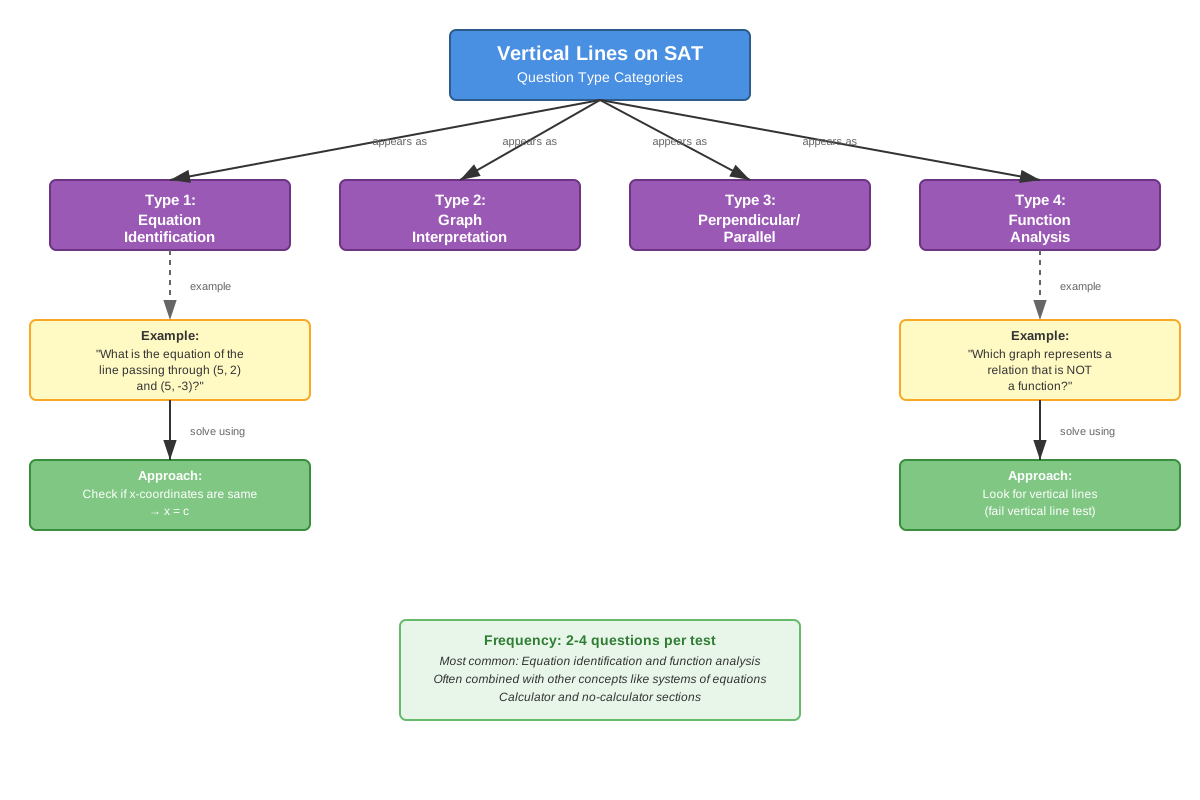
On the SAT, vertical lines appear in approximately 2-4 questions per test, making them a medium-frequency but high-importance topic. Questions involving vertical lines typically appear in both the calculator and no-calculator sections, with point values ranging from 1-2 points each. The College Board includes vertical lines in multiple question formats: identifying equations from graphs, determining properties of lines, solving systems of equations, and analyzing geometric relationships on the coordinate plane.
Common SAT question types include: (1) identifying the equation of a vertical line passing through a given point, (2) determining whether a line is vertical based on two points, (3) recognizing that vertical lines have undefined slope, (4) finding the intersection of a vertical line with another function, and (5) applying the concept that vertical lines are not functions. These questions often appear as part of multi-step problems where recognizing a vertical line is one component of a larger solution strategy.
Core Concepts
Definition and Equation Form
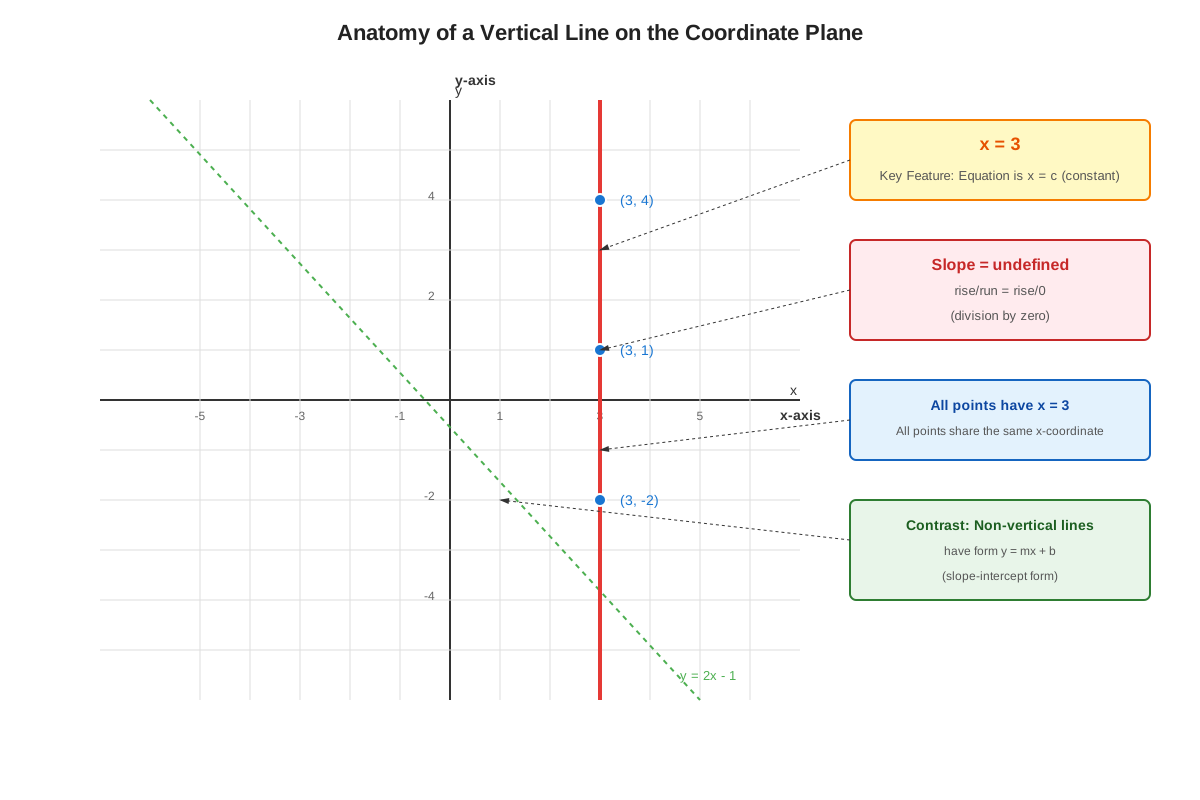
A vertical line is a straight line on the coordinate plane where all points share the same x-coordinate. The standard equation of a vertical line is x = k, where k is a constant representing the fixed x-coordinate of every point on the line. This equation form is fundamentally different from the slope-intercept form (y = mx + b) used for non-vertical lines because the equation does not contain y as a variable.
For example, the equation x = 3 represents a vertical line passing through all points with an x-coordinate of 3, including (3, -2), (3, 0), (3, 5), and infinitely many others. The y-coordinate can be any real number, but the x-coordinate must always equal 3. This characteristic makes vertical lines unique in coordinate geometry.
Slope of Vertical Lines
The slope of a vertical line is undefined (not zero—this is a critical distinction). Slope is calculated as the change in y divided by the change in x: m = (y₂ - y₁)/(x₂ - x₁). For any two points on a vertical line, the x-coordinates are identical, making the denominator zero. Since division by zero is undefined in mathematics, the slope of a vertical line is undefined.
Consider two points on the line x = 5: (5, 2) and (5, 7). Using the slope formula:
m = (7 - 2)/(5 - 5) = 5/0 = undefinedThis undefined slope has important implications for parallel and perpendicular relationships. Two vertical lines are always parallel to each other (they never intersect), while a vertical line is perpendicular to any horizontal line (which has a slope of zero).
Graphical Representation
On a coordinate plane, a vertical line appears as a straight line running parallel to the y-axis. The line intersects the x-axis at exactly one point: (k, 0), where k is the constant from the equation x = k. The line extends infinitely in both the positive and negative y-directions.
Key graphical features include:
- The line is perfectly vertical (90-degree angle with the x-axis)
- The line never crosses itself
- The line has no y-intercept unless k = 0 (in which case the vertical line is the y-axis itself)
- The line has exactly one x-intercept at x = k
Domain and Range
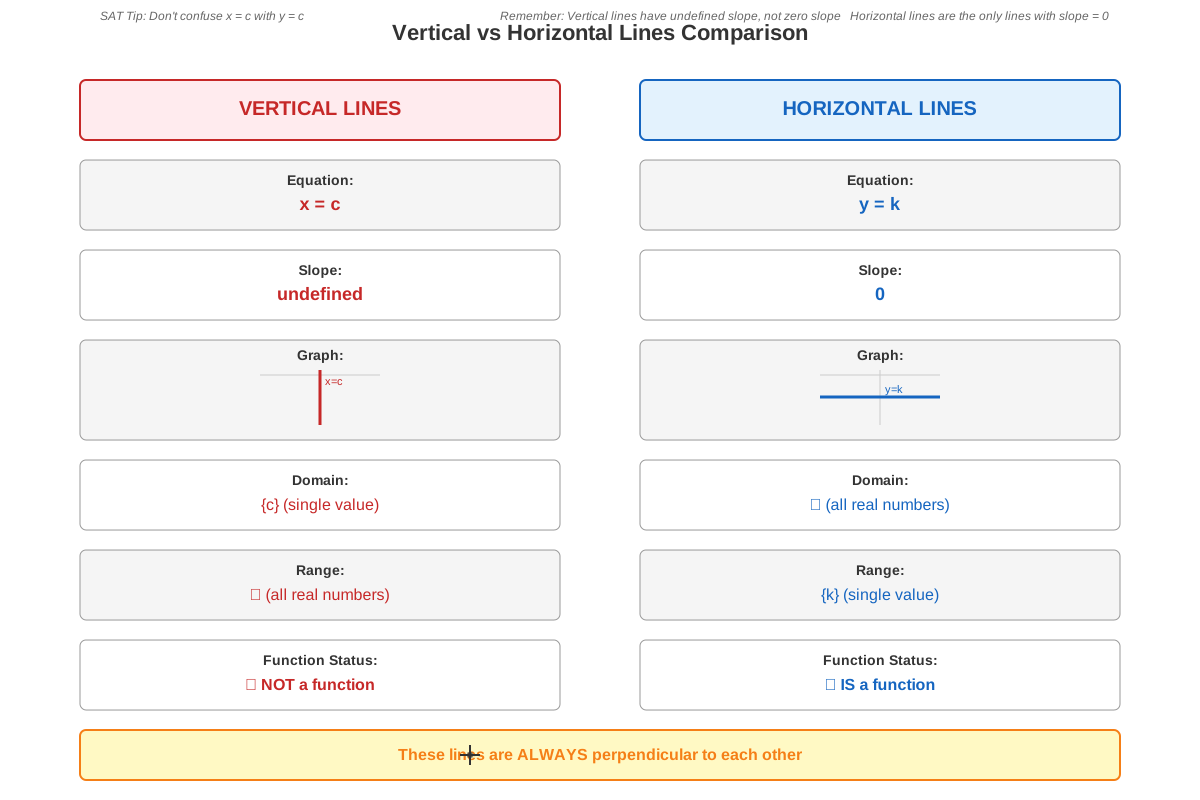
The domain of a vertical line (when considered as a relation) consists of a single value: {k}. This means the relation only includes points with one specific x-coordinate. The range of a vertical line is all real numbers: (-∞, ∞), because the y-coordinate can take any value.
This domain-range relationship is the opposite of a horizontal line, which has a domain of all real numbers and a range consisting of a single value. Understanding this distinction helps students analyze graphs and identify line types quickly.
Vertical Lines and Functions
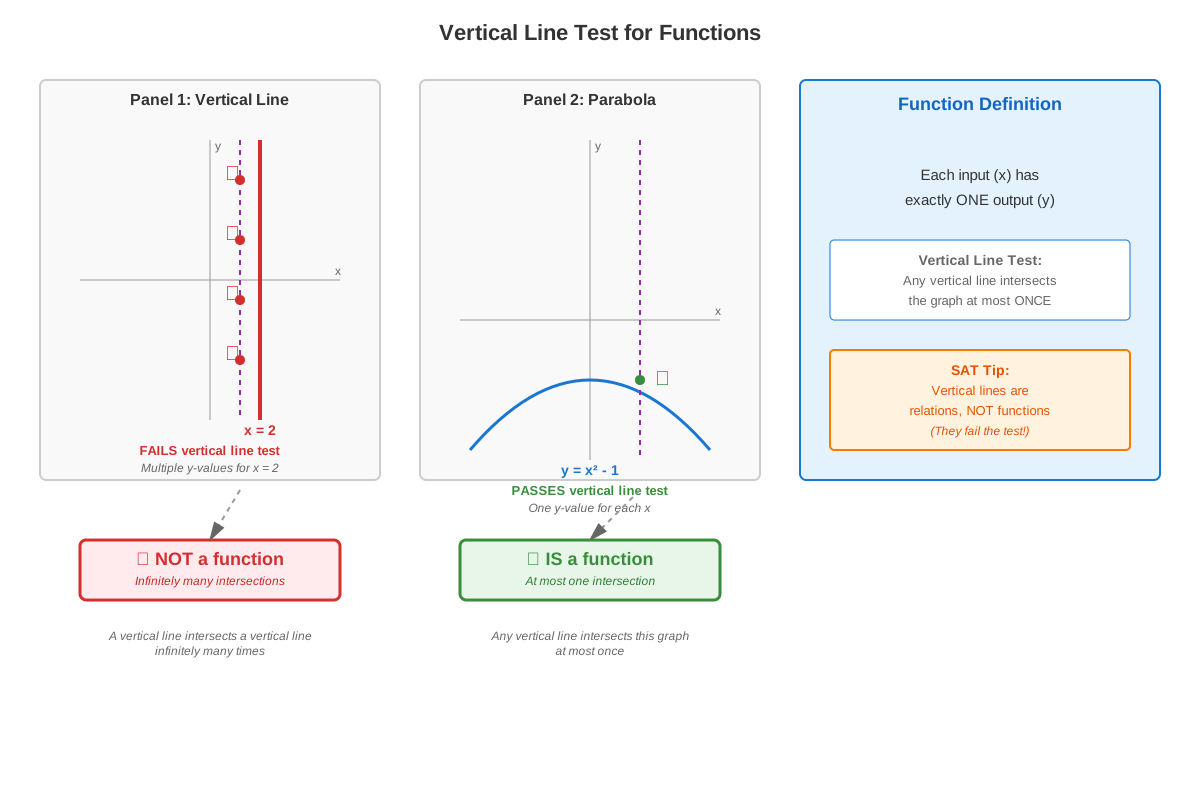
A vertical line does not represent a function because it fails the vertical line test. The vertical line test states that if any vertical line intersects a graph at more than one point, the graph does not represent a function. Since a vertical line intersects itself at infinitely many points, it cannot be a function.
This concept is crucial for SAT questions that ask students to identify which graphs represent functions or to explain why certain relations are not functions. A function requires that each input (x-value) corresponds to exactly one output (y-value), but a vertical line maps one x-value to infinitely many y-values, violating the function definition.
Comparison Table
| Feature | Vertical Line | Horizontal Line | Oblique Line |
|---|---|---|---|
| Equation Form | x = k | y = k | y = mx + b (m ≠ 0) |
| Slope | Undefined | 0 | Defined (m ≠ 0) |
| Domain | {k} | All real numbers | All real numbers |
| Range | All real numbers | {k} | All real numbers |
| Is a Function? | No | Yes | Yes |
| Parallel to | y-axis | x-axis | Neither axis |
Finding Equations from Points
To find the equation of a vertical line passing through a given point (a, b), simply identify the x-coordinate: the equation is x = a. The y-coordinate is irrelevant because all points on the vertical line share the same x-coordinate.
For example:
- Vertical line through (4, 7): x = 4
- Vertical line through (-2, 0): x = -2
- Vertical line through (0, 5): x = 0 (this is the y-axis)
If given two points and asked to determine if they lie on a vertical line, check whether the x-coordinates are identical. If (x₁, y₁) and (x₂, y₂) have x₁ = x₂, then they lie on the vertical line x = x₁.
Concept Relationships
The concept of vertical lines connects directly to the fundamental definition of slope, as understanding why vertical lines have undefined slope requires grasping the slope formula and the impossibility of division by zero. This relationship flows as: Slope formula → Division by zero → Undefined slope for vertical lines.
Vertical lines relate to the broader concept of linear equations through contrast: Standard linear equations (y = mx + b) → Special case where slope is undefined → Vertical line equation (x = k). This progression helps students understand that vertical lines are not exceptions to rules but rather special cases that require different notation.
The connection between vertical lines and functions follows this logical path: Function definition (one output per input) → Vertical line test → Vertical lines fail the test → Vertical lines are relations but not functions. This relationship is bidirectional, as the vertical line test itself is named for the geometric property of vertical lines.
Vertical lines also connect to perpendicular relationships: Horizontal lines (slope = 0) → Perpendicular relationship → Vertical lines (undefined slope). This relationship extends to the general principle that perpendicular lines have slopes that are negative reciprocals, though this rule requires special consideration when one line is vertical.
Within coordinate geometry, vertical lines relate to symmetry concepts: Reflection across a vertical line → x-coordinates change, y-coordinates remain constant. This connects to transformations and geometric properties tested on the SAT.
Quick check — test yourself on Vertical lines so far.
Try Flashcards →High-Yield Facts
⭐ The equation of a vertical line is always in the form x = k, where k is a constant
⭐ Vertical lines have undefined slope, not zero slope (zero slope describes horizontal lines)
⭐ A vertical line is NOT a function because it fails the vertical line test
⭐ All points on a vertical line share the same x-coordinate but can have any y-coordinate
⭐ The domain of a vertical line consists of a single value; the range is all real numbers
- Two vertical lines are always parallel to each other (they have the same undefined slope)
- A vertical line is perpendicular to any horizontal line
- The x-intercept of the line x = k is the point (k, 0)
- A vertical line has no y-intercept unless k = 0 (in which case the line is the y-axis)
- To find the equation of a vertical line through point (a, b), use x = a (ignore the y-coordinate)
- Vertical lines extend infinitely in both the positive and negative y-directions
- The distance between two vertical lines x = k₁ and x = k₂ is |k₂ - k₁|
- A vertical line divides the coordinate plane into two half-planes: x < k and x > k
Common Misconceptions
Misconception: Vertical lines have a slope of zero → Correction: Vertical lines have undefined slope. Horizontal lines have a slope of zero. The confusion arises because both are "extreme" cases, but they are opposite extremes. Zero means no change in y, while undefined means no change in x.
Misconception: The equation of a vertical line can be written as y = mx + b → Correction: Vertical lines cannot be expressed in slope-intercept form because they have undefined slope. The equation must be written as x = k. Attempting to use y = mx + b would require dividing by zero.
Misconception: A vertical line through (3, 5) has equation y = 3 → Correction: The equation is x = 3. Students often confuse which coordinate appears in the equation. For vertical lines, use the x-coordinate; for horizontal lines, use the y-coordinate.
Misconception: Vertical lines are functions → Correction: Vertical lines are relations but not functions because they map one input to infinitely many outputs. Each x-value corresponds to all possible y-values, violating the function definition.
Misconception: All lines have a defined slope → Correction: Only non-vertical lines have defined slopes. Vertical lines are the exception because the slope formula requires division by zero, which is undefined in mathematics.
Misconception: Undefined slope and infinite slope are the same thing → Correction: Undefined slope is not the same as infinite slope. Mathematically, we say the slope is undefined, not infinite, because division by zero does not produce infinity—it produces an undefined result.
Misconception: A vertical line has no x-intercept → Correction: A vertical line x = k has exactly one x-intercept at the point (k, 0), unless we're discussing the line in a restricted domain. It has no y-intercept unless k = 0.
Worked Examples
Example 1: Identifying and Writing Equations
Problem: Line l passes through points A(2, -3) and B(2, 5). Write the equation of line l and determine whether it represents a function.
Solution:
Step 1: Examine the coordinates of the two points. Notice that both points have the same x-coordinate: x = 2.
Step 2: Since both points share the same x-coordinate, the line connecting them must be vertical. All vertical lines have equations in the form x = k.
Step 3: The constant k equals the shared x-coordinate. Therefore, the equation is x = 2.
Step 4: Determine if this is a function. A function requires that each input (x-value) corresponds to exactly one output (y-value). For the line x = 2, the input x = 2 corresponds to infinitely many outputs (all real numbers for y). Therefore, this line does not represent a function.
Step 5: Verify by checking the slope: m = (5 - (-3))/(2 - 2) = 8/0 = undefined. This confirms the line is vertical.
Answer: The equation is x = 2, and it does not represent a function.
Example 2: Application in Systems of Equations
Problem: Find the point of intersection between the vertical line x = -1 and the line y = 2x + 5.
Solution:
Step 1: Understand what the question asks. The intersection point must satisfy both equations simultaneously.
Step 2: Since the vertical line has equation x = -1, any point on this line must have x-coordinate equal to -1. Therefore, the x-coordinate of the intersection point is x = -1.
Step 3: Substitute x = -1 into the second equation to find the y-coordinate:
y = 2(-1) + 5
y = -2 + 5
y = 3
Step 4: The intersection point is (-1, 3).
Step 5: Verify by checking that this point satisfies both equations:
- For x = -1: The x-coordinate is -1 ✓
- For y = 2x + 5: y = 2(-1) + 5 = 3 ✓
Answer: The lines intersect at the point (-1, 3).
Connection to Learning Objectives: This example demonstrates how to apply vertical line concepts to solve systems of equations, a common SAT question type. It reinforces that the equation x = k immediately tells us the x-coordinate of any point on the line.
Exam Strategy
When approaching SAT questions involving vertical lines, first scan the problem for trigger words and visual cues. Look for phrases like "undefined slope," "x equals a constant," "passes through points with the same x-coordinate," or "perpendicular to a horizontal line." If you see a graph with a perfectly vertical line, immediately recognize it as x = k and identify the value of k.
For equation identification questions, use this decision tree:
- Are you given two points? Check if x-coordinates are identical → If yes, write x = (that x-coordinate)
- Are you told the slope is undefined? → The line must be vertical
- Does the equation contain only x and a constant? → It's a vertical line
- Are you asked if something is a function and you see a vertical line? → The answer is no
When eliminating answer choices, remember these key distinctions:
- If an answer choice shows y = (something), it cannot be a vertical line
- If an answer choice claims a vertical line has slope 0, eliminate it (slope is undefined)
- If an answer choice states a vertical line is a function, eliminate it
- If you need a line perpendicular to y = k (horizontal), the answer must be a vertical line
Time allocation strategy: Vertical line questions typically require 30-60 seconds once you recognize the concept. Don't waste time trying to calculate slope for vertical lines—if x-coordinates match, immediately write x = k. For graphing questions, quickly identify the x-intercept rather than plotting multiple points.
Exam Tip: If a question asks for the equation of a line through (a, b) and (a, c) where b ≠ c, immediately write x = a without calculating slope. The matching x-coordinates are your instant signal.
Memory Techniques
Mnemonic for equation form: "Vertical lines use the Variable X" (V-X connection). This helps remember that vertical line equations use x, not y.
Visual memory aid: Picture a vertical line as a "wall" or "fence" standing upright. Just as a wall has a fixed position (you can't move it left or right), a vertical line has a fixed x-coordinate. The wall can extend up and down (any y-value), but its position (x-value) never changes.
Slope memory technique: Think "Up and down, Undefined." Vertical lines go up and down, and their slope is undefined. Both start with "U."
Function test acronym: VLT-F = "Vertical Line Test Fails" for vertical lines. This reminds you that vertical lines fail the vertical line test and are not functions.
Perpendicular relationship: Remember "Horizontal and Vertical make a + sign" (like the plus symbol). This visual reminds you that horizontal and vertical lines are perpendicular, forming 90-degree angles.
Domain-Range flip: For vertical lines, think "Domain is Diminutive (small—just one value), Range is Really big (all real numbers)." This helps remember the domain-range relationship.
Summary
Vertical lines are straight lines on the coordinate plane where all points share the same x-coordinate, expressed by the equation x = k. These lines have undefined slope because calculating slope requires dividing by zero, which is mathematically impossible. Unlike most linear relationships, vertical lines are not functions because they fail the vertical line test—each x-value corresponds to infinitely many y-values. On the SAT, recognizing vertical lines quickly is essential for solving coordinate geometry problems, systems of equations, and function analysis questions. The key features to remember are: equation form (x = k), undefined slope, domain of a single value, range of all real numbers, perpendicularity to horizontal lines, and the fact that they are relations but not functions. Mastering vertical lines requires understanding both their algebraic representation and geometric properties, as SAT questions test the ability to translate between these representations and apply the concepts in various contexts.
Key Takeaways
- Vertical lines have equations in the form x = k, where k is the constant x-coordinate of all points on the line
- The slope of a vertical line is undefined (not zero), resulting from division by zero in the slope formula
- Vertical lines are not functions because they map one input to infinitely many outputs, failing the vertical line test
- To find a vertical line's equation through point (a, b), use x = a—the y-coordinate is irrelevant
- Vertical lines are perpendicular to horizontal lines and parallel to other vertical lines
- The domain of a vertical line is a single value {k}, while the range is all real numbers
- On the SAT, quickly identifying vertical lines from matching x-coordinates or undefined slope saves valuable time
Related Topics
Horizontal Lines: Understanding horizontal lines (y = k) provides essential contrast to vertical lines and completes the picture of special linear cases. Horizontal lines have zero slope and are functions, making them the "opposite" of vertical lines in many ways.
Slope and Rate of Change: Deeper exploration of slope concepts, including positive, negative, zero, and undefined slopes, builds on the vertical line foundation and enables analysis of all linear relationships.
Functions and Relations: Expanding knowledge of what constitutes a function versus a general relation helps explain why vertical lines fail the function test and prepares students for more advanced function concepts.
Systems of Linear Equations: Mastering vertical lines enables solving systems where one equation is vertical, a common SAT scenario that tests both algebraic and geometric reasoning.
Perpendicular and Parallel Lines: Understanding the special perpendicular relationship between vertical and horizontal lines leads to general principles about perpendicular slopes and parallel line identification.
Practice CTA
Now that you've mastered the core concepts of vertical lines, it's time to solidify your understanding through practice. Attempt the practice questions to test your ability to identify vertical lines, write their equations, and apply these concepts in various SAT-style scenarios. Use the flashcards to reinforce the high-yield facts and ensure you can quickly recall key properties under test conditions. Remember, vertical lines appear frequently on the SAT, and confident mastery of this topic will earn you valuable points. Each practice problem you complete strengthens your pattern recognition and builds the automaticity needed for test day success!
Sign up free to keep reading
Create a free AnvayaPrep account to finish this SAT guide on Vertical lines — plus flashcards and practice questions.