Overview
The initial value is one of the most fundamental concepts in linear functions and appears frequently on the SAT math section. In mathematical terms, the initial value represents the y-coordinate of a point where a linear function crosses the y-axis—also known as the y-intercept. This concept is crucial because it provides the starting point of a linear relationship before any changes occur in the independent variable. Understanding initial value allows students to interpret real-world scenarios, construct equations from context, and analyze graphs efficiently.
On the SAT, initial value questions test a student's ability to translate between different representations of linear functions: equations, graphs, tables, and word problems. The College Board consistently includes 3-5 questions per test that directly or indirectly assess understanding of initial value, making this a high-yield topic for score improvement. These questions often appear in both the calculator and no-calculator sections, embedded within word problems about finances, motion, population growth, or other real-world contexts.
Mastering initial value creates a foundation for understanding more complex mathematical relationships. This concept connects directly to slope-intercept form (y = mx + b), systems of equations, and function transformations. Students who thoroughly understand initial value can quickly identify key features of linear models, make predictions, and solve multi-step problems involving linear relationships—skills that are essential not only for the SAT but also for college-level mathematics and quantitative reasoning in various fields.
Learning Objectives
- [ ] Identify key features of initial value in equations, graphs, and tables
- [ ] Explain how initial value appears on the SAT in various question formats
- [ ] Apply initial value to answer SAT-style questions efficiently and accurately
- [ ] Determine initial value from word problems by identifying the starting condition
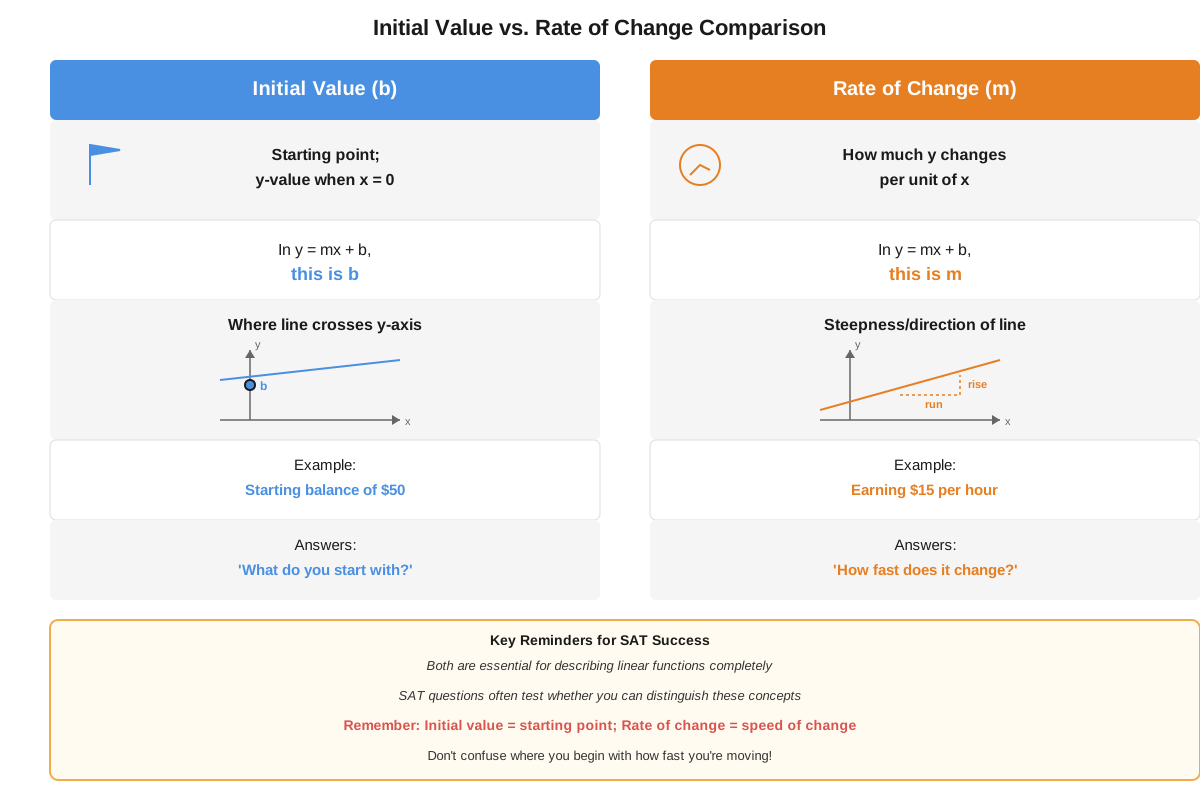
- [ ] Distinguish between initial value and rate of change in linear contexts
- [ ] Convert between different representations of linear functions while preserving initial value
- [ ] Solve real-world problems by interpreting initial value in context
Prerequisites
- Basic algebraic manipulation: Necessary for rearranging equations into slope-intercept form to identify initial value
- Coordinate plane understanding: Required to locate the y-intercept on a graph and understand ordered pairs
- Function notation: Essential for interpreting f(0) as the initial value and understanding input-output relationships
- Linear equation structure: Needed to recognize different forms of linear equations and identify components
- Table interpretation: Important for extracting initial value from data presented in tabular format
Why This Topic Matters
Initial value has profound real-world significance across numerous fields. In finance, it represents starting balances, initial investments, or base salaries before commissions. In physics, it describes initial position or starting velocity. In business, it indicates fixed costs that exist before production begins. Environmental scientists use initial value to represent baseline pollution levels or starting populations. Medical researchers track initial measurements before treatment interventions. Understanding initial value enables students to model and predict outcomes in any scenario involving linear change.
On the SAT, initial value appears in approximately 8-12% of all math questions, making it one of the most frequently tested concepts in the linear functions domain. Questions typically appear in multiple formats: identifying y-intercepts from graphs (2-3 questions per test), extracting initial values from word problems (3-4 questions), determining starting values from tables (1-2 questions), and writing equations based on contextual information (2-3 questions). The College Board particularly favors questions that require students to interpret initial value within real-world contexts rather than simply identifying it mechanically.
Common SAT question types include: determining which equation models a situation with a given starting value; identifying what the y-intercept represents in context; comparing initial values across multiple linear models; finding the initial value when given two points on a line; and solving for unknown parameters when the initial value is specified. Questions often combine initial value with other concepts like slope, creating multi-step problems that test comprehensive understanding of linear functions.
Core Concepts
Definition and Mathematical Representation
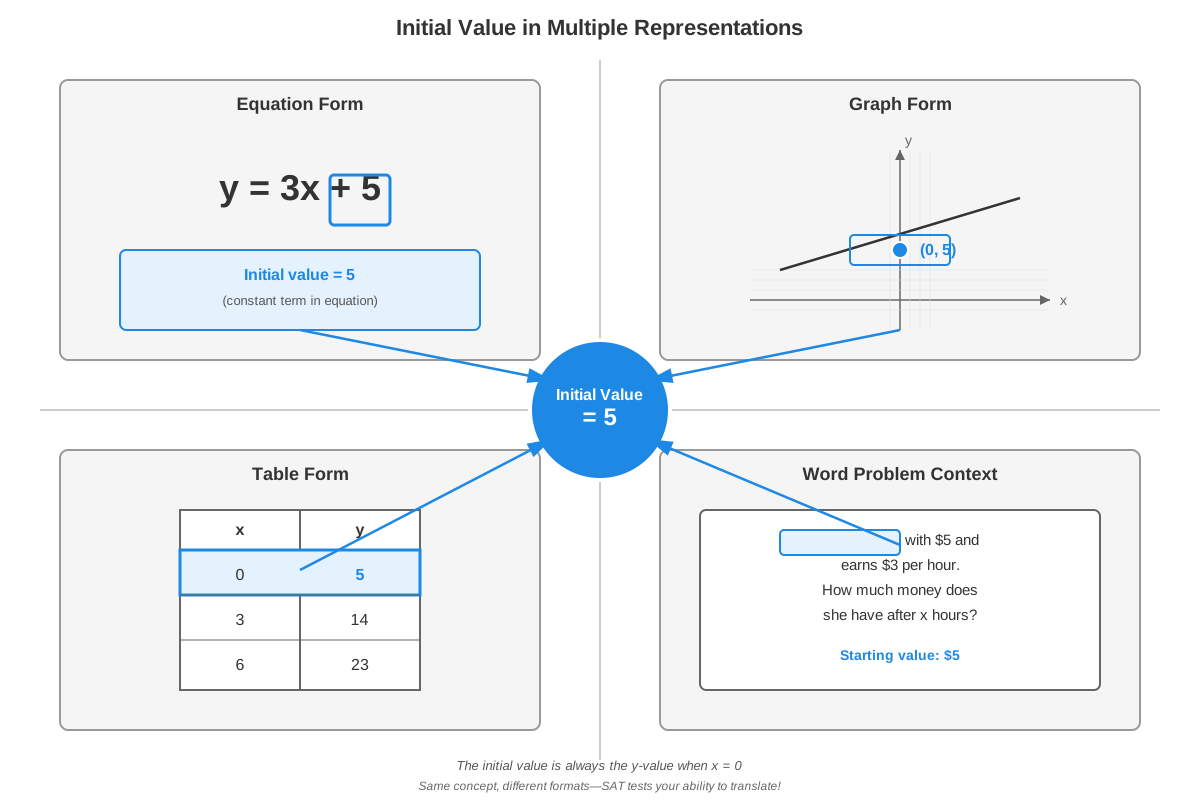
The initial value of a linear function is the output value when the input equals zero. Mathematically, if a function is written as f(x), the initial value is f(0). In the most common form of a linear equation—slope-intercept form y = mx + b—the initial value is represented by the constant term b. This value indicates where the line crosses the y-axis, which is why it's also called the y-intercept.
The initial value has a specific coordinate representation: (0, b), where b is the initial value. This point is unique because it's the only location where the line intersects the vertical axis. Understanding this geometric interpretation helps students quickly identify initial value from graphs and verify their algebraic work.
Identifying Initial Value in Different Representations
From Equations: The method for finding initial value depends on the equation form:
- Slope-intercept form (y = mx + b): The initial value is b directly
- Standard form (Ax + By = C): Solve for y when x = 0, giving y = C/B
- Point-slope form (y - y₁ = m(x - x₁)): Substitute x = 0 and solve for y
- Function notation (f(x) = mx + b): The initial value is f(0) = b
From Graphs: Locate the point where the line crosses the y-axis. The y-coordinate of this intersection point is the initial value. If the graph doesn't clearly show the y-axis, trace the line backward (or forward) to determine where it would cross.
From Tables: Find the row where the input (x-value) equals zero. The corresponding output (y-value) is the initial value. If x = 0 is not in the table, use the pattern of change to work backward or forward to determine what the output would be when x = 0.
From Context: Identify the starting condition or baseline measurement before any changes occur. Look for phrases like "initially," "starting amount," "base fee," "fixed cost," or "when time equals zero."
Initial Value in Real-World Contexts
Understanding what initial value represents in context is crucial for SAT success. Here are common interpretations:
| Context | Initial Value Represents |
|---|---|
| Financial (savings) | Starting balance or initial deposit |
| Financial (cost) | Fixed fee or base price before variable charges |
| Motion/Distance | Starting position or initial distance from reference point |
| Population | Initial population size at time zero |
| Temperature | Starting temperature before heating/cooling |
| Business | Fixed costs that exist regardless of production |
| Employment | Base salary before commissions or bonuses |
The key to interpreting initial value correctly is identifying what quantity exists before the independent variable begins to change. If time is the independent variable, the initial value represents the situation at time zero. If quantity produced is the independent variable, the initial value represents costs or conditions before any production occurs.
Relationship Between Initial Value and Function Behavior
The initial value affects the vertical position of a linear function but does not influence its rate of change (slope). Two lines with the same slope but different initial values are parallel—they never intersect and maintain constant vertical separation. This relationship is essential for understanding systems of equations and comparing linear models.
When the initial value is positive, the line crosses the y-axis above the origin. When it's negative, the line crosses below the origin. When the initial value is zero, the line passes through the origin, creating a proportional relationship where y = mx. Recognizing these patterns helps students quickly sketch graphs and verify solutions.
Calculating Initial Value from Two Points
When given two points on a line but not the equation, students can find the initial value using this process:
- Calculate the slope: m = (y₂ - y₁)/(x₂ - x₁)
- Use point-slope form with either point: y - y₁ = m(x - x₁)
- Substitute x = 0 and solve for y, or rearrange to slope-intercept form
This skill frequently appears on the SAT when students must construct equations from data points or graph information.
Concept Relationships
Initial value serves as the foundation for understanding complete linear functions. The relationship flows as follows: Initial Value → combines with → Slope (Rate of Change) → creates → Complete Linear Model → enables → Predictions and Analysis.
Within the topic itself, different representations of initial value are interconnected. The algebraic representation (b in y = mx + b) corresponds directly to the geometric representation (y-intercept on a graph), which relates to the numerical representation (y-value when x = 0 in a table), all of which must align with the contextual interpretation (starting condition in word problems). Mastery requires fluency in translating between these representations.
Initial value connects to prerequisite knowledge of the coordinate plane by utilizing the y-axis as the reference line where x = 0. It builds upon function notation by recognizing that f(0) yields the initial value. The concept extends to more advanced topics like systems of equations (where comparing initial values helps determine intersection points), function transformations (where vertical shifts change initial value), and exponential functions (where initial value plays a similar role in exponential models).
The relationship between initial value and slope is complementary: Slope determines direction and steepness while Initial value determines starting position. Together, these two parameters completely define a unique linear function. Understanding this partnership allows students to construct equations, compare models, and solve complex problems efficiently.
High-Yield Facts
⭐ The initial value is the y-coordinate where a line crosses the y-axis, occurring when x = 0
⭐ In slope-intercept form (y = mx + b), the initial value is always the constant term b
⭐ Initial value represents the starting condition or baseline measurement before changes occur in context problems
⭐ To find initial value from standard form (Ax + By = C), substitute x = 0 and solve: y = C/B
⭐ When a table doesn't include x = 0, use the constant rate of change to work backward to find the initial value
- The initial value can be positive, negative, or zero, affecting where the line crosses the y-axis
- Two lines with the same slope but different initial values are parallel and never intersect
- In function notation, f(0) always equals the initial value regardless of how the function is written
- When initial value equals zero, the relationship is proportional and the line passes through the origin
- Changing only the initial value shifts a line vertically without changing its slope or direction
Quick check — test yourself on Initial value so far.
Try Flashcards →Common Misconceptions
Misconception: The initial value is always positive because it's a "starting" amount. → Correction: Initial value can be negative, representing scenarios like debt, positions below a reference point, or temperatures below zero. The sign depends on the context and the chosen reference point.
Misconception: The initial value is the same as the slope. → Correction: Initial value (b) and slope (m) are distinct parameters in y = mx + b. The slope represents the rate of change, while the initial value represents the starting point. They serve completely different functions in defining a linear relationship.
Misconception: If a table doesn't show x = 0, there is no initial value. → Correction: Every linear function has an initial value even if it's not explicitly shown in the data. Use the constant rate of change to extend the pattern backward or forward to determine what y would be when x = 0.
Misconception: The initial value is always the first y-value in a table. → Correction: The initial value is specifically the y-value when x = 0, not simply the first entry in a table. If the table starts at x = 5, the first y-value is not the initial value—you must calculate what y would be at x = 0.
Misconception: In a word problem, the initial value is always explicitly stated with the word "initial." → Correction: The SAT uses varied language to describe initial value, including "starting amount," "base fee," "fixed cost," "when time is zero," "originally," or "at the beginning." Students must recognize these contextual clues rather than searching for specific keywords.
Misconception: Changing the initial value changes the slope of the line. → Correction: Modifying the initial value only shifts the line vertically (up or down) without affecting its steepness or direction. The slope remains constant when only the initial value changes.
Worked Examples
Example 1: Identifying Initial Value from Multiple Representations
Problem: A phone company charges customers based on the equation C = 0.15m + 25, where C is the total cost in dollars and m is the number of minutes used. A competitor's pricing is shown in the table below:
| Minutes (m) | Cost ($) |
|---|---|
| 100 | 35 |
| 200 | 45 |
| 300 | 55 |
Which company has the lower initial value, and what does this represent?
Solution:
Step 1: Identify the initial value for the first company.
The equation C = 0.15m + 25 is in slope-intercept form, where the initial value is the constant term: $25
Step 2: Find the initial value for the competitor from the table.
First, calculate the rate of change (slope):
- From 100 to 200 minutes: (45 - 35)/(200 - 100) = 10/100 = $0.10 per minute
- Verify with another interval: (55 - 45)/(300 - 200) = 10/100 = $0.10 per minute ✓
Now work backward from any point. Using (100, 35):
- At 100 minutes, cost is $35
- Each minute costs $0.10, so 100 minutes of usage costs: 100 × 0.10 = $10
- Initial value (fixed fee) = Total cost - Variable cost = 35 - 10 = $25
Alternatively, write the equation: C = 0.10m + b, substitute a point (100, 35):
35 = 0.10(100) + b
35 = 10 + b
b = 25
Step 3: Compare and interpret.
Both companies have the same initial value of $25. This represents the base monthly fee or fixed charge that customers pay regardless of how many minutes they use. The initial value is the cost when m = 0 (no minutes used).
Connection to Learning Objectives: This example demonstrates identifying initial value from both equations and tables, and interpreting its meaning in context—essential skills for SAT success.
Example 2: Finding Initial Value to Write an Equation
Problem: A water tank contains 500 gallons initially. Water drains at a constant rate, and after 8 minutes, 340 gallons remain. Write an equation for the amount of water W (in gallons) as a function of time t (in minutes), and determine how much water will remain after 15 minutes.
Solution:
Step 1: Identify the initial value from context.
The problem states "contains 500 gallons initially," meaning when t = 0, W = 500.
Initial value = 500 gallons
Step 2: Calculate the rate of change (slope).
We have two points: (0, 500) and (8, 340)
Slope = (340 - 500)/(8 - 0) = -160/8 = -20 gallons per minute
(Negative because water is draining)
Step 3: Write the equation in slope-intercept form.
W = mt + b, where m = -20 and b = 500
W = -20t + 500
Step 4: Use the equation to predict.
After 15 minutes: W = -20(15) + 500 = -300 + 500 = 200 gallons
Step 5: Verify the answer makes sense.
Starting with 500 gallons and draining 20 gallons per minute for 15 minutes:
500 - (20 × 15) = 500 - 300 = 200 ✓
Connection to Learning Objectives: This example shows how to identify initial value from word problems, construct a complete linear equation, and apply it to make predictions—all high-frequency SAT skills.
Exam Strategy
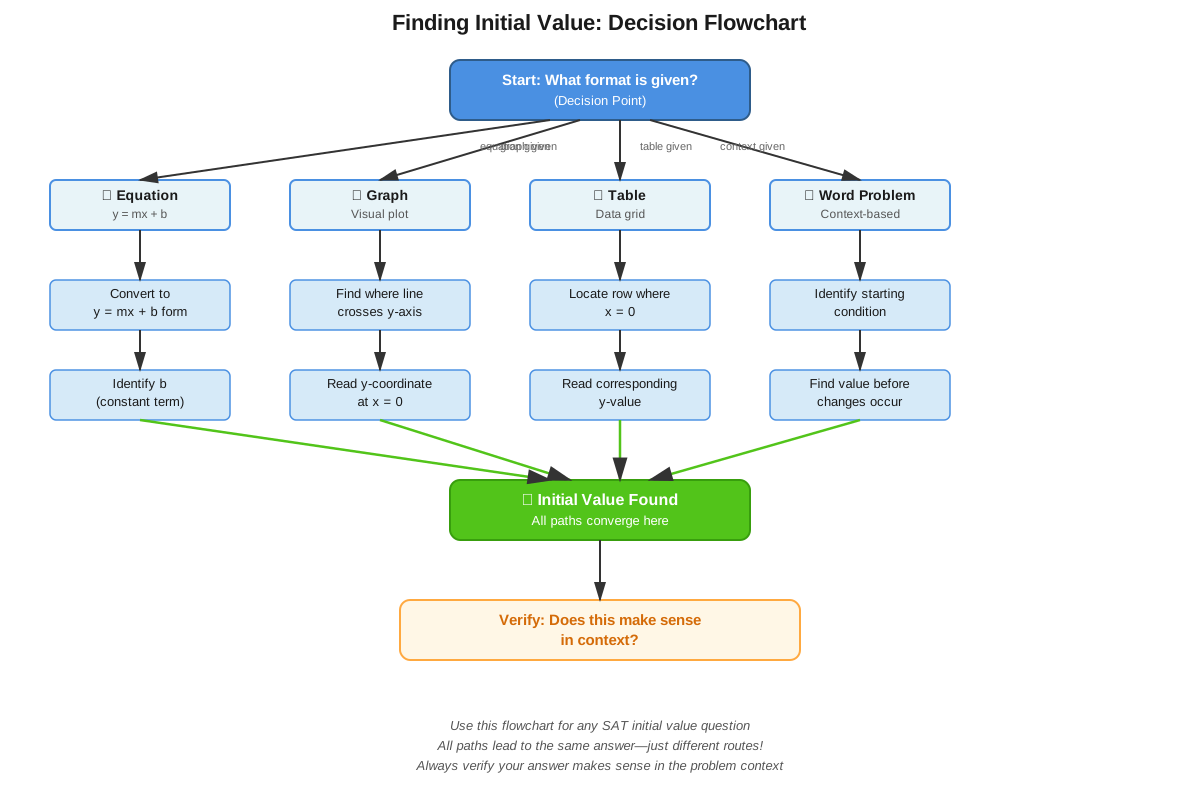
When approaching SAT questions involving initial value, follow this systematic process:
Step 1: Identify the question type. Determine whether you need to find the initial value, interpret its meaning, use it to write an equation, or compare initial values across models. This dictates your approach.
Step 2: Recognize the representation. Is the information given as an equation, graph, table, or word problem? Each requires a specific extraction method:
- Equations: Rearrange to slope-intercept form if necessary
- Graphs: Locate the y-intercept visually
- Tables: Find or calculate the y-value when x = 0
- Word problems: Identify the starting condition before changes occur
Step 3: Watch for trigger words and phrases:
- "Initially," "starting," "at the beginning," "originally" → direct indicators of initial value
- "Base fee," "fixed cost," "flat rate" → initial value in cost contexts
- "When x = 0," "y-intercept," "where the line crosses the y-axis" → mathematical descriptions
- "Before any," "at time zero" → temporal indicators
Step 4: Use process of elimination strategically:
- If a graph is provided, eliminate any answer choice that doesn't match the y-intercept
- If the context describes a starting amount, eliminate equations where b doesn't match
- For comparison questions, calculate initial values for all options and eliminate those that don't fit the criteria
Step 5: Verify in context. Always check whether your answer makes sense given the real-world situation. If you find an initial value of -50 for a population problem, reconsider your work—populations can't be negative.
Time-Saving Tip: On multiple-choice questions, if you can identify the initial value from context, check which answer choice has that value as the constant term. This often eliminates 2-3 options immediately without calculating slope.
Common SAT Traps to Avoid:
- Confusing the first value in a table with the initial value when x ≠ 0
- Selecting the slope instead of the y-intercept when asked for initial value
- Forgetting to account for units or context when interpreting initial value
- Misreading negative signs, especially in standard form equations
Time Allocation: Initial value questions typically require 45-90 seconds. If you're spending more than 2 minutes, you may be overcomplicating the problem. Look for a more direct path to the answer.
Memory Techniques
"B is for Beginning": In y = mx + b, remember that b represents the beginning value (initial value). The letter association helps recall which parameter is which.
"Zero Hero": The initial value is the hero that appears when x equals zero. This mnemonic reinforces that initial value = f(0).
"Y-intercept = Y when X is absent": The y-intercept (initial value) is the y-value when x is "absent" (equals zero). This helps students remember the geometric meaning.
Visual Anchor: Picture a rocket launch. The initial value is the launch pad height before the rocket moves. The slope is how fast it rises. This concrete image helps distinguish between initial value (starting position) and rate of change (speed of movement).
The "BINGO" Method for finding initial value from tables:
- Back up to zero (work backward if needed)
- Identify the pattern (find the rate of change)
- Number of steps (count how many intervals from your data point to x = 0)
- Go backward (subtract rate × steps from your known y-value)
- Obtain initial value (your answer)
Context Clue Acronym - "FIRST": When reading word problems, look for:
- Fixed costs or fees
- Initial amounts or conditions
- Reference point at time zero
- Starting values before changes
- Time zero situations
Summary
Initial value is the cornerstone concept for understanding linear functions on the SAT. It represents the y-coordinate where a line crosses the y-axis, occurring when the input variable equals zero. In the slope-intercept form y = mx + b, the initial value is the constant term b. This value indicates the starting condition in real-world contexts—the baseline measurement before any changes occur. Students must be fluent in identifying initial value from equations (by rearranging to slope-intercept form or substituting x = 0), from graphs (by locating the y-intercept), from tables (by finding or calculating the y-value when x = 0), and from word problems (by recognizing contextual clues about starting conditions). The SAT frequently tests this concept through multi-step problems requiring students to extract initial values, write equations, make predictions, and interpret results in context. Mastery requires understanding that initial value and slope are complementary parameters that together define a unique linear function, with initial value determining vertical position and slope determining direction and steepness.
Key Takeaways
- Initial value is the y-intercept: the y-coordinate where a line crosses the y-axis when x = 0
- In y = mx + b, the initial value is always b, regardless of whether b is positive, negative, or zero
- Context is crucial: initial value represents starting conditions, base fees, fixed costs, or baseline measurements before changes occur
- Multiple representations require different techniques: equations need algebraic manipulation, graphs need visual identification, tables need pattern recognition, and word problems need contextual interpretation
- Initial value and slope work together: changing initial value shifts a line vertically without affecting its steepness or direction
- SAT questions test application, not just identification: expect to write equations, make predictions, compare models, and interpret results using initial value
- Verification prevents errors: always check that your initial value makes sense in the context of the problem
Related Topics
Slope and Rate of Change: Understanding how the rate of change (m in y = mx + b) works together with initial value to create complete linear models. Mastering initial value makes learning about slope more intuitive since you'll understand one of the two essential parameters.
Systems of Linear Equations: Comparing initial values helps determine whether lines intersect, are parallel, or are identical. This topic builds directly on initial value concepts by analyzing multiple linear functions simultaneously.
Linear Inequalities: Initial value plays the same role in linear inequalities as in equations, but with added complexity of inequality symbols. Understanding initial value in equations provides the foundation for this extension.
Function Transformations: Vertical shifts of functions directly change the initial value while preserving the rate of change. This topic generalizes the concept of initial value to non-linear functions.
Exponential Functions: While exponential functions have different growth patterns, they also have initial values (the coefficient in y = a·bˣ). Understanding initial value in linear contexts prepares students for this parallel concept in exponential models.
Practice CTA
Now that you've mastered the concept of initial value, it's time to solidify your understanding through practice! Attempt the practice questions to test your ability to identify, interpret, and apply initial value in various SAT-style scenarios. Use the flashcards to reinforce key definitions and relationships. Remember, the SAT rewards not just knowledge but also speed and accuracy—practice helps you develop both. Each problem you solve strengthens your pattern recognition and builds the confidence you need to excel on test day. You've got this!
Sign up free to keep reading
Create a free AnvayaPrep account to finish this SAT guide on Initial value — plus flashcards and practice questions.