Overview
Interpreting intercepts is a foundational skill in the SAT math section that requires students to understand the real-world meaning of where a line crosses the x-axis and y-axis. On the SAT, this topic appears frequently in both multiple-choice and grid-in questions, often embedded within word problems that describe real-world scenarios such as business profits, distance-time relationships, or resource consumption. Rather than simply calculating intercept values, students must demonstrate their ability to explain what these intercepts represent in context—a skill that tests both mathematical understanding and reading comprehension.
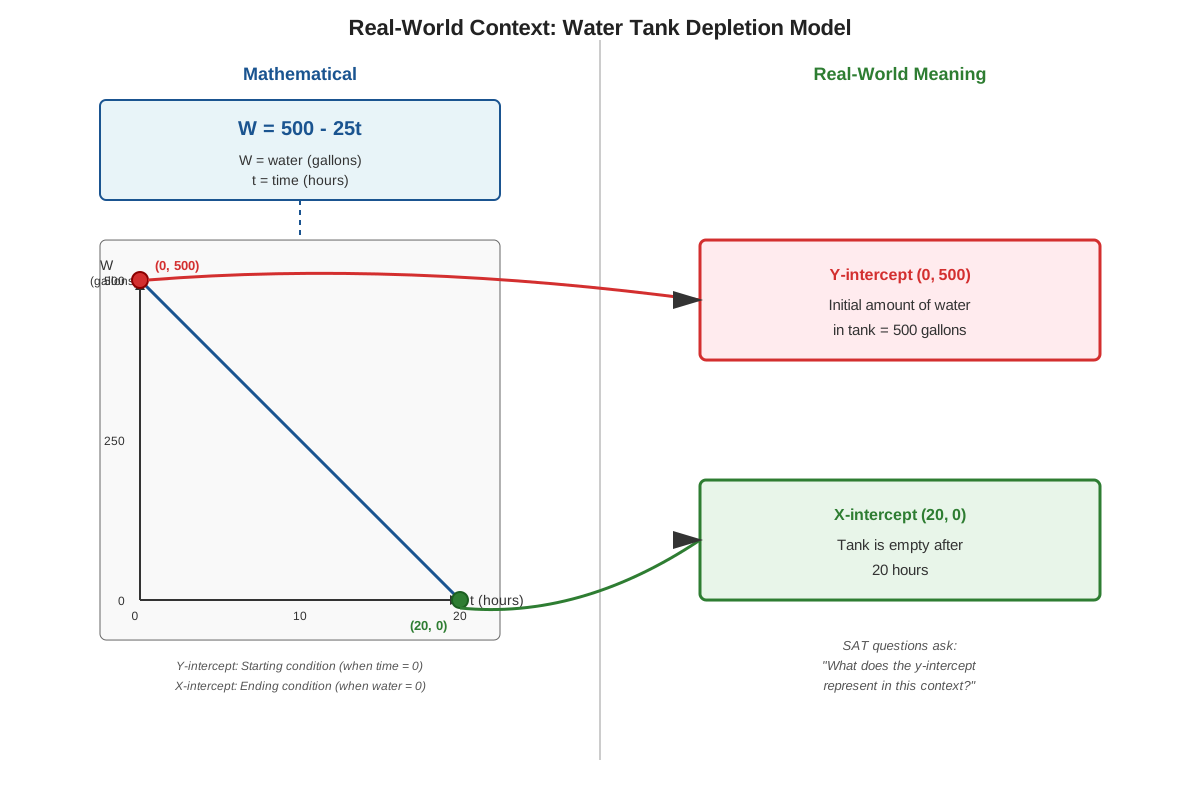
The SAT emphasizes sat interpreting intercepts as part of its broader focus on modeling real-world situations with linear functions. Questions typically present a scenario, provide a linear equation or graph, and ask students to identify what the x-intercept or y-intercept means in the given context. For example, if a linear equation models the amount of water remaining in a tank over time, the y-intercept represents the initial amount of water, while the x-intercept indicates when the tank becomes empty. This type of question assesses whether students can bridge abstract mathematical concepts with concrete, practical situations.
Understanding intercepts connects directly to other critical SAT topics including slope interpretation, linear modeling, systems of equations, and function notation. Mastery of intercept interpretation provides the foundation for analyzing more complex functions and serves as a gateway to understanding how mathematical models describe change over time. This topic appears in approximately 3-5 questions per SAT exam, making it a high-yield area that deserves focused attention during preparation.
Learning Objectives
- [ ] Identify key features of interpreting intercepts including x-intercepts and y-intercepts in equations and graphs
- [ ] Explain how interpreting intercepts appears on the SAT in word problems and contextual scenarios
- [ ] Apply interpreting intercepts to answer SAT-style questions involving real-world linear models
- [ ] Determine the practical meaning of intercepts within various contexts such as business, science, and everyday situations
- [ ] Distinguish between when to use x-intercepts versus y-intercepts to answer specific questions
- [ ] Convert between different representations (equations, graphs, tables) to identify and interpret intercepts
Prerequisites
- Basic linear equation forms: Understanding y = mx + b and Ax + By = C is essential because intercepts are found by manipulating these equations
- Coordinate plane fundamentals: Knowing how to plot points and read graphs enables visualization of where intercepts occur
- Solving simple equations: The ability to solve for variables when one variable equals zero is the mechanical skill needed to find intercepts
- Unit analysis: Understanding units of measurement helps interpret what intercept values represent in context
- Reading comprehension: Extracting relevant information from word problems is crucial since SAT intercept questions are typically embedded in scenarios
Why This Topic Matters
In real-world applications, intercepts provide critical information about starting conditions and endpoints. The y-intercept often represents an initial value—the starting balance in a bank account, the initial temperature of a cooling object, or the fixed cost before any production begins. The x-intercept typically indicates when something reaches zero—when a debt is paid off, when a resource is depleted, or when a moving object reaches its destination. These interpretations appear in business planning, scientific research, engineering design, and everyday financial decisions.
On the SAT, interpreting intercepts appears in approximately 8-12% of all math questions, making it one of the most frequently tested linear function concepts. Questions typically appear in the Heart of Algebra domain and are distributed across both calculator and no-calculator sections. The College Board specifically designs these questions to test conceptual understanding rather than mere calculation, which means students cannot rely solely on computational skills—they must truly understand what the numbers mean.
Common SAT question formats include: providing a linear equation that models a scenario and asking what the y-intercept represents; showing a graph and asking students to interpret the x-intercept; presenting a word problem and asking which equation correctly models the situation based on intercept values; or giving a table of values and requiring students to identify what happens when one variable equals zero. These questions often combine multiple skills, requiring students to read carefully, identify relevant information, set up equations correctly, and translate mathematical results back into contextual language.
Core Concepts
Understanding the Y-Intercept
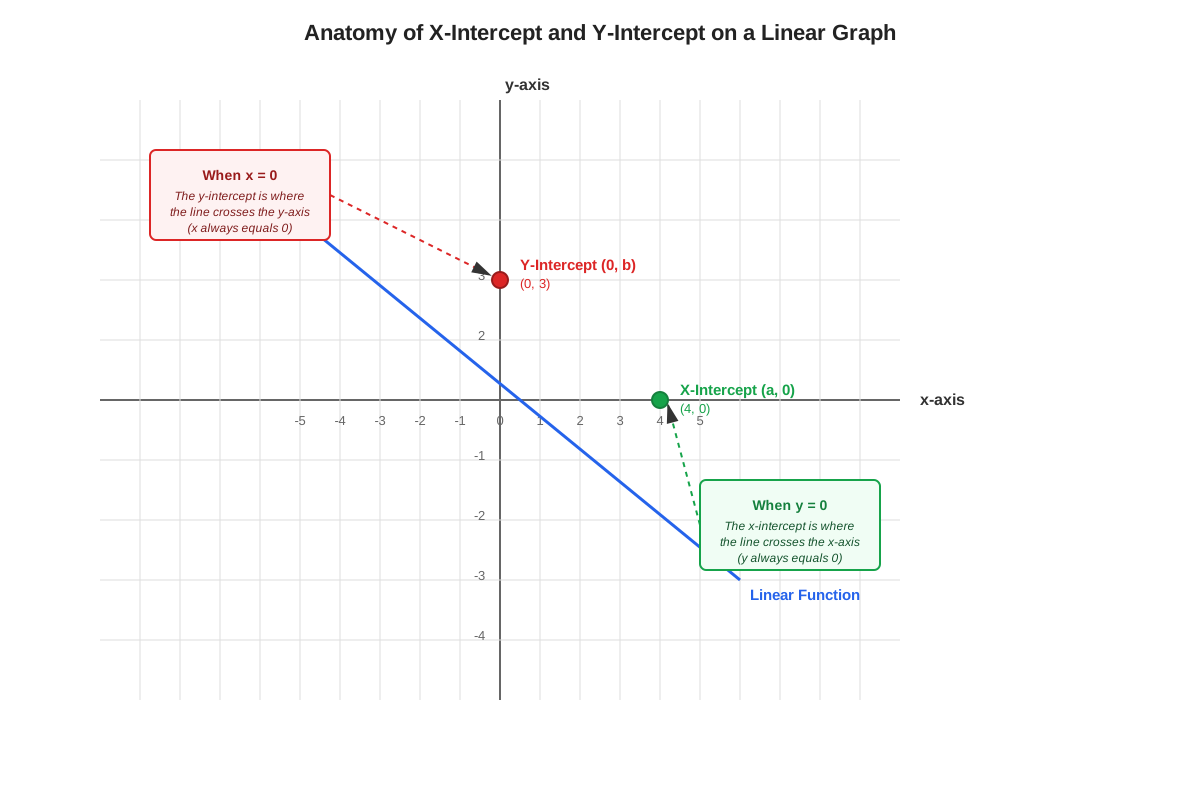
The y-intercept is the point where a line crosses the y-axis, which occurs when x = 0. In the slope-intercept form y = mx + b, the y-intercept is simply the constant term b. Graphically, this is the point (0, b) on the coordinate plane. The y-intercept represents the initial value or starting condition in most real-world scenarios.
To find the y-intercept from any linear equation, substitute x = 0 and solve for y. For example, in the equation 3x + 2y = 12, setting x = 0 gives 2y = 12, so y = 6. The y-intercept is (0, 6). In context, if this equation represented the relationship between hours worked (x) and total earnings in dollars (y), the y-intercept of 6 would mean the person started with $6 before working any hours—perhaps a signing bonus or initial payment.
Understanding the X-Intercept
The x-intercept is the point where a line crosses the x-axis, which occurs when y = 0. This point has coordinates (a, 0) where a is the x-intercept value. The x-intercept often represents when something reaches zero, ends, or breaks even in contextual problems.
To find the x-intercept from any linear equation, substitute y = 0 and solve for x. Using the same equation 3x + 2y = 12, setting y = 0 gives 3x = 12, so x = 4. The x-intercept is (4, 0). If this equation modeled the same earnings scenario where y represents total money and x represents hours worked, an x-intercept would not make practical sense in this context (since you cannot have negative money from working), illustrating that not all intercepts have meaningful real-world interpretations in every scenario.
Contextual Interpretation Framework
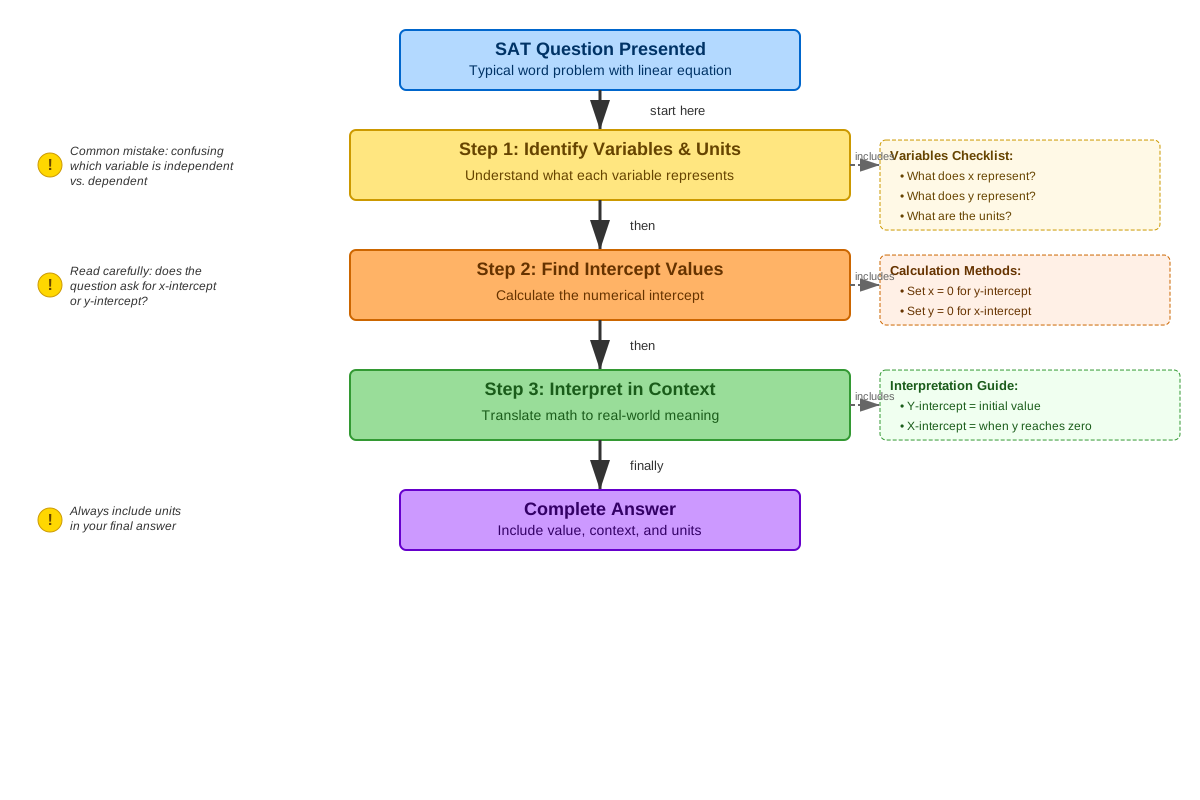
When interpreting intercepts on the SAT, follow this systematic approach:
- Identify the variables: Determine what x and y represent, including their units
- Locate the intercept value: Find the numerical value of the intercept from the equation, graph, or table
- Apply the zero condition: Remember that at the y-intercept, x = 0, and at the x-intercept, y = 0
- Translate to context: Express what it means for that variable to equal zero in the given scenario
- Check reasonableness: Verify that your interpretation makes logical sense within the problem constraints
Common Contextual Scenarios
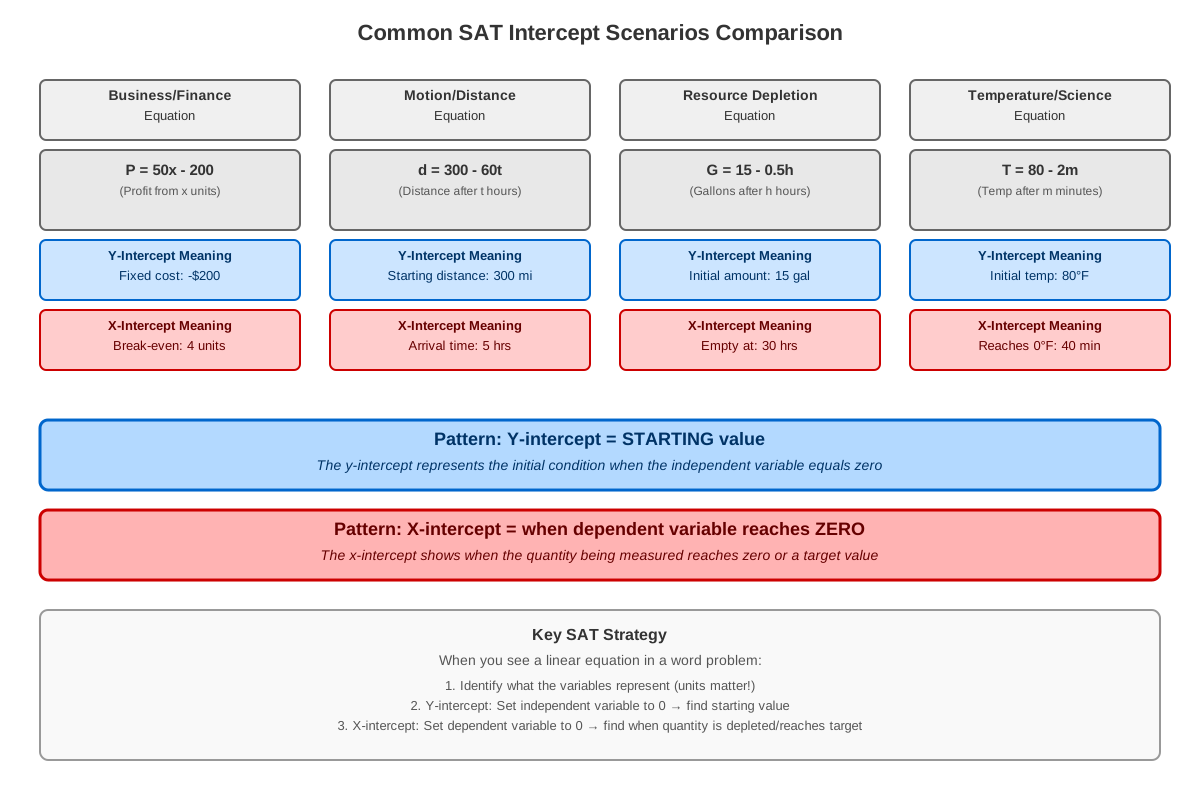
Different types of SAT problems feature intercepts with characteristic interpretations:
| Scenario Type | Y-Intercept Meaning | X-Intercept Meaning |
|---|---|---|
| Cost/Revenue | Fixed cost or initial fee | Break-even point (when profit = 0) |
| Distance/Time | Starting position or initial distance | Time when object reaches destination |
| Resource Depletion | Initial amount of resource | Time when resource is completely used |
| Temperature Change | Initial temperature | Time when temperature reaches zero (or target) |
| Account Balance | Starting balance | Time when account reaches zero balance |
| Population Growth | Initial population | Time when population reaches zero (extinction) |
Reading Intercepts from Graphs
When a graph is provided, intercepts can be read directly without calculation. The y-intercept is where the line crosses the vertical axis, and the x-intercept is where it crosses the horizontal axis. However, SAT questions rarely ask students to simply identify these points—instead, they require interpretation of what these crossing points mean.
Pay careful attention to axis labels and scales. If the y-axis represents "Gallons of Water" and the x-axis represents "Minutes," a y-intercept of 50 means 50 gallons at 0 minutes (initial amount), while an x-intercept of 25 means 0 gallons at 25 minutes (tank empty after 25 minutes).
Negative Intercepts and Domain Restrictions
Not all intercepts have practical meaning in real-world contexts. A negative x-intercept might indicate when something would have started in the past, while a negative y-intercept could represent a deficit or debt. The SAT sometimes includes answer choices that describe mathematically correct but contextually impossible interpretations to test whether students understand domain restrictions.
For example, if a linear model describes the height of a plant over time, a negative x-intercept would suggest when the plant had zero height in the past (before measurement began), which might or might not be meaningful depending on the problem. Students must evaluate whether intercepts fall within the reasonable domain of the problem.
Concept Relationships
The interpretation of intercepts builds directly upon understanding linear equations and their graphical representations. The relationship flows as follows: Linear equation forms → enables identification of → Intercept values → which require → Contextual interpretation → leading to → Real-world problem solving.
Within this topic, the y-intercept and x-intercept are complementary concepts that together provide a complete picture of a linear relationship. The y-intercept describes the starting state (when the independent variable is zero), while the x-intercept describes the ending state (when the dependent variable reaches zero). Understanding both allows students to describe the full trajectory of a linear model.
Interpreting intercepts connects to slope interpretation because together they provide the complete story of a linear function: the y-intercept tells where you start, the slope tells how fast you're changing, and the x-intercept tells when you reach zero. This trio of concepts forms the foundation for all linear modeling on the SAT.
The skill also connects forward to systems of equations, where intercepts can represent solutions, and to quadratic functions, where x-intercepts become roots or zeros. Mastering linear intercept interpretation prepares students for these more advanced topics by establishing the fundamental principle that mathematical features have contextual meanings.
Quick check — test yourself on Interpreting intercepts so far.
Try Flashcards →High-Yield Facts
- ⭐ The y-intercept occurs when x = 0 and represents the initial value or starting condition in most contexts
- ⭐ The x-intercept occurs when y = 0 and typically represents when something ends, reaches zero, or breaks even
- ⭐ In the equation y = mx + b, the value b is always the y-intercept
- ⭐ To find the y-intercept from any equation, substitute x = 0 and solve for y
- ⭐ To find the x-intercept from any equation, substitute y = 0 and solve for x
- The y-intercept has coordinates (0, b) while the x-intercept has coordinates (a, 0)
- Not all intercepts have meaningful real-world interpretations—check if values make sense in context
- SAT questions focus on interpretation, not just calculation of intercept values
- Intercepts can be negative, which often represents deficits, debts, or past time points
- When reading graphs, always check axis labels and scales before interpreting intercepts
- In cost models, the y-intercept typically represents fixed costs or initial fees
- In distance-time models, the x-intercept often represents when an object reaches its destination
- The units of the intercept match the units of the corresponding axis variable
- Some linear models have domain restrictions that exclude one or both intercepts from practical meaning
Common Misconceptions
Misconception: The y-intercept is always positive and represents something good or beneficial.
Correction: The y-intercept can be negative, representing a deficit, debt, or below-zero starting point. For example, if y represents profit and the y-intercept is -500, this means the business starts with a $500 loss (perhaps from startup costs).
Misconception: Every linear equation must have both intercepts that make sense in the real-world context.
Correction: Many real-world scenarios have domain or range restrictions that make one or both intercepts meaningless. For instance, if x represents time and must be positive, a negative x-intercept has no practical interpretation even though it exists mathematically.
Misconception: The x-intercept and y-intercept are interchangeable concepts.
Correction: These intercepts have fundamentally different meanings. The y-intercept describes the initial state (when the independent variable is zero), while the x-intercept describes when the dependent variable reaches zero—these are distinct moments in the scenario.
Misconception: Finding the intercept value is the same as interpreting it.
Correction: The SAT specifically tests interpretation, not just calculation. Finding that the y-intercept is 50 is only the first step; students must explain what "50" means in the context of the problem, including appropriate units and contextual language.
Misconception: In the equation Ax + By = C, the constant C is always the y-intercept.
Correction: The constant C is not directly the y-intercept unless B = 1. To find the y-intercept from standard form, you must set x = 0 and solve for y, giving y = C/B.
Misconception: If a graph doesn't show an intercept on the visible portion, the line doesn't have one.
Correction: All non-horizontal and non-vertical lines have both intercepts; they may simply fall outside the displayed window of the graph. Students should use the equation to calculate intercepts even when they're not visible.
Worked Examples
Example 1: Water Tank Depletion
Problem: A water tank initially contains 300 gallons of water. Water drains from the tank at a constant rate. The equation G = 300 - 15t models the number of gallons G remaining in the tank after t minutes. What does the t-intercept represent in this context?
Solution:
Step 1: Identify the variables and their meanings.
- G represents gallons of water remaining (dependent variable)
- t represents time in minutes (independent variable)
Step 2: Understand what the t-intercept means mathematically.
- The t-intercept occurs when G = 0 (when gallons remaining equals zero)
Step 3: Find the t-intercept value.
- Set G = 0: 0 = 300 - 15t
- Solve for t: 15t = 300
- t = 20
Step 4: Interpret in context.
- When t = 20, G = 0, meaning after 20 minutes, there are 0 gallons remaining in the tank
- The t-intercept represents the time when the tank is completely empty
Answer: The t-intercept of 20 represents that the water tank will be completely drained after 20 minutes.
Connection to Learning Objectives: This example demonstrates how to identify the x-intercept (here called t-intercept) from an equation and interpret its meaning in a real-world depletion scenario, directly addressing the application objective.
Example 2: Business Profit Model
Problem: A small business's monthly profit P (in dollars) is modeled by the equation P = 45n - 2700, where n is the number of units sold. What does the P-intercept represent, and what does the n-intercept represent?
Solution:
Finding and interpreting the P-intercept (y-intercept):
Step 1: The P-intercept occurs when n = 0.
- Substitute n = 0: P = 45(0) - 2700
- P = -2700
Step 2: Interpret the meaning.
- When n = 0 (no units sold), P = -2700 (profit is -$2700)
- A negative profit means a loss
- The P-intercept represents that the business loses $2700 per month when no units are sold (these are fixed costs like rent, utilities, and salaries)
Finding and interpreting the n-intercept (x-intercept):
Step 1: The n-intercept occurs when P = 0.
- Substitute P = 0: 0 = 45n - 2700
- 45n = 2700
- n = 60
Step 2: Interpret the meaning.
- When n = 60 (60 units sold), P = 0 (profit is $0)
- This is the break-even point where revenue equals costs
- The n-intercept represents that the business must sell 60 units to break even (neither profit nor loss)
Answer: The P-intercept of -2700 represents the monthly fixed costs of $2700 (loss when no units are sold). The n-intercept of 60 represents the break-even point where the business must sell 60 units to cover all costs.
Connection to Learning Objectives: This example shows how both intercepts provide complementary information about a business model, demonstrating the ability to distinguish between when to use each intercept and how to interpret negative values in context.
Exam Strategy
When approaching SAT questions on interpreting intercepts, begin by carefully reading the problem to identify what each variable represents, including units. Underline or circle the variable definitions, as mixing up which variable is which is a common source of errors. The SAT deliberately writes questions where the independent and dependent variables might not be in their typical positions.
Trigger words and phrases that signal intercept interpretation questions include: "initial value," "starting amount," "when does [something] reach zero," "break-even point," "at the beginning," "when time equals zero," "when [variable] is zero," and "what does the [y/x]-intercept represent." When you see these phrases, immediately identify which intercept is relevant and set up the appropriate equation with one variable equal to zero.
For process of elimination, use these strategies:
- Eliminate answer choices that confuse x and y variables or their meanings
- Eliminate interpretations that include the wrong units (if the y-axis is in dollars, the y-intercept cannot be in hours)
- Eliminate answers that describe the slope rather than an intercept
- Eliminate contextually impossible interpretations (like negative time in scenarios where time must be positive)
- Eliminate answers that state the numerical value without interpretation or that interpret the wrong intercept
Time allocation: Intercept interpretation questions typically require 45-90 seconds. Spend the first 20-30 seconds carefully reading and identifying variables, 15-30 seconds finding the intercept value if needed, and 15-30 seconds matching your interpretation to the answer choices. Do not rush the reading phase—most errors come from misunderstanding the context, not from calculation mistakes.
If a question provides a graph, use it to estimate intercept values before looking at answer choices. This helps you eliminate obviously wrong answers quickly. If the question provides an equation, decide whether you need to calculate the intercept value or if you can interpret directly from the equation form (in y = mx + b, you can immediately identify the y-intercept as b without calculation).
Memory Techniques
Y-intercept mnemonic: "Y starts with a Yell" → The y-intercept is where you start (initial value). When x = 0, you're at the beginning of the x-axis, so the y-intercept represents the starting condition.
X-intercept mnemonic: "X marks the spot where it stops" → The x-intercept is where y reaches zero, meaning something ends or stops.
Visualization strategy: Picture a graph in your mind with a downward-sloping line. The y-intercept is where the line starts on the left side (high up on the y-axis), and as you follow the line to the right, it eventually hits the x-axis and stops—that's the x-intercept. This visual reinforces that y-intercepts are starting points and x-intercepts are ending points.
Zero substitution acronym: ZERO helps remember the process:
- Zero out one variable
- Equate the equation
- Rearrange to solve
- Obtain the intercept value
Context categories: Remember DIRT for common y-intercept meanings:
- Debt or deficit (negative starting values)
- Initial amount or inventory
- Reserve or resource at start
- Total at time zero
Summary
Interpreting intercepts is a critical SAT math skill that requires students to understand both the mathematical definition and contextual meaning of where lines cross the axes. The y-intercept, occurring when x = 0, typically represents initial values, starting conditions, or fixed costs in real-world scenarios. The x-intercept, occurring when y = 0, usually indicates when something reaches zero, ends, or breaks even. Success on SAT questions requires more than calculating these values—students must translate mathematical results into contextual language that accurately describes what the intercept means in the given situation. The key to mastery is practicing the systematic approach of identifying variables, finding intercept values, applying the zero condition, and translating results back to context while checking for reasonableness. Understanding that not all intercepts have meaningful real-world interpretations and recognizing domain restrictions separates strong students from those who merely memorize procedures. This topic connects fundamentally to linear modeling, slope interpretation, and systems of equations, making it essential foundational knowledge for SAT success.
Key Takeaways
- The y-intercept (when x = 0) represents the initial value or starting condition in most contexts
- The x-intercept (when y = 0) represents when something reaches zero, ends, or breaks even
- SAT questions test interpretation of intercepts, not just calculation of their values
- Always identify what each variable represents, including units, before interpreting intercepts
- Not all intercepts have meaningful real-world interpretations—check contextual reasonableness
- To find y-intercept: substitute x = 0; to find x-intercept: substitute y = 0
- Intercepts can be negative, representing deficits, debts, or past time points that may or may not be contextually meaningful
Related Topics
Slope Interpretation: Understanding what the rate of change means in context complements intercept interpretation, as together they provide a complete description of linear relationships. Mastering intercepts prepares students to analyze how quickly values change.
Linear Modeling: Creating equations from word problems requires understanding what intercepts should represent, making intercept interpretation essential for building accurate models from contextual information.
Systems of Linear Equations: The solution to a system can be interpreted as an intercept point where two lines cross, extending the concept of intercepts beyond just axis crossings.
Domain and Range: Understanding which x and y values are meaningful in context directly relates to determining whether intercepts have practical interpretations, building on the reasonableness checking developed in this topic.
Function Notation: Interpreting f(0) and solving f(x) = 0 are alternative ways of expressing y-intercepts and x-intercepts, connecting this topic to broader function concepts tested on the SAT.
Practice CTA
Now that you understand the core concepts of interpreting intercepts, it's time to solidify your mastery through practice. Attempt the practice questions to apply these strategies to SAT-style problems, and use the flashcards to reinforce the key definitions and interpretation frameworks. Remember, the SAT rewards not just knowing how to find intercepts, but truly understanding what they mean—and that understanding comes through deliberate practice. Each problem you work through builds the pattern recognition and contextual thinking skills that will help you confidently tackle any intercept question on test day. You've got this!
Sign up free to keep reading
Create a free AnvayaPrep account to finish this SAT guide on Interpreting intercepts — plus flashcards and practice questions.