Overview
Linear function word problems represent one of the most frequently tested concepts on the SAT math section, appearing in approximately 15-20% of all algebra questions. These problems require students to translate real-world scenarios into mathematical equations of the form y = mx + b, where m represents the rate of change and b represents the initial value or y-intercept. Unlike straightforward algebraic manipulation questions, SAT linear function word problems demand that students interpret contextual information, identify relevant variables, construct appropriate equations, and apply mathematical reasoning to solve practical situations.
Mastery of linear function word problems is essential for SAT success because these questions assess multiple competencies simultaneously: reading comprehension, algebraic reasoning, and problem-solving skills. The College Board designs these questions to evaluate whether students can apply mathematical concepts beyond rote memorization, making them high-value discriminators between average and exceptional scores. Students who excel at these problems demonstrate the analytical thinking skills that colleges value most.
Linear function word problems serve as a foundational bridge connecting basic algebra to more advanced mathematical concepts tested on the SAT. They integrate seamlessly with systems of equations, data interpretation, and function analysis questions. Understanding how to model real-world situations with linear functions prepares students for questions involving exponential growth, quadratic relationships, and statistical analysis—all of which build upon the same fundamental skill of translating contextual information into mathematical representations.
Learning Objectives
- [ ] Identify key features of linear function word problems, including rate of change, initial value, and dependent/independent variables
- [ ] Explain how linear function word problems appears on the SAT, including common contexts and question formats
- [ ] Apply linear function word problems to answer SAT-style questions with accuracy and efficiency
- [ ] Construct linear equations from verbal descriptions and data tables
- [ ] Interpret the meaning of slope and y-intercept within specific real-world contexts
- [ ] Determine which variable should be independent and which should be dependent based on problem context
- [ ] Evaluate and compare multiple linear models to select the most appropriate representation
Prerequisites
- Basic algebraic manipulation: Students must solve for variables and rearrange equations, as linear word problems require isolating specific quantities
- Understanding of slope and y-intercept: The concepts of rate of change (m) and initial value (b) form the foundation of all linear function interpretations
- Coordinate plane familiarity: Visualizing linear relationships graphically helps students verify their algebraic work and understand function behavior
- Unit conversion skills: Many word problems involve different units of measurement that must be reconciled within equations
- Ratio and proportion reasoning: Linear relationships fundamentally represent proportional change, requiring comfort with multiplicative thinking
Why This Topic Matters
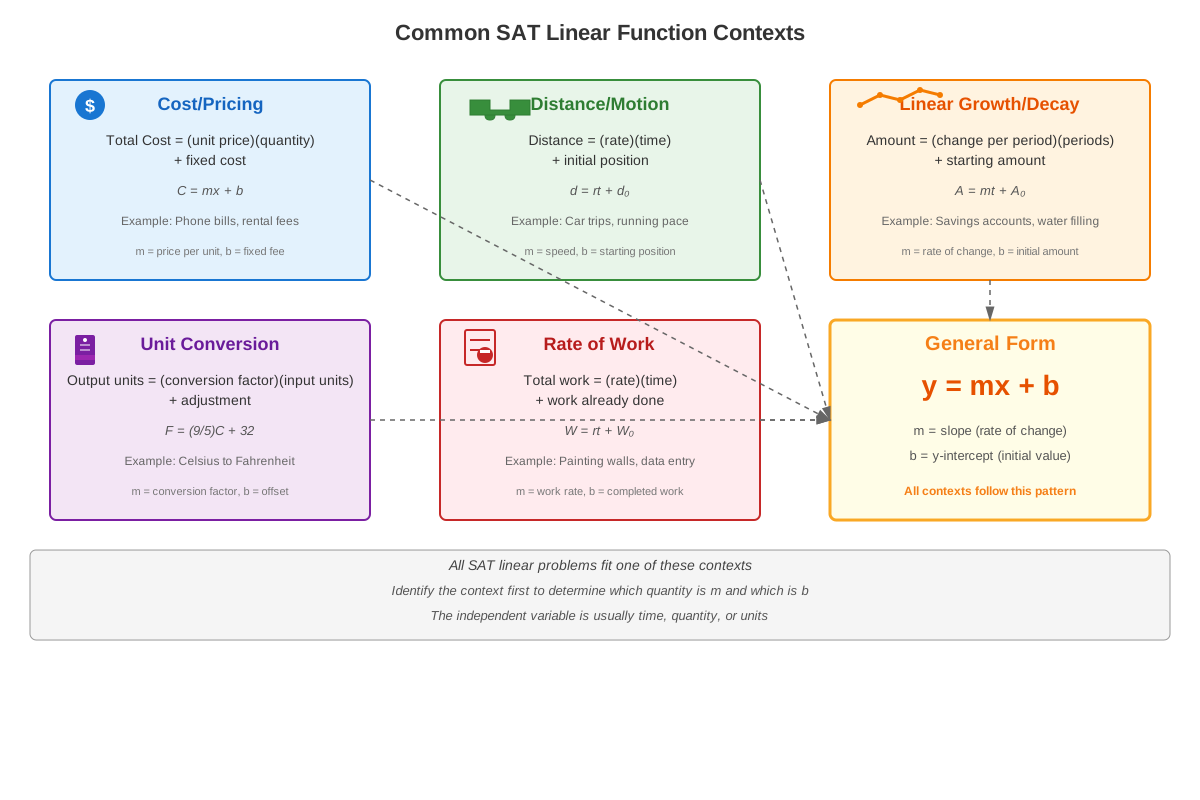
Linear function word problems appear in everyday life more frequently than almost any other mathematical concept. From calculating phone plan costs (fixed monthly fee plus per-minute charges) to determining travel times (distance equals rate times time), linear relationships model countless practical situations. Professionals in business, science, engineering, and economics use linear models daily to make predictions, analyze trends, and optimize decisions. Understanding these relationships empowers students to make informed financial choices, interpret data critically, and solve real-world problems systematically.
On the SAT, linear function word problems appear in approximately 4-6 questions per test, making them one of the highest-yield topics for focused study. These questions typically appear in both the calculator and no-calculator sections, with difficulty ranging from medium to hard. The College Board frequently embeds these problems within multi-step questions worth 2-3 minutes each, making efficiency crucial. Students who master this topic can expect to gain 40-60 points on their overall SAT math score.
Common SAT contexts for linear function word problems include: subscription services with monthly fees, distance-rate-time scenarios, cost analysis with fixed and variable components, population growth at constant rates, temperature conversion, salary structures with base pay plus commission, and resource consumption over time. The test writers deliberately choose realistic scenarios that require careful reading and variable identification, rewarding students who can systematically extract mathematical relationships from verbal descriptions.
Core Concepts
Structure of Linear Functions
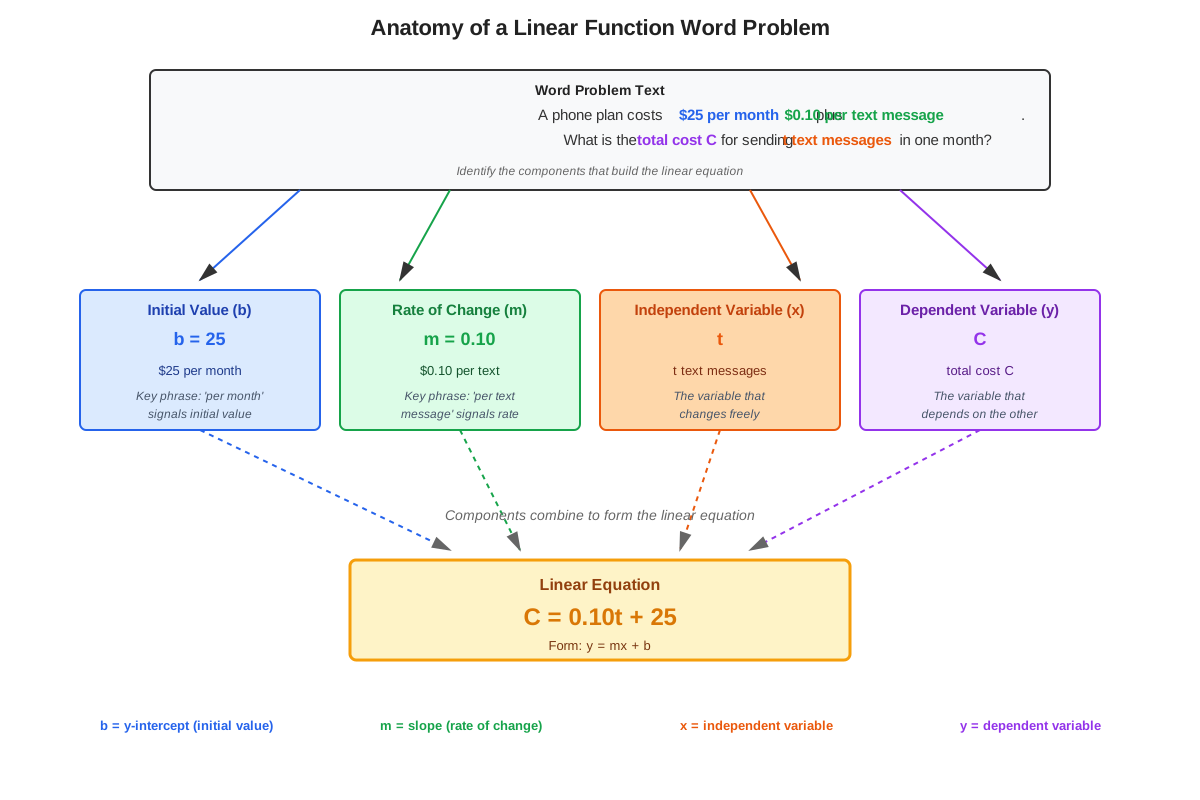
A linear function takes the form y = mx + b, where each component carries specific meaning. The variable y represents the dependent variable—the quantity that changes in response to another factor. The variable x represents the independent variable—the quantity that can be freely chosen or controlled. The coefficient m represents the slope or rate of change, indicating how much y increases (or decreases if negative) for each one-unit increase in x. The constant b represents the y-intercept or initial value, showing the value of y when x equals zero.
In word problems, identifying these components requires careful analysis of the problem context. The independent variable typically represents time, quantity produced, distance traveled, or another controllable input. The dependent variable represents cost, total distance, population, temperature, or another resulting output. The rate of change appears in phrases like "per hour," "each month," "for every," or "at a rate of." The initial value appears in phrases like "starting with," "initial fee," "base cost," or "when x = 0."
Translating Words to Equations
The translation process follows a systematic approach:
- Identify what changes: Determine which quantities vary in the problem
- Establish the independent variable: Choose which quantity to represent with x (usually time or quantity)
- Establish the dependent variable: Determine what y represents (usually cost, distance, or total)
- Find the rate of change: Look for "per," "each," "every," or similar language indicating the slope
- Find the initial value: Identify any starting amount, fixed fee, or value when the independent variable equals zero
- Construct the equation: Combine components into y = mx + b form
Consider this example: "A taxi charges a $3 base fare plus $0.50 per mile." Here, the independent variable x represents miles traveled, the dependent variable y represents total cost, the rate of change m = 0.50 (dollars per mile), and the initial value b = 3 (base fare). The equation becomes: y = 0.50x + 3.
Interpreting Slope in Context
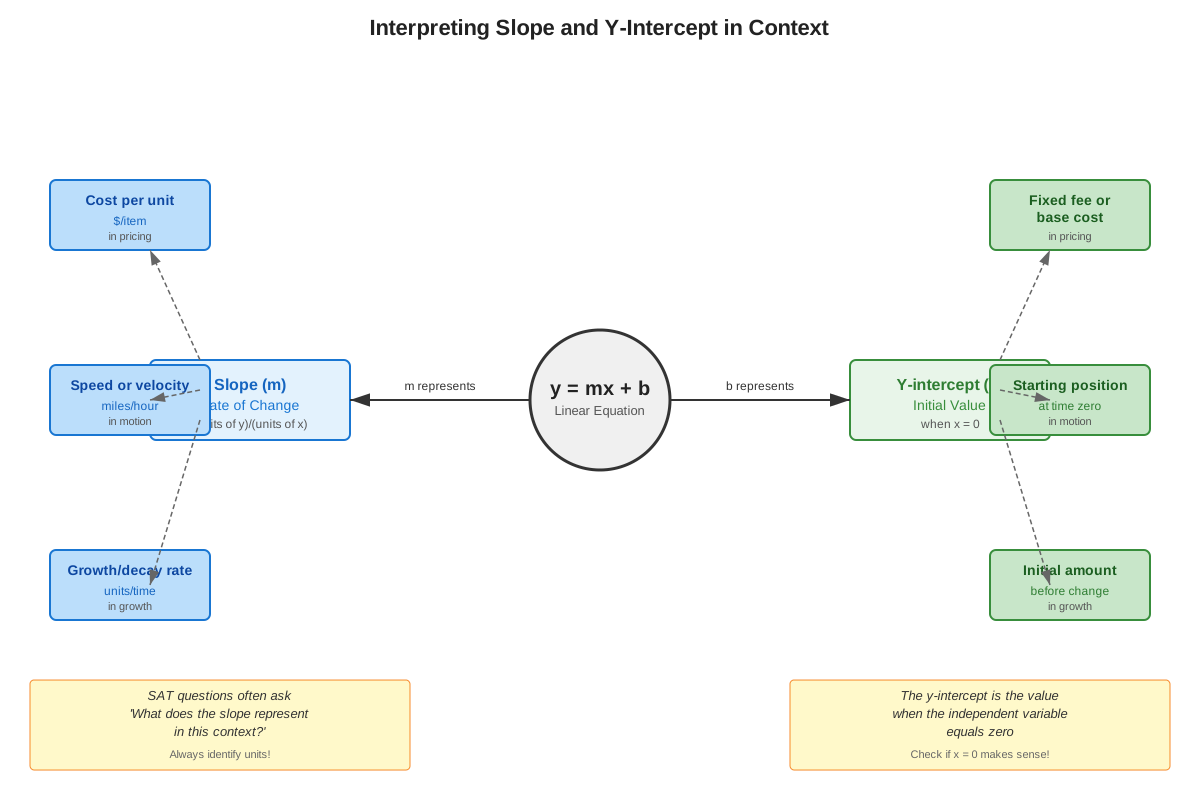
The slope represents the rate at which the dependent variable changes relative to the independent variable. In SAT problems, students must interpret slope within the specific context rather than simply calculating a numerical value. For instance, a slope of 25 in a problem about filling a swimming pool means the water level increases by 25 gallons per minute, not just "the slope is 25."
Positive slopes indicate direct relationships where both variables increase together (more hours worked means more money earned). Negative slopes indicate inverse relationships where one variable increases as the other decreases (more discounts applied means lower total cost). Zero slopes indicate no change in the dependent variable regardless of the independent variable (a flat monthly subscription fee regardless of usage). The magnitude of the slope indicates the strength of the relationship—larger absolute values mean steeper changes.
Interpreting Y-Intercept in Context
The y-intercept represents the value of the dependent variable when the independent variable equals zero. In practical terms, this often represents initial conditions, starting values, or fixed costs. SAT questions frequently ask students to interpret what the y-intercept means within a specific scenario, testing whether students understand the conceptual significance rather than just the mathematical definition.
For example, in an equation modeling the height of a plant over time (h = 2t + 5, where h is height in inches and t is time in weeks), the y-intercept of 5 means the plant was already 5 inches tall when measurements began (at t = 0). In a cost equation (C = 15n + 50, where C is total cost and n is number of items), the y-intercept of 50 represents a fixed cost that applies regardless of how many items are purchased—perhaps a shipping fee or membership charge.
Solving Linear Word Problems
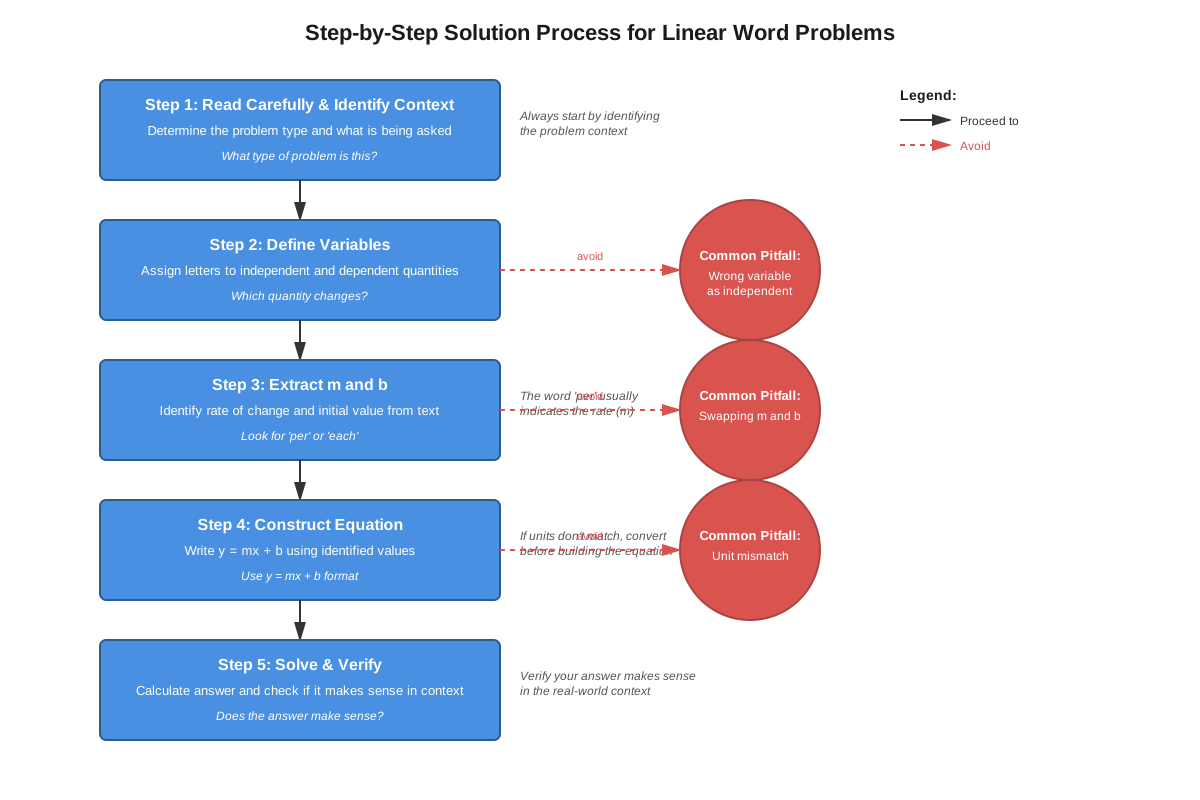
The solution process involves multiple steps:
- Read carefully: Identify all given information and what the question asks
- Define variables: Explicitly state what x and y represent with units
- Extract numerical information: Find the rate of change and initial value
- Write the equation: Construct y = mx + b using the identified components
- Solve or evaluate: Substitute known values and solve for the unknown
- Check reasonableness: Verify the answer makes sense in context
Working with Data Tables
SAT linear function word problems often present information in table format rather than verbal descriptions. To construct a linear equation from a table:
| Time (hours) | Distance (miles) |
|---|---|
| 0 | 50 |
| 1 | 90 |
| 2 | 130 |
| 3 | 170 |
Calculate the slope by finding the change in the dependent variable divided by the change in the independent variable: m = (90 - 50)/(1 - 0) = 40 miles per hour. Identify the y-intercept as the dependent variable value when the independent variable equals zero: b = 50 miles. The equation becomes: d = 40t + 50, representing a vehicle that started 50 miles from the origin and travels at 40 mph.
Comparing Linear Models
Some SAT questions require comparing two different linear functions to determine which is more cost-effective, faster, or otherwise superior under specific conditions. This involves:
- Setting up separate equations for each scenario
- Finding the point of intersection (where they're equal) by setting the equations equal to each other
- Determining which function yields better results for values above or below the intersection point
- Interpreting the comparison in context
For example, comparing Phone Plan A (y = 30 + 0.10x) with Phone Plan B (y = 50 + 0.05x), where x represents minutes used, requires finding when 30 + 0.10x = 50 + 0.05x, which solves to x = 400 minutes. Plan A is cheaper for usage below 400 minutes; Plan B is cheaper above 400 minutes.
Concept Relationships
Linear function word problems integrate multiple mathematical concepts into a cohesive problem-solving framework. The foundation begins with basic algebraic manipulation → which enables → equation construction from verbal descriptions → which leads to → interpretation of mathematical models in context → which supports → making predictions and comparisons.
The relationship between slope and y-intercept forms the core structure: identifying the rate of change (slope) + identifying the initial value (y-intercept) → combine to create → complete linear model → which enables → solving for unknown values and making predictions.
These concepts connect to prerequisite knowledge through several pathways: coordinate plane understanding → supports → visualizing linear relationships graphically → which reinforces → algebraic interpretations. Similarly, ratio and proportion reasoning → underlies → understanding constant rates of change → which is fundamental to → recognizing linear relationships.
Linear function word problems also connect forward to more advanced SAT topics: mastery here → enables → systems of linear equations (comparing two linear models), data interpretation (analyzing trends in scatterplots), and function notation (evaluating f(x) for specific inputs). The skill of translating contextual information into mathematical representations extends beyond linear functions to exponential growth, quadratic models, and statistical analysis.
Quick check — test yourself on Linear function word problems so far.
Try Flashcards →High-Yield Facts
⭐ Linear functions have the form y = mx + b, where m is the slope (rate of change) and b is the y-intercept (initial value)
⭐ The slope represents how much the dependent variable changes for each one-unit increase in the independent variable
⭐ The y-intercept represents the value of the dependent variable when the independent variable equals zero
⭐ Words like "per," "each," "every," and "for each" signal the rate of change (slope) in word problems
⭐ Words like "initial," "starting," "base fee," and "fixed cost" signal the y-intercept in word problems
- The independent variable (x) typically represents time, quantity, or distance—something controllable or chosen
- The dependent variable (y) typically represents cost, total amount, or distance—something that results from the independent variable
- To find slope from a table, calculate (change in y)/(change in x) between any two points
- When comparing two linear models, they are equal at their point of intersection
- A positive slope indicates both variables increase together; a negative slope indicates one increases as the other decreases
- Linear functions have constant rates of change—the slope never varies
- The units of slope are always (units of dependent variable) per (units of independent variable)
Common Misconceptions
Misconception: The y-intercept always represents time zero or the starting point of the scenario.
Correction: The y-intercept represents the value of y when x = 0, which may not always be the "beginning" of the real-world situation. For example, in a temperature conversion formula, the y-intercept doesn't represent "starting temperature" but rather the temperature in one scale when the other scale reads zero.
Misconception: The larger number in a word problem is always the slope.
Correction: The slope is specifically the rate of change—the amount per unit. A problem might state "a $500 initial fee plus $25 per month," where 500 is the y-intercept (larger) and 25 is the slope (smaller). Context determines which number represents which component.
Misconception: The independent variable must always be time.
Correction: While time is common, the independent variable can be any quantity that varies freely—number of items purchased, distance traveled, temperature in one scale, or quantity produced. The key is identifying which variable is controlled or chosen first.
Misconception: All linear word problems require solving for y.
Correction: SAT questions may ask for the value of x (given y), the slope, the y-intercept, or the meaning of these components. Students must read carefully to determine what the question actually requests.
Misconception: If a problem mentions two quantities, one must be x and the other must be y.
Correction: Some problems involve more than two quantities, requiring students to determine which relationship to model. Other problems might give both x and y values and ask for the slope or equation. Careful reading determines which quantities to use and how.
Misconception: The equation y = mx + b is the only form of a linear equation.
Correction: Linear equations can appear in multiple forms: slope-intercept (y = mx + b), point-slope (y - y₁ = m(x - x₁)), standard form (Ax + By = C), or verbal descriptions. SAT problems may require converting between forms or working directly with alternative representations.
Worked Examples
Example 1: Subscription Service Cost
Problem: A streaming service charges a monthly subscription fee of $12.99 plus $3.99 for each premium movie rented. Write an equation for the total monthly cost C in terms of the number of premium movies m rented. Then determine how many movies were rented if the total monthly bill was $32.95.
Solution:
Step 1: Identify the variables
- Independent variable: m = number of premium movies rented (this is what the customer chooses)
- Dependent variable: C = total monthly cost (this results from the choice)
Step 2: Identify the rate of change and initial value
- Rate of change (slope): $3.99 per movie
- Initial value (y-intercept): $12.99 monthly subscription fee (cost when m = 0)
Step 3: Write the equation
C = 3.99m + 12.99
Step 4: Solve for the unknown
Given: C = 32.95
32.95 = 3.99m + 12.99
32.95 - 12.99 = 3.99m
19.96 = 3.99m
m = 19.96 ÷ 3.99
m = 5
Step 5: Check reasonableness
5 movies × $3.99 = $19.95, plus $12.99 subscription = $32.94 (the one-cent difference is due to rounding)
Answer: The equation is C = 3.99m + 12.99, and 5 premium movies were rented.
Connection to Learning Objectives: This problem demonstrates identifying key features (rate of change and initial value), constructing an equation from a verbal description, and solving for an unknown value—all core SAT skills.
Example 2: Comparing Two Plans
Problem: Company A charges $40 per month plus $0.15 per text message. Company B charges $55 per month with unlimited texting. For what number of text messages do the two plans cost the same? Which plan is more economical for someone who sends 80 messages per month?
Solution:
Step 1: Write equations for both plans
Let x = number of text messages
Let y = total monthly cost
Company A: y = 0.15x + 40
Company B: y = 55 (this is a horizontal line—no variable cost)
Step 2: Find when the plans cost the same
Set the equations equal:
0.15x + 40 = 55
0.15x = 15
x = 100
The plans cost the same at 100 text messages.
Step 3: Evaluate both plans at x = 80
Company A: y = 0.15(80) + 40 = 12 + 40 = $52
Company B: y = $55
Step 4: Compare and interpret
At 80 messages, Company A costs $52 and Company B costs $55, so Company A is more economical.
Additional insight: For fewer than 100 messages, Company A is cheaper. For more than 100 messages, Company B becomes more economical because the unlimited texting provides better value at higher usage.
Answer: The plans cost the same at 100 text messages. For 80 messages per month, Company A is more economical by $3.
Connection to Learning Objectives: This problem requires constructing multiple linear models, comparing them by finding their intersection point, and interpreting which model is superior under specific conditions—a common SAT question type.
Exam Strategy
When approaching SAT linear function word problems, begin by reading the entire problem carefully before attempting any calculations. Underline or circle key numerical information and phrases that indicate rates of change ("per," "each," "every") or initial values ("starting," "base," "initial"). This active reading prevents missing crucial details that determine the correct equation structure.
Trigger words and phrases to watch for:
- "Per," "each," "every," "for each" → indicates slope
- "Initial," "starting," "base fee," "fixed cost," "when x = 0" → indicates y-intercept
- "Total," "altogether," "in all" → indicates the dependent variable
- "After," "at," "when" → signals a specific value to substitute
- "Rate," "speed," "per unit time" → indicates slope in distance/time problems
Develop a systematic variable definition habit: always write "Let x = [description with units]" and "Let y = [description with units]" before constructing equations. This practice prevents confusion about which variable represents which quantity and helps catch unit mismatches. SAT questions sometimes deliberately use unconventional variable choices to test whether students truly understand the relationships rather than memorizing formulas.
For process-of-elimination strategies, check whether answer choices make sense by testing extreme values. If a problem asks for a cost equation, substitute x = 0 to verify the y-intercept matches the stated initial cost. If answer choices provide different slopes, consider which rate of change matches the problem description. Eliminate any equation where the units don't align properly (for example, if the problem describes dollars per hour, the slope must have those units).
Time allocation: Budget approximately 1.5-2 minutes for straightforward linear word problems and 2.5-3 minutes for comparison problems or multi-step questions. If a problem requires more than 3 minutes, mark it for review and move forward—returning with fresh perspective often reveals overlooked details. The SAT rewards efficient problem-solving, and spending excessive time on one question jeopardizes performance on others.
When questions ask for the "meaning" of slope or y-intercept, eliminate answer choices that provide only numerical values without context. The correct answer will include units and explain what the number represents within the specific scenario. For example, "the slope of 25 means the temperature increases by 25 degrees Fahrenheit per hour" is complete, while "the slope is 25" is insufficient.
Memory Techniques
Mnemonic for equation components: "My Brother Xeroxes" → M (slope) comes before B (y-intercept) in y = Mx + B, and X (independent variable) comes before Y (dependent variable) in the equation structure.
Visualization strategy: Picture a linear function as a ramp or staircase. The slope represents how steep the ramp is (how much you rise for each step forward), while the y-intercept represents where the ramp starts on the vertical axis (the height of the first step). Steeper ramps have larger slopes; ramps starting higher have larger y-intercepts.
Acronym for problem-solving steps: "DRIVES"
- Define variables with units
- Read for rate of change (slope)
- Identify initial value (y-intercept)
- Verify the equation structure
- Evaluate or solve as requested
- Substitute back to check
Slope interpretation memory aid: "Slope is RISE over RUN" extends to word problems as "Rate In Specific Equation" over "Relevant Unit Number." This reminds students that slope always represents a rate (change in dependent variable) per unit (of independent variable).
Y-intercept memory technique: Think of "y-intercept" as "Your Initial Number That Exists Right at Commencement (when Everything Pauses at Time zero)." This elaborate acronym helps remember that the y-intercept represents the starting value when the independent variable equals zero.
Summary
Linear function word problems require students to translate real-world scenarios into mathematical equations of the form y = mx + b, where m represents the rate of change and b represents the initial value. Success depends on systematically identifying the independent variable (typically time, quantity, or distance), the dependent variable (typically cost, total, or distance), the slope (indicated by words like "per" or "each"), and the y-intercept (indicated by words like "initial" or "base"). SAT questions test whether students can construct equations from verbal descriptions, interpret the meaning of slope and y-intercept within specific contexts, solve for unknown values, and compare multiple linear models. The key to mastery lies in careful reading, explicit variable definition with units, and checking that answers make sense within the problem context. These problems appear frequently on the SAT and serve as foundational skills for more advanced mathematical modeling, making them essential for achieving competitive scores.
Key Takeaways
- Linear function word problems translate real-world scenarios into y = mx + b format, where m is the rate of change and b is the initial value
- The slope (m) represents how much the dependent variable changes per unit increase in the independent variable, indicated by words like "per," "each," or "every"
- The y-intercept (b) represents the value of the dependent variable when the independent variable equals zero, indicated by words like "initial," "starting," or "base"
- Always define variables explicitly with units before constructing equations to prevent confusion and ensure dimensional consistency
- SAT questions frequently ask for interpretations of slope and y-intercept within context, not just numerical calculations
- When comparing two linear models, find their intersection point by setting the equations equal, then determine which is superior for values above or below that point
- Check answers for reasonableness by substituting back into the original equation and verifying units align with the problem context
Related Topics
Systems of Linear Equations: Building on single linear function word problems, systems involve finding where two linear relationships intersect or determining values that satisfy both equations simultaneously. Mastering linear function word problems provides the foundation for setting up and solving systems in context.
Linear Inequalities in Context: These problems extend linear functions by asking when one quantity exceeds another (using >, <, ≥, or ≤ instead of =). Understanding linear function structure makes transitioning to inequalities straightforward.
Scatterplots and Lines of Best Fit: SAT data analysis questions often require interpreting linear trends in graphical data. The skills of identifying slope and y-intercept transfer directly to analyzing scatterplot relationships and understanding correlation.
Function Notation and Evaluation: Linear word problems provide concrete context for abstract function notation like f(x) = mx + b. Mastering contextual problems makes formal function notation more intuitive and meaningful.
Rate Problems and Proportional Relationships: Linear functions represent constant rates of change, connecting directly to ratio, proportion, and rate problems. These concepts reinforce each other and appear together in multi-step SAT questions.
Practice CTA
Now that you've mastered the core concepts of linear function word problems, it's time to solidify your understanding through active practice. Attempt the practice questions to apply these strategies under test-like conditions, and use the flashcards to reinforce key definitions and formulas. Remember: understanding the concepts is only the first step—fluency comes from repeated application. Each practice problem you solve builds the pattern recognition and problem-solving speed that will serve you on test day. You've invested the time to learn this high-yield topic; now maximize that investment by practicing until these skills become automatic. Your SAT math score will reflect the effort you put into mastering these essential problems!
Sign up free to keep reading
Create a free AnvayaPrep account to finish this SAT guide on Linear function word problems — plus flashcards and practice questions.