Overview
Point-slope form is one of the three fundamental ways to express linear equations in math, alongside slope-intercept form and standard form. This powerful algebraic tool allows students to write the equation of a line when given a single point on the line and its slope. On the SAT point-slope form appears frequently in both multiple-choice and grid-in questions, making it an essential skill for achieving a competitive score in the Math section.
Understanding point-slope form provides students with a versatile approach to linear function problems. Rather than always converting to slope-intercept form (y = mx + b), recognizing when to use point-slope form directly can save valuable time during the exam. This form is particularly useful when dealing with problems involving parallel and perpendicular lines, finding equations from graphs, or working with real-world linear relationships where a specific data point and rate of change are provided.
The mastery of point-slope form connects deeply to broader mathematical concepts tested on the SAT. It reinforces understanding of slope as a rate of change, strengthens algebraic manipulation skills, and builds the foundation for more advanced topics like systems of equations and linear modeling. Students who can fluently move between different forms of linear equations demonstrate the mathematical flexibility that the SAT rewards, particularly in the calculator and no-calculator sections where linear functions constitute approximately 15-20% of all questions.
Learning Objectives
- [ ] Identify key features of Point-slope form
- [ ] Explain how Point-slope form appears on the SAT
- [ ] Apply Point-slope form to answer SAT-style questions
- [ ] Convert between point-slope form and other linear equation forms
- [ ] Determine the equation of a line given a point and slope using point-slope form
- [ ] Solve real-world problems involving linear relationships using point-slope form
- [ ] Recognize when point-slope form is the most efficient approach to a problem
Prerequisites
- Slope calculation: Understanding how to find slope from two points or from a graph using rise over run is essential because point-slope form requires knowing the slope value
- Coordinate plane basics: Familiarity with plotting points and understanding (x, y) coordinates is necessary since point-slope form uses specific coordinate pairs
- Basic algebraic manipulation: The ability to distribute, combine like terms, and isolate variables enables conversion between different forms of linear equations
- Understanding of linear functions: Recognizing that linear equations represent straight lines with constant rates of change provides context for why point-slope form works
Why This Topic Matters
Point-slope form represents a critical bridge between conceptual understanding of linear relationships and practical problem-solving. In real-world applications, data often comes in the form of a specific measurement point and a rate of change—exactly what point-slope form requires. Scientists use this form when analyzing experimental data with known rates, economists apply it when modeling trends from specific data points, and engineers employ it when designing systems with linear specifications.
On the SAT, point-slope form appears in approximately 3-5 questions per test, representing roughly 5-8% of the total Math section. These questions typically fall into several categories: direct identification of point-slope form equations, conversion between forms, finding equations of parallel or perpendicular lines, and application problems involving linear modeling. The College Board specifically tests whether students can recognize the structure of point-slope form and use it efficiently rather than defaulting to more familiar forms.
Common SAT question formats include: presenting a graph with a highlighted point and asking for the equation in point-slope form; providing a word problem describing a linear relationship with an initial value and rate of change; asking students to identify which equation represents a line passing through a given point with a specific slope; and requiring students to find the equation of a line parallel or perpendicular to another line through a given point. The ability to work fluently with point-slope form often distinguishes students scoring in the 700+ range from those scoring lower.
Core Concepts
The Structure of Point-Slope Form
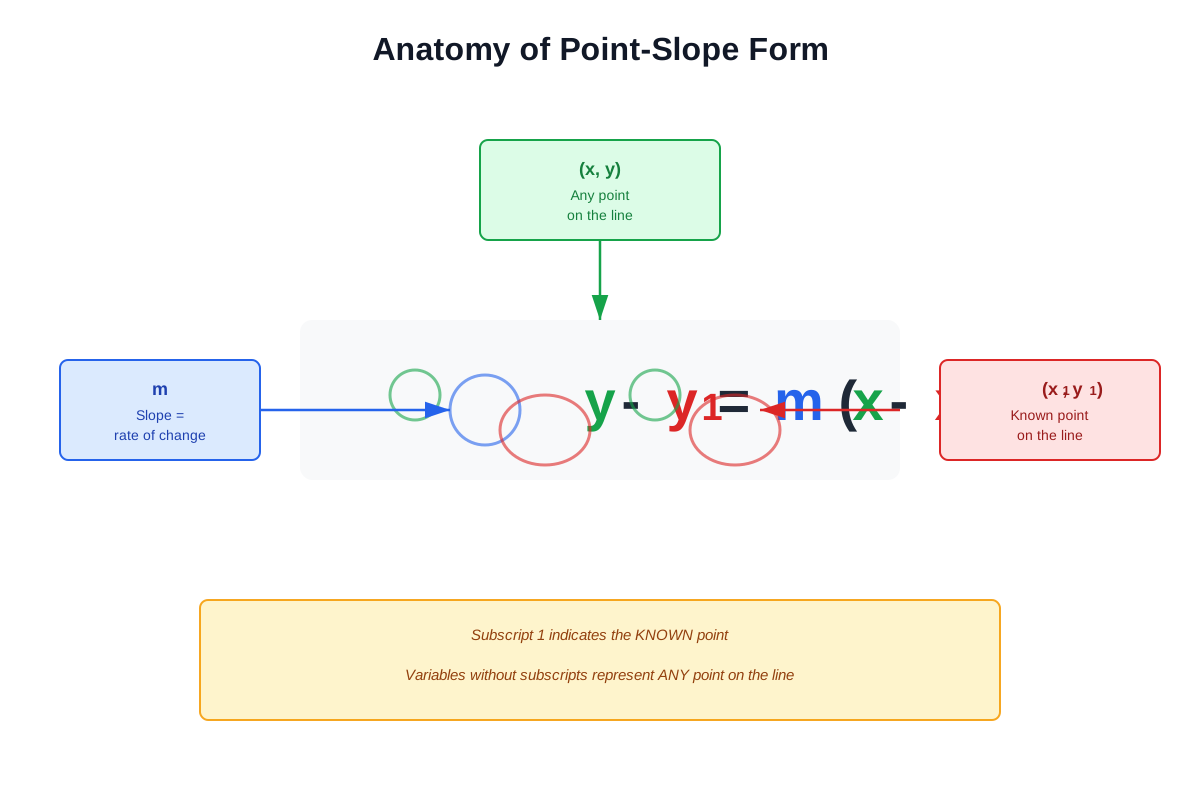
The point-slope form of a linear equation is expressed as:
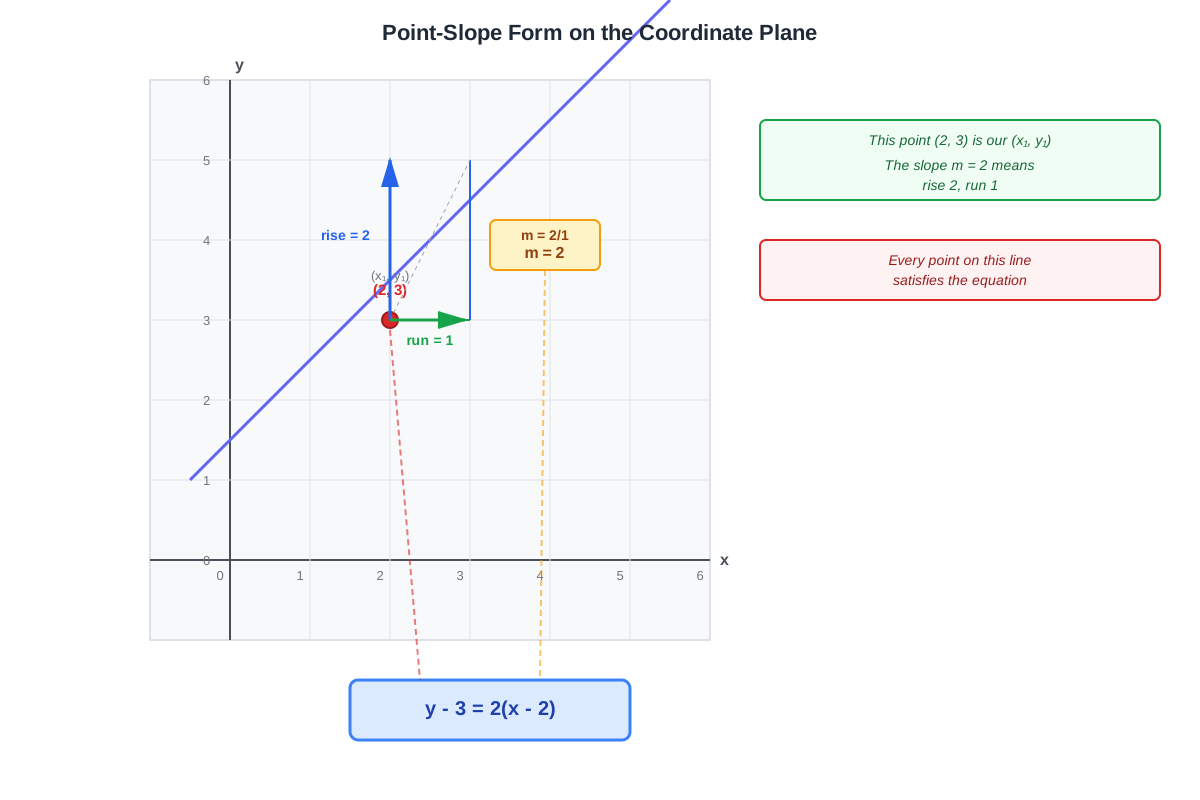
y - y₁ = m(x - x₁)In this equation, (x₁, y₁) represents a specific point on the line, m represents the slope of the line, and (x, y) represents any general point on the line. This form directly encodes the definition of slope: the change in y divided by the change in x equals the constant slope m.
The beauty of point-slope form lies in its directness. Unlike slope-intercept form, which requires knowing the y-intercept, point-slope form works with any point on the line. This makes it particularly efficient when the y-intercept is not immediately known or would require additional calculation to determine.
Components and Their Meanings
Each element of point-slope form carries specific mathematical significance:
| Component | Symbol | Meaning | Example |
|---|---|---|---|
| Slope | m | Rate of change; rise over run | m = 3 means up 3, right 1 |
| Known x-coordinate | x₁ | The x-value of the given point | If point is (2, 5), then x₁ = 2 |
| Known y-coordinate | y₁ | The y-value of the given point | If point is (2, 5), then y₁ = 5 |
| Variable x | x | Any x-coordinate on the line | Changes for different points |
| Variable y | y | Any y-coordinate on the line | Changes for different points |
The subtraction signs in the form (y - y₁) and (x - x₁) are crucial. They represent the vertical and horizontal distances from the known point to any other point on the line, which is precisely how slope is calculated.
Deriving Point-Slope Form
Understanding where point-slope form comes from strengthens conceptual mastery. Starting with the definition of slope between two points:
m = (y - y₁)/(x - x₁)Multiplying both sides by (x - x₁) yields:
m(x - x₁) = y - y₁Rearranging gives the standard point-slope form:
y - y₁ = m(x - x₁)This derivation shows that point-slope form is simply the slope formula rearranged, making it a natural way to express linear relationships.
Writing Equations Using Point-Slope Form
To write an equation in point-slope form, follow these steps:
- Identify the slope (m): This may be given directly, calculated from two points, or determined from context
- Identify a point on the line (x₁, y₁): Use any point that lies on the line
- Substitute into the formula: Replace m, x₁, and y₁ with their values
- Simplify if needed: The equation can be left in point-slope form or converted to another form
For example, if a line has slope 4 and passes through the point (3, -2):
- m = 4
- (x₁, y₁) = (3, -2)
- Substituting: y - (-2) = 4(x - 3)
- Simplified: y + 2 = 4(x - 3)
Converting Between Forms
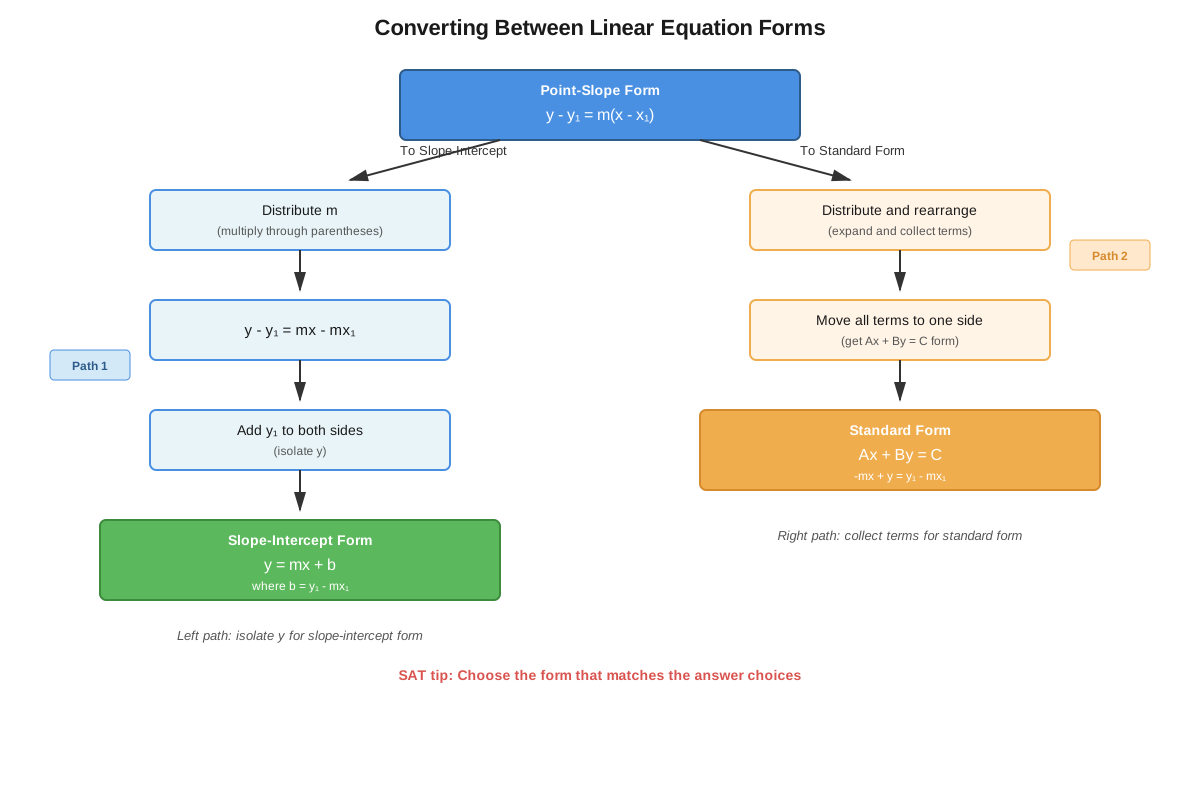
Point-slope form can be converted to other forms through algebraic manipulation:
Point-Slope to Slope-Intercept:
Starting with y - y₁ = m(x - x₁), distribute m and solve for y:
- y - y₁ = mx - mx₁
- y = mx - mx₁ + y₁
- y = mx + (y₁ - mx₁), where b = y₁ - mx₁
Point-Slope to Standard Form:
Starting with y - y₁ = m(x - x₁), distribute and rearrange to Ax + By = C:
- y - y₁ = mx - mx₁
- -mx + y = mx₁ + y₁
- Multiply through to eliminate fractions if m is a fraction
- Arrange so A, B, and C are integers with A positive
Special Cases and Applications
Parallel Lines: Parallel lines have identical slopes. To find the equation of a line parallel to another line through a specific point, use the same slope with the new point in point-slope form.
Perpendicular Lines: Perpendicular lines have slopes that are negative reciprocals (m₁ × m₂ = -1). To find a perpendicular line through a point, calculate the negative reciprocal of the original slope and use point-slope form.
Horizontal and Vertical Lines: Horizontal lines have slope m = 0, giving y - y₁ = 0(x - x₁), which simplifies to y = y₁. Vertical lines have undefined slope and cannot be expressed in point-slope form; they are written as x = x₁.
Concept Relationships
Point-slope form serves as a central hub connecting multiple linear function concepts. The relationship begins with slope calculation → which feeds into → point-slope form → which enables → equation writing and form conversion.
More specifically, understanding coordinate geometry provides the foundation for identifying points (x₁, y₁), while slope as rate of change gives meaning to the m value in the formula. Point-slope form then connects directly to slope-intercept form through algebraic manipulation, and to standard form through rearrangement.
The concept also links to parallel and perpendicular lines because these relationships are defined by slope, and point-slope form is the most efficient way to write equations when a point and slope are known. Additionally, point-slope form connects to linear modeling in real-world contexts, where initial conditions (a point) and rates of change (slope) are commonly given.
The progression typically flows: basic slope understanding → point-slope form mastery → flexible form conversion → advanced applications (systems of equations, linear inequalities, and function transformations). This topic also reinforces algebraic manipulation skills that apply across all SAT Math topics.
High-Yield Facts
⭐ Point-slope form is written as y - y₁ = m(x - x₁), where (x₁, y₁) is a point on the line and m is the slope
⭐ Any point on the line can be used as (x₁, y₁) in point-slope form; the resulting equation will be equivalent
⭐ Parallel lines have equal slopes; use the same m value with a different point to write parallel line equations
⭐ Perpendicular lines have slopes that are negative reciprocals; if one slope is m, the perpendicular slope is -1/m
⭐ Point-slope form is most efficient when you know a point and slope but not the y-intercept
- The subtraction signs in point-slope form are part of the structure; y - y₁ means subtract the y-coordinate of the known point
- Converting point-slope form to slope-intercept form requires distributing m and isolating y
- If a point-slope equation shows y + 3, this means y₁ = -3 (because y - (-3) = y + 3)
- Point-slope form cannot represent vertical lines because vertical lines have undefined slope
- Multiple correct point-slope equations can represent the same line if different points are used
- On the SAT, point-slope form questions often involve finding equations of lines through specific points
- The coefficient of (x - x₁) in point-slope form is always the slope of the line
Quick check — test yourself on Point-slope form so far.
Try Flashcards →Common Misconceptions
Misconception: The signs in point-slope form should match the signs of the coordinates.
Correction: Point-slope form always uses subtraction: y - y₁ = m(x - x₁). If a point has coordinates (2, -3), the form is y - (-3) = m(x - 2), which simplifies to y + 3 = m(x - 2). The subtraction is built into the formula structure.
Misconception: Point-slope form and slope-intercept form always give different equations for the same line.
Correction: These are different forms of the same equation. Through algebraic manipulation, point-slope form can be converted to slope-intercept form, and they represent identical lines. They are equivalent expressions, not different lines.
Misconception: You must use the y-intercept point when writing an equation in point-slope form.
Correction: Any point on the line can be used in point-slope form. The y-intercept is only required for slope-intercept form (y = mx + b). Point-slope form's advantage is that it works with any known point.
Misconception: If a problem gives two points, you cannot use point-slope form.
Correction: When given two points, first calculate the slope using m = (y₂ - y₁)/(x₂ - x₁), then use either of the two points as (x₁, y₁) in point-slope form. This is often more efficient than finding the y-intercept first.
Misconception: The variables x and y in point-slope form should be replaced with numbers.
Correction: The variables x and y remain as variables in the final equation; they represent any point on the line. Only x₁, y₁, and m are replaced with specific numbers from the given information.
Misconception: Point-slope form is only used for positive slopes.
Correction: Point-slope form works for any slope value: positive, negative, zero, or even undefined (though undefined slope indicates a vertical line that cannot be expressed in this form). Negative slopes simply result in negative m values in the equation.
Worked Examples
Example 1: Writing an Equation from a Point and Slope
Problem: Write the equation of a line that passes through the point (5, -2) and has a slope of 3/4.
Solution:
Step 1: Identify the given information.
- Point: (x₁, y₁) = (5, -2)
- Slope: m = 3/4
Step 2: Substitute into point-slope form y - y₁ = m(x - x₁).
- y - (-2) = (3/4)(x - 5)
Step 3: Simplify the left side.
- y + 2 = (3/4)(x - 5)
This is the equation in point-slope form. If the problem requires slope-intercept form:
Step 4: Distribute 3/4.
- y + 2 = (3/4)x - 15/4
Step 5: Isolate y.
- y = (3/4)x - 15/4 - 2
- y = (3/4)x - 15/4 - 8/4
- y = (3/4)x - 23/4
Connection to Learning Objectives: This example demonstrates identifying the key features of point-slope form (the point and slope) and applying the formula to write an equation, which are core SAT skills.
Example 2: Finding a Perpendicular Line Equation
Problem: Line ℓ has the equation y = 2x + 7. What is the equation, in point-slope form, of the line perpendicular to line ℓ that passes through the point (-4, 3)?
Solution:
Step 1: Identify the slope of line ℓ.
- From y = 2x + 7, the slope is m₁ = 2
Step 2: Find the slope of the perpendicular line.
- Perpendicular slopes are negative reciprocals
- m₂ = -1/m₁ = -1/2
Step 3: Identify the point the new line passes through.
- Point: (x₁, y₁) = (-4, 3)
Step 4: Substitute into point-slope form.
- y - y₁ = m(x - x₁)
- y - 3 = (-1/2)(x - (-4))
- y - 3 = (-1/2)(x + 4)
Answer: y - 3 = (-1/2)(x + 4)
Connection to Learning Objectives: This example shows how point-slope form appears in SAT questions involving perpendicular lines, a high-yield question type. It requires recognizing the relationship between slopes and efficiently applying point-slope form.
Example 3: Real-World Application
Problem: A water tank contains 500 gallons of water. Water is being drained at a constant rate of 15 gallons per minute. Write an equation in point-slope form that represents the amount of water W (in gallons) in the tank after t minutes.
Solution:
Step 1: Identify the rate of change (slope).
- Water is draining, so the rate is negative: m = -15 gallons per minute
Step 2: Identify a known point.
- At t = 0 minutes, W = 500 gallons
- Point: (t₁, W₁) = (0, 500)
Step 3: Write the equation using point-slope form.
- W - W₁ = m(t - t₁)
- W - 500 = -15(t - 0)
- W - 500 = -15t
Answer: W - 500 = -15t (or equivalently, W = -15t + 500 in slope-intercept form)
Connection to Learning Objectives: This demonstrates applying point-slope form to real-world SAT-style questions, showing how the form naturally fits problems where an initial value (point) and rate of change (slope) are given.
Exam Strategy
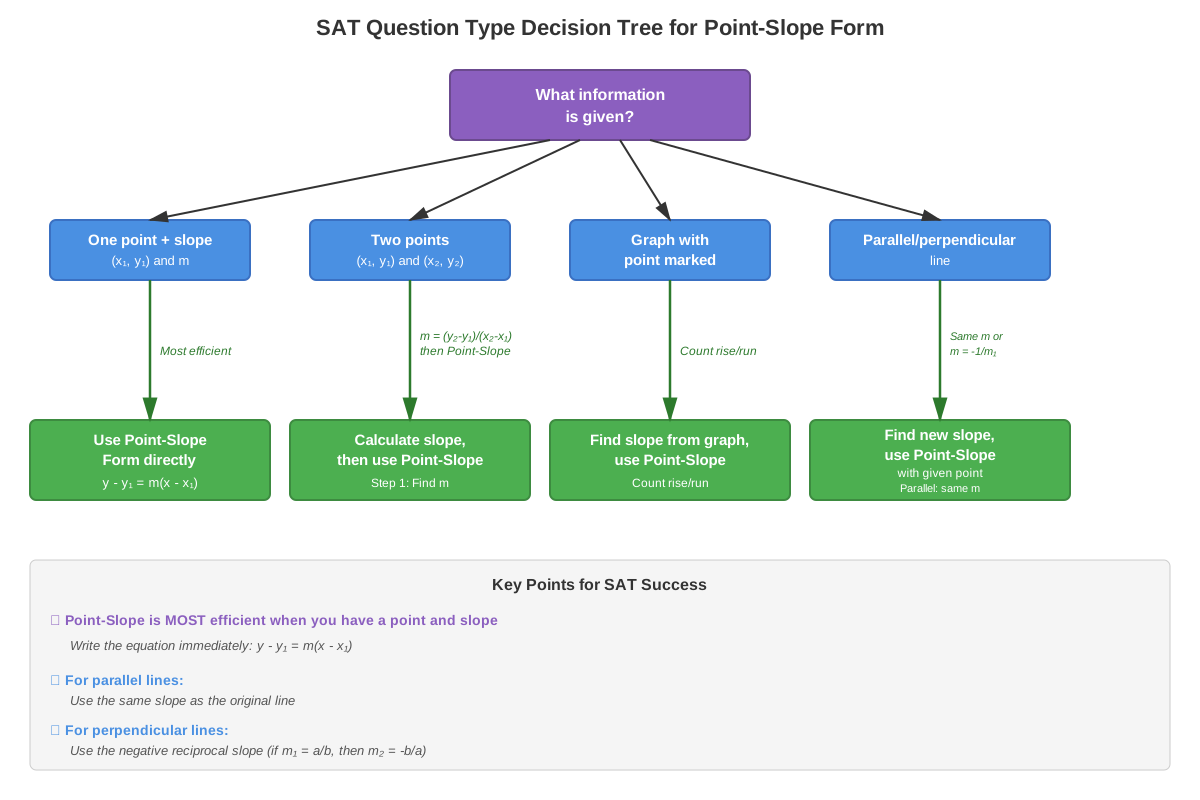
When approaching SAT questions involving point-slope form, begin by identifying what information is provided. Look for trigger phrases such as "passes through the point," "has a slope of," "parallel to," "perpendicular to," or "rate of change." These phrases signal that point-slope form may be the most efficient approach.
Time-saving strategy: If a question asks for an equation and provides a point and slope directly, write the answer in point-slope form immediately rather than converting to slope-intercept form unless specifically requested. Many students waste time converting when the question accepts point-slope form as an answer.
For multiple-choice questions, use the answer choices to guide your approach. If answers are in point-slope form, work in that form. If they're in slope-intercept form, you may need to convert. When answers show different points in point-slope form, remember that multiple correct point-slope equations can represent the same line—verify by checking if the given point satisfies the equation and if the slope matches.
Process of elimination tips:
- Eliminate any answer choice where the slope doesn't match the given or calculated slope
- Check the signs carefully; if a point is (3, -5), the correct form includes (x - 3) and (y - (-5)) or (y + 5)
- For parallel line questions, eliminate choices with different slopes
- For perpendicular line questions, eliminate choices where the slope isn't the negative reciprocal
Time allocation: Point-slope form questions typically require 45-90 seconds. If you find yourself spending more than 90 seconds, you may be overcomplicating the problem. Consider whether you're using the most direct approach or if you're making unnecessary conversions between forms.
Common question variations:
- Direct application: Given point and slope, write the equation
- Two points given: Calculate slope first, then apply point-slope form
- Parallel/perpendicular lines: Determine the new slope, then use point-slope form
- Graph interpretation: Read a point from the graph, determine slope, write equation
- Word problems: Extract the rate of change (slope) and initial condition (point) from context
Memory Techniques
Mnemonic for the formula structure: "You Minus Yesterday Equals Movement X-wise" helps remember y - y₁ = m(x - x₁). The "yesterday" represents the known point from the past, and "movement" represents the slope.
Visual memory aid: Picture point-slope form as a "distance × slope" equation. The (x - x₁) represents horizontal distance from the known point, multiplied by the slope m, equals the vertical distance (y - y₁) from the known point. This reinforces the geometric meaning.
Sign memory trick: Remember "Subtract Both" for point-slope form—you subtract both coordinates of the known point. This prevents the common error of mixing addition and subtraction.
Acronym for problem-solving steps: PISS - Point (identify it), Identify slope, Substitute into formula, Simplify. While informal, memorable acronyms improve recall under test pressure.
Parallel and Perpendicular memory device: "Parallel = Perfectly same slope" and "Perpendicular = Product of slopes is -1" (or "flip and negate"). The alliteration helps distinguish these commonly confused concepts.
Summary
Point-slope form, expressed as y - y₁ = m(x - x₁), is an essential tool for writing linear equations when a point and slope are known. This form appears frequently on the SAT Math section, particularly in questions involving parallel and perpendicular lines, linear modeling, and equation writing from graphs or data. The key advantage of point-slope form is its directness—it requires only a single point on the line and the slope, making it more efficient than slope-intercept form in many situations. Students must be able to identify when point-slope form is the optimal approach, substitute values correctly while paying careful attention to signs, and convert between different forms of linear equations when necessary. Mastery of point-slope form demonstrates mathematical flexibility and efficiency, skills that the SAT specifically rewards. Understanding the geometric meaning behind the formula—that it represents the relationship between distances from a known point and the constant slope—strengthens both conceptual understanding and problem-solving ability.
Key Takeaways
- Point-slope form y - y₁ = m(x - x₁) uses any point (x₁, y₁) on the line and the slope m to write a linear equation
- This form is most efficient when the y-intercept is unknown or would require extra calculation to determine
- Parallel lines share the same slope; perpendicular lines have slopes that are negative reciprocals
- Multiple equivalent point-slope equations can represent the same line if different points are used
- Pay careful attention to signs: the formula structure always uses subtraction, so y - (-3) becomes y + 3
- Point-slope form appears in 5-8% of SAT Math questions, often involving real-world linear modeling or geometric relationships
- Converting between forms requires algebraic manipulation: distribute, combine like terms, and isolate variables as needed
Related Topics
Slope-Intercept Form (y = mx + b): Understanding this form complements point-slope form knowledge and enables efficient form conversion. Mastering both forms allows students to choose the most efficient approach for each problem type.
Standard Form (Ax + By = C): This form is useful for certain applications and appears on the SAT. Learning to convert point-slope form to standard form strengthens algebraic manipulation skills.
Systems of Linear Equations: Point-slope form provides an efficient way to write equations when solving systems, particularly when dealing with geometric constraints or word problems.
Linear Inequalities: The concepts underlying point-slope form extend naturally to linear inequalities, where regions above or below lines must be identified.
Function Notation and Transformations: Understanding how point-slope form relates to function notation f(x) builds toward more advanced function concepts tested on the SAT.
Practice CTA
Now that you've mastered the core concepts of point-slope form, it's time to solidify your understanding through practice. Attempt the practice questions to apply these concepts in SAT-style problems, and use the flashcards to reinforce key formulas and relationships. Remember, the difference between understanding a concept and mastering it for test day lies in deliberate practice. Each problem you solve strengthens your pattern recognition and builds the confidence you need to tackle any point-slope form question the SAT presents. You've got this!
Sign up free to keep reading
Create a free AnvayaPrep account to finish this SAT guide on Point-slope form — plus flashcards and practice questions.