Overview
The x-intercept is one of the most fundamental concepts in coordinate geometry and linear functions, representing the point where a graph crosses the horizontal axis. On the SAT, understanding x-intercepts is crucial because they appear in multiple question formats across both the calculator and no-calculator sections. The x-intercept represents the solution to an equation when the output (y-value) equals zero, making it essential for solving real-world problems involving break-even points, zeros of functions, and roots of equations.
Mastery of x-intercepts extends far beyond simply identifying where a line crosses the x-axis. This concept connects directly to solving linear equations, understanding function behavior, and interpreting graphical representations of mathematical relationships. The SAT frequently tests whether students can move fluidly between algebraic expressions, graphical representations, and contextual interpretations of x-intercepts. Questions may ask students to find x-intercepts algebraically, identify them on graphs, or interpret their meaning in word problems involving profit, distance, or other real-world scenarios.
The x-intercept serves as a bridge between multiple mathematical domains tested on the SAT Math section. It connects algebraic manipulation skills with graphical interpretation abilities, and it provides the foundation for understanding more complex topics like systems of equations, quadratic functions, and polynomial behavior. Students who thoroughly understand x-intercepts gain a significant advantage on test day, as this concept appears in approximately 10-15% of SAT Math questions either directly or as a component of more complex problems.
Learning Objectives
- [ ] Identify key features of x-intercept on graphs and in equations
- [ ] Explain how x-intercept appears on the SAT in various question formats
- [ ] Apply x-intercept concepts to answer SAT-style questions accurately and efficiently
- [ ] Calculate x-intercepts algebraically from linear equations in multiple forms
- [ ] Interpret the meaning of x-intercepts in real-world contextual problems
- [ ] Distinguish between x-intercepts and y-intercepts in both graphical and algebraic representations
- [ ] Convert between different representations of linear functions to identify x-intercepts
Prerequisites
- Basic coordinate plane understanding: Students must know how to plot points using (x, y) coordinates, as x-intercepts are specific points on the coordinate plane where y = 0
- Solving linear equations: The ability to isolate variables and solve for x is essential, since finding x-intercepts algebraically requires setting y = 0 and solving
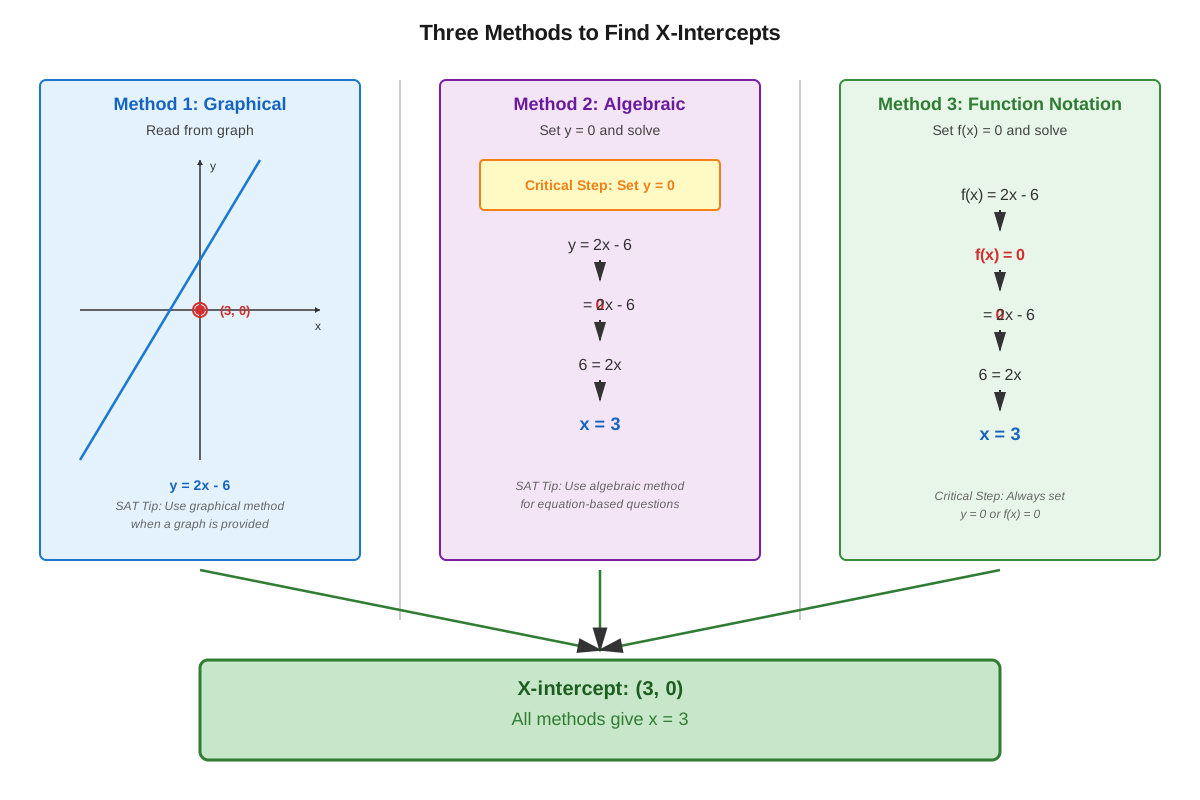
- Function notation: Understanding f(x) notation helps recognize that finding x-intercepts means solving f(x) = 0
- Graphing fundamentals: Familiarity with how equations translate to visual representations enables students to identify x-intercepts on graphs quickly
Why This Topic Matters
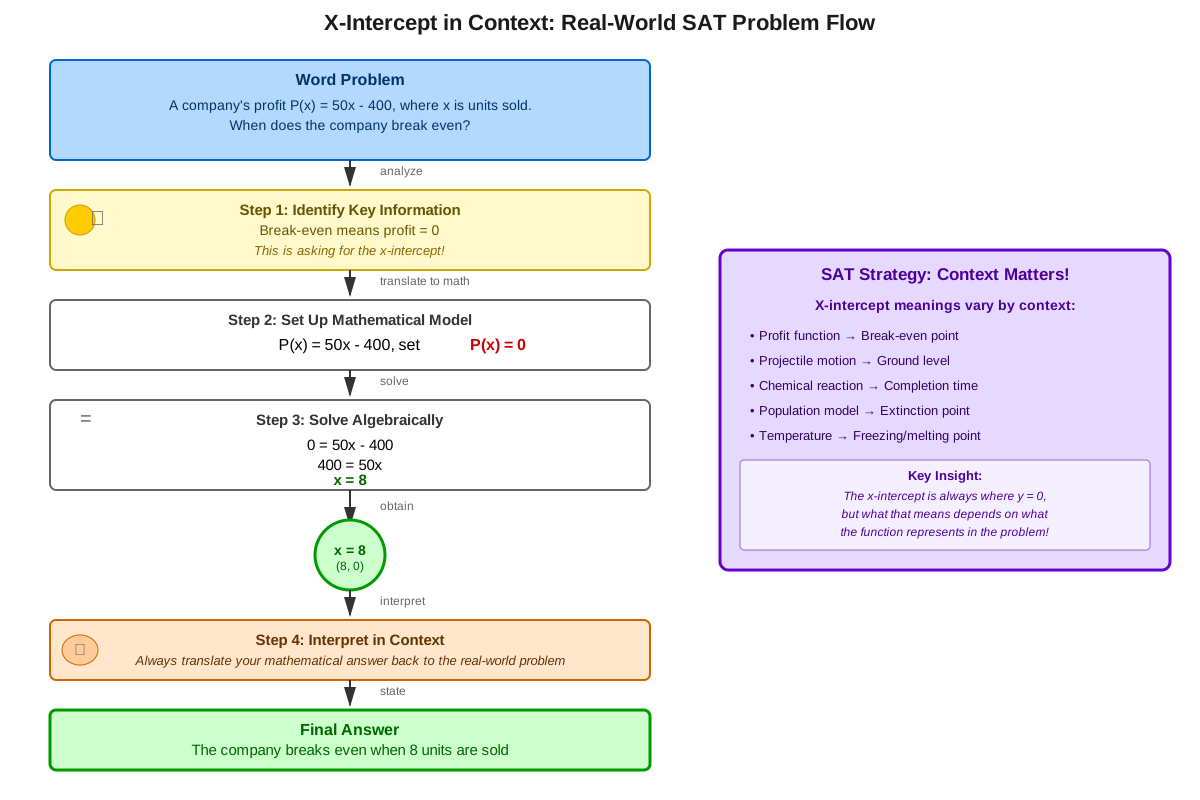
Understanding x-intercepts has practical applications across numerous real-world scenarios. In business, the x-intercept represents the break-even point where revenue equals costs (profit = 0). In physics, it might represent the time when an object returns to ground level (height = 0). In chemistry, it could indicate when a reaction reaches completion (concentration = 0). These contextual applications make x-intercepts one of the most frequently tested concepts in SAT word problems.
On the SAT, x-intercept questions appear in multiple formats with high frequency. Approximately 3-5 questions per test directly involve x-intercepts, while many additional questions incorporate them as part of multi-step problems. The College Board tests x-intercepts through direct calculation questions, graph interpretation problems, word problems requiring contextual understanding, and questions involving systems of equations. The concept appears in both multiple-choice and student-produced response (grid-in) formats.
Common SAT question types include: identifying x-intercepts from graphs, calculating x-intercepts algebraically from equations in standard form or slope-intercept form, interpreting the meaning of x-intercepts in context, finding where two functions have the same x-intercept, and determining how changes to an equation affect its x-intercept. The versatility of this concept makes it a high-yield study topic that directly impacts test scores.
Core Concepts
Definition and Fundamental Properties
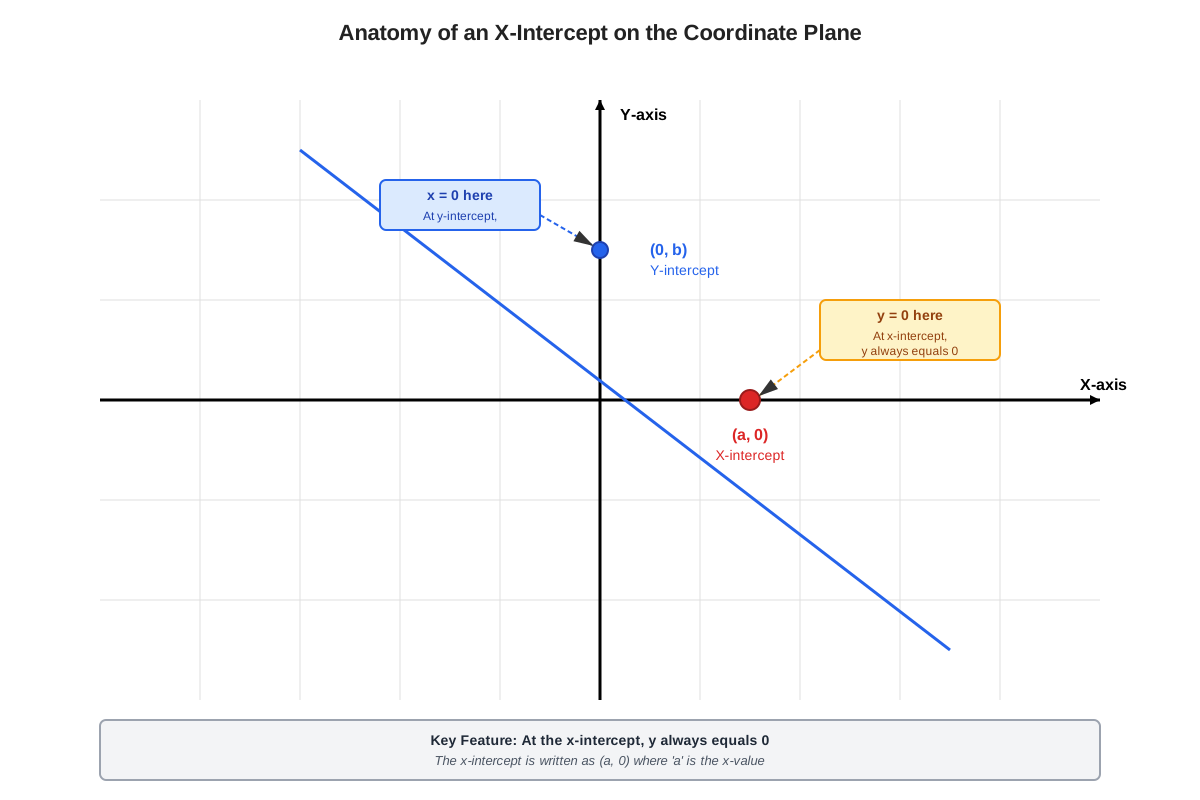
The x-intercept is the point where a graph crosses or touches the x-axis. At this point, the y-coordinate always equals zero, making every x-intercept expressible as an ordered pair (a, 0), where 'a' is the x-coordinate. The x-intercept represents the solution to the equation when the output value is zero. For a linear function written as y = mx + b, the x-intercept occurs when y = 0, requiring students to solve 0 = mx + b for x.
A linear function can have exactly one x-intercept, no x-intercept (if the line is horizontal and doesn't cross the x-axis), or infinitely many x-intercepts (if the line coincides with the x-axis itself, though this is rare on the SAT). Understanding this cardinality helps students verify their answers and recognize when they may have made an error.
Algebraic Methods for Finding X-Intercepts
To find the x-intercept algebraically, follow this systematic process:
- Set y = 0 (or f(x) = 0 if using function notation)
- Solve the resulting equation for x
- Express the answer as an ordered pair (x, 0) or as just the x-value, depending on what the question asks
For an equation in slope-intercept form (y = mx + b):
- Substitute 0 for y: 0 = mx + b
- Solve for x: x = -b/m
- The x-intercept is (-b/m, 0)
For an equation in standard form (Ax + By = C):
- Substitute 0 for y: Ax + B(0) = C
- Simplify: Ax = C
- Solve for x: x = C/A
- The x-intercept is (C/A, 0)
For an equation in point-slope form (y - y₁ = m(x - x₁)):
- Substitute 0 for y: 0 - y₁ = m(x - x₁)
- Solve for x: -y₁ = m(x - x₁)
- Continue: -y₁/m = x - x₁
- Final form: x = x₁ - y₁/m
Graphical Identification
When identifying x-intercepts from a graph, look for the point(s) where the line, curve, or function crosses the x-axis (the horizontal axis). The y-coordinate at this location is always zero. On SAT graphs, x-intercepts may be clearly marked with grid lines, or students may need to estimate based on the scale provided. Always check the scale of both axes, as SAT questions sometimes use non-standard scales to test careful reading.
Comparison with Y-Intercepts
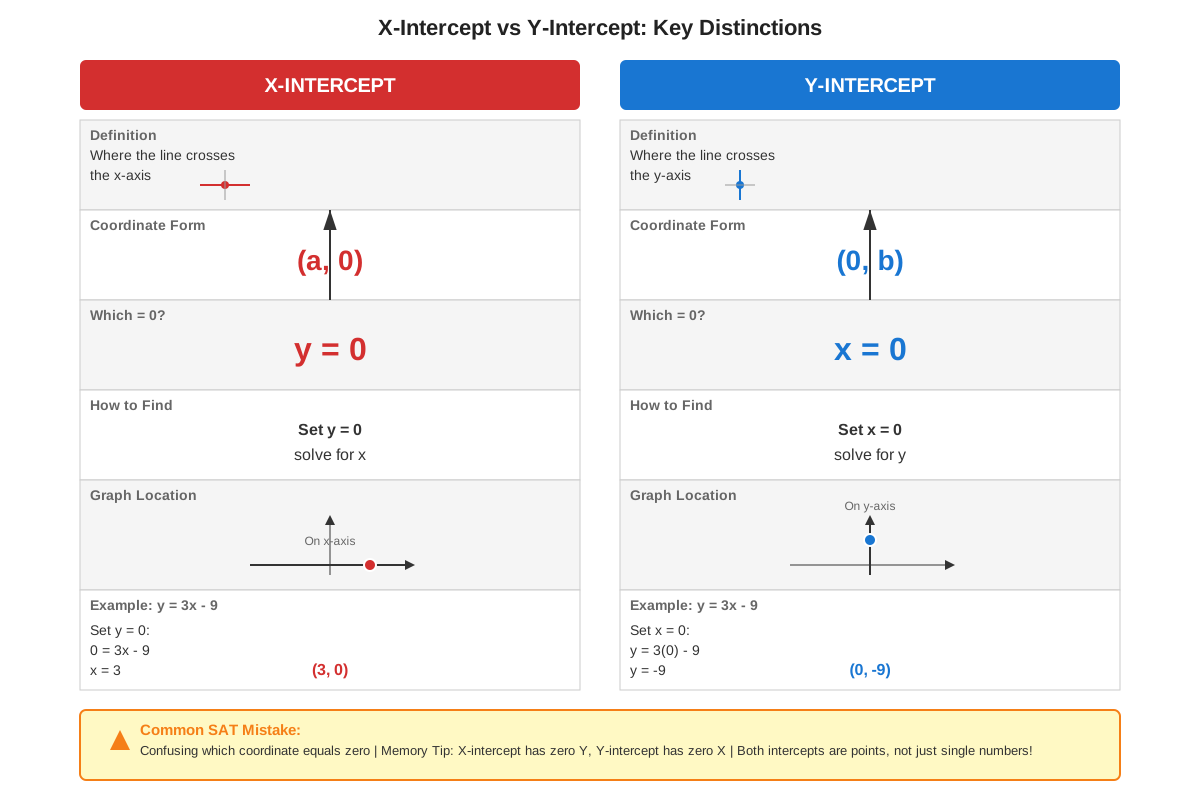
| Feature | X-Intercept | Y-Intercept |
|---|---|---|
| Definition | Where graph crosses x-axis | Where graph crosses y-axis |
| Y-coordinate | Always 0 | Can be any value |
| X-coordinate | Can be any value | Always 0 |
| Ordered pair form | (a, 0) | (0, b) |
| How to find algebraically | Set y = 0 and solve for x | Set x = 0 and solve for y |
| In y = mx + b | x = -b/m | y = b |
Contextual Interpretation
On the SAT, x-intercepts frequently appear in word problems where they represent meaningful real-world values. The key to these problems is understanding what the variables represent:
- If y represents profit and x represents units sold, the x-intercept is the break-even point
- If y represents height and x represents time, the x-intercept is when the object reaches ground level
- If y represents distance from home and x represents time, the x-intercept is when someone returns home
- If y represents account balance and x represents months, the x-intercept is when the account reaches zero
Always read the axis labels carefully and translate the mathematical meaning (y = 0) into the contextual meaning specific to the problem.
Multiple Representations
The SAT tests whether students can work with x-intercepts across different representations:
Algebraic: Given the equation 2x - 6y = 12, find the x-intercept
- Set y = 0: 2x - 6(0) = 12
- Solve: 2x = 12, so x = 6
- X-intercept: (6, 0)
Graphical: Identify the x-intercept by observing where the line crosses the x-axis
Tabular: In a table of values, the x-intercept occurs at the row where y = 0
Verbal: "At what value of x does the function equal zero?" is asking for the x-intercept
Concept Relationships
The x-intercept concept sits at the intersection of multiple mathematical ideas. Solving linear equations provides the algebraic foundation → which enables finding x-intercepts → which connects to graphing linear functions → which supports understanding systems of equations (where solutions can be found at intersection points, which may include x-intercepts).
X-intercepts relate directly to the concept of zeros of functions. When a function f(x) has an x-intercept at x = a, this means f(a) = 0, making 'a' a zero or root of the function. This relationship becomes increasingly important in higher-level mathematics but appears on the SAT in the context of linear and quadratic functions.
The relationship between slope and x-intercepts is also significant. For a line with equation y = mx + b, the x-intercept is -b/m. This means that if two lines have the same y-intercept but different slopes, their x-intercepts will differ. Conversely, if two lines have the same x-intercept but different slopes, they must have different y-intercepts. Understanding these relationships helps students verify answers and solve complex problems involving multiple linear functions.
X-intercepts also connect to domain and range concepts. The x-intercept is always within the domain of a function (the set of possible x-values), and it represents a specific point where the range includes zero. This connection helps students understand function behavior more comprehensively.
Quick check — test yourself on X-intercept so far.
Try Flashcards →High-Yield Facts
⭐ The x-intercept always has a y-coordinate of zero, making every x-intercept expressible as (a, 0)
⭐ To find the x-intercept algebraically, set y = 0 and solve for x in any form of linear equation
⭐ For y = mx + b, the x-intercept is x = -b/m (provided m ≠ 0)
⭐ The x-intercept represents the solution to f(x) = 0, connecting intercepts to zeros and roots
⭐ In word problems, the x-intercept often represents a break-even point, return to zero, or equilibrium state
- A horizontal line y = k (where k ≠ 0) has no x-intercept because it never crosses the x-axis
- A vertical line x = a has its x-intercept at (a, 0) and crosses the x-axis at exactly one point
- For standard form Ax + By = C, the x-intercept is found by setting y = 0, giving x = C/A
- Two different non-parallel lines can share the same x-intercept if they intersect on the x-axis
- The x-intercept changes when the y-intercept or slope of a line changes (unless specific compensating adjustments are made)
- On SAT graphs, always check the scale before identifying x-intercepts, as non-standard scales are common
- If a line passes through the origin (0, 0), then the origin is both the x-intercept and y-intercept
- The distance between two x-intercepts on the same graph equals the absolute value of their difference: |x₁ - x₂|
Common Misconceptions
Misconception: The x-intercept is just a single number → Correction: The x-intercept is a point with two coordinates (a, 0), though sometimes questions ask only for the x-coordinate value. Always check what format the question requires.
Misconception: To find the x-intercept, set x = 0 → Correction: To find the x-intercept, set y = 0 (not x = 0). Setting x = 0 finds the y-intercept instead. This is one of the most common errors on the SAT.
Misconception: All lines have an x-intercept → Correction: Horizontal lines of the form y = k (where k ≠ 0) never cross the x-axis and therefore have no x-intercept. Only the line y = 0 (the x-axis itself) has infinitely many x-intercepts.
Misconception: The x-intercept and y-intercept are always different points → Correction: The origin (0, 0) serves as both the x-intercept and y-intercept for lines passing through it, such as y = 2x or any line of the form y = mx where b = 0.
Misconception: A negative x-intercept means the line is decreasing → Correction: The sign of the x-intercept indicates its position on the x-axis (left or right of the origin) but doesn't determine whether the line is increasing or decreasing. The slope determines whether a line increases or decreases.
Misconception: The x-intercept formula -b/m only works for slope-intercept form → Correction: While this formula is derived from slope-intercept form, the principle of setting y = 0 and solving for x works for any form of a linear equation. Different forms just require different algebraic steps.
Misconception: If two lines have the same slope, they have the same x-intercept → Correction: Parallel lines (same slope) have different x-intercepts unless they are the same line. Lines with the same slope but different y-intercepts will have different x-intercepts.
Worked Examples
Example 1: Finding X-Intercept from Slope-Intercept Form
Problem: A line has the equation y = 3x - 12. What is the x-coordinate of the x-intercept?
Solution:
Step 1: Identify what we're looking for. The question asks for the x-coordinate of the x-intercept, which occurs when y = 0.
Step 2: Set y = 0 in the equation:
0 = 3x - 12Step 3: Solve for x by adding 12 to both sides:
12 = 3xStep 4: Divide both sides by 3:
x = 4Step 5: Verify by checking. If x = 4, then y = 3(4) - 12 = 12 - 12 = 0 ✓
Answer: The x-coordinate of the x-intercept is 4. (The complete x-intercept as a point is (4, 0), but the question only asked for the x-coordinate.)
Connection to Learning Objectives: This example demonstrates the core algebraic method for finding x-intercepts and shows how to apply the concept to answer SAT-style questions that may ask for just the x-coordinate rather than the full ordered pair.
Example 2: Contextual Interpretation
Problem: A small business's monthly profit P (in dollars) can be modeled by the equation P = 150n - 3000, where n is the number of units sold. What does the n-intercept represent in this context, and what is its value?
Solution:
Step 1: Understand the context. P represents profit and n represents units sold. The n-intercept (which is the x-intercept in this context, since n is the independent variable) occurs when P = 0.
Step 2: Interpret the meaning. When P = 0, the business breaks even (neither profit nor loss). The n-intercept represents the break-even point—the number of units that must be sold to have zero profit.
Step 3: Find the n-intercept algebraically by setting P = 0:
0 = 150n - 3000Step 4: Add 3000 to both sides:
3000 = 150nStep 5: Divide both sides by 150:
n = 20Step 6: Verify: If n = 20, then P = 150(20) - 3000 = 3000 - 3000 = 0 ✓
Answer: The n-intercept represents the break-even point, where the business has zero profit. The business must sell 20 units to break even.
Connection to Learning Objectives: This example shows how x-intercepts appear in SAT word problems and demonstrates the critical skill of interpreting mathematical results in real-world contexts. It also shows that the "x-intercept" concept applies to any independent variable, not just x.
Exam Strategy
When approaching SAT questions involving x-intercepts, follow this strategic framework:
Trigger Words to Recognize: Watch for phrases like "where the graph crosses the x-axis," "when y equals zero," "the zero of the function," "break-even point," "returns to ground level," "reaches zero," or "the solution to f(x) = 0." All of these indicate x-intercept questions.
Step-by-Step Approach:
- Identify whether the question provides an equation, graph, table, or verbal description
- If given an equation, immediately set y (or the output variable) equal to 0
- If given a graph, locate where the line crosses the x-axis and read the x-coordinate carefully
- Check whether the question asks for the x-coordinate only or the complete ordered pair
- In word problems, translate the contextual meaning before solving
Process of Elimination Tips:
- Eliminate any answer choice where the y-coordinate is not zero (if the question asks for the x-intercept as a point)
- If you can quickly test answer choices by substitution, plug them into the equation with y = 0 to verify
- For graphical questions, eliminate answers that don't align with the visible grid lines
- In contextual problems, eliminate answers that don't make sense in the real-world scenario (e.g., negative time when time must be positive)
Time Management: X-intercept questions typically require 30-60 seconds for straightforward algebraic problems and 60-90 seconds for contextual word problems. If a question involves multiple steps or systems of equations, allocate up to 2 minutes. Don't spend excessive time on graphical estimation—if you can't determine the exact value from the graph, look for algebraic information in the problem.
Common Traps to Avoid: The SAT often includes the y-intercept as a distractor answer choice in x-intercept questions. Always double-check that you set the correct variable to zero. Also, watch for questions that ask for the x-coordinate only versus the complete point—providing (4, 0) when the question asks for "the x-intercept" is correct, but providing just "4" when the question asks for "the coordinates of the x-intercept" is incomplete.
Memory Techniques
Mnemonic for X-Intercept: "X marks the spot where Y is not" — This reminds students that at the x-intercept, y = 0 (y is "not" there).
Visual Memory Aid: Picture the x-axis as the ground and the y-axis as a wall. The x-intercept is where something "lands on the ground" (y = 0), while the y-intercept is where something "hits the wall" (x = 0).
Formula Memory: For y = mx + b, remember "Negative B over M" (x-intercept = -b/m). The phrase "be negative over 'em" can help recall this formula.
Acronym for Steps: SIZZ — Set y to zero, Isolate x, Zero check (verify), Zone in on the answer format (point or coordinate only).
Contextual Memory: In word problems, remember "ZERO means something" — The x-intercept represents a meaningful zero point in the context (break-even, ground level, empty, etc.).
Coordinate Memory: Think "X-intercept = (X, 0)" and "Y-intercept = (0, Y)" — The intercept name tells you which coordinate is NOT zero.
Summary
The x-intercept represents the point where a graph crosses the x-axis, always having a y-coordinate of zero and expressible as (a, 0). Finding x-intercepts algebraically requires setting y = 0 and solving for x, with the specific steps varying based on the equation form (slope-intercept, standard, or point-slope). On the SAT, x-intercepts appear frequently in multiple contexts: direct calculation problems, graphical interpretation questions, and word problems where they represent meaningful real-world values like break-even points or return-to-zero situations. Mastery requires fluency in moving between algebraic, graphical, and contextual representations, as well as avoiding common errors like confusing x-intercepts with y-intercepts or forgetting to set y = 0. The concept connects fundamentally to solving equations, understanding function zeros, and interpreting linear relationships, making it essential for success on approximately 10-15% of SAT Math questions.
Key Takeaways
- The x-intercept is the point (a, 0) where a graph crosses the x-axis, always having y = 0
- To find x-intercepts algebraically, set y = 0 and solve for x in any form of equation
- For y = mx + b, the x-intercept formula is x = -b/m (provided the slope is not zero)
- X-intercepts represent zeros, roots, or solutions to f(x) = 0, connecting algebra and graphing
- In SAT word problems, x-intercepts often represent break-even points, ground level, or return-to-zero situations
- Always distinguish between x-intercepts (set y = 0) and y-intercepts (set x = 0) to avoid the most common error
- Check whether questions ask for the x-coordinate only or the complete ordered pair (a, 0)
Related Topics
Y-Intercepts: Understanding y-intercepts complements x-intercept knowledge and together they provide complete information about linear function behavior. Mastering both intercepts enables quick graphing and equation writing.
Systems of Linear Equations: X-intercepts become crucial when solving systems graphically, as solutions may occur at or near the x-axis. Understanding intercepts helps verify solutions and interpret results.
Quadratic Functions: The concept of x-intercepts extends to parabolas, where functions may have zero, one, or two x-intercepts. Linear x-intercepts provide the foundation for understanding more complex function behavior.
Slope and Rate of Change: The relationship between slope and x-intercepts (x = -b/m) connects these concepts. Understanding how slope affects where a line crosses the x-axis deepens comprehension of linear functions.
Function Transformations: Learning how changes to equations affect x-intercepts (shifts, stretches, reflections) builds on basic x-intercept knowledge and appears in advanced SAT questions.
Practice CTA
Now that you've mastered the core concepts of x-intercepts, it's time to solidify your understanding through practice! Attempt the practice questions to test your ability to find x-intercepts algebraically, identify them graphically, and interpret them in context. Use the flashcards to reinforce key formulas and definitions until they become automatic. Remember, x-intercepts appear on virtually every SAT, so the time you invest in mastering this topic will directly translate to points on test day. You've got this!
Sign up free to keep reading
Create a free AnvayaPrep account to finish this SAT guide on X-intercept — plus flashcards and practice questions.