Overview
Constraints are mathematical conditions or limitations that restrict the possible values of variables in a problem. In the context of SAT math, constraints typically appear as inequalities that define boundaries for solutions, often representing real-world limitations such as budget restrictions, time limits, capacity requirements, or physical boundaries. Understanding constraints is fundamental to solving systems of linear inequalities, optimization problems, and word problems that model practical scenarios.
On the SAT, sat constraints questions test a student's ability to translate verbal descriptions into mathematical inequalities, interpret graphical representations of constraint regions, and determine whether specific values satisfy given conditions. These problems frequently appear in both the calculator and no-calculator sections, often embedded within word problems that require students to set up and analyze systems of inequalities. Mastery of constraints is essential because these questions assess critical thinking skills, the ability to model real-world situations mathematically, and the capacity to work with multiple conditions simultaneously.
Constraints connect directly to broader mathematical concepts including linear inequalities, systems of equations, coordinate geometry, and function analysis. They serve as a bridge between abstract algebraic manipulation and practical problem-solving, requiring students to understand not just how to solve inequalities but also how to interpret their solutions within meaningful contexts. This topic builds upon foundational algebra skills while preparing students for more advanced mathematical reasoning required in college-level coursework.
Learning Objectives
- [ ] Identify key features of constraints in mathematical problems and real-world scenarios
- [ ] Explain how constraints appears on the SAT across different question formats
- [ ] Apply constraints to answer SAT-style questions involving systems of inequalities
- [ ] Translate verbal descriptions of limitations into mathematical inequality expressions
- [ ] Determine feasible regions on coordinate planes defined by multiple constraints
- [ ] Evaluate whether specific ordered pairs satisfy given constraint systems
- [ ] Interpret constraint-based word problems and extract relevant mathematical relationships
Prerequisites
- Linear inequalities: Understanding how to solve and graph single-variable and two-variable inequalities is essential for working with constraint systems
- Coordinate plane graphing: Ability to plot points and lines enables visualization of constraint regions and solution sets
- Algebraic manipulation: Solving equations and isolating variables provides the foundation for working with inequality expressions
- Systems of equations: Experience with multiple simultaneous conditions prepares students for handling multiple constraints together
- Word problem translation: Converting verbal descriptions into mathematical expressions is crucial for constraint-based application problems
Why This Topic Matters
Constraints represent one of the most practical applications of mathematics in everyday life. From budgeting personal finances to planning travel itineraries, from designing manufacturing processes to optimizing resource allocation, constraints define the boundaries within which decisions must be made. Understanding how to work with mathematical constraints develops critical thinking skills that extend far beyond the classroom, enabling students to analyze complex situations, identify limitations, and make informed decisions within given parameters.
On the SAT, constraint problems appear with significant frequency, typically comprising 3-5 questions per test across both the calculator and no-calculator sections. These questions often carry medium to high difficulty ratings and appear in various formats: multiple-choice questions asking students to identify correct inequality systems, grid-in questions requiring numerical answers from constraint analysis, and word problems embedded in real-world contexts. According to College Board data, approximately 8-12% of SAT math questions involve some form of constraint reasoning, making this a high-yield topic for focused study.
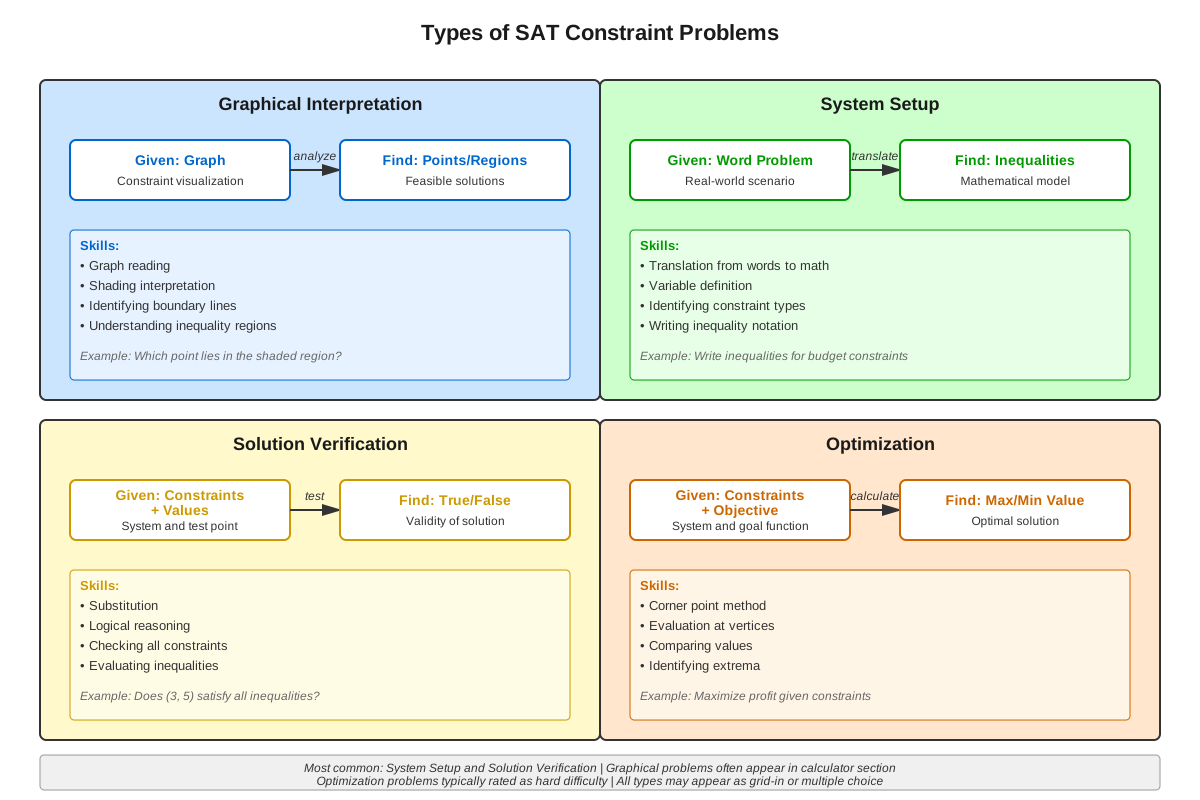
Constraint questions commonly appear as optimization scenarios (maximizing profit or minimizing cost), feasibility problems (determining whether certain combinations are possible), and graphical interpretation tasks (identifying regions that satisfy multiple inequalities). The SAT particularly favors contexts involving business decisions, mixture problems, scheduling scenarios, and geometric limitations. Students who master constraints gain a significant advantage because these questions often separate high-scoring students from average performers, as they require both computational accuracy and conceptual understanding.
Core Concepts
Understanding Mathematical Constraints
A constraint is a mathematical condition that limits the possible values a variable or set of variables can take. In algebraic terms, constraints are most commonly expressed as inequalities using symbols such as <, >, ≤, and ≥. Unlike equations that define specific values or relationships, constraints define ranges or regions of acceptable values. For example, if x represents the number of items purchased and there's a budget limitation, the constraint might be expressed as 5x ≤ 100, meaning the total cost (at $5 per item) cannot exceed $100.
Constraints can be classified into several types:
| Constraint Type | Description | Example |
|---|---|---|
| Upper bound | Maximum value limitation | x ≤ 10 |
| Lower bound | Minimum value requirement | y ≥ 5 |
| Non-negativity | Values must be zero or positive | x ≥ 0, y ≥ 0 |
| Capacity | Total amount limitation | x + y ≤ 50 |
| Ratio/Proportion | Relative relationship requirement | 2x ≥ 3y |
Translating Verbal Constraints into Inequalities
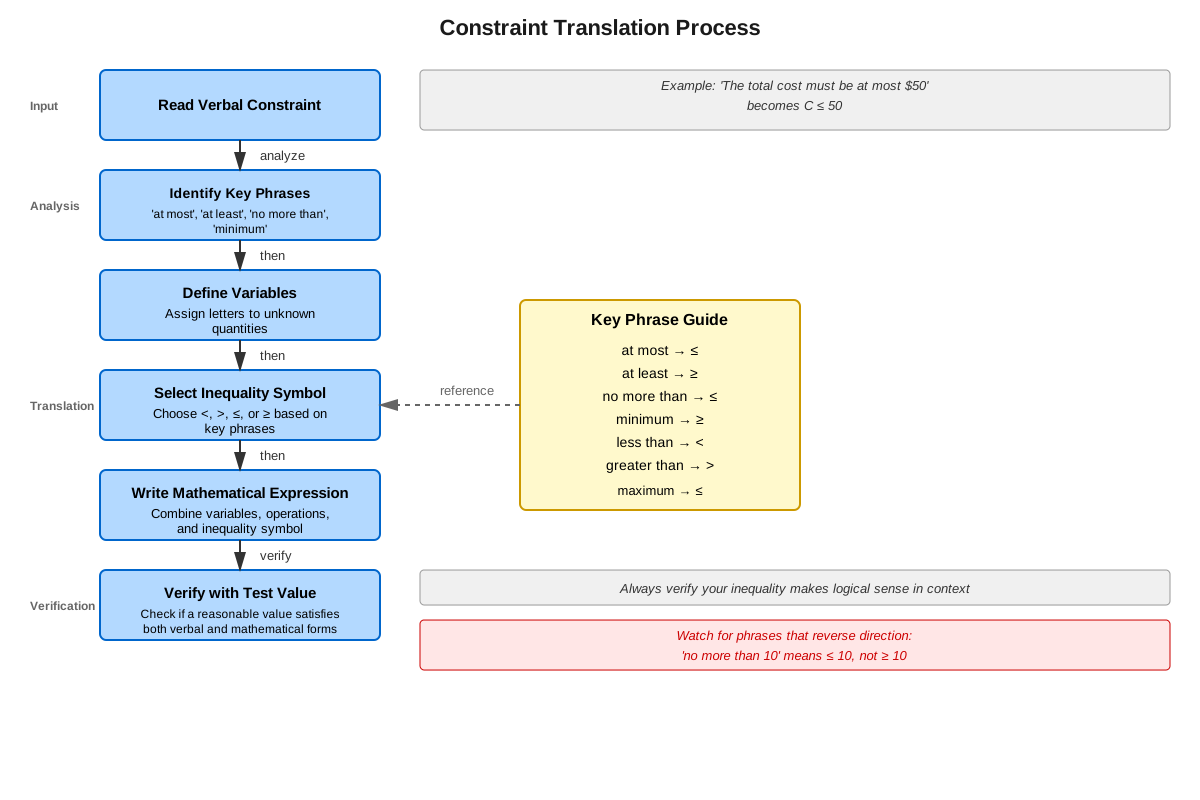
One of the most critical skills for SAT success is converting word descriptions into mathematical inequalities. This translation process requires careful attention to key phrases that signal specific inequality relationships:
Key translation phrases:
- "At most" → ≤ (less than or equal to)
- "At least" → ≥ (greater than or equal to)
- "No more than" → ≤
- "No fewer than" → ≥
- "Maximum" → ≤
- "Minimum" → ≥
- "Exceeds" → >
- "Less than" → <
- "Cannot exceed" → ≤
For example, if a problem states "The total number of adults (a) and children (c) cannot exceed 50," this translates to a + c ≤ 50. If it adds "there must be at least twice as many adults as children," this creates a second constraint: a ≥ 2c.
Systems of Constraints
Most SAT constraint problems involve systems of constraints—multiple inequalities that must all be satisfied simultaneously. The solution to a system of constraints is the set of all values that satisfy every constraint in the system. When working with two variables, this solution set can be visualized as a region on the coordinate plane.
To solve systems of constraints:
- Identify all constraints from the problem statement
- Express each constraint as a mathematical inequality
- Consider implicit constraints (such as non-negativity when dealing with quantities that cannot be negative)
- Determine the feasible region where all constraints overlap
- Test specific points if asked whether particular values satisfy the system
Graphical Representation of Constraints
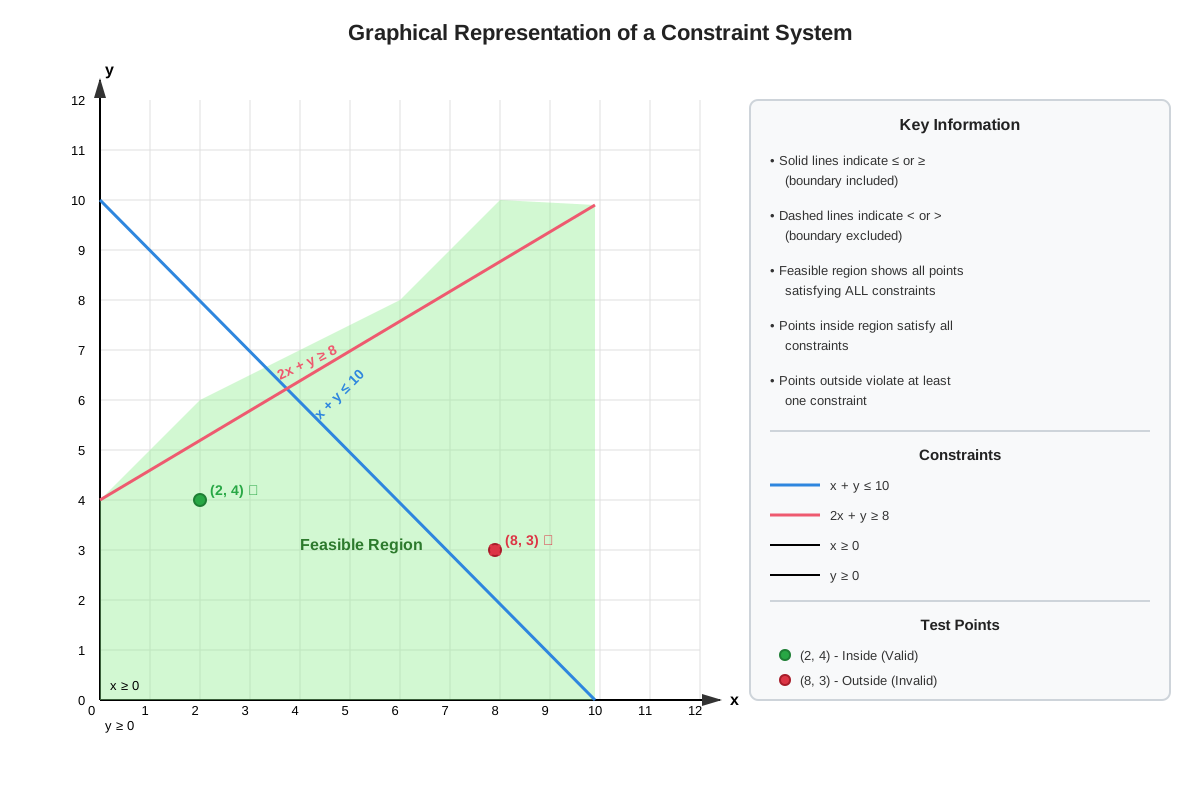
When constraints involve two variables, they can be represented graphically on a coordinate plane. Each linear inequality divides the plane into two half-planes: one that satisfies the inequality and one that doesn't. The boundary line is determined by replacing the inequality symbol with an equals sign.
Graphing procedure:
- Convert the inequality to an equation to find the boundary line
- Graph the boundary line (solid for ≤ or ≥, dashed for < or >)
- Choose a test point (often the origin if it's not on the line)
- Substitute the test point into the original inequality
- Shade the half-plane containing points that satisfy the inequality
- For systems, the solution region is where all shaded areas overlap
The feasible region is the area where all constraints are satisfied simultaneously. This region may be bounded (enclosed) or unbounded (extending infinitely in some direction). Points on the boundary are included in the solution set only if the constraint uses ≤ or ≥ rather than < or >.
Constraint Optimization
Some SAT problems ask students to find maximum or minimum values subject to constraints. While full linear programming is beyond the SAT scope, students should understand that optimal values in constraint systems often occur at corner points (vertices) of the feasible region. When a problem asks for the maximum or minimum value of an expression like 3x + 2y subject to several constraints, testing the corner points of the feasible region typically yields the answer.
Common Constraint Contexts on the SAT
The SAT presents constraints within various real-world scenarios:
- Budget problems: Total cost must not exceed available funds
- Time allocation: Total time spent on activities cannot exceed available time
- Mixture problems: Combining ingredients with specific requirements
- Production scenarios: Manufacturing items with resource limitations
- Geometric constraints: Dimensions that must satisfy certain relationships
- Scheduling problems: Allocating resources across time periods
Concept Relationships
The concepts within constraints are deeply interconnected. Understanding mathematical constraints begins with recognizing limitations in problem statements, which leads to translating verbal descriptions into inequalities. These individual inequalities combine to form systems of constraints, which can be analyzed algebraically or graphically. The graphical representation connects constraints to coordinate geometry, where feasible regions emerge from the intersection of half-planes. When optimization is involved, the feasible region concept connects to finding extreme values at boundary points.
Relationship flow:
Verbal problem description → Individual constraints (inequalities) → System of constraints → Graphical representation (feasible region) → Solution verification or optimization
Constraints build upon prerequisite knowledge of linear inequalities by extending single-condition problems to multiple-condition scenarios. The coordinate plane graphing skills students already possess become tools for visualizing constraint systems. Algebraic manipulation techniques apply when solving for specific variables or testing whether values satisfy constraints. This topic also connects forward to more advanced mathematics, including linear programming, calculus optimization, and operations research.
The relationship between constraints and systems of equations is particularly important: while systems of equations seek specific points where conditions are exactly met, constraint systems identify entire regions where conditions are satisfied. This shift from point solutions to region solutions represents a conceptual leap that many SAT problems test.
Quick check — test yourself on Constraints so far.
Try Flashcards →High-Yield Facts
⭐ Constraints are mathematical conditions that limit possible values, typically expressed as inequalities
⭐ "At most" translates to ≤, while "at least" translates to ≥
⭐ The solution to a system of constraints is the region where ALL constraints are satisfied simultaneously
⭐ Non-negativity constraints (x ≥ 0, y ≥ 0) are often implicit when variables represent real-world quantities like number of items or time
⭐ On a graph, solid boundary lines indicate ≤ or ≥ (boundary included), while dashed lines indicate < or > (boundary excluded)
- When testing whether a point satisfies a system of constraints, it must satisfy EVERY individual constraint
- The feasible region is the overlapping area where all constraint inequalities are true
- Corner points (vertices) of feasible regions are critical for optimization problems
- Constraints can be combined algebraically by adding or subtracting inequalities (maintaining inequality direction)
- If multiplying or dividing an inequality by a negative number, the inequality symbol must be reversed
- Parallel constraints with the same inequality direction create a bounded strip; opposite directions may create no solution
- The origin (0,0) is often the easiest test point for determining which side of a boundary line to shade
- Constraint problems often include "hidden" constraints that aren't explicitly stated but are logically necessary
Common Misconceptions
Misconception: "At most 10" means x < 10 → Correction: "At most 10" means x ≤ 10, including the value 10 itself. The phrase indicates a maximum that can be reached, not exceeded.
Misconception: When graphing x + y ≤ 5, the boundary line should be dashed → Correction: The boundary line should be solid because the inequality includes the equals case (≤). Only strict inequalities (< or >) use dashed lines.
Misconception: If a point satisfies most constraints in a system, it's approximately in the feasible region → Correction: A point must satisfy ALL constraints to be in the feasible region. Even one violated constraint disqualifies the point entirely.
Misconception: Constraints always create bounded regions → Correction: Some constraint systems create unbounded regions that extend infinitely. For example, x ≥ 0 and y ≥ 0 alone create an unbounded first quadrant region.
Misconception: The solution to a constraint system is always a single point → Correction: Unlike systems of equations, constraint systems typically have infinitely many solutions forming a region, not a single point.
Misconception: When combining inequalities, you can always add them together → Correction: You can add inequalities with the same direction (both ≤ or both ≥), but adding inequalities with opposite directions doesn't yield valid conclusions.
Misconception: Variables in constraint problems can take any value within the feasible region → Correction: Context matters—if variables represent discrete quantities (like number of people), only integer values are valid, even if the feasible region is continuous.
Worked Examples
Example 1: Budget Constraint Problem
Problem: A student is buying notebooks (n) for $3 each and pens (p) for $2 each. She has at most $24 to spend and needs at least 5 notebooks. She also wants at least twice as many pens as notebooks. Write a system of inequalities representing these constraints, and determine whether buying 6 notebooks and 10 pens satisfies all constraints.
Solution:
Step 1: Translate each verbal constraint into an inequality.
- "At most $24 to spend": The total cost is 3n + 2p, so 3n + 2p ≤ 24
- "At least 5 notebooks": n ≥ 5
- "At least twice as many pens as notebooks": p ≥ 2n
- Implicit constraints: n ≥ 0 and p ≥ 0 (can't buy negative items)
Step 2: Write the complete system:
3n + 2p ≤ 24
n ≥ 5
p ≥ 2n
n ≥ 0
p ≥ 0
Step 3: Test whether n = 6 and p = 10 satisfies all constraints.
- Budget constraint: 3(6) + 2(10) = 18 + 20 = 38 ≤ 24? NO (38 > 24)
Since the point fails the budget constraint, we don't need to check further. The answer is no, buying 6 notebooks and 10 pens does NOT satisfy all constraints because it exceeds the budget.
Connection to learning objectives: This example demonstrates translating verbal descriptions into mathematical constraints and testing whether specific values satisfy a constraint system—core skills for SAT success.
Example 2: Graphical Feasible Region
Problem: A company produces two products, A and B. Each unit of Product A requires 2 hours of labor, and each unit of Product B requires 3 hours. The company has at most 18 hours of labor available. Additionally, they must produce at least 2 units of Product A and at least 1 unit of Product B. If x represents units of Product A and y represents units of Product B, graph the feasible region and identify which of the following points lies within it: (3, 4), (2, 3), (5, 2).
Solution:
Step 1: Write the constraint system.
2x + 3y ≤ 18  (labor constraint)
x ≥ 2         (minimum Product A)
y ≥ 1         (minimum Product B)
x ≥ 0, y ≥ 0  (non-negativity)
Step 2: Identify boundary lines.
- 2x + 3y = 18 (rewrite as y = -⅔x + 6)
- x = 2 (vertical line)
- y = 1 (horizontal line)
Step 3: Determine the feasible region.
The feasible region is bounded by:
- Below the line 2x + 3y = 18
- Right of the line x = 2
- Above the line y = 1
- In the first quadrant
Step 4: Test each point.
Point (3, 4):
- 2(3) + 3(4) = 6 + 12 = 18 ≤ 18 ✓
- 3 ≥ 2 ✓
- 4 ≥ 1 ✓
- Result: IN the feasible region
Point (2, 3):
- 2(2) + 3(3) = 4 + 9 = 13 ≤ 18 ✓
- 2 ≥ 2 ✓
- 3 ≥ 1 ✓
- Result: IN the feasible region
Point (5, 2):
- 2(5) + 3(2) = 10 + 6 = 16 ≤ 18 ✓
- 5 ≥ 2 ✓
- 2 ≥ 1 ✓
- Result: IN the feasible region
All three points satisfy all constraints and lie within the feasible region.
Connection to learning objectives: This example demonstrates graphical representation of constraints, identification of feasible regions, and systematic verification of whether points satisfy constraint systems.
Exam Strategy
When approaching SAT constraint questions, follow this systematic process:
1. Read carefully and identify all constraints: Don't rush. Constraint problems often include multiple conditions, and missing even one can lead to incorrect answers. Underline or circle key phrases like "at most," "at least," "no more than," and "minimum."
2. Watch for implicit constraints: Real-world contexts often imply constraints that aren't explicitly stated. If a variable represents number of people, it must be non-negative and likely an integer. If it represents a percentage, it must be between 0 and 100.
3. Translate systematically: Convert each verbal constraint into mathematical notation before attempting to solve. Write them down separately to avoid confusion.
4. Test answer choices strategically: For multiple-choice questions asking which inequality system represents a situation, eliminate choices that contradict obvious constraints first. For example, if the problem states "at least 5," immediately eliminate any choice with "≤ 5."
Exam Tip: When testing whether a point satisfies a system, check the easiest constraints first. If a point fails any single constraint, you can immediately eliminate it without checking the others.
Trigger words to watch for:
- "Cannot exceed" → set up a ≤ inequality
- "Must be at least" → set up a ≥ inequality
- "Combined total" → add variables together
- "Difference between" → subtract variables
- "Ratio of" → set up a proportion or inequality involving division
Time allocation: Constraint problems typically require 1.5-2 minutes. If a problem involves graphing or testing multiple points, allocate up to 2.5 minutes. If you're spending more than 3 minutes, mark it for review and move on.
Process of elimination tips:
- Eliminate inequalities with reversed symbols (< instead of >, ≤ instead of ≥)
- Eliminate systems missing necessary constraints
- For graphical problems, eliminate regions that obviously violate stated conditions
- Check extreme cases: if x = 0 or y = 0 should work, test those values
Memory Techniques
Mnemonic for inequality translation: "MALL"
- Maximum → ≤ (Most)
- At least → ≥ (Above)
- Less than → <
- Lower bound → ≥
Visualization strategy for graphing: Remember "SHADE AWAY" from the origin when the test point (0,0) doesn't satisfy the inequality. If (0,0) makes the inequality false, shade the opposite side of the boundary line.
Acronym for constraint problem steps: "WRITE"
- Word problem → read carefully
- Recognize all constraints
- Inequalities → translate to math
- Test points or solve
- Evaluate answer
Boundary line memory aid: "Solid = Satisfied" — if the boundary values satisfy the inequality (≤ or ≥), draw a solid line. "Dashed = Doesn't count" — if boundary values don't satisfy (< or >), draw a dashed line.
Corner point concept: Think "COPS" — Corner Of Polygon = Solution for optimization. When maximizing or minimizing, check the corners first.
Summary
Constraints are mathematical limitations expressed as inequalities that restrict the possible values variables can take in a problem. On the SAT, constraint problems require students to translate verbal descriptions into mathematical inequalities, work with systems of multiple constraints simultaneously, and determine whether specific values satisfy all given conditions. The key skills include recognizing trigger phrases like "at most" (≤) and "at least" (≥), understanding that solutions to constraint systems form regions rather than single points, and systematically testing whether values satisfy all constraints in a system. Graphically, constraints divide the coordinate plane into regions, with the feasible region representing all points that satisfy every constraint. Success on SAT constraint questions depends on careful reading, systematic translation of verbal conditions into mathematical notation, attention to implicit constraints, and methodical verification of solutions against all stated conditions.
Key Takeaways
- Constraints are limitations expressed as inequalities that define ranges of acceptable values rather than specific solutions
- Translating verbal phrases correctly is critical: "at most" means ≤, "at least" means ≥, and similar phrases have specific mathematical meanings
- A point satisfies a constraint system only if it satisfies ALL individual constraints—one violation disqualifies it entirely
- Non-negativity constraints (x ≥ 0, y ≥ 0) are often implicit when variables represent real-world quantities
- The feasible region is the overlapping area where all constraints are simultaneously satisfied
- Solid boundary lines indicate inclusive inequalities (≤, ≥), while dashed lines indicate strict inequalities (<, >)
- SAT constraint problems appear frequently in word problem contexts involving budgets, time allocation, production, and resource management
Related Topics
Linear Programming: Building on constraint systems, linear programming involves optimizing (maximizing or minimizing) a linear objective function subject to constraints. This advanced topic uses the feasible regions from constraint systems to find optimal solutions.
Systems of Linear Equations: While constraint systems use inequalities to define regions, systems of linear equations use equalities to find specific intersection points. Understanding both helps students recognize when problems seek exact values versus ranges.
Absolute Value Inequalities: These create constraint-like conditions but involve distance from a point on the number line. Mastering basic constraints prepares students for the more complex absolute value scenarios.
Quadratic Inequalities: After mastering linear constraints, students can extend these concepts to quadratic inequalities, which create parabolic boundary curves rather than straight lines.
Function Domain and Range: Constraints naturally connect to domain and range concepts, as both involve identifying acceptable input and output values for mathematical relationships.
Practice CTA
Now that you've mastered the core concepts of constraints, it's time to solidify your understanding through practice! Attempt the practice questions to test your ability to translate verbal descriptions into inequalities, work with constraint systems, and identify feasible regions. Use the flashcards to reinforce key vocabulary and translation phrases. Remember, constraint problems are high-yield SAT topics—investing time in practice now will pay dividends on test day. Each problem you solve strengthens your pattern recognition and builds the confidence you need to tackle any constraint question the SAT presents. You've got this!
Sign up free to keep reading
Create a free AnvayaPrep account to finish this SAT guide on Constraints — plus flashcards and practice questions.