Overview
Feasible regions represent one of the most powerful applications of linear inequalities in math, combining algebraic reasoning with geometric visualization. On the SAT, this topic tests a student's ability to translate real-world constraints into mathematical inequalities and identify solution sets that satisfy multiple conditions simultaneously. A feasible region is the set of all points on a coordinate plane that satisfy a system of linear inequalities—essentially, it's where all the constraints "agree" and overlap. Understanding feasible regions is crucial because they appear in optimization problems, constraint-based scenarios, and questions involving multiple conditions that must be met at once.
The SAT frequently presents sat feasible regions problems in the context of real-world situations: budgeting scenarios where you must stay within spending limits, production problems where resources are limited, or scheduling situations where time and capacity constraints exist. These questions require students to move fluidly between algebraic representations (inequalities), graphical representations (shaded regions on a coordinate plane), and verbal descriptions of constraints. Mastery of this topic demonstrates mathematical maturity—the ability to synthesize multiple pieces of information and represent them visually.
This topic sits at the intersection of several fundamental mathematical concepts. It builds directly on understanding linear equations and their graphs, extends knowledge of inequalities to two-variable systems, and connects to coordinate geometry. Furthermore, feasible regions provide the foundation for understanding optimization problems and linear programming, topics that appear in advanced mathematics and real-world applications ranging from business to engineering. For the SAT, this topic typically appears 1-2 times per test, often in the calculator-permitted section, and questions can range from straightforward identification to multi-step application problems worth critical points.
Learning Objectives
- [ ] Identify key features of feasible regions including boundaries, vertices, and bounded vs. unbounded regions
- [ ] Explain how feasible regions appears on the SAT in word problems, graphical representations, and constraint-based scenarios
- [ ] Apply feasible regions to answer SAT-style questions involving systems of linear inequalities
- [ ] Graph systems of linear inequalities accurately and determine the correct shaded region
- [ ] Determine whether specific points lie within a given feasible region
- [ ] Translate verbal constraints into mathematical inequalities that define feasible regions
- [ ] Identify corner points (vertices) of feasible regions and understand their significance in optimization
Prerequisites
- Linear equations and graphing: Understanding how to graph lines using slope-intercept form (y = mx + b) or standard form (Ax + By = C) is essential because the boundaries of feasible regions are linear equations
- Single-variable inequalities: Familiarity with inequality symbols (<, >, ≤, ≥) and solution sets provides the foundation for understanding two-variable inequalities
- Coordinate plane basics: Knowledge of plotting points, identifying quadrants, and reading coordinates is necessary for visualizing and working with feasible regions
- Systems of equations: Experience solving systems helps understand how multiple conditions interact, though feasible regions extend this to inequalities rather than equations
- Shading and graphical interpretation: Basic understanding of how to shade regions on a coordinate plane helps visualize solution sets
Why This Topic Matters
Feasible regions have profound real-world applications that extend far beyond the SAT. Businesses use them daily for resource allocation—determining how many of each product to manufacture given limited materials, labor, and budget. Urban planners use feasible regions to balance zoning requirements, population density limits, and infrastructure constraints. Even personal finance decisions involve feasible regions: when you budget for expenses while maintaining minimum savings and staying within income limits, you're working within a feasible region of financial choices.
On the SAT, feasible regions questions appear with moderate frequency—typically 1-2 questions per test, representing approximately 2-4% of the Math section. These questions are considered medium to medium-high difficulty and often appear in the second half of each math section. The College Board values this topic because it assesses multiple skills simultaneously: algebraic manipulation, graphical reasoning, logical thinking, and the ability to model real-world situations mathematically. Questions may ask students to identify which graph represents a given set of constraints, determine whether specific points satisfy all conditions, or find maximum or minimum values within a feasible region.
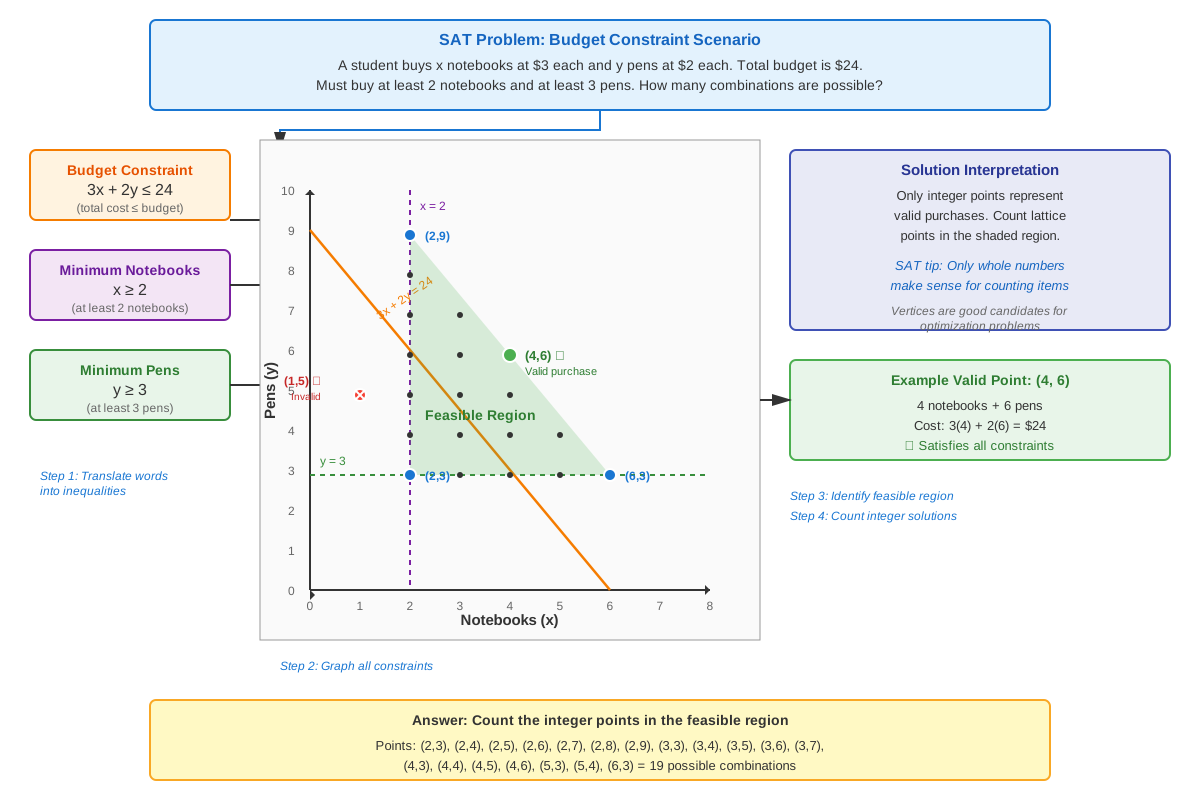
Common SAT question formats include: (1) word problems describing constraints that must be translated into inequalities and graphed, (2) multiple-choice questions showing four different shaded regions where students must identify the correct feasible region, (3) questions providing a graph and asking which point within the feasible region maximizes or minimizes a particular value, and (4) problems asking how many integer coordinate pairs lie within a feasible region. The topic frequently appears in contexts involving budgets, mixtures, production schedules, or any scenario with multiple limiting factors.
Core Concepts
Understanding Linear Inequalities in Two Variables
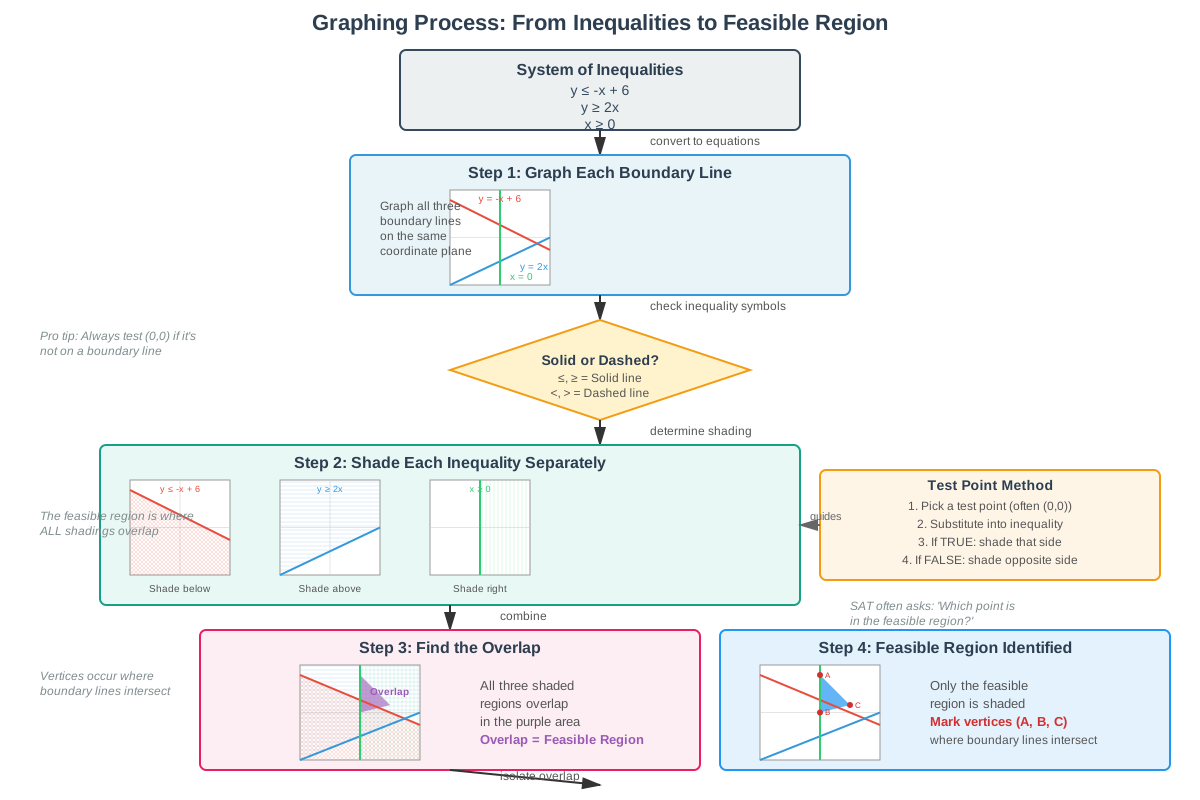
A linear inequality in two variables takes the form Ax + By < C, Ax + By > C, Ax + By ≤ C, or Ax + By ≥ C, where A, B, and C are constants. Unlike a linear equation that represents a single line, a linear inequality represents a half-plane—an entire region on one side of a boundary line. The boundary line itself is the equation Ax + By = C. When the inequality uses ≤ or ≥, the boundary line is included in the solution set (drawn as a solid line). When the inequality uses < or >, the boundary line is not included (drawn as a dashed line).
To graph a single linear inequality:
- Graph the boundary line by treating the inequality as an equation
- Determine whether the line should be solid (≤ or ≥) or dashed (< or >)
- Choose a test point not on the line (often the origin (0,0) if it's not on the line)
- Substitute the test point into the inequality
- If the inequality is true, shade the region containing the test point; if false, shade the opposite side
For example, to graph y ≤ 2x + 3, first graph the line y = 2x + 3 as a solid line (because of ≤). Testing the origin: 0 ≤ 2(0) + 3 → 0 ≤ 3, which is true, so shade the region containing the origin (below the line in this case).
Defining Feasible Regions
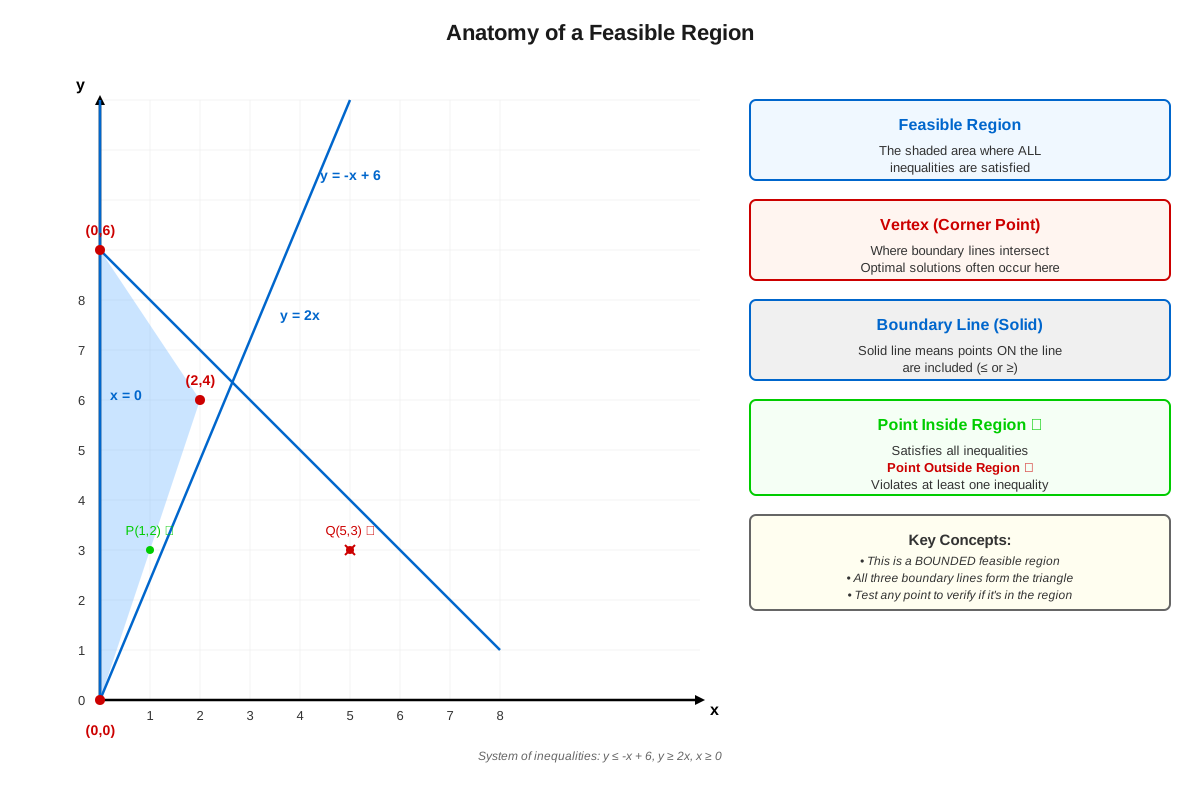
A feasible region is the set of all points that simultaneously satisfy all inequalities in a system. Graphically, it's the area where all the shaded regions from individual inequalities overlap. This intersection represents all possible solutions that meet every constraint in the problem. The term "feasible" comes from optimization contexts—these are the "feasible" or allowable solutions given all the restrictions.
Feasible regions have several important characteristics:
- Boundaries: The edges of the feasible region, formed by the boundary lines of the inequalities
- Vertices (corner points): Points where two or more boundary lines intersect; these are crucial in optimization problems
- Interior points: Points strictly inside the feasible region, not on any boundary
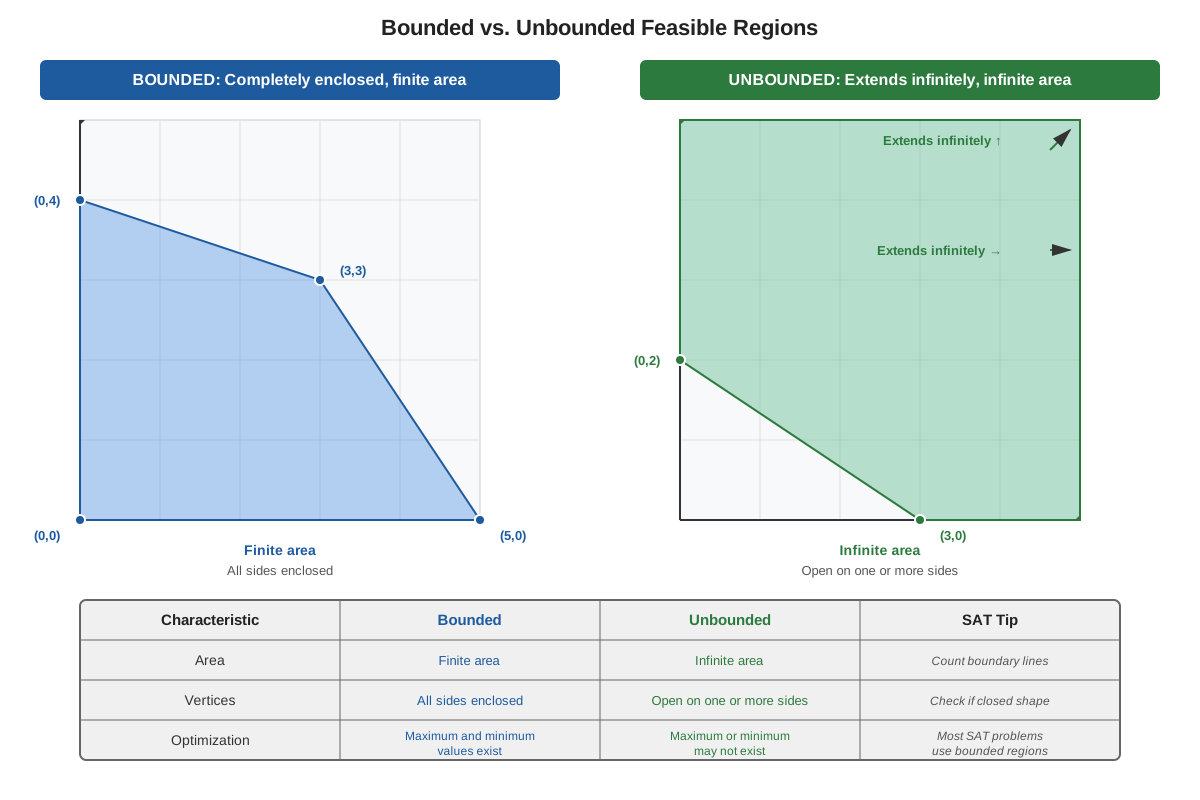
- Bounded vs. unbounded: A bounded feasible region is completely enclosed (like a polygon), while an unbounded region extends infinitely in at least one direction
Graphing Systems of Linear Inequalities
To graph a system of linear inequalities and identify the feasible region:
- Graph each inequality separately on the same coordinate plane, including proper shading
- Identify the overlap where all shaded regions intersect—this is the feasible region
- Mark the vertices by finding intersection points of boundary lines
- Verify the region by testing a point clearly inside the overlapping area in all original inequalities
Consider this system:
x + y ≤ 6
x ≥ 0
y ≥ 0
2x + y ≤ 8
Each inequality creates a half-plane. The first inequality (x + y ≤ 6) creates a region below and including the line x + y = 6. The constraints x ≥ 0 and y ≥ 0 restrict solutions to the first quadrant. The final inequality (2x + y ≤ 8) creates another region. The feasible region is the quadrilateral formed where all four conditions are satisfied simultaneously.
Testing Points in Feasible Regions
A critical SAT skill is determining whether a specific point lies within a feasible region. To test if point (a, b) is in the feasible region:
- Substitute x = a and y = b into each inequality
- Check if ALL inequalities are satisfied
- If even one inequality is false, the point is NOT in the feasible region
- If all inequalities are true, the point IS in the feasible region
For example, to test if (2, 3) is in the feasible region defined by x + y ≤ 6, x ≥ 1, and y ≥ 2:
- Check x + y ≤ 6: 2 + 3 = 5 ≤ 6 ✓
- Check x ≥ 1: 2 ≥ 1 ✓
- Check y ≥ 2: 3 ≥ 2 ✓
Since all three are satisfied, (2, 3) is in the feasible region.
Translating Word Problems into Inequalities
SAT questions often present constraints verbally, requiring translation into mathematical inequalities. Key phrases to recognize:
| Verbal Phrase | Mathematical Symbol | Example |
|---|---|---|
| "at most," "no more than," "maximum" | ≤ | "at most 10 hours" → h ≤ 10 |
| "at least," "no less than," "minimum" | ≥ | "at least $50" → m ≥ 50 |
| "less than," "fewer than" | < | "fewer than 20 items" → n < 20 |
| "more than," "greater than" | > | "more than 5 pounds" → w > 5 |
| "exactly," "equal to" | = | "exactly 100 points" → p = 100 |
When translating, identify what the variables represent, then convert each constraint into an inequality. For instance: "A student works at most 20 hours per week between two jobs. Job A pays $12/hour and Job B pays $15/hour. The student needs to earn at least $200 per week." This translates to:
- Let x = hours at Job A, y = hours at Job B
- x + y ≤ 20 (total hours constraint)
- 12x + 15y ≥ 200 (earnings constraint)
- x ≥ 0, y ≥ 0 (non-negativity constraints)
Special Cases and Edge Conditions
Empty feasible regions: Sometimes a system of inequalities has no solution—the constraints are contradictory. For example, x + y ≤ 3 and x + y ≥ 5 have no overlapping region. On the SAT, recognizing impossible constraint combinations is occasionally tested.
Unbounded feasible regions: When a feasible region extends infinitely, it's unbounded. For example, the system x ≥ 0, y ≥ 0, x + y ≥ 4 creates an unbounded region in the first quadrant above the line x + y = 4.
Single-line feasible regions: Rarely, the feasible region might be just a line segment or ray, occurring when constraints are very restrictive.
Concept Relationships
The concepts within feasible regions build hierarchically. Linear inequalities in two variables form the foundation—understanding how a single inequality creates a half-plane is essential before combining multiple inequalities. This leads directly to systems of linear inequalities, where multiple constraints must be satisfied simultaneously. The graphical representation of these systems produces the feasible region, which is the visual manifestation of all solutions. Within feasible regions, vertices (corner points) emerge as particularly important because optimization problems (finding maximum or minimum values) always have solutions at vertices in bounded regions.
The connection to prerequisite topics is strong. Linear equations provide the boundary lines for inequalities—every inequality boundary is simply the corresponding equation. Coordinate geometry enables the visualization and graphing of these regions. Systems of equations techniques help find vertices by solving for intersection points of boundary lines. The logical reasoning from single-variable inequalities extends naturally to two-variable cases.
Feasible regions also connect forward to more advanced topics. They're the geometric foundation for linear programming, where objective functions are optimized over feasible regions. They relate to absolute value inequalities when constraints involve distances. They appear in parametric equations when describing allowable parameter ranges.
Relationship map:
Linear Equations → Boundary Lines → Linear Inequalities → Half-Planes → Systems of Inequalities → Feasible Regions → Vertices → Optimization Problems
Quick check — test yourself on Feasible regions so far.
Try Flashcards →High-Yield Facts
⭐ The feasible region is the intersection (overlap) of all shaded regions from individual inequalities in a system
⭐ Use a solid line for ≤ or ≥ inequalities; use a dashed line for < or > inequalities
⭐ To test which side of a boundary line to shade, substitute a test point (usually the origin if not on the line) into the inequality
⭐ A point is in the feasible region only if it satisfies ALL inequalities in the system simultaneously
⭐ Vertices (corner points) of feasible regions are found by solving systems of equations formed by pairs of boundary lines
- Non-negativity constraints (x ≥ 0, y ≥ 0) restrict the feasible region to the first quadrant
- A bounded feasible region is completely enclosed and forms a polygon; an unbounded region extends infinitely
- The phrase "at most" translates to ≤, while "at least" translates to ≥
- If a test point makes an inequality false, shade the opposite side of the boundary line from that point
- Feasible regions can be triangles, quadrilaterals, or other polygons depending on the number and arrangement of constraints
- When counting integer points in a feasible region, check each candidate point individually in all inequalities
- Parallel boundary lines in a system create feasible regions with parallel edges
- If two inequalities have the same boundary line but opposite inequality signs, the feasible region is empty (no solutions)
- The feasible region for a single inequality is always a half-plane (infinite region on one side of a line)
- On the SAT, most feasible region problems involve 2-4 inequalities and create bounded regions
Common Misconceptions
Misconception: When graphing y < 2x + 1, the line y = 2x + 1 should be solid because it's part of the solution.
Correction: The strict inequality < means the boundary line is NOT included in the solution set, so it must be dashed. Only ≤ and ≥ use solid lines because they include the boundary.
Misconception: To find the feasible region, shade the region for each inequality separately and the feasible region is any area that has any shading.
Correction: The feasible region is only where ALL shaded regions overlap simultaneously. It's the intersection, not the union, of the individual solution sets.
Misconception: The origin (0,0) is always a good test point for determining which side of a line to shade.
Correction: The origin only works as a test point if it's NOT on the boundary line. If the line passes through the origin, choose a different test point like (1,0), (0,1), or (1,1).
Misconception: If a point lies on the boundary of a feasible region, it's always included in the feasible region.
Correction: Points on the boundary are only included if the corresponding inequality uses ≤ or ≥. If the boundary comes from a < or > inequality, points on that boundary are NOT in the feasible region.
Misconception: The feasible region is always a closed, bounded shape like a triangle or rectangle.
Correction: Feasible regions can be unbounded (extending infinitely) or even empty (no solutions). The shape depends entirely on the specific constraints in the system.
Misconception: When translating "no more than 10," the inequality should be x > 10.
Correction: "No more than 10" means the value cannot exceed 10, so it translates to x ≤ 10. The phrase indicates an upper limit, not a lower bound.
Misconception: To find vertices of a feasible region, substitute x = 0 and y = 0 into each equation.
Correction: Vertices are found by solving systems of equations formed by pairs of boundary lines. You need to find where two boundary lines intersect, which requires solving simultaneous equations.
Worked Examples
Example 1: Identifying and Graphing a Feasible Region
Problem: A bakery makes cookies and brownies. Each batch of cookies requires 2 hours of baking time and 1 pound of flour. Each batch of brownies requires 1 hour of baking time and 2 pounds of flour. The bakery has at most 12 hours of baking time and 10 pounds of flour available per day. Write a system of inequalities representing the constraints and describe the feasible region.
Solution:
Step 1: Define variables
- Let x = number of cookie batches
- Let y = number of brownie batches
Step 2: Translate constraints into inequalities
- Baking time constraint: 2x + y ≤ 12 (cookies use 2 hours each, brownies use 1 hour each, total at most 12 hours)
- Flour constraint: x + 2y ≤ 10 (cookies use 1 pound each, brownies use 2 pounds each, total at most 10 pounds)
- Non-negativity: x ≥ 0 and y ≥ 0 (cannot make negative batches)
Step 3: Graph each inequality
- For 2x + y ≤ 12: Boundary line is 2x + y = 12. Find intercepts: when x = 0, y = 12; when y = 0, x = 6. Draw a solid line through (0,12) and (6,0). Test (0,0): 2(0) + 0 = 0 ≤ 12 ✓, so shade toward the origin.
- For x + 2y ≤ 10: Boundary line is x + 2y = 10. Intercepts: (0,5) and (10,0). Solid line. Test (0,0): 0 + 0 = 0 ≤ 10 ✓, shade toward origin.
- For x ≥ 0: Solid vertical line at x = 0 (y-axis), shade to the right.
- For y ≥ 0: Solid horizontal line at y = 0 (x-axis), shade upward.
Step 4: Identify the feasible region
The feasible region is the quadrilateral in the first quadrant where all four shaded regions overlap. The vertices are:
- (0,0): intersection of x = 0 and y = 0
- (6,0): intersection of 2x + y = 12 and y = 0
- (0,5): intersection of x + 2y = 10 and x = 0
- To find the fourth vertex, solve 2x + y = 12 and x + 2y = 10 simultaneously:
- From first equation: y = 12 - 2x
- Substitute into second: x + 2(12 - 2x) = 10
- x + 24 - 4x = 10
- -3x = -14
- x = 14/3
- y = 12 - 2(14/3) = 12 - 28/3 = 8/3
- Fourth vertex: (14/3, 8/3) ≈ (4.67, 2.67)
Answer: The system is 2x + y ≤ 12, x + 2y ≤ 10, x ≥ 0, y ≥ 0. The feasible region is a quadrilateral with vertices at (0,0), (6,0), (14/3, 8/3), and (0,5).
Example 2: Testing Points in a Feasible Region
Problem: A feasible region is defined by the system: x + y ≤ 8, 2x - y ≥ 2, x ≥ 0, y ≥ 0. Which of the following points lie within the feasible region?
A) (2, 5)
B) (4, 3)
C) (1, 1)
D) (5, 4)
Solution:
Test each point by substituting into all four inequalities.
Point A: (2, 5)
- x + y ≤ 8: 2 + 5 = 7 ≤ 8 ✓
- 2x - y ≥ 2: 2(2) - 5 = 4 - 5 = -1 ≥ 2 ✗ (FALSE)
- Since one inequality fails, (2, 5) is NOT in the feasible region.
Point B: (4, 3)
- x + y ≤ 8: 4 + 3 = 7 ≤ 8 ✓
- 2x - y ≥ 2: 2(4) - 3 = 8 - 3 = 5 ≥ 2 ✓
- x ≥ 0: 4 ≥ 0 ✓
- y ≥ 0: 3 ≥ 0 ✓
- All inequalities satisfied, so (4, 3) IS in the feasible region.
Point C: (1, 1)
- x + y ≤ 8: 1 + 1 = 2 ≤ 8 ✓
- 2x - y ≥ 2: 2(1) - 1 = 2 - 1 = 1 ≥ 2 ✗ (FALSE)
- (1, 1) is NOT in the feasible region.
Point D: (5, 4)
- x + y ≤ 8: 5 + 4 = 9 ≤ 8 ✗ (FALSE)
- (5, 4) is NOT in the feasible region.
Answer: Only point B, (4, 3), lies within the feasible region.
Connection to learning objectives: This example demonstrates how to apply feasible regions to answer SAT-style questions by systematically testing points against all constraints, a common question format on the exam.
Exam Strategy
When approaching SAT feasible region questions, follow this systematic process:
1. Identify the question type: Determine whether you need to graph a system, test points, translate constraints, or find vertices. This dictates your approach.
2. For graphing questions:
- Quickly sketch the boundary lines (you don't need perfect precision on the SAT)
- Mark intercepts to place lines accurately
- Use solid vs. dashed lines correctly
- Test one point (usually origin) to determine shading direction
- Look for the overlap region
3. For point-testing questions:
- Substitute the point into each inequality systematically
- Stop testing as soon as one inequality fails (the point is out)
- Double-check arithmetic, especially with negative numbers
4. For word problems:
- Define variables clearly before writing inequalities
- Identify constraint phrases ("at most," "at least," "no more than")
- Don't forget non-negativity constraints (x ≥ 0, y ≥ 0) when quantities can't be negative
- Verify your inequalities make logical sense in context
Trigger words to watch for:
- "at most," "maximum," "no more than" → ≤
- "at least," "minimum," "no less than" → ≥
- "feasible," "possible," "allowable" → indicates feasible region concept
- "satisfy all constraints" → all inequalities must be true
- "corner point," "vertex" → intersection of boundary lines
Process of elimination tips:
- If a graph shows dashed lines for ≤ or ≥ inequalities, eliminate it
- If the shaded region doesn't include the origin when (0,0) should satisfy all inequalities, eliminate it
- If a point clearly violates one obvious constraint, eliminate answers including that point
- For "which system represents..." questions, test the given constraints against the graph's features
Time allocation: Feasible region questions typically take 1.5-2.5 minutes. If graphing from scratch takes too long, test answer choices by substituting points. If finding exact vertices algebraically is time-consuming, estimate from the graph for multiple-choice questions.
Exam Tip: On graphing calculator-permitted sections, you can graph inequalities using the calculator's inequality mode to verify your answer, but practice sketching by hand for the no-calculator section.
Memory Techniques
SOLID vs. DASHED mnemonic: "Solid Only with Less-or-equal and Dashed for Strict"
- Solid lines: ≤ and ≥ (includes the boundary)
- Dashed lines: < and > (excludes the boundary)
MOST-LEAST mnemonic: "Most means Minus (≤), Least means Larger-or-equal (≥)"
- "At most" → ≤ (can't go higher)
- "At least" → ≥ (can't go lower)
TEST acronym for checking points:
- Take the point coordinates
- Enter them into each inequality
- Substitute and simplify
- True for all? Then it's in the region!
Visualization technique: Imagine the feasible region as a "safe zone" where all rules are followed. Each inequality is a fence or boundary. The feasible region is where you can stand without breaking any rules. Solid fences you can touch; dashed fences you can't.
Vertex finding: Remember "Two Lines Meet" → To find vertices, solve Two Lines simultaneously using substitution or elimination Method.
Shading direction: "Test Origin First" (TOF) - Test the Origin First unless it's on a boundary line. If the origin makes the inequality true, shade toward it; if false, shade away from it.
Summary
Feasible regions represent the solution sets to systems of linear inequalities, visualized as overlapping shaded areas on the coordinate plane. Mastering this topic requires three interconnected skills: translating verbal constraints into mathematical inequalities, graphing these inequalities correctly with appropriate boundary lines (solid for ≤ and ≥, dashed for < and >), and identifying the intersection region where all constraints are simultaneously satisfied. The feasible region contains all points that make every inequality in the system true. Key features include vertices (corner points where boundary lines intersect), boundaries (the edges of the region), and the distinction between bounded regions (completely enclosed) and unbounded regions (extending infinitely). On the SAT, feasible region questions appear in real-world contexts involving constraints like budgets, time limits, or resource availability. Success requires systematic approaches: when graphing, use test points to determine shading direction; when testing points, substitute into all inequalities and verify all are satisfied; when translating word problems, identify constraint phrases and remember non-negativity conditions. The vertices of feasible regions are particularly important in optimization contexts, found by solving systems of equations from pairs of boundary lines.
Key Takeaways
- Feasible regions are the intersection of all shaded regions from a system of linear inequalities—only the overlapping area satisfies all constraints simultaneously
- Boundary line style matters: solid lines (≤, ≥) include the boundary in the solution; dashed lines (<, >) exclude it
- To test if a point is in the feasible region, substitute it into every inequality—all must be true for the point to be included
- Translate constraint phrases carefully: "at most" means ≤, "at least" means ≥, and don't forget x ≥ 0, y ≥ 0 for non-negative quantities
- Vertices (corner points) are found by solving pairs of boundary line equations simultaneously and are crucial for optimization problems
- Use test points (typically the origin if not on a boundary) to determine which side of each boundary line to shade
- SAT feasible region questions often involve real-world contexts with 2-4 constraints, creating bounded polygonal regions in the first quadrant
Related Topics
Linear Programming and Optimization: Feasible regions form the foundation for linear programming, where objective functions (like profit or cost) are maximized or minimized over the feasible region. The optimal solution always occurs at a vertex of a bounded feasible region.
Systems of Linear Equations: While feasible regions deal with inequalities, the techniques for finding vertices require solving systems of linear equations. Strengthening equation-solving skills directly improves feasible region work.
Absolute Value Inequalities: These create V-shaped or bounded regions on the coordinate plane and can be combined with linear inequalities to form more complex feasible regions.
Parametric Equations and Constraints: In advanced mathematics, feasible regions help describe allowable parameter values in parametric systems, extending the concept beyond linear constraints.
Piecewise Functions: Understanding how different rules apply in different regions of the coordinate plane connects to how feasible regions partition the plane based on constraints.
Mastering feasible regions enables progression to optimization problems, provides geometric insight into constraint satisfaction, and develops the spatial reasoning skills essential for advanced mathematics and real-world problem-solving.
Practice CTA
Now that you've mastered the core concepts of feasible regions, it's time to cement your understanding through practice! Attempt the practice questions to apply these concepts to SAT-style problems, testing your ability to graph systems, identify regions, and solve constraint-based scenarios. Use the flashcards to reinforce key definitions, translation phrases, and graphing rules until they become automatic. Remember: feasible regions questions are high-yield on the SAT—investing time in practice now will pay dividends on test day. Each problem you solve strengthens your pattern recognition and builds the confidence needed to tackle these questions quickly and accurately under exam conditions. You've got this!
Sign up free to keep reading
Create a free AnvayaPrep account to finish this SAT guide on Feasible regions — plus flashcards and practice questions.