Overview
Inequality signs form the foundation of expressing mathematical relationships where values are not equal but instead greater than, less than, or within a range of one another. On the SAT math section, understanding these symbols and their properties is absolutely critical—they appear in approximately 10-15% of all questions across both calculator and no-calculator portions. Mastery of inequality signs enables students to solve linear inequalities, interpret graphs, analyze real-world constraints, and tackle complex algebraic problems that test logical reasoning alongside computational skills.
The SAT frequently embeds sat inequality signs within word problems, coordinate geometry questions, and systems of equations. Unlike simple equations where a single solution exists, inequalities describe solution sets—often infinite ranges of values that satisfy given conditions. This conceptual shift from discrete answers to continuous ranges challenges students to think more flexibly about mathematical relationships. Questions may ask students to identify which inequality represents a scenario, determine solution sets on number lines, or manipulate inequalities while preserving their truth.
Understanding inequality signs connects directly to broader mathematical concepts including linear functions, absolute value, systems of equations, and even quadratic relationships. The rules governing inequality manipulation—particularly what happens when multiplying or dividing by negative numbers—form a cornerstone of algebraic reasoning that extends throughout higher mathematics. Students who master inequality signs gain powerful tools for modeling constraints, optimization problems, and real-world scenarios where exact equality rarely occurs but ranges and boundaries define acceptable solutions.
Learning Objectives
- [ ] Identify key features of inequality signs and distinguish between the four primary symbols
- [ ] Explain how inequality signs appear on the SAT across multiple question formats
- [ ] Apply inequality signs to answer SAT-style questions involving algebraic manipulation and word problems
- [ ] Demonstrate proper reversal of inequality direction when multiplying or dividing by negative values
- [ ] Translate verbal descriptions of constraints into correct inequality notation
- [ ] Graph solution sets of inequalities on number lines with appropriate notation
- [ ] Solve compound inequalities and express solutions in multiple formats
Prerequisites
- Basic algebraic operations: Students must perform addition, subtraction, multiplication, and division with variables and constants, as these operations form the basis of inequality manipulation
- Number line understanding: Visualizing numbers on a continuous line helps interpret inequality solutions and determine which values satisfy given conditions
- Equation-solving skills: The process of isolating variables in equations directly transfers to solving inequalities, with one critical modification regarding sign reversal
- Negative number operations: Comfort with negative numbers is essential since multiplying or dividing by negatives triggers the inequality reversal rule
Why This Topic Matters
Inequality signs represent one of the most practical mathematical tools students encounter. In real-world applications, constraints and boundaries appear everywhere: speed limits establish maximum velocities, minimum age requirements restrict access, budget constraints limit spending, and acceptable ranges define quality control in manufacturing. Scientists use inequalities to express measurement uncertainties, economists model supply and demand constraints, and engineers specify tolerances for component dimensions. The ability to translate real-world limitations into mathematical notation and solve for acceptable ranges is a fundamental skill across STEM fields and everyday decision-making.
On the SAT, inequality questions appear with remarkable consistency. Approximately 3-5 questions per test directly involve inequality signs, while many additional questions incorporate inequalities within larger problems. The College Board tests inequalities through multiple formats: pure algebraic manipulation (solve for x), word problems requiring translation from English to mathematical notation, coordinate geometry questions involving shaded regions, and data interpretation scenarios where students must identify which inequality matches a given constraint. Questions range from straightforward one-step inequalities to complex compound inequalities requiring multiple operations.
The SAT particularly favors questions that combine inequality understanding with other concepts. Students might encounter a linear function problem where they must determine for which x-values the function exceeds a certain threshold, or a system of inequalities question requiring identification of the solution region on a coordinate plane. The test also includes questions where students must recognize that multiplying both sides of an inequality by a negative expression reverses the inequality sign—a concept that frequently appears in answer choices designed to trap students who forget this critical rule.
Core Concepts
The Four Primary Inequality Signs
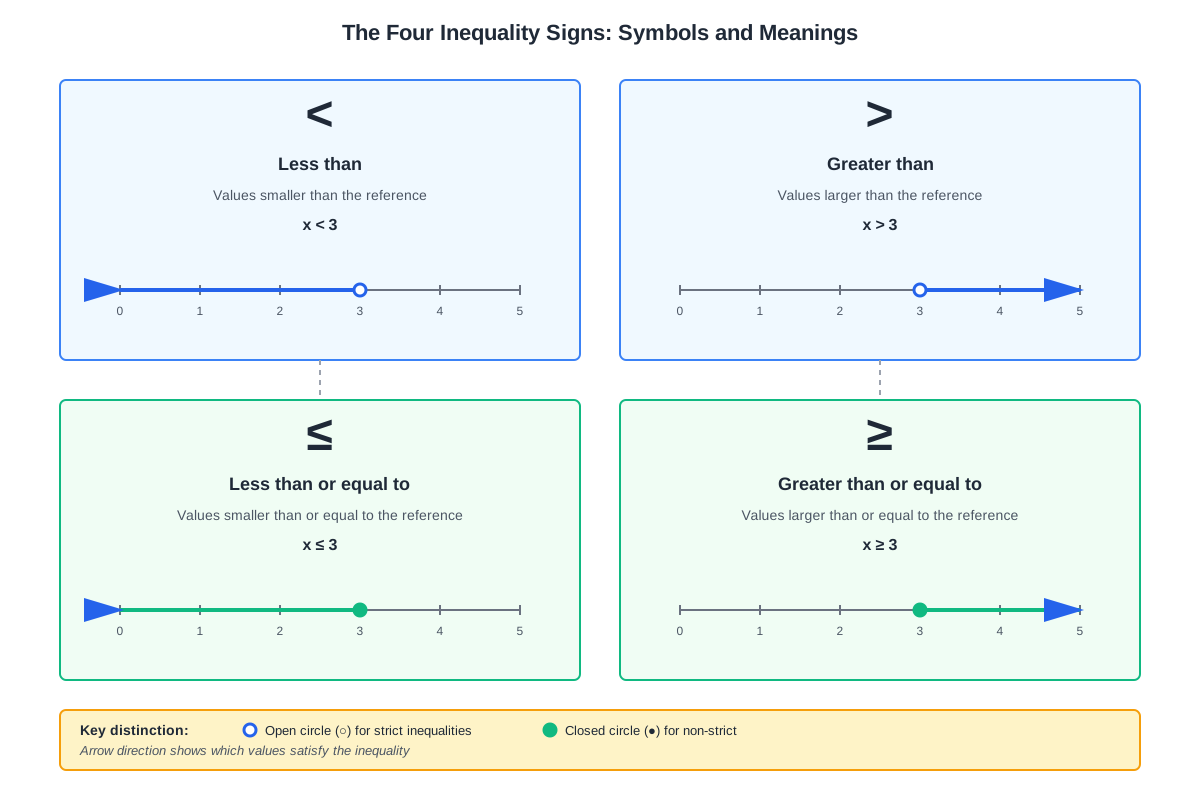
Inequality signs are mathematical symbols that express relationships between quantities where one value is larger, smaller, or not equal to another. The four fundamental symbols each convey distinct meaning:
| Symbol | Name | Meaning | Example | Read As |
|---|---|---|---|---|
| < | Less than | Left value is smaller | x < 5 | "x is less than 5" |
| > | Greater than | Left value is larger | x > 5 | "x is greater than 5" |
| ≤ | Less than or equal to | Left value is smaller or equal | x ≤ 5 | "x is less than or equal to 5" |
| ≥ | Greater than or equal to | Left value is larger or equal | x ≥ 5 | "x is greater than or equal to 5" |
The distinction between strict inequalities (< and >) versus inclusive inequalities (≤ and ≥) is crucial. Strict inequalities exclude the boundary value itself—if x < 5, then x cannot equal 5. Inclusive inequalities include the boundary—if x ≤ 5, then x = 5 is a valid solution. On number line graphs, strict inequalities use open circles (○) at boundary points, while inclusive inequalities use closed circles (●).
Properties of Inequalities
Inequalities follow most algebraic rules that equations follow, with one critical exception. Understanding which operations preserve inequality direction and which reverse it determines success on SAT questions.
Operations that preserve inequality direction:
- Adding or subtracting the same value to both sides
- If a < b, then a + c < b + c
- If x > 7, then x + 3 > 10
- Multiplying or dividing both sides by a positive number
- If a < b and c > 0, then ac < bc
- If 2x < 10, then x < 5 (dividing both sides by 2)
- Taking the same root or power of both sides when all values are positive
- If a < b and both are positive, then a² < b²
Operations that reverse inequality direction:
- Multiplying or dividing both sides by a negative number
- If a < b and c < 0, then ac > bc
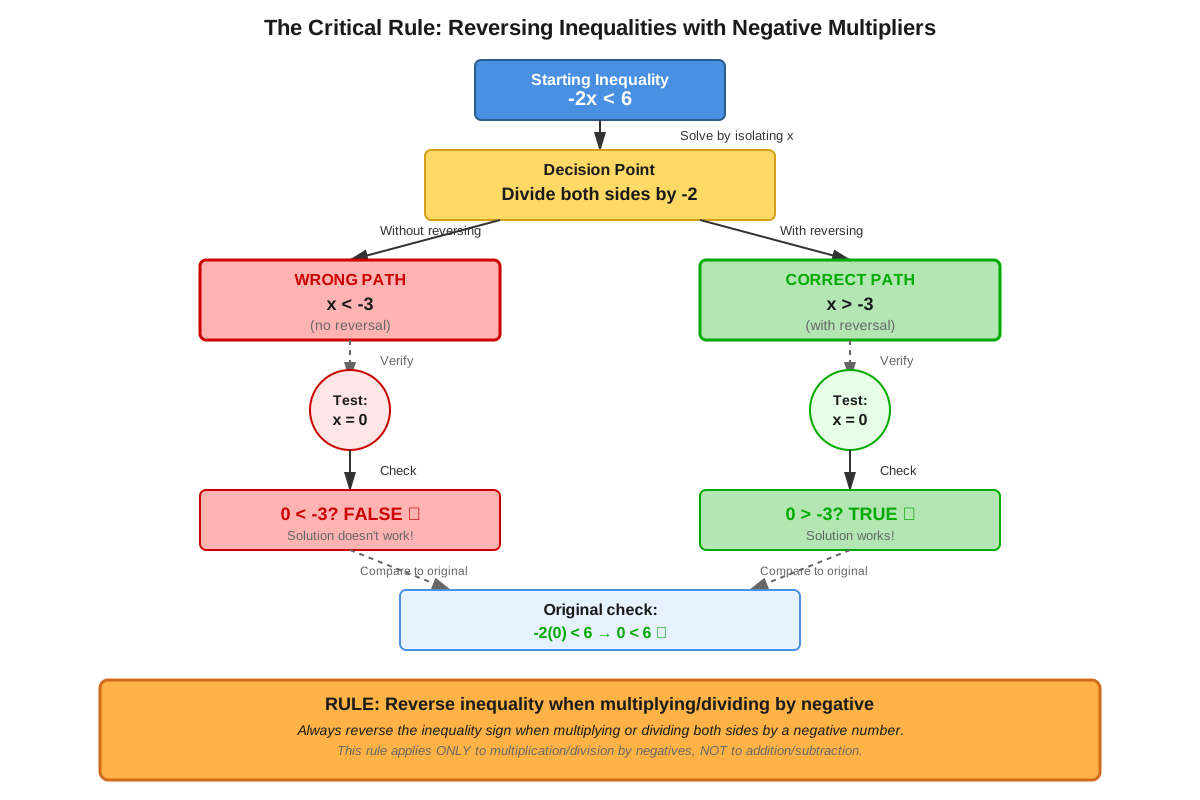
- If -2x < 10, then x > -5 (dividing both sides by -2 reverses the sign)
This reversal rule represents the single most tested concept regarding inequality manipulation on the SAT. The logic behind it: if 3 < 5, multiplying both sides by -1 gives -3 and -5, but -3 > -5 (negative three is to the right of negative five on the number line, making it larger).
Solving Linear Inequalities
The process for solving linear inequalities mirrors equation-solving with constant awareness of the reversal rule:
- Simplify both sides by combining like terms
- Isolate the variable term on one side using addition or subtraction
- Isolate the variable by multiplying or dividing
- Reverse the inequality sign if multiplying or dividing by a negative
- Express the solution in appropriate notation
Example: Solve 3 - 2x ≥ 11
- Subtract 3 from both sides: -2x ≥ 8
- Divide both sides by -2: x ≤ -4 (sign reverses!)
- Solution: all values less than or equal to -4
Compound Inequalities
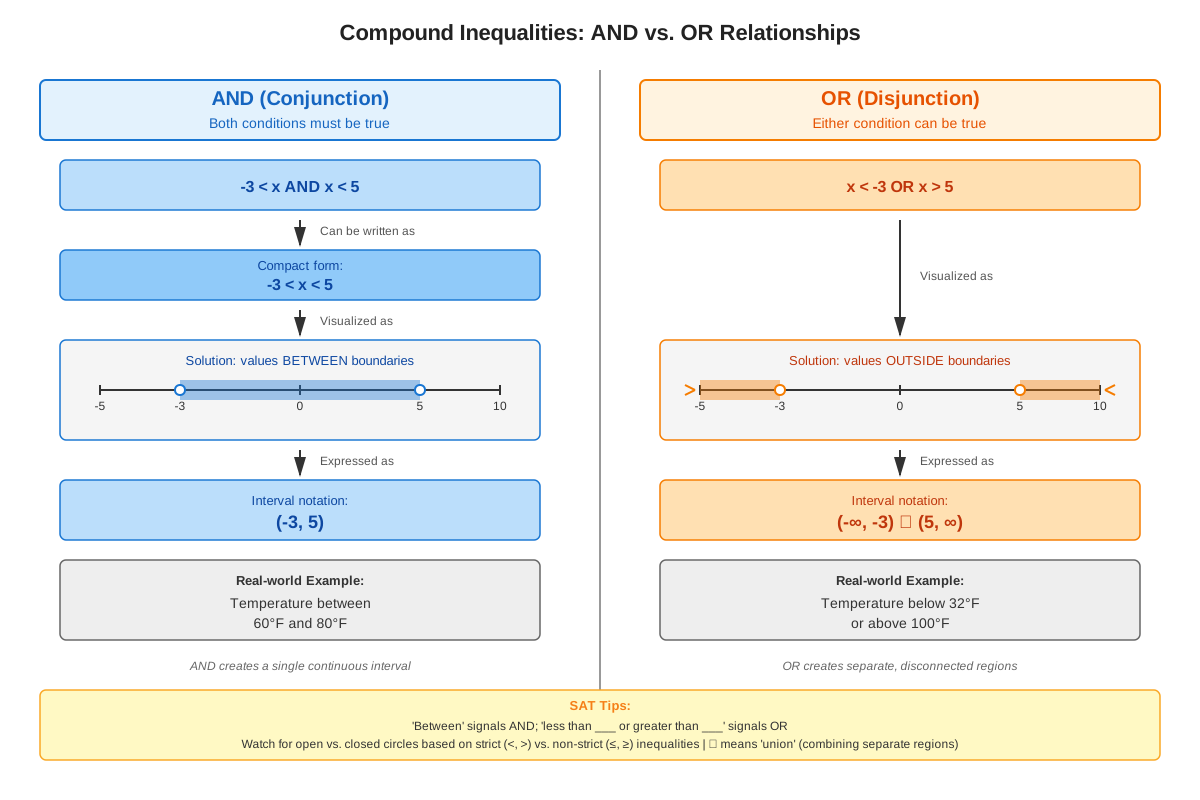
Compound inequalities express two simultaneous conditions. They appear in two forms:
Conjunction (AND): Both conditions must be true simultaneously
- Written as: a < x < b (meaning x > a AND x < b)
- Example: -3 < x ≤ 5 means x is greater than -3 AND less than or equal to 5
- Solution set: the intersection of both conditions
Disjunction (OR): At least one condition must be true
- Written as: x < a OR x > b
- Example: x < -2 OR x ≥ 4
- Solution set: the union of both conditions
To solve compound inequalities written as a < expression < b, perform the same operation to all three parts while maintaining inequality relationships. For example, to solve 2 < 3x - 1 ≤ 11:
- Add 1 to all parts: 3 < 3x ≤ 12
- Divide all parts by 3: 1 < x ≤ 4
Graphing Inequalities on Number Lines
Visual representation of inequality solutions reinforces understanding and appears frequently on SAT questions. The conventions are:
- Open circle (○): Use for strict inequalities (< or >) to show the boundary value is excluded
- Closed circle (●): Use for inclusive inequalities (≤ or ≥) to show the boundary value is included
- Shading/arrow: Extends in the direction of values that satisfy the inequality
For x < 3: place an open circle at 3, shade left
For x ≥ -2: place a closed circle at -2, shade right
For -1 ≤ x < 4: closed circle at -1, open circle at 4, shade between them
Translating Word Problems to Inequalities
The SAT frequently requires converting verbal descriptions into inequality notation. Key phrases signal specific symbols:
- "At least," "no less than," "minimum of" → ≥
- "At most," "no more than," "maximum of" → ≤
- "More than," "exceeds," "greater than" → >
- "Less than," "fewer than," "below" → <
- "Between a and b" → a < x < b (or with ≤ depending on whether endpoints are included)
Example: "A rental car costs $40 per day plus $0.25 per mile. Sarah's budget is at most $100."
Translation: 40 + 0.25m ≤ 100, where m represents miles driven.
Concept Relationships
The concepts within inequality signs form a logical progression. Understanding the four primary symbols provides the foundation → which enables recognition of when operations preserve or reverse direction → which allows solving linear inequalities → which extends to compound inequalities → which can be represented graphically on number lines → and all of these skills combine when translating word problems into mathematical notation.
Inequality signs connect directly to prerequisite knowledge of equation-solving. The algebraic manipulation techniques students learned for equations transfer almost entirely to inequalities, with the critical addition of the reversal rule. This connection means students don't learn an entirely new skill set but rather extend existing knowledge with one important modification.
Looking forward, mastery of inequality signs enables progression to systems of linear inequalities (graphing multiple inequalities on coordinate planes and finding solution regions), absolute value inequalities (which split into compound inequalities), quadratic inequalities (requiring factoring and sign analysis), and optimization problems (where inequalities represent constraints). The concept also appears in functions when determining domain and range restrictions, and in statistics when expressing confidence intervals and margins of error.
The relationship between inequalities and number lines creates a bidirectional connection: inequalities can be graphed on number lines for visualization, while number line diagrams can be translated back into inequality notation. This visual-symbolic connection reinforces understanding and provides multiple pathways for problem-solving.
Quick check — test yourself on Inequality signs so far.
Try Flashcards →High-Yield Facts
⭐ Multiplying or dividing both sides of an inequality by a negative number reverses the inequality sign—this is the most commonly tested property on the SAT
⭐ The symbol ≤ means "less than or equal to" and includes the boundary value, while < excludes it
⭐ When graphing on a number line, use a closed circle (●) for ≤ or ≥, and an open circle (○) for < or >
⭐ Compound inequalities written as a < x < b mean x satisfies both conditions simultaneously (x is greater than a AND less than b)
⭐ Adding or subtracting the same value to both sides of an inequality never changes the inequality direction
- The phrase "at least" translates to ≥ (greater than or equal to), while "at most" translates to ≤ (less than or equal to)
- When solving compound inequalities like 2 < 3x - 1 ≤ 11, perform the same operation to all three parts
- Inequalities describe solution sets (often infinite ranges) rather than single solutions like equations
- The solution to x < 5 includes all real numbers less than 5, such as 4.9, 0, -100, but not 5 itself
- Multiplying both sides by a positive number preserves the inequality direction: if x < 5, then 2x < 10
- The inequality x > 3 OR x < -1 represents a disjunction where values can satisfy either condition
- When an inequality includes a variable in the denominator, consider restrictions where the denominator cannot equal zero
Common Misconceptions
Misconception: The inequality sign always points to the smaller number
Correction: The inequality sign opens toward the larger value. In x < 5, the open side faces 5 (the larger value), and the point faces x (which must be smaller). Think of the symbol as a mouth that wants to eat the bigger number.
Misconception: When solving -x < 3, dividing by -1 gives x < -3
Correction: Dividing both sides by -1 requires reversing the inequality sign, giving x > -3. Any time you multiply or divide by a negative value, the inequality direction flips.
Misconception: The solution to x ≤ 5 is just x = 5
Correction: The solution includes all values less than 5 AND the value 5 itself. This represents infinitely many numbers: 5, 4.99, 4, 0, -10, etc.
Misconception: "At least 10" means x < 10
Correction: "At least 10" means the minimum value is 10, so x ≥ 10. The value can be 10 or anything greater. Similarly, "at most 10" means x ≤ 10.
Misconception: When graphing x > 3, use a closed circle at 3
Correction: Use an open circle at 3 because the strict inequality (>) excludes the boundary value. Only ≥ or ≤ use closed circles to indicate the boundary value is included.
Misconception: Squaring both sides of an inequality always preserves the direction
Correction: Squaring can reverse inequalities when negative numbers are involved. If -3 < 2, squaring gives 9 and 4, but 9 > 4. Only when both sides are positive does squaring preserve direction.
Misconception: The compound inequality x < 2 OR x > 5 means 2 < x < 5
Correction: The OR statement means x is either less than 2 OR greater than 5—values outside the interval [2, 5]. The notation 2 < x < 5 represents AND (x is greater than 2 AND less than 5), which is the opposite region.
Worked Examples
Example 1: Solving an Inequality with Sign Reversal
Problem: Solve for x: 5 - 3x ≥ 17
Solution:
Step 1: Isolate the term containing x by subtracting 5 from both sides
- 5 - 3x - 5 ≥ 17 - 5
- -3x ≥ 12
Step 2: Divide both sides by -3 to isolate x
- Remember: dividing by a negative number reverses the inequality sign
- -3x ÷ (-3) ≤ 12 ÷ (-3)
- x ≤ -4
Step 3: Verify the solution by testing a value
- Test x = -5 (which should satisfy x ≤ -4): 5 - 3(-5) = 5 + 15 = 20, and 20 ≥ 17 ✓
- Test x = 0 (which should NOT satisfy x ≤ -4): 5 - 3(0) = 5, and 5 ≥ 17 ✗
Answer: x ≤ -4
This problem directly addresses the learning objective of applying inequality signs while demonstrating the critical reversal rule. The verification step reinforces that the solution represents all values less than or equal to -4.
Example 2: Translating and Solving a Word Problem
Problem: A cell phone plan charges a $25 monthly fee plus $0.10 per text message. If Marcus wants to spend no more than $40 per month, what is the maximum number of text messages he can send?
Solution:
Step 1: Identify the constraint and translate to inequality notation
- Monthly cost = fixed fee + (cost per text × number of texts)
- "No more than $40" means ≤ 40
- Let t = number of text messages
- Inequality: 25 + 0.10t ≤ 40
Step 2: Solve for t
- Subtract 25 from both sides: 0.10t ≤ 15
- Divide both sides by 0.10: t ≤ 150
- (Note: dividing by positive 0.10 preserves the inequality direction)
Step 3: Interpret the solution in context
- Marcus can send at most 150 text messages
- Any value from 0 to 150 texts keeps his bill at or below $40
Step 4: Verify with boundary value
- If t = 150: 25 + 0.10(150) = 25 + 15 = 40 ✓
- If t = 151: 25 + 0.10(151) = 25 + 15.10 = 40.10, which exceeds $40 ✓
Answer: Marcus can send a maximum of 150 text messages
This example demonstrates translating verbal constraints into mathematical notation, solving the resulting inequality, and interpreting the solution in real-world context—all high-yield skills for SAT word problems.
Exam Strategy
When approaching SAT questions involving inequality signs, begin by identifying what the question asks: Are you solving for a variable, translating a word problem, or identifying which inequality matches a scenario? This initial classification determines your approach.
Trigger words and phrases to watch for:
- "At least," "minimum," "no less than" → signals ≥
- "At most," "maximum," "no more than" → signals ≤
- "More than," "exceeds" → signals >
- "Less than," "fewer than" → signals <
- "Between" → signals compound inequality
- Any mention of "budget," "limit," or "constraint" → likely requires inequality notation
Process-of-elimination strategies:
- When answer choices show different inequality signs, immediately check whether the boundary value should be included (closed circle/≤ or ≥) or excluded (open circle/< or >)
- If you're unsure about sign direction after solving, test a simple value in both the original inequality and your answer—they should agree
- For word problems, eliminate answers that use the wrong inequality symbol by checking whether the boundary value makes sense in context
- When answers differ only in inequality direction, focus on whether you multiplied or divided by a negative during solving
Time allocation advice:
Straightforward inequality-solving questions should take 30-45 seconds. Word problems requiring translation may take 60-90 seconds. If you find yourself spending more than 90 seconds, mark the question and return to it after completing easier problems. The most time-consuming step is usually translating verbal descriptions accurately—practice this skill to build speed.
Common trap answers:
- The SAT frequently includes answer choices showing the correct boundary value but wrong inequality direction (testing whether you remembered to reverse the sign)
- Watch for answers that use strict inequalities when inclusive ones are needed, or vice versa
- Be alert for answers that correctly solve the inequality but fail to answer what the question actually asks (e.g., solving for x when the question asks for 2x)
Exam Tip: Always perform a quick reasonableness check. If solving an inequality about "at least 50 people" gives you x < 50, you know something went wrong—the answer should be x ≥ 50.
Memory Techniques
Mnemonic for inequality direction: "The alligator eats the bigger number." The inequality symbol looks like an alligator's mouth that opens toward the larger value. In 3 < 7, the mouth opens toward 7 because it's bigger.
Mnemonic for "at least" vs. "at most":
- "At LEAST" = "Greater than or Equal" (both have E's)
- "At MOST" = "Less than or equal" (think: "most" sounds like "low-st")
Visualization for sign reversal: Picture a number line. When you multiply by a negative, you're flipping the entire line around zero. Everything that was to the right (greater) is now to the left (less), so the inequality reverses. Visualize -2x < 6 as "negative two x's" pointing left, so when you divide by -2 to get x alone, you're flipping direction to point right: x > -3.
Acronym for solving steps - SIRD:
- Simplify both sides
- Isolate the variable term
- Reverse sign if multiplying/dividing by negative
- Determine solution set
Circle memory trick:
- Closed circle = Can equal (≤ or ≥)
- Open circle = Only less/greater (< or >)
Compound inequality visualization: For a < x < b, visualize x trapped between two walls at positions a and b. The x must stay between them. For x < a OR x > b, visualize x escaping to either side, outside the walls.
Summary
Inequality signs represent mathematical relationships where values are not equal but instead greater than, less than, or within specified ranges. The four primary symbols—<, >, ≤, and ≥—each convey distinct meanings, with strict inequalities excluding boundary values and inclusive inequalities including them. Mastering inequality manipulation requires understanding that most algebraic operations preserve inequality direction, but multiplying or dividing by negative numbers reverses the sign. This reversal rule represents the most frequently tested concept on the SAT. Solving linear inequalities follows the same process as solving equations with constant awareness of when sign reversal occurs. Compound inequalities express two simultaneous conditions, either as conjunctions (AND) or disjunctions (OR), and can be solved by performing operations across all parts. Graphing solutions on number lines uses open circles for strict inequalities and closed circles for inclusive ones. Success on SAT inequality questions requires translating verbal constraints into mathematical notation, recognizing trigger phrases like "at least" and "at most," and verifying solutions through substitution. The ability to work fluently with inequality signs enables students to model real-world constraints and solve optimization problems across mathematics.
Key Takeaways
- Multiplying or dividing both sides of an inequality by a negative number reverses the inequality sign—this is the single most important rule and most commonly tested concept
- The four inequality symbols convey distinct relationships: < (less than), > (greater than), ≤ (less than or equal to), and ≥ (greater than or equal to), with the latter two including boundary values
- When graphing inequalities on number lines, use closed circles (●) for ≤ or ≥ and open circles (○) for < or >, with shading extending in the direction of values satisfying the inequality
- Compound inequalities like a < x < b represent AND conditions where x must satisfy both simultaneously, while x < a OR x > b represents disjunction where either condition suffices
- Key translation phrases include "at least" (≥), "at most" (≤), "more than" (>), and "less than" (<)—recognizing these enables accurate conversion from word problems to mathematical notation
- Adding or subtracting the same value to both sides never changes inequality direction, while multiplying or dividing by positive numbers preserves direction
- Always verify solutions by testing values, especially when unsure whether sign reversal was needed during solving
Related Topics
Systems of Linear Inequalities: Building on single inequality mastery, systems involve graphing multiple inequalities on coordinate planes and identifying solution regions where shaded areas overlap. This topic appears frequently in SAT questions involving optimization and constraint modeling.
Absolute Value Inequalities: These combine absolute value concepts with inequalities, typically splitting into compound inequalities. For example, |x - 3| < 5 becomes -5 < x - 3 < 5. Mastering basic inequality signs is essential before tackling absolute value variations.
Quadratic Inequalities: These extend linear inequality concepts to quadratic expressions, requiring factoring and sign analysis to determine solution intervals. Understanding inequality notation and graphing provides the foundation for this more advanced topic.
Linear Programming: This optimization technique uses systems of linear inequalities to model constraints and find maximum or minimum values. Business, economics, and engineering applications rely heavily on this practical extension of inequality concepts.
Interval Notation: An alternative way to express inequality solutions using brackets and parentheses, such as [2, 5) for 2 ≤ x < 5. This notation appears in advanced mathematics and provides a compact way to represent solution sets.
Practice CTA
Now that you've mastered the core concepts of inequality signs, it's time to solidify your understanding through active practice. Attempt the practice questions designed specifically for this topic—they mirror actual SAT question formats and difficulty levels. Work through each problem methodically, paying special attention to sign reversal situations and word problem translations. Use the flashcards to drill the key facts and translation phrases until they become automatic. Remember: understanding the concepts is the first step, but fluency comes from repeated application. The more you practice recognizing inequality patterns and avoiding common traps, the more confident and accurate you'll become on test day. You've got this!
Sign up free to keep reading
Create a free AnvayaPrep account to finish this SAT guide on Inequality signs — plus flashcards and practice questions.