Overview
Inequality transformations are fundamental algebraic operations that allow students to manipulate and solve inequalities while preserving their truth values. On the SAT math section, understanding how to correctly transform inequalities is crucial because these questions appear frequently across multiple question types, from straightforward algebraic manipulation to complex word problems involving constraints and optimization. Unlike equations, inequalities require special attention to direction-changing rules, particularly when multiplying or dividing by negative numbers—a distinction that the SAT deliberately tests through carefully crafted distractors.
Mastering inequality transformations enables students to solve real-world problems involving ranges, constraints, and comparative relationships. The SAT presents these concepts in various contexts: determining possible values for variables, analyzing solution sets on number lines, and interpreting inequalities in applied scenarios such as budgeting, measurement tolerances, and rate problems. Students who thoroughly understand transformation rules can confidently navigate both the Heart of Algebra and Problem Solving and Data Analysis domains of the SAT.
The relationship between inequality transformations and broader mathematical concepts is essential. These transformations build directly on equation-solving techniques while introducing critical modifications that affect solution interpretation. They connect to graphing linear inequalities, systems of inequalities, absolute value inequalities, and quadratic inequalities—all topics that may appear on the SAT. Understanding how transformations affect inequality direction and solution sets provides the foundation for more advanced mathematical reasoning required for competitive SAT scores.
Learning Objectives
- [ ] Identify key features of inequality transformations
- [ ] Explain how inequality transformations appears on the SAT
- [ ] Apply inequality transformations to answer SAT-style questions
- [ ] Determine when inequality direction must be reversed during transformations
- [ ] Solve multi-step inequalities using proper transformation sequences
- [ ] Interpret solution sets of transformed inequalities in context
- [ ] Recognize and avoid common transformation errors that lead to incorrect solutions
Prerequisites
- Basic algebraic operations: Addition, subtraction, multiplication, and division are the foundation for all inequality transformations
- Equation-solving techniques: Understanding how to isolate variables in equations transfers directly to inequality manipulation
- Number line representation: Visualizing solutions on number lines helps interpret inequality solution sets
- Properties of real numbers: Knowing how positive and negative numbers behave under operations is essential for direction-change rules
- Order relationships: Understanding less than, greater than, and their inclusive variants (<, >, ≤, ≥) is fundamental to inequality work
Why This Topic Matters
Inequality transformations represent one of the most practical mathematical skills tested on the SAT. In real-world applications, inequalities model constraints in business (profit must exceed costs), science (temperature ranges for chemical reactions), engineering (load limits for structures), and everyday decision-making (staying within budget). The ability to manipulate inequalities allows students to determine feasible solutions and optimal choices in scenarios where exact equality rarely occurs.
On the SAT, inequality transformation questions appear with remarkable frequency—typically 3-5 questions per test across both the calculator and no-calculator sections. These questions account for approximately 8-12% of the total math score, making them high-yield content for focused study. The College Board tests inequality transformations through multiple question formats: direct algebraic manipulation problems, word problems requiring inequality setup and solution, questions involving compound inequalities, and interpretation questions where students must match transformations to their graphical or contextual meanings.
Common SAT presentations include: solving for a variable in an inequality and identifying the correct solution set; determining which transformation step is valid or invalid in a given sequence; applying inequalities to real-world scenarios like pricing, measurements, or rates; and identifying equivalent inequality expressions after transformation. The SAT particularly favors questions that test whether students remember to reverse the inequality sign when multiplying or dividing by negative numbers—this single concept appears in various disguised forms throughout the exam.
Core Concepts
Fundamental Transformation Rules
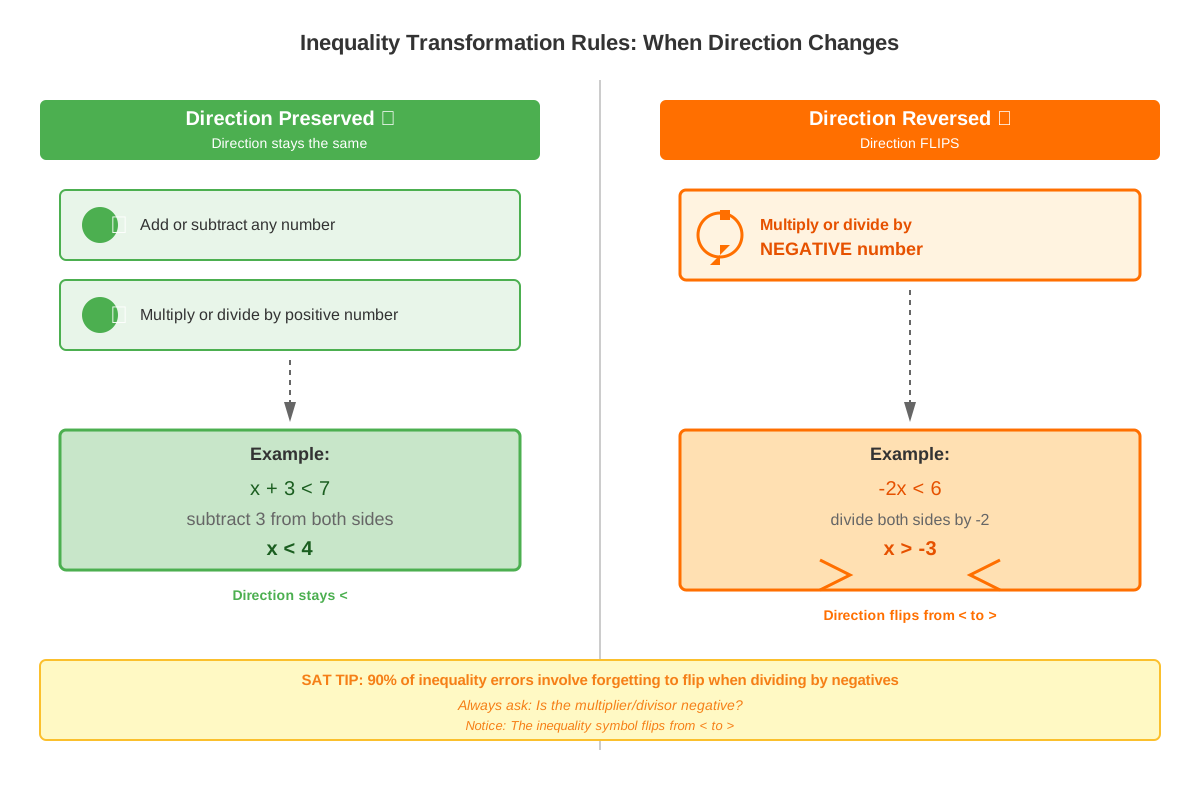
Inequality transformations are operations performed on both sides of an inequality that maintain or predictably alter the relationship between the two sides. The most critical distinction from equation transformations is that certain operations reverse the inequality direction. Understanding when this reversal occurs is essential for SAT success.
The addition and subtraction properties state that adding or subtracting the same value from both sides of an inequality preserves the inequality direction. If a < b, then a + c < b + c and a - c < b - c for any real number c. This property works identically to equations and never requires direction reversal.
The multiplication and division properties require careful attention to sign. When multiplying or dividing both sides by a positive number, the inequality direction remains unchanged. However, when multiplying or dividing by a negative number, the inequality direction must reverse. This is the most frequently tested transformation rule on the SAT.
| Operation | Example | Direction Change? |
|---|---|---|
| Add positive/negative | x - 3 < 5 → x < 8 | No |
| Subtract positive/negative | x + 7 ≥ 2 → x ≥ -5 | No |
| Multiply by positive | 2x < 10 → x < 5 | No |
| Multiply by negative | -2x < 10 → x > -5 | Yes |
| Divide by positive | 3x ≥ 15 → x ≥ 5 | No |
| Divide by negative | -3x ≥ 15 → x ≤ -5 | Yes |
Multi-Step Inequality Solving
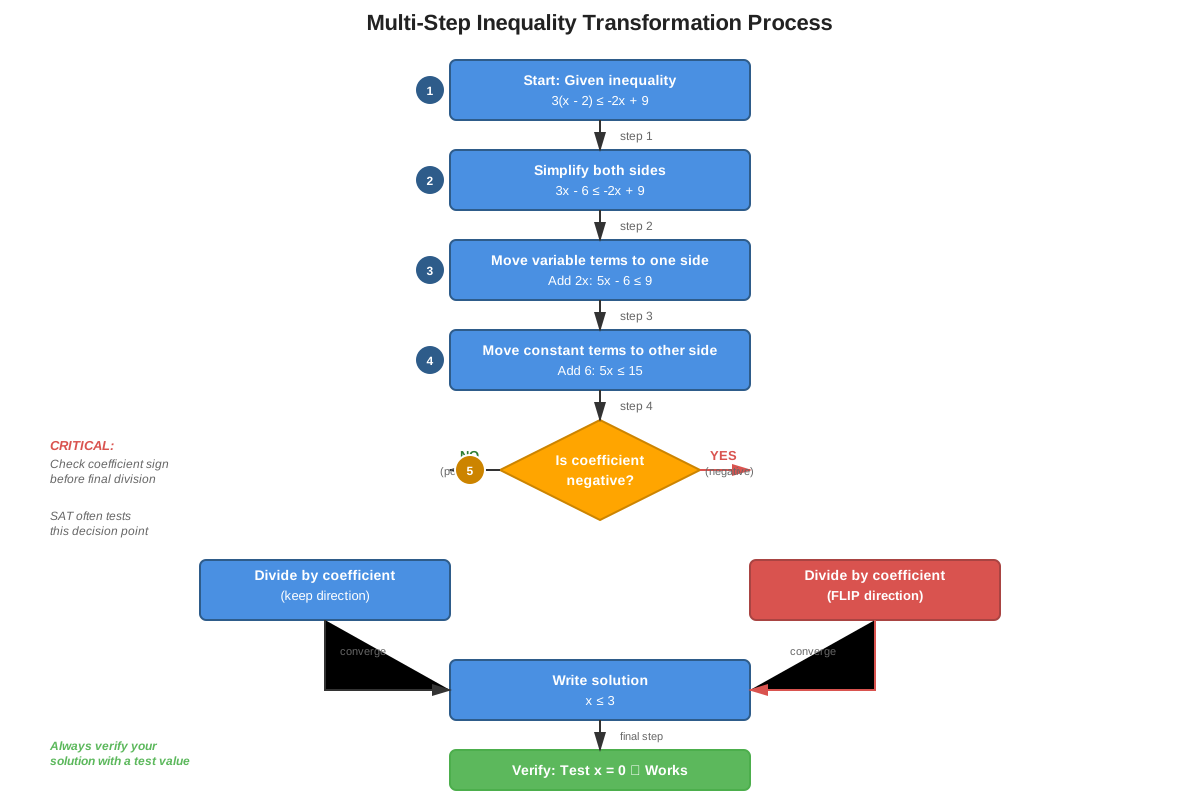
Solving complex inequalities requires applying transformation rules in strategic sequences, similar to multi-step equation solving but with constant attention to direction changes. The standard approach follows these steps:
- Simplify both sides by combining like terms and eliminating parentheses using the distributive property
- Collect variable terms on one side and constant terms on the other using addition/subtraction
- Isolate the variable by multiplying or dividing, reversing the inequality if dividing/multiplying by a negative
- Express the solution in proper notation and verify with test values
For example, solving -3(2x - 4) ≥ 18:
- Distribute: -6x + 12 ≥ 18
- Subtract 12: -6x ≥ 6
- Divide by -6 (reverse direction): x ≤ -1
Compound Inequalities
Compound inequalities involve two inequality statements connected by "and" or "or." The SAT frequently tests these in contexts requiring range determination. An "and" compound inequality like 2 < x < 7 means x must satisfy both x > 2 AND x < 7 simultaneously. An "or" compound inequality means x satisfies at least one condition.
When transforming compound inequalities written in compact form (a < x < b), apply the same operation to all three parts simultaneously. For example, transforming -3 < 2x - 1 < 5:
- Add 1 to all parts: -2 < 2x < 6
- Divide all parts by 2: -1 < x < 3
Inequality Reversal Situations
Beyond the obvious case of multiplying/dividing by negatives, the SAT tests inequality reversal understanding through several scenarios:
Taking reciprocals: When both sides of an inequality are positive and you take reciprocals, the direction reverses. If 0 < a < b, then 1/a > 1/b. This appears in rate and proportion problems.
Negating both sides: Multiplying both sides by -1 reverses direction. If a < b, then -a > -b. The SAT uses this in problems involving opposites or direction changes.
Squaring with mixed signs: Squaring both sides of an inequality only preserves direction when both sides have the same sign. This complexity means squaring is generally avoided in SAT inequality problems, but understanding the limitation is important.
Solution Set Interpretation
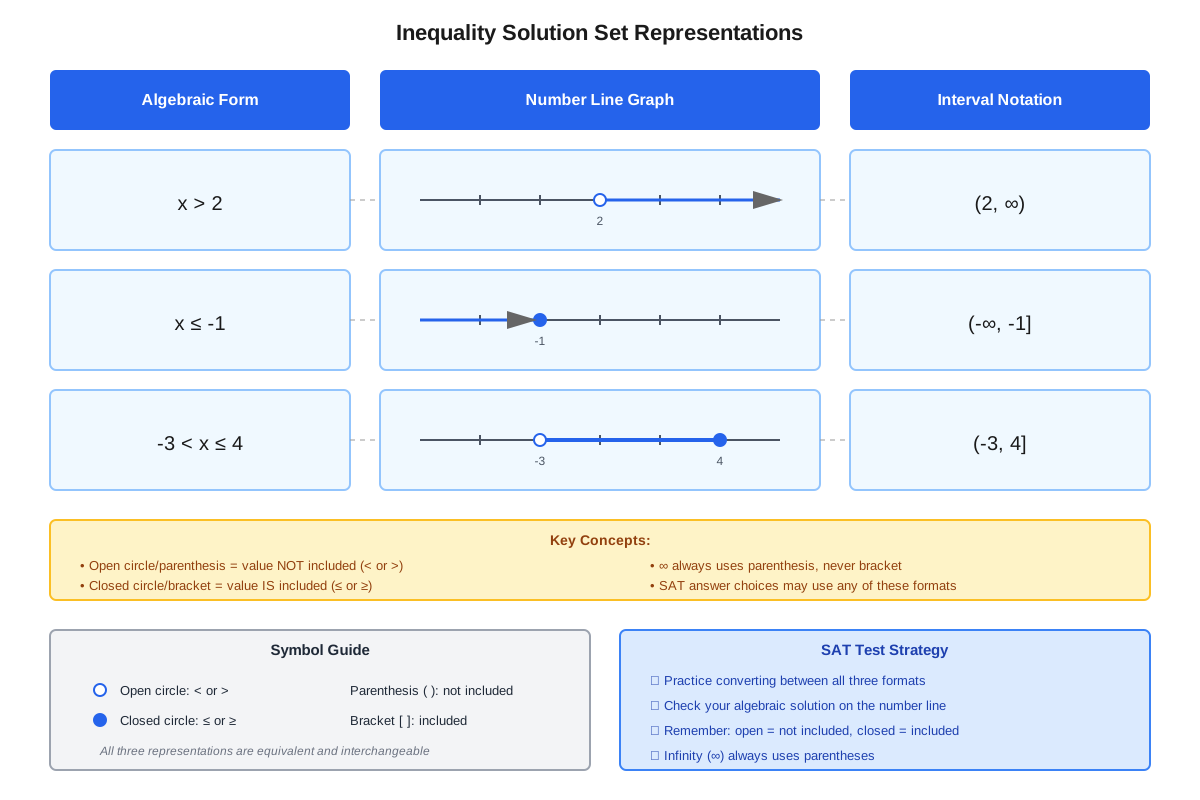
After transforming an inequality, correctly interpreting the solution set is crucial. The solution x < 3 means all real numbers less than 3, represented on a number line with an open circle at 3 and shading to the left. The solution x ≥ -2 includes -2 and all numbers greater, shown with a closed circle at -2 and shading to the right.
The SAT tests solution interpretation through multiple formats: number line graphs, interval notation, set-builder notation, and contextual descriptions. Students must translate between these representations fluently. For instance, x ≤ 5 can be written as (-∞, 5], {x | x ≤ 5}, or "all values up to and including 5."
Special Cases and Edge Conditions
Certain inequality transformations produce special results that the SAT occasionally tests. An inequality that simplifies to a true statement like 3 < 5 means all real numbers are solutions. An inequality simplifying to a false statement like 2 > 7 means no solutions exist. These cases often appear in questions about parameter values that make inequalities have specific solution properties.
Concept Relationships
The core concepts within inequality transformations form a hierarchical structure. Fundamental transformation rules serve as the foundation, establishing when operations preserve or reverse inequality direction. These rules directly enable multi-step inequality solving, which applies transformation sequences strategically. Multi-step solving extends naturally to compound inequalities, which require applying transformations to multiple inequality statements simultaneously.
Inequality reversal situations represent special applications of the fundamental rules, particularly the multiplication/division by negative numbers principle. Understanding these situations prevents errors when transforming inequalities in non-standard forms. Finally, solution set interpretation connects all transformation work to meaningful mathematical communication, translating algebraic results into graphical and contextual representations.
The relationship map flows as: Fundamental Rules → Multi-Step Solving → Compound Inequalities, with Reversal Situations branching from Fundamental Rules and Solution Interpretation serving as the output stage for all transformation processes.
Inequality transformations connect to prerequisite topics by extending equation-solving techniques with direction-change considerations. They build toward more advanced topics like systems of inequalities (where multiple transformed inequalities interact), absolute value inequalities (requiring case-based transformation approaches), and optimization problems (where inequalities define feasible regions). Mastering transformations also supports function analysis, where inequalities describe domain restrictions and range limitations.
High-Yield Facts
⭐ When multiplying or dividing both sides of an inequality by a negative number, the inequality direction must reverse
⭐ Adding or subtracting any value (positive or negative) to both sides never changes the inequality direction
⭐ The solution to x < a includes all values less than a but not a itself; x ≤ a includes a
⭐ Compound inequalities like a < x < b require applying the same operation to all three parts simultaneously
⭐ Taking reciprocals of both sides reverses the inequality direction when both sides are positive
- Multiplying or dividing both sides by a positive number preserves the inequality direction
- The distributive property applies to inequalities exactly as it does to equations
- Combining like terms on either side of an inequality does not affect the direction
- An inequality that simplifies to a true statement (like 3 < 5) has all real numbers as solutions
- An inequality that simplifies to a false statement (like 2 > 7) has no solutions
- Graphing x < a uses an open circle; graphing x ≤ a uses a closed circle
- The solution set of an "and" compound inequality is the intersection of individual solution sets
- The solution set of an "or" compound inequality is the union of individual solution sets
- Subtracting a negative number is equivalent to adding a positive number and never reverses direction
- When solving inequalities with variables on both sides, collect terms strategically to avoid negative coefficients when possible
Quick check — test yourself on Inequality transformations so far.
Try Flashcards →Common Misconceptions
Misconception: The inequality direction always stays the same during transformations, just like with equations.
Correction: While many operations preserve direction, multiplying or dividing by negative numbers requires reversing the inequality sign. This is the fundamental difference between equation and inequality transformations.
Misconception: Subtracting a negative number from both sides reverses the inequality direction.
Correction: Addition and subtraction never change inequality direction, regardless of whether the number being added or subtracted is positive or negative. Only multiplication and division by negatives cause reversal.
Misconception: When solving -2x > 6, dividing by 2 first (to get -x > 3) avoids the direction change.
Correction: This approach still requires dealing with the negative coefficient. Dividing by 2 gives -x > 3, and then multiplying by -1 to get x requires reversing to x < -3. The direction change is unavoidable when the variable has a negative coefficient.
Misconception: The solution x < 3 includes the value 3.
Correction: The strict inequality < means "less than but not equal to," so 3 is not part of the solution set. Only x ≤ 3 includes 3 as a solution. On a number line, this distinction appears as an open circle (not included) versus closed circle (included).
Misconception: When transforming 2 < x + 3 < 7, you can subtract 3 from just the middle term.
Correction: Operations on compound inequalities must be applied to all parts simultaneously. Subtracting 3 from only the middle would destroy the inequality relationships. The correct transformation is 2 - 3 < x + 3 - 3 < 7 - 3, giving -1 < x < 4.
Misconception: Multiplying both sides by a variable expression never requires direction reversal.
Correction: Multiplying by a variable expression is problematic because the sign of the expression may be unknown. If the expression could be negative, the direction change rule applies. The SAT avoids this complexity, but students should recognize that multiplying by variables requires knowing their sign.
Misconception: The inequality x² > 9 solves to x > 3.
Correction: Squaring creates two cases. The solution is x > 3 OR x < -3 (written as x < -3 or x > 3). Both 4² = 16 > 9 and (-4)² = 16 > 9 are true. The SAT rarely tests this directly but may include it in advanced problems.
Worked Examples
Example 1: Multi-Step Inequality with Direction Reversal
Problem: Solve for x: -3(x - 4) + 5 ≤ 2x - 7
Solution:
Step 1: Distribute the -3 on the left side
-3x + 12 + 5 ≤ 2x - 7Step 2: Combine like terms on the left side
-3x + 17 ≤ 2x - 7Step 3: Subtract 2x from both sides (collecting variable terms)
-3x - 2x + 17 ≤ 2x - 2x - 7
-5x + 17 ≤ -7
Step 4: Subtract 17 from both sides (isolating the variable term)
-5x + 17 - 17 ≤ -7 - 17
-5x ≤ -24
Step 5: Divide both sides by -5 (REVERSE the inequality direction)
x ≥ 24/5Final Answer: x ≥ 4.8 or x ≥ 24/5
Connection to Learning Objectives: This example demonstrates applying inequality transformations through multiple steps, identifying when direction reversal is necessary (dividing by -5), and expressing the solution set correctly. The key SAT skill tested here is remembering to reverse direction in step 5—a common trap answer would be x ≤ 4.8.
Example 2: Compound Inequality Transformation
Problem: A manufacturing process requires the temperature T (in degrees Celsius) to satisfy -10 ≤ 2T + 6 ≤ 30. What is the range of acceptable temperatures?
Solution:
Step 1: Identify this as a compound inequality requiring simultaneous transformation of all three parts
Step 2: Subtract 6 from all three parts
-10 - 6 ≤ 2T + 6 - 6 ≤ 30 - 6
-16 ≤ 2T ≤ 24
Step 3: Divide all three parts by 2 (positive number, so no direction change)
-16/2 ≤ 2T/2 ≤ 24/2
-8 ≤ T ≤ 12
Final Answer: The acceptable temperature range is -8°C to 12°C, inclusive.
Interpretation: This means any temperature from -8 degrees up to and including 12 degrees satisfies the manufacturing requirements. On a number line, this would be represented with closed circles at -8 and 12, with the region between them shaded.
Connection to Learning Objectives: This example shows how inequality transformations appear in SAT word problems, requiring students to apply transformations to compound inequalities and interpret the solution in context. The problem tests whether students can maintain the compound structure throughout the transformation process and correctly interpret the inclusive inequalities (≤) as including the boundary values.
Exam Strategy
When approaching SAT questions on inequality transformations, begin by carefully reading the inequality symbol and noting whether it's strict (<, >) or inclusive (≤, ≥). This distinction affects solution set interpretation and is often the difference between answer choices.
Trigger words and phrases that signal inequality transformation questions include: "at most" (≤), "at least" (≥), "more than" (>), "less than" (<), "no more than" (≤), "no less than" (≥), "between" (compound inequality), "range of values," and "possible values." When you see these phrases, immediately translate them into proper inequality notation before solving.
For process-of-elimination, use these strategies:
- Eliminate answer choices that show the wrong inequality direction if you know a reversal was required
- Test boundary values in answer choices by substituting them back into the original inequality
- For compound inequalities, eliminate choices where the boundary values are in the wrong order
- If the problem involves dividing by a negative coefficient, immediately eliminate any answer that doesn't reverse direction
Time allocation for inequality transformation questions should average 45-60 seconds for straightforward algebraic problems and 90-120 seconds for word problems requiring setup and interpretation. If a problem requires more than two minutes, mark it for review and move on—these questions rarely require complex techniques, so extended time usually indicates a misunderstanding that won't resolve quickly.
Exam Tip: Always perform a quick verification by testing a value from your solution set in the original inequality. If x ≥ 3 is your answer, test x = 4 in the original problem. This 5-second check catches direction reversal errors and arithmetic mistakes.
When the SAT presents multi-step inequalities, work systematically through one operation at a time, writing each step. Trying to perform multiple operations mentally increases error risk, especially with direction changes. The test rewards careful, methodical work over speed.
Memory Techniques
Mnemonic for Direction Reversal: "Negative Division Reverses Direction" (NDRD). Whenever you divide or multiply by a negative number, remember NDRD and flip that inequality sign.
Visualization Strategy: Picture an inequality as a balance scale that tips in one direction. Adding or subtracting weight from both sides keeps the tipping direction the same. But multiplying by a negative is like flipping the entire scale upside down—now the heavier side points the opposite direction.
The "Flip-Flop Rule": Create a mental association between negative operations and flip-flops (sandals that flip). When you see a negative coefficient that you're dividing by, think "flip-flop" and reverse the inequality direction.
Acronym for Compound Inequalities: SAT = Same Action to Three parts. When solving compound inequalities like a < x + b < c, remember SAT: apply the Same Action to all Three parts simultaneously.
Number Line Circles: Remember "Closed circle for Can equal" (≤ or ≥ uses closed circles) and "Open circle for Only less/greater" (< or > uses open circles). The matching first letters help recall which symbol uses which circle type.
Direction Change Checklist: Before finalizing any inequality solution, mentally ask: "Did I multiply or divide by a negative?" If yes, verify the direction reversed. If no, verify it stayed the same. This two-question check catches the most common SAT inequality error.
Summary
Inequality transformations are essential algebraic operations that allow manipulation of inequalities while maintaining or predictably altering their truth relationships. The fundamental principle distinguishing inequality transformations from equation solving is the direction reversal rule: multiplying or dividing both sides by a negative number requires reversing the inequality symbol, while addition and subtraction never change direction. Multi-step inequality solving applies these transformation rules in strategic sequences, requiring careful attention to when direction changes occur. Compound inequalities extend these principles by requiring simultaneous operations on all parts of the inequality chain. Solution sets must be correctly interpreted through multiple representations including number lines, interval notation, and contextual descriptions. The SAT tests these concepts frequently through direct algebraic problems, word problems requiring inequality setup and solution, and interpretation questions. Success requires mastering the direction reversal rule, applying transformations systematically, and verifying solutions through substitution or logical reasoning.
Key Takeaways
- The direction reversal rule is the most critical concept: Multiplying or dividing by negative numbers reverses inequality direction; addition and subtraction never do
- Compound inequalities require simultaneous operations: Apply the same transformation to all three parts of inequalities like a < x < b
- Solution set notation matters: Distinguish between strict inequalities (<, >) and inclusive inequalities (≤, ≥) in both algebraic and graphical representations
- Systematic solving prevents errors: Work through multi-step inequalities one operation at a time, writing each step to avoid mental arithmetic mistakes
- Verification catches mistakes: Test a value from your solution set in the original inequality to confirm correctness
- Context interpretation is essential: SAT questions often require translating word problems into inequalities and interpreting solutions in real-world terms
- Direction reversal appears in disguised forms: Beyond obvious division by negatives, watch for reciprocals, negation, and coefficient manipulation that trigger direction changes
Related Topics
Systems of Linear Inequalities: Building on single inequality transformations, systems require solving multiple inequalities simultaneously and finding solution regions that satisfy all constraints. Mastering inequality transformations provides the foundation for analyzing feasible regions graphically and algebraically.
Absolute Value Inequalities: These extend inequality transformations by requiring case-based analysis. Understanding how to transform basic inequalities is essential before tackling the two-case approach needed for absolute value problems.
Quadratic Inequalities: More advanced inequality problems involve quadratic expressions, requiring factoring or the quadratic formula combined with sign analysis. The transformation principles learned here apply to isolating and analyzing quadratic inequality solutions.
Linear Programming: This optimization technique uses systems of linear inequalities to define constraint regions. The transformation skills developed here enable students to manipulate constraints and identify optimal solutions in applied contexts.
Function Domain and Range: Inequalities describe the valid input (domain) and output (range) values for functions. Understanding inequality transformations helps analyze function behavior and restrictions.
Practice CTA
Now that you've mastered the core concepts of inequality transformations, it's time to solidify your understanding through active practice. The practice questions and flashcards are specifically designed to mirror SAT question formats and difficulty levels, targeting the high-yield concepts most likely to appear on test day. Focus particularly on problems involving direction reversal and compound inequalities—these represent the highest-value skills for score improvement. Remember, transformation mastery comes through deliberate practice with immediate feedback. Each problem you solve strengthens your pattern recognition and builds the automaticity needed for test-day success. Challenge yourself to work through problems systematically, verify your solutions, and learn from any mistakes. Your investment in practice now directly translates to points on the SAT!
Sign up free to keep reading
Create a free AnvayaPrep account to finish this SAT guide on Inequality transformations — plus flashcards and practice questions.