Overview
Inequality word problems represent one of the most practical and frequently tested applications of algebraic reasoning on the SAT math section. These problems require students to translate real-world scenarios involving constraints, limits, budgets, and ranges into mathematical inequalities, then solve them to find acceptable solution sets. Unlike equations that have specific solutions, inequalities describe ranges of values that satisfy given conditions, making them essential for modeling situations where multiple answers are possible within defined boundaries.
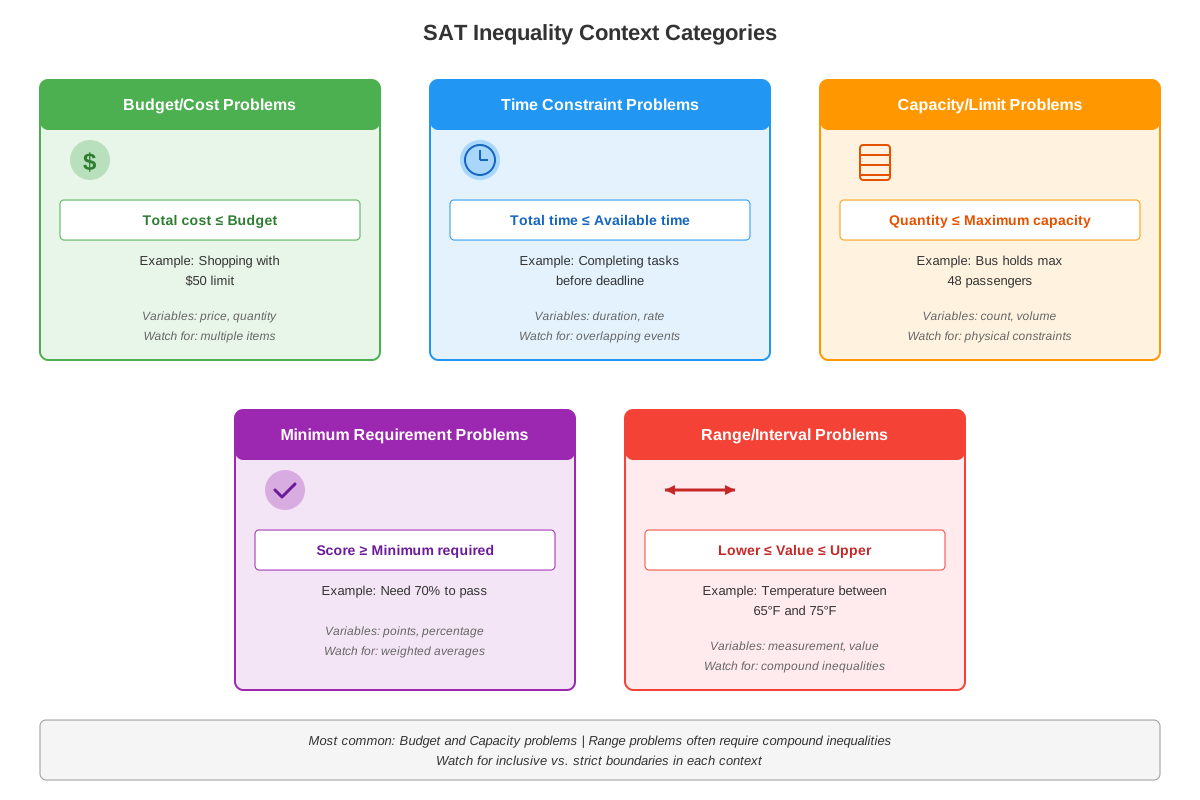
Mastering sat inequality word problems is crucial because they appear consistently across both the calculator and no-calculator portions of the exam, often embedded within multi-step problems that test both reading comprehension and mathematical reasoning. The College Board frequently uses inequality contexts involving budgets, time constraints, minimum requirements, and maximum capacities—scenarios students will encounter throughout college and professional life. These problems typically account for 3-5 questions per test, making them a high-yield topic that can significantly impact overall scores.
The relationship between inequality word problems and broader mathematical concepts is fundamental. They build directly upon linear equations, algebraic manipulation, and number sense while connecting forward to systems of inequalities, optimization problems, and even basic calculus concepts. Understanding how to construct and solve inequalities from verbal descriptions strengthens overall problem-solving skills and reinforces the critical connection between abstract mathematical notation and concrete real-world applications. This topic serves as a bridge between pure algebraic manipulation and applied mathematical reasoning, a skill set the SAT explicitly tests.
Learning Objectives
- [ ] Identify key features of inequality word problems, including constraint types, boundary conditions, and solution set characteristics
- [ ] Explain how inequality word problems appears on the SAT, including common contexts, question formats, and difficulty patterns
- [ ] Apply inequality word problems to answer SAT-style questions accurately and efficiently
- [ ] Translate verbal descriptions of constraints into correct mathematical inequality notation
- [ ] Determine whether to use strict (<, >) or inclusive (≤, ≥) inequality symbols based on problem context
- [ ] Interpret solution sets in terms of the original word problem context and identify realistic answers
Prerequisites
- Linear equations and solving techniques: Essential for manipulating inequality expressions using similar algebraic operations
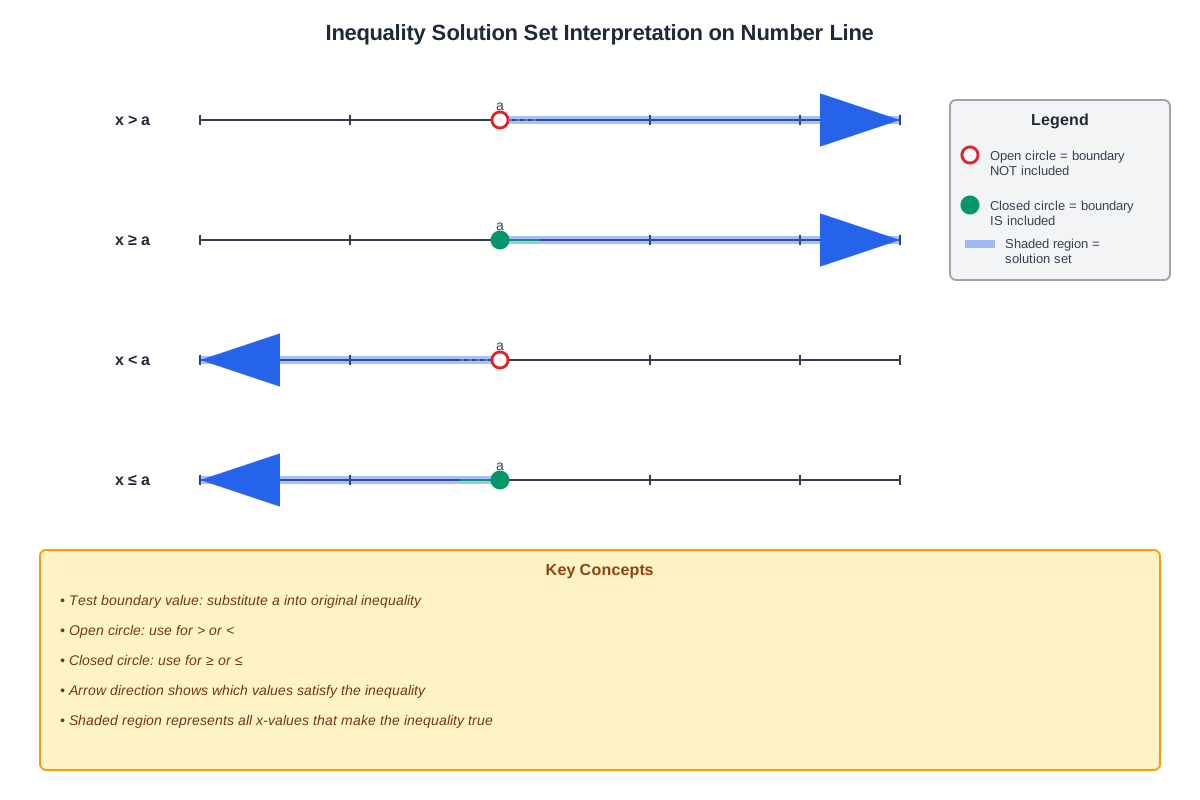
- Number line representation: Necessary for visualizing solution sets and understanding inequality relationships
- Basic algebraic manipulation: Required for isolating variables while maintaining inequality direction
- Order of operations: Critical for correctly simplifying complex inequality expressions
- Understanding of inequality symbols: Foundational knowledge of <, >, ≤, ≥ and their meanings
Why This Topic Matters
Inequality word problems represent one of the most practical applications of mathematics in everyday decision-making. From budgeting personal finances to determining minimum study hours needed for a target grade, from calculating safe medication dosages to planning travel itineraries within time constraints, inequalities model the boundaries within which real decisions must be made. This practical relevance makes them particularly valuable for college readiness, as students will encounter similar reasoning in economics, engineering, business, and natural sciences courses.
On the SAT specifically, inequality word problems appear with remarkable consistency. Statistical analysis of released SAT exams shows that approximately 8-12% of math questions involve inequalities, with roughly half of these presented as word problems rather than pure symbolic manipulation. These questions typically appear at medium difficulty levels (questions 8-15 in a 22-question section), though more complex multi-step inequality problems can appear in the final third of each section. The College Board favors certain contexts repeatedly: budget constraints, time management scenarios, minimum/maximum requirements for mixtures or combinations, and rate problems involving distance, work, or cost.
Common SAT presentations include: determining how many items can be purchased within a budget; calculating minimum scores needed on remaining tests to achieve a target average; finding acceptable ranges for measurements or quantities; and analyzing scenarios where multiple constraints must be satisfied simultaneously. The exam frequently tests whether students can correctly translate phrases like "at least," "no more than," "exceeds," and "within" into appropriate inequality symbols—a skill that requires both mathematical knowledge and careful reading comprehension.
Core Concepts
Understanding Inequality Notation and Meaning
An inequality is a mathematical statement that compares two expressions using symbols that indicate relative size or order rather than equality. The four primary inequality symbols each convey specific relationships:
- < (less than): The left side is strictly smaller than the right side
- > (greater than): The left side is strictly larger than the right side
- ≤ (less than or equal to): The left side is smaller than or equal to the right side
- ≥ (greater than or equal to): The left side is larger than or equal to the right side
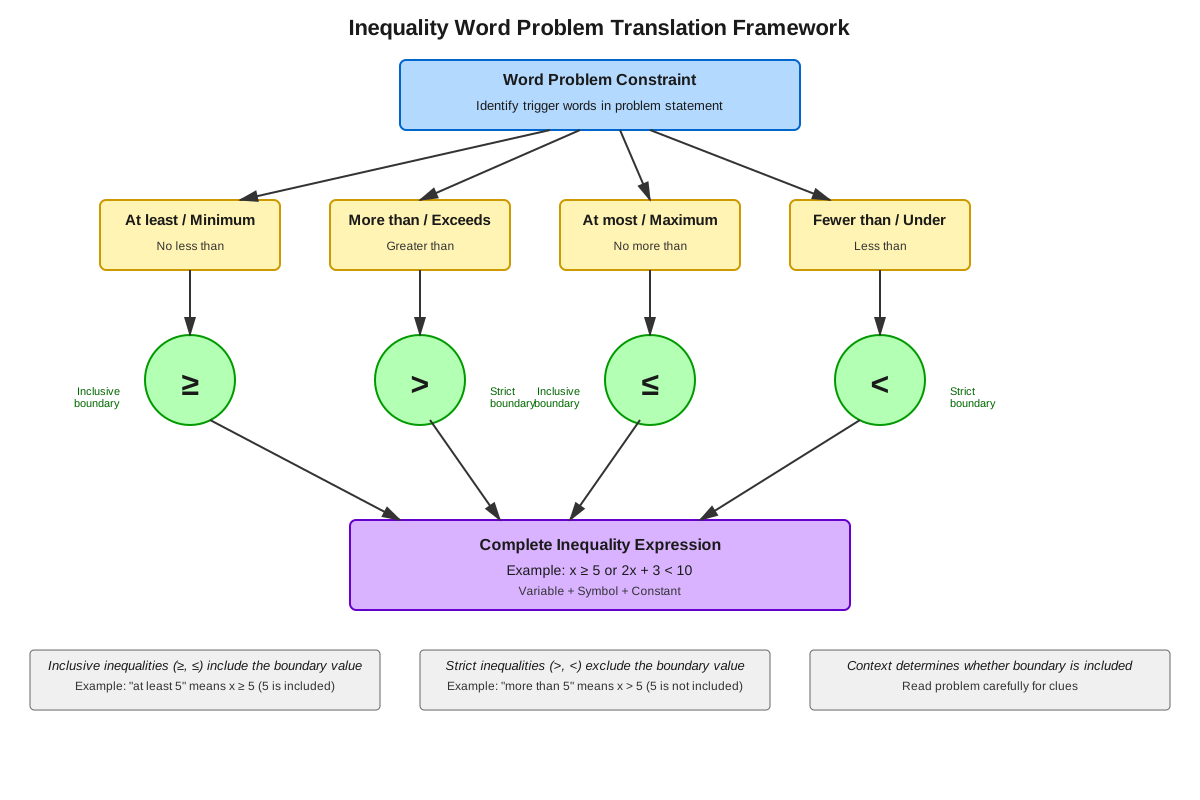
The distinction between strict inequalities (<, >) and inclusive inequalities (≤, ≥) is critical in word problems. Strict inequalities exclude the boundary value, while inclusive inequalities include it. For example, "fewer than 10 people" translates to x < 10, while "at most 10 people" translates to x ≤ 10.
Translating Verbal Phrases to Inequality Symbols
The most crucial skill for solving inequality word problems is accurate translation from English to mathematical notation. The following table shows common phrases and their mathematical equivalents:
| Verbal Phrase | Mathematical Symbol | Example |
|---|---|---|
| at least, no less than, minimum | ≥ | "at least 5 hours" → h ≥ 5 |
| at most, no more than, maximum | ≤ | "at most $50" → c ≤ 50 |
| more than, exceeds, greater than | > | "more than 3 attempts" → a > 3 |
| fewer than, less than, below | < | "fewer than 20 students" → s < 20 |
| between (exclusive) | < and < | "between 10 and 20" → 10 < x < 20 |
| between (inclusive) | ≤ and ≤ | "from 10 to 20" → 10 ≤ x ≤ 20 |
Context determines whether boundaries are included. "You must be at least 18 years old" includes 18 (x ≥ 18), while "children under 12 eat free" excludes 12 (x < 12).
The Five-Step Process for Solving Inequality Word Problems
- Identify the unknown quantity: Determine what variable you need to find and define it clearly with appropriate units
- Extract all constraints: Locate every limiting condition, requirement, or boundary mentioned in the problem
- Translate to mathematical notation: Convert verbal descriptions into inequality expressions using appropriate symbols
- Solve the inequality: Apply algebraic operations to isolate the variable, remembering to reverse the inequality symbol when multiplying or dividing by negative numbers
- Interpret the solution: Translate the mathematical answer back into the problem context and verify it makes practical sense
Critical Rule: Reversing Inequality Direction
When solving inequalities, most algebraic operations preserve the inequality direction: adding, subtracting, multiplying by positive numbers, and dividing by positive numbers all maintain the relationship. However, multiplying or dividing both sides by a negative number requires reversing the inequality symbol.
For example, solving -3x > 12:
- Divide both sides by -3: x < -4 (inequality reversed)
This rule is frequently tested on the SAT, often embedded within multi-step problems where students must track sign changes carefully.
Common Word Problem Contexts
Budget and Cost Problems: These involve total costs that must stay within spending limits. The general form is: (cost per item)(number of items) + fixed costs ≤ budget. Example: "Concert tickets cost $45 each plus a $12 service fee. If you have $200, how many tickets can you buy?"
Average and Test Score Problems: These require calculating what score is needed on remaining assessments to achieve a target average. The form is: (sum of known scores + unknown score) / (total number of scores) ≥ target average.
Mixture and Combination Problems: These involve combining quantities with different properties to meet minimum or maximum requirements. Example: "A trail mix contains almonds ($8/lb) and raisins ($3/lb). How many pounds of each are needed to make at least 5 pounds while spending no more than $30?"
Rate Problems: These apply distance = rate × time or work = rate × time formulas with inequality constraints. Example: "A car travels at 55 mph. How long must it travel to cover more than 200 miles?"
Compound Inequalities
Some SAT problems involve compound inequalities, where a variable must satisfy multiple constraints simultaneously. These appear in two forms:
- Conjunction (AND): Both conditions must be true, written as a < x < b or as two separate inequalities connected by "and"
- Disjunction (OR): At least one condition must be true, written as two separate inequalities connected by "or"
Example: "The temperature must be between 65°F and 75°F" translates to 65 ≤ T ≤ 75 (conjunction), while "The pH must be below 6 or above 8" translates to pH < 6 or pH > 8 (disjunction).
Concept Relationships
The concepts within inequality word problems form a logical progression: Understanding inequality notation → Translating verbal phrases → Setting up inequality expressions → Solving algebraically → Interpreting solutions in context. Each step depends on the previous one, and weakness in any area compromises the entire problem-solving process.
Inequality word problems connect backward to prerequisite topics in essential ways. Linear equations provide the algebraic manipulation framework, with inequalities adding the complexity of directional relationships and the reversal rule. Number sense helps students evaluate whether solutions are reasonable (negative people or fractional test attempts indicate errors). Order of operations ensures correct simplification of complex expressions before solving.
Forward connections include systems of inequalities, where multiple constraints create feasible regions on coordinate planes—a topic that appears in more advanced SAT questions and extensively in college mathematics. Understanding single-variable inequalities also prepares students for optimization problems in calculus and constraint satisfaction in computer science and operations research.
The relationship map: Basic Algebra → Linear Equations → Single-Variable Inequalities → Inequality Word Problems → Systems of Inequalities → Linear Programming → Optimization
Quick check — test yourself on Inequality word problems so far.
Try Flashcards →High-Yield Facts
⭐ When multiplying or dividing both sides of an inequality by a negative number, the inequality symbol must be reversed.
⭐ "At least" translates to ≥ (greater than or equal to), while "at most" translates to ≤ (less than or equal to).
⭐ "More than" and "exceeds" use strict inequality (>), excluding the boundary value.
⭐ "Fewer than" and "less than" use strict inequality (<), excluding the boundary value.
⭐ The solution to an inequality is typically a range of values, not a single number.
- "Between" typically means exclusive (< and <) unless the problem specifies "inclusive" or uses "from...to"
- When solving for a minimum value needed, set up the inequality so the unknown is greater than or equal to the target
- When solving for a maximum value allowed, set up the inequality so the unknown is less than or equal to the limit
- Budget problems typically use the form: (variable cost)(quantity) + fixed cost ≤ total budget
- Average problems use: (sum of all values) / (number of values) ≥ or ≤ target average
- Always check that your final answer makes sense in the real-world context of the problem
- Compound inequalities joined by "and" require both conditions to be true simultaneously
- The SAT often tests whether students correctly interpret "at least" vs. "more than" distinctions
Common Misconceptions
Misconception: "At least 5" means x > 5 → Correction: "At least 5" means x ≥ 5, including 5 itself. The phrase indicates a minimum value that is acceptable, so the boundary is included. "More than 5" would be x > 5.
Misconception: When dividing by a negative number, students forget to reverse the inequality symbol → Correction: Multiplying or dividing by a negative number reverses the inequality direction because it flips the number line. If -2x < 6, then x > -3 (not x < -3). Always check the sign of the number you're multiplying or dividing by.
Misconception: The solution to an inequality is a single number → Correction: Inequalities typically have infinite solutions forming a range or interval. For example, x ≥ 3 includes 3, 3.1, 4, 100, and all values greater than or equal to 3. Only in specific contexts (like "how many whole items") might you identify a single answer.
Misconception: "Between 10 and 20" always means 10 < x < 20 → Correction: Context determines whether endpoints are included. "Between" often suggests exclusive boundaries, but phrases like "from 10 to 20" or "anywhere between 10 and 20, inclusive" indicate 10 ≤ x ≤ 20. Read carefully for clarifying language.
Misconception: You can add inequalities just like equations without considering direction → Correction: While you can add inequalities with the same direction (if a > b and c > d, then a + c > b + d), you cannot subtract inequalities or combine inequalities with opposite directions without careful analysis. Treat each inequality manipulation step-by-step.
Misconception: Negative solutions are always wrong in word problems → Correction: While negative values may be unrealistic for quantities like "number of people" or "hours worked," they can be valid in contexts involving temperatures, elevations, financial losses, or coordinate positions. Always consider the problem context.
Worked Examples
Example 1: Budget Constraint Problem
Problem: Maria is planning a party and needs to rent tables and chairs. Tables cost $15 each to rent, and chairs cost $3 each. She has a budget of $150. If she needs to rent 6 tables, what is the maximum number of chairs she can rent?
Solution:
Step 1 - Define the variable: Let c = number of chairs Maria can rent
Step 2 - Identify constraints:
- Tables cost $15 each, and she needs 6 tables: 6 × $15 = $90
- Chairs cost $3 each
- Total budget is $150
Step 3 - Set up the inequality: The total cost must be less than or equal to the budget:
(cost of tables) + (cost of chairs) ≤ budget
90 + 3c ≤ 150
Step 4 - Solve algebraically:
90 + 3c ≤ 150
3c ≤ 150 - 90
3c ≤ 60
c ≤ 20
Step 5 - Interpret: Maria can rent at most 20 chairs while staying within her $150 budget. Since we're looking for the maximum number, the answer is 20 chairs.
Verification: 6 tables ($90) + 20 chairs ($60) = $150 ✓
This problem demonstrates the standard budget constraint format and tests understanding of "at most" (≤) versus strict inequality.
Example 2: Average Score Problem
Problem: Jason has taken four math tests this semester and earned scores of 78, 85, 82, and 88. He has one test remaining. What is the minimum score he needs on the fifth test to have an average of at least 85 for all five tests?
Solution:
Step 1 - Define the variable: Let x = Jason's score on the fifth test
Step 2 - Identify constraints:
- Known scores: 78, 85, 82, 88
- Total number of tests: 5
- Target average: at least 85 (meaning ≥ 85)
Step 3 - Set up the inequality: Average equals sum divided by count:
(78 + 85 + 82 + 88 + x) / 5 ≥ 85Step 4 - Solve algebraically:
(333 + x) / 5 ≥ 85Multiply both sides by 5:
333 + x ≥ 425
x ≥ 425 - 333
x ≥ 92
Step 5 - Interpret: Jason needs to score at least 92 on his fifth test to achieve an average of at least 85. The minimum acceptable score is 92.
Verification: (78 + 85 + 82 + 88 + 92) / 5 = 425 / 5 = 85 ✓
This problem illustrates average calculations with inequality constraints and tests understanding of "at least" (≥). Note that while 92 is the minimum, any score of 92 or higher would satisfy the requirement.
Exam Strategy
Trigger Word Recognition: Train yourself to immediately translate key phrases. When you see "at least," "at most," "more than," "fewer than," "minimum," or "maximum," underline them and write the corresponding inequality symbol in the margin before setting up your equation.
Approach SAT inequality word problems systematically: First, read the entire problem to understand the context. Second, identify what you're solving for and define your variable with units. Third, locate all numerical information and constraints. Fourth, translate the constraint into an inequality. Fifth, solve algebraically. Sixth, check that your answer makes sense in context.
Process of elimination strategies: When answer choices are given, you can often eliminate options by testing boundary cases. If the problem asks for "at least 10," eliminate any answer that doesn't include 10 as a valid solution. If you're unsure whether to use < or ≤, test the boundary value in the original problem context—can you have exactly that amount, or must you exceed it?
Watch for reversal traps: The SAT frequently includes problems where you must divide by a negative number. When you see negative coefficients on your variable, slow down and double-check the inequality direction after solving. A common wrong answer choice will show the correct numerical value but with the inequality symbol in the wrong direction.
Time allocation: Straightforward inequality word problems should take 60-90 seconds. If you're spending more than 2 minutes, you may be overcomplicating the setup. Consider whether you've correctly identified the variable and constraint, or whether you need to move on and return later.
Context checking: Always ask "Does this answer make sense?" If you're solving for "number of people" and get x ≥ -3, you know something went wrong—you can't have negative people. If you're solving for "hours studied" and get x ≤ 200, that's technically correct mathematically but unrealistic, suggesting you may have misread the problem.
Memory Techniques
LAME mnemonic for inequality phrases:
- Less than: "fewer than," "below," "under"
- At most: ≤ (includes the boundary)
- More than: "exceeds," "greater than," "above"
- Equal or more: "at least" uses ≥ (includes the boundary)
Visualization for inequality direction: Picture a number line with your solution region shaded. If the problem says "at least 5," visualize shading everything from 5 rightward (including 5). If it says "fewer than 5," shade everything left of 5 (not including 5). This mental image helps prevent symbol confusion.
The "Negative Flip" reminder: When you multiply or divide by a negative, think "negative attitude = opposite direction." The inequality becomes contrary, just like a negative attitude reverses positivity.
SETUP acronym for problem-solving:
- State the variable
- Extract all constraints
- Translate to inequality notation
- Use algebra to solve
- Prove your answer makes sense
Summary
Inequality word problems require translating real-world constraints into mathematical notation, solving algebraically while observing special rules, and interpreting solutions as ranges rather than single values. The critical skills include recognizing that "at least" means ≥, "at most" means ≤, "more than" means >, and "fewer than" means <, with careful attention to whether boundary values are included. The fundamental solving process mirrors linear equations with one crucial exception: multiplying or dividing by negative numbers reverses the inequality direction. SAT problems typically involve budget constraints, average calculations, mixture scenarios, or rate problems, all requiring systematic translation from verbal descriptions to mathematical expressions. Success depends on careful reading to distinguish between inclusive and exclusive boundaries, methodical algebraic manipulation with attention to sign changes, and contextual verification that solutions make practical sense. These problems appear consistently on every SAT, making them high-yield topics that reward thorough preparation and strategic practice.
Key Takeaways
- Inequality word problems translate real-world constraints into mathematical expressions using <, >, ≤, or ≥ symbols based on whether boundaries are included or excluded
- "At least" and "at most" are inclusive (≥ and ≤), while "more than" and "fewer than" are exclusive (> and <)
- When multiplying or dividing both sides by a negative number, the inequality symbol must be reversed
- Solutions to inequalities represent ranges of acceptable values, not single numbers
- The five-step process (identify variable, extract constraints, translate, solve, interpret) provides a reliable framework for all inequality word problems
- Always verify that your mathematical solution makes sense in the original problem context
- Budget, average, mixture, and rate problems are the most common SAT contexts for inequality word problems
Related Topics
Systems of Inequalities: Building on single-variable inequalities, systems involve multiple constraints that must be satisfied simultaneously, often represented graphically as feasible regions on coordinate planes. Mastering inequality word problems provides the foundation for understanding how multiple real-world constraints interact.
Absolute Value Inequalities: These combine inequality reasoning with absolute value concepts, creating compound inequalities that describe distances from reference points. The translation skills developed in word problems transfer directly to these more abstract scenarios.
Linear Programming: An advanced application where inequalities define constraints and optimization techniques find maximum or minimum values within feasible regions. Understanding basic inequality word problems is essential preparation for this college-level topic.
Quadratic Inequalities: These extend inequality reasoning to parabolic functions, requiring students to identify intervals where quadratic expressions are positive or negative. The logical framework from linear inequalities applies with added complexity.
Practice CTA
Now that you've mastered the core concepts of inequality word problems, it's time to solidify your understanding through active practice. Attempt the practice questions to test your ability to translate verbal descriptions into mathematical notation, solve inequalities accurately, and interpret solutions in context. Use the flashcards to reinforce key phrases and their mathematical equivalents until the translations become automatic. Remember, inequality word problems appear on every SAT—your investment in mastering this topic will directly impact your score. Approach each practice problem systematically using the five-step process, and you'll build the confidence and speed needed for test day success.
Sign up free to keep reading
Create a free AnvayaPrep account to finish this SAT guide on Inequality word problems — plus flashcards and practice questions.