Overview
Linear inequality graphs represent one of the most frequently tested concepts in SAT math, appearing in approximately 3-5 questions per exam across both calculator and no-calculator sections. Unlike linear equations that show exact relationships between variables, linear inequalities describe regions of solutions where one expression is greater than, less than, greater than or equal to, or less than or equal to another expression. When graphed on a coordinate plane, these inequalities create half-planes bounded by lines, with shading indicating all possible solution points.
Understanding sat linear inequality graphs is essential because they bridge algebraic manipulation with visual-spatial reasoning—two core competencies the SAT assesses. Students must not only interpret existing graphs but also translate word problems into inequalities, determine appropriate boundary lines, and identify solution regions. This topic connects directly to systems of inequalities, optimization problems, and real-world constraint modeling, making it a high-yield area for score improvement.
Mastery of linear inequality graphs builds upon foundational knowledge of linear equations, coordinate geometry, and algebraic manipulation while serving as a gateway to more complex topics like systems of inequalities and linear programming. The SAT frequently embeds these questions in real-world contexts—budgeting scenarios, manufacturing constraints, or time management problems—requiring students to move fluidly between verbal descriptions, algebraic representations, and graphical interpretations.
Learning Objectives
- [ ] Identify key features of linear inequality graphs including boundary lines, shading direction, and solid versus dashed lines
- [ ] Explain how linear inequality graphs appears on the SAT in multiple-choice and grid-in formats
- [ ] Apply linear inequality graphs to answer SAT-style questions involving single inequalities and systems
- [ ] Determine whether a boundary line should be solid or dashed based on inequality symbols
- [ ] Convert word problems into appropriate linear inequalities and graph them accurately
- [ ] Test points to verify correct shading regions in linear inequality graphs
- [ ] Analyze systems of linear inequalities to identify feasible solution regions
Prerequisites
- Linear equations in two variables: Understanding slope-intercept form (y = mx + b) and standard form (Ax + By = C) is essential because inequality boundary lines follow these same patterns
- Coordinate plane fundamentals: Plotting points, identifying quadrants, and understanding x and y axes enables accurate graph interpretation
- Inequality symbols and properties: Knowing that < means "less than," > means "greater than," ≤ means "less than or equal to," and ≥ means "greater than or equal to" forms the foundation for all inequality work
- Solving linear inequalities: The ability to isolate variables while remembering to flip inequality signs when multiplying or dividing by negative numbers is crucial for algebraic manipulation
- Slope and y-intercept identification: Recognizing these features quickly allows for efficient boundary line graphing
Why This Topic Matters
Linear inequality graphs model countless real-world situations where constraints and limitations exist. Businesses use them to determine production levels given resource constraints, individuals apply them to budget planning with income and expense limitations, and scientists employ them to describe acceptable ranges for experimental conditions. The visual representation of solution regions makes complex constraint problems accessible and solvable.
On the SAT, linear inequality questions appear with remarkable consistency. Approximately 8-12% of all math questions involve inequalities in some form, with 3-5 questions specifically testing graphical interpretation or creation of linear inequalities. These questions appear in both multiple-choice and student-produced response formats, often worth the same point value as more complex problems, making them high-efficiency targets for score improvement.
The SAT presents linear inequality graphs in several characteristic ways: identifying which inequality matches a given graph, selecting the correct graph for a given inequality, determining whether specific points satisfy an inequality, solving word problems that require inequality setup and graphical analysis, and working with systems of inequalities to find feasible regions. Questions frequently embed inequalities within real-world contexts like ticket sales with capacity constraints, mixture problems with minimum or maximum requirements, or time allocation scenarios with competing demands.
Core Concepts
Understanding Inequality Symbols and Boundary Lines
The four primary inequality symbols each convey specific mathematical relationships. The symbol < (less than) indicates values strictly smaller than the boundary, while > (greater than) indicates values strictly larger. The symbols ≤ (less than or equal to) and ≥ (greater than or equal to) include the boundary value itself as part of the solution set.
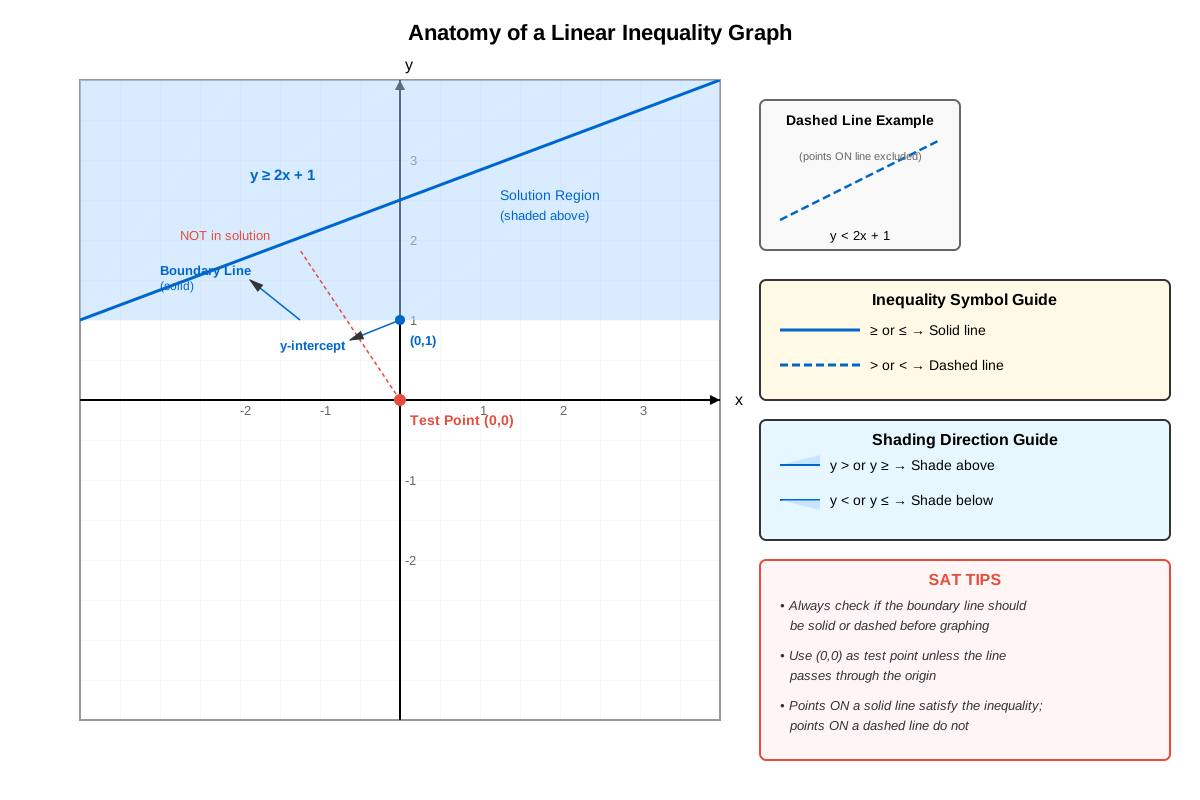
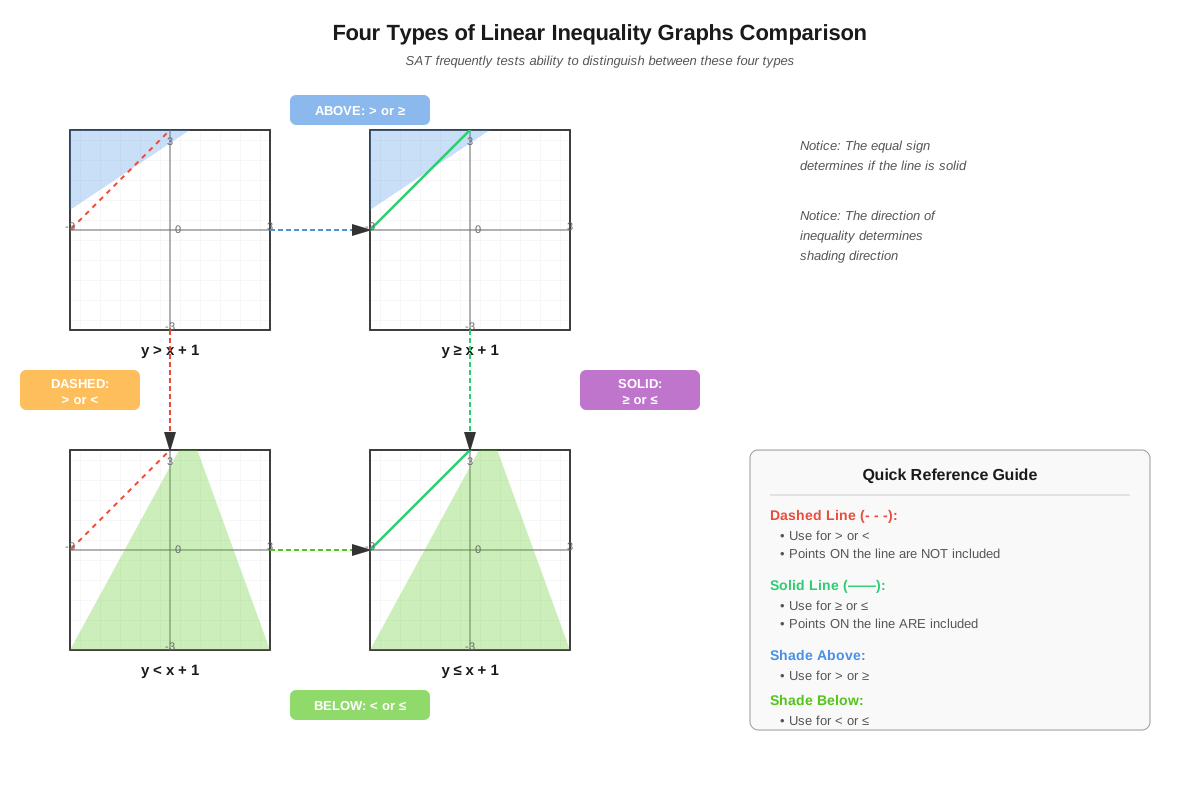
When graphing, these symbols determine whether the boundary line appears solid or dashed. Inequalities using ≤ or ≥ include points on the line itself, requiring a solid line. Inequalities using < or > exclude boundary points, requiring a dashed line. This visual distinction immediately communicates whether boundary values satisfy the inequality—a critical feature the SAT frequently tests.
Converting Inequalities to Boundary Line Equations
To graph a linear inequality, first convert it to its corresponding boundary line equation by temporarily replacing the inequality symbol with an equals sign. For example, the inequality y < 2x + 3 has the boundary line y = 2x + 3. This line divides the coordinate plane into two half-planes: one containing all solutions to the inequality, the other containing all non-solutions.
The boundary line can be graphed using any standard method: plotting the y-intercept and using slope, creating a table of values, or converting to intercept form. The key is accuracy—even small errors in the boundary line position will lead to incorrect solution regions.
Determining the Solution Region
Once the boundary line is drawn, determining which side to shade requires systematic testing. The most reliable method uses a test point—any point not on the boundary line. The origin (0, 0) serves as the most convenient test point when the boundary line doesn't pass through it.
Substitute the test point coordinates into the original inequality. If the resulting statement is true, shade the region containing the test point. If false, shade the opposite region. For example, testing (0, 0) in y < 2x + 3 yields 0 < 3, which is true, so shade the region containing the origin.
Shading Direction and Inequality Forms
When an inequality is solved for y, the inequality symbol provides a quick shading guide:
| Inequality Form | Shading Direction | Memory Aid |
|---|---|---|
| y > mx + b | Above the line | "Greater than" means higher values |
| y ≥ mx + b | Above the line (solid) | "Greater than or equal" includes the line |
| y < mx + b | Below the line | "Less than" means lower values |
| y ≤ mx + b | Below the line (solid) | "Less than or equal" includes the line |
This pattern works reliably when y is isolated on the left side with a positive coefficient. If the inequality isn't solved for y, either solve for y first or use the test point method.
Special Cases: Horizontal and Vertical Boundaries
Horizontal boundary lines have equations of the form y = k (where k is a constant). The inequality y > k means "all points above the horizontal line y = k," while y < k means "all points below." These create simple horizontal shading patterns.
Vertical boundary lines have equations of the form x = h. The inequality x > h means "all points to the right of the vertical line x = h," while x < h means "all points to the left." These inequalities cannot be written in y = mx + b form, making the test point method essential.
Systems of Linear Inequalities
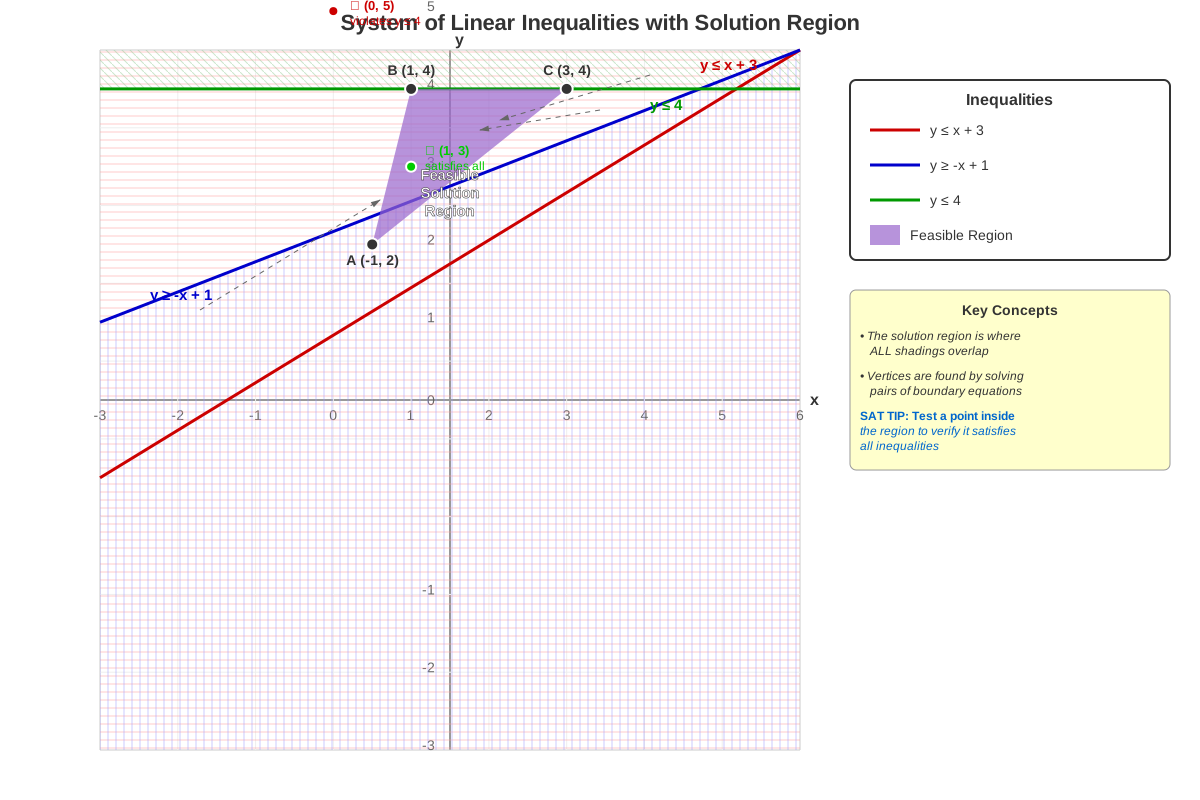
A system of linear inequalities consists of two or more inequalities that must be satisfied simultaneously. The solution region is the intersection of all individual solution regions—the area where all shadings overlap. On the SAT, these problems often ask students to identify feasible regions or determine whether specific points satisfy all constraints.
To graph a system:
- Graph each inequality separately with its boundary line and shading
- Identify the region where all shadings overlap
- Verify the region by testing a point within it against all inequalities
- Note that the solution region may be bounded (enclosed) or unbounded (extending infinitely)
Reading Graphs to Write Inequalities
The SAT frequently provides a graph and asks students to identify the corresponding inequality. This reverse process requires:
- Identifying the boundary line equation by finding its slope and y-intercept
- Determining line type: solid lines indicate ≤ or ≥, dashed lines indicate < or >
- Checking shading direction: above the line suggests > or ≥, below suggests < or ≤
- Verifying with a test point from the shaded region to confirm the inequality symbol
This skill requires fluency in moving between visual and algebraic representations—a hallmark of mathematical reasoning the SAT values highly.
Concept Relationships
The foundation of linear inequality graphs rests on linear equations, which provide the boundary lines that divide the coordinate plane. Understanding slope-intercept form enables quick identification of boundary line characteristics, which then determines the baseline for inequality graphing.
Inequality symbols directly determine boundary line appearance (solid versus dashed), creating the first visual distinction in graphs. These symbols also guide shading direction when combined with the inequality's algebraic form, though the test point method provides a universal verification strategy that works regardless of the inequality's format.
Single linear inequalities serve as building blocks for systems of linear inequalities, where multiple constraints create more complex solution regions through intersection. This progression mirrors real-world problem complexity: simple constraints combine to model realistic scenarios with multiple limitations.
The relationship map flows as follows:
Linear Equations → Boundary Lines → Line Type (solid/dashed) determined by Inequality Symbols → Solution Region identified through Test Points or Shading Rules → Systems of Inequalities created by combining multiple regions → Real-world Applications requiring constraint modeling
Quick check — test yourself on Linear inequality graphs so far.
Try Flashcards →High-Yield Facts
- ⭐ Solid lines (—) are used for ≤ and ≥ inequalities; dashed lines (---) are used for < and > inequalities
- ⭐ When y is isolated, y > mx + b means shade above the line; y < mx + b means shade below the line
- ⭐ The test point (0, 0) is the fastest way to determine shading direction unless the boundary line passes through the origin
- ⭐ In systems of inequalities, the solution region is where all shadings overlap, not where any single inequality is satisfied
- ⭐ Multiplying or dividing both sides of an inequality by a negative number reverses the inequality symbol
- Vertical lines (x = k) cannot be written in slope-intercept form and require special attention
- Horizontal lines (y = k) have zero slope and create the simplest inequality graphs
- A point on a dashed boundary line is never part of the solution set
- A point on a solid boundary line is always part of the solution set
- The boundary line equation is found by replacing the inequality symbol with an equals sign
- Shading always covers an entire half-plane, never just a line or isolated points
- If an inequality cannot be easily solved for y, the test point method is more reliable than trying to determine shading direction algebraically
Common Misconceptions
Misconception: All boundary lines should be drawn as solid lines.
Correction: Only inequalities with ≤ or ≥ use solid lines because they include the boundary points in the solution set. Inequalities with < or > must use dashed lines because boundary points are explicitly excluded.
Misconception: Shading above the line always means "greater than."
Correction: Shading direction depends on whether the inequality is solved for y. If the inequality is in the form y > expression, shade above. However, if written as x > expression or in standard form, the shading direction requires either solving for y first or using a test point.
Misconception: The origin (0, 0) can always be used as a test point.
Correction: The origin works as a test point only when the boundary line doesn't pass through it. If the boundary line contains (0, 0), choose a different convenient point like (1, 0), (0, 1), or (1, 1).
Misconception: In systems of inequalities, the solution is the union of all shaded regions (anywhere that any inequality is satisfied).
Correction: The solution to a system is the intersection of all shaded regions—only the area where all individual solution regions overlap. Points must satisfy every inequality simultaneously.
Misconception: When graphing x < 3, shade below the vertical line x = 3.
Correction: For vertical boundary lines, "less than" means to the left (smaller x-values), and "greater than" means to the right (larger x-values). The terms "above" and "below" only apply to non-vertical lines.
Misconception: If a test point makes the inequality false, the inequality must be wrong.
Correction: A false test point result simply means that point is not in the solution region. Shade the opposite side of the boundary line from where the test point is located.
Worked Examples
Example 1: Graphing a Linear Inequality
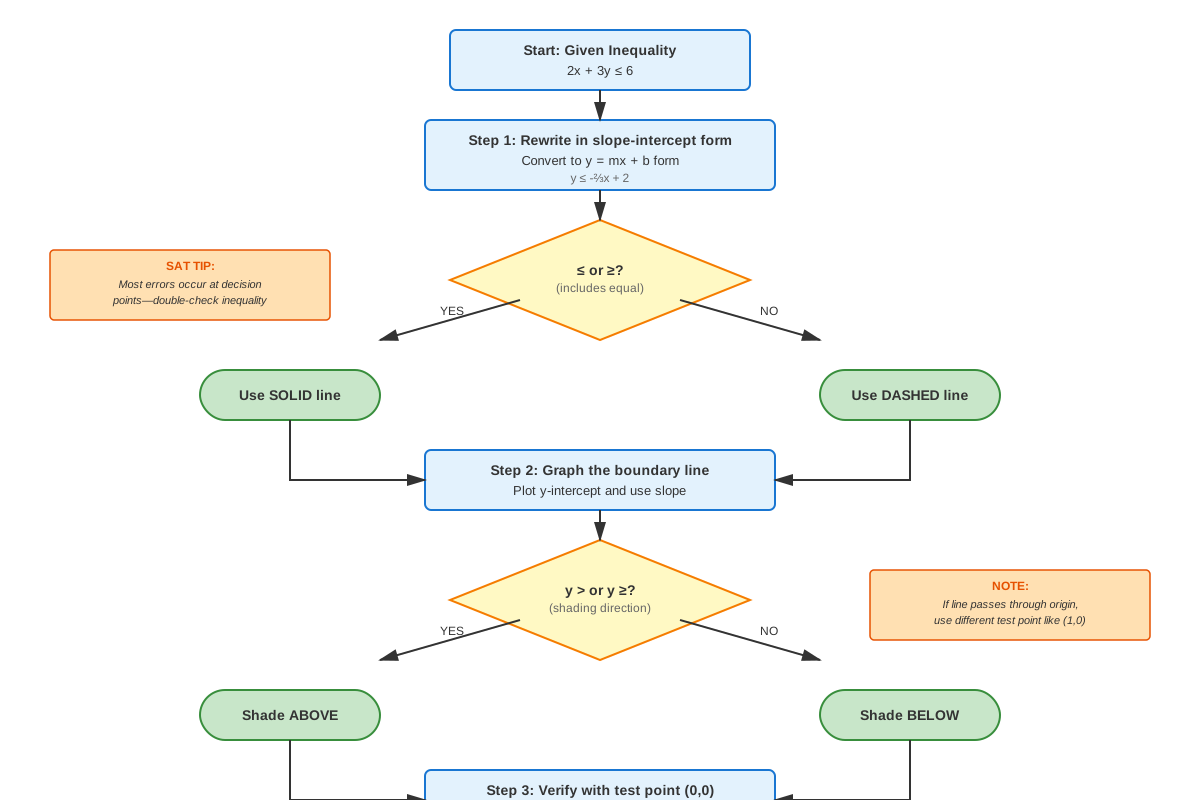
Problem: Graph the inequality 2x + 3y ≤ 12 on a coordinate plane.
Solution:
Step 1: Convert to the boundary line equation by replacing ≤ with =:
2x + 3y = 12
Step 2: Find the intercepts to graph the line efficiently.
- When x = 0: 3y = 12, so y = 4. Point: (0, 4)
- When y = 0: 2x = 12, so x = 6. Point: (6, 0)
Step 3: Determine line type. Since the inequality uses ≤ (less than or equal to), the boundary line should be solid because points on the line are included in the solution.
Step 4: Plot points (0, 4) and (6, 0), then draw a solid line through them.
Step 5: Choose a test point. The origin (0, 0) doesn't lie on the line, so it's a good choice.
Substitute into the original inequality: 2(0) + 3(0) ≤ 12
0 ≤ 12 ✓ (True)
Step 6: Since the test point makes the inequality true, shade the region containing (0, 0), which is the region below and to the left of the line.
Verification: Test another point in the shaded region, such as (1, 1):
2(1) + 3(1) = 5 ≤ 12 ✓ (True)
This problem demonstrates the complete process of converting an inequality to a graph, addressing the learning objective of applying linear inequality graphs to answer SAT-style questions.
Example 2: Identifying an Inequality from a Graph
Problem: A graph shows a dashed line passing through points (0, -2) and (3, 1), with shading above the line. Which inequality does this graph represent?
Solution:
Step 1: Find the boundary line equation using the two points.
Slope: m = (1 - (-2))/(3 - 0) = 3/3 = 1
Using point-slope form with (0, -2): y - (-2) = 1(x - 0)
Simplifying: y = x - 2
Step 2: Determine the inequality symbol based on line type.
The line is dashed, so the inequality uses either < or > (not ≤ or ≥).
Step 3: Determine the direction based on shading.
The shading is above the line. When an inequality is solved for y, "above" corresponds to > (greater than).
Step 4: Combine the information.
The inequality is: y > x - 2
Step 5: Verify with a test point from the shaded region.
Choose (0, 0), which appears to be in the shaded region:
0 > 0 - 2
0 > -2 ✓ (True)
Alternative forms: The inequality could also be written as:
- x - y < 2 (standard form)
- -x + y > -2 (another standard form)
This example addresses the learning objective of identifying key features of linear inequality graphs and demonstrates the reverse process of reading graphs to write inequalities—a common SAT question type.
Exam Strategy
When approaching sat linear inequality graphs questions, begin by identifying the question type: Are you graphing an inequality, identifying an inequality from a graph, or working with a system? Each type requires a slightly different approach but shares common strategies.
Trigger words that signal inequality problems include: "at least" (≥), "at most" (≤), "more than" (>), "less than" (<), "maximum," "minimum," "no more than," "no less than," "exceeds," and "does not exceed." When these appear in word problems, immediately translate them to the appropriate inequality symbols.
For graphing questions, always start by identifying whether the boundary line should be solid or dashed—this eliminates half the answer choices immediately in multiple-choice questions. Then use the test point method with (0, 0) when possible, as it's the fastest calculation. If (0, 0) lies on the boundary line, use (1, 0) or (0, 1) as alternatives.
For graph interpretation questions, examine the line type first (solid or dashed), then determine the boundary line equation, and finally verify the inequality symbol by testing a point from the shaded region. This systematic approach prevents careless errors and builds confidence.
Time-saving tip: On multiple-choice questions showing four different graphs, eliminate answers based on line type (solid vs. dashed) first, then check shading direction. This often reduces four choices to one or two without extensive calculation.
When working with systems of inequalities, sketch quick graphs if they're not provided. The SAT often asks whether specific points satisfy the system—test each inequality separately rather than trying to visualize the entire solution region. A point must satisfy ALL inequalities to be in the solution set.
Process of elimination works powerfully with inequality graphs. If a question asks which inequality matches a graph, test the given answer choices with a point clearly in the shaded region. Any inequality that makes that point false can be eliminated immediately. Similarly, if testing a point on the boundary line, any inequality with < or > (strict inequalities) should make that point false.
Allocate approximately 45-60 seconds for straightforward single-inequality graphing or identification questions, and up to 90 seconds for systems of inequalities or complex word problems requiring inequality setup. If a question requires more time, mark it and return after completing easier problems.
Memory Techniques
Solid/Dashed Line Mnemonic: "Solid means Same" — the inequality includes the Same points as the line (≤ or ≥). Dashed means different (< or >).
Shading Direction Acronym: GUAL — Greater Up, Above Line. When y is isolated and the inequality is y > or y ≥, shade above. The opposite (less than) goes below.
Test Point Visualization: Picture the origin (0, 0) as "home base." If you can walk home from the boundary line through the shaded region, home is in the solution. If home makes the inequality true, shade toward home.
Inequality Symbol Memory: The inequality symbol "points to" the smaller value, like an arrow. In x < 5, the symbol points to x, meaning x is smaller. In y > 3, the symbol points away from y, meaning y is larger.
System Solution Acronym: SOAP — Solution Overlaps All Parts. The solution to a system is where all individual solutions overlap, not where any single one exists.
Boundary Line Conversion: Think "Equality Boundary" — replace the inequality with Equality to find the Boundary line equation.
Summary
Linear inequality graphs represent solution sets as shaded regions on the coordinate plane, bounded by lines that may be solid (for ≤ or ≥) or dashed (for < or >). The process of graphing requires converting the inequality to its boundary line equation, determining the appropriate line type, and identifying the solution region through test points or algebraic analysis. When inequalities are solved for y, shading above the line corresponds to "greater than" relationships while shading below corresponds to "less than" relationships. Systems of inequalities require finding the intersection of multiple solution regions. The SAT tests these concepts through direct graphing, graph interpretation, and real-world application problems. Success requires fluency in moving between algebraic and graphical representations, systematic use of test points for verification, and careful attention to boundary line types. Mastery of linear inequality graphs provides essential skills for constraint modeling and optimization problems while building visual-spatial reasoning abilities critical for higher-level mathematics.
Key Takeaways
- Solid boundary lines include the line itself in the solution (≤ or ≥); dashed lines exclude it (< or >)
- The test point method using (0, 0) provides the most reliable way to determine shading direction
- When y is isolated, y > expression means shade above; y < expression means shade below
- Systems of inequalities have solutions only where all individual solution regions overlap
- Boundary line equations are found by temporarily replacing the inequality symbol with an equals sign
- Vertical and horizontal boundary lines require special attention and cannot always be written in slope-intercept form
- SAT questions frequently embed inequalities in real-world contexts using trigger words like "at least," "at most," "maximum," and "minimum"
Related Topics
Systems of Linear Equations: While linear inequality graphs show regions of solutions, systems of linear equations typically have single point solutions. Understanding both concepts together reveals the difference between exact solutions and solution sets, preparing students for optimization problems.
Linear Programming: This advanced topic uses systems of linear inequalities to find optimal solutions within constrained regions. Mastering basic inequality graphing is essential before tackling these more complex applications.
Absolute Value Inequalities: These create V-shaped boundary regions rather than straight lines. The graphing principles learned with linear inequalities extend to these more complex cases.
Quadratic Inequalities: Moving from linear to quadratic inequalities introduces parabolic boundaries. The fundamental concepts of boundary curves, test points, and shading regions remain applicable.
Piecewise Functions: Understanding how different rules apply to different regions of the coordinate plane builds directly on the regional thinking developed through inequality graphing.
Practice CTA
Now that you've mastered the core concepts of linear inequality graphs, it's time to cement your understanding through active practice. The practice questions and flashcards designed for this topic will challenge you to apply these concepts in various SAT-style formats, building the speed and accuracy needed for test day. Remember, every inequality question you practice is an opportunity to refine your systematic approach and boost your confidence. Start with the practice problems to identify any remaining gaps, then use the flashcards to reinforce the high-yield facts and strategies you've learned. Your investment in deliberate practice now will pay dividends in points on test day!
Sign up free to keep reading
Create a free AnvayaPrep account to finish this SAT guide on Linear inequality graphs — plus flashcards and practice questions.