Overview
One-variable inequalities form a cornerstone of algebraic reasoning tested extensively on the SAT. These mathematical statements express relationships where one quantity is greater than, less than, greater than or equal to, or less than or equal to another quantity. Unlike equations that have specific solutions, inequalities describe ranges of values that satisfy given conditions. Mastering this topic is essential because it appears in approximately 10-15% of SAT math questions, spanning both the calculator and no-calculator sections.
The SAT tests one-variable inequalities through multiple question formats: solving basic inequalities, interpreting inequality solutions on number lines, working with compound inequalities, and applying inequalities to real-world contexts such as budget constraints, measurement tolerances, and optimization problems. Students must not only solve these inequalities algebraically but also understand what the solutions represent graphically and contextually. The ability to translate word problems into inequality notation and interpret solutions correctly distinguishes high-scoring students from average performers.
Understanding one-variable inequalities creates a foundation for more advanced mathematical concepts tested on the SAT, including systems of inequalities, absolute value inequalities, and quadratic inequalities. This topic connects directly to linear equations, number line representations, and set notation—all critical components of the SAT math curriculum. Strong proficiency in manipulating and interpreting inequalities enables students to tackle complex problem-solving scenarios efficiently, making this a high-yield area for focused study and practice.
Learning Objectives
- [ ] Identify key features of one-variable inequalities including inequality symbols, solution sets, and boundary points
- [ ] Explain how one-variable inequalities appears on the SAT across different question formats and contexts
- [ ] Apply one-variable inequalities to answer SAT-style questions with accuracy and efficiency
- [ ] Solve multi-step one-variable inequalities while correctly applying properties of inequality operations
- [ ] Represent inequality solutions using interval notation, set-builder notation, and number line graphs
- [ ] Translate real-world scenarios into inequality statements and interpret solutions within context
- [ ] Recognize when to reverse inequality signs during algebraic manipulation
Prerequisites
- Basic algebraic manipulation: Ability to isolate variables, combine like terms, and apply inverse operations—essential for solving inequalities using the same techniques as equations
- Understanding of inequality symbols: Knowledge that < means "less than," > means "greater than," ≤ means "less than or equal to," and ≥ means "greater than or equal to"—the fundamental language of inequalities
- Number line familiarity: Comfort with plotting points and intervals on a number line—necessary for visualizing solution sets
- Order of operations: Mastery of PEMDAS/BODMAS—required for correctly simplifying expressions within inequalities
- Properties of real numbers: Understanding of positive, negative, and zero values—critical for knowing when inequality signs reverse
Why This Topic Matters
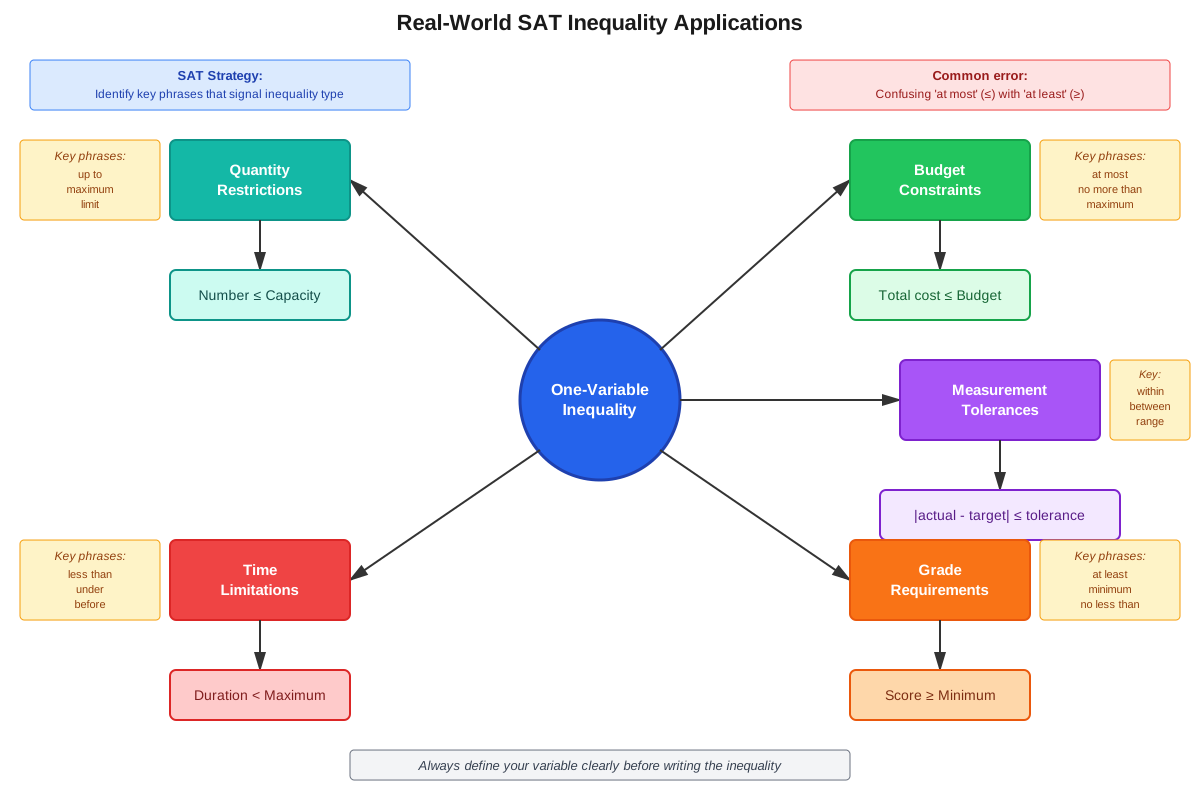
One-variable inequalities extend beyond abstract mathematics into countless real-world applications that the SAT frequently models. Budget planning (spending must be less than income), manufacturing tolerances (dimensions must fall within acceptable ranges), speed limits (velocity must not exceed certain values), and grade requirements (scores must be at least a certain threshold) all rely on inequality reasoning. These practical applications make inequality questions particularly common in SAT word problems.
On the SAT, one-variable inequalities appear in approximately 3-5 questions per test, representing roughly 5-8% of the total math score. Questions range from straightforward algebraic solving (difficulty level 1-2) to complex multi-step problems involving real-world contexts (difficulty level 3-4). The College Board consistently includes at least one question requiring students to interpret inequality solutions graphically and another requiring translation from verbal descriptions to mathematical notation.
Common SAT question formats include: solving linear inequalities and identifying solution sets from multiple choices; determining which values satisfy given inequalities; graphing solutions on number lines; writing inequalities from word problems; identifying errors in inequality solving; and working with compound inequalities (combining two or more inequality statements). The test also frequently embeds inequality concepts within data interpretation, function analysis, and optimization scenarios, making this topic's applications far-reaching across the entire math section.
Core Concepts
Understanding Inequality Symbols and Notation
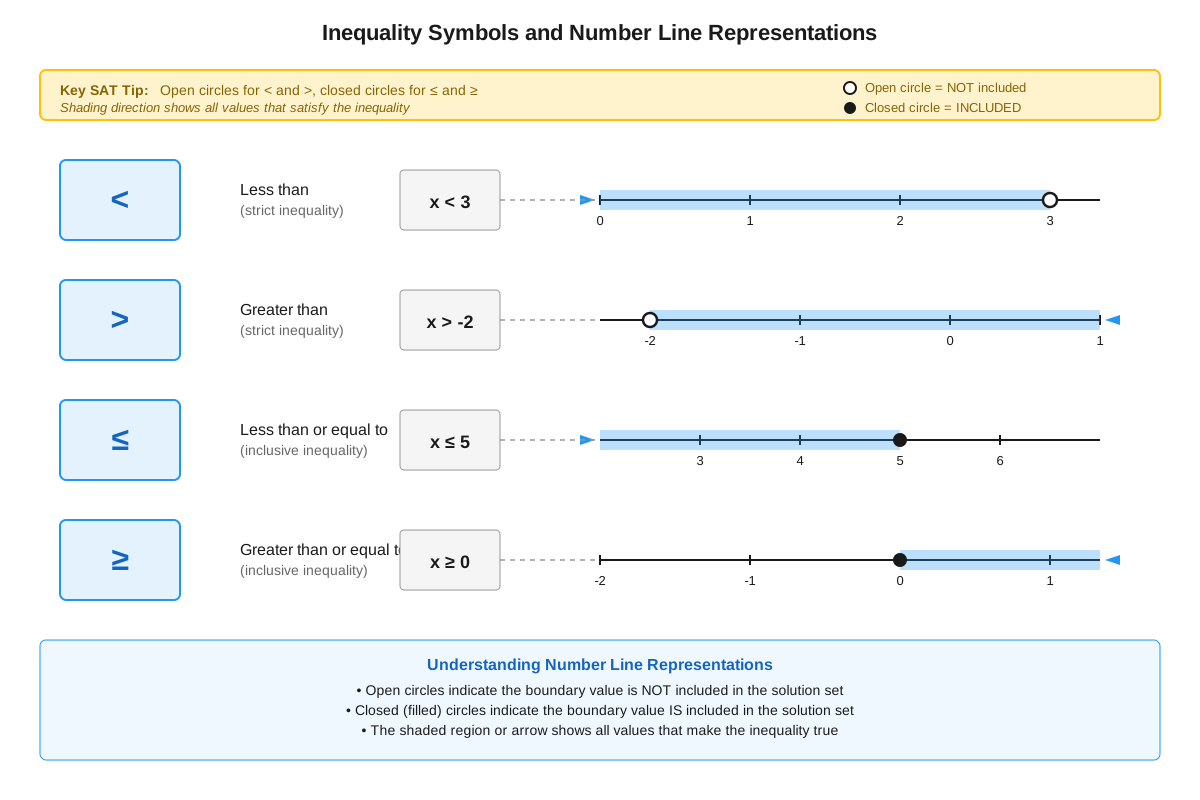
Inequality symbols express relationships between quantities that are not equal. The four primary symbols are:
- < (less than): indicates the left side is strictly smaller than the right side
- > (greater than): indicates the left side is strictly larger than the right side
- ≤ (less than or equal to): indicates the left side is smaller than or equal to the right side
- ≥ (greater than or equal to): indicates the left side is larger than or equal to the right side
The distinction between strict inequalities (< and >) and non-strict inequalities (≤ and ≥) is crucial. Strict inequalities exclude the boundary value from the solution set, while non-strict inequalities include it. For example, x < 5 means x can be 4.9, 4.99, or 4.999, but never exactly 5. However, x ≤ 5 includes 5 as a valid solution.
Solving One-Variable Inequalities
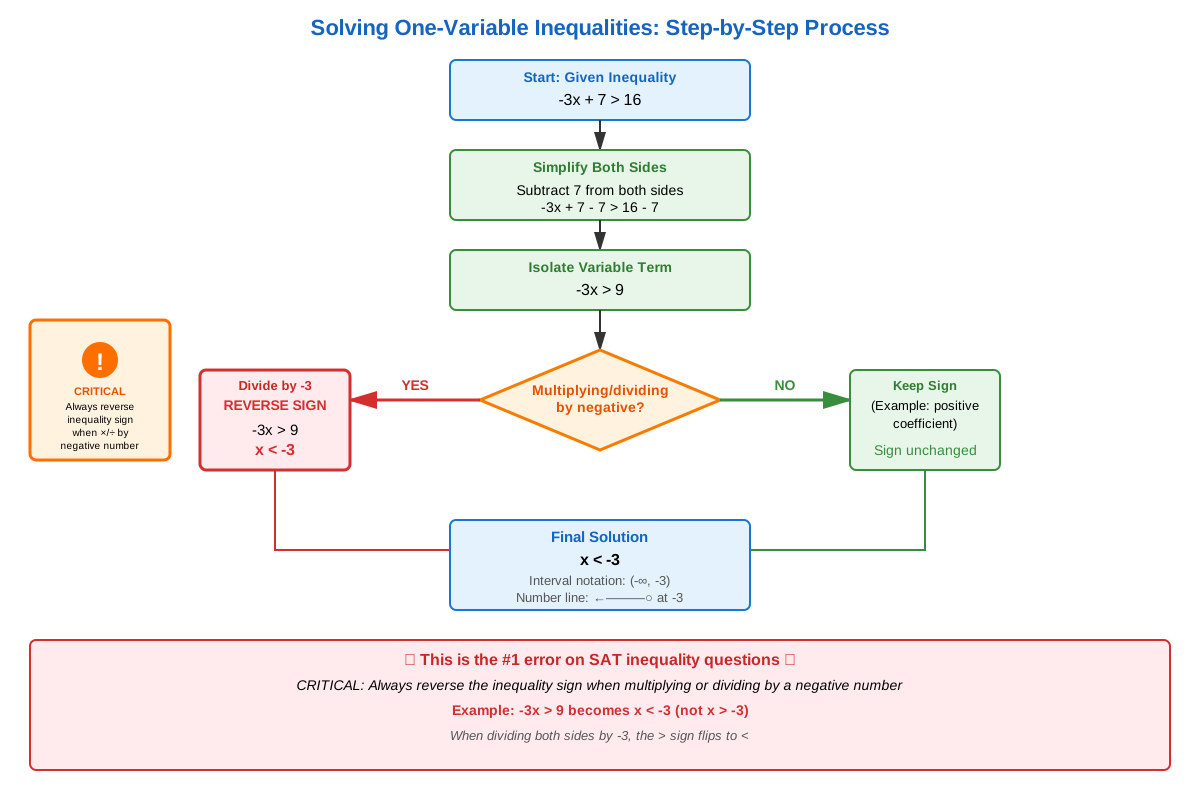
The process of solving one-variable inequalities closely mirrors solving equations, with one critical exception: multiplying or dividing both sides by a negative number reverses the inequality sign. This rule stems from the properties of the real number line—when you multiply by a negative, you flip the number line, reversing all relationships.
Standard solving steps:
- Simplify both sides of the inequality by combining like terms
- Use addition or subtraction to isolate the variable term on one side
- Use multiplication or division to isolate the variable completely
- Reverse the inequality sign if multiplying or dividing by a negative number
- Express the solution in appropriate notation
Consider the inequality: 3x - 7 > 8
3x - 7 > 8
3x > 15        (add 7 to both sides)
x > 5          (divide both sides by 3)
Now consider: -2x + 6 ≤ 14
-2x + 6 ≤ 14
-2x ≤ 8        (subtract 6 from both sides)
x ≥ -4         (divide both sides by -2, REVERSE the sign)
Representing Solutions
SAT one-variable inequalities require students to express solutions in multiple formats:
| Representation Type | Example for x > 3 | Example for x ≤ -2 | ||
|---|---|---|---|---|
| Inequality notation | x > 3 | x ≤ -2 | ||
| Interval notation | (3, ∞) | (-∞, -2] | ||
| Set-builder notation | {x \ | x > 3} | {x \ | x ≤ -2} |
| Number line | Open circle at 3, arrow right | Closed circle at -2, arrow left |
Interval notation uses parentheses ( ) for values not included (strict inequalities) and brackets [ ] for values included (non-strict inequalities). Infinity symbols always use parentheses because infinity is a concept, not a reachable value.
Compound Inequalities
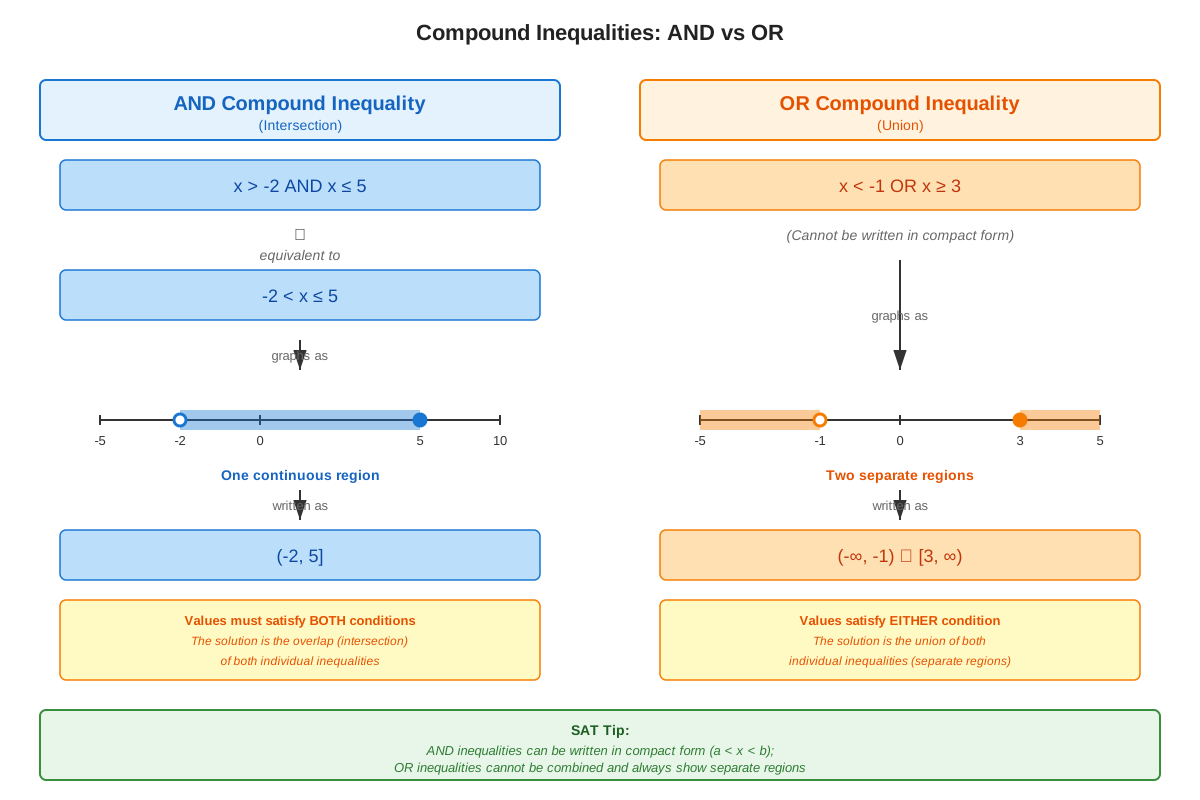
Compound inequalities combine two inequality statements, appearing frequently on the SAT. They come in two types:
"And" compound inequalities (conjunction): Both conditions must be satisfied simultaneously. Written as a < x < b, meaning x is greater than a AND less than b. The solution is the intersection of both conditions.
Example: -3 < 2x + 1 < 7
-3 < 2x + 1 < 7
-4 < 2x < 6        (subtract 1 from all parts)
-2 < x < 3         (divide all parts by 2)
Solution: x is between -2 and 3 (not including endpoints)
"Or" compound inequalities (disjunction): At least one condition must be satisfied. Written as x < a OR x > b. The solution is the union of both conditions.
Example: x - 5 < -2 OR x + 3 > 8
x < 3 OR x > 5Solution: x is less than 3 or greater than 5
Special Cases and Edge Scenarios
Certain inequality problems produce unusual results that the SAT occasionally tests:
All real numbers as solutions: When simplification yields a true statement like 5 > 2, every real number satisfies the original inequality.
No solution: When simplification yields a false statement like 3 < -1, no real number satisfies the original inequality.
Inequalities with absolute values: While technically a separate topic, simple absolute value inequalities appear in one-variable inequality contexts. Remember that |x| < a means -a < x < a, while |x| > a means x < -a OR x > a.
Contextual Inequality Problems
The SAT frequently embeds inequalities in real-world scenarios. Key translation phrases include:
- "At least" → ≥
- "At most" → ≤
- "More than" → >
- "Less than" → <
- "No more than" → ≤
- "No less than" → ≥
- "Between" → compound inequality with <
- "Exceeds" → >
- "Maximum" → ≤
- "Minimum" → ≥
When solving contextual problems, always verify that solutions make sense within the problem's constraints. For instance, if x represents the number of tickets sold, negative solutions are meaningless even if mathematically valid.
Concept Relationships
The concepts within one-variable inequalities build hierarchically. Understanding inequality symbols forms the foundation → enabling basic inequality solving → which extends to multi-step inequalities → leading to compound inequalities as a more complex application. Simultaneously, solution representation connects to all solving techniques, as every solved inequality must be expressed appropriately.
One-variable inequalities connect directly to prerequisite knowledge of linear equations—the solving procedures are nearly identical, with the critical addition of the sign-reversal rule. The topic also relies heavily on number line understanding from earlier mathematics, as visualizing solutions spatially reinforces algebraic manipulation.
Looking forward, mastering one-variable inequalities enables progression to systems of inequalities (multiple variables and constraints), quadratic inequalities (involving x² terms), and absolute value inequalities (combining absolute value properties with inequality solving). The logical reasoning developed through inequality work also supports function domain and range analysis, where inequalities describe valid input and output values.
The relationship between algebraic and graphical representations is bidirectional: students must translate from inequality notation to number lines and vice versa. This dual representation skill is essential for SAT success, as questions frequently require recognizing equivalent forms or identifying which graph matches a given algebraic statement.
Quick check — test yourself on One-variable inequalities so far.
Try Flashcards →High-Yield Facts
⭐ When multiplying or dividing both sides of an inequality by a negative number, the inequality sign must be reversed (e.g., if -2x > 6, then x < -3)
⭐ Strict inequalities (< and >) use open circles on number lines and parentheses in interval notation; non-strict inequalities (≤ and ≥) use closed circles and brackets
⭐ Compound "and" inequalities (a < x < b) represent values between two boundaries; compound "or" inequalities represent values outside a range
⭐ Adding or subtracting the same value to both sides of an inequality never changes the inequality direction
⭐ The phrase "at least" translates to ≥, while "at most" translates to ≤—these are among the most common SAT translation requirements
- Multiplying or dividing both sides by a positive number preserves the inequality direction
- The solution to x > a is all numbers to the right of a on the number line
- Interval notation uses ∞ (infinity) with parentheses, never brackets, because infinity is not a specific value
- When an inequality simplifies to a true statement (like 5 > 2), all real numbers are solutions
- When an inequality simplifies to a false statement (like 3 < 1), there is no solution
- Compound inequalities connected by "and" require both conditions to be true simultaneously (intersection)
- Compound inequalities connected by "or" require at least one condition to be true (union)
- The inequality x ≤ 5 includes the value 5 in its solution set; x < 5 does not
- Contextual inequality problems often have restricted domains (e.g., number of items must be non-negative integers)
- Testing a value from each region created by boundary points verifies inequality solutions
Common Misconceptions
Misconception: The inequality sign always stays the same when solving, just like the equals sign in equations.
Correction: The inequality sign reverses when multiplying or dividing both sides by a negative number. This is a fundamental difference between equations and inequalities that stems from how negative multiplication affects the number line.
Misconception: x > 5 means x = 6, 7, 8, etc. (only integers).
Correction: Unless the context specifies integers, x > 5 includes all real numbers greater than 5, such as 5.1, 5.01, 5.001, and irrational numbers like √30. The solution set is continuous, not discrete.
Misconception: The solution to -x < 3 is x < -3.
Correction: To solve -x < 3, divide both sides by -1 (or multiply by -1), which reverses the sign: x > -3. Many students forget to reverse the sign when the variable has a negative coefficient.
Misconception: "At least 10" means x < 10.
Correction: "At least 10" means the value must be 10 or greater, translating to x ≥ 10. The phrase "at least" includes the stated value as a minimum, not a maximum.
Misconception: In interval notation, (3, 7) means the same thing as in coordinate notation.
Correction: In interval notation, (3, 7) represents all real numbers between 3 and 7, not including the endpoints—it's a range on the number line. In coordinate notation, (3, 7) represents a single point in the xy-plane. Context determines meaning.
Misconception: Compound inequalities like x < 2 OR x > 5 can be written as 2 > x > 5.
Correction: The notation 2 > x > 5 is mathematically meaningless (it would mean 2 > 5, which is false). "Or" compound inequalities must be written as two separate statements: x < 2 OR x > 5. Only "and" compound inequalities can use the compact a < x < b notation.
Misconception: When graphing x ≥ 3 on a number line, use an open circle at 3.
Correction: The symbol ≥ means "greater than or equal to," so 3 is included in the solution. Use a closed (filled) circle at 3. Open circles are only for strict inequalities (< or >).
Worked Examples
Example 1: Multi-Step Inequality with Sign Reversal
Problem: Solve the inequality and express the solution in interval notation: 5 - 3x ≥ 17
Solution:
Step 1: Isolate the variable term by subtracting 5 from both sides
5 - 3x ≥ 17
-3x ≥ 12
Step 2: Divide both sides by -3 to isolate x. Critical: Since we're dividing by a negative number, reverse the inequality sign from ≥ to ≤
x ≤ -4Step 3: Express in interval notation. Since x can be any value less than or equal to -4, and there's no lower bound, we write:
(-∞, -4]The bracket at -4 indicates that -4 is included in the solution set (because of the ≤ symbol). The parenthesis at -∞ is always used because infinity is not a reachable value.
Verification: Test a value in the solution set, such as x = -5:
5 - 3(-5) = 5 + 15 = 20 ≥ 17 ✓Test a value outside the solution set, such as x = 0:
5 - 3(0) = 5 ≥ 17 ✗Connection to learning objectives: This example demonstrates applying one-variable inequalities to solve SAT-style questions, specifically addressing the critical skill of recognizing when to reverse the inequality sign—a key feature that distinguishes inequalities from equations.
Example 2: Compound Inequality in Context
Problem: A student needs to score at least 85 on the final exam to earn an A in the class, but the maximum possible score is 100. If the final exam score is represented by x, write a compound inequality representing the possible scores that would earn an A, then solve for the range if the student's current average requires the final score to satisfy 2x - 70 ≥ 100.
Solution:
Step 1: Translate the context into a compound inequality. The score must be "at least 85" (x ≥ 85) AND "at most 100" (x ≤ 100):
85 ≤ x ≤ 100Step 2: Now solve the additional constraint 2x - 70 ≥ 100:
2x - 70 ≥ 100
2x ≥ 170        (add 70 to both sides)
x ≥ 85          (divide both sides by 2)
Step 3: Combine both constraints. The student needs x ≥ 85 (from the grade requirement) AND x ≥ 85 (from the average calculation) AND x ≤ 100 (maximum possible). The most restrictive constraint is:
85 ≤ x ≤ 100Interpretation: The student must score between 85 and 100, inclusive, on the final exam to earn an A. Any score in this range satisfies all conditions.
SAT Connection: This problem type appears frequently on the SAT, requiring students to translate verbal descriptions into mathematical notation, solve multi-step inequalities, and interpret solutions within realistic constraints. The problem tests understanding of "at least" (≥), maximum values (≤), and how to combine multiple conditions.
Exam Strategy
When approaching SAT one-variable inequalities questions, employ this systematic strategy:
Step 1: Identify the question type. Determine whether you need to solve an inequality, interpret a solution, graph a solution set, or translate a word problem into inequality notation. This identification guides your approach.
Step 2: Watch for trigger words. Phrases like "at least," "at most," "no more than," "exceeds," "minimum," and "maximum" signal inequality relationships. Underline these phrases and immediately translate them to the correct inequality symbol before proceeding.
Step 3: Solve carefully, tracking sign changes. As you manipulate the inequality, explicitly note each step where you multiply or divide by a negative number. Write "REVERSE SIGN" in your work to avoid the most common error. If working mentally, double-check any step involving negative coefficients.
Step 4: Verify with test values. After solving, quickly test one value that should be in the solution set and one that shouldn't. This 10-second check catches most errors. For x > 3, test x = 4 (should work) and x = 2 (shouldn't work).
Step 5: Match the answer format. SAT questions may ask for solutions in inequality notation, interval notation, set-builder notation, or graphical form. Ensure your answer matches the requested format, paying special attention to open versus closed circles on number lines and parentheses versus brackets in interval notation.
Time-saving tip: For multiple-choice questions, if the algebra seems complex, consider testing the answer choices directly in the original inequality. This "backsolving" strategy often saves time and reduces algebraic errors.
Process of elimination strategies:
- Eliminate answer choices with incorrect inequality directions (if you know the solution should be x > a, eliminate any choice showing x < a)
- Eliminate graphs with incorrect circle types (open vs. closed)
- Eliminate interval notations with brackets around infinity symbols
- For word problems, eliminate answers that produce nonsensical values in context (negative quantities where only positive makes sense)
Time allocation: Straightforward inequality solving should take 30-45 seconds. Multi-step problems with context may require 60-90 seconds. If a problem exceeds 2 minutes, mark it for review and move forward—you can return with fresh perspective.
Memory Techniques
Mnemonic for sign reversal: "Negative Flips"—whenever you multiply or divide by a negative number, the inequality sign flips direction. Visualize a negative sign as a flip switch.
Mnemonic for "at least" vs. "at most": "At LEAST means GREATER or equal" (both have more letters than their counterparts). "At MOST means LESS or equal" (both have fewer letters). This helps distinguish ≥ from ≤.
Visualization for compound inequalities: Picture "AND" as a sandwich—the solution is squeezed between two pieces of bread (boundaries). Picture "OR" as two separate plates—the solution is on one plate or the other, but not in the middle.
Acronym for interval notation: PIES = Parentheses for Infinity, Everything else depends on Strict (parentheses) or non-strict (brackets) inequalities.
Number line memory aid: Think of Closed circles for Can equal (≤ or ≥) and Open circles for Only greater/less than (< or >). The matching first letters create a memorable association.
Solving sequence: SITAR = Simplify, Isolate variable term, Track negatives, Apply final operation, Reverse if needed. This acronym guides you through the solving process systematically.
Summary
One-variable inequalities represent a fundamental algebraic skill tested extensively on the SAT, requiring students to solve, interpret, and apply inequality relationships. The core distinction from equations lies in the sign-reversal rule: multiplying or dividing by negative numbers reverses the inequality direction. Students must master multiple representation formats—inequality notation, interval notation, set-builder notation, and number line graphs—and translate fluently between them. Compound inequalities extend basic concepts by combining two conditions with "and" (intersection) or "or" (union) logic. SAT questions embed inequalities in real-world contexts using trigger phrases like "at least," "at most," and "between," requiring careful translation from verbal descriptions to mathematical notation. Success demands both procedural fluency in algebraic manipulation and conceptual understanding of what solutions represent. The ability to verify solutions through test values, recognize when answers are contextually appropriate, and efficiently match answer formats distinguishes high-performing students on this high-yield topic.
Key Takeaways
- The inequality sign reverses when multiplying or dividing both sides by a negative number—this is the single most important rule distinguishing inequalities from equations
- Strict inequalities (< and >) exclude boundary values (open circles, parentheses), while non-strict inequalities (≤ and ≥) include boundary values (closed circles, brackets)
- Compound "and" inequalities (a < x < b) describe values between boundaries; compound "or" inequalities describe values outside a range
- Common SAT translation phrases: "at least" = ≥, "at most" = ≤, "more than" = >, "less than" = <, "between" = compound inequality
- Always verify solutions by testing values and checking contextual appropriateness—mathematical solutions may not always make real-world sense
- Multiple representation formats (inequality notation, interval notation, number lines) are all testable, so practice converting between them
- Interval notation uses parentheses with infinity symbols and brackets/parentheses for finite boundaries based on whether values are included
Related Topics
Systems of Linear Inequalities: Extends one-variable inequalities to two variables, requiring graphing on coordinate planes and identifying solution regions. Mastering one-variable inequalities provides the foundational solving skills needed for this more complex topic.
Absolute Value Inequalities: Combines absolute value properties with inequality solving, creating compound inequalities. Understanding basic inequality manipulation is essential before tackling the additional complexity of absolute values.
Quadratic Inequalities: Involves inequalities with x² terms, requiring factoring and sign analysis. The logical reasoning and solution representation skills from one-variable linear inequalities transfer directly to this advanced topic.
Linear Programming: Applies systems of inequalities to optimization problems in real-world contexts. The contextual translation skills developed through one-variable inequality word problems form the foundation for this application-focused topic.
Function Domain and Range: Uses inequality notation to describe valid input and output values for functions. Comfort with inequality notation and interval notation from this topic enables precise function analysis.
Practice CTA
Now that you've mastered the core concepts of one-variable inequalities, it's time to solidify your understanding through active practice. Attempt the practice questions to apply these strategies to authentic SAT-style problems, and use the flashcards to reinforce key facts and procedures. Remember: the difference between understanding a concept and scoring points on test day lies in deliberate practice. Each problem you solve strengthens your pattern recognition and builds the confidence needed to tackle any inequality question the SAT presents. You've built a strong foundation—now put it to work!
Sign up free to keep reading
Create a free AnvayaPrep account to finish this SAT guide on One-variable inequalities — plus flashcards and practice questions.