Overview
Parameter inequalities represent a sophisticated category of algebraic problems where an inequality contains one or more unknown constants (parameters) in addition to the variable being solved. Unlike standard inequalities where all coefficients are known numbers, parameter inequalities require students to consider how different values of the parameter affect the solution set. For example, in the inequality ax + 3 > 7, the parameter 'a' determines whether the solution involves dividing by a positive number, a negative number, or even whether the inequality has a solution at all.
This topic is essential for the SAT because it tests multiple mathematical skills simultaneously: algebraic manipulation, logical reasoning, understanding of inequality properties, and the ability to consider multiple cases. The College Board frequently includes sat parameter inequalities questions in both the calculator and no-calculator sections, often embedding them within word problems or systems of inequalities. These questions typically appear 2-3 times per test and are considered medium to high difficulty, making them excellent opportunities for students aiming for scores above 650 to demonstrate advanced mathematical reasoning.
Parameter inequalities connect directly to fundamental concepts in algebra, including solving linear inequalities, understanding the properties of inequality operations, and working with absolute values. They also bridge to more advanced topics like systems of inequalities, quadratic inequalities, and function analysis. Mastering this topic strengthens overall algebraic thinking and prepares students for the type of abstract reasoning required in college-level math courses.
Learning Objectives
- [ ] Identify key features of parameter inequalities, including the parameter, variable, and conditions that affect solution sets
- [ ] Explain how parameter inequalities appears on the SAT, including common question formats and difficulty patterns
- [ ] Apply parameter inequalities to answer SAT-style questions with accuracy and efficiency
- [ ] Determine when case analysis is necessary based on the sign of a parameter
- [ ] Solve parameter inequalities for specific parameter values and interpret the resulting solution sets
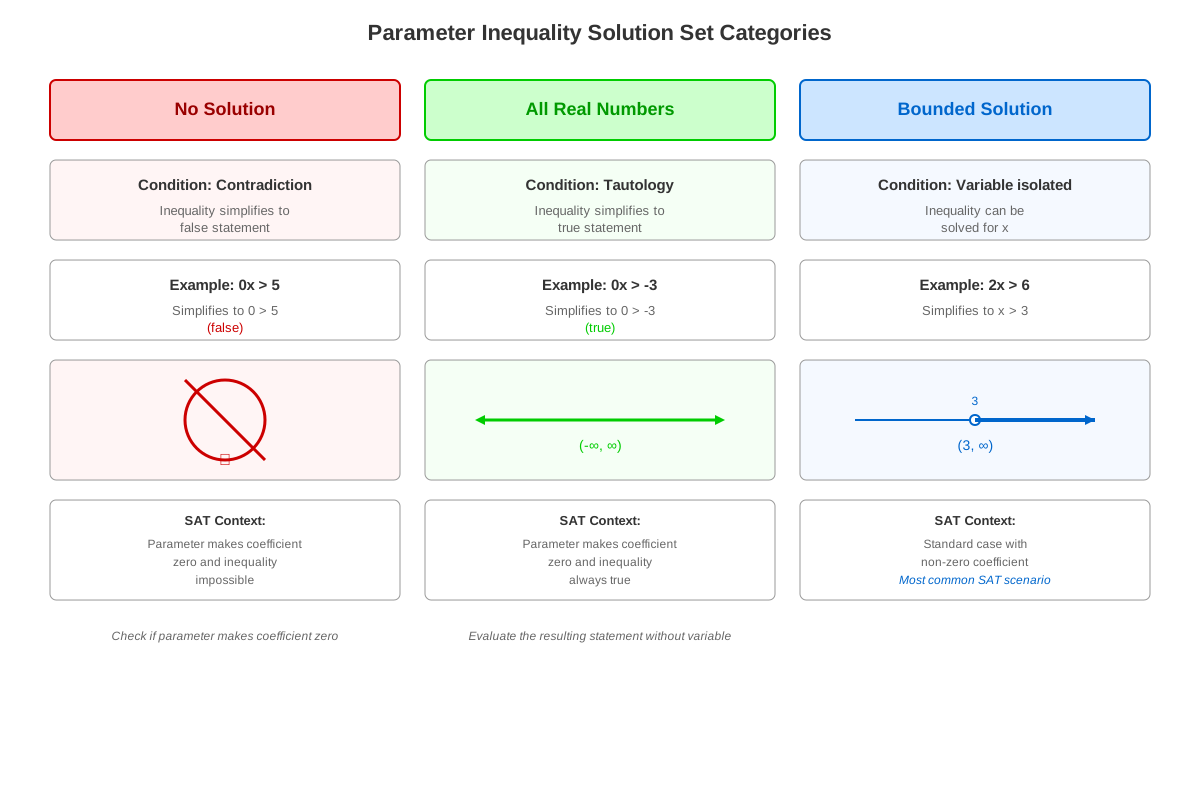
- [ ] Recognize when a parameter inequality has no solution, infinitely many solutions, or a bounded solution set
Prerequisites
- Solving linear inequalities: Essential for understanding how to manipulate parameter inequalities and apply inequality properties correctly
- Properties of inequality operations: Necessary to know when inequality signs flip (multiplying/dividing by negative numbers) and how parameters affect this
- Algebraic manipulation: Required for isolating variables and simplifying expressions containing parameters
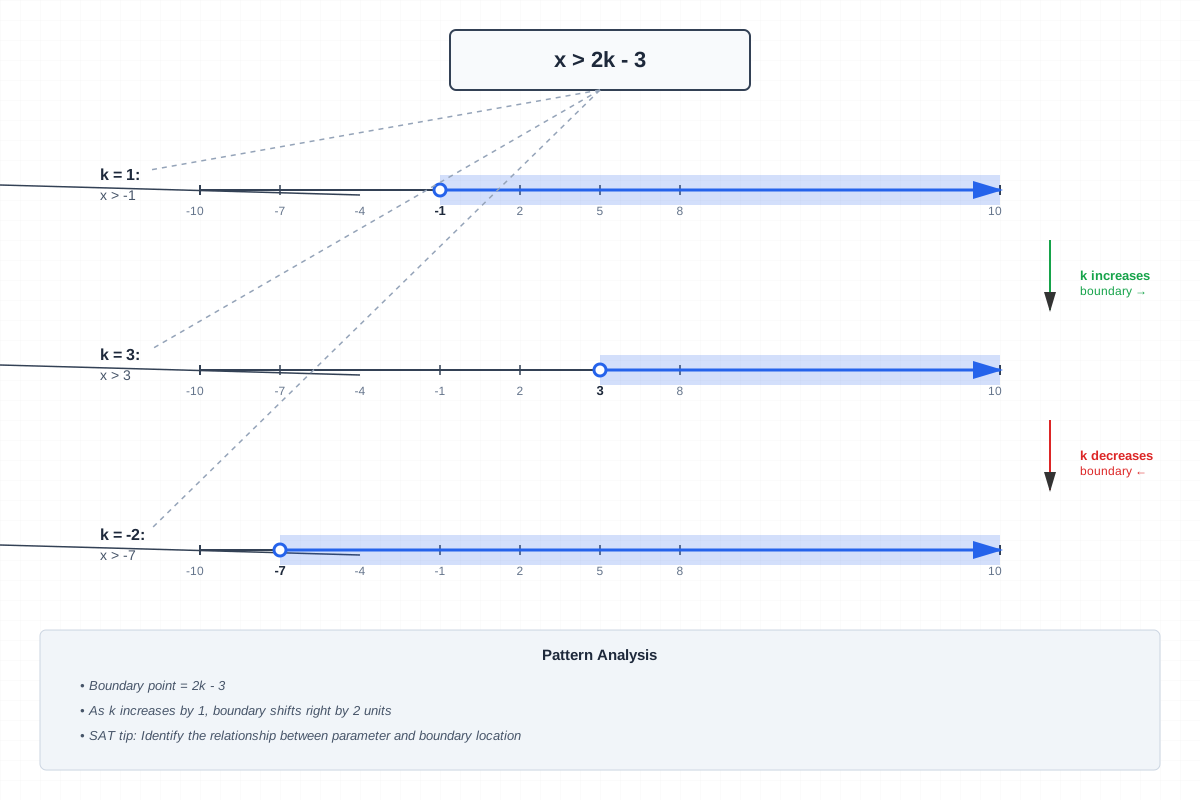
- Number line representation: Helpful for visualizing solution sets and understanding how parameters affect the range of solutions
- Basic function notation: Useful for understanding how changing parameter values transforms the inequality
Why This Topic Matters
Parameter inequalities appear in numerous real-world contexts where relationships involve unknown constants. Engineers use them when designing systems with variable specifications, economists apply them when modeling markets with uncertain parameters, and scientists employ them when establishing experimental conditions with tolerance ranges. For instance, a manufacturing process might require that the temperature T satisfy 2p - 5 < T < 3p + 10, where p represents a parameter that varies based on material properties.
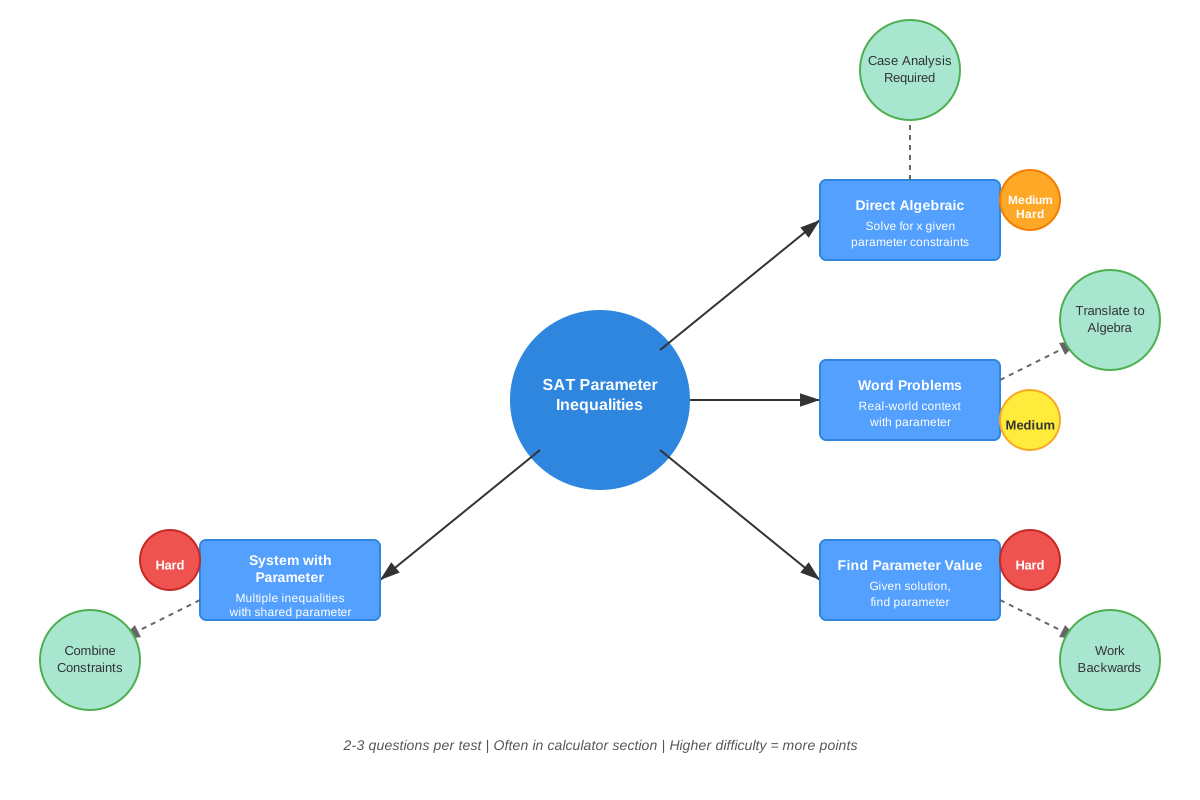
On the SAT, parameter inequalities appear in approximately 2-3 questions per test, representing roughly 4-6% of the math section. These questions typically appear as:
- Direct algebraic problems asking for solution sets given parameter constraints
- Word problems where a parameter represents a real-world quantity
- Questions asking "for what values of k does the inequality have no solution?"
- Problems involving systems where one equation contains a parameter
- Questions requiring students to determine relationships between parameters
The College Board uses parameter inequalities to assess higher-order thinking because these problems require students to move beyond mechanical computation to conceptual understanding. Students must recognize that the solution process depends on the parameter's value, demonstrate logical case analysis, and communicate mathematical reasoning clearly. Questions on this topic frequently serve as discriminators between students scoring in the 600s versus those achieving 700+.
Core Concepts
Understanding Parameters in Inequalities
A parameter is a constant whose value is not specified but affects the behavior of an inequality. In the expression kx + 5 > 12, the letter k is a parameter while x is the variable to be solved. The critical distinction is that we solve FOR the variable but solve WITH RESPECT TO the parameter. The parameter's value determines the nature of the solution set.
Parameters can appear in various positions within an inequality:
- As coefficients of the variable: ax + b > c
- As constant terms: x + k > 5
- In multiple positions: ax + b > cx + d
- Within absolute values: |x - p| < q
The Critical Role of Parameter Sign
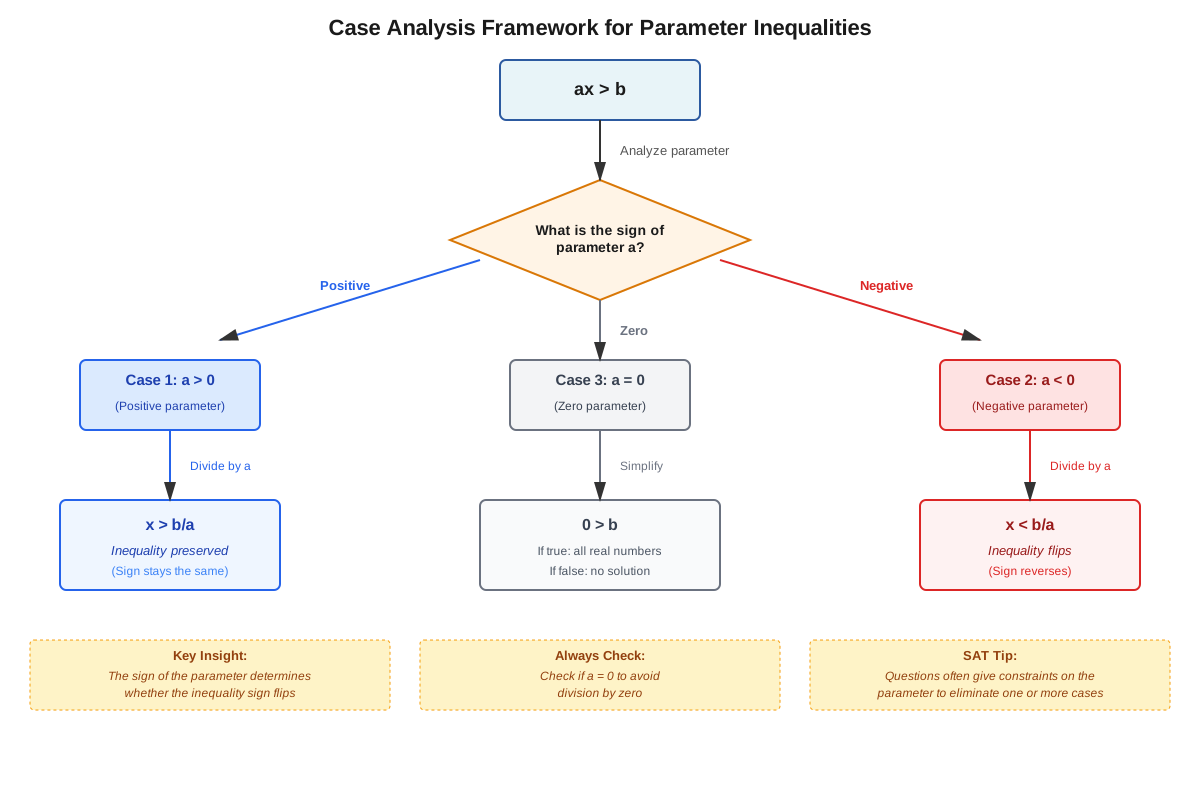
The most important concept in parameter inequalities is understanding how the sign of a parameter affects the solution process. When solving ax > b for x, three distinct cases emerge:
Case 1: Parameter is positive (a > 0)
When dividing both sides by a positive parameter, the inequality sign remains unchanged.
Example: If 3x > 12, then x > 4
Case 2: Parameter is negative (a < 0)
When dividing both sides by a negative parameter, the inequality sign must flip.
Example: If -3x > 12, then x < -4
Case 3: Parameter equals zero (a = 0)
The variable term disappears, leaving a statement that is either always true or always false.
Example: If 0·x > 12, this simplifies to 0 > 12, which is false (no solution)
Solving Parameter Inequalities: Step-by-Step Process
- Isolate the variable term containing the parameter on one side
- Identify the parameter that will be used in division or multiplication
- Consider all cases based on the parameter's possible values
- Solve each case separately, applying appropriate inequality rules
- Express the solution in terms of the parameter for each case
- Check boundary conditions where the parameter equals zero or other critical values
Solution Set Notation with Parameters
Solutions to parameter inequalities are expressed conditionally:
| Condition on Parameter | Solution Format | Example |
|---|---|---|
| a > 0 | x > (expression in a) | If a > 0, then x > 5/a |
| a < 0 | x < (expression in a) | If a < 0, then x < 5/a |
| a = 0 | No solution or all reals | If a = 0, no solution exists |
Special Cases and Edge Conditions
Empty Solution Set: Some parameter values result in contradictions. For example, in the inequality x + k > x + 5, subtracting x from both sides yields k > 5. This means the original inequality has solutions only when k > 5; otherwise, no value of x satisfies it.
Universal Solution Set: When parameter values create tautologies (always true statements), every real number is a solution. For instance, if k < 5 in the inequality x + k < x + 5, the statement is true for all x.
Boundary Analysis: Critical parameter values often occur where:
- The parameter coefficient equals zero
- The inequality becomes an equality
- The solution set transitions from bounded to unbounded
Systems Involving Parameter Inequalities
When parameter inequalities appear in systems, students must find parameter values that make the system consistent. For example:
x > 2k + 1
x < k + 7
For this system to have solutions, we need 2k + 1 < k + 7, which gives k < 6.
Absolute Value with Parameters
Parameter inequalities frequently involve absolute values: |x - a| < b. The solution depends on whether b is positive, negative, or zero:
- If b > 0: -b < x - a < b, giving a - b < x < a + b
- If b = 0: x = a (single solution)
- If b < 0: No solution (absolute values cannot be negative)
Concept Relationships
Parameter inequalities build directly on standard linear inequalities by introducing an additional layer of abstraction. The foundational skill of solving linear inequalities (isolating variables, applying inequality properties) serves as the base, while parameter analysis adds the requirement of case-based reasoning.
Relationship Map:
Linear Inequalities → Parameter Inequalities → Systems with Parameters → Quadratic Inequalities with Parameters
Within parameter inequalities, several concepts interconnect:
- Parameter sign analysis → determines → Solution method (whether to flip inequality)
- Boundary conditions → identify → Critical parameter values → define → Case divisions
- Solution set existence → depends on → Parameter constraints → leads to → Conditional solutions
The connection to absolute value inequalities is particularly strong, as parameters within absolute values create compound conditions. Similarly, systems of inequalities with parameters require synthesizing both topics, as students must ensure consistency across multiple conditions while accounting for parameter variation.
Understanding parameter inequalities also prepares students for function analysis, where parameters represent family characteristics (like the slope in y = mx + b), and for optimization problems where constraints contain variable coefficients.
High-Yield Facts
⭐ When dividing or multiplying both sides of an inequality by a parameter, you must consider whether the parameter is positive, negative, or zero
⭐ If the parameter coefficient of the variable equals zero, the inequality reduces to a statement about constants that is either always true or always false
⭐ For the inequality ax > b where a ≠ 0: if a > 0, then x > b/a; if a < 0, then x < b/a
⭐ A system of inequalities with parameters has solutions only when the parameter values make the system consistent
⭐ The solution set of a parameter inequality is typically expressed as a conditional statement: "If [parameter condition], then [solution]"
- Parameter inequalities can have empty solution sets, single solutions, bounded intervals, or unbounded intervals depending on parameter values
- Critical parameter values occur where the coefficient of the variable equals zero or where boundary conditions change
- When a parameter appears in multiple terms, collect like terms before analyzing cases
- The inequality |x - p| < q has solutions only when q > 0; the solution is p - q < x < p + q
- For compound inequalities with parameters, solve each part separately and find the intersection of solution sets
- Word problems with parameters often describe situations where a quantity "depends on" or "varies with" another factor
- On the SAT, parameter inequality questions frequently ask "for what values of k" or "if the inequality has no solution, then k must be"
- When parameters appear in both the coefficient and constant term, isolate the variable term first before case analysis
- The number line representation of parameter inequality solutions often shows rays or intervals with endpoints expressed in terms of the parameter
- Always verify solutions by testing specific parameter values, especially at critical points like zero and boundary values
Quick check — test yourself on Parameter inequalities so far.
Try Flashcards →Common Misconceptions
Misconception: When solving ax > b, you can always divide by a to get x > b/a.
Correction: This is only valid when a > 0. If a < 0, the inequality flips to x < b/a. If a = 0, division is undefined and the variable term vanishes entirely, requiring separate analysis.
Misconception: If a parameter inequality has no solution for one parameter value, it has no solution for all parameter values.
Correction: The solution set depends on the specific parameter value. An inequality might have no solution for some parameter values but have solutions for others. For example, x + k > x + 5 has solutions only when k > 5.
Misconception: Parameters and variables are interchangeable in an inequality.
Correction: Parameters are treated as constants (though unknown), while variables are what we solve for. In kx > 5, we solve for x in terms of k, not the other way around.
Misconception: The solution to a parameter inequality is always a single expression.
Correction: Solutions are typically conditional, requiring different expressions for different parameter ranges. A complete solution includes all cases: when the parameter is positive, negative, and zero.
Misconception: When a parameter appears on both sides of an inequality, it cancels out.
Correction: Parameters only cancel when they have identical coefficients and signs. In 2kx > kx + 5, you cannot simply "cancel the k" without first factoring and considering whether k equals zero.
Misconception: If |x - a| < b, then x < a + b.
Correction: The absolute value inequality gives a compound inequality: -b < x - a < b, which means a - b < x < a + b. Both bounds are necessary, and the solution only exists when b > 0.
Misconception: Parameter inequalities always have more complex solutions than regular inequalities.
Correction: While they require case analysis, the actual algebraic manipulation is often straightforward. The complexity lies in logical organization, not computational difficulty.
Worked Examples
Example 1: Basic Parameter Inequality with Case Analysis
Problem: Solve for x: (k - 2)x > 6, where k is a real number.
Solution:
Step 1: Identify that we need to divide by (k - 2), so we must consider its sign.
Step 2: Analyze cases based on the sign of (k - 2).
Case 1: k - 2 > 0 (equivalently, k > 2)
When the coefficient is positive, divide both sides without flipping:
(k - 2)x > 6
x > 6/(k - 2)
Case 2: k - 2 < 0 (equivalently, k < 2)
When the coefficient is negative, divide both sides and flip the inequality:
(k - 2)x > 6
x < 6/(k - 2)
Case 3: k - 2 = 0 (equivalently, k = 2)
The inequality becomes:
0·x > 6
0 > 6
This is false, so there is no solution when k = 2.
Complete Solution:
- If k > 2, then x > 6/(k - 2)
- If k < 2, then x < 6/(k - 2)
- If k = 2, no solution exists
This example demonstrates the fundamental principle that parameter sign determines solution structure. Notice how the solution set changes dramatically based on whether k is greater than, less than, or equal to 2.
Example 2: System with Parameter Requiring Consistency Analysis
Problem: For what values of m does the system have at least one solution?
x > 3m - 2
x < m + 4Solution:
Step 1: Understand that for the system to have solutions, the two conditions must overlap. This means we need the lower bound to be less than the upper bound.
Step 2: Set up the consistency condition:
3m - 2 < m + 4Step 3: Solve for m:
3m - 2 < m + 4
3m - m < 4 + 2
2m < 6
m < 3
Step 4: Interpret the result.
When m < 3, the inequality 3m - 2 < m + 4 is satisfied, meaning there exists a range of x values satisfying both conditions. For example, if m = 0:
- x > 3(0) - 2 = -2
- x < 0 + 4 = 4
- Solution: -2 < x < 4 ✓
If m ≥ 3, the lower bound exceeds or equals the upper bound, creating an impossible condition. For example, if m = 4:
- x > 3(4) - 2 = 10
- x < 4 + 4 = 8
- This requires x > 10 AND x < 8, which is impossible ✗
Answer: The system has solutions when m < 3.
This example illustrates how parameter constraints emerge from requiring consistency in systems. This type of question frequently appears on the SAT, testing whether students can translate "has a solution" into a mathematical condition on the parameter.
Exam Strategy
Approach Framework:
When encountering parameter inequalities on the SAT, follow this systematic approach:
- Identify the parameter and variable immediately. Circle or underline the parameter to avoid confusing it with the variable you're solving for.
- Determine critical parameter values before solving. Ask: "What parameter values would make the coefficient zero or change the inequality's behavior?"
- Set up case analysis explicitly. Even if you don't write out every case in detail, mentally note: positive case, negative case, zero case.
- Watch for "no solution" or "all solutions" answer choices. These often correspond to the zero case or contradictory conditions.
Trigger Words and Phrases:
- "For what values of k..." → Signals you need to find parameter constraints
- "has no solution" → Look for contradictions or the zero coefficient case
- "for all values of x" → Indicates a tautology or universal solution set
- "depends on" or "varies with" → Suggests a parameter relationship
- "at least one solution" → Requires consistency analysis in systems
Process of Elimination Tips:
- Eliminate answer choices that don't account for sign changes (if they give a single expression without conditions)
- Test extreme parameter values (very large positive, very large negative, zero) to eliminate impossible answers
- If an answer choice suggests x > (expression), verify it works when the parameter is positive
- For "no solution" questions, the correct answer often involves the parameter making a coefficient zero
Time Allocation:
- Spend 15-20 seconds identifying the parameter and planning your case analysis
- Allocate 45-60 seconds for solving (longer if it's a multi-part question)
- Reserve 15 seconds for verification by testing a specific parameter value
- If stuck after 90 seconds, make an educated guess and move on—these questions can be time traps
Exam Tip: On the SAT, parameter inequality questions rarely require you to write out all three cases in complete detail. Often, the question asks about a specific scenario (like "when is there no solution?"), allowing you to focus on just one case. Read the question carefully to determine exactly what's being asked.
Memory Techniques
PANS Mnemonic for solving parameter inequalities:
- Parameter: Identify what's the parameter vs. variable
- Analyze: Determine critical values (especially zero)
- Negative check: Consider if parameter could be negative (flip inequality)
- Solution: Express answer conditionally for each case
Sign Rule Visualization:
Picture a number line with zero in the middle:
- Right side (positive): Inequality sign stays the same →
- Left side (negative): Inequality sign flips ←
- At zero: Variable disappears (poof!)
The "Flip-Flop" Rule:
"Negative parameter? Flip the inequality. Zero parameter? Flop the variable (it disappears)."
Three C's of Parameter Analysis:
- Coefficient sign (positive, negative, or zero)
- Cases (organize your work by parameter ranges)
- Conditions (express solutions conditionally)
Acronym for System Consistency: BOLT
- Bounds must overlap
- Order matters (lower < upper)
- Lower bound from one inequality
- Top (upper) bound from the other
Summary
Parameter inequalities represent a sophisticated algebraic concept where unknown constants (parameters) affect how inequalities are solved and what solution sets emerge. The fundamental principle is that when dividing or multiplying by a parameter, the sign of that parameter determines whether the inequality sign remains the same (positive parameter), flips (negative parameter), or causes the variable to vanish (zero parameter). Solving parameter inequalities requires systematic case analysis, considering all possible parameter values and expressing solutions conditionally. On the SAT, these problems test logical reasoning and the ability to handle abstract relationships, appearing in direct algebraic questions, word problems, and system consistency problems. Success requires identifying parameters versus variables, determining critical parameter values, organizing case-by-case analysis, and expressing solutions in conditional form. The most common pitfall is forgetting to consider all cases, particularly the zero case, which often corresponds to "no solution" scenarios. Mastery of parameter inequalities demonstrates advanced algebraic thinking and prepares students for higher-level mathematics involving variable coefficients and conditional reasoning.
Key Takeaways
- Parameter inequalities require case analysis based on whether the parameter is positive, negative, or zero—this is the single most important concept for SAT success
- When dividing by a parameter: if positive, inequality stays same; if negative, inequality flips; if zero, variable disappears
- Solutions are expressed conditionally: "If [parameter condition], then [solution in terms of parameter]"
- Systems with parameters have solutions only when consistency conditions are met, typically requiring the lower bound to be less than the upper bound
- The zero case often corresponds to "no solution" answers on the SAT, making it a high-yield scenario to check
- Parameter inequalities test logical reasoning more than computational skill—organize your thinking systematically rather than rushing through algebra
- Always identify what you're solving FOR (the variable) versus what you're solving WITH RESPECT TO (the parameter) to avoid confusion
Related Topics
Systems of Linear Inequalities: Building on parameter inequalities, systems combine multiple constraints and often require graphical interpretation alongside algebraic solutions. Mastering parameter inequalities provides the foundation for analyzing when systems have feasible regions.
Quadratic Inequalities: The next level of complexity involves parameters in quadratic expressions, requiring analysis of discriminants and parabola properties. The case-based reasoning developed with linear parameter inequalities transfers directly.
Absolute Value Inequalities: These frequently contain parameters within the absolute value or as bounds, combining the challenges of absolute value properties with parameter analysis.
Function Analysis and Transformations: Parameters in functions (like y = mx + b) represent family characteristics. Understanding how parameters affect inequalities prepares students for analyzing how parameters transform entire functions.
Optimization and Linear Programming: Advanced applications where parameter inequalities define constraint regions, connecting algebra to real-world decision-making scenarios.
Practice CTA
Now that you've mastered the core concepts of parameter inequalities, it's time to solidify your understanding through practice! Attempt the practice questions to apply these strategies to SAT-style problems, and use the flashcards to reinforce the key facts and procedures. Remember, parameter inequalities are high-value questions on the SAT—investing time to master them now will pay dividends on test day. Focus especially on case analysis and recognizing when parameters create special conditions like "no solution." You've got this!
Sign up free to keep reading
Create a free AnvayaPrep account to finish this SAT guide on Parameter inequalities — plus flashcards and practice questions.