Overview
Markup is a fundamental concept in percentage mathematics that appears consistently on the SAT math section. It represents the amount added to the cost of an item to determine its selling price, typically expressed as a percentage of the original cost. Understanding markup is essential for solving real-world business problems that frequently appear on standardized tests, where students must calculate selling prices, determine profit margins, or work backward from retail prices to find original costs.
On the SAT, markup problems test a student's ability to work with percentages, set up equations, and translate word problems into mathematical expressions. These questions often appear in both the calculator and no-calculator sections, making them high-yield topics that can significantly impact overall scores. Markup problems may be presented as straightforward calculations or embedded within more complex multi-step word problems that require careful analysis and strategic problem-solving.
The concept of markup connects directly to broader percentage applications, including discount problems, percent change, and proportional reasoning. Mastering markup provides students with a framework for understanding how businesses price products and how to manipulate percentage relationships—skills that extend beyond the SAT into real-world financial literacy. This topic typically accounts for 2-4 questions per SAT administration, making it a critical area for focused study and practice.
Learning Objectives
- [ ] Identify key features of Markup
- [ ] Explain how Markup appears on the SAT
- [ ] Apply Markup to answer SAT-style questions
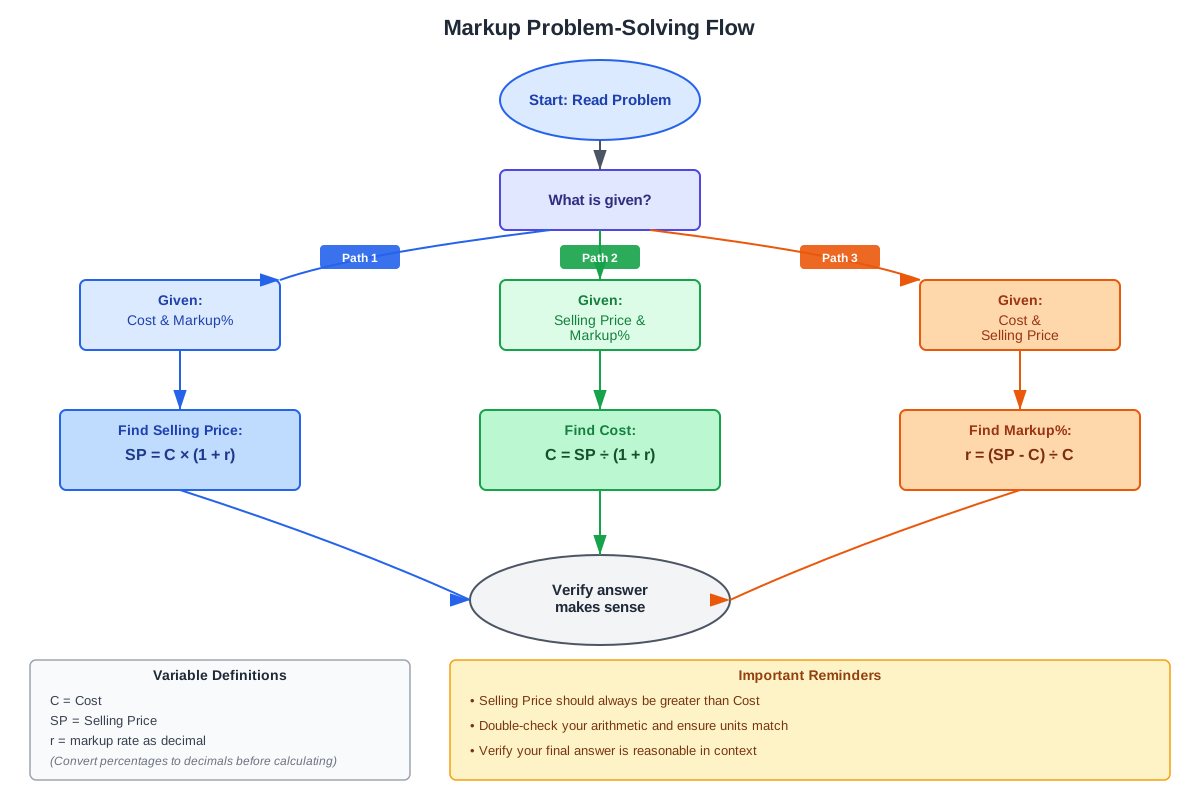
- [ ] Calculate selling price given cost and markup percentage
- [ ] Determine the original cost when given selling price and markup rate
- [ ] Solve multi-step problems involving markup combined with discounts or taxes
- [ ] Convert between different representations of markup (percentage, decimal, dollar amount)
Prerequisites
- Basic percentage calculations: Students must be able to find a percentage of a number and convert between percentages, decimals, and fractions, as markup problems fundamentally rely on these operations.
- Algebraic equation solving: The ability to set up and solve linear equations is necessary for working backward from selling prices to find original costs or markup rates.
- Word problem translation: Students should be comfortable translating verbal descriptions into mathematical expressions, as markup problems are almost always presented in context.
- Order of operations: Understanding the correct sequence for applying multiple percentage changes is crucial when markup appears alongside other adjustments like discounts or taxes.
Why This Topic Matters
Markup is one of the most practical mathematical concepts students will encounter, directly applicable to retail business, entrepreneurship, and personal finance. Every product sold in stores involves markup calculations—from grocery items to electronics—making this concept immediately relevant to daily life. Understanding markup helps consumers make informed purchasing decisions and enables future business owners to price products profitably.
On the SAT, markup problems appear with notable frequency, typically showing up 2-4 times per test administration. These questions most commonly appear in the Problem Solving and Data Analysis domain, though they can also emerge in Heart of Algebra questions when combined with algebraic reasoning. The College Board favors markup problems because they assess multiple skills simultaneously: percentage fluency, algebraic thinking, and real-world application.
SAT markup questions typically manifest in several formats: direct calculation problems asking for selling price given cost and markup percentage; reverse problems requiring students to find the original cost from a marked-up price; comparison problems where students must determine which of several markup scenarios yields the highest profit; and complex multi-step problems where markup is combined with discounts, taxes, or multiple pricing tiers. The versatility of markup as a testing vehicle makes it a high-yield topic that rewards thorough preparation.
Core Concepts
Understanding Markup Fundamentals
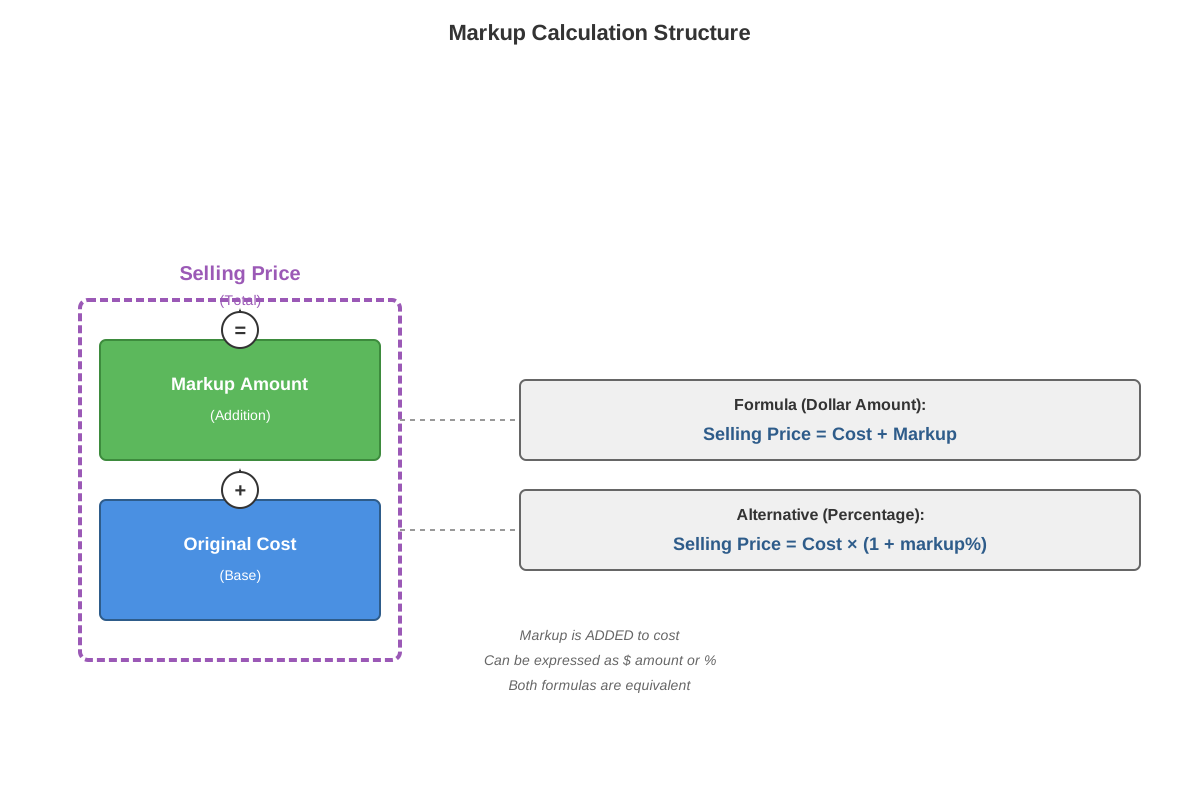
Markup is the amount added to the cost price of goods to cover overhead expenses and profit. It represents the difference between what a business pays for an item (the cost) and what they charge customers (the selling price). The markup can be expressed as a dollar amount or, more commonly on the SAT, as a percentage of the original cost.
The fundamental relationship is:
Selling Price = Cost + MarkupWhen markup is expressed as a percentage:
Selling Price = Cost + (Markup Percentage × Cost)This can be simplified to:
Selling Price = Cost × (1 + Markup Percentage)For example, if a store purchases a shirt for $20 and applies a 50% markup, the selling price would be $20 × (1 + 0.50) = $20 × 1.50 = $30. The markup amount in dollars is $10, which is 50% of the $20 cost.
Markup vs. Margin
A critical distinction that occasionally appears on the SAT is the difference between markup and profit margin. While markup is calculated as a percentage of the cost, profit margin is calculated as a percentage of the selling price. This distinction matters when interpreting word problems.
| Concept | Base for Calculation | Formula |
|---|---|---|
| Markup | Original Cost | (Selling Price - Cost) / Cost × 100% |
| Profit Margin | Selling Price | (Selling Price - Cost) / Selling Price × 100% |
For the same transaction, markup percentage will always be higher than profit margin percentage. Using our previous example: the $10 profit on a $20 cost represents a 50% markup, but that same $10 profit on a $30 selling price represents only a 33.3% profit margin.
Calculating Selling Price from Cost and Markup
The most straightforward markup problem provides the original cost and markup percentage, asking for the selling price. The efficient approach uses the multiplier method:
- Convert the markup percentage to a decimal
- Add 1 to this decimal (representing 100% of the original cost plus the markup)
- Multiply the cost by this factor
For a 35% markup on a $80 item:
- Markup as decimal: 0.35
- Multiplier: 1 + 0.35 = 1.35
- Selling Price: $80 × 1.35 = $108
Working Backward: Finding Cost from Selling Price
More challenging SAT problems provide the selling price and markup percentage, requiring students to determine the original cost. This requires algebraic thinking and careful equation setup.
If an item sells for $156 after a 30% markup, the original cost can be found by recognizing that $156 represents 130% of the cost (100% original + 30% markup):
Cost × 1.30 = $156
Cost = $156 ÷ 1.30
Cost = $120
The key insight is that the selling price represents the cost multiplied by (1 + markup rate), so dividing the selling price by this multiplier yields the original cost.
Multiple Markup Applications
Some SAT problems involve successive markups, where an item is marked up multiple times. When this occurs, each markup is applied to the result of the previous markup, not to the original cost. This creates a compound effect.
If an item costing $50 receives a 20% markup, then an additional 10% markup:
- First markup: $50 × 1.20 = $60
- Second markup: $60 × 1.10 = $66
Alternatively, multiply the factors: $50 × 1.20 × 1.10 = $66
The total markup is not simply 30% (20% + 10%), but rather 32%, because the second markup applies to an already increased price.
Markup Combined with Discounts
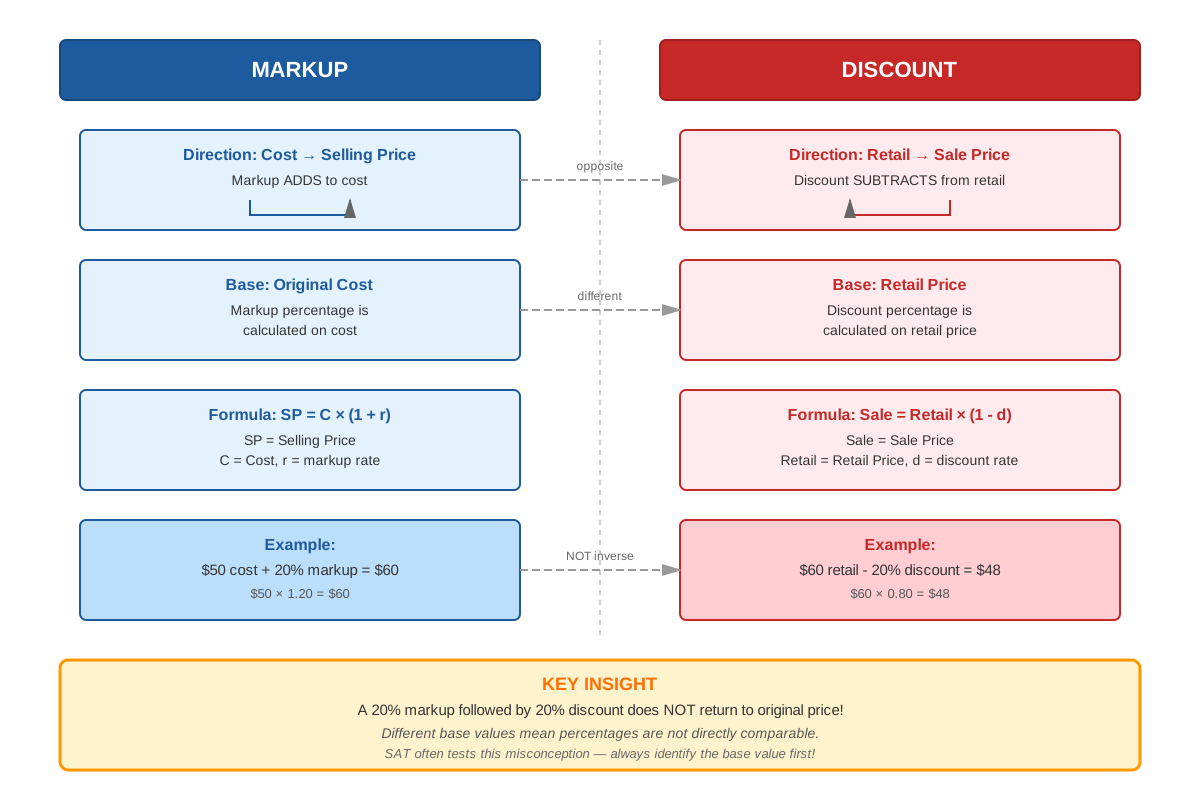
A particularly challenging SAT scenario involves markup followed by discount (or vice versa). Students must carefully track which percentage applies to which base amount. A 25% markup followed by a 25% discount does not return the item to its original price.
For a $100 item with 25% markup then 25% discount:
- After markup: $100 × 1.25 = $125
- After discount: $125 × 0.75 = $93.75
The final price is $93.75, not $100, because the discount applies to the higher marked-up price while the markup applied to the lower original cost.
Concept Relationships
Markup serves as a foundational concept within the broader category of percentage applications. The core relationship flows from basic percentage calculation → markup calculation → selling price determination. Understanding how to find a percentage of a number directly enables markup calculations, which in turn determine final selling prices.
Markup problems connect intimately with percent change concepts, as markup represents a specific type of percent increase. The formula structure mirrors percent increase calculations, with the original cost serving as the baseline. This relationship extends to discount problems, which represent the inverse operation—a percent decrease from a marked-up price.
The algebraic manipulation required for reverse markup problems (finding cost from selling price) reinforces equation-solving skills and inverse operations. Students must recognize that if multiplication by (1 + markup rate) produces the selling price, then division by the same factor reverses the operation to find the original cost.
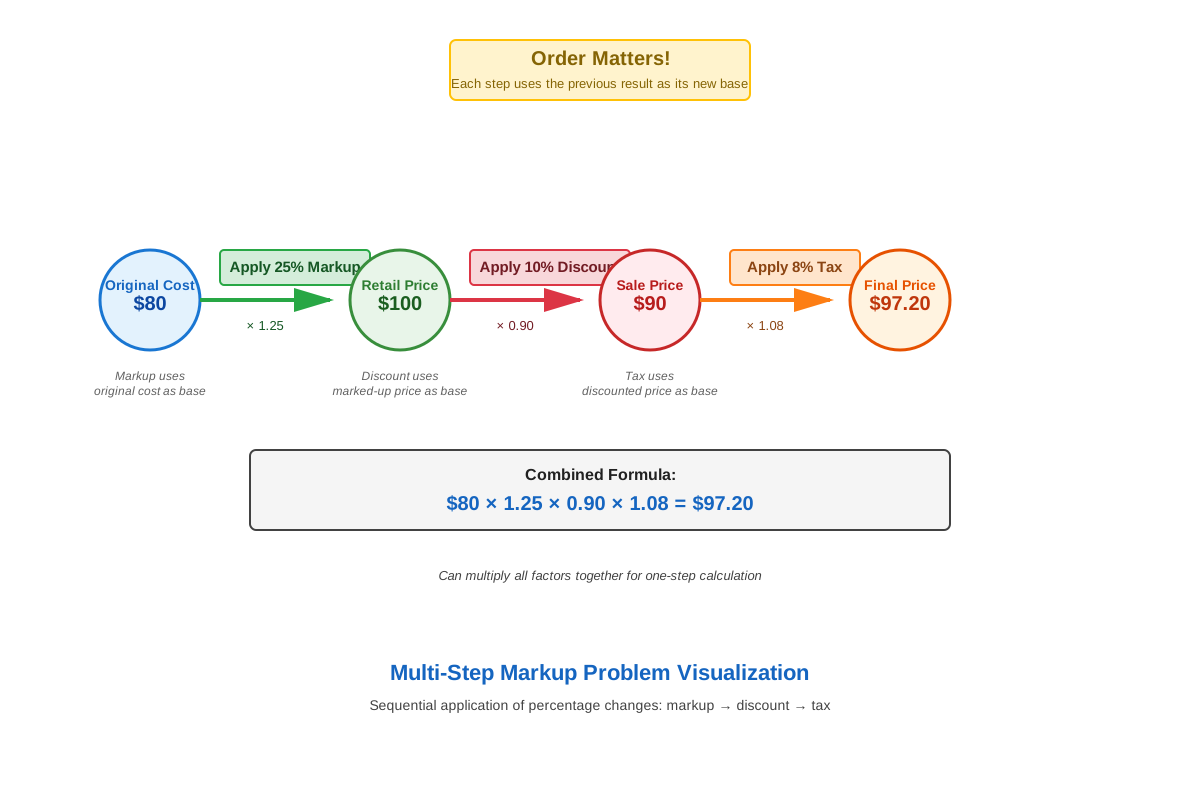
When markup appears alongside discounts or taxes in multi-step problems, students must apply order of operations and understand that percentage changes are not commutative when applied to different bases. The relationship map for complex problems follows: Original Cost → apply markup → Marked-up Price → apply discount/tax → Final Price. Each transformation uses the previous result as its base, creating a chain of dependent calculations.
High-Yield Facts
⭐ Markup is always calculated as a percentage of the original cost, not the selling price
⭐ The selling price formula is: Selling Price = Cost × (1 + Markup Rate as decimal)
⭐ To find original cost from selling price: Cost = Selling Price ÷ (1 + Markup Rate)
⭐ A markup followed by an equal percentage discount does NOT return to the original price
⭐ Multiple successive markups multiply their factors: apply (1 + rate₁) × (1 + rate₂), not (1 + rate₁ + rate₂)
- Markup percentage can exceed 100% (a 150% markup means the selling price is 2.5 times the cost)
- The dollar amount of markup equals Selling Price minus Cost
- Markup and profit margin are different: markup uses cost as the base, margin uses selling price
- When markup and discount percentages are equal, the final price is always less than the original cost
- Converting markup percentage to decimal before calculating prevents common arithmetic errors
Quick check — test yourself on Markup so far.
Try Flashcards →Common Misconceptions
Misconception: Adding the markup percentage directly to the cost in dollars (e.g., adding 25 to a $100 item for a 25% markup).
Correction: Markup percentage must be converted to a decimal and multiplied by the cost. A 25% markup on $100 means $100 × 0.25 = $25 markup, for a selling price of $125, not $125 from adding 25 to 100.
Misconception: Believing that a 50% markup followed by a 50% discount returns the item to its original price.
Correction: These operations apply to different base amounts. If cost is $100, after 50% markup the price is $150. A 50% discount on $150 yields $75, not $100, because the discount applies to the higher marked-up price.
Misconception: Thinking that markup and profit margin are the same thing.
Correction: Markup is calculated as a percentage of cost, while profit margin is calculated as a percentage of selling price. For the same transaction, these will yield different percentages.
Misconception: Adding multiple markup percentages together (believing a 20% markup followed by 15% markup equals 35% total markup).
Correction: Successive markups compound. The correct calculation multiplies the factors: 1.20 × 1.15 = 1.38, representing a 38% total markup, not 35%.
Misconception: Confusing "markup" with "marked up to" (thinking a 40% markup means the selling price is 40% of the cost).
Correction: A 40% markup means 40% is added to the cost, so the selling price is 140% of the cost (1.40 times the cost), not 40% of the cost.
Misconception: Applying the markup percentage to the selling price when working backward to find cost.
Correction: When given selling price and markup rate, recognize that selling price = cost × (1 + rate), so cost = selling price ÷ (1 + rate). The markup rate relates to the cost, not the selling price.
Worked Examples
Example 1: Standard Markup Calculation
Problem: A bookstore purchases textbooks from a publisher for $45 each. The store applies a 60% markup to determine the selling price. What is the selling price of each textbook?
Solution:
Step 1: Identify the given information
- Cost = $45
- Markup rate = 60% = 0.60
Step 2: Determine what we're solving for
- Selling Price = ?
Step 3: Apply the markup formula
- Selling Price = Cost × (1 + Markup Rate)
- Selling Price = $45 × (1 + 0.60)
- Selling Price = $45 × 1.60
Step 4: Calculate
- Selling Price = $72
Answer: The selling price is $72.
Connection to Learning Objectives: This problem directly applies the core markup formula to calculate selling price, demonstrating the fundamental skill of identifying key features of markup and applying the concept to answer SAT-style questions.
Example 2: Reverse Markup Problem with Multiple Steps
Problem: A furniture store sells a chair for $234 after applying a 30% markup. The store then offers a 15% discount on the marked-up price during a sale. What was the original cost of the chair to the store, and what is the final sale price after the discount?
Solution:
Part A: Finding Original Cost
Step 1: Recognize the relationship
- Selling Price (before discount) = Cost × (1 + Markup Rate)
- $234 = Cost × 1.30
Step 2: Solve for Cost
- Cost = $234 ÷ 1.30
- Cost = $180
Part B: Finding Final Sale Price
Step 3: Apply the discount to the marked-up price
- The discount applies to $234, not the original cost
- Discount = 15% = 0.15
- Final Price = $234 × (1 - 0.15)
- Final Price = $234 × 0.85
Step 4: Calculate
- Final Price = $198.90
Answers: The original cost was $180, and the final sale price is $198.90.
Connection to Learning Objectives: This multi-step problem demonstrates how to work backward from selling price to find original cost, then apply a subsequent percentage change. It illustrates the critical concept that markup and discount apply to different base amounts, addressing common misconceptions while applying markup to answer complex SAT-style questions.
Exam Strategy
When approaching SAT markup problems, begin by carefully identifying what information is given and what is being asked. Circle or underline the cost, selling price, and markup percentage in the problem, and note which value is unknown. This prevents confusion about which formula to apply.
Trigger words and phrases to watch for include: "marked up by," "markup of," "increased the price by," "selling price," "retail price," "cost," "wholesale price," and "original price." The phrase "marked up by X%" always means the markup is X% of the cost, while "marked up to X%" would mean the selling price is X% of the cost (though this phrasing is less common).
For process of elimination on multiple-choice questions, quickly check whether answer choices are greater or less than the given price. If a problem states a positive markup, the selling price must be greater than the cost—eliminate any answers that violate this logic. When working backward from selling price to cost, the cost must be less than the selling price, so eliminate answers that are equal to or greater than the given selling price.
Time allocation for markup problems should typically be 60-90 seconds for straightforward single-step calculations and 2-3 minutes for complex multi-step problems involving markup combined with discounts or multiple markups. If a problem requires more than 3 minutes, consider marking it for review and moving on, as SAT math sections reward efficient time management.
Use the multiplier method rather than calculating markup amount separately. Instead of finding 40% of $50 ($20) and then adding it to $50 ($70), directly multiply $50 × 1.40 = $70. This reduces calculation steps and minimizes arithmetic errors. For reverse problems, immediately set up the division: if selling price is $156 with 30% markup, calculate $156 ÷ 1.30 without intermediate steps.
When problems involve both markup and discount, draw a simple flow diagram in the margin: Cost → [×1.markup] → Marked Price → [×(1-discount)] → Final Price. This visual representation prevents the common error of applying both percentages to the original cost.
Memory Techniques
Mnemonic for Markup Formula: "Selling price Comes from Multiplying Cost" → S = C × M (where M is the markup multiplier, 1 + rate)
Visualization Strategy: Picture a ladder where the bottom rung is the cost and the top rung is the selling price. The markup percentage tells you how many "steps up" to climb. A 50% markup means climbing halfway up again from where you started. This visual reinforces that markup adds to the original, and you can't climb down to the original by descending the same percentage from the top.
Acronym for Multi-Step Problems: CODA - Cost first, Operation order matters, Different bases, Answer check
- Cost first: Always identify the original cost before applying changes
- Operation order: Apply markups and discounts in the sequence given
- Different bases: Remember each percentage applies to a different amount
- Answer check: Verify your answer makes logical sense (selling price > cost for markup)
The "Plus One" Rule: When converting markup percentage to a multiplier, always remember to add 1. Think "markup means MORE" → Multiplier Of Rate plus Exactly one. A 35% markup isn't 0.35, it's 1.35 (the original 100% plus 35% more).
Reverse Problem Reminder: "Divide to Discover the Deeper Dollar" - When working backward from selling price to cost, Divide by the multiplier to Discover the original amount.
Summary
Markup represents the percentage increase applied to the cost of an item to determine its selling price, calculated as a percentage of the original cost. The fundamental formula—Selling Price = Cost × (1 + Markup Rate)—enables students to solve forward problems efficiently, while algebraic manipulation of this formula allows for reverse calculations when finding original cost from selling price. On the SAT, markup problems test percentage fluency, algebraic reasoning, and the ability to translate word problems into mathematical expressions. Critical concepts include understanding that markup differs from profit margin, recognizing that successive markups compound rather than add, and knowing that equal markup and discount percentages do not cancel each other out. Success on markup problems requires careful identification of given information, strategic use of the multiplier method, and awareness of common misconceptions about percentage operations. Mastering markup provides a foundation for understanding broader percentage applications and real-world financial literacy.
Key Takeaways
- Markup is always calculated as a percentage of the original cost, and the selling price equals cost times (1 + markup rate as a decimal)
- To find original cost when given selling price and markup percentage, divide the selling price by (1 + markup rate)
- A markup followed by an equal percentage discount results in a final price lower than the original cost because the operations apply to different base amounts
- Multiple successive markups require multiplying their factors together, not adding the percentages
- The multiplier method (using 1 + rate) is faster and more accurate than calculating markup amount separately and adding it to cost
- Markup and profit margin are different concepts: markup uses cost as the base while margin uses selling price
- Careful reading of word problems is essential to identify whether you're given cost or selling price and whether you're solving forward or backward
Related Topics
Discount Problems: The inverse of markup, where a percentage is subtracted from a price. Mastering markup provides the foundation for understanding discount calculations, as both involve percentage changes from a base amount. Students who understand markup can easily adapt their knowledge to discount scenarios.
Percent Change: A broader category that encompasses both increases (like markup) and decreases (like discounts). Understanding markup deepens comprehension of how percent change works and why the base amount matters when calculating percentage changes.
Sales Tax Calculations: Similar to markup in structure, sales tax adds a percentage to a base price. The mathematical operations mirror markup problems, making this a natural extension of markup mastery.
Compound Interest: While applied to financial contexts rather than retail pricing, compound interest uses the same mathematical principle of successive percentage increases. Students who master multiple markups have the foundation for understanding compound interest.
Ratio and Proportion: Markup problems often involve proportional relationships between cost and selling price. Strengthening markup skills reinforces proportional reasoning abilities that apply across many SAT math topics.
Practice CTA
Now that you've mastered the core concepts of markup, it's time to solidify your understanding through active practice. Attempt the practice questions to apply these strategies to SAT-style problems, and use the flashcards to reinforce key formulas and concepts. Remember, markup problems are high-yield topics that appear consistently on the SAT—your investment in practice now will pay dividends on test day. Challenge yourself with both straightforward calculations and complex multi-step problems to build the flexibility and confidence needed to tackle any markup question the SAT presents. You've got this!
Sign up free to keep reading
Create a free AnvayaPrep account to finish this SAT guide on Markup — plus flashcards and practice questions.