Overview
Sales tax is a fundamental percentage application that appears regularly on the SAT and serves as a practical bridge between abstract mathematical concepts and real-world financial literacy. Understanding sales tax calculations requires students to work fluently with percentages, decimal conversions, and multi-step problem solving—all essential skills for the SAT math section. Sales tax problems test whether students can translate word problems into mathematical operations, apply percentage increases correctly, and work backward from total costs to find original prices.
On the SAT, sales tax questions typically appear as part of the Problem Solving and Data Analysis domain, though they may also integrate with algebra when variables are introduced. These problems assess computational accuracy, conceptual understanding of percentage increases, and the ability to set up equations that model real-world scenarios. Students must recognize that sales tax represents an additional charge calculated as a percentage of the original price, making the final cost greater than the base price.
Mastering sales tax calculations strengthens broader mathematical competencies including percentage operations, proportional reasoning, and equation setup. This topic connects directly to other percentage applications such as discounts, tips, interest calculations, and markup/markdown problems. The skills developed through sales tax problems—particularly the ability to distinguish between the base amount and the total amount after a percentage increase—transfer directly to more complex SAT questions involving compound percentages, sequential operations, and algebraic modeling of real-world situations.
Learning Objectives
- [ ] Identify key features of sales tax including the base price, tax rate, tax amount, and total cost
- [ ] Explain how sales tax appears on the SAT in various question formats and difficulty levels
- [ ] Apply sales tax formulas to answer SAT-style questions efficiently and accurately
- [ ] Calculate the original price when given the total cost including sales tax
- [ ] Determine the sales tax rate when provided with the base price and total cost
- [ ] Solve multi-step problems involving sales tax combined with other percentage operations
- [ ] Set up and solve algebraic equations modeling sales tax scenarios with variables
Prerequisites
- Basic percentage concepts: Understanding what percentages represent and how to convert between percentages, decimals, and fractions is essential for calculating tax amounts
- Decimal operations: Proficiency with multiplying and dividing decimals enables accurate computation of tax amounts and total costs
- Basic algebra: Ability to set up and solve simple equations is necessary for working backward from total costs or solving for unknown variables
- Order of operations: Knowing when to calculate tax before or after other operations prevents common calculation errors in multi-step problems
Why This Topic Matters
Sales tax calculations represent one of the most practical mathematical applications students encounter in daily life. Every retail purchase, online transaction, and service payment involves sales tax, making this topic immediately relevant to financial literacy. Understanding sales tax empowers students to verify receipts, budget accurately, compare prices across different tax jurisdictions, and make informed purchasing decisions. Beyond personal finance, sales tax concepts apply to business operations, accounting, economics, and public policy discussions about taxation.
On the SAT, sales tax questions appear with moderate to high frequency, typically showing up 1-2 times per test administration. These questions most commonly appear in the calculator-permitted section as part of word problems testing percentage applications. The College Board favors sales tax problems because they assess multiple competencies simultaneously: reading comprehension, mathematical translation, percentage calculation, and real-world application. Sales tax questions range from straightforward single-step calculations to complex multi-step problems involving variables, systems of equations, or combined operations with discounts and tips.
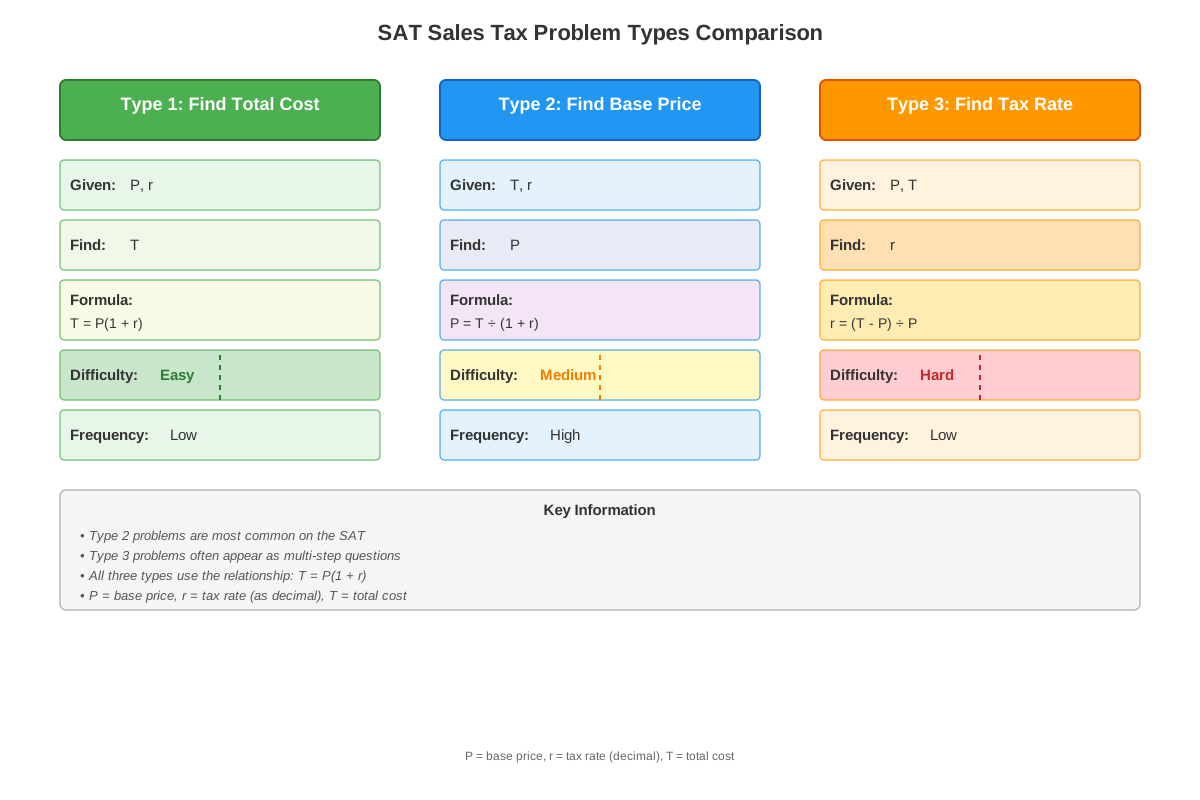
Common SAT presentations include: calculating total cost given base price and tax rate; finding the original price when given the total with tax; determining the tax rate from price information; comparing costs across different tax rates; and solving for unknown quantities in algebraic expressions involving sales tax. Questions may present information in tables, require interpretation of real-world scenarios, or combine sales tax with other percentage operations like discounts applied before tax or tips calculated after tax.
Core Concepts
Understanding Sales Tax Fundamentals
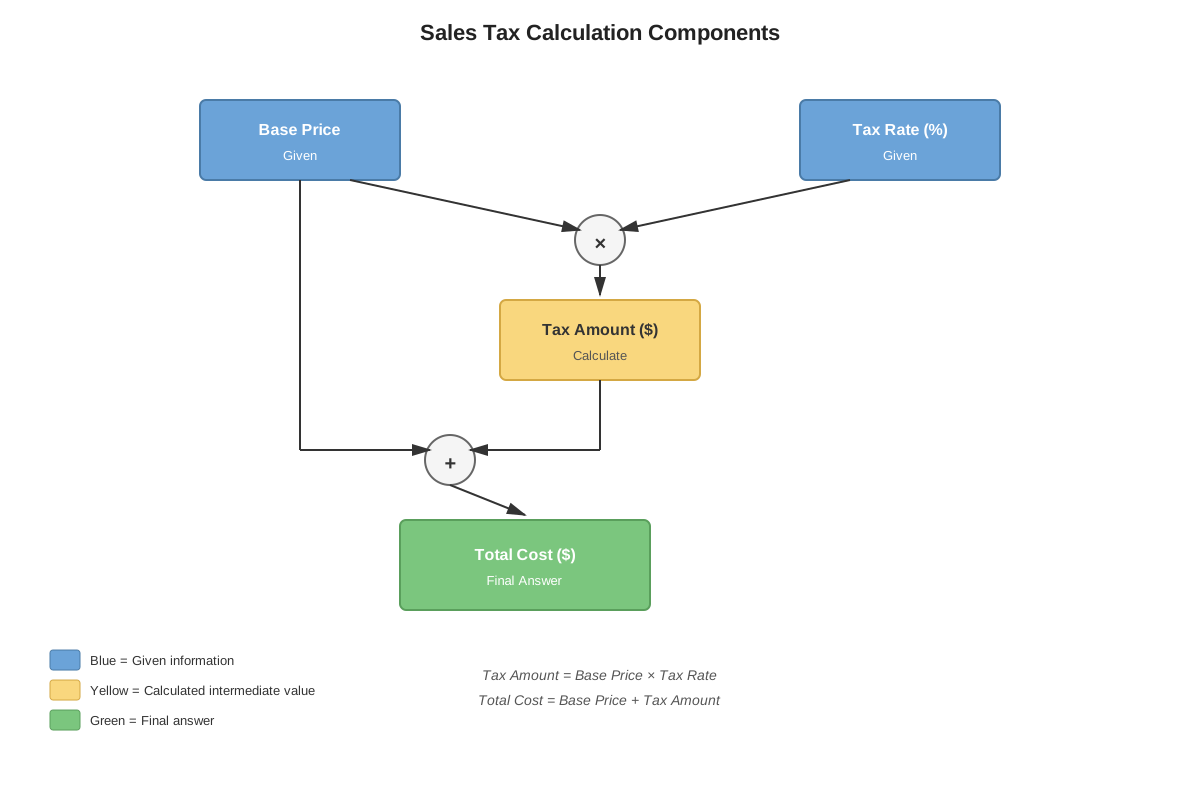
Sales tax is a consumption tax imposed by governments on the sale of goods and services, calculated as a percentage of the purchase price. The tax is collected by the seller at the point of sale and remitted to the taxing authority. For SAT sales tax problems, students need to understand four key components:
- Base price (or original price): The cost of the item before tax
- Tax rate: The percentage charged as tax, expressed as a decimal in calculations
- Tax amount: The dollar amount of tax charged (base price × tax rate)
- Total cost: The final amount paid (base price + tax amount)
The fundamental relationship can be expressed as:
Total Cost = Base Price + (Base Price × Tax Rate)
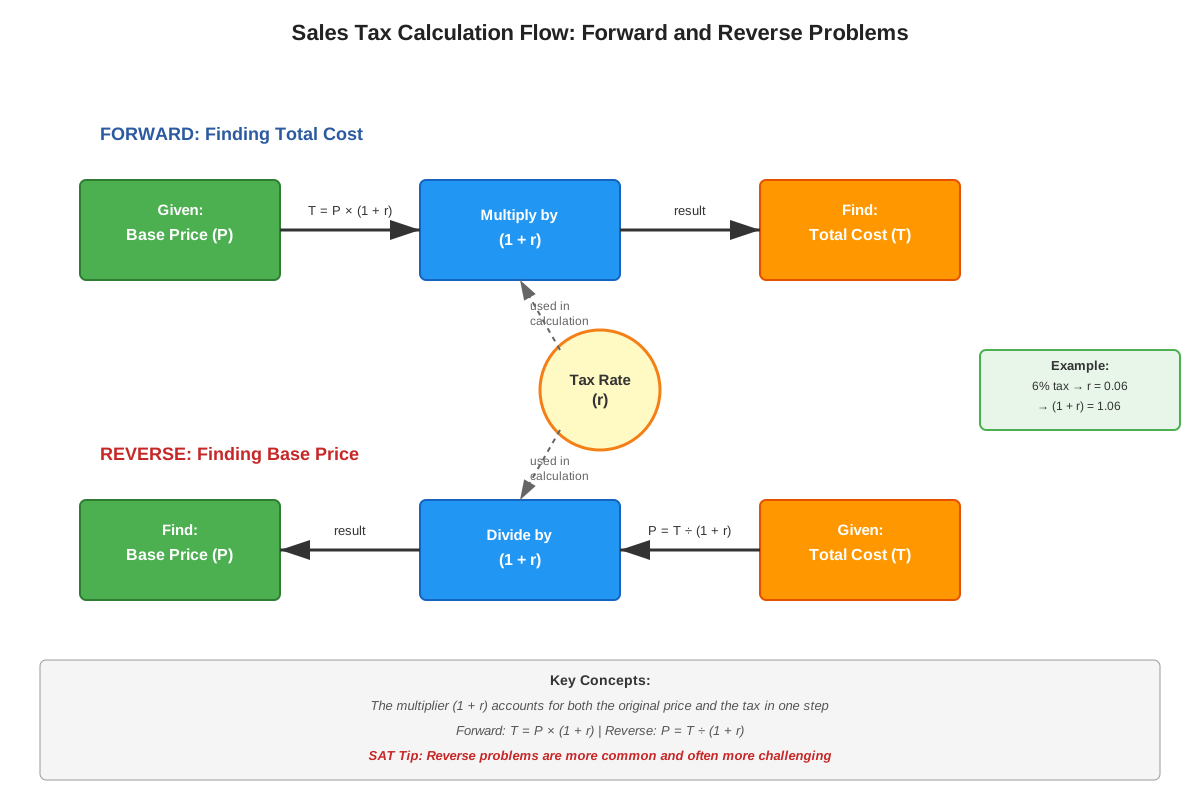
Total Cost = Base Price × (1 + Tax Rate)
This second form, using the multiplier (1 + tax rate), is particularly efficient for SAT calculations and represents a key insight: adding a percentage increase is equivalent to multiplying by a factor greater than 1.
Calculating Total Cost with Sales Tax
The most straightforward sales tax problem provides the base price and tax rate, asking students to find the total cost. The process involves two steps:
Step 1: Convert the tax rate percentage to a decimal (divide by 100)
Step 2: Multiply the base price by (1 + tax rate as decimal)
For example, if a laptop costs $800 and the sales tax rate is 6.5%:
- Tax rate as decimal: 6.5% = 0.065
- Total cost: $800 × (1 + 0.065) = $800 × 1.065 = $852
Alternatively, students can calculate the tax amount separately and add it to the base price:
- Tax amount: $800 × 0.065 = $52
- Total cost: $800 + $52 = $852
Both methods yield the same result, but the multiplier method (using 1.065) is generally faster and reduces calculation errors on the SAT.
Finding the Original Price (Working Backward)
A more challenging SAT question type provides the total cost including tax and asks for the original base price. This requires working backward through the sales tax calculation. Students must recognize that the total cost represents the base price multiplied by (1 + tax rate), so dividing the total by this multiplier yields the original price.
Base Price = Total Cost ÷ (1 + Tax Rate)For example, if the total cost is $742.50 and the tax rate is 6%:
- Multiplier: 1 + 0.06 = 1.06
- Base price: $742.50 ÷ 1.06 = $700
This concept frequently challenges students because it requires recognizing that the total cost is not simply reduced by the tax percentage. A common error is calculating 6% of $742.50 and subtracting it, which yields an incorrect answer because the 6% should be calculated from the base price, not the total.
Determining the Tax Rate
Some SAT problems provide both the base price and total cost, asking students to find the tax rate. This requires setting up an equation and solving for the unknown rate:
Total Cost = Base Price × (1 + Tax Rate)
(Total Cost ÷ Base Price) = 1 + Tax Rate
Tax Rate = (Total Cost ÷ Base Price) - 1
Alternatively, students can find the tax amount first, then calculate what percentage it represents:
Tax Amount = Total Cost - Base Price
Tax Rate = (Tax Amount ÷ Base Price) × 100%
For example, if an item costs $250 before tax and $267.50 after tax:
- Tax amount: $267.50 - $250 = $17.50
- Tax rate: ($17.50 ÷ $250) × 100% = 0.07 × 100% = 7%
Sales Tax in Multi-Step Problems
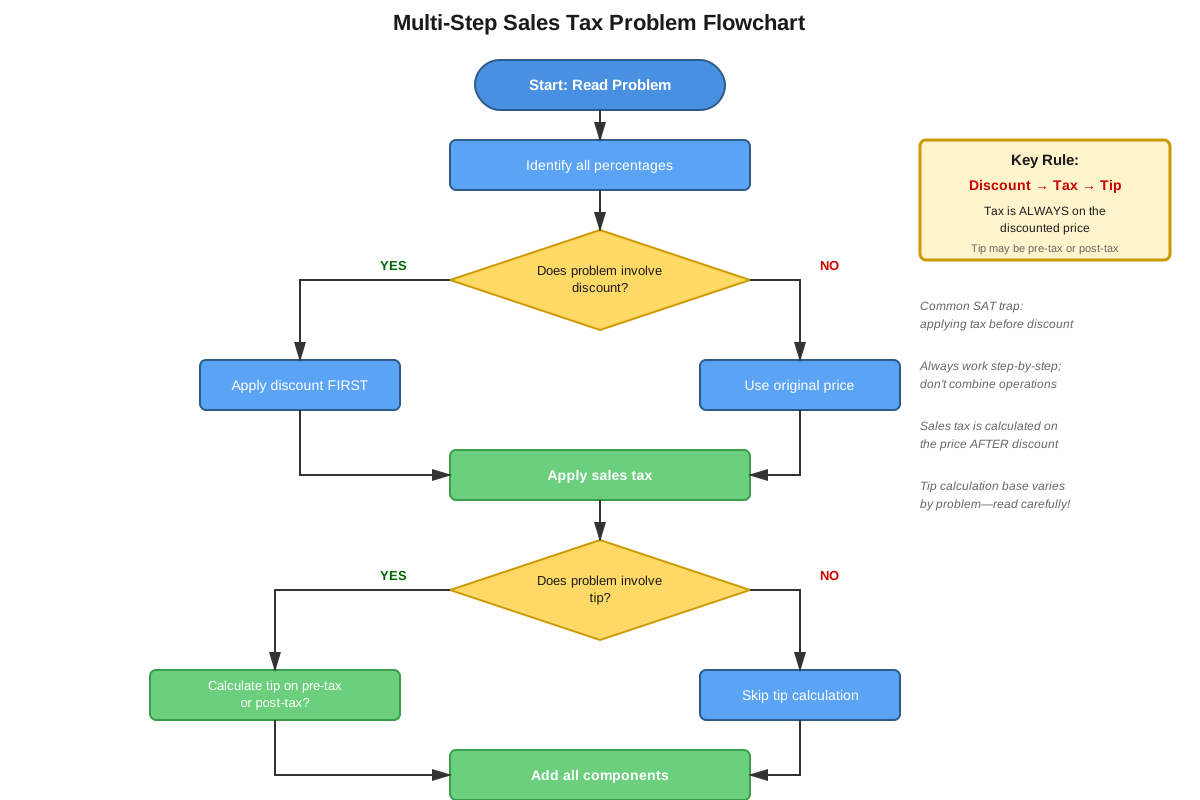
Advanced SAT questions combine sales tax with other operations such as discounts, tips, or multiple purchases. The key to solving these problems is carefully tracking the order of operations and identifying which amount serves as the base for each calculation.
Critical principle: Sales tax is typically calculated on the price after discounts are applied but before tips are added. The sequence is usually:
- Original price
- Apply discount (if any)
- Calculate and add sales tax
- Add tip (if any, calculated on pre-tax or post-tax amount depending on context)
For example, if a $60 item is discounted 25% and then subject to 8% sales tax:
- Price after discount: $60 × (1 - 0.25) = $60 × 0.75 = $45
- Total with tax: $45 × (1 + 0.08) = $45 × 1.08 = $48.60
Algebraic Sales Tax Problems
SAT questions may introduce variables into sales tax scenarios, requiring students to set up and solve equations. These problems test algebraic thinking alongside percentage concepts.
For example: "The total cost of an item including 7% sales tax is $t$. Express the base price in terms of $t$."
Solution: Base price = $\frac{t}{1.07}$
Or: "Two items have base prices of $x$ and $y$. If the sales tax rate is 6%, what is the total cost of both items?"
Solution: Total cost = $(x + y) × 1.06$ or equivalently $1.06x + 1.06y$
Concept Relationships
Sales tax problems build directly on foundational percentage concepts, particularly percentage increase calculations. The relationship "sales tax → percentage increase → multiplication by a factor greater than 1" forms the conceptual backbone of this topic. Understanding that adding 6% tax is equivalent to multiplying by 1.06 connects sales tax to the broader concept of growth factors used throughout mathematics.
Within sales tax problems themselves, the four key components (base price, tax rate, tax amount, and total cost) form an interconnected system where knowing any two typically allows calculation of the others. This creates a web of relationships: base price × tax rate → tax amount; base price + tax amount → total cost; total cost ÷ (1 + tax rate) → base price; (total cost - base price) ÷ base price → tax rate.
Sales tax connects forward to more complex percentage applications including compound interest (repeated percentage increases), markup and markdown chains (sequential percentage operations), and percentage point versus percentage change distinctions. The algebraic formulation of sales tax problems (using variables for prices or rates) bridges to linear equations, systems of equations, and function notation. Multi-step problems involving sales tax alongside discounts or tips demonstrate the importance of order of operations and careful identification of base amounts for each calculation.
The skill of working backward from a total to find an original amount (reverse percentage problems) extends beyond sales tax to applications in science (finding initial quantities after growth or decay), finance (determining principal from final amounts), and data analysis (adjusting for inflation or other factors).
High-Yield Facts
⭐ Sales tax is always calculated as a percentage of the base price, not the total cost
⭐ To find total cost: multiply base price by (1 + tax rate as decimal)
⭐ To find base price from total: divide total cost by (1 + tax rate as decimal)
⭐ Converting tax rate to decimal: divide the percentage by 100 (e.g., 7% = 0.07)
⭐ Sales tax is applied after discounts but before tips in multi-step problems
- The tax amount alone equals base price × tax rate as a decimal
- To find the tax rate: (total cost ÷ base price) - 1, then convert to percentage
- A 6% sales tax means the total cost is 106% of the base price
- Sales tax rates vary by location but SAT problems always provide the rate
- When comparing prices with different tax rates, calculate total costs separately
- In algebraic problems, the expression (1 + r) where r is the tax rate appears frequently
- Multiple items purchased together have tax calculated on the sum of their base prices
- Sales tax increases the final cost, so total cost is always greater than base price
- The multiplier method (using 1 + tax rate) is faster than calculating tax separately
- Rounding should typically be done only at the final answer, not intermediate steps
Quick check — test yourself on Sales tax so far.
Try Flashcards →Common Misconceptions
Misconception: Sales tax is subtracted from the total cost to find the base price by calculating the tax percentage of the total.
Correction: The tax percentage applies to the base price, not the total cost. To find the base price, divide the total by (1 + tax rate), don't subtract the tax percentage of the total. For example, with 8% tax and $108 total, the base price is $108 ÷ 1.08 = $100, not $108 - (0.08 × $108) = $99.36.
Misconception: A 5% sales tax means the total cost is 5% of the original price.
Correction: A 5% sales tax means the total cost is 105% of the original price (100% original + 5% tax). The tax amount is 5% of the base price, but the total includes both the full base price and the additional tax.
Misconception: When an item is discounted 20% and then taxed 8%, you can simply subtract 20% and add 8% for a net 12% reduction.
Correction: Percentages of different bases cannot be directly added or subtracted. The discount applies to the original price, while the tax applies to the discounted price. You must calculate sequentially: first multiply by 0.80 (20% discount), then multiply that result by 1.08 (8% tax), giving an overall multiplier of 0.864, which is a 13.6% reduction, not 12%.
Misconception: If two items cost $50 each before tax and the tax rate is 6%, the total cost is $50 × 1.06 + $50 × 1.06.
Correction: While this calculation is mathematically correct, it's inefficient. The tax applies to the combined base price, so the total is ($50 + $50) × 1.06 = $100 × 1.06 = $106. Both methods work, but recognizing that tax can be calculated on the sum saves time.
Misconception: The tax rate can be found by dividing the tax amount by the total cost.
Correction: The tax rate is the tax amount divided by the base price, not the total cost. If the base price is $200 and tax is $14, the rate is $14 ÷ $200 = 0.07 = 7%, not $14 ÷ $214 = 6.54%. The tax rate represents what percentage the tax is of the original price.
Misconception: In a problem with variables, if the base price is $p$ and tax rate is 5%, the total cost is $p + 5$.
Correction: The tax rate must be expressed as a decimal and multiplied by the base price. The total cost is $p + 0.05p = 1.05p$, not $p + 5$. The number 5 represents 5%, which is 0.05 as a decimal, and this must be multiplied by the price to get the tax amount in dollars.
Worked Examples
Example 1: Multi-Step Problem with Discount and Sales Tax
Problem: A jacket originally priced at $120 is on sale for 30% off. If the sales tax rate is 7%, what is the total cost of the jacket after the discount and tax are applied?
Solution:
Step 1: Calculate the sale price after the 30% discount.
- A 30% discount means paying 70% of the original price
- Sale price = $120 × 0.70 = $84
- Alternatively: Discount amount = $120 × 0.30 = $36; Sale price = $120 - $36 = $84
Step 2: Calculate the total cost including 7% sales tax on the sale price.
- The tax is calculated on the discounted price ($84), not the original price
- Total cost = $84 × 1.07 = $89.88
Answer: $89.88
Key insight: This problem tests the understanding that discounts are applied before sales tax, and that the tax is calculated on the post-discount price. A common error would be calculating tax on the original $120 price or incorrectly combining the 30% discount and 7% tax.
Example 2: Finding Base Price from Total Cost (Algebraic Approach)
Problem: Maria paid $477 for a tablet, which included 6% sales tax. What was the price of the tablet before tax?
Solution:
Step 1: Set up the relationship between base price and total cost.
- Let $b$ = base price before tax
- The total cost equals the base price plus 6% of the base price
- Equation: $b + 0.06b = 477$
Step 2: Solve for the base price.
- Combine like terms: $1.06b = 477$
- Divide both sides by 1.06: $b = 477 ÷ 1.06$
- Calculate: $b = 450$
Step 3: Verify the answer.
- Tax amount: $450 × 0.06 = $27
- Total cost: $450 + $27 = $477 ✓
Answer: $450
Alternative method: Recognize that $477 represents 106% of the base price, so divide directly: $477 ÷ 1.06 = $450. This method is faster once students understand the conceptual relationship.
Key insight: This problem requires working backward from the total to find the original amount. Students must recognize that they cannot simply subtract 6% of $477 because the 6% tax was calculated on the unknown base price, not on the $477 total. The equation $1.06b = 477$ captures the essential relationship and leads directly to the solution.
Exam Strategy
When approaching SAT sales tax questions, begin by identifying what information is given and what is being asked. Circle or underline the base price, tax rate, and total cost (whichever are provided), and clearly note which quantity you need to find. This prevents confusion in multi-step problems where several dollar amounts appear.
Trigger words and phrases to watch for include: "including tax," "before tax," "after tax is applied," "sales tax rate of," "total cost," and "original price." The phrase "including tax" signals that the given amount is the total cost, not the base price, which often indicates a working-backward problem. "Before tax" or "original price" typically refers to the base price.
For calculation efficiency, use the multiplier method (1 + tax rate) rather than calculating tax separately and adding. This reduces steps and minimizes arithmetic errors. When working backward to find base price, immediately set up the division: total ÷ (1 + tax rate). Memorize that this is the correct approach for reverse percentage problems.
In multi-step problems involving discounts, tips, or multiple items, carefully track the order of operations. Write out each step rather than trying to combine operations mentally. Remember the typical sequence: apply discounts first, then calculate tax on the discounted price. If tips are involved, clarify whether the tip is calculated on the pre-tax or post-tax amount (SAT problems usually specify this).
Process of elimination tips: If answer choices are given, you can often eliminate options quickly. For a problem asking for total cost with tax, eliminate any answer less than or equal to the base price (since tax increases cost). For finding base price from total, eliminate any answer greater than or equal to the total. Check if answer choices are close together or widely spaced—widely spaced answers may allow estimation, while close answers require precise calculation.
Time allocation: Straightforward sales tax calculations should take 30-45 seconds. Multi-step problems involving discounts or algebra may require 60-90 seconds. If a problem is taking longer, check whether you're using the most efficient method (multiplier approach) and whether you've correctly identified what's being asked. Don't spend time calculating unnecessary values—focus only on what the question requests.
For problems with variables, set up the algebraic expression carefully before manipulating it. Write out what each variable represents to avoid confusion. When the problem asks for an expression rather than a numerical answer, look for answer choices that match the form of your expression (factored, expanded, etc.).
Memory Techniques
Mnemonic for the sales tax multiplier: "One Plus Tax" reminds you that to find the total cost, you multiply the base price by (1 + tax rate as decimal). The "one" represents the original 100% of the base price, and you're adding the tax percentage to it.
Visualization strategy: Picture a receipt with three lines: (1) Item price, (2) Tax amount, (3) Total. This mental image helps you remember that tax is added to the base price to get the total. When working backward, visualize erasing the tax line and total line to reveal the original item price underneath.
Acronym for multi-step problems: "DITT" = Discount first, then Item price, then Tax, then Tip. This sequence helps you remember the typical order of operations in complex percentage problems.
Decimal conversion reminder: "Percent means per hundred" helps you remember to divide by 100 when converting percentages to decimals. 7% = 7 per 100 = 7/100 = 0.07.
Backward calculation memory aid: "Divide to derive" reminds you that finding the base price from a total requires division by the multiplier (1 + tax rate). The rhyme makes it memorable, and "derive" suggests working backward to find the original.
Relationship memory technique: Think of sales tax as a "growth factor" similar to population growth or compound interest. Just as a population growing by 5% is multiplied by 1.05, a price with 5% tax is multiplied by 1.05. This connects sales tax to other mathematical growth concepts you already know.
Summary
Sales tax problems on the SAT test students' ability to work with percentage increases in practical contexts. The fundamental concept is that sales tax represents an additional charge calculated as a percentage of the base price, making the total cost equal to the base price multiplied by (1 + tax rate as decimal). Mastery requires fluency with three problem types: calculating total cost from base price and tax rate, finding base price when given total cost and tax rate, and determining tax rate from price information. The multiplier method—using (1 + tax rate) as a single factor—provides the most efficient calculation approach and reduces errors. Multi-step problems require careful attention to order of operations, particularly recognizing that discounts apply before tax. Algebraic sales tax problems demand proper equation setup and variable manipulation. Success on SAT sales tax questions depends on accurately translating word problems into mathematical operations, distinguishing between base amounts and totals, and working comfortably with both forward calculations (base to total) and reverse calculations (total to base).
Key Takeaways
- Sales tax is calculated as a percentage of the base price and added to create the total cost
- Use the multiplier (1 + tax rate as decimal) to efficiently calculate total cost: Total = Base × (1 + rate)
- To find base price from total cost, divide by the multiplier: Base = Total ÷ (1 + rate)
- In multi-step problems, apply discounts before calculating sales tax
- Working backward from total to base requires division, not subtraction of the tax percentage
- Tax rates must be converted to decimals before calculations (divide percentage by 100)
- The total cost is always greater than the base price when sales tax is applied
Related Topics
Discounts and Markdowns: Understanding how to calculate percentage decreases complements sales tax (percentage increases) and frequently appears in combined problems where discounts are applied before tax.
Tips and Gratuities: Similar to sales tax, tips are percentage-based additions to a base amount, though tips may be calculated on pre-tax or post-tax totals depending on context.
Simple Interest: Extends percentage increase concepts to financial contexts where interest is calculated on principal amounts over time periods.
Compound Percentages: Builds on sales tax concepts to handle repeated percentage changes or multiple sequential percentage operations.
Markup and Profit Margins: Business applications of percentage increases where retailers add percentages to wholesale costs, similar in structure to sales tax calculations.
Percent Change and Percent Difference: Broader category of percentage problems that includes both increases (like sales tax) and decreases, essential for data analysis questions.
Practice CTA
Now that you've mastered the core concepts of sales tax calculations, it's time to reinforce your learning through active practice. Attempt the practice questions to apply these strategies to SAT-style problems, testing your ability to calculate totals, work backward to find base prices, and handle multi-step scenarios. Use the flashcards to drill the key formulas and relationships until they become automatic. Remember, confidence with sales tax problems comes from recognizing patterns and executing calculations efficiently—skills that develop through deliberate practice. Every problem you solve strengthens your percentage reasoning and prepares you for the variety of ways the SAT can test this high-yield topic. You've got this!
Sign up free to keep reading
Create a free AnvayaPrep account to finish this SAT guide on Sales tax — plus flashcards and practice questions.