Overview
Multi-step percentage problems represent one of the most frequently tested concepts in SAT math, appearing in approximately 3-5 questions per exam. These problems require students to perform sequential percentage calculations, where the result of one percentage operation becomes the basis for the next calculation. Unlike simple percentage problems that involve a single calculation, multi-step percentage questions demand careful tracking of changing base values and the ability to chain operations together logically.
The SAT specifically favors multi-step percentage problems because they assess multiple mathematical competencies simultaneously: proportional reasoning, decimal-fraction conversion, order of operations, and real-world application skills. These questions often appear in contexts involving price changes (discounts followed by tax, or successive markups), population growth over multiple time periods, or compound interest scenarios. The College Board uses these problems to differentiate between students who merely memorize formulas and those who truly understand how percentages function as multiplicative relationships.
Mastering sat multi-step percentage problems creates a foundation for success across numerous SAT math topics, including ratios, proportions, exponential functions, and data interpretation. The logical sequencing required in these problems also strengthens problem-solving skills applicable to algebra word problems and real-world modeling questions. Students who develop fluency with multi-step percentage calculations gain both points on direct percentage questions and improved performance on complex word problems where percentage changes appear as one component of a larger mathematical scenario.
Learning Objectives
- [ ] Identify key features of multi-step percentage problems, including sequential operations and changing base values
- [ ] Explain how multi-step percentage appears on the SAT, including common contexts and question formats
- [ ] Apply multi-step percentage to answer SAT-style questions with accuracy and efficiency
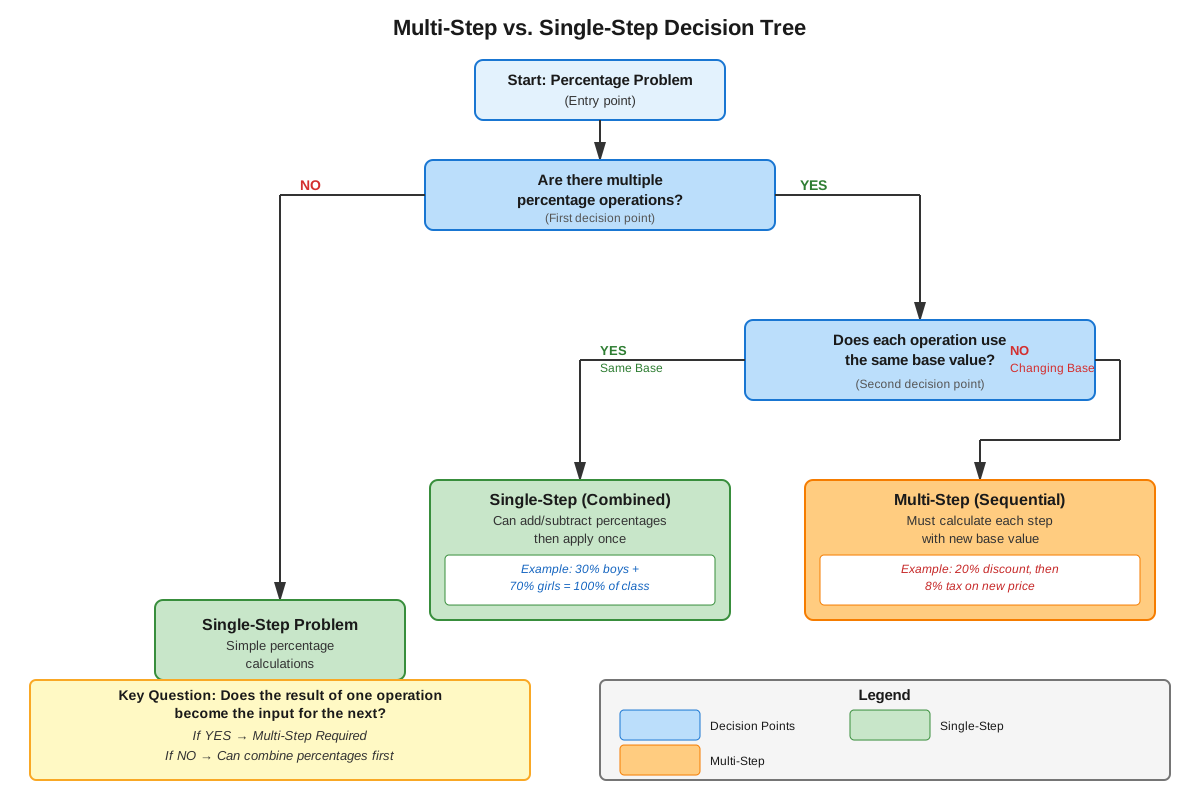
- [ ] Distinguish between situations requiring successive percentage calculations versus single-step approaches
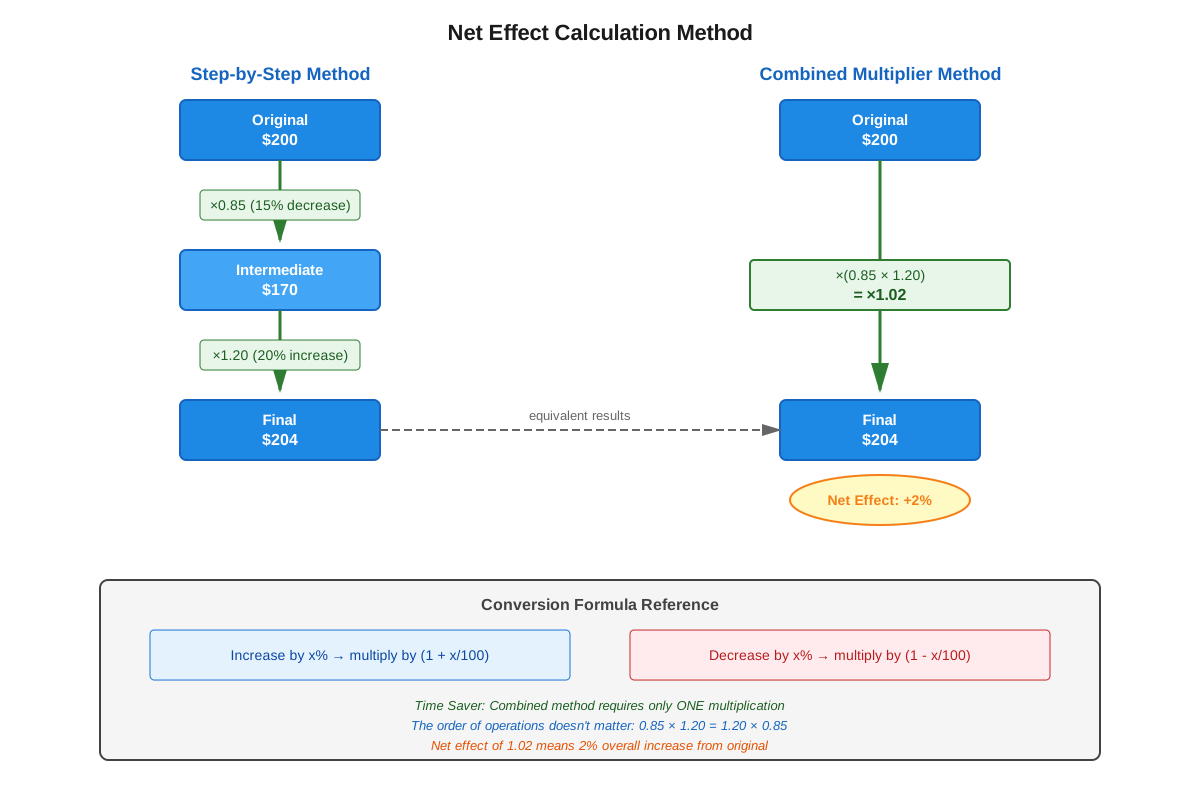
- [ ] Calculate the net effect of multiple percentage changes without computing intermediate values
- [ ] Recognize and avoid common errors related to base value confusion in sequential percentage problems
Prerequisites
- Basic percentage calculations: Converting between percentages, decimals, and fractions is essential for executing each step in multi-step problems
- Order of operations: Understanding which calculations to perform first prevents errors when chaining percentage operations together
- Decimal multiplication: Multi-step percentage problems require multiplying decimals accurately without a calculator (on non-calculator sections)
- Word problem interpretation: Translating verbal descriptions into mathematical operations is crucial for identifying the correct sequence of steps
Why This Topic Matters
Multi-step percentage problems appear throughout real-world financial decision-making, from calculating the final price after multiple discounts and sales tax to understanding investment returns over time. Consumers encounter these calculations when comparing shopping deals, evaluating loan terms, or analyzing salary increases that compound over multiple years. The ability to work through sequential percentage changes represents practical numeracy that extends far beyond test-taking.
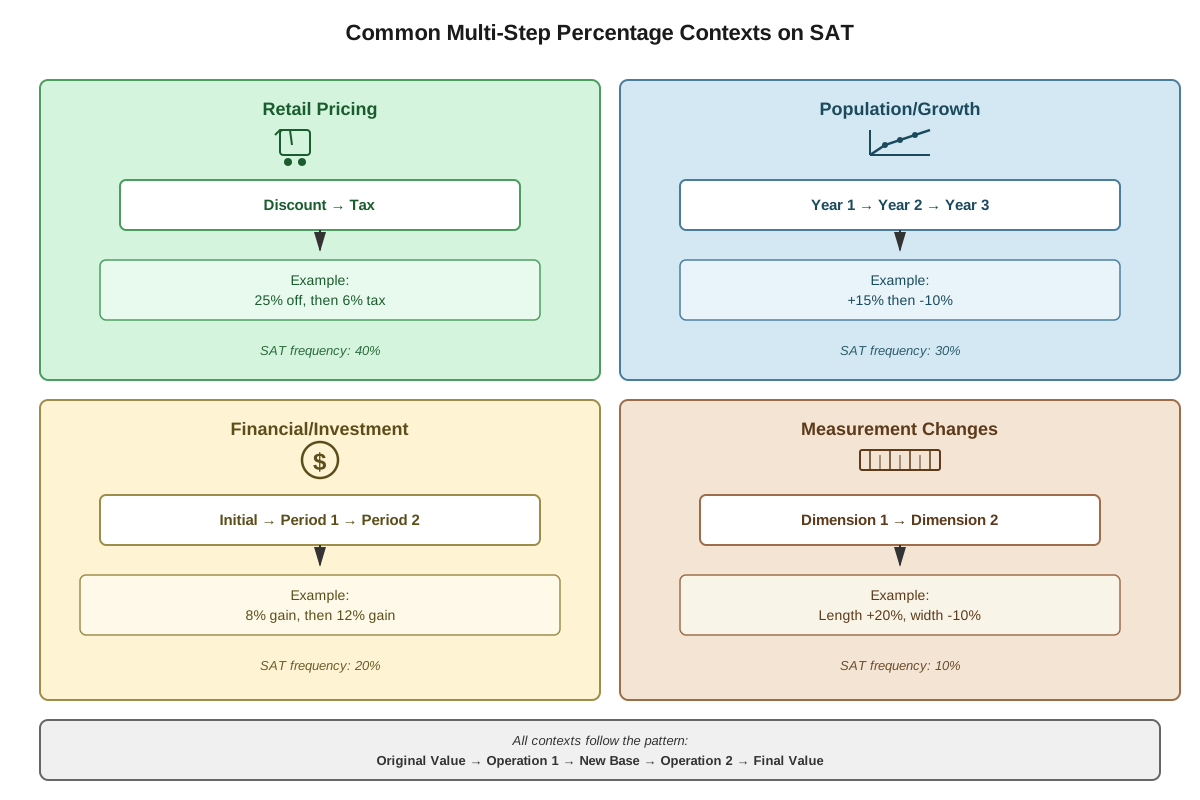
On the SAT, multi-step percentage questions appear with high frequency across both calculator and non-calculator sections, typically comprising 8-12% of all math questions. These problems appear in multiple formats: straightforward calculation questions, word problems embedded in real-world scenarios, and data interpretation questions requiring percentage analysis of tables or graphs. The College Board particularly favors scenarios involving retail pricing (successive discounts or markup-then-discount), population changes over multiple time periods, and financial contexts like investment growth or depreciation.
Common SAT presentations include: "A store offers a 20% discount, then takes an additional 15% off the sale price—what is the final price?"; "A population increases by 10% one year, then decreases by 10% the next year—what is the net change?"; and "An item is marked up 50%, then discounted 30%—what percentage of the original price is the final price?" These questions test whether students understand that successive percentage changes don't simply add together and that the base value changes with each operation.
Core Concepts
Understanding Sequential Percentage Operations
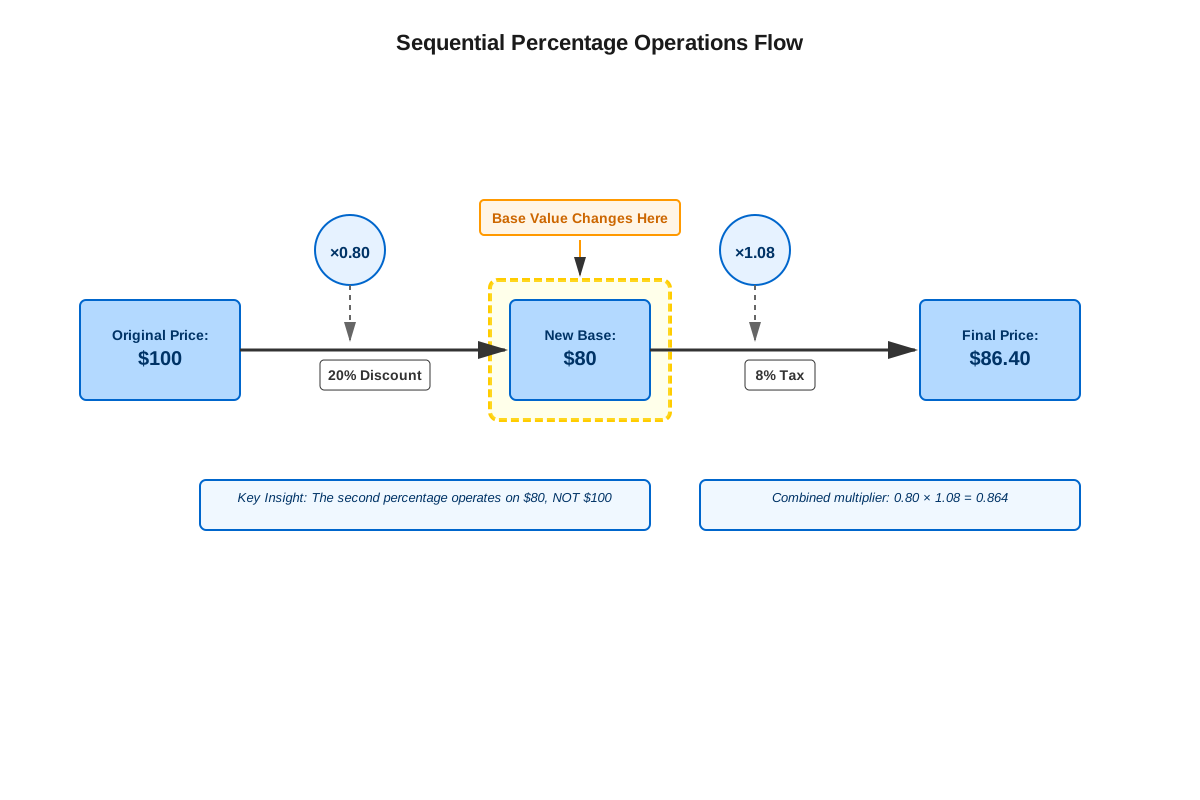
The fundamental principle of multi-step percentage problems is that each percentage operation creates a new base value for the next calculation. When a quantity undergoes a percentage change, the result becomes the starting point for any subsequent percentage operation. This differs critically from single-step problems where one percentage is applied to an original value.
Consider the mathematical structure: if a value V undergoes a percentage change of p₁%, the result is V × (1 + p₁/100). If this result then undergoes a second percentage change of p₂%, the final value is [V × (1 + p₁/100)] × (1 + p₂/100), which simplifies to V × (1 + p₁/100) × (1 + p₂/100). This multiplicative relationship is key—successive percentage changes multiply their multipliers together.
Increase vs. Decrease Operations
Percentage increases and decreases follow distinct patterns that must be applied correctly in sequence:
| Operation Type | Multiplier Form | Example (20% change) |
|---|---|---|
| Increase | 1 + (percentage/100) | 1 + 0.20 = 1.20 |
| Decrease | 1 - (percentage/100) | 1 - 0.20 = 0.80 |
When working through multi-step problems, each operation must be classified correctly. A 25% increase followed by a 10% decrease translates to multiplying by 1.25, then by 0.90. The order matters because multiplication is performed left-to-right through the sequence of operations.
The Non-Commutative Nature of Percentage Changes
A critical concept that the SAT frequently tests is that the order of percentage operations generally doesn't affect the final numerical result (since multiplication is commutative), but the intermediate values differ. However, the context matters: a 50% increase followed by a 50% decrease does NOT return to the original value. Starting with 100, increasing by 50% gives 150, then decreasing 150 by 50% gives 75, not 100. This asymmetry occurs because the base value changes.
Calculating Net Percentage Change
For two successive percentage changes, the net effect can be calculated using the formula:
Net multiplier = (1 + p₁/100) × (1 + p₂/100)Where p₁ and p₂ are the percentage changes (positive for increases, negative for decreases). The net percentage change is then:
Net percentage change = [(Net multiplier) - 1] × 100%For example, a 20% increase followed by a 30% increase:
- Net multiplier = 1.20 × 1.30 = 1.56
- Net percentage change = (1.56 - 1) × 100% = 56%
This approach allows solving multi-step problems without calculating intermediate values, which saves time and reduces arithmetic errors.
Common SAT Contexts
Retail pricing scenarios are the most frequent context. These involve combinations of markups, discounts, and taxes. The typical sequence is: original price → markup → discount → tax. Each operation uses the result of the previous step as its base.
Population or quantity changes over time represent another high-yield context. These problems describe growth or decline over multiple periods: "A population grows 15% in year one and 20% in year two." Students must recognize that year two's growth applies to the already-increased population from year one.
Investment and depreciation problems involve compound changes where the same percentage is applied repeatedly. While true compound interest uses exponents, SAT problems typically limit these to 2-3 time periods, making them manageable as multi-step percentage problems.
Working Backwards from Final Values
Some SAT questions provide the final value after multiple percentage changes and ask for the original value. These require setting up an equation: Original × (multiplier₁) × (multiplier₂) = Final, then solving for Original. For instance, if a price after a 20% increase and then a 10% decrease is $132, the equation is: Original × 1.20 × 0.90 = 132, so Original = 132 ÷ 1.08 = $122.22.
Concept Relationships
Multi-step percentage problems build directly on single-step percentage calculations, extending the concept of "finding a percentage of a number" into sequential operations. The relationship flows: basic percentage calculation → understanding percentage as a multiplier → chaining multiple multipliers → multi-step percentage problems.
These problems connect intimately with proportional reasoning because each percentage operation maintains a proportional relationship between input and output. The multiplicative nature of percentages links to exponential functions, particularly when the same percentage change repeats over multiple periods (compound growth/decay).
Within the topic itself, concepts connect as follows: Sequential operations (the foundation) → changing base values (the key insight) → net percentage change calculations (the efficiency technique) → reverse calculations (the advanced application). Understanding that the base changes with each step is prerequisite to calculating net effects correctly.
Multi-step percentage problems also relate to systems of equations when problems involve multiple unknowns undergoing percentage changes, and to data interpretation when tables or graphs present information requiring sequential percentage analysis.
Quick check — test yourself on Multi-step percentage so far.
Try Flashcards →High-Yield Facts
⭐ Successive percentage changes multiply their multipliers together; they do not add. A 10% increase followed by a 20% increase equals a 32% increase (1.10 × 1.20 = 1.32), not 30%.
⭐ A percentage increase followed by the same percentage decrease does NOT return to the original value. The decrease applies to a larger base, resulting in a net decrease overall.
⭐ The order of operations matters for intermediate values but not for final results when dealing with pure percentage changes (multiplication is commutative).
⭐ To find the net effect of two percentage changes, multiply (1 + p₁/100) × (1 + p₂/100), where increases are positive and decreases are negative.
⭐ Sales tax is always applied AFTER discounts in real-world and SAT problems, unless explicitly stated otherwise.
- A 50% increase followed by a 33.33% decrease returns approximately to the original value (1.50 × 0.6667 ≈ 1.00).
- When the same percentage increase and decrease are applied, the net result is always a decrease (except for 0%).
- Three successive 10% increases result in a 33.1% total increase (1.10³ = 1.331), not 30%.
- To reverse a percentage increase of x%, divide by (1 + x/100); to reverse a decrease, divide by (1 - x/100).
- The net effect of a 25% increase followed by a 20% decrease is a 0% change (1.25 × 0.80 = 1.00).
- Doubling a value is equivalent to a 100% increase (multiplier of 2.00).
- Reducing a value to half is equivalent to a 50% decrease (multiplier of 0.50).
Common Misconceptions
Misconception: Successive percentage changes can be added together to find the total change.
Correction: Percentage changes must be multiplied as multipliers. A 20% increase followed by a 30% increase is calculated as 1.20 × 1.30 = 1.56 (a 56% increase), not 20% + 30% = 50%.
Misconception: A 10% increase followed by a 10% decrease returns to the original value.
Correction: The decrease applies to the increased value, not the original. Starting with 100: 100 × 1.10 = 110, then 110 × 0.90 = 99. The result is 1% less than the original because the 10% decrease operates on a larger base.
Misconception: The order of percentage operations doesn't matter at all.
Correction: While the final numerical result is the same regardless of order (due to commutative property of multiplication), the intermediate values differ, and context matters. Additionally, when operations involve different bases (like tax on a subtotal), order is specified and must be followed.
Misconception: To find the original price before a percentage increase, simply subtract that percentage from the final price.
Correction: To reverse a percentage change, divide by the multiplier. If a price increased 25% to reach $150, the original price is $150 ÷ 1.25 = $120, not $150 - 25% of $150.
Misconception: A 50% discount followed by another 50% discount means the item is free.
Correction: Each discount applies to the current price. After the first 50% discount, the price is 50% of original. The second 50% discount reduces this to 50% of 50%, which is 25% of the original price (0.50 × 0.50 = 0.25).
Misconception: When calculating multiple percentage changes, the base value remains constant throughout.
Correction: The base value changes with each operation. The result of step one becomes the base for step two, the result of step two becomes the base for step three, and so on.
Worked Examples
Example 1: Retail Pricing with Multiple Operations
Problem: A jacket originally priced at $80 is marked up by 25%, then put on sale for 20% off the marked-up price. Finally, an 8% sales tax is applied. What is the final price the customer pays?
Solution:
Step 1: Identify the sequence of operations
- Original price: $80
- First operation: 25% markup (increase)
- Second operation: 20% discount (decrease)
- Third operation: 8% tax (increase)
Step 2: Calculate the markup
- Multiplier for 25% increase: 1.25
- Price after markup: $80 × 1.25 = $100
Step 3: Calculate the discount
- Multiplier for 20% decrease: 0.80
- Price after discount: $100 × 0.80 = $80
Step 4: Calculate the tax
- Multiplier for 8% increase: 1.08
- Final price: $80 × 1.08 = $86.40
Alternative approach (more efficient):
- Combine all multipliers: $80 × 1.25 × 0.80 × 1.08
- $80 × 1.08 = $86.40
Answer: $86.40
Connection to learning objectives: This problem demonstrates identifying sequential operations (Objective 1), applying the multi-step process (Objective 3), and recognizing that operations must be performed in the correct order with changing base values (Objective 4).
Example 2: Population Change with Net Effect
Problem: A town's population increased by 15% from 2020 to 2021, then decreased by 10% from 2021 to 2022. If the population in 2020 was 8,000, what was the population in 2022? Additionally, what was the net percentage change from 2020 to 2022?
Solution:
Step 1: Calculate population after first change
- 2020 population: 8,000
- 15% increase multiplier: 1.15
- 2021 population: 8,000 × 1.15 = 9,200
Step 2: Calculate population after second change
- 10% decrease multiplier: 0.90
- 2022 population: 9,200 × 0.90 = 8,280
Step 3: Calculate net percentage change
- Net multiplier: 1.15 × 0.90 = 1.035
- Net percentage change: (1.035 - 1) × 100% = 3.5% increase
Alternative verification:
- Change in population: 8,280 - 8,000 = 280
- Percentage of original: 280/8,000 = 0.035 = 3.5%
Answer: The 2022 population was 8,280, representing a net 3.5% increase from 2020.
Connection to learning objectives: This problem illustrates calculating net effects without intermediate values (Objective 5), demonstrates that a 15% increase followed by a 10% decrease does NOT equal a 5% increase (Objective 8 - misconception avoidance), and shows how to apply multi-step percentage in a real-world context (Objective 2).
Exam Strategy
When approaching SAT multi-step percentage questions, begin by identifying all operations in sequence before performing any calculations. Read the problem completely, underlining or noting each percentage change and whether it represents an increase or decrease. This prevents the common error of missing a step or applying operations in the wrong order.
Trigger words and phrases to watch for include:
- "Then," "followed by," "subsequently" → indicate sequential operations
- "Marked up," "increased by," "grew by" → indicate increases (multiply by 1 + percentage)
- "Discounted," "decreased by," "reduced by" → indicate decreases (multiply by 1 - percentage)
- "Sales tax," "tax is applied" → always comes last unless specified otherwise
- "Net change," "overall change" → asking for combined effect, not intermediate values
- "Original price," "initial value" → may require working backwards
For process of elimination, recognize that:
- If two increases are applied, the net increase must be greater than either individual increase
- If an increase and decrease of the same percentage are applied, the result must be less than the original
- Answer choices that simply add percentages together are almost always incorrect
- Extremely large or small values often result from calculation errors (check reasonableness)
Time allocation: Multi-step percentage problems typically require 60-90 seconds. If a problem involves more than three operations or requires working backwards, allocate up to 2 minutes. On non-calculator sections, consider using the "multiplier chain" approach (multiplying all multipliers together at once) to reduce arithmetic steps.
Calculator usage: On calculator-permitted sections, enter the entire calculation as a chain: original × multiplier₁ × multiplier₂ × multiplier₃. This reduces rounding errors and saves time. However, always verify that you've entered the correct multipliers (1.20 for 20% increase, 0.80 for 20% decrease).
Memory Techniques
Mnemonic for operation types: "I Add, Don't Subtract" → Increases Add to 1 (1.20 for 20% increase), Decreases Subtract from 1 (0.80 for 20% decrease).
Visualization strategy: Picture a number line where each percentage operation moves the value to a new position. The new position becomes the starting point for the next move. This reinforces that the base changes with each step.
The "Multiplier Chain" acronym - CHAIN:
- Convert percentages to multipliers
- Hook them together with multiplication
- Apply to the original value
- Identify the final result
- Net change = (final multiplier - 1) × 100%
For remembering that equal increase/decrease don't cancel: Think "BIGGER BASE" → the decrease operates on a bigger base after an increase, so it removes more than the increase added.
Tax timing: "SALT" → Sales tax Always comes Last in Transactions (after all discounts and markups).
Summary
Multi-step percentage problems require performing sequential percentage calculations where each operation's result becomes the base for the next calculation. The fundamental principle is that percentage changes multiply their multipliers together rather than adding. A percentage increase uses a multiplier of (1 + percentage/100), while a decrease uses (1 - percentage/100). The SAT frequently tests understanding that equal percentage increases and decreases don't cancel out, that the order of operations matters for intermediate values, and that sales tax applies after discounts. Efficient problem-solving involves converting all percentage changes to multipliers and chaining them together in a single calculation. Students must recognize common contexts including retail pricing scenarios, population changes over time, and compound growth situations. The ability to work backwards from final values and calculate net percentage changes without computing intermediate steps represents advanced mastery that saves time and reduces errors on exam day.
Key Takeaways
- Multi-step percentage problems involve sequential operations where each result becomes the base for the next calculation
- Percentage changes multiply as (1 ± percentage/100), never add percentages directly
- A percentage increase followed by an equal percentage decrease results in a net decrease
- The net effect of multiple percentage changes equals the product of all multipliers minus 1
- Sales tax always applies after discounts unless explicitly stated otherwise
- Efficient solving chains all multipliers together: Original × multiplier₁ × multiplier₂ × multiplier₃
- Common SAT contexts include retail pricing, population changes, and investment scenarios
Related Topics
Exponential Growth and Decay: Multi-step percentage problems with repeated identical percentage changes lead naturally to exponential functions, where the multiplier is raised to a power representing the number of time periods.
Compound Interest: A specialized application of multi-step percentages where the same percentage increase is applied repeatedly, typically requiring the formula A = P(1 + r)^t.
Ratios and Proportions: Understanding how quantities relate proportionally provides the conceptual foundation for why percentages work as multipliers.
Linear vs. Exponential Models: Distinguishing between situations where quantities change by a constant amount (linear) versus a constant percentage (exponential) builds on multi-step percentage concepts.
Data Interpretation with Percentages: Applying multi-step percentage reasoning to tables, graphs, and charts represents a higher-order application of these skills.
Practice CTA
Now that you've mastered the concepts behind multi-step percentage problems, it's time to solidify your understanding through practice. Work through the practice questions to test your ability to identify sequential operations, apply multipliers correctly, and avoid common pitfalls. Use the flashcards to reinforce key formulas and trigger words. Remember, multi-step percentage problems appear frequently on the SAT, so every practice question you complete builds both skill and confidence. The difference between knowing the concepts and scoring points lies in application—start practicing now to transform your understanding into test-day success!
Sign up free to keep reading
Create a free AnvayaPrep account to finish this SAT guide on Multi-step percentage — plus flashcards and practice questions.