Overview
Percent error is a fundamental mathematical concept that measures the accuracy of an estimated or measured value compared to an actual or accepted value. This topic represents a critical intersection of percentages, absolute value, and real-world problem-solving that appears regularly on the SAT exam. Understanding percent error requires students to synthesize multiple mathematical skills: calculating differences, working with absolute values, converting to percentages, and interpreting the meaning of their results in context.
On the SAT, percent error questions test a student's ability to evaluate the precision of measurements, predictions, or approximations. These problems often appear in both calculator and no-calculator sections, embedded within word problems that require careful reading and methodical calculation. The College Board frequently uses percent error to assess whether students can apply mathematical formulas to practical scenarios, making this a high-yield topic for test preparation.
Percent error connects directly to broader math concepts including ratios, proportions, and percentage calculations. It builds upon foundational percentage skills while introducing the important concept of absolute value to ensure errors are always expressed as positive quantities. Mastering percent error not only prepares students for direct questions on this topic but also strengthens their overall quantitative reasoning abilities, which are essential for tackling complex multi-step problems throughout the SAT Math section.
Learning Objectives
- [ ] Identify key features of percent error, including the formula components and when to apply absolute value
- [ ] Explain how percent error appears on the SAT, including common question formats and contexts
- [ ] Apply percent error to answer SAT-style questions with accuracy and efficiency
- [ ] Calculate percent error given measured and actual values in various units and contexts
- [ ] Interpret the meaning of percent error results and determine whether an estimate is reasonable
- [ ] Distinguish between percent error, percent change, and percent difference in problem contexts
Prerequisites
- Basic percentage calculations: Understanding how to convert between decimals, fractions, and percentages is essential for expressing error as a percentage
- Absolute value: Recognizing that absolute value ensures all errors are positive regardless of whether the estimate is too high or too low
- Order of operations: Following PEMDAS correctly ensures accurate calculation of the numerator before division
- Unit awareness: Recognizing when values must be in the same units before calculating percent error prevents common calculation mistakes
Why This Topic Matters
Percent error has extensive real-world applications across science, engineering, manufacturing, and everyday decision-making. Scientists use percent error to evaluate experimental accuracy, manufacturers employ it to maintain quality control standards, and financial analysts apply it to assess forecasting precision. Understanding percent error helps students evaluate the reliability of measurements and predictions in any field requiring quantitative analysis.
On the SAT, percent error appears in approximately 2-4 questions per test administration, making it a moderately high-frequency topic. These questions typically appear as word problems in the Problem Solving and Data Analysis domain, though they can also emerge in the Heart of Algebra section when combined with algebraic manipulation. The College Board values percent error because it assesses multiple competencies simultaneously: reading comprehension, formula application, computational accuracy, and contextual interpretation.
Common SAT presentations include: comparing a predicted value to an actual outcome, evaluating measurement accuracy in scientific contexts, determining whether an approximation method is sufficiently precise, and solving for an unknown value when the percent error is given. Questions may require students to calculate percent error directly, work backward from a given percent error to find missing values, or compare multiple percent errors to determine which estimate was most accurate.
Core Concepts
The Percent Error Formula
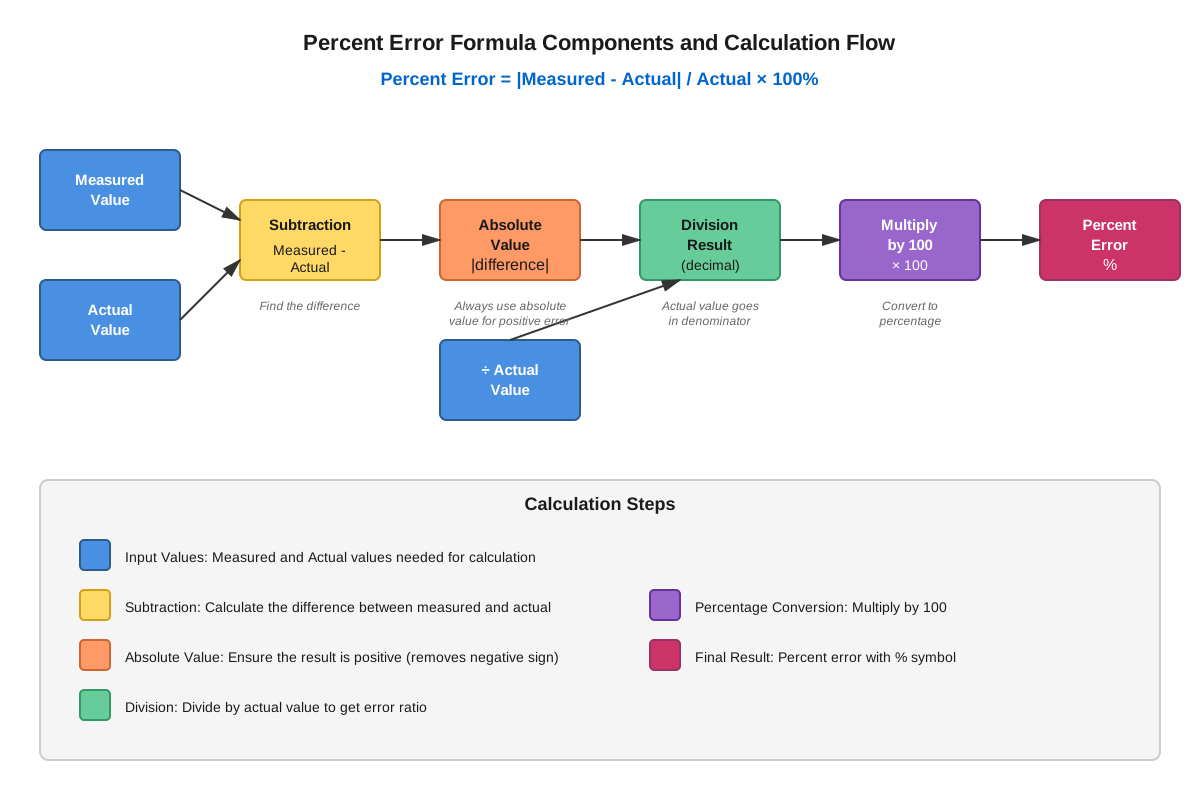
The percent error formula is the cornerstone of this topic and must be memorized precisely:
Percent Error = (|Measured Value - Actual Value| / |Actual Value|) × 100%Each component serves a specific purpose:
- Measured Value: The estimated, predicted, or experimentally determined value
- Actual Value: The true, accepted, or exact value (also called the theoretical or expected value)
- Absolute Value (| |): Ensures the result is always positive, since error magnitude matters more than direction
- Division by Actual Value: Expresses the error relative to the true value, not as an absolute difference
- Multiplication by 100%: Converts the decimal result to a percentage
The numerator calculates the absolute difference between the measured and actual values, representing the magnitude of the error. The denominator provides the reference point for comparison. Without dividing by the actual value, we would only know the absolute error, not how significant that error is relative to the quantity being measured.
Understanding Absolute Value in Percent Error
The absolute value symbols in the percent error formula are critical. They ensure that percent error is always expressed as a positive number, regardless of whether the measured value overestimates or underestimates the actual value.
For example:
- If the actual value is 50 and the measured value is 55, the difference is +5
- If the actual value is 50 and the measured value is 45, the difference is -5
- In both cases, the absolute value of the difference is 5, yielding the same percent error
Some formulas show absolute value only around the numerator: |Measured - Actual|. Since the actual value in the denominator should also be positive in practical contexts, some textbooks write |Actual Value| in the denominator as well, though this is often implied when dealing with physical quantities.
Step-by-Step Calculation Process
To calculate percent error systematically:
- Identify the values: Determine which value is the measured/estimated value and which is the actual/accepted value
- Check units: Ensure both values use the same units; convert if necessary
- Calculate the difference: Subtract the actual value from the measured value
- Apply absolute value: Take the absolute value of the difference to ensure a positive result
- Divide by actual value: Divide the absolute difference by the actual value
- Convert to percentage: Multiply the result by 100 and add the % symbol
- Round appropriately: Follow any rounding instructions or round to a reasonable number of decimal places
Interpreting Percent Error Results
Understanding what percent error values mean is crucial for SAT questions:
| Percent Error Range | Interpretation | Example Context |
|---|---|---|
| 0% - 5% | Excellent accuracy | Precision scientific instruments |
| 5% - 10% | Good accuracy | Quality manufacturing processes |
| 10% - 20% | Moderate accuracy | Rough estimates or approximations |
| 20% - 50% | Poor accuracy | Crude estimation methods |
| > 50% | Very poor accuracy | Fundamentally flawed measurement |
A percent error of 0% indicates perfect accuracy (measured value equals actual value). As percent error increases, the reliability of the measurement decreases. SAT questions may ask students to determine whether a measurement method is acceptable based on its percent error, requiring judgment about what constitutes reasonable accuracy in context.
Common Variations and Related Concepts
While the standard percent error formula is most common on the SAT, students should recognize related concepts:
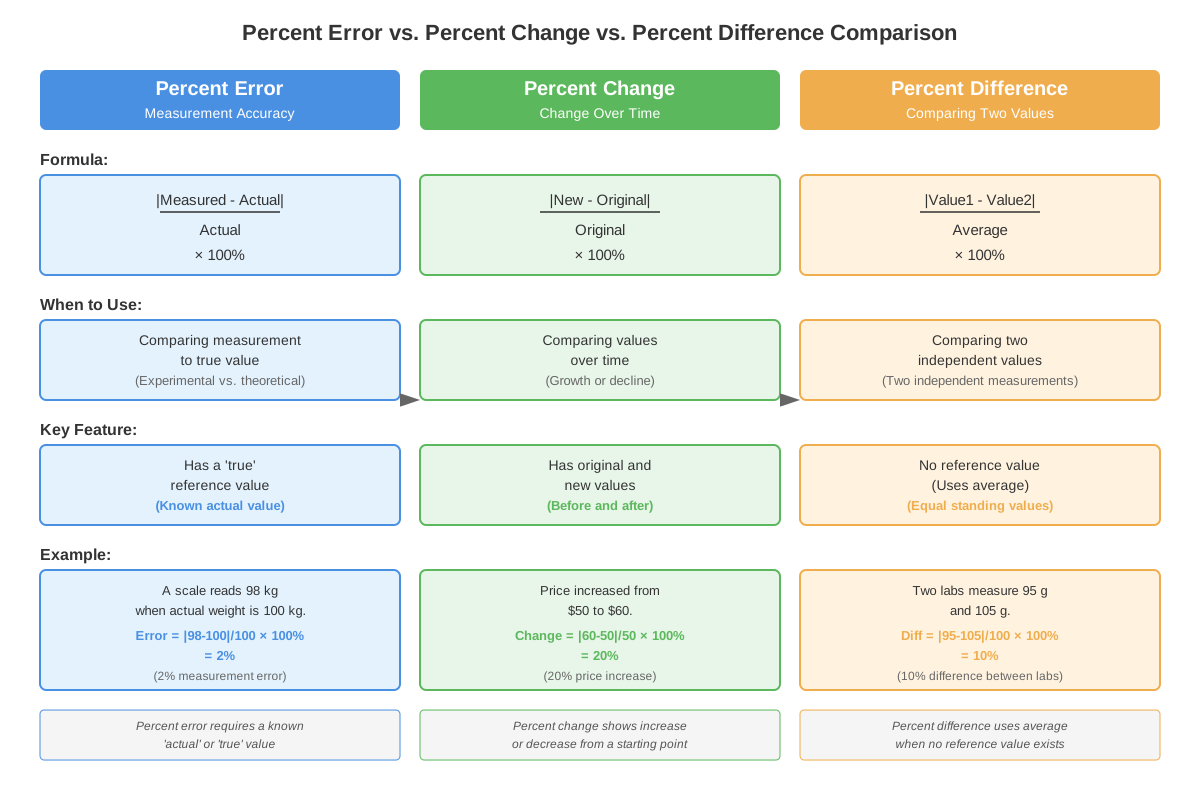
Percent Change differs from percent error because it measures the change between an old value and a new value, where direction matters (positive for increase, negative for decrease). The formula is: (New - Old) / Old × 100%.
Percent Difference compares two values without designating one as "correct," often using the average of the two values in the denominator: |Value₁ - Value₂| / [(Value₁ + Value₂)/2] × 100%.
Relative Error is the decimal form of percent error (before multiplying by 100%), sometimes called fractional error.
The SAT primarily tests percent error, but recognizing these distinctions prevents confusion when interpreting question wording.
Concept Relationships
Percent error builds directly upon foundational percentage concepts, requiring students to understand that percentages represent parts of a whole expressed per hundred. The formula structure (part/whole × 100%) mirrors basic percentage calculations, with the absolute difference serving as the "part" and the actual value as the "whole."
The absolute value concept connects percent error to number line distance and magnitude calculations. Students must recognize that absolute value strips away directional information, focusing solely on size—a critical feature when error magnitude matters more than whether an estimate was too high or too low.
Within the topic itself, the relationships flow as follows:
Measured Value & Actual Value → Absolute Difference → Relative Error → Percent Error
First, identifying the two values correctly is essential. These values generate the absolute difference (numerator). Dividing by the actual value produces relative error (a decimal). Multiplying by 100% converts relative error to percent error (the final answer).
Percent error also connects to data analysis and statistics, where understanding measurement precision helps evaluate data quality. In scientific contexts on the SAT, percent error relates to experimental design and the reliability of conclusions drawn from data.
Quick check — test yourself on Percent error so far.
Try Flashcards →High-Yield Facts
⭐ The percent error formula is: |Measured - Actual| / |Actual| × 100%
⭐ Percent error is always expressed as a positive value due to absolute value
⭐ The actual value (true/accepted value) always goes in the denominator
⭐ Both values must be in the same units before calculating percent error
⭐ A percent error of 0% means the measured value exactly equals the actual value
- Percent error measures accuracy, not precision (precision refers to consistency of repeated measurements)
- Larger percent errors indicate less accurate measurements or estimates
- The measured value can be called the experimental, estimated, or approximate value
- Percent error can exceed 100% when the measured value is more than twice the actual value (or less than zero for positive actual values)
- SAT questions may provide the percent error and ask you to solve for the measured or actual value
- Converting the final decimal to a percentage requires multiplying by 100, not just adding a % symbol
- Rounding should typically occur at the final step, not during intermediate calculations
- The order of subtraction (measured - actual vs. actual - measured) doesn't matter because of absolute value
Common Misconceptions
Misconception: Percent error can be negative if the measured value is less than the actual value.
→ Correction: Percent error is always positive because absolute value is applied to the difference. The direction of error (overestimate vs. underestimate) is not reflected in percent error; only the magnitude matters.
Misconception: The measured value always goes in the denominator.
→ Correction: The actual (true, accepted, or theoretical) value always goes in the denominator. The measured (experimental or estimated) value goes in the numerator as part of the difference calculation.
Misconception: Percent error and percent change are the same thing.
→ Correction: Percent change measures the relative change between two values over time or between conditions, and can be positive or negative. Percent error specifically compares a measured value to a known correct value and is always positive.
Misconception: If two measurements have the same absolute error, they have the same percent error.
→ Correction: Percent error is relative to the actual value. An absolute error of 5 represents a 10% error when the actual value is 50, but a 5% error when the actual value is 100. The same absolute error produces different percent errors depending on the magnitude of the actual value.
Misconception: You can calculate percent error with values in different units as long as you convert at the end.
→ Correction: Both values must be in the same units before any calculations begin. Converting after calculation will produce incorrect results because the ratio will be meaningless if the units don't match.
Misconception: A percent error greater than 100% is impossible or indicates a calculation error.
→ Correction: Percent errors can exceed 100% when the measured value differs from the actual value by more than the actual value itself. For example, if the actual value is 10 and the measured value is 25, the percent error is 150%, which is mathematically valid.
Worked Examples
Example 1: Direct Percent Error Calculation
Problem: A student estimates that a textbook weighs 1,200 grams. When weighed on a precise scale, the textbook actually weighs 1,050 grams. What is the percent error of the student's estimate?
Solution:
Step 1: Identify the values
- Measured Value (estimate) = 1,200 grams
- Actual Value (true weight) = 1,050 grams
Step 2: Check units
- Both values are in grams ✓
Step 3: Calculate the difference
- Difference = 1,200 - 1,050 = 150 grams
Step 4: Apply absolute value
- |150| = 150 grams (already positive)
Step 5: Divide by actual value
- 150 ÷ 1,050 = 0.142857...
Step 6: Convert to percentage
- 0.142857... × 100% = 14.29%
Step 7: Round appropriately
- Percent Error ≈ 14.3% (or 14% if rounding to nearest whole number)
Connection to Learning Objectives: This example demonstrates the direct application of the percent error formula, showing all calculation steps clearly. The student's estimate had a moderate percent error of about 14%, indicating the estimate was reasonably close but not highly accurate.
Example 2: Working Backward from Percent Error
Problem: A scientist measures the boiling point of a liquid and calculates a percent error of 4%. If the actual boiling point is 80°C, and the measured value was higher than the actual value, what was the measured boiling point?
Solution:
Step 1: Write the percent error formula
- Percent Error = |Measured - Actual| / Actual × 100%
Step 2: Substitute known values
- 4% = |Measured - 80| / 80 × 100%
Step 3: Solve for the absolute value expression
- 4 = |Measured - 80| / 80 × 100
- 4 / 100 = |Measured - 80| / 80
- 0.04 = |Measured - 80| / 80
- 0.04 × 80 = |Measured - 80|
- 3.2 = |Measured - 80|
Step 4: Consider both cases for absolute value
- Case 1: Measured - 80 = 3.2, so Measured = 83.2°C
- Case 2: Measured - 80 = -3.2, so Measured = 76.8°C
Step 5: Apply the given constraint
- The problem states the measured value was higher than actual
- Therefore, Measured = 83.2°C
Connection to Learning Objectives: This example shows how to work backward from a given percent error to find an unknown value, a common SAT question type. It also demonstrates the importance of carefully reading the problem for additional constraints (the measured value was higher) that help determine which solution is correct when absolute value creates two possibilities.
Exam Strategy
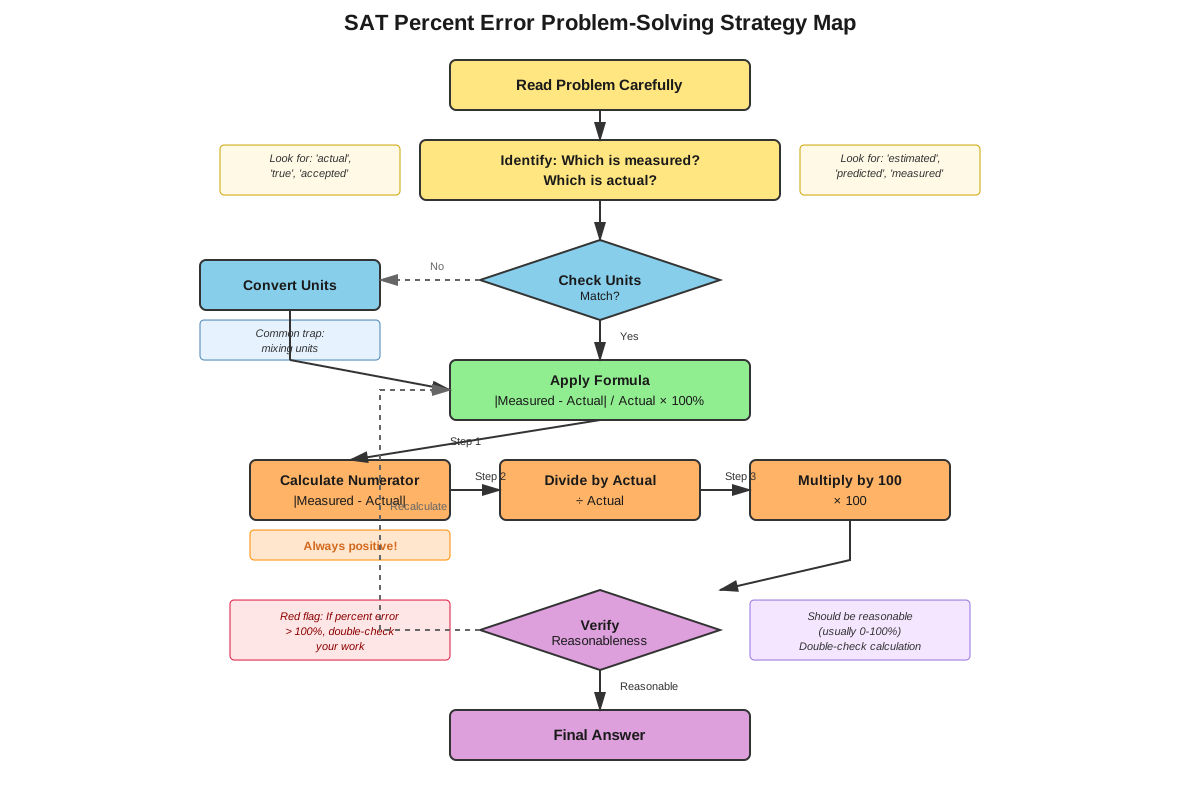
When approaching sat percent error questions on the exam, follow this systematic strategy:
Trigger Words to Identify Percent Error Questions:
- "percent error," "percentage error," "error in the measurement"
- "accuracy of the estimate," "how accurate was the prediction"
- "experimental value," "measured value," "actual value," "accepted value"
- "by what percent did the estimate differ from the actual"
Step-by-Step Approach:
- Read carefully: Identify which value is measured/estimated and which is actual/true
- Highlight numbers: Mark the two values and note their units
- Check for unit conversion: Convert if necessary before any calculations
- Write the formula: Jot down the percent error formula to avoid mistakes
- Substitute carefully: Place values in the correct positions (actual in denominator)
- Calculate methodically: Follow order of operations precisely
- Verify reasonableness: Does your answer make sense in context?
Process of Elimination Tips:
- Eliminate any negative answer choices immediately (percent error is always positive)
- If the measured and actual values are very close, eliminate large percent errors (>20%)
- If the measured value is roughly double or half the actual value, eliminate small percent errors (<30%)
- Check whether answer choices are in decimal form (0.15) or percentage form (15%)—SAT typically uses percentage form
Time Allocation:
Percent error questions typically require 60-90 seconds. If a question involves working backward or multiple steps, allocate up to 2 minutes. Don't spend more than 2 minutes on any single percent error question—mark it and return if needed.
Calculator Usage:
For calculator-permitted sections, use your calculator for division and multiplication, but write down intermediate steps to avoid entry errors. For no-calculator sections, look for opportunities to simplify fractions before converting to percentages.
Memory Techniques
Formula Mnemonic: "MAD over A times 100"
- Measured minus Actual gives the Difference
- Put it over Actual
- times 100 for percent
Absolute Value Reminder: Think "Always Positive Percent" (APP) to remember that percent error is always positive due to absolute value.
Denominator Memory Aid: "Actual is the Anchor" - The actual value anchors the bottom of the fraction (denominator) because it's the reference point for comparison.
Unit Check Visualization: Picture a balance scale—both sides must have the same units to compare fairly. This visual reminds you to check units before calculating.
Percent vs. Decimal: Remember "×100 to Percent-ify" - multiplying by 100 converts your decimal to a percentage.
Summary
Percent error is a critical mathematical concept that measures the accuracy of a measured or estimated value compared to an actual or accepted value. The formula—|Measured - Actual| / |Actual| × 100%—must be memorized and applied correctly, with the actual value always in the denominator and absolute value ensuring a positive result. On the SAT, percent error questions appear regularly in word problem formats, testing students' abilities to identify values correctly, perform multi-step calculations accurately, and interpret results in context. Success requires understanding that percent error differs from percent change, recognizing that both values must share the same units, and knowing how to work both forward (calculating percent error from given values) and backward (finding unknown values from given percent error). Mastering this topic strengthens overall percentage skills, reinforces absolute value concepts, and develops the quantitative reasoning abilities essential for achieving high scores on the SAT Math section.
Key Takeaways
- The percent error formula is |Measured - Actual| / |Actual| × 100%, with the actual value always in the denominator
- Percent error is always positive due to absolute value, measuring magnitude of error without regard to direction
- Both measured and actual values must be in identical units before performing any calculations
- Percent error measures relative accuracy—the same absolute error produces different percent errors depending on the actual value's magnitude
- SAT questions may require calculating percent error directly or working backward to find unknown measured or actual values
- Lower percent errors indicate higher accuracy; a 0% error means perfect accuracy
- Distinguish percent error from percent change and percent difference, which have different formulas and meanings
Related Topics
Percent Change: Building on percent error, percent change calculates the relative increase or decrease between an original and new value, allowing negative results to indicate decreases. This topic appears frequently in growth/decay problems and financial contexts on the SAT.
Ratios and Proportions: Percent error fundamentally involves comparing two quantities through a ratio, making strong ratio skills essential for quick, accurate calculations. Mastering ratios enables faster problem-solving across multiple SAT Math domains.
Absolute Value Equations: Deeper understanding of absolute value, including solving equations with absolute value, extends the concepts used in percent error calculations and appears in algebra-focused SAT questions.
Scientific Notation and Significant Figures: In advanced applications, percent error connects to precision and accuracy in scientific measurements, topics that occasionally appear in SAT science-based word problems.
Statistics and Data Analysis: Percent error relates to concepts of measurement reliability, experimental error, and data quality—all important for the Problem Solving and Data Analysis domain of the SAT.
Practice CTA
Now that you've mastered the core concepts of percent error, it's time to solidify your understanding through active practice. Attempt the practice questions to apply these formulas and strategies to SAT-style problems, and use the flashcards to reinforce the key facts and formulas until they become automatic. Remember, percent error questions are highly testable on the SAT, and consistent practice will build both your speed and accuracy. Every practice problem you solve strengthens your mathematical reasoning and brings you closer to your target score. You've got this!
Sign up free to keep reading
Create a free AnvayaPrep account to finish this SAT guide on Percent error — plus flashcards and practice questions.