Overview
Understanding how to calculate the percent of a number is a fundamental skill that appears frequently throughout the SAT Math section. This topic forms the foundation for more complex percentage problems, including percent increase and decrease, compound interest, and data interpretation questions. Students who master this concept gain a significant advantage, as percentage calculations appear in approximately 10-15% of all SAT Math questions across both calculator and no-calculator sections.
The ability to find a percent of a number involves converting between percentages, decimals, and fractions, then applying multiplication to determine the result. This seemingly simple operation becomes the building block for analyzing real-world scenarios involving discounts, tax calculations, statistical data, and proportional relationships. On the SAT, these questions range from straightforward computational problems to multi-step word problems that require students to identify what percentage is being applied and to which quantity.
Mastery of sat percent of a number calculations connects directly to broader mathematical concepts including ratios, proportions, algebraic equations, and data analysis. Students who can quickly and accurately compute percentages can allocate more time to complex problem-solving questions, improving overall test performance. This topic also serves as a gateway to understanding more advanced percentage applications that appear in both the Heart of Algebra and Problem Solving and Data Analysis domains of the SAT.
Learning Objectives
- [ ] Identify key features of Percent of a number
- [ ] Explain how Percent of a number appears on the SAT
- [ ] Apply Percent of a number to answer SAT-style questions
- [ ] Convert between percentages, decimals, and fractions fluently
- [ ] Solve multi-step word problems involving percent of a number
- [ ] Recognize and avoid common calculation errors in percentage problems
- [ ] Apply percent calculations to real-world contexts including finance and statistics
Prerequisites
- Basic multiplication and division: Essential for performing the actual calculations after converting percentages to decimals or fractions
- Understanding of fractions and decimals: Necessary because percentages are fundamentally fractions with a denominator of 100
- Order of operations: Required when percent calculations appear within larger expressions or multi-step problems
- Basic algebraic manipulation: Helpful when the unknown quantity is the original number or the percentage itself
Why This Topic Matters
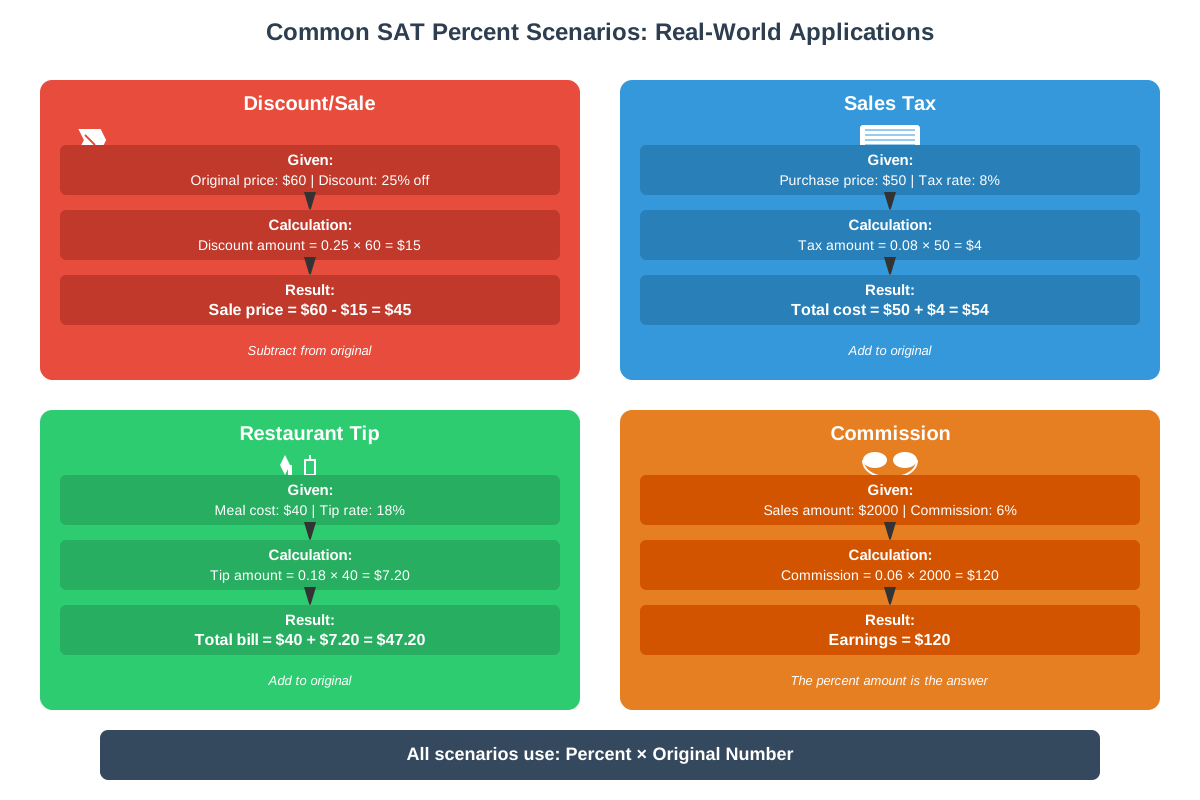
In real-world applications, calculating a percent of a number appears constantly in financial literacy (calculating tips, sales tax, discounts), data interpretation (understanding survey results, statistical reports), and professional contexts (commission calculations, budget allocations, growth rates). These practical applications make this topic one of the most immediately useful mathematical skills students will develop.
On the SAT, percent of a number questions appear with remarkable frequency. Students can expect to encounter 3-5 questions directly testing this concept, with many additional questions incorporating percentage calculations as part of more complex problems. These questions appear in both multiple-choice and grid-in formats, across calculator and no-calculator sections. The College Board consistently includes percentage problems because they assess both computational fluency and the ability to translate between mathematical representations.
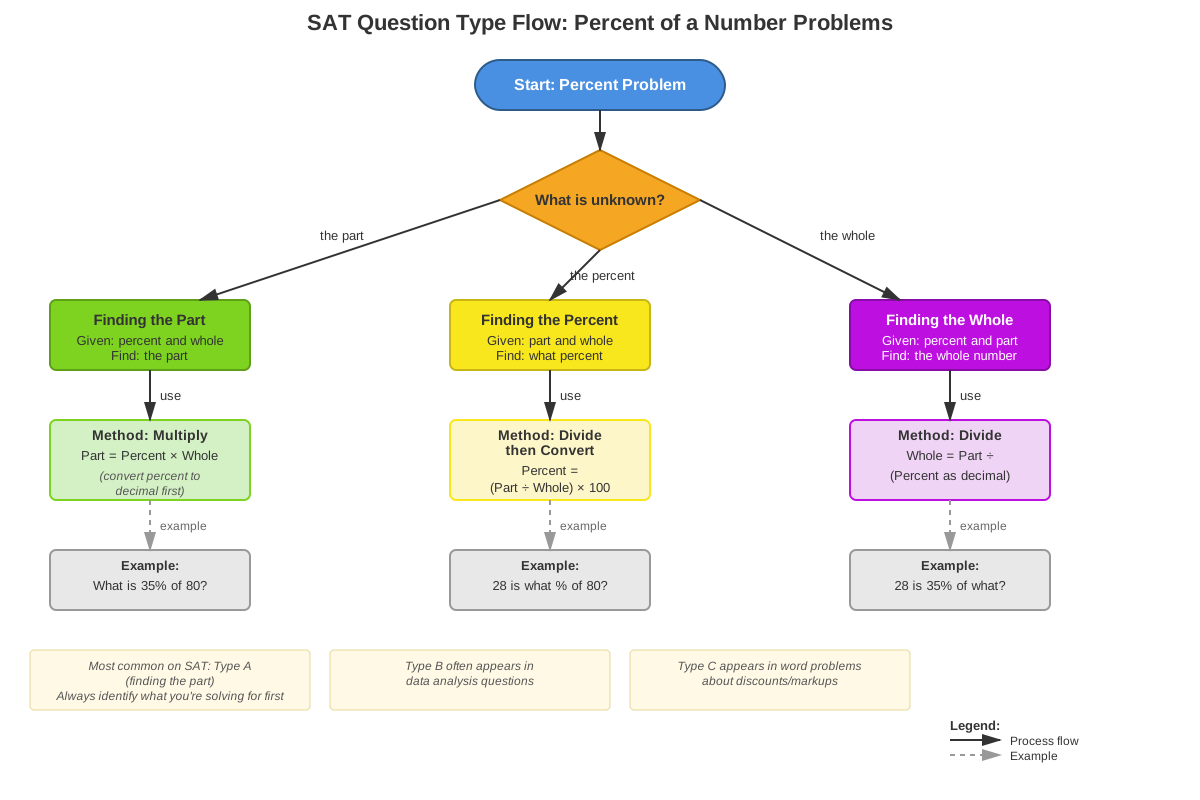
Common SAT question formats include: straightforward calculations ("What is 35% of 80?"), word problems involving discounts or markups ("A $60 shirt is on sale for 25% off. What is the sale price?"), data interpretation questions requiring percentage calculations from tables or graphs, and algebraic problems where students must set up equations involving percentages. The topic also appears disguised in questions about probability, statistics, and proportional reasoning, making it one of the most versatile and high-yield concepts to master.
Core Concepts
Understanding Percentages as Fractions
A percentage literally means "per hundred" or "out of 100." When working with percent of a number problems, the first critical step is recognizing that any percentage can be expressed as a fraction with 100 as the denominator. For example, 45% means 45 out of 100, or 45/100. This fundamental understanding allows students to convert percentages into more workable forms for calculation.
The word "of" in mathematical contexts signals multiplication. Therefore, "percent of a number" translates to: (percentage as a decimal or fraction) × (the number). This translation from English to mathematical operations is crucial for SAT success, as many questions are presented as word problems requiring this interpretation.
Converting Percentages to Decimals
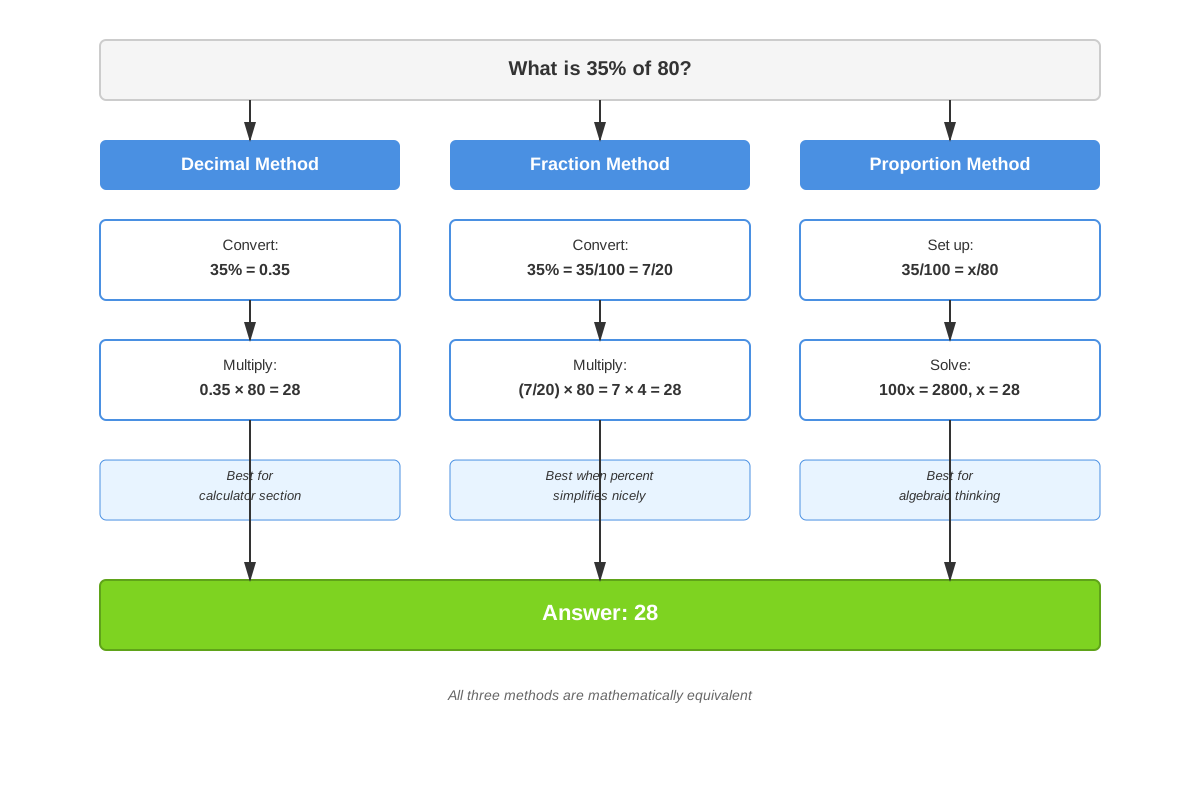
The most common and efficient method for calculating a percent of a number involves converting the percentage to a decimal, then multiplying. To convert a percentage to a decimal, divide by 100 (or equivalently, move the decimal point two places to the left).
Conversion examples:
- 25% = 25 ÷ 100 = 0.25
- 8% = 8 ÷ 100 = 0.08
- 150% = 150 ÷ 100 = 1.50
- 0.5% = 0.5 ÷ 100 = 0.005
Once converted to decimal form, multiply by the number in question. For instance, to find 25% of 80: 0.25 × 80 = 20.
Converting Percentages to Fractions
Some percentages convert to simple fractions that make mental calculation easier. Recognizing these common conversions can significantly speed up problem-solving:
| Percentage | Fraction | Decimal |
|---|---|---|
| 50% | 1/2 | 0.5 |
| 25% | 1/4 | 0.25 |
| 75% | 3/4 | 0.75 |
| 20% | 1/5 | 0.2 |
| 10% | 1/10 | 0.1 |
| 33⅓% | 1/3 | 0.333... |
| 66⅔% | 2/3 | 0.666... |
Using fractions can be particularly advantageous in no-calculator sections. For example, finding 25% of 84 is easier when recognizing that 25% = 1/4, so the answer is 84 ÷ 4 = 21.
The Standard Calculation Method
The systematic approach to finding a percent of a number follows these steps:
- Identify the percentage being applied
- Identify the base number (the quantity you're taking a percentage of)
- Convert the percentage to decimal or fraction form
- Multiply the converted percentage by the base number
- Verify that your answer makes logical sense
For example, to find 35% of 200:
- Percentage: 35%
- Base number: 200
- Convert: 35% = 0.35
- Multiply: 0.35 × 200 = 70
- Verify: 35% is slightly more than one-third, and one-third of 200 is about 67, so 70 makes sense
Working with Percentages Greater Than 100%
Students often struggle with percentages exceeding 100%, but the same principles apply. A percentage greater than 100% means the result will be larger than the original number. For instance, 150% of 40 means 1.5 × 40 = 60. This concept frequently appears in growth problems or when calculating amounts that include both an original value and an increase.
Working with Percentages Less Than 1%
Small percentages (less than 1%) require careful attention to decimal placement. For example, 0.5% of 1,000 requires converting 0.5% to 0.005, then multiplying: 0.005 × 1,000 = 5. These appear less frequently on the SAT but test precision and attention to detail.
Multi-Step Percentage Problems
Many SAT questions require finding a percent of a number as one step within a larger problem. For example: "A store marks up items by 40% above wholesale cost, then offers a 25% discount. If the wholesale cost is $50, what is the final price?" This requires:
- Finding 40% of $50: 0.40 × 50 = $20
- Adding the markup: $50 + $20 = $70
- Finding 25% of $70: 0.25 × 70 = $17.50
- Subtracting the discount: $70 - $17.50 = $52.50
Concept Relationships
The concept of finding a percent of a number serves as the foundation for virtually all percentage-related problems on the SAT. This fundamental skill connects directly to percent increase and decrease (which requires finding a percent of a number, then adding or subtracting it from the original), percent change calculations (which involve finding the difference between values as a percentage), and solving percentage equations (where the unknown might be the original number or the percentage itself).
The relationship flows as follows: Basic multiplication and division → Understanding fractions and decimals → Percent of a number → Percent increase/decrease → Compound percentage changes → Complex word problems involving percentages.
Within this topic itself, the concepts connect hierarchically: understanding that percentages are fractions out of 100 enables conversion to decimals or simpler fractions, which then allows for efficient multiplication to find the result. The ability to verify answers through estimation connects back to number sense and proportional reasoning.
This topic also bridges to other SAT Math domains: in Problem Solving and Data Analysis, percentages appear in statistical contexts and data interpretation; in Heart of Algebra, percentage problems often require setting up and solving equations; in Passport to Advanced Math, compound interest problems apply repeated percentage calculations.
High-Yield Facts
⭐ To find a percent of a number, convert the percentage to a decimal by dividing by 100, then multiply by the number
⭐ The word "of" in percentage problems indicates multiplication
⭐ Common percentage-to-fraction conversions (50% = 1/2, 25% = 1/4, 10% = 1/10) enable faster mental calculation
⭐ Percentages greater than 100% produce results larger than the original number
⭐ To convert a percentage to a decimal, move the decimal point two places to the left
- Finding 10% of any number is accomplished by dividing by 10 (moving the decimal one place left)
- Finding 1% of any number is accomplished by dividing by 100 (moving the decimal two places left)
- Percentages less than 1% require careful attention to decimal placement (0.5% = 0.005)
- The result of finding a percent of a number should always be smaller than the original number if the percentage is less than 100%
- When a question asks for a percentage "of" one quantity "of" another, multiply all values together (e.g., 20% of 50% of 200 = 0.20 × 0.50 × 200)
Quick check — test yourself on Percent of a number so far.
Try Flashcards →Common Misconceptions
Misconception: Adding the percentage directly to the number (e.g., thinking 25% of 80 equals 80 + 25 = 105) → Correction: The percentage must first be converted to a decimal or fraction, then multiplied by the number. 25% of 80 = 0.25 × 80 = 20, not 105.
Misconception: Confusing "percent of" with "percent more than" or "percent less than" → Correction: "Percent of" means simply multiplying the percentage by the number. "Percent more than" requires finding the percent of the number AND adding it to the original. For example, "25% of 80" gives 20, but "25% more than 80" gives 80 + 20 = 100.
Misconception: Believing that percentages cannot exceed 100% → Correction: Percentages can be any positive value. 150% of 60 = 1.5 × 60 = 90. This commonly appears in growth problems or when expressing one quantity as a percentage of a smaller quantity.
Misconception: Incorrectly converting percentages to decimals (e.g., converting 35% to 0.035 instead of 0.35) → Correction: To convert a percentage to a decimal, divide by 100 or move the decimal point exactly two places to the left. 35% = 35.0% = 0.35, not 0.035.
Misconception: Thinking that finding 50% twice is the same as finding 100% → Correction: Finding 50% of a number twice means taking 50% of the result, not of the original number. 50% of 50% of 100 = 0.5 × 0.5 × 100 = 25, not 100.
Misconception: Forgetting to convert the percentage before multiplying → Correction: You cannot multiply a number directly by a percentage value. 20% × 50 ≠ 20 × 50. You must first convert: 0.20 × 50 = 10.
Worked Examples
Example 1: Basic Calculation with Verification
Problem: A student answers 85% of 60 questions correctly on a practice test. How many questions did the student answer correctly?
Solution:
Step 1: Identify the percentage and base number
- Percentage: 85%
- Base number: 60 questions
Step 2: Convert the percentage to a decimal
- 85% = 85 ÷ 100 = 0.85
Step 3: Multiply the decimal by the base number
- 0.85 × 60 = 51
Step 4: Verify the answer makes sense
- 85% is close to 90%, which would be 54 questions (90% = 9/10, and 9/10 of 60 = 54)
- 85% should be slightly less than 54, and 51 is indeed slightly less
- Also, 85% is more than 80% (which would be 48), and 51 > 48 ✓
Answer: The student answered 51 questions correctly.
Connection to learning objectives: This example demonstrates the standard method for finding a percent of a number and shows how to verify answers through estimation, addressing the objectives of applying the concept and avoiding calculation errors.
Example 2: Multi-Step Word Problem
Problem: A laptop originally priced at $800 is on sale for 30% off. The store then applies an additional 10% discount to the sale price for students. What is the final price a student pays?
Solution:
Step 1: Find the first discount amount
- 30% of $800 = 0.30 × 800 = $240
Step 2: Calculate the price after the first discount
- $800 - $240 = $560
Step 3: Find the second discount amount (applied to the new price, not the original)
- 10% of $560 = 0.10 × 560 = $56
Step 4: Calculate the final price
- $560 - $56 = $504
Alternative approach (more efficient):
- After a 30% discount, the customer pays 70% of the original price
- After an additional 10% discount, the customer pays 90% of that price
- Final price = 0.70 × 0.90 × $800 = 0.63 × $800 = $504
Step 5: Verify
- Total discount is not 40% (common error), because the second discount applies to an already-reduced price
- The final price ($504) is 63% of the original ($800), which makes sense as it's less than 70% but more than 60%
Answer: The student pays $504.
Connection to learning objectives: This example illustrates how percent of a number appears in real-world SAT contexts, requires multi-step problem solving, and demonstrates a common misconception (adding percentages directly) that must be avoided.
Exam Strategy
When approaching sat percent of a number questions on the SAT, begin by carefully reading the problem to identify what percentage is being applied and to which quantity. Circle or underline these key values to avoid confusion in multi-step problems.
Trigger words and phrases to watch for include:
- "What is [percentage] of [number]?" — direct calculation
- "How many/much" — often requires finding a percent of a number
- "Discount," "sale," "off" — subtract the percent from the original
- "Tax," "tip," "markup," "increase" — add the percent to the original
- "Of the [total]" — the total is your base number
For process of elimination on multiple-choice questions, use estimation before calculating precisely. If asked to find 48% of 250, recognize that 50% would be 125, so the answer must be slightly less than 125. Eliminate any choices that are 125 or greater, or significantly less than 125. This strategy is particularly valuable in the no-calculator section.
Time allocation: Straightforward percent of a number questions should take 30-45 seconds. If you find yourself spending more than one minute, you may be overcomplicating the problem. Consider whether you can use a simpler fraction equivalent (like converting 25% to 1/4) or whether you've correctly identified what the question is asking.
Calculator usage: When calculators are permitted, use them for complex decimals but maintain mental math skills for simple conversions. For example, finding 20% of 85 can be done mentally (10% is 8.5, so 20% is 17) faster than reaching for a calculator.
Common trap: SAT questions often ask for a value that requires one additional step beyond finding the percent of a number. For example, after calculating a 30% discount, the question might ask for the sale price (requiring subtraction from the original) rather than the discount amount itself. Always reread the question before selecting your answer.
Memory Techniques
Mnemonic for conversion: "Percentage Divided by Hundred" (PDH) — to convert a percentage to a decimal, divide by 100.
The "OF means MULTIPLY" rule: Whenever you see "of" in a percentage problem, replace it mentally with a multiplication sign. "30% of 50" becomes "30% × 50" or "0.30 × 50."
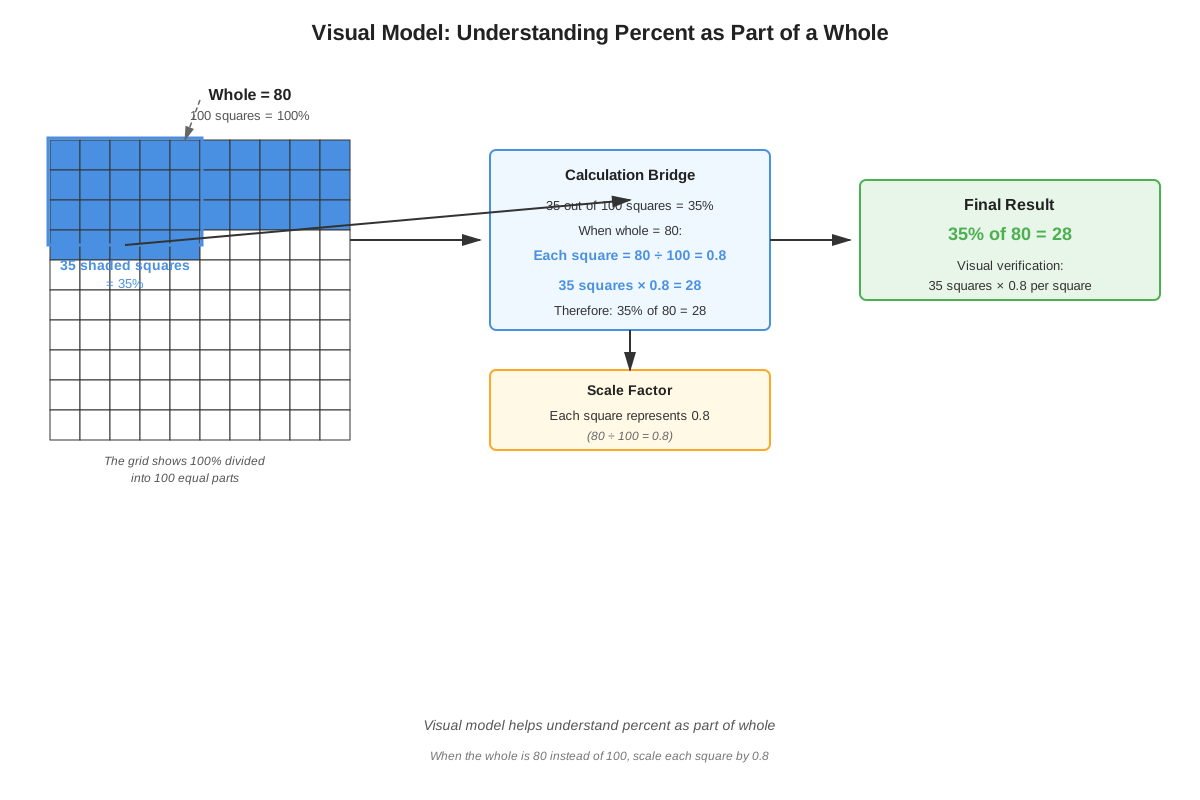
Visualization strategy: Picture a percentage as a shaded portion of a 10×10 grid (100 squares total). 35% means 35 squares are shaded. This visual helps verify whether your answer makes sense — if you're finding 35% of 200, imagine two of these grids, with 35 squares shaded in each, giving you 70 total.
The "Benchmark Percentages" anchor: Memorize these instant conversions and use them as reference points:
- 10% = divide by 10 (move decimal left once)
- 25% = divide by 4 (one quarter)
- 50% = divide by 2 (one half)
- 75% = multiply by 3, then divide by 4 (three quarters)
Acronym for problem-solving steps: ICMV — Identify (the percentage and base), Convert (to decimal or fraction), Multiply, Verify (check if the answer makes sense).
Summary
Finding a percent of a number is a foundational skill that appears throughout the SAT Math section in various contexts and difficulty levels. The core process involves converting a percentage to either a decimal (by dividing by 100) or a simple fraction, then multiplying by the base number. Understanding that "of" signals multiplication is crucial for translating word problems into mathematical operations. Students must distinguish between finding a percent of a number (a single multiplication) and related concepts like percent increase or decrease (which require additional steps). Common percentages should be memorized as fractions for mental math efficiency, particularly in no-calculator sections. Multi-step problems require careful attention to which quantity serves as the base for each percentage calculation. Verification through estimation prevents careless errors and builds confidence. Mastery of this topic enables success on direct calculation questions and provides the foundation for more complex percentage problems involving change, growth, and proportional relationships that appear frequently on the SAT.
Key Takeaways
- Convert percentages to decimals by dividing by 100 (moving the decimal two places left), then multiply by the base number
- The word "of" in percentage problems always indicates multiplication
- Memorize common percentage-fraction equivalents (50% = 1/2, 25% = 1/4, 10% = 1/10) for faster calculation
- Always verify answers through estimation: 48% of 200 should be close to 50% of 200, which is 100
- In multi-step problems, carefully identify which number serves as the base for each percentage calculation
- Percentages can exceed 100%, resulting in values larger than the original number
- Distinguish between "percent of" (simple multiplication) and "percent more/less than" (multiplication plus addition/subtraction)
Related Topics
Percent Increase and Decrease: Building directly on percent of a number, this topic involves calculating the change in a quantity and expressing it as a percentage. Mastering basic percent calculations is essential before tackling these more complex problems.
Percent Change: This advanced application requires finding the difference between two values, then expressing that difference as a percentage of the original value. Success depends on fluency with finding a percent of a number.
Ratios and Proportions: Percentages are a special type of ratio (comparing to 100), so understanding percent of a number strengthens proportional reasoning skills used throughout SAT Math.
Data Interpretation: Many SAT questions present data in tables or graphs and ask students to calculate percentages of totals, requiring the fundamental skill of finding a percent of a number.
Linear Growth and Decay: These algebra problems often involve repeated percentage calculations, making fluency with basic percent of a number operations essential for efficiency.
Practice CTA
Now that you've mastered the core concepts of finding a percent of a number, it's time to solidify your understanding through practice. Attempt the practice questions to apply these strategies under test-like conditions, and use the flashcards to reinforce the key conversions and formulas until they become automatic. Remember, percentage problems appear on virtually every SAT, so the time you invest in mastering this topic will directly translate to points on test day. Confidence with percentages frees up mental energy for more challenging problems—start practicing now to build that confidence!
Sign up free to keep reading
Create a free AnvayaPrep account to finish this SAT guide on Percent of a number — plus flashcards and practice questions.