Overview
Percent increase is one of the most frequently tested concepts in the SAT Math section, appearing in multiple questions across both the calculator and no-calculator portions of the exam. This fundamental topic requires students to understand how quantities change proportionally and express those changes as percentages. Mastering percent increase is essential not only for direct percentage questions but also for word problems involving growth, price markups, population changes, and compound interest scenarios.
The concept of sat percent increase builds upon basic percentage knowledge and extends into more complex applications involving sequential changes, reverse calculations, and algebraic representations. Students who thoroughly understand percent increase gain a significant advantage on the SAT because these questions often appear in medium-to-hard difficulty ranges where many test-takers struggle. The ability to quickly identify percent increase scenarios and apply the correct formula can save valuable time and boost overall scores.
Beyond its direct applications, percent increase connects to broader mathematical concepts including ratios, proportions, linear functions, and exponential growth. Understanding how to calculate and interpret percent increase provides a foundation for more advanced topics such as percent decrease, compound percentage changes, and growth models. This interconnected nature makes percent increase a high-yield topic that rewards thorough preparation and practice.
Learning Objectives
- [ ] Identify key features of percent increase in various problem contexts
- [ ] Explain how percent increase appears on the SAT across different question formats
- [ ] Apply percent increase to answer SAT-style questions accurately and efficiently
- [ ] Calculate percent increase using the standard formula with both whole numbers and decimals
- [ ] Solve reverse percent increase problems where the final value is given
- [ ] Distinguish between percent increase and absolute increase in word problems
- [ ] Apply percent increase concepts to multi-step problems involving sequential changes
Prerequisites
- Basic percentage concepts: Understanding that percentages represent parts per hundred is fundamental to calculating percent increase
- Fraction and decimal conversions: Converting between percentages, decimals, and fractions enables flexible problem-solving approaches
- Basic algebra: Solving for unknown variables is necessary when working with percent increase formulas
- Arithmetic operations: Proficiency with addition, subtraction, multiplication, and division ensures accurate calculations
- Ratio and proportion understanding: Recognizing proportional relationships helps identify percent increase scenarios
Why This Topic Matters
Percent increase appears extensively in real-world contexts that students encounter daily. Businesses use percent increase to calculate price markups, sales growth, and profit margins. Economists track percent increase in GDP, inflation rates, and employment figures. Scientists measure percent increase in population growth, chemical concentrations, and experimental results. Personal finance applications include calculating investment returns, salary raises, and credit card interest accumulation. Understanding percent increase empowers students to make informed decisions about money, interpret news reports critically, and analyze data effectively.
On the SAT, percent increase questions appear with remarkable frequency—typically 2-4 questions per test, representing approximately 5-10% of all math questions. These questions span multiple difficulty levels and appear in various formats including multiple-choice, grid-in, and multi-step word problems. The College Board consistently includes percent increase in contexts such as retail pricing, population statistics, scientific measurements, and financial scenarios. Questions may present data in tables, graphs, or purely textual formats, requiring students to extract relevant information and apply the percent increase formula correctly.
Common SAT question types involving percent increase include: calculating the percent increase between two given values; determining a final value after a specified percent increase; finding the original value when given the increased value and percent increase; comparing multiple percent increases; and solving problems with sequential percent changes. The topic frequently appears in Heart of Algebra and Problem Solving and Data Analysis questions, often combined with other concepts like linear equations, ratios, or data interpretation.
Core Concepts
The Fundamental Percent Increase Formula
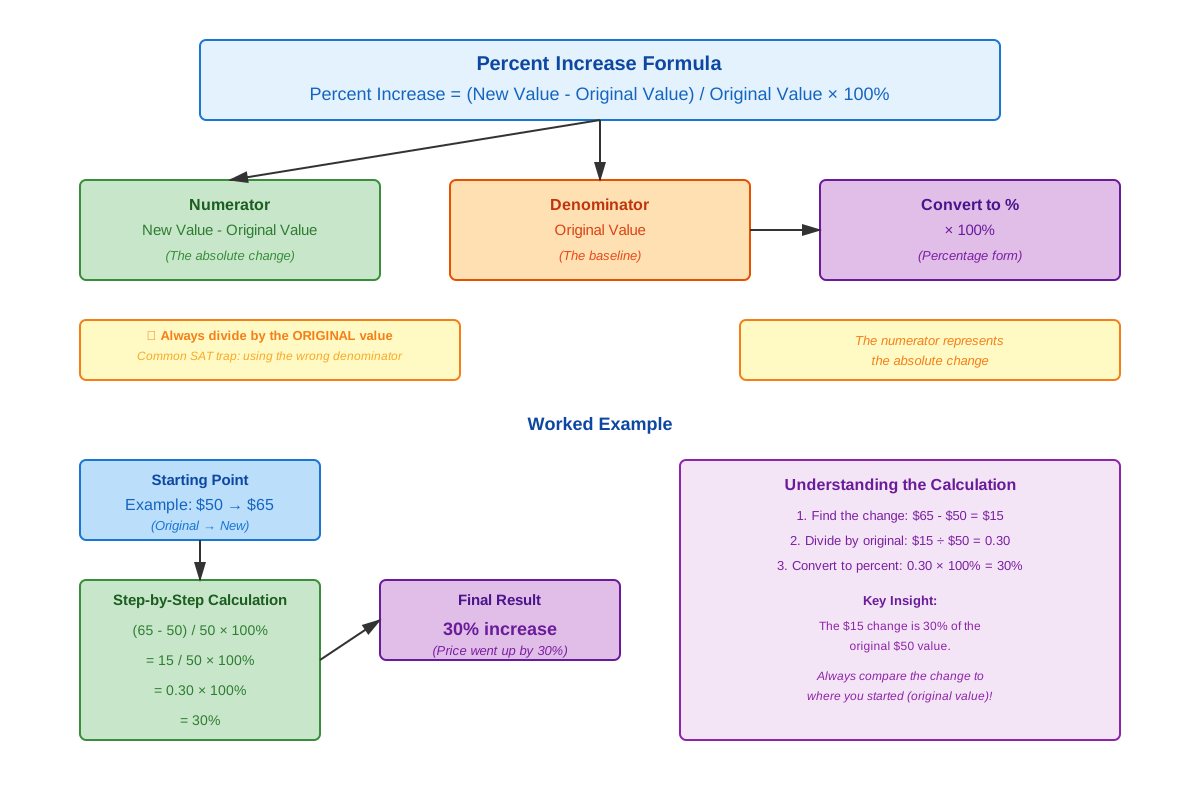
The percent increase formula represents the cornerstone of this topic. Percent increase measures how much a quantity has grown relative to its original value, expressed as a percentage. The standard formula is:
Percent Increase = (New Value - Original Value) / Original Value × 100%This formula can also be written as:
Percent Increase = (Amount of Change) / Original Value × 100%The numerator (New Value - Original Value) represents the absolute increase—the actual amount by which the quantity grew. The denominator (Original Value) provides the reference point for comparison. Dividing these values creates a ratio that, when multiplied by 100, converts to a percentage. Understanding each component of this formula prevents common calculation errors and enables students to solve variations of percent increase problems.
Calculating Percent Increase Step-by-Step
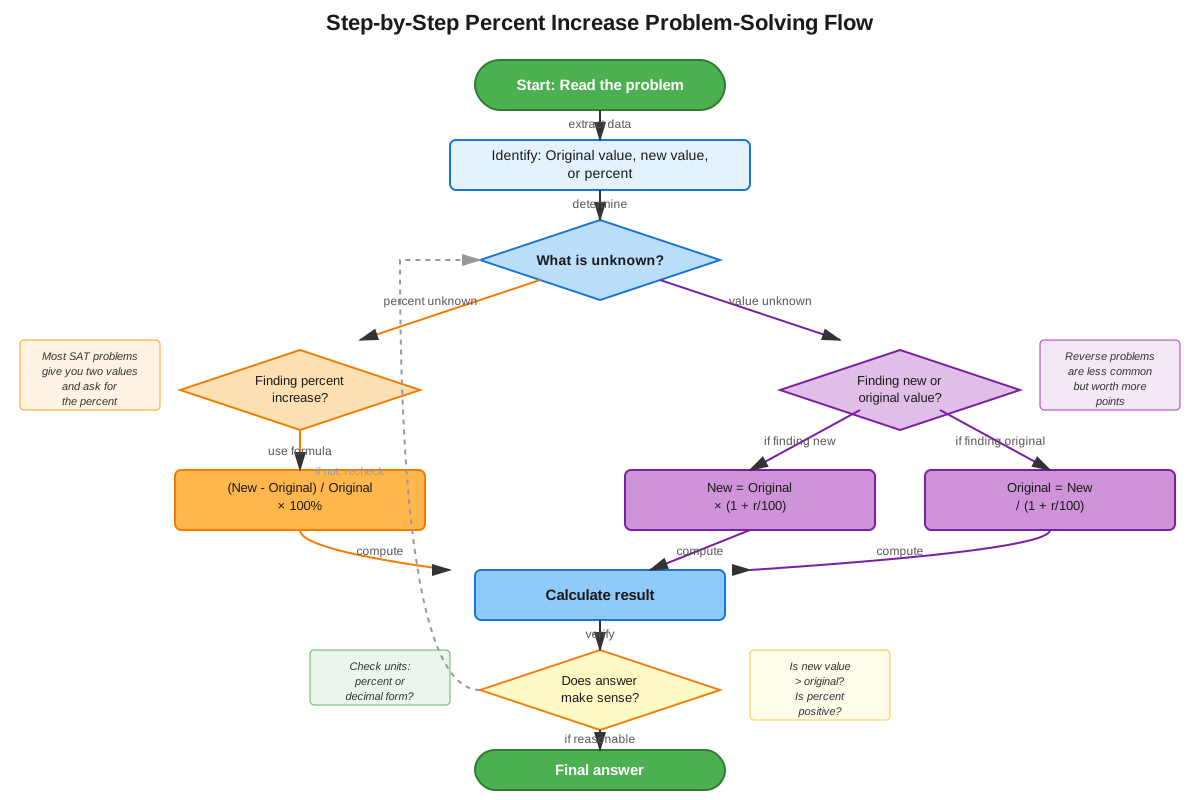
When approaching any percent increase problem, follow this systematic process:
- Identify the original value (the starting amount, initial price, or baseline measurement)
- Identify the new value (the ending amount, final price, or increased measurement)
- Calculate the absolute change by subtracting: New Value - Original Value
- Divide the absolute change by the original value to find the decimal increase
- Multiply by 100 to convert the decimal to a percentage
- Include the percent symbol and round appropriately if necessary
For example, if a stock price increases from $40 to $52:
- Original Value = $40
- New Value = $52
- Absolute Change = $52 - $40 = $12
- Decimal Increase = $12 ÷ $40 = 0.30
- Percent Increase = 0.30 × 100% = 30%
Alternative Formula: Finding New Value
When the percent increase and original value are known, students need to calculate the new value. This requires rearranging the formula:
New Value = Original Value × (1 + Percent Increase as decimal)The expression (1 + Percent Increase) represents the growth factor or multiplier. The "1" represents the original 100% of the value, and the percent increase (converted to decimal form) represents the additional growth. For instance, a 25% increase means multiplying by 1.25, because the new value equals 100% of the original plus an additional 25%.
This formula streamlines calculations and reduces errors. If a $60 item increases by 15%:
- Growth Factor = 1 + 0.15 = 1.15
- New Value = $60 × 1.15 = $69
Reverse Percent Increase Problems
Reverse percent increase problems provide the final value and percent increase, requiring students to find the original value. This problem type frequently appears on the SAT and challenges many students. The formula becomes:
Original Value = New Value / (1 + Percent Increase as decimal)For example, if a price after a 20% increase is $96, the original price was:
- Growth Factor = 1 + 0.20 = 1.20
- Original Value = $96 ÷ 1.20 = $80
This can be verified: $80 × 1.20 = $96 ✓
Percent Increase vs. Absolute Increase
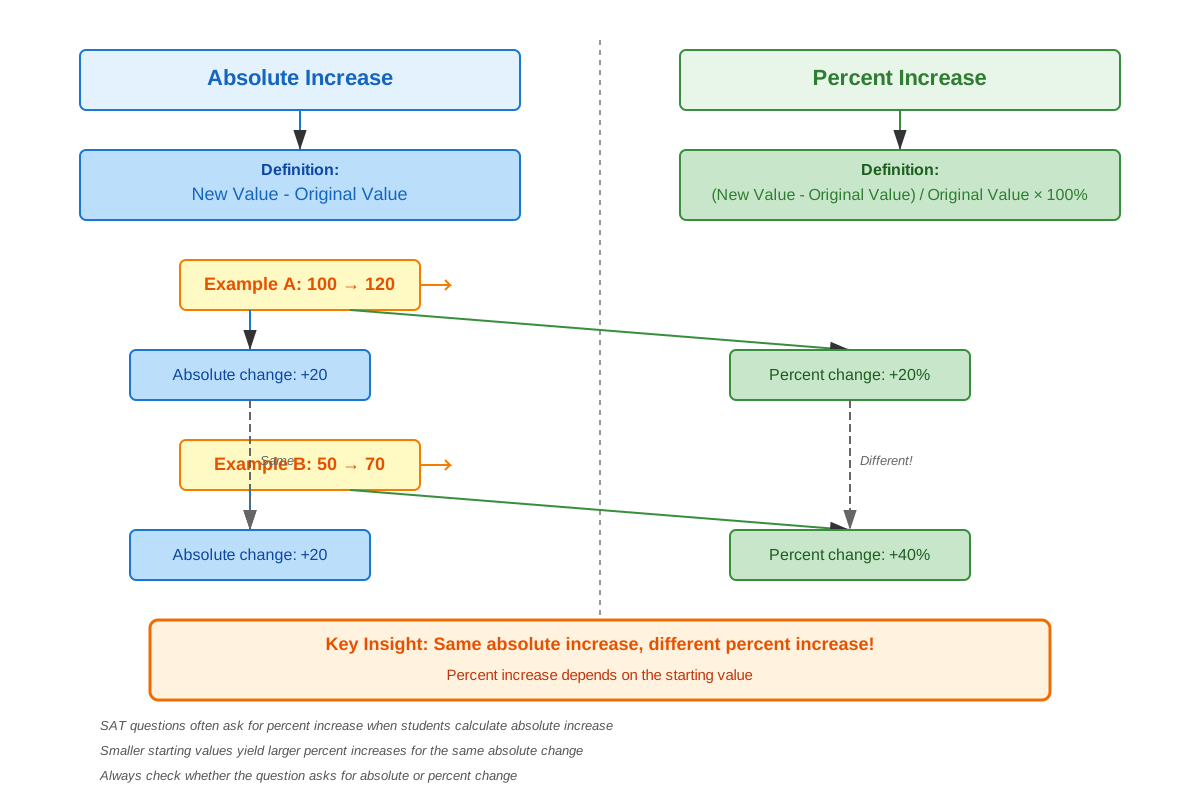
A critical distinction that appears frequently on the SAT is the difference between percent increase and absolute increase. The absolute increase is simply the numerical difference between two values, while percent increase expresses that difference relative to the original value.
| Concept | Definition | Formula | Example (20 to 25) |
|---|---|---|---|
| Absolute Increase | The actual amount of change | New - Original | 25 - 20 = 5 |
| Percent Increase | The relative change as a percentage | (Change/Original) × 100% | (5/20) × 100% = 25% |
Two quantities can have the same absolute increase but different percent increases if their original values differ. For instance, increasing from 20 to 25 (absolute increase of 5) represents a 25% increase, while increasing from 100 to 105 (same absolute increase of 5) represents only a 5% increase. The SAT frequently tests whether students understand this distinction through comparison questions.
Sequential Percent Increases
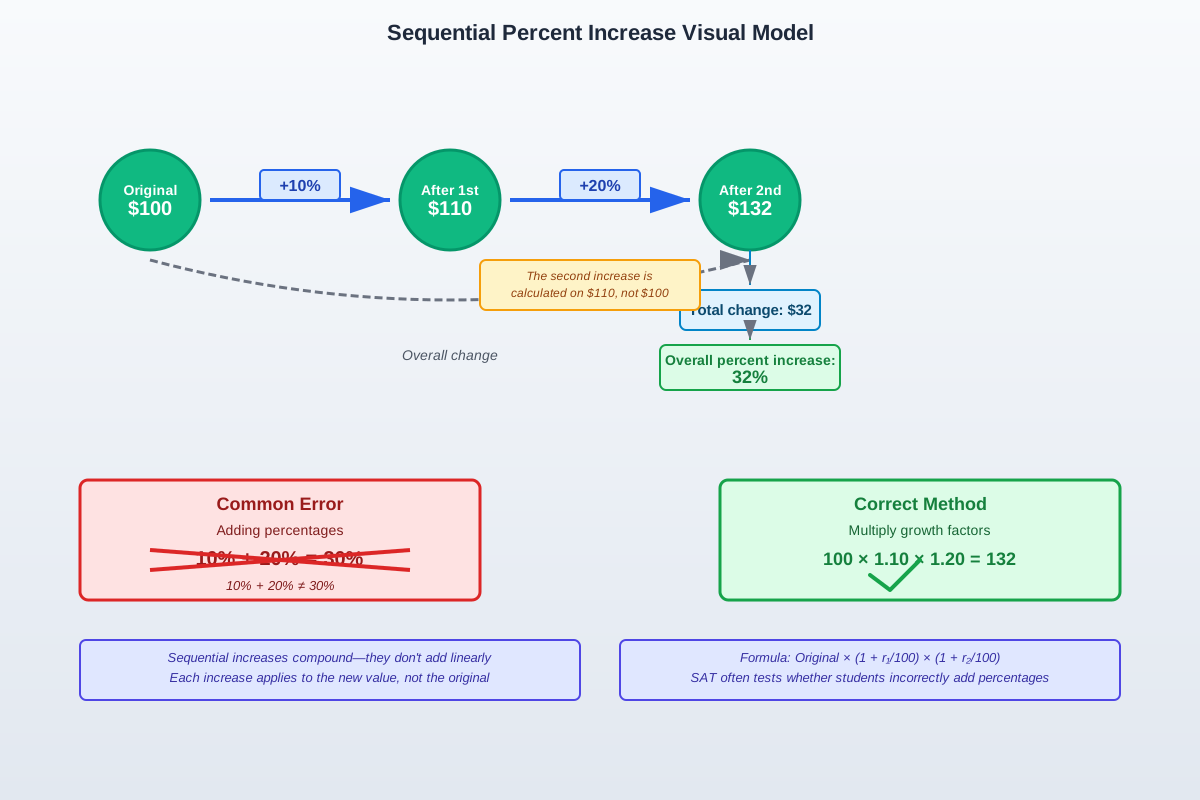
When multiple percent increases occur consecutively, students cannot simply add the percentages. Instead, each increase must be calculated based on the value after the previous increase. This concept appears in compound interest problems, multi-year growth scenarios, and sequential price changes.
For two consecutive increases of r₁% and r₂%:
Final Value = Original Value × (1 + r₁) × (1 + r₂)For example, if a population increases by 10% one year and 20% the next year:
- After first increase: Original × 1.10
- After second increase: (Original × 1.10) × 1.20 = Original × 1.32
- Total percent increase = 32% (not 30%)
Percent Increase in Algebraic Contexts
The SAT often embeds percent increase within algebraic expressions and equations. Students must translate word problems into mathematical expressions using variables. If a quantity x increases by p%, the new value can be expressed as:
x + (p/100)x = x(1 + p/100)This algebraic representation enables solving complex problems where multiple unknowns exist. For instance, "If a number increased by 30% equals 91, what is the original number?" translates to:
x(1.30) = 91
x = 91/1.30 = 70
Concept Relationships
The concepts within percent increase form a hierarchical structure where understanding the fundamental formula enables mastery of all variations. The fundamental percent increase formula serves as the foundation → which leads to → calculating new values using growth factors → which enables → solving reverse percent increase problems. Additionally, understanding absolute vs. percent increase prevents conceptual errors → which supports → correctly interpreting sequential percent increases.
Percent increase connects directly to prerequisite topics: basic percentages provide the foundational understanding of parts per hundred; fraction and decimal conversions enable flexible calculation methods; algebraic manipulation allows solving for unknown variables in percent increase equations. Moving forward, percent increase knowledge extends to related topics: percent decrease uses parallel logic with subtraction instead of addition; compound interest applies sequential percent increases over time; exponential growth functions model continuous percent increase mathematically.
The relationship between percent increase and ratios is particularly important—percent increase essentially compares the change to the original value as a ratio, then scales it to a base of 100. This connection helps students recognize percent increase scenarios in problems that initially appear to involve only ratios or proportions.
High-Yield Facts
⭐ The percent increase formula is: (New Value - Original Value) / Original Value × 100%
⭐ To find a new value after a percent increase, multiply the original value by (1 + percent increase as decimal)
⭐ Percent increase always uses the ORIGINAL value as the denominator, never the new value
⭐ Sequential percent increases cannot be added; they must be multiplied as growth factors
⭐ A 100% increase means the value doubled (multiplied by 2)
- A 50% increase means multiplying by 1.5, not adding 50 to the original value
- Percent increase can exceed 100% when the new value is more than double the original
- The absolute increase equals the original value multiplied by the percent increase (as a decimal)
- Reverse percent increase problems require dividing by the growth factor, not multiplying
- Converting percent increase to decimal form requires dividing by 100 (e.g., 25% = 0.25)
- Two different quantities with the same absolute increase will have different percent increases unless their original values are equal
- Percent increase problems often hide the original value in phrases like "before the increase" or "initially"
- The SAT frequently tests percent increase in contexts involving money, population, and measurements
- When a value increases by x% then decreases by x%, the final value is NOT equal to the original value
- Percent increase is always calculated relative to the starting point, making the order of operations critical in multi-step problems
Quick check — test yourself on Percent increase so far.
Try Flashcards →Common Misconceptions
Misconception: Percent increase and absolute increase are the same thing.
Correction: Absolute increase is the numerical difference between values (New - Original), while percent increase expresses that difference as a percentage of the original value. A $10 increase on a $50 item (20% increase) is very different from a $10 increase on a $200 item (5% increase), even though the absolute increase is identical.
Misconception: To find a value after a 30% increase, add 30 to the original value.
Correction: Percent increase requires multiplying by a growth factor, not adding the percentage number. A 30% increase means multiplying by 1.30 (or 1.3). For a $100 item, the new value is $100 × 1.30 = $130, not $100 + $30 = $130 (which coincidentally gives the same answer but uses incorrect reasoning that fails with other values).
Misconception: Sequential percent increases can be added together to find the total percent increase.
Correction: Each percent increase applies to the value after the previous increase, not the original value. A 10% increase followed by a 20% increase results in a 32% total increase (1.10 × 1.20 = 1.32), not a 30% increase. The growth factors multiply, not add.
Misconception: The denominator in the percent increase formula can be either the original or new value.
Correction: The denominator must ALWAYS be the original value. Using the new value as the denominator calculates a different quantity (related to percent decrease from the new value back to the original). This is one of the most common errors on the SAT.
Misconception: A 100% increase means the value stays the same.
Correction: A 100% increase means the value doubles. The growth factor is 1 + 1.00 = 2.00. If something costs $50 and increases by 100%, the new price is $50 × 2 = $100. A 0% increase means the value stays the same.
Misconception: If a value increases by 50% then decreases by 50%, it returns to the original value.
Correction: These percentages apply to different base values. If a $100 item increases by 50% to $150, then decreases by 50%, the decrease is 50% of $150 (which is $75), resulting in a final value of $75, not the original $100. The asymmetry occurs because the decrease applies to a larger base value.
Worked Examples
Example 1: Standard Percent Increase Calculation
Problem: A store's monthly revenue increased from $45,000 in January to $54,000 in February. What was the percent increase in revenue?
Solution:
Step 1: Identify the values
- Original Value (January) = $45,000
- New Value (February) = $54,000
Step 2: Calculate the absolute increase
- Absolute Increase = $54,000 - $45,000 = $9,000
Step 3: Apply the percent increase formula
- Percent Increase = (Absolute Increase / Original Value) × 100%
- Percent Increase = ($9,000 / $45,000) × 100%
Step 4: Simplify the fraction
- $9,000 / $45,000 = 9/45 = 1/5 = 0.20
Step 5: Convert to percentage
- 0.20 × 100% = 20%
Answer: The revenue increased by 20%.
Connection to Learning Objectives: This example demonstrates identifying key features of percent increase (original and new values) and applying the fundamental formula to answer an SAT-style question involving real-world context.
Example 2: Reverse Percent Increase Problem
Problem: After a 35% increase, the population of a town is 16,200 residents. What was the population before the increase?
Solution:
Step 1: Identify what is known
- New Value (after increase) = 16,200
- Percent Increase = 35%
- Original Value = unknown (what we're solving for)
Step 2: Determine the growth factor
- Growth Factor = 1 + 0.35 = 1.35
Step 3: Set up the equation
- Original Value × 1.35 = 16,200
Step 4: Solve for the original value
- Original Value = 16,200 ÷ 1.35
- Original Value = 12,000
Step 5: Verify the answer
- Check: 12,000 × 1.35 = 16,200 ✓
Answer: The original population was 12,000 residents.
Alternative Method (using the formula directly):
- Original Value = New Value / (1 + Percent Increase as decimal)
- Original Value = 16,200 / 1.35 = 12,000
Connection to Learning Objectives: This example shows how to solve reverse percent increase problems, a high-yield SAT question type that requires algebraic manipulation and understanding of the growth factor concept.
Example 3: Sequential Percent Increases
Problem: A stock price increases by 20% in the first quarter and then increases by 15% in the second quarter. If the stock started at $80, what is the price after both increases, and what is the total percent increase over the two quarters?
Solution:
Step 1: Calculate the price after the first increase
- First Growth Factor = 1 + 0.20 = 1.20
- Price after Q1 = $80 × 1.20 = $96
Step 2: Calculate the price after the second increase
- Second Growth Factor = 1 + 0.15 = 1.15
- Price after Q2 = $96 × 1.15 = $110.40
Step 3: Calculate the total percent increase
- Method A (using the final price):
- Total Increase = $110.40 - $80 = $30.40
- Percent Increase = ($30.40 / $80) × 100% = 38%
- Method B (using combined growth factor):
- Combined Growth Factor = 1.20 × 1.15 = 1.38
- This means 38% increase (since 1.38 = 1 + 0.38)
Answer: The final stock price is $110.40, representing a total increase of 38%.
Key Insight: Notice that 20% + 15% = 35%, but the actual total increase is 38%. The additional 3% comes from the 15% increase applying to the already-increased value of $96 rather than the original $80. Specifically, 15% of the $16 first-quarter gain equals $2.40, which accounts for the difference.
Connection to Learning Objectives: This example demonstrates distinguishing between simple addition of percentages and the correct method for sequential changes, a sophisticated concept that appears on harder SAT questions.
Exam Strategy
When approaching percent increase questions on the SAT, begin by carefully reading the problem to identify which value represents the original (starting, initial, before) amount and which represents the new (final, after, increased) amount. The SAT deliberately uses varied language to describe these values, so watch for trigger phrases like "originally," "initially," "before the change," "at first" (indicating original value) and "after," "increased to," "grew to," "became" (indicating new value).
Immediately determine which type of percent increase problem you're facing:
- Standard calculation: Given both values, find the percent increase
- Forward calculation: Given original value and percent increase, find new value
- Reverse calculation: Given new value and percent increase, find original value
- Sequential changes: Multiple percent increases applied consecutively
For standard calculations, write out the formula explicitly to avoid errors: (New - Original) / Original × 100%. Many students rush this step and accidentally use the new value as the denominator—taking an extra three seconds to write the formula prevents this costly mistake.
For forward calculations, immediately convert the percent to a growth factor by adding 1 to the decimal form. This single-step multiplication (Original × Growth Factor) is faster and more accurate than calculating the increase separately and adding it to the original value.
For reverse calculations, recognize that you must divide by the growth factor, not multiply. Set up the equation: Original × Growth Factor = New Value, then solve for Original by dividing both sides by the growth factor.
Process-of-elimination tips: When answer choices are given, you can often eliminate options by estimating. A 50% increase should result in a value approximately 1.5 times the original—if an answer choice is double or only slightly larger, eliminate it immediately. For percent increase answers, check whether the absolute increase is larger or smaller than the original value: if the absolute increase is less than the original value, the percent increase must be less than 100%.
Time allocation: Standard percent increase problems should take 30-45 seconds once you've identified the problem type. If you're spending more than 90 seconds, you may be overcomplicating the solution—consider whether you're using the most efficient formula. For multi-step problems involving sequential changes, allocate up to 2 minutes, but work systematically through each change rather than trying to find a shortcut.
Calculator usage: On calculator-permitted sections, use your calculator for division and multiplication, but write down intermediate steps to avoid entry errors. When dividing to find percent increase, calculate the decimal first, then multiply by 100 mentally or with the calculator. For reverse problems, store the growth factor in calculator memory to avoid rounding errors.
Memory Techniques
The "NEW over OLD" mnemonic: Remember that percent increase = (NEW - OLD) / OLD × 100%. Visualize climbing stairs where you're moving from the OLD (bottom) to the NEW (top), and you measure progress relative to where you started (OLD). The denominator is always where you started.
The "Growth Factor = 1 + Percent" rule: Visualize 1 as representing "keeping what you have" (100% of the original) and the percent increase as "adding more." A 25% increase means you keep your original 100% and add 25% more, giving 125% total, or 1.25 as a multiplier.
The "Reverse means Divide" reminder: When working backward from a new value to find the original, remember that multiplication and division are inverse operations. If going forward uses multiplication (Original × Growth Factor = New), going backward uses division (New ÷ Growth Factor = Original).
The "Sequential = Multiply" acronym: For sequential percent changes, remember "MULTIPLY the multipliers." Don't add percentages; multiply growth factors. Create the visual of a chain where each link represents a growth factor, and the total chain length is the product of all links.
The "100% = Double" anchor: Memorize that a 100% increase means doubling. This provides a reference point: 50% increase is halfway to doubling (multiply by 1.5), 200% increase is tripling (multiply by 3), etc. This helps with estimation and error-checking.
Finger counting for common percentages: Memorize these common percent increases and their growth factors:
- 10% → 1.1 (one finger)
- 25% → 1.25 (quarter)
- 50% → 1.5 (half)
- 75% → 1.75 (three quarters)
- 100% → 2.0 (double)
Summary
Percent increase measures the relative change in a quantity by comparing the absolute increase to the original value, expressed as a percentage. The fundamental formula—(New Value - Original Value) / Original Value × 100%—serves as the foundation for all percent increase calculations on the SAT. Students must distinguish between three problem types: calculating percent increase from two given values, finding a new value after a specified percent increase using growth factors, and solving reverse problems where the original value must be determined. Critical to success is understanding that the original value always serves as the denominator, that sequential percent increases multiply rather than add, and that percent increase differs fundamentally from absolute increase. The SAT tests this concept through word problems involving money, population, measurements, and data interpretation, often embedding percent increase within multi-step problems or algebraic contexts. Mastery requires recognizing problem types quickly, applying the appropriate formula accurately, and avoiding common misconceptions about how percentages combine and relate to their base values.
Key Takeaways
- The percent increase formula always uses the original value as the denominator: (New - Original) / Original × 100%
- Growth factors streamline calculations: multiply the original value by (1 + percent increase as decimal) to find the new value
- Reverse percent increase problems require dividing the new value by the growth factor to find the original value
- Sequential percent increases multiply as growth factors; a 20% increase followed by a 30% increase equals a 56% total increase (1.20 × 1.30 = 1.56), not 50%
- Percent increase and absolute increase are distinct concepts—the same absolute increase represents different percent increases depending on the original value
- A 100% increase means the value doubles; percent increases can exceed 100% when values more than double
- The SAT frequently tests percent increase in real-world contexts requiring careful identification of original and new values from word problems
Related Topics
Percent Decrease: The complementary concept to percent increase, using subtraction instead of addition in the growth factor. Mastering percent increase provides the foundation for understanding percent decrease, as the formulas and logic are parallel. Students who understand growth factors can easily adapt to decay factors (1 - percent decrease).
Compound Interest: Applies sequential percent increases over multiple time periods, directly building on the concept of multiplying growth factors. Understanding percent increase is essential before tackling compound interest problems, which appear frequently in SAT Problem Solving and Data Analysis questions.
Exponential Growth and Decay Functions: Mathematical models that represent continuous percent increase or decrease over time. The growth factor concept from percent increase translates directly to the base of exponential functions (y = a × b^x, where b is the growth factor).
Percent Change: A broader category that encompasses both percent increase and percent decrease. After mastering percent increase, students can learn to determine whether a change is positive (increase) or negative (decrease) and apply the appropriate formula.
Ratios and Proportions: Percent increase problems often involve proportional reasoning, as the percent increase represents a ratio of the change to the original value. Understanding these connections strengthens problem-solving flexibility.
Practice CTA
Now that you've mastered the concepts, formulas, and strategies for percent increase, it's time to solidify your understanding through practice. Attempt the practice questions to apply what you've learned to SAT-style problems, and use the flashcards to reinforce key formulas and concepts. Remember, percent increase appears on virtually every SAT, making this one of the highest-yield topics for your preparation. Each practice problem you solve builds the pattern recognition and calculation speed that will serve you on test day. You've built a strong foundation—now transform that knowledge into points through deliberate practice!
Sign up free to keep reading
Create a free AnvayaPrep account to finish this SAT guide on Percent increase — plus flashcards and practice questions.