Overview
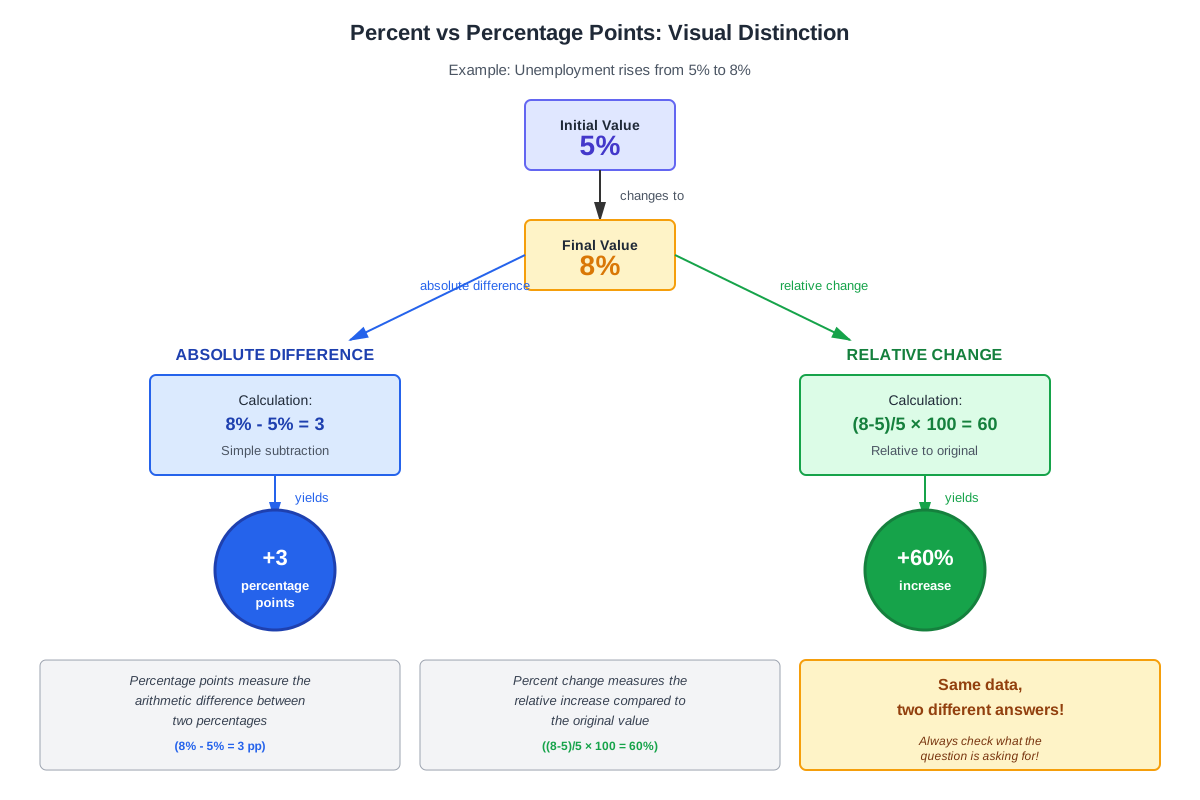
Understanding the distinction between percent and percentage points is a critical skill for SAT Math success, yet it remains one of the most commonly confused concepts among test-takers. While these terms sound similar and both relate to proportional relationships, they represent fundamentally different mathematical operations. A percent describes a ratio or proportion relative to 100, while percentage points measure the absolute arithmetic difference between two percentages. For example, if unemployment rises from 5% to 8%, it has increased by 3 percentage points but has increased by 60% as a relative change. This distinction appears frequently on the SAT, particularly in Problem Solving and Data Analysis questions involving statistics, surveys, and real-world scenarios.
The SAT deliberately tests whether students can distinguish between these concepts because this confusion mirrors real-world misinterpretations of data that appear in news reports, scientific studies, and business contexts. Questions may present data in tables or graphs showing percentage changes over time, or they may describe scenarios where students must calculate either relative percent changes or absolute percentage point differences. Mastering this topic requires not just memorizing definitions but developing the analytical skill to recognize which type of calculation a question demands.
This topic connects directly to broader mathematical concepts including ratios, proportions, and data interpretation. It serves as a foundation for understanding more complex statistical reasoning and is frequently integrated with other SAT topics such as linear functions, scatterplots, and two-way tables. Students who master the percent vs percentage points distinction gain a significant advantage in avoiding trap answers that exploit this common confusion.
Learning Objectives
- [ ] Identify key features of percent vs percentage points and distinguish between the two concepts
- [ ] Explain how percent vs percentage points appears on the SAT in various question formats
- [ ] Apply percent vs percentage points to answer SAT-style questions accurately and efficiently
- [ ] Calculate both relative percent change and absolute percentage point change from given data
- [ ] Recognize trap answers that deliberately confuse percent with percentage points
- [ ] Interpret real-world scenarios and data presentations to determine which measure is appropriate
Prerequisites
- Basic percentage calculations: Understanding how to convert between decimals, fractions, and percentages is essential for calculating both types of changes
- Arithmetic operations with decimals: Students must be comfortable with subtraction and division of decimal values to compute percentage differences
- Ratio and proportion concepts: The foundation of percent change relies on understanding proportional relationships between quantities
- Reading and interpreting data tables: Many SAT questions present percentage data in tabular format requiring accurate data extraction
Why This Topic Matters
In real-world applications, the distinction between percent and percentage points has profound implications. When a news report states that interest rates increased from 2% to 3%, understanding that this represents both a 1 percentage point increase and a 50% relative increase is crucial for financial literacy. Medical studies reporting that a treatment reduces risk from 4% to 3% might emphasize the 25% relative reduction or the 1 percentage point absolute reduction—each framing tells a different story. Politicians, marketers, and researchers often strategically choose which measure to report based on which sounds more impressive, making this skill essential for informed citizenship.
On the SAT, percent vs percentage points questions appear with high frequency, particularly in the Problem Solving and Data Analysis domain, which comprises approximately 29% of the Math section. These questions typically appear 1-3 times per test and often carry medium to high difficulty ratings. The College Board specifically includes these questions to assess quantitative literacy—the ability to reason with numerical information in context. Students who miss these questions typically fall into predictable traps, making this a high-yield topic for score improvement.
Common SAT presentations include: survey results showing approval ratings over time, economic data displaying unemployment or inflation rates, scientific experiments reporting success rates for different treatments, and demographic statistics showing population changes. Questions may ask students to identify which statement correctly describes the data, calculate a specific change, or determine which conclusion is supported by the evidence. The ability to quickly distinguish between the two types of changes is essential for both accuracy and time management.
Core Concepts
Understanding Percent (Relative Change)
Percent expresses a ratio or proportion as a fraction of 100. When discussing changes, percent refers to the relative change—how much something has changed compared to its original value. The formula for percent change is:
Percent Change = (New Value - Original Value) / Original Value × 100%This calculation answers the question: "By what proportion has the value changed relative to where it started?" For example, if a stock price increases from $50 to $75, the percent change is (75 - 50) / 50 × 100% = 50%. The stock increased by half of its original value.
The key characteristic of percent change is that it's relative to the starting point. A $25 increase means something very different for a $50 stock (50% increase) versus a $1,000 stock (2.5% increase). This relative nature makes percent change ideal for comparing changes across different scales or magnitudes.
Understanding Percentage Points (Absolute Change)
Percentage points measure the absolute arithmetic difference between two percentages. This is simply subtraction: the new percentage minus the old percentage. When a value expressed as a percentage changes, the percentage point change tells us the raw numerical difference between the two percentages.
Percentage Point Change = New Percentage - Original PercentageFor example, if voter turnout increases from 45% to 52%, the change is 52% - 45% = 7 percentage points. This calculation answers the question: "What is the arithmetic difference between these two percentages?" Notice that we don't divide by anything—we simply subtract.
Percentage points are particularly useful when comparing changes in rates, proportions, or any values already expressed as percentages. They provide an absolute measure that doesn't depend on the starting value, making them ideal for certain types of comparisons.
The Critical Distinction
The confusion between these concepts arises because both involve percentages, but they measure fundamentally different things. Consider this example:
| Scenario | Original Value | New Value | Percentage Point Change | Percent Change |
|---|---|---|---|---|
| Interest Rate | 2% | 5% | 3 percentage points | 150% |
| Test Score | 60% | 75% | 15 percentage points | 25% |
| Unemployment | 8% | 6% | -2 percentage points | -25% |
Notice that the percentage point change is always the simple difference between the two percentages, while the percent change can be dramatically different because it's calculated relative to the original value.
When to Use Each Measure
Use percentage points when:
- Comparing two values that are already expressed as percentages
- Describing the absolute difference in rates, proportions, or percentages
- The context emphasizes the raw numerical change in the percentage itself
- Example: "The approval rating increased from 42% to 51%, a gain of 9 percentage points"
Use percent change when:
- Describing how much a quantity has grown or shrunk relative to its original value
- Comparing proportional changes across different scales
- The context emphasizes relative growth or decline
- Example: "Sales increased from 200 units to 250 units, a 25% increase"
SAT-Specific Applications
On the SAT, questions testing this distinction often present data in context and ask students to identify which statement correctly describes the change. The test may provide a table showing survey results over multiple years, then offer answer choices that mix percentage point changes with percent changes. Recognizing the difference requires careful attention to whether the data values are already percentages (suggesting percentage point calculations) or raw numbers (suggesting percent change calculations).
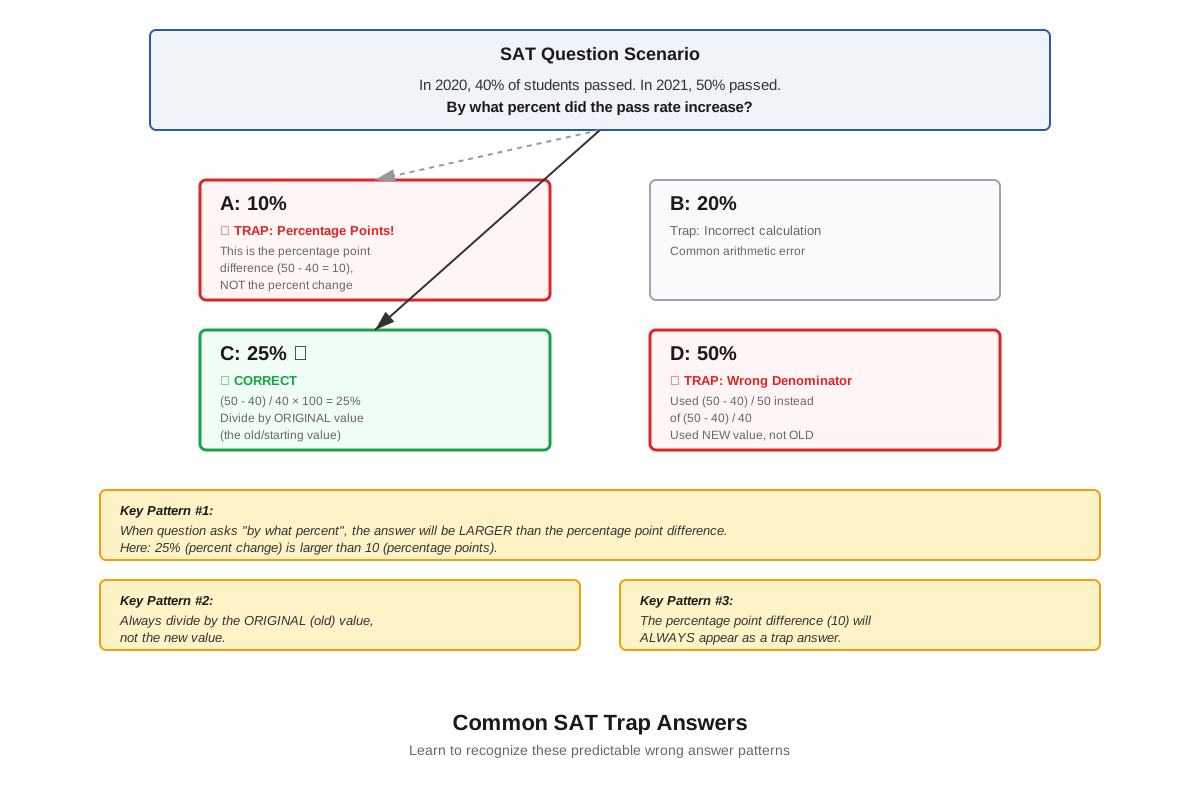
Another common SAT approach involves providing a scenario and asking students to calculate a specific value. For instance: "In 2010, 35% of students participated in sports. In 2020, 42% participated. By what percent did participation increase?" The trap answer would be 7% (the percentage point difference), while the correct answer requires calculating (42 - 35) / 35 × 100% = 20%.
Concept Relationships
The relationship between percent and percentage points forms a hierarchical structure where understanding basic percentages → enables calculation of percent change → which must be distinguished from → percentage point change. Both concepts share the common foundation of proportional reasoning but diverge in their application.
Percent change connects directly to ratio and proportion concepts because it expresses change as a fraction of the original value. This links to topics like growth rates, compound interest, and exponential functions. When students understand that a 50% increase means multiplying by 1.5, they're applying proportional reasoning.
Percentage point change connects more directly to arithmetic operations and absolute differences. It relates to topics involving data interpretation, statistics, and linear functions. When analyzing scatterplots or line graphs showing percentages over time, the slope represents percentage point change per unit time, not percent change.
The two concepts intersect when analyzing the same data from different perspectives. Given unemployment data, students might need to calculate both measures to fully understand the situation. This dual analysis appears in SAT questions that ask "which statement is supported by the data?" where multiple answer choices present different valid interpretations using different measures.
Understanding this topic also enables progression to more advanced concepts like margin of error in statistics, confidence intervals, and rate of change in calculus. The fundamental skill of distinguishing between relative and absolute measures of change extends far beyond the SAT into college-level quantitative reasoning.
High-Yield Facts
⭐ Percentage point change is always the simple subtraction of two percentages: New % - Old %
⭐ Percent change requires division by the original value: (New - Old) / Old × 100%
⭐ When both values are already percentages, the question likely asks for percentage point change
⭐ A small percentage point change can represent a large percent change if the original percentage is small
⭐ The SAT frequently includes trap answers that confuse these two measures
- Percentage points can never exceed 100 in absolute value when dealing with percentages (since percentages range from 0% to 100%)
- Percent change can exceed 100% (e.g., doubling represents a 100% increase)
- The phrase "increased by X percentage points" always indicates absolute difference, not relative change
- The phrase "increased by X percent" always indicates relative change, not absolute difference
- When comparing changes across different starting values, percent change provides better comparison than percentage points
- Negative percentage point changes indicate decreases in the percentage value
- A change from 1% to 2% is both a 1 percentage point increase AND a 100% increase
Quick check — test yourself on Percent vs percentage points so far.
Try Flashcards →Common Misconceptions
Misconception: When a value changes from 20% to 30%, it increased by 10%.
Correction: The change is 10 percentage points, but the percent increase is 50% because (30-20)/20 × 100% = 50%. The "10" alone is ambiguous without specifying the unit.
Misconception: Percentage points and percent are interchangeable terms.
Correction: These are distinct mathematical concepts. Percentage points measure absolute differences between percentages, while percent measures relative change. Using them interchangeably leads to incorrect calculations and misinterpretation of data.
Misconception: If unemployment drops from 8% to 6%, it decreased by 2%.
Correction: It decreased by 2 percentage points. The percent decrease is (8-6)/8 × 100% = 25%. Saying "decreased by 2%" is technically incorrect without specifying "percentage points."
Misconception: A larger percentage point change always represents a more significant change than a smaller one.
Correction: Context matters. A 5 percentage point increase from 2% to 7% (250% increase) may be more significant than a 10 percentage point increase from 50% to 60% (20% increase), depending on what's being measured.
Misconception: When data is presented as percentages in a table, any calculation involving those values should use percent change formulas.
Correction: When comparing two percentages from a table, the direct subtraction gives percentage point change. Percent change would only apply if you're calculating how much the percentage itself changed relative to its original value.
Misconception: The answer choices on the SAT will clearly indicate whether they're expressing percentage points or percent.
Correction: The SAT deliberately creates ambiguity to test understanding. Answer choices might say "increased by 15" without units, requiring students to determine from context whether this means 15 percentage points or 15 percent.
Worked Examples
Example 1: Survey Data Analysis
Problem: A survey found that in 2015, 24% of teenagers used a particular social media platform. By 2020, this figure had risen to 36%. A news article reported this change. Which statement correctly describes the change?
A) Usage increased by 12%
B) Usage increased by 12 percentage points
C) Usage increased by 50%
D) Both B and C are correct
Solution:
Step 1: Identify what type of values we're working with. Both 24% and 36% are already expressed as percentages, so we're comparing two percentages.
Step 2: Calculate the percentage point change (absolute difference):
36% - 24% = 12 percentage points
Step 3: Calculate the percent change (relative change):
(36 - 24) / 24 × 100% = 12/24 × 100% = 0.5 × 100% = 50%
Step 4: Evaluate each answer choice:
- Choice A says "increased by 12%" which is incorrect—this confuses percentage points with percent
- Choice B correctly identifies the 12 percentage point increase
- Choice C correctly identifies the 50% relative increase
- Choice D recognizes that both B and C are mathematically correct descriptions
Answer: D
This problem demonstrates how the same data can be correctly described using either measure, but each tells a different story. The 12 percentage point increase emphasizes the absolute change in the rate, while the 50% increase emphasizes how dramatically usage grew relative to the starting point.
Example 2: Economic Data Interpretation
Problem: The unemployment rate in a city was 5.0% in January and 5.5% in February. The mayor claimed that unemployment "increased by 10%." Is this claim accurate?
Solution:
Step 1: Identify what changed. The unemployment rate (already a percentage) changed from 5.0% to 5.5%.
Step 2: Calculate the percentage point change:
5.5% - 5.0% = 0.5 percentage points
Step 3: Calculate the percent change:
(5.5 - 5.0) / 5.0 × 100% = 0.5/5.0 × 100% = 0.1 × 100% = 10%
Step 4: Evaluate the mayor's claim. The mayor said unemployment "increased by 10%." This is technically accurate—the unemployment rate itself increased by 10% relative to its January value. However, this phrasing could be misleading because many people might interpret "10%" as meaning the rate went from 5% to 15%, which would be a 10 percentage point increase.
Answer: The claim is mathematically accurate but potentially misleading. The unemployment rate increased by 0.5 percentage points, which represents a 10% relative increase in the rate itself. Clear communication would specify "increased by 10 percent" or "increased by 0.5 percentage points."
This example illustrates why the SAT tests this distinction—it's not just about calculation but about interpreting claims and recognizing when language might obscure the true magnitude of change.
Exam Strategy
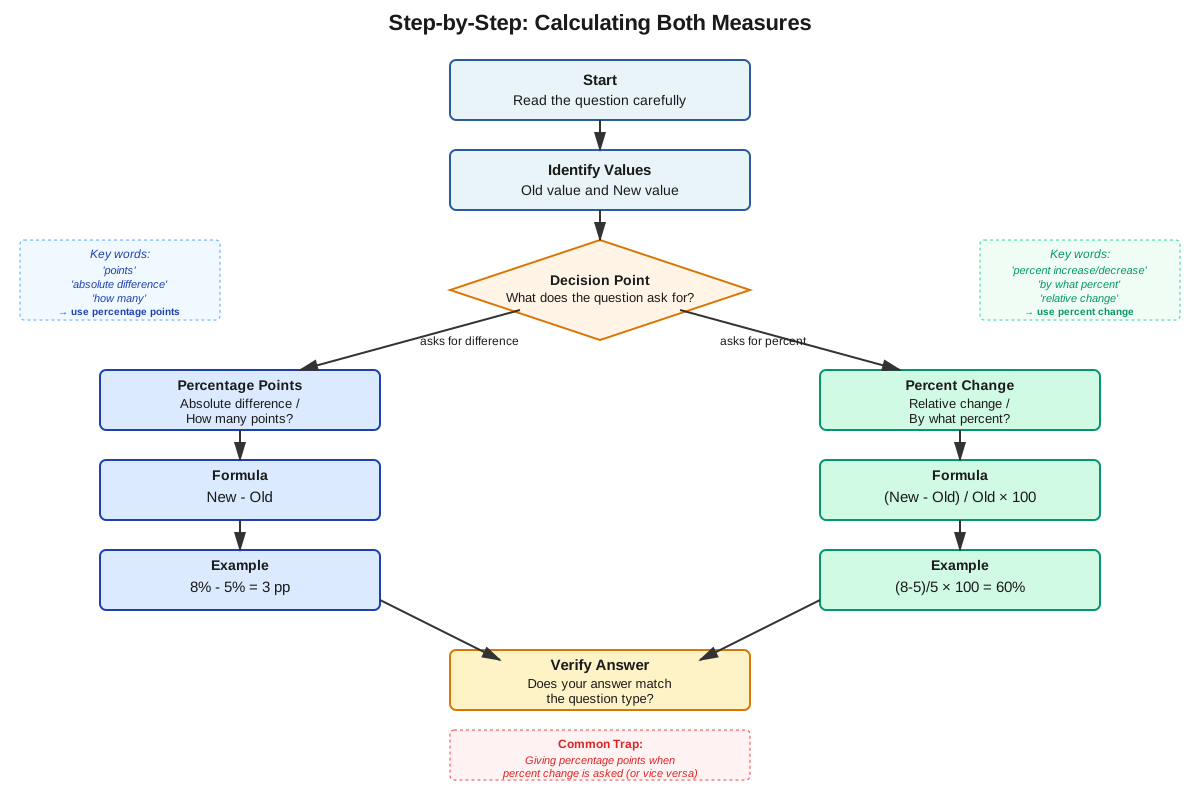
When approaching SAT questions on percent vs percentage points, follow this systematic process:
Step 1: Identify the data type. Are the values in the problem already expressed as percentages, or are they raw numbers? If both values are percentages (like 45% and 52%), you're likely dealing with percentage point changes. If they're raw numbers (like 200 and 250), you're calculating percent change.
Trigger words to watch for:
- "Percentage points" or "points" → Use subtraction only
- "Percent increase/decrease" → Use the percent change formula
- "By what percent" → Calculate relative change
- "How many percentage points" → Calculate absolute difference
Process of elimination tips:
- Calculate both the percentage point change and the percent change before looking at answer choices
- Eliminate any answer that confuses the two measures
- Watch for trap answers that present the percentage point change without units, making it look like a percent change
- If an answer seems too small or too large, verify which measure it represents
Time allocation: These questions typically require 60-90 seconds. Spend 20 seconds identifying what's being asked, 30 seconds calculating both measures if needed, and 20 seconds verifying your answer against the choices. Don't rush the identification phase—misunderstanding the question type is the most common error.
Common trap patterns:
- Answer choices that include both the percentage point change and percent change, with one labeled incorrectly
- Questions that ask for one measure but include the other as a trap answer
- Scenarios where the percentage point change and percent change are numerically similar, testing whether you can distinguish them conceptually
Red flags in answer choices:
- When you see your calculated number appear in multiple answer choices with different units or labels
- When answer choices differ by factors of 10 or 100 (suggesting unit confusion)
- When the question context emphasizes "rate" or "percentage" changes (signaling percentage point focus)
Memory Techniques
Mnemonic for Percentage Points: "Percentage Points = Plain Plus/minus" (just add or subtract the percentages directly)
Mnemonic for Percent Change: "Relative Requires Ratio" (percent change is relative, requiring division to create a ratio)
Visualization Strategy: Picture percentage points as steps on a ladder. Moving from 30% to 45% means climbing 15 steps (15 percentage points). Percent change asks: "How much higher am I relative to where I started?" If you started at step 30 and climbed 15 steps, you climbed 15/30 = 50% of your starting height.
The "Already Percent?" Rule: Create a mental checkpoint: "Are the numbers already percentages?" If YES → think percentage points first. If NO → think percent change first.
Acronym for checking work: CUPS
- Calculate both measures
- Units matter (percentage points vs percent)
- Problem context determines which to use
- Subtraction alone = percentage points
Summary
The distinction between percent and percentage points is fundamental to quantitative literacy and appears frequently on the SAT Math section. Percent (or percent change) measures relative change—how much something has changed compared to its original value, calculated using the formula (New - Old) / Old × 100%. Percentage points measure absolute change—the arithmetic difference between two percentages, calculated by simple subtraction. The same data can yield dramatically different numbers depending on which measure is used: a change from 2% to 5% represents both a 3 percentage point increase and a 150% increase. SAT questions exploit this distinction by presenting data in tables or scenarios and asking students to identify correct interpretations or calculate specific values. Success requires recognizing whether values are already percentages (suggesting percentage point calculations) or raw numbers (suggesting percent change calculations), understanding the conceptual difference between relative and absolute measures, and carefully reading what the question asks for. This topic connects to broader mathematical concepts including ratios, proportions, and data interpretation, making it essential not just for test success but for informed citizenship in a data-driven world.
Key Takeaways
- Percentage point change = simple subtraction of two percentages; percent change = relative change requiring division by the original value
- When both values are already percentages, the question typically involves percentage point changes
- The same data can be correctly described using either measure, but each tells a different story about the magnitude of change
- SAT trap answers frequently confuse these measures; always calculate both and verify which the question asks for
- Small percentage point changes can represent large percent changes when the original percentage is small (e.g., 1% to 2% is 1 percentage point but 100% increase)
- Clear communication requires specifying units: "increased by 5 percentage points" vs "increased by 5 percent"
- This distinction appears 1-3 times per SAT and is a high-yield topic for score improvement
Related Topics
Percent Increase and Decrease: Building on the percent change concept, this topic explores sequential percentage changes and why they don't simply add (e.g., a 20% increase followed by a 20% decrease doesn't return to the original value). Mastering percent vs percentage points provides the foundation for understanding these more complex scenarios.
Ratios and Proportions: The underlying mathematics of percent change relies on proportional reasoning. Deeper study of ratios helps students understand why percent change is calculated as a fraction of the original value.
Data Interpretation and Statistics: Many SAT questions combine percentage point changes with data presented in tables, graphs, or scatterplots. Advanced study involves analyzing trends, calculating rates of change, and drawing conclusions from statistical data.
Exponential Growth and Decay: Percent change connects directly to exponential functions, where repeated percentage changes compound over time. Understanding the distinction between percentage points and percent is essential for modeling real-world growth scenarios.
Practice CTA
Now that you've mastered the distinction between percent and percentage points, it's time to cement your understanding through practice. The concepts you've learned here appear regularly on the SAT, and each practice question you complete builds the pattern recognition and calculation speed you need for test day success. Challenge yourself with the practice questions designed specifically for this topic—they'll expose you to the exact types of traps and scenarios the SAT uses. Don't just answer the questions; analyze why wrong answers are tempting and how the test writers exploit common misconceptions. Your ability to quickly distinguish between these measures and avoid trap answers will directly translate to points on test day. Start practicing now, and watch this high-yield topic become one of your strengths!
Sign up free to keep reading
Create a free AnvayaPrep account to finish this SAT guide on Percent vs percentage points — plus flashcards and practice questions.