Overview
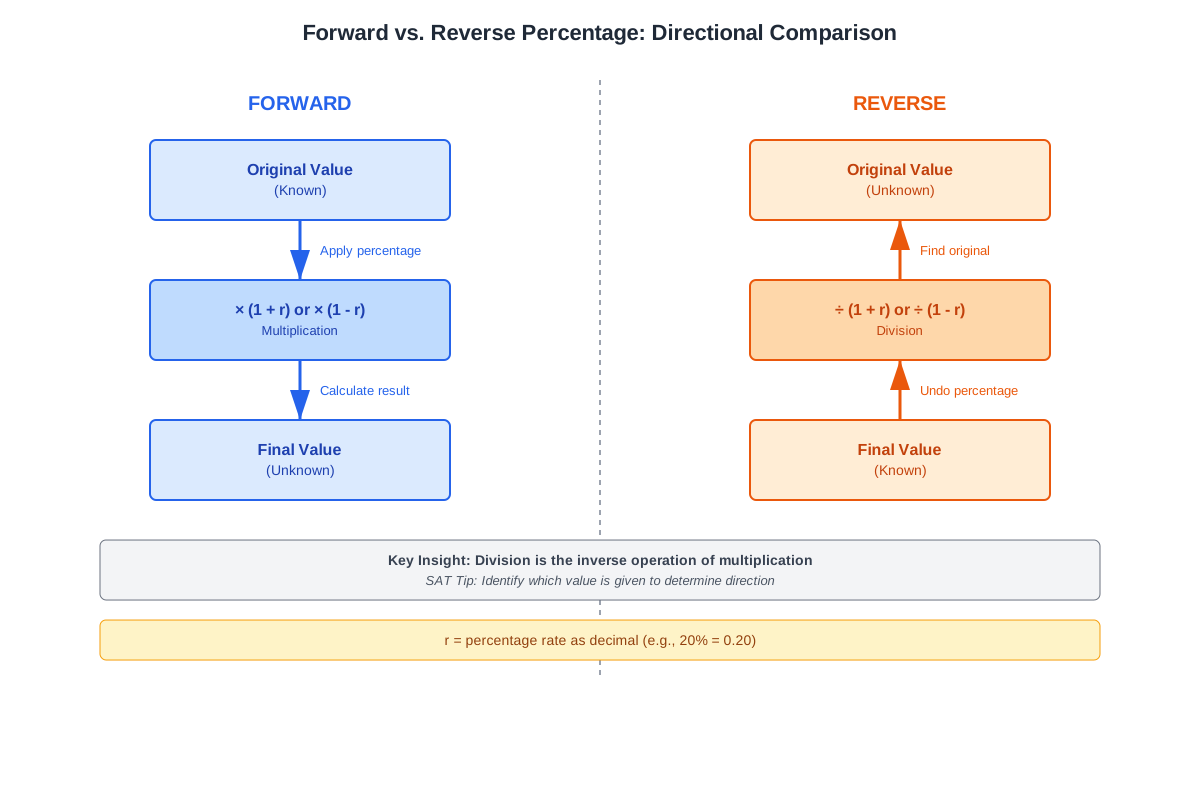
Reverse percentage problems represent a critical skill tested on the SAT that requires students to work backward from a final value to determine an original amount before a percentage change occurred. Unlike standard percentage problems where students calculate the result of applying a percentage increase or decrease, reverse percentage questions provide the outcome and ask students to find the starting value. This type of problem challenges students to think algebraically and understand the multiplicative relationship between percentages and their base values.
Mastery of reverse percentage is essential for SAT success because these questions appear regularly in both the calculator and no-calculator sections of the math portion. The College Board frequently embeds reverse percentage concepts within word problems involving discounts, markups, tax calculations, population changes, and financial scenarios. Students who can quickly identify and solve reverse percentage problems gain a significant advantage, as these questions often appear as medium-to-hard difficulty items that separate average scorers from high achievers.
The concept of reverse percentage connects fundamentally to algebraic thinking, equation solving, and proportional reasoning—all cornerstone skills in SAT Math. Understanding reverse percentage deepens comprehension of how percentages function as operators rather than static values, reinforces the relationship between multiplication and division as inverse operations, and builds the foundation for more complex topics like exponential growth, compound interest, and multi-step percentage problems that frequently appear on the exam.
Learning Objectives
- [ ] Identify key features of reverse percentage problems in SAT questions
- [ ] Explain how reverse percentage appears on the SAT across different question formats
- [ ] Apply reverse percentage techniques to answer SAT-style questions accurately and efficiently
- [ ] Construct algebraic equations to represent reverse percentage scenarios
- [ ] Distinguish between forward percentage calculations and reverse percentage problems
- [ ] Solve multi-step problems that combine reverse percentage with other mathematical operations
- [ ] Verify reverse percentage solutions using forward calculation checks
Prerequisites
- Basic percentage concepts: Understanding that percentages represent parts per hundred is fundamental to recognizing what "reverse" means in this context
- Decimal and fraction conversion: Converting between percentages, decimals, and fractions enables flexible problem-solving approaches
- Linear equation solving: Reverse percentage problems require setting up and solving equations with one variable
- Order of operations: Correctly applying mathematical operations in sequence ensures accurate calculations
- Proportional reasoning: Understanding ratios and proportions underlies the multiplicative relationships in percentage problems
Why This Topic Matters
Reverse percentage problems appear in everyday financial decisions that students will encounter throughout their lives. Calculating the original price before a discount, determining pre-tax amounts, finding initial investment values, and understanding salary changes before percentage-based raises all require reverse percentage thinking. These real-world applications make this topic particularly relevant for practical numeracy beyond test-taking.
On the SAT, reverse percentage questions appear approximately 2-4 times per test administration, representing roughly 3-7% of the total math questions. These problems most commonly appear as word problems in the Problem Solving and Data Analysis domain, though they can also surface in Heart of Algebra questions. The College Board particularly favors scenarios involving retail discounts, sales tax, population statistics, and financial calculations. Questions may appear in multiple-choice format, grid-in format, or as part of multi-step problems worth multiple points.
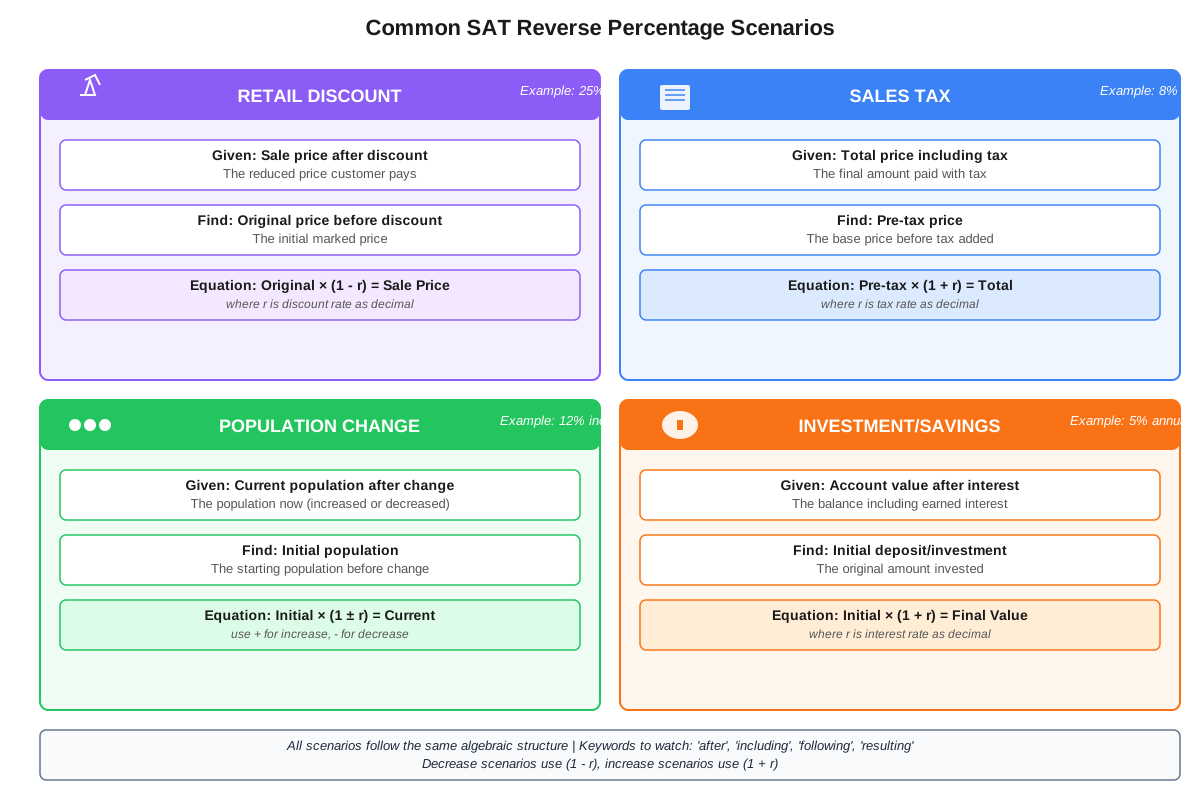
The SAT presents reverse percentage in several characteristic ways: "After a 20% discount, the price is $80. What was the original price?"; "A population decreased by 15% to 3,400. What was the original population?"; "Including 8% sales tax, the total cost is $54. What was the pre-tax price?" These formulations test whether students can recognize that they must work backward from a given result to find an unknown starting value.
Core Concepts
Understanding Reverse Percentage
Reverse percentage (also called sat reverse percentage in test prep contexts) refers to the mathematical process of determining an original value when given only the final value after a percentage increase or decrease has been applied. The key insight is that the final value represents a specific percentage of the original value, and this relationship can be expressed algebraically.
When a value increases by a percentage, the final value equals the original value multiplied by (1 + percentage as a decimal). When a value decreases by a percentage, the final value equals the original value multiplied by (1 - percentage as a decimal). In reverse percentage problems, students know the final value and must solve for the original value.
The Fundamental Formula
The core formula for reverse percentage problems can be expressed as:
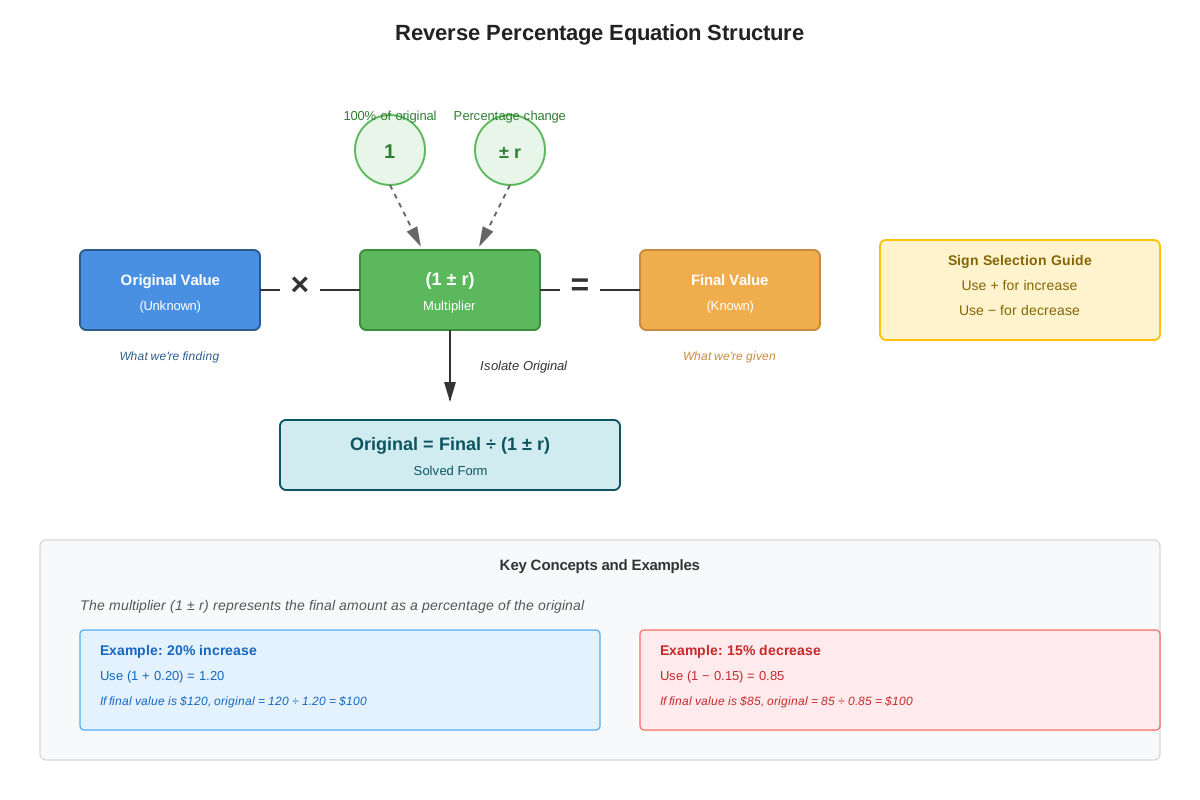
Original Value = Final Value ÷ (1 ± percentage as decimal)For percentage increases, use the plus sign; for percentage decreases, use the minus sign. This formula derives from the algebraic relationship:
Final Value = Original Value × (1 ± percentage as decimal)Dividing both sides by (1 ± percentage as decimal) isolates the original value on the right side.
The Multiplier Method
The multiplier method provides an efficient approach to reverse percentage calculations. Every percentage change corresponds to a multiplier:
| Percentage Change | Multiplier | Calculation |
|---|---|---|
| Increase by 20% | 1.20 | Original × 1.20 = Final |
| Decrease by 20% | 0.80 | Original × 0.80 = Final |
| Increase by 5% | 1.05 | Original × 1.05 = Final |
| Decrease by 15% | 0.85 | Original × 0.85 = Final |
| Increase by 100% | 2.00 | Original × 2.00 = Final |
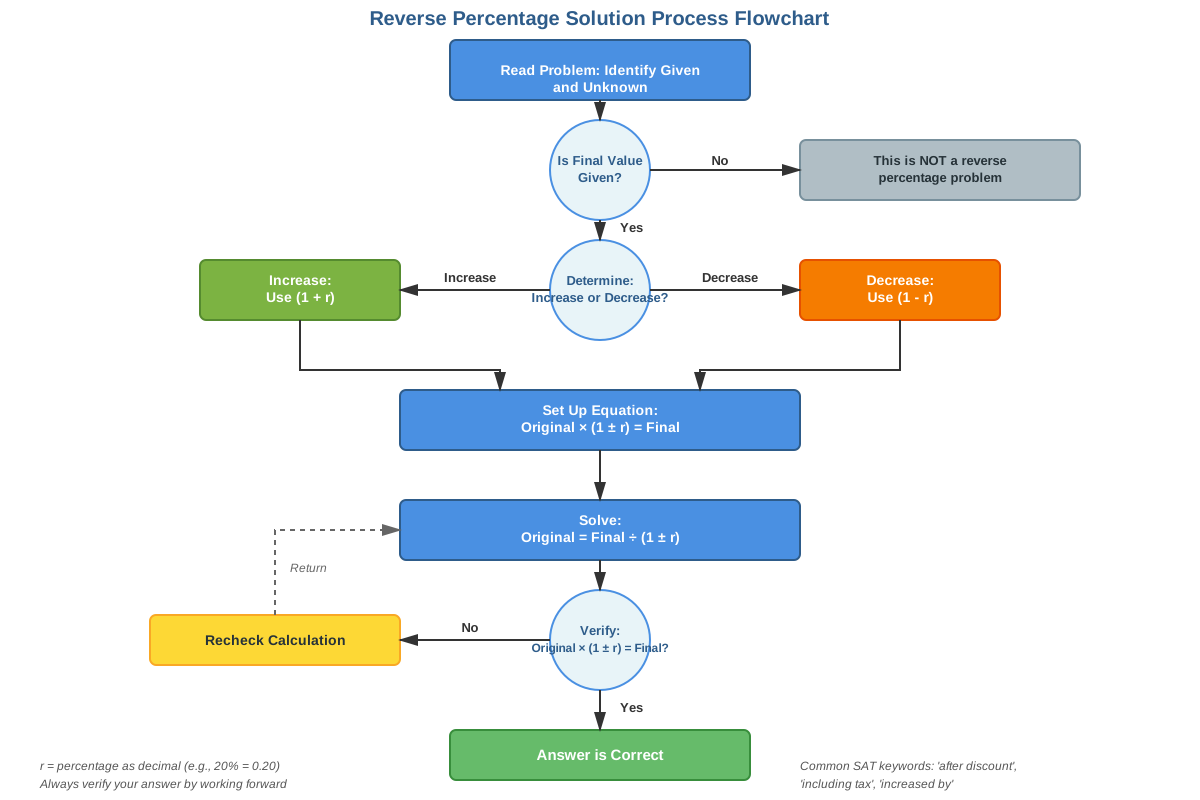
To solve reverse percentage problems using multipliers:
- Identify whether the change is an increase or decrease
- Calculate the multiplier (1 + decimal for increase, 1 - decimal for decrease)
- Divide the final value by the multiplier to find the original value
Setting Up Equations
For algebraic thinkers, reverse percentage problems can be solved by setting up equations. Let x represent the original value. The equation structure follows this pattern:
For increases: x × (1 + rate) = final value
For decreases: x × (1 - rate) = final value
Then solve for x by dividing both sides by the multiplier. This method makes the mathematical relationship explicit and helps students understand why the division operation reverses the percentage change.
Common Percentage Scenarios
Discount problems: When an item is discounted by p%, the sale price represents (100 - p)% of the original price. If the sale price is known, divide by (1 - p as decimal) to find the original price.
Tax problems: When sales tax of t% is added, the total price represents (100 + t)% of the pre-tax price. Divide the total by (1 + t as decimal) to find the pre-tax amount.
Growth and decay: Population, investment, or quantity changes follow the same pattern. After a p% increase, the new amount is (100 + p)% of the original. After a p% decrease, the new amount is (100 - p)% of the original.
Verification Strategy
After solving a reverse percentage problem, students should verify their answer by applying the percentage change forward. If the original value is correct, applying the stated percentage increase or decrease should yield the given final value. This check catches calculation errors and confirms understanding.
Concept Relationships
The concepts within reverse percentage form a logical progression: understanding the multiplier method → leads to → recognizing the algebraic equation structure → leads to → efficiently solving for original values → leads to → verifying solutions through forward calculation.
Reverse percentage connects directly to prerequisite knowledge of basic percentages by inverting the standard calculation process. Where basic percentage problems ask "What is 20% of 50?", reverse percentage asks "50 is 20% of what number?" This inversion requires understanding percentages as multiplicative relationships rather than simple arithmetic operations.
The topic also connects to equation solving from algebra, as every reverse percentage problem can be expressed as a linear equation with one unknown. Students apply inverse operations (division to undo multiplication) to isolate the variable, reinforcing algebraic thinking.
Looking forward, reverse percentage serves as foundation for compound interest problems, exponential growth and decay, and multi-step percentage problems where students must work both forward and backward through a sequence of percentage changes. Mastery of reverse percentage enables students to tackle these more complex scenarios with confidence.
Quick check — test yourself on Reverse percentage so far.
Try Flashcards →High-Yield Facts
- ⭐ To find the original value after a percentage increase, divide the final value by (1 + percentage as decimal)
- ⭐ To find the original value after a percentage decrease, divide the final value by (1 - percentage as decimal)
- ⭐ A 20% discount means the sale price is 80% of the original price (100% - 20% = 80%)
- ⭐ Including 8% sales tax means the total is 108% of the pre-tax price (100% + 8% = 108%)
- ⭐ Always verify reverse percentage answers by applying the percentage change forward to check if you get the given final value
- The multiplier for a p% increase is always (1 + p/100)
- The multiplier for a p% decrease is always (1 - p/100)
- Reverse percentage problems always provide the final value and ask for the original value
- A 50% increase means the final value is 1.5 times the original (multiplier = 1.50)
- A 25% decrease means the final value is 0.75 times the original (multiplier = 0.75)
- Converting percentages to decimals before calculating prevents common arithmetic errors
- The phrase "after a discount" or "after an increase" signals a reverse percentage problem
- Original value × multiplier = final value, so original value = final value ÷ multiplier
- Reverse percentage requires exactly one division operation once the multiplier is identified
Common Misconceptions
Misconception: To reverse a 20% discount, simply add 20% to the sale price. → Correction: Adding 20% of the sale price does not return to the original because you're calculating 20% of a smaller number. Instead, divide the sale price by 0.80 (since the sale price represents 80% of the original).
Misconception: A 25% increase followed by a 25% decrease returns to the original value. → Correction: These percentage changes apply to different base values. If you start with 100, increase by 25% to get 125, then decrease 125 by 25%, you get 93.75, not 100. Percentage changes are not simply additive.
Misconception: To find the original price before 15% tax, subtract 15% from the total. → Correction: The total represents 115% of the original, not 100% plus a separate 15%. Divide the total by 1.15 to find the pre-tax amount.
Misconception: Reverse percentage problems can be solved by subtracting the percentage from 100 and using that as the answer. → Correction: The calculation requires division by a multiplier, not simple subtraction. The relationship is multiplicative, not additive.
Misconception: The multiplier for a 30% decrease is 0.30. → Correction: The multiplier for a 30% decrease is 0.70 (which is 1 - 0.30). The value 0.30 represents the amount of decrease, not the remaining portion.
Misconception: Reverse percentage problems are the same as finding what percentage one number is of another. → Correction: These are distinct problem types. Reverse percentage finds an unknown original value given a final value and a percentage change. Finding what percentage one number is of another involves dividing two known values.
Worked Examples
Example 1: Discount Problem
Problem: A jacket is on sale for $68 after a 15% discount. What was the original price of the jacket?
Solution:
Step 1: Identify the problem type. The final value ($68) is given after a percentage decrease (15% discount). This is a reverse percentage problem.
Step 2: Determine the multiplier. A 15% discount means the sale price is 85% of the original price (100% - 15% = 85%). Convert to decimal: 0.85.
Step 3: Set up the relationship. Let x = original price. Then: x × 0.85 = 68
Step 4: Solve for x by dividing both sides by 0.85:
x = 68 ÷ 0.85 = 80Step 5: Verify the answer. Check: $80 × 0.85 = $68 ✓
Answer: The original price was $80.
Connection to learning objectives: This example demonstrates identifying key features (discount scenario), applying the reverse percentage technique (dividing by the multiplier), and verifying the solution.
Example 2: Tax Problem with Grid-In Format
Problem: The total cost of a meal including 8% sales tax is $37.80. What was the cost of the meal before tax? (Grid-in answer)
Solution:
Step 1: Recognize this as a reverse percentage problem. The total ($37.80) includes an 8% increase from the pre-tax amount.
Step 2: Calculate the multiplier. Including 8% tax means the total is 108% of the pre-tax cost (100% + 8% = 108%). As a decimal: 1.08.
Step 3: Set up the equation. Let x = pre-tax cost. Then: x × 1.08 = 37.80
Step 4: Solve for x:
x = 37.80 ÷ 1.08 = 35Step 5: Verify. Check: $35 × 1.08 = $37.80 ✓
Answer: 35 (grid in as 35 or 35.0 or 35.00)
Connection to learning objectives: This example shows how reverse percentage appears in different SAT formats (grid-in), demonstrates the construction of algebraic equations, and applies the technique to a common real-world scenario (sales tax).
Exam Strategy
When approaching reverse percentage questions on the SAT, first identify trigger phrases that signal this problem type: "after a discount," "including tax," "decreased to," "increased to," "the new population is," or "the sale price is." These phrases indicate that the given value is a result, not a starting point.
Immediately determine whether the percentage change is an increase or decrease. This determines whether the multiplier will be greater than 1 (increase) or less than 1 (decrease). Write down the multiplier before attempting calculations to avoid errors.
For multiple-choice questions, use the answer choices strategically. Apply each answer choice forward (multiply by the appropriate multiplier) to see which produces the given final value. This process-of-elimination approach can be faster than algebraic solving and provides built-in verification.
Watch for questions that combine reverse percentage with other operations. The SAT may ask for a value that requires first finding the original amount through reverse percentage, then performing an additional calculation. Read carefully to identify what the question ultimately asks for.
Time allocation for reverse percentage problems should be approximately 60-90 seconds for straightforward single-step problems and up to 2 minutes for multi-step scenarios. If a problem takes longer, mark it for review and move forward to maximize points across the entire test.
Be cautious with percentage values that seem designed to confuse. A "25% off" discount is not the same as "25% of the original price"—the sale price is 75% of the original. Always convert the percentage change into the correct multiplier before calculating.
Memory Techniques
The "Multiplier Flip" mnemonic: Remember "To REVERSE, DIVIDE by the multiplier." The word REVERSE contains the word VERSE, which sounds like "versus"—you're working against the original operation, so you divide instead of multiply.
The 100% Anchor: Visualize the original value as always being 100%. Any increase adds to 100%, any decrease subtracts from 100%. This mental anchor helps construct the correct multiplier: 20% off → 80% remains → 0.80 multiplier.
The "Tax and Discount" acronym TAD:
- Total includes tax → divide by (1 + tax rate)
- After discount → divide by (1 - discount rate)
- Divide, don't subtract
Visualization strategy: Picture a number line where the original value sits at 100%. A percentage increase moves right beyond 100%, a decrease moves left below 100%. The final value's position tells you the multiplier. To get back to 100% (the original), you must divide by that multiplier.
The "Reverse Check" habit: Always multiply your answer by the multiplier to verify you get the given final value. Make this automatic—every reverse percentage solution gets checked forward. This catches 90% of calculation errors.
Summary
Reverse percentage problems require students to work backward from a final value to determine an original amount before a percentage change occurred. The fundamental technique involves dividing the final value by the appropriate multiplier: (1 + percentage as decimal) for increases, (1 - percentage as decimal) for decreases. These problems appear regularly on the SAT in contexts involving discounts, taxes, population changes, and financial scenarios. Success requires recognizing trigger phrases that signal reverse percentage situations, correctly constructing the multiplier, and applying division to isolate the original value. Students should always verify solutions by applying the percentage change forward to confirm the calculation produces the given final value. Mastery of reverse percentage connects to broader algebraic thinking and proportional reasoning skills essential for SAT Math success.
Key Takeaways
- Reverse percentage problems provide a final value and ask for the original value before a percentage change
- The solution method is: Original Value = Final Value ÷ Multiplier
- For increases, the multiplier is (1 + percentage as decimal); for decreases, it's (1 - percentage as decimal)
- Common SAT scenarios include discounts (divide by 1 - rate), taxes (divide by 1 + rate), and population changes
- Always verify answers by multiplying the original value by the multiplier to check if you get the final value
- Trigger phrases like "after a discount," "including tax," and "decreased to" signal reverse percentage problems
- Converting percentages to decimals before calculating prevents arithmetic errors and clarifies the mathematical relationship
Related Topics
Compound percentage changes: After mastering single reverse percentage problems, students can tackle scenarios involving multiple sequential percentage changes, requiring them to work backward through several steps. This builds on reverse percentage by applying the technique iteratively.
Exponential growth and decay: These topics extend percentage change concepts to repeated applications over time, using formulas like A = P(1 + r)^t. Understanding reverse percentage provides the foundation for solving for initial values (P) when given final amounts (A).
Percent error and percent difference: These related concepts involve comparing values using percentages but focus on the relationship between two quantities rather than finding an unknown original value. Mastering reverse percentage strengthens the proportional reasoning needed for these calculations.
Markup and markdown chains: Retail and business problems often involve multiple percentage changes (wholesale to retail markup, then customer discount). Reverse percentage skills enable students to work backward through these chains to find original wholesale costs.
Practice CTA
Now that you've mastered the core concepts of reverse percentage, it's time to solidify your understanding through practice. Attempt the practice questions designed specifically for this topic, focusing on identifying problem types quickly and applying the multiplier method efficiently. Use the flashcards to reinforce the key formulas and trigger phrases that signal reverse percentage problems on the SAT. Remember, reverse percentage questions often separate good scores from great scores—your investment in practicing this skill will pay dividends on test day. Approach each practice problem methodically, verify your answers using forward calculation, and track which scenarios (discounts, taxes, population changes) you find most challenging so you can target your review effectively.
Sign up free to keep reading
Create a free AnvayaPrep account to finish this SAT guide on Reverse percentage — plus flashcards and practice questions.