Overview
Adding polynomials is a fundamental algebraic skill that appears consistently throughout the SAT math section, forming the foundation for more complex polynomial operations and algebraic manipulations. This topic involves combining polynomial expressions by grouping and simplifying like terms—a process that requires careful attention to coefficients, variables, and exponents. Mastery of polynomial addition enables students to tackle a wide range of SAT questions, from straightforward simplification problems to multi-step word problems involving algebraic modeling.
The SAT frequently tests polynomial addition both as a standalone skill and as an intermediate step within larger problems. Students encounter these questions in both the calculator and no-calculator sections, often embedded within questions about functions, systems of equations, or real-world applications. Understanding how to efficiently add polynomials reduces computational errors and saves valuable time during the exam, making this a high-yield topic for score improvement.
Beyond its direct application, adding polynomials connects to virtually every algebraic concept tested on the SAT. It serves as the building block for polynomial subtraction, multiplication, and division, while also appearing in factoring problems, quadratic equations, and function operations. Students who develop fluency in polynomial addition gain confidence in manipulating algebraic expressions generally, which translates to improved performance across multiple content domains within the SAT math section.
Learning Objectives
- [ ] Identify key features of adding polynomials, including like terms, coefficients, and degree
- [ ] Explain how adding polynomials appears on the SAT in various question formats
- [ ] Apply adding polynomials to answer SAT-style questions accurately and efficiently
- [ ] Recognize and correctly combine like terms in polynomial expressions with multiple variables
- [ ] Simplify complex polynomial addition problems involving parentheses and distribution
- [ ] Determine the degree and leading coefficient of a polynomial sum without fully expanding
- [ ] Solve real-world SAT problems that require polynomial addition as part of the solution process
Prerequisites
- Basic algebraic terminology: Understanding terms like variable, coefficient, constant, and exponent is essential for identifying components of polynomials
- Order of operations (PEMDAS): Necessary for correctly simplifying expressions and handling parentheses during polynomial addition
- Combining like terms: The core skill underlying polynomial addition, requiring recognition of identical variable parts
- Integer operations: Adding and subtracting positive and negative numbers accurately ensures correct coefficient calculations
- Exponent rules: Understanding that variables must have identical exponents to be combined prevents common errors
Why This Topic Matters
In real-world applications, polynomial addition models countless scenarios involving rates of change, financial projections, and physical phenomena. Engineers use polynomial expressions to represent forces and stresses; economists employ them in cost and revenue functions; scientists apply them to model population growth and chemical reactions. The ability to combine these expressions accurately is fundamental to problem-solving across STEM fields and quantitative disciplines.
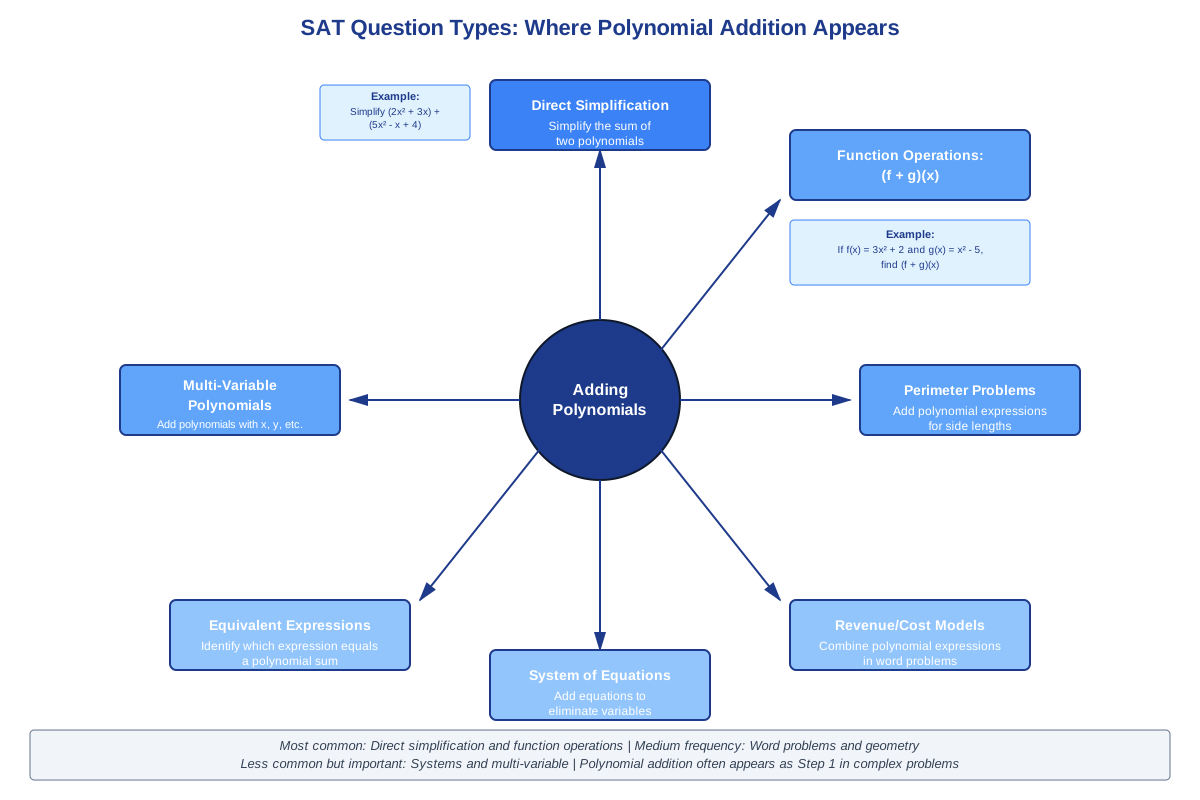
On the SAT, polynomial addition appears in approximately 8-12% of math questions, making it a high-frequency topic that directly impacts scores. Questions range from straightforward "simplify the sum" problems worth one point to complex multi-step problems where polynomial addition is one of several required skills. The College Board tests this concept through direct algebraic manipulation questions, word problems requiring algebraic modeling, and questions about function operations where students must add polynomial functions.
Common SAT question formats include: presenting two polynomial expressions and asking for their sum in simplified form; providing a word problem where students must write and add polynomial expressions representing different quantities; asking students to identify coefficients or terms in a polynomial sum; and embedding polynomial addition within larger problems involving systems of equations, quadratic functions, or geometric formulas. The topic also appears in grid-in questions where students must calculate specific numerical values from polynomial sums.
Core Concepts
Definition and Structure of Polynomials
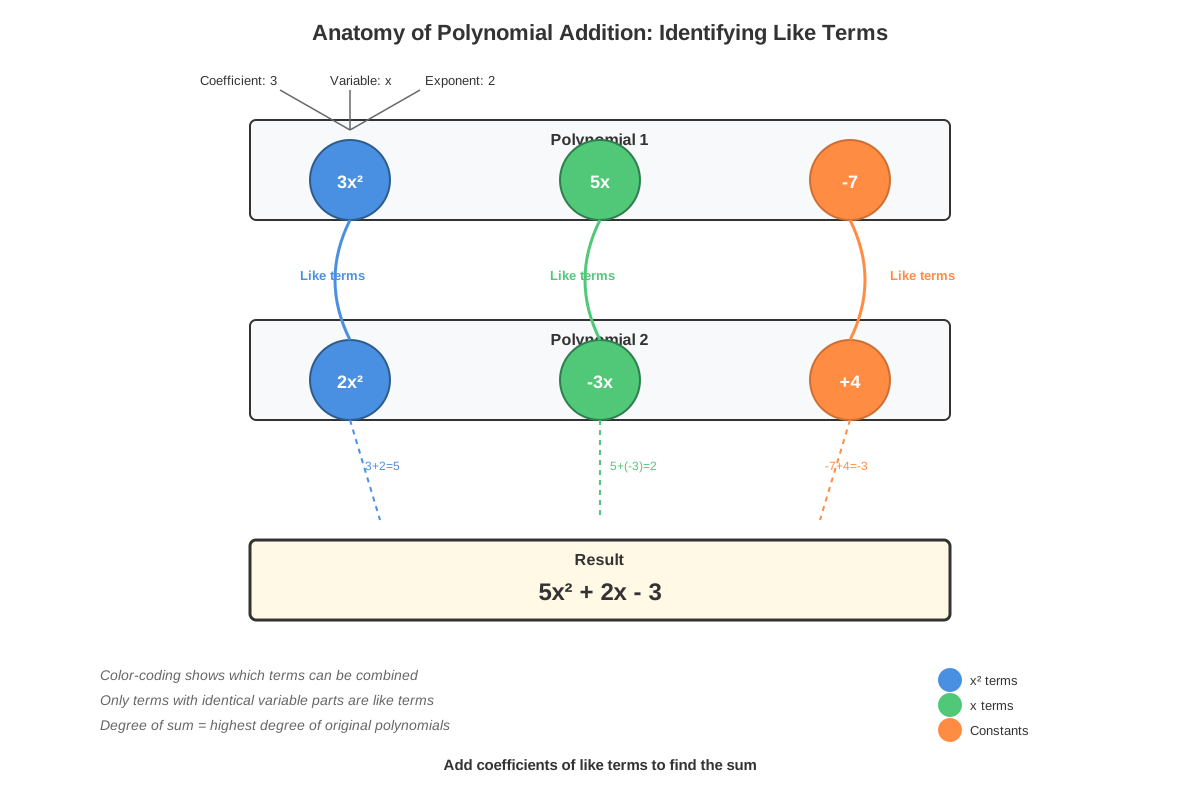
A polynomial is an algebraic expression consisting of variables and coefficients combined using addition, subtraction, and multiplication, where variables have only non-negative integer exponents. Each component separated by addition or subtraction is called a term. For example, in the polynomial 3x² + 5x - 7, there are three terms: 3x², 5x, and -7. The coefficient is the numerical factor of each term (3, 5, and -7 respectively), while the degree of a term is the sum of the exponents of its variables. The degree of the polynomial is the highest degree among all its terms.
Understanding polynomial structure is crucial for SAT adding polynomials questions because the SAT often tests whether students can identify specific components after addition. A polynomial in standard form arranges terms in descending order of degree, which helps prevent errors during addition and makes the final answer match the expected format on the exam.
Like Terms and the Foundation of Polynomial Addition
Like terms are terms that have identical variable parts, including the same variables raised to the same powers. Only like terms can be combined through addition. For instance, 4x² and 7x² are like terms because both contain x², but 4x² and 7x are not like terms because the variable parts differ. This principle extends to polynomials with multiple variables: 3xy² and -5xy² are like terms, while 3xy² and 3x²y are not.
The process of adding polynomials fundamentally involves identifying and combining like terms while leaving unlike terms unchanged. This requires systematic organization and careful attention to detail—skills the SAT specifically assesses. When adding (2x² + 3x - 5) + (4x² - x + 7), students must recognize that 2x² and 4x² are like terms (sum: 6x²), 3x and -x are like terms (sum: 2x), and -5 and 7 are like terms (sum: 2), yielding the final answer 6x² + 2x + 2.
Step-by-Step Process for Adding Polynomials
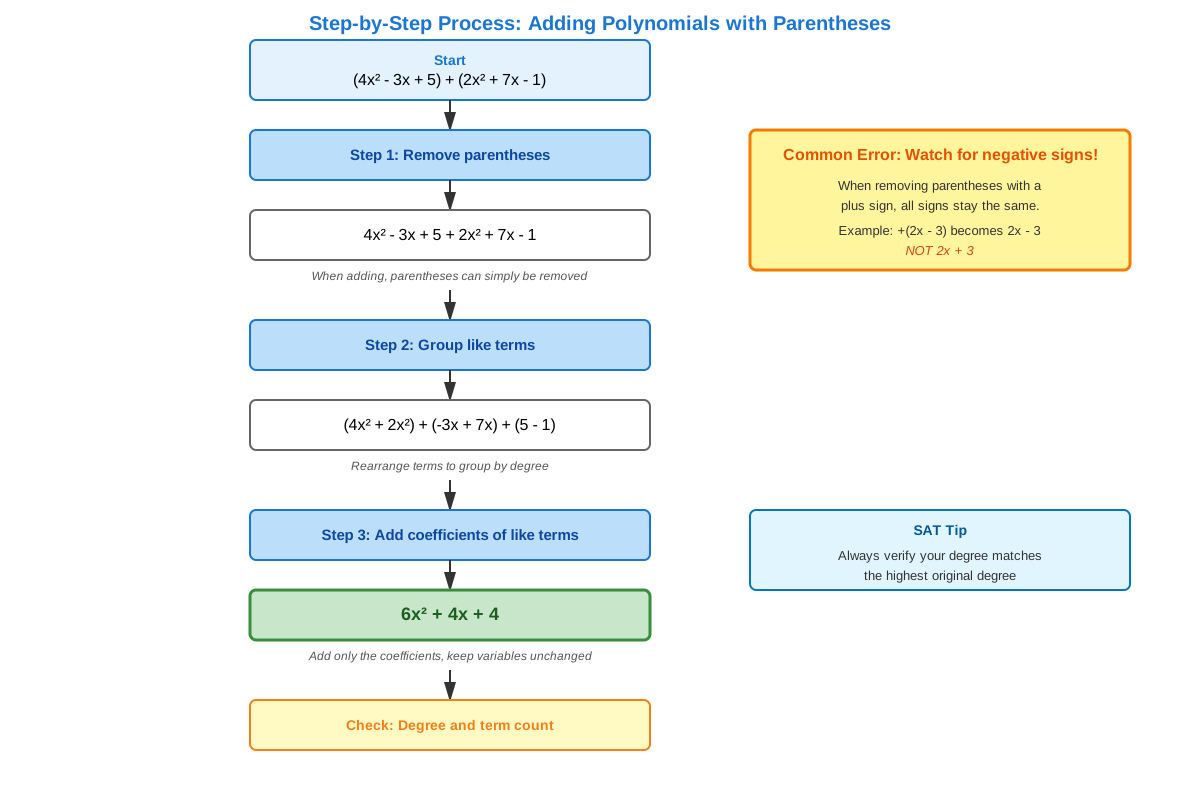
The systematic approach to adding polynomials involves these steps:
- Remove parentheses if present, being careful to distribute any negative signs or coefficients
- Identify like terms by examining the variable part of each term
- Group like terms together, either mentally or by rearranging (maintaining proper signs)
- Combine coefficients of like terms through addition or subtraction
- Write the result in standard form with terms arranged by descending degree
Consider adding (5x³ - 2x² + 4x - 1) + (3x³ + x² - 6x + 8):
- Group x³ terms: 5x³ + 3x³ = 8x³
- Group x² terms: -2x² + x² = -x²
- Group x terms: 4x + (-6x) = -2x
- Group constants: -1 + 8 = 7
- Final answer: 8x³ - x² - 2x + 7
Vertical and Horizontal Addition Methods
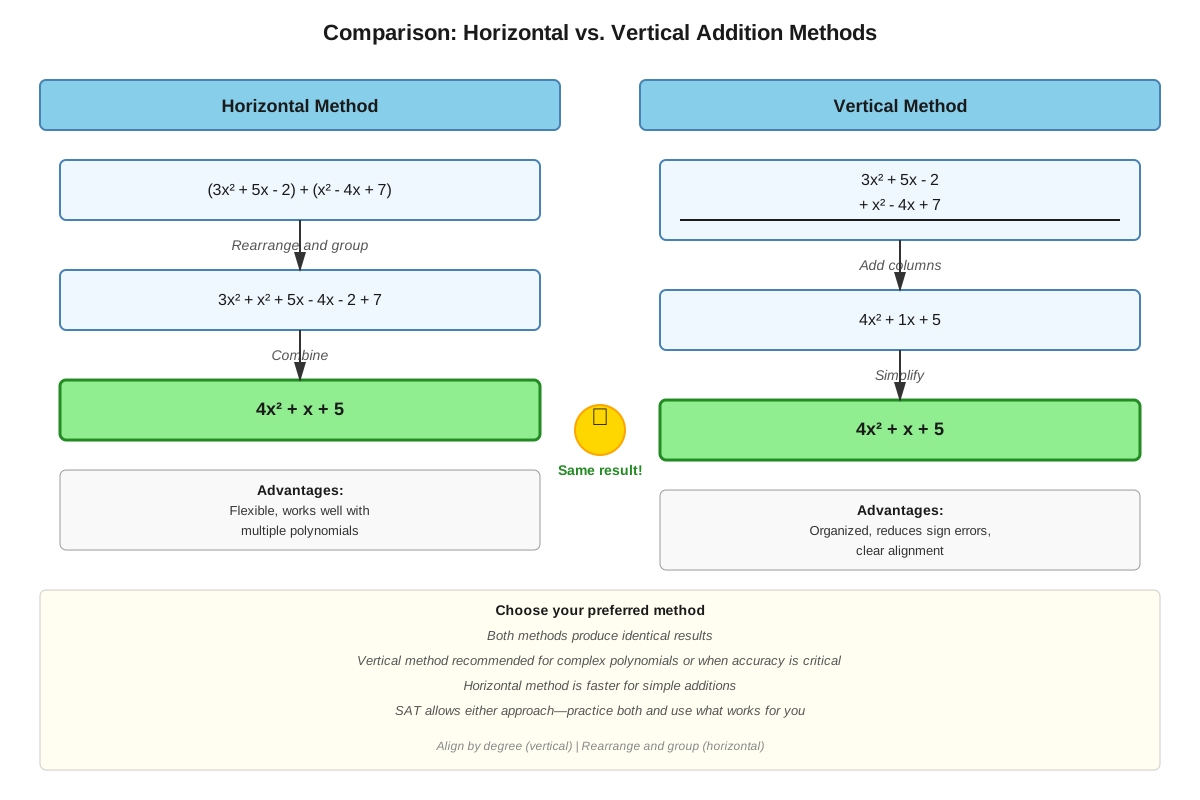
Polynomials can be added using two organizational methods. The horizontal method writes polynomials in a single line and combines like terms as shown above. The vertical method aligns like terms in columns, similar to traditional arithmetic addition:
    5x³ - 2x² + 4x - 1
  + 3x³ +  x² - 6x + 8
  ________________________
    8x³ -  x² - 2x + 7
The vertical method reduces errors by making like terms visually obvious and is particularly useful for polynomials with many terms or when working without a calculator. SAT students should practice both methods and choose based on the problem's complexity and their personal preference.
Polynomials with Multiple Variables
SAT questions frequently involve polynomials with two or more variables, requiring careful attention to all variable factors when identifying like terms. In the expression 3x²y + 4xy² - 2x²y + 5xy², the terms 3x²y and -2x²y are like terms (both contain x²y), as are 4xy² and 5xy² (both contain xy²). The sum simplifies to x²y + 9xy².
When adding multivariable polynomials, students must match both the variables AND their exponents exactly. The terms 2x²y and 2xy² cannot be combined despite having the same variables and the same total degree, because the distribution of exponents differs. This distinction frequently appears in SAT questions designed to test conceptual understanding rather than mere computation.
Special Cases and Edge Situations
Several special situations deserve attention. When adding polynomials results in like terms with coefficients that sum to zero, those terms disappear from the final answer: (3x² + 5x - 2) + (-3x² + 2x + 7) = 7x + 5. Students must recognize that the x² terms cancel completely.
Another important case involves missing terms—when a polynomial lacks a particular degree. For example, x³ + 5 has no x² or x terms. When adding this to 2x² - 3x + 1, students should recognize that x³ has no like term in the second polynomial and remains unchanged: x³ + 2x² - 3x + 6. The vertical method helps visualize missing terms by leaving spaces in the appropriate columns.
Concept Relationships
The concepts within polynomial addition form a hierarchical structure: understanding polynomial structure and terminology → enables recognition of like terms → which allows systematic grouping → leading to accurate combination of coefficients → resulting in simplified polynomial sums. Each step depends on the previous one, making the foundational concepts critical for success.
Polynomial addition connects directly to prerequisite knowledge of combining like terms and integer operations, extending these simpler skills to more complex expressions. It serves as the foundation for polynomial subtraction (which is addition of the opposite) and appears as a component within polynomial multiplication (where products must be added after distribution). The topic also relates to function operations, as adding polynomial functions f(x) + g(x) requires adding the polynomial expressions that define them.
The relationship map flows: Basic algebra → Combining like terms → Adding polynomials → Polynomial subtraction → Polynomial multiplication → Factoring → Solving polynomial equations. Mastery of adding polynomials is therefore essential for progression through the entire polynomial unit and beyond to rational expressions and advanced function concepts.
High-Yield Facts
⭐ Only like terms—those with identical variable parts including exponents—can be combined when adding polynomials
⭐ The degree of a polynomial sum never exceeds the highest degree of the polynomials being added
⭐ When adding polynomials, coefficients are added but exponents remain unchanged
⭐ Parentheses must be properly removed before combining like terms, with careful attention to negative signs
⭐ The final answer should be written in standard form with terms in descending order of degree
- Adding polynomials is commutative: (A + B) = (B + A), meaning order doesn't affect the result
- The sum of two polynomials is always another polynomial
- Missing terms in a polynomial can be thought of as having a coefficient of zero
- When like terms cancel completely (coefficients sum to zero), they disappear from the final answer
- Multivariable terms must match ALL variables and ALL exponents to be considered like terms
- The leading coefficient of a polynomial sum is determined by the highest-degree terms
- Polynomial addition problems on the SAT often embed the operation within word problems or function notation
Quick check — test yourself on Adding polynomials so far.
Try Flashcards →Common Misconceptions
Misconception: Students can add exponents when combining like terms → Correction: When adding polynomials, only coefficients are added; exponents remain unchanged. For example, 3x² + 5x² = 8x², not 3x² + 5x² = 8x⁴. The exponent indicates repeated multiplication of the base, and adding terms doesn't change how many times the variable is multiplied by itself.
Misconception: Any terms with the same variable can be combined → Correction: Terms must have identical variable parts, including matching exponents, to be like terms. The expression 4x² + 3x cannot be simplified further because x² and x are different variable parts. Students must check both the variables present and their exponents.
Misconception: When removing parentheses preceded by a plus sign, the signs of terms inside change → Correction: A plus sign before parentheses means all terms inside keep their original signs. Only a negative sign (or subtraction) before parentheses requires changing all interior signs. For (3x - 5) + (2x + 4), the second set of parentheses simply removes to give 3x - 5 + 2x + 4.
Misconception: The degree of a polynomial sum equals the sum of the degrees of the polynomials being added → Correction: The degree of a sum never exceeds the highest degree among the polynomials being added, and may be lower if highest-degree terms cancel. Adding (3x³ + 2x) + (-3x³ + 5) results in 2x + 5, which has degree 1, not degree 3 or 6.
Misconception: Terms with the same total degree but different variable distributions are like terms → Correction: For multivariable polynomials, the exact distribution of exponents matters. The terms 3x²y and 3xy² both have total degree 3, but they are not like terms because the exponents on x and y differ. Each must be treated as a separate term in the final answer.
Misconception: Polynomial addition requires finding a common denominator → Correction: Unlike adding fractions, polynomial addition does not require common denominators. Students sometimes confuse the processes, but polynomial terms combine directly through coefficient addition when variable parts match. Common denominators are only necessary when adding rational expressions (fractions containing polynomials).
Worked Examples
Example 1: Standard Polynomial Addition
Problem: Simplify (4x³ - 2x² + 7x - 3) + (2x³ + 5x² - 4x + 9)
Solution:
Step 1: Identify and group like terms by degree
- x³ terms: 4x³ and 2x³
- x² terms: -2x² and 5x²
- x terms: 7x and -4x
- Constant terms: -3 and 9
Step 2: Combine coefficients of like terms
- x³ terms: 4x³ + 2x³ = 6x³
- x² terms: -2x² + 5x² = 3x²
- x terms: 7x + (-4x) = 3x
- Constants: -3 + 9 = 6
Step 3: Write in standard form
Answer: 6x³ + 3x² + 3x + 6
This problem directly addresses the learning objective of applying polynomial addition to SAT-style questions. The SAT frequently presents this exact format, asking students to simplify the sum of two polynomials. The key skills demonstrated are systematic identification of like terms and accurate coefficient arithmetic with both positive and negative numbers.
Example 2: Multivariable Polynomial with Missing Terms
Problem: If P(x,y) = 3x²y - 4xy + 7 and Q(x,y) = -x²y + 2xy² + 5xy - 3, find P(x,y) + Q(x,y).
Solution:
Step 1: Write out both polynomials, noting all terms
- P(x,y) = 3x²y - 4xy + 7
- Q(x,y) = -x²y + 2xy² + 5xy - 3
Step 2: Identify like terms carefully, checking both variables and exponents
- x²y terms: 3x²y and -x²y (like terms)
- xy² terms: only 2xy² (no like term in P)
- xy terms: -4xy and 5xy (like terms)
- Constants: 7 and -3 (like terms)
Step 3: Combine like terms
- x²y terms: 3x²y + (-x²y) = 2x²y
- xy² terms: 2xy² (unchanged, no like term)
- xy terms: -4xy + 5xy = xy
- Constants: 7 + (-3) = 4
Step 4: Write final answer in standard form (typically by total degree, then alphabetically)
Answer: 2x²y + 2xy² + xy + 4
This example addresses the learning objective of recognizing and combining like terms in polynomials with multiple variables. The SAT often uses function notation as shown here, requiring students to understand that P(x,y) + Q(x,y) means adding the polynomial expressions. The presence of the xy² term with no corresponding term in P tests whether students understand that unlike terms remain in the final answer unchanged. This problem also reinforces that terms like x²y and xy² are distinct despite containing the same variables.
Exam Strategy
When approaching SAT adding polynomials questions, begin by quickly scanning both polynomials to estimate the complexity—count the number of terms and check for multiple variables. This assessment helps determine whether to use the horizontal or vertical method and how much time to allocate. For polynomials with four or more terms each, the vertical method often prevents errors and saves time despite requiring an extra step to set up.
Trigger words and phrases that signal polynomial addition include: "simplify," "find the sum," "combine," "add the expressions," "what is f(x) + g(x)," and "the total of." Word problems may use phrases like "combined," "altogether," or "in total" to indicate that polynomial expressions should be added. Function notation such as (f + g)(x) or f(x) + g(x) always requires adding the polynomial expressions that define the functions.
For process of elimination on multiple-choice questions, immediately eliminate any answer choice with an incorrect degree—the degree of the sum cannot exceed the highest degree in the original polynomials. Next, check the leading coefficient by adding only the highest-degree terms; if an answer choice has the wrong leading coefficient, eliminate it. For remaining choices, verify one or two additional terms rather than fully computing the entire sum, which saves valuable time.
Time allocation for polynomial addition questions should be approximately 30-60 seconds for straightforward problems and up to 90 seconds for complex multivariable polynomials or word problems requiring setup. If a problem takes longer, mark it for review and move on—these questions are designed to be solved quickly, and excessive time spent suggests a conceptual misunderstanding that won't resolve through continued effort. Return to challenging problems after completing easier questions.
Always write your work systematically even on the no-calculator section. Attempting to add polynomials entirely mentally increases error rates significantly. Use the test booklet margins to organize like terms, and double-check signs when combining coefficients. The most common errors occur with negative coefficients, so pay special attention when subtracting or adding negative numbers.
Memory Techniques
LOCO helps remember the polynomial addition process: Like terms only, Organize by degree, Combine coefficients, Order in standard form. This acronym provides a quick mental checklist during the exam.
"Same Variables, Same Powers, Add the Numbers" is a simple phrase that captures the essence of combining like terms. Visualize this as a three-part check: verify variables match, verify exponents match, then add coefficients.
For remembering that exponents don't change during addition, visualize "Exponents are Stubborn"—they refuse to change when terms are added, only the coefficients are flexible. This anthropomorphization helps prevent the common error of adding exponents.
The Vertical Alignment Visualization technique involves mentally picturing polynomials stacked in columns even when using the horizontal method. This mental image helps ensure all like terms are identified and combined. Practice visualizing the column structure until it becomes automatic.
Color-coding practice: When studying, use different colors for different degrees (e.g., x³ terms in blue, x² terms in red, x terms in green, constants in black). This visual association strengthens the ability to quickly identify like terms during the exam, even without actual colors available.
Summary
Adding polynomials is a foundational algebraic skill that requires identifying and combining like terms—those with identical variable parts including matching exponents. The process involves systematically grouping terms by their variable components, adding or subtracting coefficients while keeping exponents unchanged, and expressing the result in standard form with terms arranged by descending degree. This skill appears frequently on the SAT both as a standalone topic and embedded within more complex problems involving functions, word problems, and multi-step algebraic manipulations. Success requires careful attention to signs, accurate arithmetic with positive and negative coefficients, and recognition that only terms with exactly matching variable parts can be combined. The degree of a polynomial sum never exceeds the highest degree of the polynomials being added, and may be lower if highest-degree terms cancel. Mastery of polynomial addition provides the foundation for all subsequent polynomial operations and significantly impacts SAT math performance across multiple content domains.
Key Takeaways
- Like terms must have identical variable parts, including the same variables raised to the same exponents, to be combined through addition
- When adding polynomials, only coefficients are added or subtracted; exponents remain completely unchanged
- The systematic process—remove parentheses, identify like terms, group them, combine coefficients, write in standard form—prevents errors and ensures accuracy
- Polynomial addition appears in 8-12% of SAT math questions, both as direct simplification problems and embedded within larger multi-step questions
- The vertical alignment method reduces errors for complex polynomials by making like terms visually obvious through column organization
- Missing terms in polynomials should be recognized and handled carefully, as they don't combine with any terms in the other polynomial
- Multivariable polynomials require exact matching of all variables and all exponents for terms to be considered like terms and combined
Related Topics
Subtracting Polynomials: Building directly on polynomial addition, subtraction requires distributing the negative sign to all terms in the polynomial being subtracted, then following the addition process. Mastery of addition makes subtraction straightforward since it becomes addition of the opposite.
Multiplying Polynomials: Uses the distributive property repeatedly to multiply each term in one polynomial by each term in the other, then requires adding the resulting products. Strong polynomial addition skills are essential for combining the terms after distribution.
Polynomial Functions and Operations: Extends polynomial addition to function notation, where (f + g)(x) means adding the polynomial expressions f(x) and g(x). This topic appears frequently on the SAT and requires fluency in polynomial addition.
Factoring Polynomials: Sometimes requires adding polynomials as an intermediate step, particularly when factoring by grouping or working with polynomial identities. Understanding polynomial structure through addition practice aids factoring skills.
Systems of Equations: Often solved by adding equations to eliminate variables, which requires adding polynomial expressions on both sides of equations. Polynomial addition skills transfer directly to this important SAT topic.
Practice CTA
Now that you've mastered the concepts and strategies for adding polynomials, it's time to solidify your understanding through active practice. Work through the practice questions to apply these techniques to SAT-style problems, and use the flashcards to reinforce key definitions and procedures until they become automatic. Remember, polynomial addition is a high-yield topic that appears throughout the SAT math section—every minute spent practicing this skill translates directly to points on test day. Approach each practice problem systematically, check your work carefully, and review any errors to understand where your process broke down. You've got this!
Sign up free to keep reading
Create a free AnvayaPrep account to finish this SAT guide on Adding polynomials — plus flashcards and practice questions.