Overview
Subtracting polynomials is a fundamental algebraic skill that appears consistently throughout the SAT math section, both as standalone questions and as essential steps within more complex problems. This operation involves combining polynomial expressions by removing or negating terms, requiring students to carefully manage signs, combine like terms, and maintain proper algebraic structure. Mastery of polynomial subtraction is not merely about mechanical computation—it demands conceptual understanding of how negative signs distribute across multiple terms and how algebraic expressions can be manipulated while preserving mathematical equivalence.
On the SAT, polynomial subtraction questions test both procedural fluency and conceptual reasoning. Students encounter these problems in multiple-choice and grid-in formats, often embedded within word problems, function notation questions, or geometric applications. The College Board specifically designs questions to expose common errors in sign management and term combination, making this a high-yield topic for score improvement. Questions may present polynomials horizontally or vertically, require simplification before subtraction, or ask students to work backward from a result to find missing terms.
The broader significance of subtracting polynomials extends throughout algebra and connects directly to factoring, solving equations, graphing functions, and working with rational expressions. This topic builds upon basic integer operations and variable manipulation while serving as a gateway to more advanced polynomial operations. Students who develop strong polynomial subtraction skills gain confidence in algebraic manipulation, which translates to improved performance across multiple SAT math domains including Heart of Algebra, Passport to Advanced Math, and Problem Solving and Data Analysis.
Learning Objectives
- [ ] Identify key features of subtracting polynomials, including like terms, coefficients, and degree
- [ ] Explain how subtracting polynomials appears on the SAT in various question formats and contexts
- [ ] Apply subtracting polynomials to answer SAT-style questions accurately and efficiently
- [ ] Distribute negative signs correctly across all terms in a polynomial expression
- [ ] Recognize and avoid common sign errors that lead to incorrect answers
- [ ] Simplify complex polynomial subtraction problems involving multiple variables and exponents
- [ ] Verify polynomial subtraction results through addition or substitution methods
Prerequisites
- Integer operations with negative numbers: Essential for understanding how subtraction affects signs and for combining coefficients correctly
- Basic variable manipulation and algebraic notation: Required to recognize terms, coefficients, and exponents in polynomial expressions
- Combining like terms: The fundamental skill needed to simplify polynomial expressions after distributing negative signs
- Understanding of exponent rules: Necessary to identify which terms can be combined based on matching variable parts
- Order of operations (PEMDAS): Critical for correctly processing parentheses and distributing negative signs before combining terms
Why This Topic Matters
Polynomial subtraction represents a cornerstone skill in algebra that extends far beyond the SAT. In real-world applications, professionals use polynomial operations in engineering (calculating differences in measurements or specifications), economics (finding profit by subtracting cost polynomials from revenue polynomials), physics (determining net forces or changes in motion), and computer science (algorithm analysis and computational complexity). The ability to manipulate algebraic expressions accurately underlies problem-solving in virtually every STEM field.
On the SAT, polynomial subtraction appears in approximately 3-5 questions per test, either directly or as a necessary step within larger problems. The College Board reports that polynomial operations fall within the Passport to Advanced Math category, which comprises 16 of the 58 math questions (approximately 28% of the math section). Questions involving polynomial subtraction typically appear in these formats: direct simplification problems, function operations (finding f(x) - g(x)), word problems requiring expression setup and simplification, and geometry problems involving perimeter or area differences.
Common SAT question types include: asking students to subtract one polynomial from another and identify the coefficient of a specific term; presenting real-world scenarios where subtraction models a situation; providing function definitions and requesting evaluation of difference functions; and embedding polynomial subtraction within multi-step problems involving factoring or equation solving. The test frequently uses these questions to assess both computational accuracy and conceptual understanding, particularly regarding sign distribution and term identification.
Core Concepts
Understanding Polynomial Structure
A polynomial is an algebraic expression consisting of variables and coefficients combined using addition, subtraction, and multiplication, where variables have non-negative integer exponents. Each component separated by addition or subtraction is called a term. For example, in the polynomial 3x² + 5x - 7, there are three terms: 3x², 5x, and -7. The coefficient is the numerical factor of each term (3, 5, and -7 respectively), while the degree of a term is the sum of the exponents of its variables. Understanding this structure is essential because polynomial subtraction operates term-by-term on like terms—terms that have identical variable parts with matching exponents.
The Fundamental Principle of Polynomial Subtraction
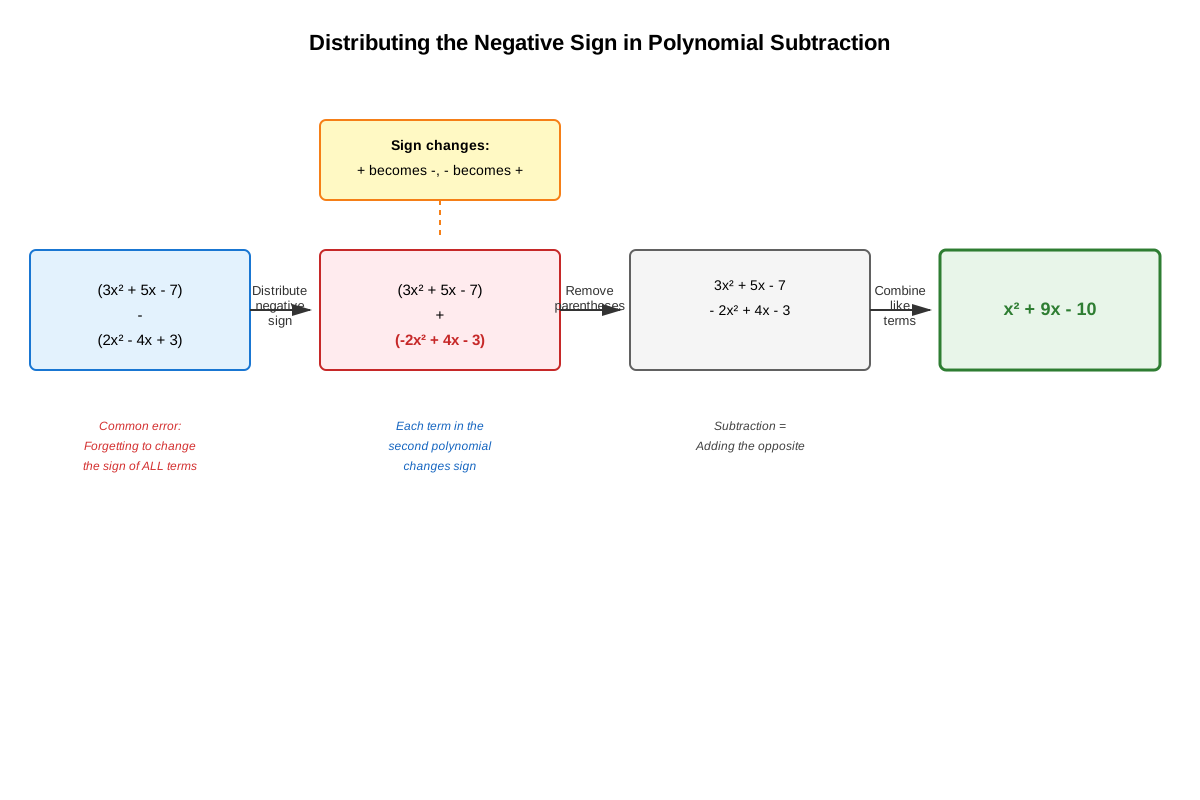
Subtracting polynomials means finding the difference between two polynomial expressions by removing the second polynomial from the first. The critical principle is that subtraction is equivalent to adding the opposite: A - B = A + (-B). This means every term in the polynomial being subtracted must have its sign changed before combining like terms. This is not optional—it is the mathematical requirement that students most frequently violate, leading to incorrect answers on the SAT.
The Distribution Process
When subtracting polynomials, the negative sign (or subtraction operation) must distribute across every term in the polynomial being subtracted. Consider this example:
(4x² + 3x - 5) - (2x² - x + 7)The subtraction operation affects all three terms in the second polynomial:
- The +2x² becomes -2x²
- The -x becomes +x (negative of negative is positive)
- The +7 becomes -7
After distribution, the expression becomes:
4x² + 3x - 5 - 2x² + x - 7Combining Like Terms
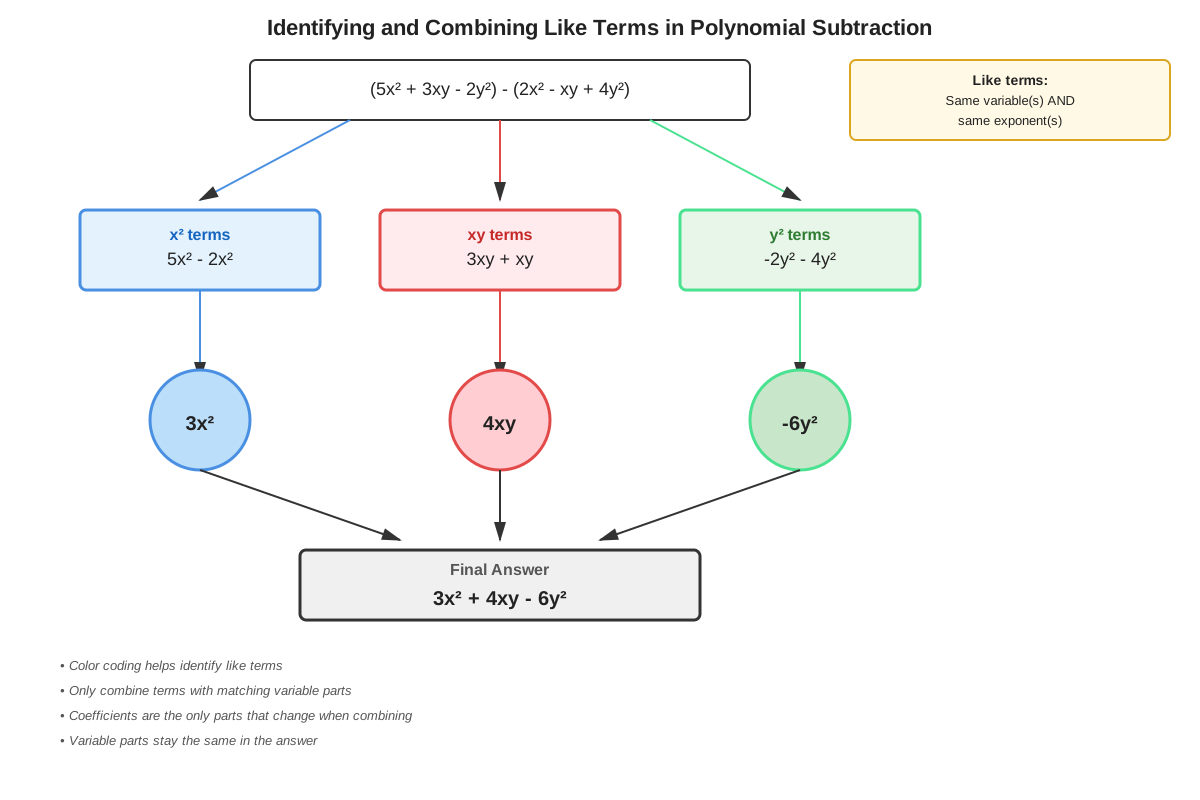
After distributing the negative sign, the next step involves identifying and combining like terms. Like terms must have exactly the same variable part—same variables raised to the same powers. Terms are combined by adding or subtracting their coefficients while keeping the variable part unchanged.
| Original Expression | Like Terms Identified | Combined Result |
|---|---|---|
| 4x² - 2x² | Both are x² terms | 2x² |
| 3x + x | Both are x terms | 4x |
| -5 - 7 | Both are constants | -12 |
The final simplified result is 2x² + 4x - 12.
Vertical vs. Horizontal Format
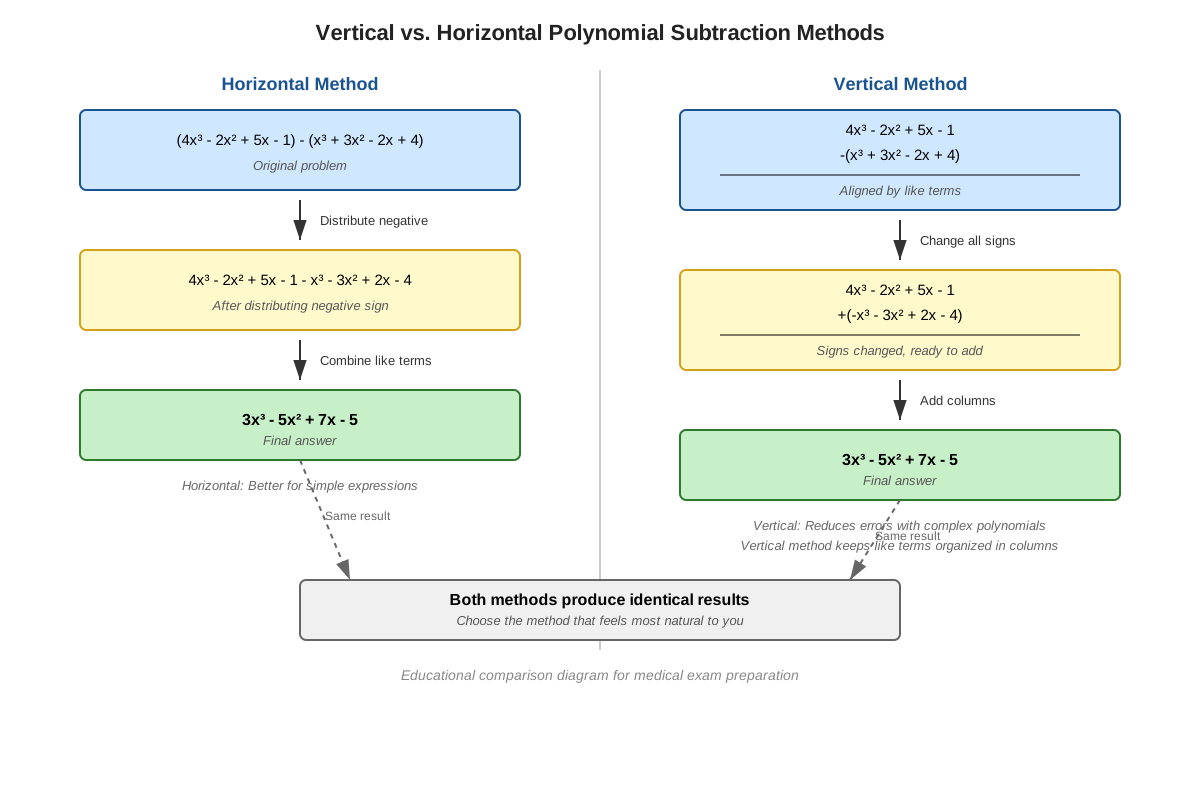
Polynomial subtraction can be performed in two formats, both appearing on the SAT:
Horizontal format: Polynomials are written in a single line with parentheses, as shown above. This format requires careful attention to distributing the negative sign.
Vertical format: Polynomials are aligned by like terms in columns, similar to multi-digit subtraction:
  4x² + 3x - 5
- (2x² - x + 7)
_______________
In vertical format, change the signs of all terms in the bottom polynomial, then add:
  4x² + 3x - 5
+ (-2x² + x - 7)
_______________
  2x² + 4x - 12
Multi-Variable Polynomials
SAT questions sometimes involve polynomials with multiple variables. The same principles apply, but term identification becomes more complex. Like terms must match in all variables and all exponents. For example:
(5xy² + 3x²y - 2xy) - (2xy² - x²y + 4xy)
= 5xy² + 3x²y - 2xy - 2xy² + x²y - 4xy
= (5xy² - 2xy²) + (3x²y + x²y) + (-2xy - 4xy)
= 3xy² + 4x²y - 6xy
Notice that xy², x²y, and xy are all different types of terms and cannot be combined with each other.
Polynomial Subtraction in Function Notation
The SAT frequently presents polynomial subtraction using function notation. If f(x) = 3x² + 2x - 1 and g(x) = x² - 4x + 3, then finding (f - g)(x) means:
(f - g)(x) = f(x) - g(x)
= (3x² + 2x - 1) - (x² - 4x + 3)
= 3x² + 2x - 1 - x² + 4x - 3
= 2x² + 6x - 4
This notation emphasizes that polynomial subtraction creates a new function representing the difference between the original functions.
Special Cases and Zero Coefficients
When subtracting polynomials of different degrees or with missing terms, it's helpful to include terms with zero coefficients as placeholders. For example:
(x³ + 5x - 2) - (x² + 3x + 1)
= (x³ + 0x² + 5x - 2) - (0x³ + x² + 3x + 1)
= x³ - x² + 2x - 3
This technique helps prevent errors by ensuring all terms are accounted for during the subtraction process.
Concept Relationships
The concepts within polynomial subtraction form a logical sequence: polynomial structure (understanding terms, coefficients, and like terms) → distribution principle (recognizing that subtraction means adding the opposite) → sign distribution (changing signs of all terms in the subtracted polynomial) → combining like terms (adding/subtracting coefficients of matching variable parts) → simplified result (the final polynomial expression).
Polynomial subtraction connects directly to prerequisite topics: it extends integer subtraction to algebraic expressions, applies combining like terms in a more complex context, and requires mastery of negative number operations. The topic also relates forward to polynomial multiplication (where distribution becomes more complex), factoring (which often requires rearranging terms after subtraction), solving polynomial equations (where subtraction isolates variables), and rational expressions (where polynomial subtraction appears in numerators and denominators).
The relationship between horizontal and vertical formats represents two approaches to the same operation: horizontal format emphasizes the algebraic manipulation and distribution process, while vertical format provides visual organization that can reduce errors. Both methods produce identical results when executed correctly, and SAT success requires comfort with both presentations.
Function notation creates a bridge between polynomial operations and function concepts, showing that (f - g)(x) represents a new function whose output at any x-value equals the difference of the original functions' outputs. This connection appears throughout advanced algebra and calculus, making it particularly high-yield for college readiness.
Quick check — test yourself on Subtracting polynomials so far.
Try Flashcards →High-Yield Facts
⭐ Subtracting a polynomial is equivalent to adding its opposite—every term's sign must change
⭐ Like terms must have identical variable parts with matching exponents to be combined
⭐ The degree of the result cannot exceed the highest degree of the original polynomials
⭐ Distributing a negative sign changes +a to -a and -a to +a for every term
⭐ Coefficients are added or subtracted; variable parts remain unchanged when combining like terms
- Polynomial subtraction is commutative: A - B ≠ B - A (order matters significantly)
- Missing terms can be represented with zero coefficients to maintain alignment
- The result of subtracting two polynomials is always another polynomial
- Parentheses are critical—they indicate which terms belong to the polynomial being subtracted
- In function notation, (f - g)(x) = f(x) - g(x), not f(x - g(x))
- Constant terms (numbers without variables) are like terms with each other
- Terms with different variables or different exponents cannot be combined
- Vertical format requires changing all signs in the subtracted polynomial before adding
- The SAT never requires polynomial long division for subtraction problems
- Double negatives in polynomial subtraction create positive terms: -(-3x) = +3x
Common Misconceptions
Misconception: Only the first term's sign changes when subtracting a polynomial → Correction: The negative sign distributes to every term in the polynomial being subtracted. If subtracting (3x² - 2x + 5), all three terms change signs: -3x², +2x, and -5.
Misconception: Terms with different exponents can be combined if they have the same variable → Correction: Like terms must match in both variable and exponent. The terms 3x² and 5x cannot be combined because x² and x are fundamentally different quantities.
Misconception: The coefficient includes the variable part → Correction: The coefficient is only the numerical factor. In -7x³, the coefficient is -7, not -7x³. The variable part is x³.
Misconception: Subtracting polynomials can increase the degree of the result → Correction: Polynomial subtraction can only maintain or decrease the degree. If both polynomials have degree 3, the result has degree 3 or less (it could be less if the leading terms cancel).
Misconception: In vertical format, simply subtract coefficients column by column → Correction: In vertical format, you must first change all signs in the bottom polynomial, then add. Direct subtraction without sign changes produces incorrect results.
Misconception: (f - g)(x) means f(x - g(x)) → Correction: The notation (f - g)(x) means f(x) - g(x). The subtraction occurs between the function outputs, not within the input.
Misconception: Parentheses are optional when writing polynomial subtraction → Correction: Parentheses are essential to indicate which terms belong together. Without them, only the first term following the subtraction sign is affected: A - B + C is different from A - (B + C).
Worked Examples
Example 1: Direct Polynomial Subtraction
Problem: Simplify (6x³ - 4x² + 7x - 3) - (2x³ + x² - 5x + 8)
Solution:
Step 1: Identify the operation. We are subtracting the second polynomial from the first.
Step 2: Distribute the negative sign to every term in the second polynomial:
- 2x³ becomes -2x³
- +x² becomes -x²
- -5x becomes +5x
- +8 becomes -8
Step 3: Rewrite without parentheses:
6x³ - 4x² + 7x - 3 - 2x³ - x² + 5x - 8
Step 4: Group like terms:
(6x³ - 2x³) + (-4x² - x²) + (7x + 5x) + (-3 - 8)
Step 5: Combine like terms:
- x³ terms: 6x³ - 2x³ = 4x³
- x² terms: -4x² - x² = -5x²
- x terms: 7x + 5x = 12x
- Constants: -3 - 8 = -11
Final Answer: 4x³ - 5x² + 12x - 11
This example demonstrates the complete process and addresses Learning Objective 3 (applying polynomial subtraction to solve problems). The careful distribution of the negative sign and systematic combination of like terms represents the standard approach for SAT questions.
Example 2: Function Notation with Real-World Context
Problem: A company's revenue is modeled by R(x) = 5x² + 20x + 100, where x is the number of units sold (in thousands) and R is revenue in thousands of dollars. The cost is modeled by C(x) = 2x² + 8x + 50. Find the profit function P(x) = R(x) - C(x) and determine the coefficient of the x term.
Solution:
Step 1: Set up the subtraction:
P(x) = R(x) - C(x)
P(x) = (5x² + 20x + 100) - (2x² + 8x + 50)
Step 2: Distribute the negative sign:
P(x) = 5x² + 20x + 100 - 2x² - 8x - 50
Step 3: Combine like terms:
- x² terms: 5x² - 2x² = 3x²
- x terms: 20x - 8x = 12x
- Constants: 100 - 50 = 50
Step 4: Write the profit function:
P(x) = 3x² + 12x + 50
Step 5: Identify the coefficient of the x term:
The coefficient of x is 12.
Final Answer: P(x) = 3x² + 12x + 50; the coefficient of the x term is 12.
This example illustrates how polynomial subtraction appears in applied contexts on the SAT (Learning Objective 2). The problem requires understanding that profit equals revenue minus cost, setting up the subtraction correctly, and extracting specific information from the result. This type of question tests both computational skill and conceptual understanding of how mathematical models represent real situations.
Exam Strategy
When approaching SAT subtracting polynomials questions, begin by identifying the format: horizontal expression, vertical alignment, or function notation. Each format requires the same mathematical operation but different organizational approaches. Read carefully to determine which polynomial is being subtracted from which—the order matters significantly.
Trigger words and phrases that signal polynomial subtraction include: "find the difference," "subtract," "how much more," "decrease by," "remove," and in function notation, "find (f - g)(x)" or "find f(x) - g(x)." Word problems may use contextual language like "profit" (revenue minus cost), "net change" (increase minus decrease), or "remaining amount" (total minus used).
For process of elimination on multiple-choice questions, first check the degree of the answer choices—eliminate any choice with a degree higher than the original polynomials. Next, verify the leading coefficient (the coefficient of the highest-degree term) by subtracting only those terms; this quick check eliminates incorrect options. Finally, check the constant term, which is often where sign errors appear most obviously.
Time allocation for polynomial subtraction questions should be approximately 45-60 seconds for straightforward problems and up to 90 seconds for multi-step or applied problems. If a problem takes longer, mark it and return after completing easier questions. The SAT rewards accuracy over speed, but polynomial subtraction should be a relatively quick operation with practice.
Exam Tip: Always write out the distribution step explicitly, even if working mentally seems faster. The few seconds spent writing "-2x³ - x² + 5x - 8" prevents the sign errors that cost points. On test day, accuracy trumps speed.
Verify answers when time permits by adding the result back to the subtracted polynomial—you should obtain the original polynomial. This addition check catches sign errors and provides confidence in your answer. For grid-in questions where partial credit doesn't exist, this verification step is particularly valuable.
Memory Techniques
SAND - Subtraction means Adding the Negative of every term, then combine like terms Diligently. This acronym reminds students that subtraction requires changing all signs before combining.
"Change Every Sign, Then Combine" - This simple phrase captures the two-step process: first distribute the negative (change every sign), then combine like terms. Repeat this phrase mentally when approaching subtraction problems.
Visualization strategy: Picture a negative sign as a "sign-flipper" that walks through the polynomial being subtracted, flipping every + to - and every - to +. This mental image reinforces that the negative sign affects all terms, not just the first one.
The Parentheses Protection Rule: Terms inside parentheses are "protected" from outside operations until the parentheses are removed. When removing parentheses preceded by a negative sign, every term inside must pay the "exit fee" of changing its sign. This metaphor helps students remember that parentheses create a boundary that must be properly processed.
Color coding technique: When practicing, use different colors for different degrees of terms (blue for x², red for x, black for constants). This visual organization helps identify like terms quickly and reduces combination errors.
Summary
Subtracting polynomials is a high-yield SAT skill that requires distributing a negative sign across all terms of the polynomial being subtracted, then combining like terms by adding or subtracting their coefficients while maintaining identical variable parts. The fundamental principle—that subtraction equals adding the opposite—must be applied systematically to every term, not just the first. Success depends on careful sign management, accurate identification of like terms based on matching variables and exponents, and methodical combination of coefficients. The SAT tests this skill directly through simplification problems and indirectly through function notation, word problems, and multi-step algebraic manipulations. Students must be equally comfortable with horizontal and vertical formats, recognize that order matters in subtraction (A - B ≠ B - A), and understand that the result's degree cannot exceed the original polynomials' degrees. Mastery requires both procedural fluency and conceptual understanding of how polynomial operations preserve algebraic structure while transforming expressions.
Key Takeaways
- Subtracting polynomials requires distributing the negative sign to every term in the polynomial being subtracted—this is the most common source of errors
- Like terms must have identical variable parts with matching exponents; only their coefficients are combined
- The operation A - B is fundamentally different from B - A; order matters in polynomial subtraction
- Function notation (f - g)(x) means f(x) - g(x), representing the difference of outputs, not f(x - g(x))
- Both horizontal and vertical formats produce the same result when executed correctly; choose the format that minimizes your personal error rate
- Verification through addition (result + subtracted polynomial = original polynomial) catches sign errors and confirms accuracy
- The SAT embeds polynomial subtraction in various contexts including direct simplification, function operations, and real-world modeling problems
Related Topics
Adding Polynomials: The complementary operation that shares the like-term combination process but without sign distribution complications. Mastering subtraction makes addition trivial by comparison.
Multiplying Polynomials: Extends distribution concepts to products, where each term in one polynomial multiplies each term in another. Subtraction skills provide the foundation for managing signs in multiplication.
Factoring Polynomials: Often requires rearranging terms after subtraction to identify common factors or special patterns. Polynomial subtraction is frequently a preliminary step in factoring problems.
Polynomial Division: The inverse operation of multiplication, sometimes requiring subtraction of products during the division algorithm. Understanding subtraction is essential for long division of polynomials.
Systems of Equations: Elimination method uses polynomial subtraction to eliminate variables. The sign management skills developed here transfer directly to systems problems.
Rational Expressions: Combining fractions with polynomial numerators and denominators requires polynomial subtraction with common denominators. This advanced topic builds directly on subtraction mastery.
Practice CTA
Now that you understand the principles and strategies for subtracting polynomials, it's time to solidify your mastery through deliberate practice. Attempt the practice questions designed specifically for this topic, focusing on accuracy first and speed second. Use the flashcards to reinforce key concepts, especially the distribution principle and like-term identification. Remember that polynomial subtraction appears throughout the SAT math section—every minute spent mastering this skill pays dividends across multiple question types. Your investment in understanding these fundamentals will translate directly to points on test day. Approach each practice problem as an opportunity to refine your technique and build the automaticity that leads to confident, accurate performance under timed conditions.
Sign up free to keep reading
Create a free AnvayaPrep account to finish this SAT guide on Subtracting polynomials — plus flashcards and practice questions.