Overview
Factoring by identifying common factors is a foundational algebraic skill that appears frequently on the SAT math section. This technique involves recognizing terms in a polynomial expression that share one or more factors, then extracting those shared elements to simplify the expression. Mastering this skill enables students to solve equations more efficiently, simplify complex expressions, and recognize patterns that unlock solutions to higher-level problems. On the SAT, common factor questions test both computational accuracy and conceptual understanding of polynomial structure.
The ability to identify and extract common factors is essential because it serves as the first step in most factoring problems. Before attempting more complex factoring techniques like grouping, difference of squares, or trinomial factoring, students must always check for common factors. Missing this initial step often leads to incomplete answers or unnecessarily complicated solution paths. The SAT frequently embeds common factor identification within multi-step problems, making it a gateway skill that determines whether students can access the full solution.
Understanding common factors connects directly to broader mathematical concepts including the distributive property, greatest common divisor (GCD), and polynomial operations. This topic bridges arithmetic number theory and algebraic manipulation, reinforcing the principle that factoring is essentially "undoing" distribution. Students who master common factor extraction develop stronger algebraic intuition and can more readily recognize equivalent expressions—a critical skill for both the calculator and no-calculator sections of the SAT.
Learning Objectives
- [ ] Identify key features of common factor in polynomial expressions
- [ ] Explain how common factor appears on the SAT across different question formats
- [ ] Apply common factor techniques to answer SAT-style questions efficiently
- [ ] Determine the greatest common factor (GCF) of polynomial terms including coefficients and variables
- [ ] Recognize when factoring out a common factor simplifies equation solving
- [ ] Verify factored expressions by applying the distributive property in reverse
- [ ] Distinguish between complete and incomplete factorization
Prerequisites
- Basic multiplication and division: Essential for identifying numerical factors and understanding the relationship between factored and expanded forms
- Distributive property: The foundation for understanding how factoring reverses distribution (a(b + c) = ab + ac)
- Exponent rules: Necessary for working with variable factors and determining which power of a variable is common to all terms
- Prime factorization: Helps identify the greatest common factor among coefficients
- Polynomial terminology: Understanding terms, coefficients, and like terms enables proper identification of common elements
Why This Topic Matters
In real-world applications, common factor extraction appears in optimization problems, engineering calculations, and financial modeling where expressions must be simplified before analysis. Scientists use factoring to simplify formulas, while computer programmers apply these principles in algorithm optimization. The skill of recognizing patterns and extracting shared elements translates beyond mathematics into logical reasoning and problem-solving across disciplines.
On the SAT, common factor questions appear with high frequency—typically 2-4 questions per test directly assess this skill, while many additional questions require it as an intermediate step. These questions appear in multiple formats: as standalone simplification problems, within equation-solving contexts, in word problems requiring algebraic modeling, and as part of function analysis questions. The College Board consistently includes common factor problems because they efficiently test both procedural fluency and conceptual understanding.
Common factor questions on the SAT typically manifest in several ways: direct factoring instructions ("Factor completely: 6x³ + 9x²"), equation-solving where factoring reveals solutions, expressions that must be simplified before comparison, and word problems where factoring helps identify meaningful relationships between quantities. The topic also appears implicitly when students must recognize equivalent expressions among answer choices or when simplifying complex fractions containing polynomials.
Core Concepts
Definition of Common Factor
A common factor is a number, variable, or algebraic expression that divides evenly into each term of a polynomial. When multiple terms share a factor, that factor can be "factored out" or extracted from the expression using the distributive property in reverse. For example, in the expression 12x + 18, both terms share the factor 6, so we can write it as 6(2x + 3). The process of identifying and extracting common factors is called factoring out or factoring by grouping common terms.
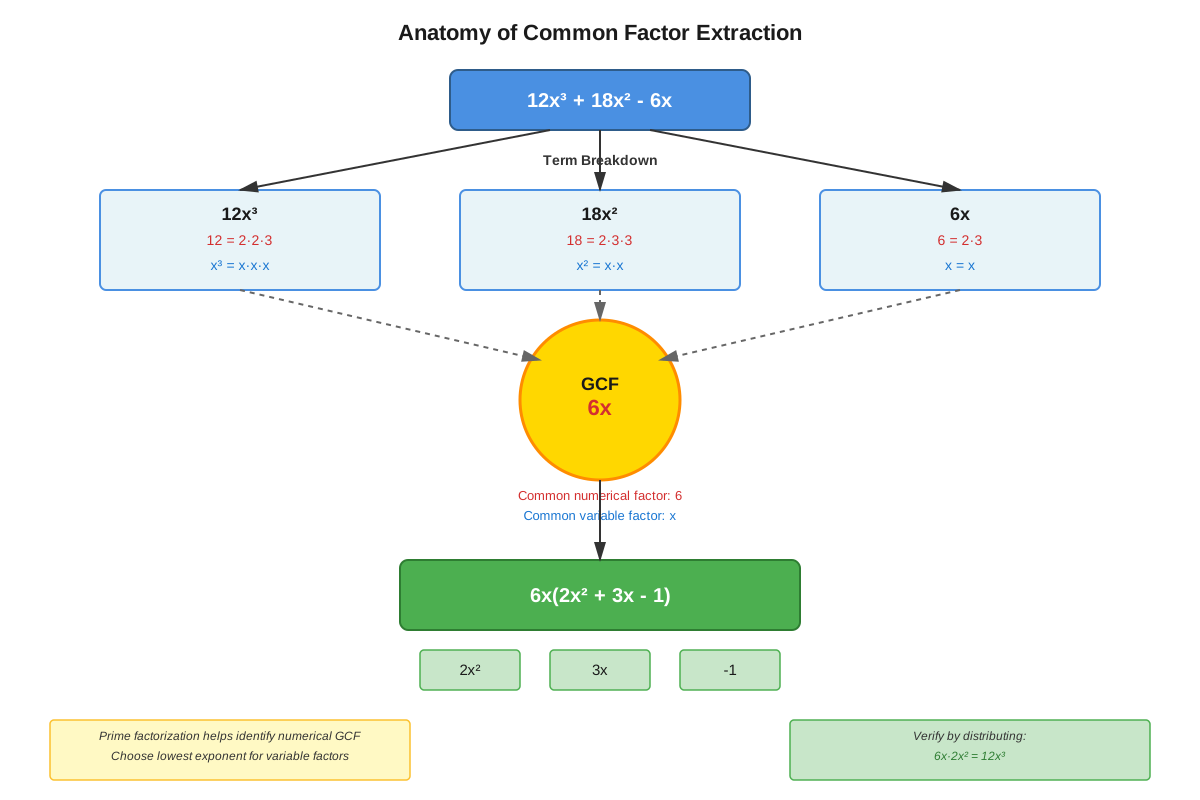
The greatest common factor (GCF) represents the largest factor shared by all terms in an expression. Finding the GCF ensures complete factorization, which is essential for SAT problems that specify "factor completely." The GCF includes both numerical coefficients and variable components. For instance, in 15x⁴y² + 25x³y⁵, the GCF is 5x³y² because 5 is the largest number dividing both 15 and 25, x³ is the highest power of x in both terms, and y² is the highest power of y in both terms.
Finding the Greatest Common Factor
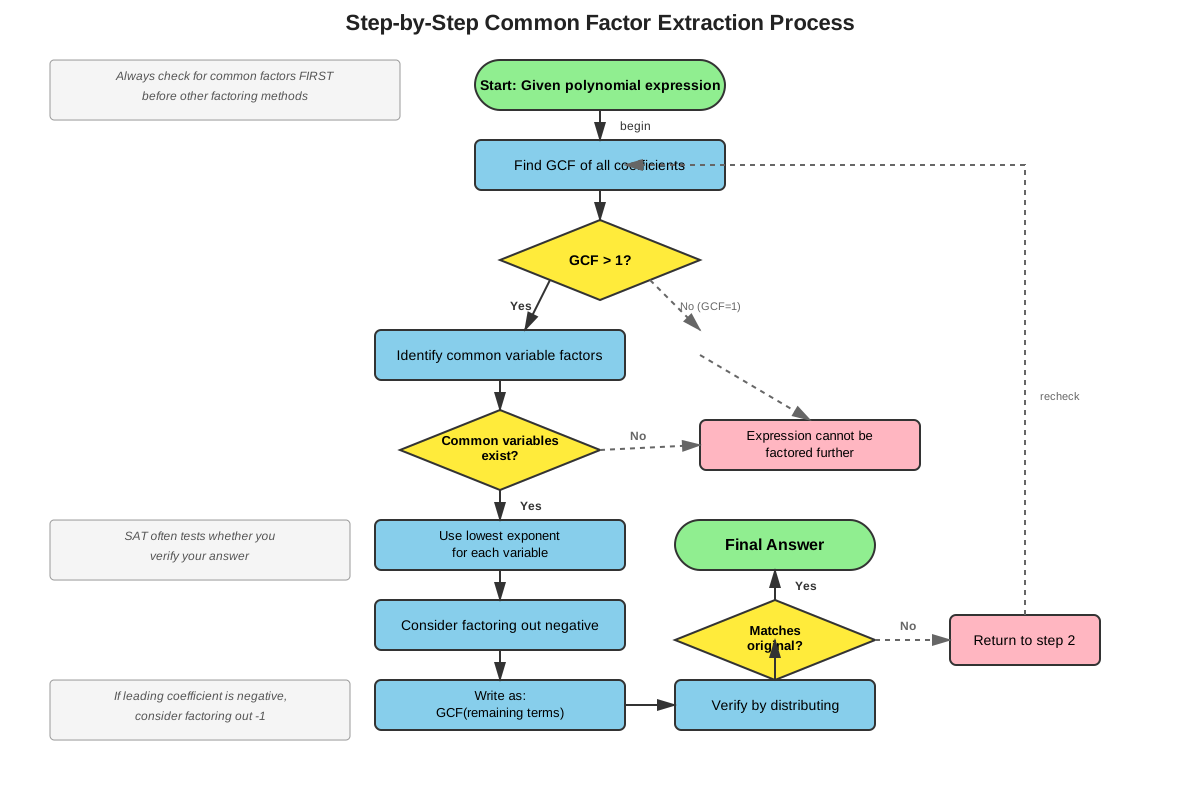
To identify the GCF of polynomial terms, follow this systematic process:
- Factor the coefficients: Find the GCF of all numerical coefficients using prime factorization or listing factors
- Identify common variables: List all variables that appear in every term
- Determine lowest exponents: For each common variable, select the smallest exponent that appears across all terms
- Combine components: Multiply the numerical GCF by all common variables with their lowest exponents
Consider the expression 24x⁵y³ + 36x³y⁴ - 12x⁴y². The coefficient GCF is 12 (since 12 divides 24, 36, and 12). The variable x appears in all terms with powers 5, 3, and 4, so we take x³. The variable y appears with powers 3, 4, and 2, so we take y². Therefore, the complete GCF is 12x³y².
The Factoring Process
Once the GCF is identified, extract it using these steps:
- Write the GCF outside parentheses: Place the GCF as a factor multiplying a set of parentheses
- Divide each term by the GCF: For each original term, divide by the GCF to find what remains
- Write remainders inside parentheses: Place the quotients inside the parentheses, maintaining original signs
- Verify by distributing: Multiply the GCF back through the parentheses to confirm you get the original expression
Example: Factor 18x³ - 27x² + 9x
- GCF = 9x
- 18x³ ÷ 9x = 2x²
- 27x² ÷ 9x = 3x
- 9x ÷ 9x = 1
- Result: 9x(2x² - 3x + 1)
- Verification: 9x(2x²) - 9x(3x) + 9x(1) = 18x³ - 27x² + 9x ✓
Common Factor with Negative Leading Coefficients
When the leading term (first term) has a negative coefficient, factoring out a negative GCF often simplifies subsequent work. This technique makes the expression inside parentheses begin with a positive term, which is conventional and reduces sign errors.
Example: Factor -8x⁴ + 12x³ - 4x²
Rather than factoring out 4x², factor out -4x²:
- -8x⁴ ÷ (-4x²) = 2x²
- 12x³ ÷ (-4x²) = -3x
- -4x² ÷ (-4x²) = 1
- Result: -4x²(2x² - 3x + 1)
This approach is particularly useful when the factored expression will be set equal to zero for equation solving, as it maintains clarity about solution signs.
Special Cases and Edge Situations
| Situation | Example | GCF | Factored Form |
|---|---|---|---|
| GCF is one term | 5x + 5 | 5 | 5(x + 1) |
| GCF equals one term | x³ + x² | x² | x²(x + 1) |
| Binomial GCF | 3(x+2) + y(x+2) | (x+2) | (x+2)(3+y) |
| All terms identical | 7x²y + 7x²y | 7x²y | 7x²y(1+1) or 14x²y |
| No common factor | 3x + 5y | 1 | Cannot factor |
When the GCF equals one of the original terms completely, remember that dividing a term by itself yields 1, which must appear in the parentheses. Students frequently omit this 1, creating an incorrect factorization.
Factoring in Equation Solving
Common factor extraction becomes particularly powerful when solving equations. After factoring, the zero product property states that if a product equals zero, at least one factor must equal zero. This allows splitting one equation into multiple simpler equations.
Example: Solve 6x³ = 15x²
First, move all terms to one side: 6x³ - 15x² = 0
Factor out the GCF (3x²): 3x²(2x - 5) = 0
Apply zero product property:
- 3x² = 0 → x = 0
- 2x - 5 = 0 → x = 5/2
Solutions: x = 0 or x = 5/2
Concept Relationships
The common factor concept builds directly on the distributive property, which states that a(b + c) = ab + ac. Factoring reverses this process: recognizing ab + ac and rewriting it as a(b + c). This inverse relationship is fundamental—every factoring operation is distribution performed backward.
Prime factorization of coefficients connects to finding numerical GCFs. When students decompose coefficients into prime factors, identifying the GCF becomes systematic rather than intuitive. For example, recognizing that 36 = 2² × 3² and 48 = 2⁴ × 3 reveals their GCF is 2² × 3 = 12.
Exponent rules govern the variable portion of common factors. The rule that x^m ÷ x^n = x^(m-n) explains why we select the lowest exponent when finding the GCF. This connects to the broader understanding that factoring out x³ from x⁵ leaves x², demonstrating exponent subtraction.
The relationship flow: Prime Factorization → GCF Identification → Common Factor Extraction → Simplified Expression → Equation Solving or Further Factoring
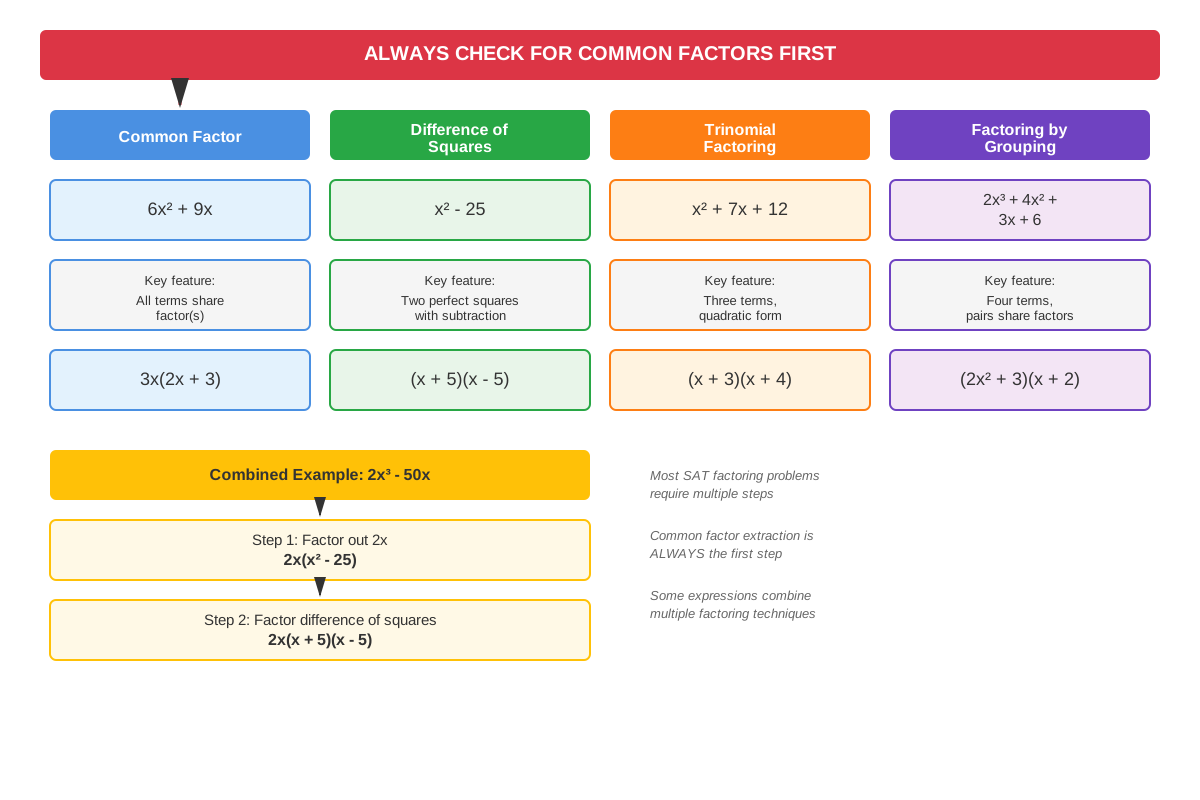
Common factor extraction often serves as the first step before applying other factoring techniques like factoring by grouping, difference of squares, or trinomial factoring. Missing the common factor step results in incomplete factorization, which the SAT penalizes. The complete factoring sequence always begins with checking for common factors.
Quick check — test yourself on Common factor so far.
Try Flashcards →High-Yield Facts
⭐ Always check for common factors first before attempting any other factoring technique—this is the most frequently tested principle
⭐ The GCF includes both numerical and variable components—forgetting variable factors is the most common error on SAT questions
⭐ When a term equals the GCF, dividing leaves 1 in the parentheses—omitting this 1 creates an incorrect expression
⭐ Factoring out a negative makes the leading coefficient inside parentheses positive—this convention reduces sign errors
⭐ Verification by distribution is essential—multiplying the factored form should reproduce the original expression exactly
- The GCF of coefficients never exceeds the smallest coefficient in the expression
- For variables, the GCF exponent never exceeds the smallest exponent appearing in any term
- An expression with no common factor other than 1 is called "prime" or "cannot be factored"
- Factoring is complete only when no further common factors can be extracted from the parenthetical expression
- The zero product property only applies after one side of an equation equals zero
- Common factor questions often appear disguised as "simplify" or "rewrite" problems
- Factored forms are considered equivalent expressions to their expanded forms
- The SAT may present answer choices in either factored or expanded form to test recognition
Common Misconceptions
Misconception: The GCF is always just the numerical coefficient that divides all terms.
Correction: The GCF must include both numerical factors AND variable factors with appropriate exponents. For 12x³ + 18x², the GCF is 6x², not just 6.
Misconception: When factoring 5x² + 5x, the answer is 5x(x) because 5x goes into both terms.
Correction: When the GCF divides evenly into a term, the quotient is 1, which must appear in parentheses: 5x(x + 1). Omitting the +1 changes the expression's value.
Misconception: Factoring 3x + 7y yields 3(x + 7y) or some other partial factorization.
Correction: These terms share no common factor except 1, so the expression cannot be factored. Not all expressions can be factored—recognizing this prevents wasted time on the SAT.
Misconception: The GCF of x⁵ and x² is x⁷ because you add exponents.
Correction: The GCF uses the smallest exponent, so it's x². Adding exponents applies to multiplication (x⁵ · x² = x⁷), but factoring involves division, where you subtract exponents.
Misconception: After factoring out the GCF, the work is complete and the expression is fully factored.
Correction: Always examine the expression inside parentheses to see if it can be factored further. For example, 2x² + 8x + 8 = 2(x² + 4x + 4) = 2(x + 2)², requiring additional factoring steps.
Misconception: Negative signs don't matter when finding the GCF.
Correction: While the GCF itself is typically positive, choosing to factor out a negative GCF affects all signs in the parentheses. For -6x - 9, factoring out -3 gives -3(2x + 3), while factoring out 3 gives 3(-2x - 3).
Misconception: You can factor out different amounts from different terms.
Correction: The same GCF must be factored from every term. Factoring inconsistently creates an incorrect expression that won't verify through distribution.
Worked Examples
Example 1: Complete Factorization with Multiple Variables
Problem: Factor completely: 45x⁴y³z² - 30x³y⁵z + 15x²y³z⁴
Solution:
Step 1: Find the GCF of coefficients
- 45 = 3² × 5
- 30 = 2 × 3 × 5
- 15 = 3 × 5
- GCF of coefficients = 3 × 5 = 15
Step 2: Find the GCF of variables
- Variable x appears in all terms: x⁴, x³, x² → lowest exponent is x²
- Variable y appears in all terms: y³, y⁵, y³ → lowest exponent is y³
- Variable z appears in all terms: z², z, z⁴ → lowest exponent is z¹ = z
Step 3: Complete GCF = 15x²y³z
Step 4: Divide each term by the GCF
- 45x⁴y³z² ÷ 15x²y³z = 3x²z
- 30x³y⁵z ÷ 15x²y³z = 2xy²
- 15x²y³z⁴ ÷ 15x²y³z = z³
Step 5: Write factored form
Answer: 15x²y³z(3x²z - 2xy² + z³)
Step 6: Verify by distributing
- 15x²y³z(3x²z) = 45x⁴y³z² ✓
- 15x²y³z(-2xy²) = -30x³y⁵z ✓
- 15x²y³z(z³) = 15x²y³z⁴ ✓
This example demonstrates the systematic approach required for complex expressions with multiple variables, directly addressing the learning objective of identifying key features of common factors.
Example 2: Equation Solving Through Factoring
Problem: Solve for all values of x: 4x³ + 10x² = 0
Solution:
Step 1: Recognize this equation is already set equal to zero (essential for zero product property)
Step 2: Identify the GCF
- Coefficients: GCF of 4 and 10 is 2
- Variables: x³ and x² → lowest exponent is x²
- Complete GCF = 2x²
Step 3: Factor out the GCF
4x³ + 10x² = 0
2x²(2x + 5) = 0
Step 4: Apply zero product property
Either 2x² = 0 OR 2x + 5 = 0
Step 5: Solve each equation
- From 2x² = 0: Divide by 2 → x² = 0 → x = 0
- From 2x + 5 = 0: Subtract 5 → 2x = -5 → x = -5/2
Answer: x = 0 or x = -5/2
Step 6: Verify solutions
- For x = 0: 4(0)³ + 10(0)² = 0 + 0 = 0 ✓
- For x = -5/2: 4(-5/2)³ + 10(-5/2)² = 4(-125/8) + 10(25/4) = -125/2 + 125/2 = 0 ✓
This example shows how common factor extraction enables equation solving, directly applying the skill to SAT-style questions where finding solutions is the ultimate goal.
Exam Strategy
When approaching SAT common factor questions, begin by scanning for the instruction words "factor," "simplify," "rewrite," or "solve." These trigger words indicate that factoring may be required. Even when not explicitly stated, if an expression appears in both the question and answer choices in different forms, factoring likely bridges them.
Time-saving approach: Spend 5-10 seconds checking for common factors before attempting any other technique. This initial investment prevents wasted time on more complex methods when simple factoring suffices. On the SAT's time-constrained environment, recognizing that a problem requires only common factor extraction (not quadratic factoring or other advanced techniques) can save 30-60 seconds per question.
Process of elimination strategy: When answer choices show factored expressions, quickly multiply one factor through to check if it matches the original. If the first term matches but others don't, eliminate that choice immediately. For example, if the original expression is 12x³ + 18x² and a choice shows 6x(2x² + 3x), verify: 6x(2x²) = 12x³ ✓, but 6x(3x) = 18x² ✓, so this could be correct. Compare against other choices to confirm.
Trigger phrases to recognize:
- "Factor completely" → Check for GCF first, then factor the remaining expression
- "Rewrite the expression" → Often means factor or simplify
- "Which is equivalent to" → May require factoring to match answer choices
- "Solve for x" with polynomial = 0 → Factor and use zero product property
- "Simplify" → Factor out common elements to reduce complexity
Common trap awareness: The SAT often includes answer choices showing incomplete factorization. For instance, if the correct answer is 6x(2x² - 3x + 1), a trap answer might be 2x(6x² - 9x + 3), which factors out only part of the GCF. Always verify you've extracted the complete GCF.
Calculator usage: For the calculator-permitted section, use your calculator to verify factorization by substituting a test value (like x = 2) into both the original and factored expressions. If they yield the same result, the factorization is likely correct. This verification takes only seconds but catches errors.
Memory Techniques
GCF Mnemonic - "Can Very Easily Factor":
- Coefficients: Find the GCF of all numbers
- Variables: Identify which variables appear in all terms
- Exponents: Choose the smallest exponent for each variable
- Factor: Write the GCF outside parentheses, remainders inside
Visualization Strategy: Picture factoring as "unpacking" a box. The GCF is the box that contains all the terms. When you factor, you're identifying the box (GCF) and listing what's inside (the parenthetical expression). To verify, you "repack" the box by distributing.
The "Divide and Check" Acronym - DIVIDE:
- Determine the GCF
- Isolate it outside parentheses
- Verify each term divides evenly
- Insert quotients in parentheses
- Distribute back to check
- Evaluate if further factoring is possible
Sign Rule Memory Aid: "Negative out, flip all about" → When factoring out a negative GCF, all signs inside the parentheses flip from the original expression.
Lowest Exponent Rule: Remember "LET it go" → Lowest Exponent Takes priority when finding the GCF of variables. Don't add, multiply, or average exponents—always take the smallest.
Summary
Common factor extraction is a fundamental algebraic technique that requires identifying the greatest common factor among all terms in a polynomial expression and factoring it out using the distributive property in reverse. The GCF consists of both numerical components (found through prime factorization or factor listing) and variable components (using the lowest exponent for each variable appearing in all terms). The factoring process involves writing the GCF outside parentheses and placing the quotients of each term divided by the GCF inside the parentheses, always verifying through distribution. This skill appears frequently on the SAT in multiple contexts: standalone factoring problems, equation solving through the zero product property, expression simplification, and as a prerequisite step for more complex factoring techniques. Mastery requires systematic application of the GCF identification process, attention to detail with signs and exponents, and recognition that factoring is complete only when no further common factors remain. Students must distinguish between complete and incomplete factorization, remember to include 1 when a term equals the GCF, and verify all work through distribution to ensure accuracy on test day.
Key Takeaways
- Always check for common factors before attempting any other factoring technique—it's the mandatory first step in complete factorization
- The GCF includes both the numerical GCF of coefficients AND the lowest exponent of each variable appearing in all terms
- When dividing a term by the GCF yields 1, that 1 must appear in the parentheses to maintain mathematical accuracy
- Verification through distribution is essential: multiply the factored form back out to confirm it matches the original expression
- Factoring enables equation solving through the zero product property, but only after setting one side equal to zero
- Incomplete factorization is a common SAT trap—always check if the expression inside parentheses can be factored further
- Factoring out a negative GCF reverses all signs inside the parentheses, which often simplifies subsequent work
Related Topics
Factoring by Grouping: After mastering common factors, students learn to factor four-term polynomials by grouping pairs of terms that share common factors, then factoring out a common binomial factor. This technique builds directly on common factor extraction.
Factoring Trinomials: Understanding common factors is prerequisite to factoring expressions like x² + 5x + 6, where students must first check for common factors before applying trinomial factoring patterns.
Difference of Squares: This special factoring pattern (a² - b² = (a+b)(a-b)) requires first checking for common factors to ensure complete factorization, connecting common factor skills to pattern recognition.
Solving Quadratic Equations: Many SAT quadratic equations are most efficiently solved by factoring rather than using the quadratic formula, making common factor extraction a gateway to faster problem-solving.
Rational Expressions: Simplifying algebraic fractions requires factoring both numerator and denominator to identify and cancel common factors, extending this topic into more advanced algebra.
Practice CTA
Now that you've mastered the core concepts of common factor extraction, it's time to solidify your understanding through practice. Attempt the practice questions to apply these techniques to SAT-style problems, and use the flashcards to reinforce the key facts and procedures. Remember, factoring is a skill that improves dramatically with repetition—each problem you solve strengthens your pattern recognition and speeds up your test-day performance. You've built a strong foundation; now practice will transform that knowledge into automatic, confident execution when you encounter these questions on the SAT!
Sign up free to keep reading
Create a free AnvayaPrep account to finish this SAT guide on Common factor — plus flashcards and practice questions.