Overview
The difference of squares is one of the most powerful and frequently tested algebraic patterns on the SAT. This elegant mathematical relationship states that any expression in the form a² − b² can be factored into (a + b)(a − b). While this may seem like a simple factoring rule, its applications extend far beyond basic algebra problems. The difference of squares appears in quadratic equations, rational expressions, complex fraction simplification, and even geometry problems involving areas and distances.
Understanding this pattern is essential for SAT success because it allows students to quickly simplify expressions, solve equations, and identify shortcuts that save valuable time during the exam. The College Board frequently embeds difference of squares problems within more complex questions, testing whether students can recognize the pattern even when it's disguised by coefficients, variables, or nested expressions. Students who master this concept gain a significant advantage in both the calculator and no-calculator sections of the SAT Math test.
The difference of squares connects directly to broader concepts in quadratic equations, including factoring techniques, solving quadratic equations, and understanding the relationship between algebraic and geometric representations. It serves as a bridge between basic polynomial operations and more advanced topics like completing the square and the quadratic formula. Recognizing when and how to apply the difference of squares formula is a hallmark of mathematical maturity that the SAT rewards consistently.
Learning Objectives
- [ ] Identify key features of difference of squares patterns in algebraic expressions
- [ ] Explain how difference of squares appears on the SAT in various question formats
- [ ] Apply difference of squares to answer SAT-style questions efficiently
- [ ] Recognize disguised difference of squares patterns involving coefficients and complex terms
- [ ] Factor expressions using the difference of squares formula in multi-step problems
- [ ] Reverse the factoring process to expand products into difference of squares form
- [ ] Combine difference of squares with other algebraic techniques to solve complex equations
Prerequisites
- Basic algebraic operations: Understanding addition, subtraction, multiplication, and division of algebraic expressions is necessary to manipulate difference of squares formulas
- Exponent rules: Knowledge of how to work with squared terms (a²) and higher powers enables recognition of the pattern
- Factoring fundamentals: Familiarity with the concept of factoring and greatest common factors provides the foundation for understanding why the difference of squares formula works
- FOIL method: The ability to expand (a + b)(a − b) using the distributive property helps verify and understand the pattern
- Perfect squares recognition: Identifying perfect square numbers (4, 9, 16, 25, etc.) and perfect square expressions (x², 4y², 9z²) is essential for spotting the pattern
Why This Topic Matters
The difference of squares appears in approximately 3-5 questions per SAT Math section, making it one of the highest-yield algebra topics to master. These questions can appear in multiple formats: direct factoring problems, equation solving, simplifying rational expressions, and even word problems involving geometric relationships. The pattern frequently appears in questions worth 1 point each, but mastering it also unlocks access to more complex multi-step problems that test multiple concepts simultaneously.
In real-world applications, the difference of squares pattern appears in physics formulas (kinetic energy differences), financial calculations (compound interest comparisons), computer science algorithms (optimization problems), and engineering (stress analysis). The pattern represents a fundamental mathematical relationship that describes how the difference between two squared quantities can be decomposed into simpler factors.
On the SAT, difference of squares questions typically appear as: direct factoring problems asking students to factor expressions like x² − 49; equation-solving questions where recognizing the pattern leads to quick solutions; simplification problems involving complex fractions where the numerator or denominator contains a difference of squares; and application problems where the pattern is embedded within a real-world context. The College Board particularly favors questions that combine the difference of squares with other algebraic concepts, testing whether students can recognize the pattern as part of a larger problem-solving strategy.
Core Concepts
The Fundamental Formula
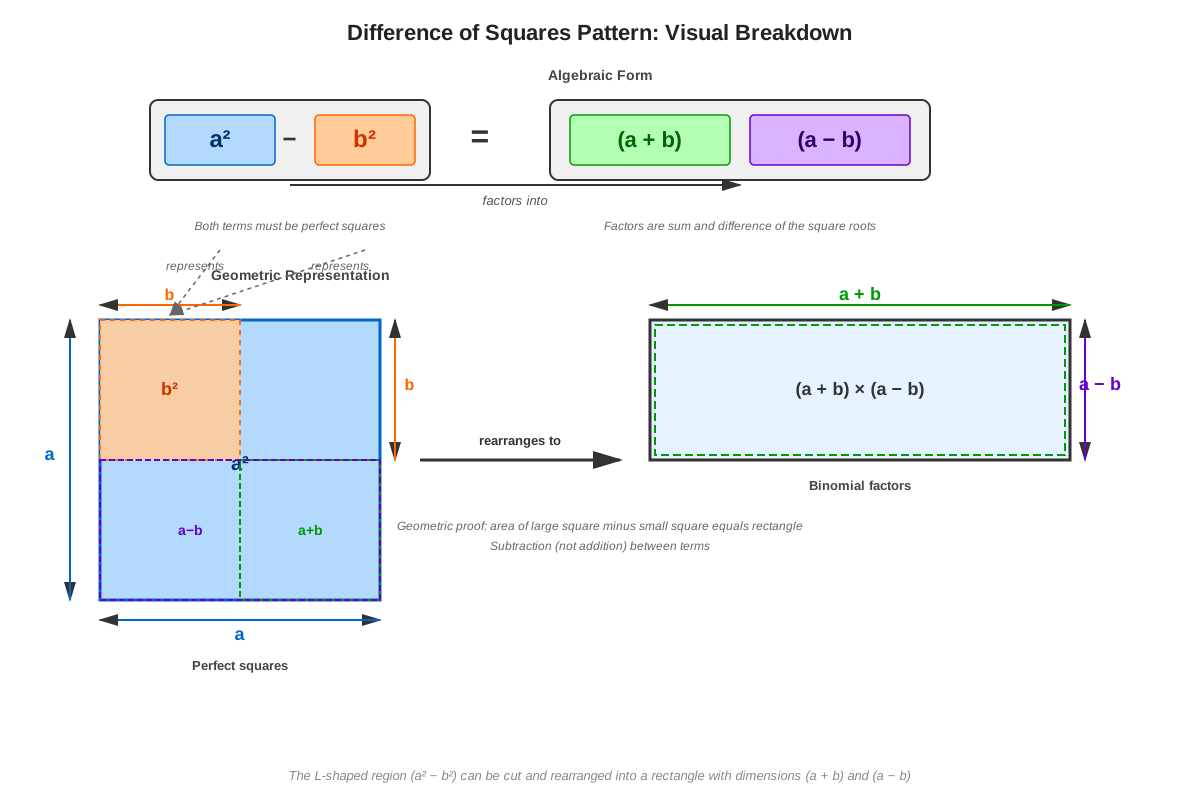
The difference of squares formula states that for any real numbers or algebraic expressions a and b:
a² − b² = (a + b)(a − b)This formula works because when you expand the right side using the distributive property (FOIL), the middle terms cancel:
(a + b)(a − b) = a² − ab + ab − b² = a² − b²The key insight is that the product of a sum and a difference of the same two terms always produces a difference of squares. This bidirectional relationship means you can both factor (going from left to right) and expand (going from right to left) using this pattern.
Identifying Difference of Squares Patterns
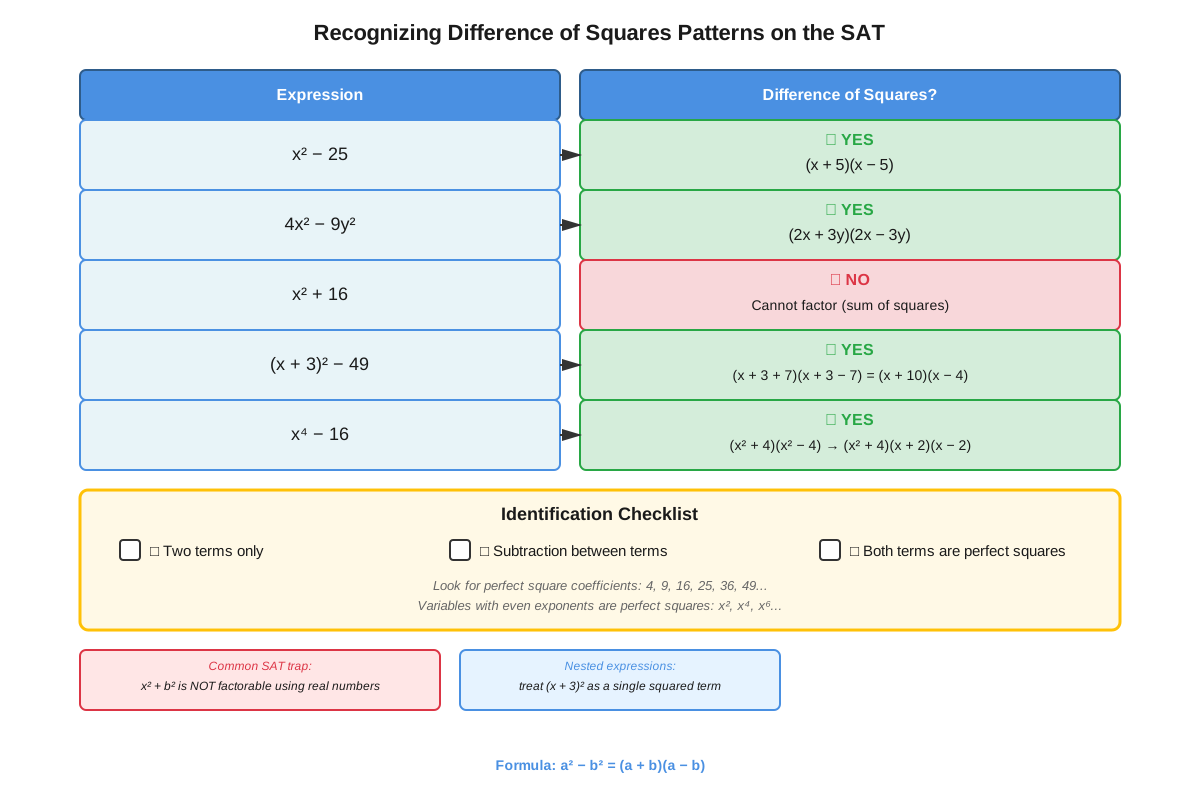
To recognize a difference of squares expression, check for three essential features:
- Two terms only: The expression must contain exactly two terms separated by a subtraction sign
- Both terms are perfect squares: Each term must be a perfect square (a number or expression that can be written as something squared)
- Subtraction operation: The terms must be subtracted, not added (a² + b² does NOT factor using this pattern)
Common perfect squares to memorize include: 1, 4, 9, 16, 25, 36, 49, 64, 81, 100, 121, 144, 169, 196, 225, 256, 289, 324, 361, 400. For variables, any even exponent creates a perfect square: x², x⁴, x⁶, y², y⁸, etc.
Factoring with Coefficients
When coefficients appear in difference of squares problems, extract perfect square factors first. Consider the expression 4x² − 25:
- Recognize that 4x² = (2x)² and 25 = 5²
- Apply the formula: 4x² − 25 = (2x)² − 5² = (2x + 5)(2x − 5)
For expressions like 9a² − 16b², identify both squared terms:
- 9a² = (3a)² and 16b² = (4b)²
- Factor: 9a² − 16b² = (3a + 4b)(3a − 4b)
Multi-Step Factoring
Some expressions require factoring out a greatest common factor (GCF) before applying the difference of squares pattern. For example, 2x² − 32:
- Factor out the GCF of 2: 2(x² − 16)
- Recognize x² − 16 as a difference of squares: x² − 4²
- Factor completely: 2(x + 4)(x − 4)
Nested Difference of Squares
Sometimes factoring reveals another difference of squares pattern. Consider x⁴ − 16:
- Recognize as (x²)² − 4²
- Factor once: (x² + 4)(x² − 4)
- Notice x² − 4 is also a difference of squares: x² − 2²
- Factor completely: (x² + 4)(x + 2)(x − 2)
Note that x² + 4 cannot be factored further using real numbers because it's a sum of squares, not a difference.
Solving Equations Using Difference of Squares
When an equation contains a difference of squares, factor first, then use the zero product property:
For x² − 49 = 0:
- Factor: (x + 7)(x − 7) = 0
- Set each factor equal to zero: x + 7 = 0 or x − 7 = 0
- Solve: x = −7 or x = 7
Simplifying Rational Expressions
The difference of squares pattern frequently appears in fraction simplification problems:
(x² − 9)/(x − 3) = (x + 3)(x − 3)/(x − 3) = x + 3The (x − 3) terms cancel, leaving the simplified expression x + 3 (with the restriction that x ≠ 3).
Comparison Table: Difference of Squares vs. Similar Patterns
| Pattern | Formula | Can Factor? | Example |
|---|---|---|---|
| Difference of squares | a² − b² = (a + b)(a − b) | Yes | x² − 25 = (x + 5)(x − 5) |
| Sum of squares | a² + b² | No (with real numbers) | x² + 25 cannot be factored |
| Difference of cubes | a³ − b³ = (a − b)(a² + ab + b²) | Yes (different formula) | x³ − 8 = (x − 2)(x² + 2x + 4) |
| Perfect square trinomial | a² + 2ab + b² = (a + b)² | Yes (different pattern) | x² + 6x + 9 = (x + 3)² |
Concept Relationships
The difference of squares serves as a central hub connecting multiple algebraic concepts. At its foundation, the pattern relies on exponent rules and perfect squares recognition, which enable students to identify when terms can be written in the form a² and b². The pattern directly builds upon basic factoring techniques, representing a special case that's faster than general factoring methods.
When solving quadratic equations, the difference of squares provides a shortcut alternative to the quadratic formula or completing the square. For equations like x² − c = 0 (where c is positive), recognizing the difference of squares pattern leads immediately to solutions x = ±√c. This connects to the broader concept of solving by factoring, where the zero product property converts factored equations into simpler linear equations.
The relationship flows as: Perfect squares recognition → Difference of squares identification → Factoring → Equation solving or Expression simplification. Additionally, the pattern connects forward to rational expressions and complex fractions, where difference of squares in numerators or denominators enables cancellation and simplification. In geometry applications, the pattern relates to area calculations (difference between two square regions) and distance formulas (differences in coordinate geometry).
High-Yield Facts
⭐ The difference of squares formula is a² − b² = (a + b)(a − b), which works for any real numbers or algebraic expressions
⭐ A sum of squares (a² + b²) CANNOT be factored using real numbers—only differences of squares factor with this pattern
⭐ Both terms in a difference of squares must be perfect squares, and they must be separated by subtraction
⭐ Common perfect squares to memorize: 1, 4, 9, 16, 25, 36, 49, 64, 81, 100, 121, 144, 169, 196, 225
⭐ When coefficients appear, identify what's being squared: 4x² = (2x)², 9y² = (3y)², 25z² = (5z)²
- Variables with even exponents are perfect squares: x², x⁴, x⁶, x⁸, etc.
- Always check for a greatest common factor (GCF) before applying the difference of squares pattern
- After factoring once, check if either factor is also a difference of squares (nested factoring)
- The difference of squares pattern is reversible: (a + b)(a − b) expands to a² − b²
- In rational expressions, difference of squares in numerator or denominator often enables simplification through cancellation
- The solutions to x² − c = 0 are always x = √c and x = −√c (when c is positive)
- Expressions like x⁴ − 16 require recognizing (x²)² as the first squared term
Quick check — test yourself on Difference of squares so far.
Try Flashcards →Common Misconceptions
Misconception: The sum of squares a² + b² can be factored using the same pattern as the difference of squares.
Correction: Only the difference of squares factors with this pattern. The sum of squares a² + b² cannot be factored using real numbers. For example, x² + 25 is already in simplest form and does not factor.
Misconception: The difference of squares formula is (a − b)(a − b) or (a + b)(a + b).
Correction: The formula requires one sum and one difference: (a + b)(a − b). Using two sums gives (a + b)² = a² + 2ab + b², and using two differences gives (a − b)² = a² − 2ab + b², neither of which equals a² − b².
Misconception: Any expression with two terms can be factored as a difference of squares.
Correction: Both terms must be perfect squares. For example, x² − 7 is technically a difference of squares (x² − (√7)²), but on the SAT, you typically work with integer coefficients. The expression 2x² − 8 is not immediately a difference of squares until you factor out the GCF of 2 first.
Misconception: When factoring 4x² − 9, the answer is (4x + 3)(4x − 3).
Correction: You must take the square root of the coefficient along with the variable. Since 4x² = (2x)², the correct factorization is (2x + 3)(2x − 3). A quick check: (4x + 3)(4x − 3) = 16x² − 9, not 4x² − 9.
Misconception: After factoring x² − 16 = (x + 4)(x − 4), the problem is complete even if the original problem was an equation.
Correction: If the original problem was an equation (x² − 16 = 0), you must continue by setting each factor equal to zero and solving: x + 4 = 0 gives x = −4, and x − 4 = 0 gives x = 4. Factoring is a step toward solving, not the final answer.
Misconception: The expression x² − y² factors to (x − y)².
Correction: The difference of squares factors to (x + y)(x − y), not (x − y)². The expression (x − y)² expands to x² − 2xy + y², which includes a middle term. The key feature of the difference of squares is that the middle terms cancel when expanding.
Misconception: Negative signs don't matter in difference of squares problems.
Correction: The order matters for the subtraction. While a² − b² = (a + b)(a − b), the expression b² − a² = (b + a)(b − a), which can also be written as −(a² − b²) = −(a + b)(a − b). Pay attention to which term is being subtracted from which.
Worked Examples
Example 1: Multi-Step Factoring and Equation Solving
Problem: Solve for all values of x: 3x² − 75 = 0
Solution:
Step 1: Identify that this is not immediately a difference of squares because of the coefficient 3. First, factor out the greatest common factor.
3x² − 75 = 0
3(x² − 25) = 0
Step 2: Now recognize that x² − 25 is a difference of squares. Identify the squared terms:
- x² = (x)²
- 25 = 5²
Step 3: Apply the difference of squares formula:
3(x² − 25) = 3(x + 5)(x − 5) = 0
Step 4: Use the zero product property. Since 3 ≠ 0, we need:
(x + 5)(x − 5) = 0
Step 5: Set each factor equal to zero:
x + 5 = 0 or x − 5 = 0
Step 6: Solve each equation:
x = −5 or x = 5
Answer: x = −5 or x = 5
Connection to Learning Objectives: This example demonstrates identifying the difference of squares pattern (even when disguised by a coefficient), applying the factoring formula, and using it to solve an SAT-style equation efficiently.
Example 2: Simplifying a Rational Expression
Problem: Simplify the expression: (x² − 16)/(x² + 8x + 16)
Solution:
Step 1: Factor the numerator. Recognize x² − 16 as a difference of squares:
- x² = (x)²
- 16 = 4²
- x² − 16 = (x + 4)(x − 4)
Step 2: Factor the denominator. Recognize x² + 8x + 16 as a perfect square trinomial (not a difference of squares):
- Check if it matches a² + 2ab + b²
- x² + 8x + 16 = (x + 4)²
Step 3: Rewrite the expression with factored forms:
(x² − 16)/(x² + 8x + 16) = [(x + 4)(x − 4)]/[(x + 4)(x + 4)]
Step 4: Cancel the common factor (x + 4) from numerator and denominator:
[(x + 4)(x − 4)]/[(x + 4)(x + 4)] = (x − 4)/(x + 4)
Step 5: State any restrictions. Since we canceled (x + 4), we must note that x ≠ −4 (the original denominator cannot equal zero).
Answer: (x − 4)/(x + 4), where x ≠ −4
Connection to Learning Objectives: This example shows how the difference of squares appears in rational expressions on the SAT, requiring students to recognize the pattern as part of a larger simplification problem and combine it with other factoring techniques.
Exam Strategy
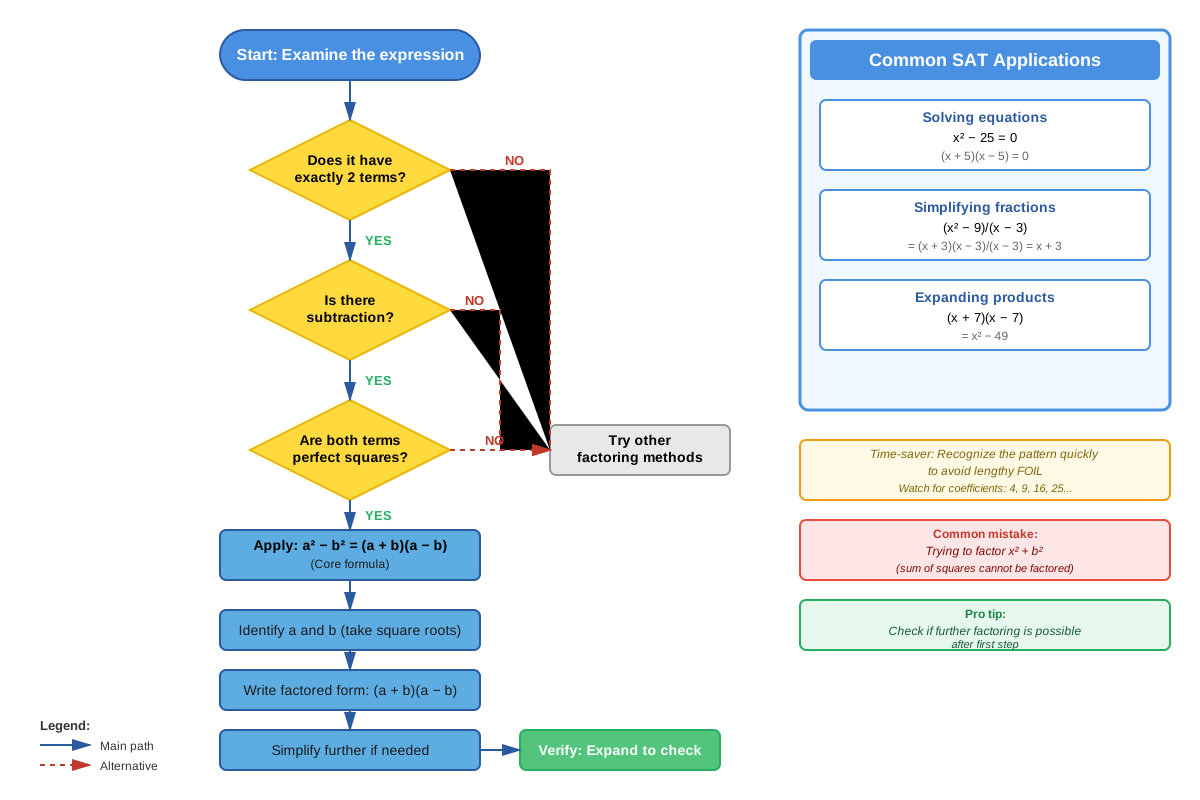
When approaching SAT questions involving the difference of squares, follow this systematic process:
Step 1: Scan for the pattern. Look for expressions with exactly two terms separated by subtraction. Train your eye to spot squared terms, including those with coefficients (4x², 9y², 25z²).
Step 2: Verify perfect squares. Quickly check whether both terms are perfect squares. For numbers, recall your perfect squares up to 400. For variables, check that exponents are even. If coefficients are present, determine what's being squared (e.g., 49x² means (7x)²).
Step 3: Check for GCF first. Before applying the difference of squares formula, always look for a greatest common factor that can be factored out. This is a frequent SAT trap—expressions like 2x² − 32 require factoring out 2 before recognizing the difference of squares pattern.
Step 4: Apply the formula carefully. Write out (a + b)(a − b) explicitly, identifying what a and b represent. Double-check that you've taken square roots correctly, especially with coefficients.
Step 5: Check for nested patterns. After factoring once, examine each factor to see if it's also a difference of squares. Expressions like x⁴ − 81 require multiple applications of the pattern.
Exam Tip: Trigger words and phrases that signal difference of squares problems include "factor completely," "simplify the expression," "solve for all values," and "which of the following is equivalent to." Questions asking you to "factor" or "simplify" are prime candidates for this pattern.
Time allocation: Simple difference of squares problems should take 30-45 seconds. Multi-step problems involving GCF or nested factoring may require 60-90 seconds. If you don't recognize the pattern within 15 seconds, mark the question and return to it later.
Process of elimination tips:
- Eliminate answer choices that show a sum of squares factored (impossible with real numbers)
- Eliminate choices where the middle terms wouldn't cancel when expanded
- Eliminate choices with incorrect signs (both factors shouldn't have the same sign)
- When solving equations, eliminate answer choices that don't satisfy the original equation by substituting back
Common SAT variations: Watch for difference of squares embedded in word problems (area of a square region minus another square region), in systems of equations (where factoring reveals solutions), and in function problems (where f(x) − g(x) might create the pattern).
Memory Techniques
The "DOTS" Acronym: Remember Difference Of Two Squares
- Difference: Must be subtraction, not addition
- Of: The word "of" reminds you it's a product (multiplication) on the factored side
- Two: Exactly two terms in the original expression
- Squares: Both terms must be perfect squares
The "Sum and Difference" Visualization: Picture a number line with a point at +b and another at −b. The distance from −b to +b is 2b, and the midpoint is 0. When you multiply (a + b)(a − b), visualize that the +ab and −ab terms meet at the middle and cancel each other out, leaving only the squared terms at the ends.
The "Perfect Squares Chant": Memorize perfect squares rhythmically: "One-four-nine-sixteen, twenty-five and thirty-six, forty-nine-sixty-four, eighty-one makes one hundred quick!" Continue: "One-twenty-one, one-forty-four, one-sixty-nine, one-ninety-six, two-twenty-five, two-fifty-six..."
The "Coefficient Square Root" Reminder: When you see coefficients, remember "Square root the number, keep the variable." For 25x², think "5x" because √25 = 5 and √(x²) = x.
The "GCF First" Rule: Use the phrase "Get Common Factors First" to remember that factoring out the GCF should always be your first step before applying any special factoring pattern.
The "Opposite Signs" Memory Hook: The factors in a difference of squares always have opposite signs: one plus, one minus. Think of them as "mathematical opposites" that create the cancellation of middle terms.
Summary
The difference of squares is a fundamental algebraic pattern that states a² − b² = (a + b)(a − b), enabling quick factorization of expressions containing two perfect square terms separated by subtraction. This pattern appears frequently on the SAT Math section in various contexts: direct factoring problems, equation solving, rational expression simplification, and embedded within multi-step problems. To successfully apply this concept, students must recognize three key features—exactly two terms, both perfect squares, and a subtraction operation—while remembering that sums of squares cannot be factored using this pattern. Mastery requires checking for greatest common factors before applying the formula, identifying perfect squares even when coefficients are present, and recognizing nested difference of squares patterns that require multiple factoring steps. The bidirectional nature of the formula allows both factoring (left to right) and expanding (right to left), making it a versatile tool for simplification and equation solving. Students who internalize this pattern gain significant time-saving advantages on the SAT, as recognizing the difference of squares often provides the fastest path to correct answers in algebra problems.
Key Takeaways
- The difference of squares formula a² − b² = (a + b)(a − b) is one of the highest-yield patterns on the SAT Math section
- Only differences of squares factor with this pattern; sums of squares (a² + b²) cannot be factored using real numbers
- Always check for a greatest common factor before applying the difference of squares formula
- Both terms must be perfect squares—memorize perfect squares up to at least 400 and recognize that variables with even exponents are perfect squares
- When coefficients appear, take the square root of both the coefficient and the variable: 9x² = (3x)²
- After factoring once, always check whether either factor is also a difference of squares (nested factoring)
- The pattern appears in multiple SAT contexts: direct factoring, equation solving, rational expressions, and word problems involving geometric relationships
Related Topics
Factoring Quadratic Trinomials: After mastering the difference of squares, students progress to factoring expressions like x² + bx + c and ax² + bx + c, which require different techniques but build on the same foundational understanding of factoring as reverse multiplication.
Completing the Square: This technique for solving quadratic equations connects to the difference of squares through the concept of perfect square trinomials and provides an alternative method when the difference of squares pattern doesn't apply.
The Quadratic Formula: Understanding the difference of squares provides insight into why the quadratic formula works and when simpler factoring methods might be more efficient than applying the formula.
Rational Expressions and Complex Fractions: Mastering the difference of squares enables students to simplify complex fractions where the pattern appears in numerators or denominators, a common SAT question type.
Sum and Difference of Cubes: These related patterns (a³ + b³ and a³ − b³) extend the concept of special factoring formulas to cubic expressions, though they appear less frequently on the SAT.
Practice CTA
Now that you've mastered the core concepts of the difference of squares, it's time to solidify your understanding through practice! Attempt the practice questions to test your ability to recognize patterns, apply the formula in various contexts, and solve SAT-style problems efficiently. Use the flashcards to reinforce your memory of perfect squares, the fundamental formula, and common variations. Remember, the difference between knowing the pattern and scoring points on test day is consistent practice. Each problem you solve strengthens your pattern recognition skills and builds the confidence you need to tackle any difference of squares question the SAT presents. You've got this!
Sign up free to keep reading
Create a free AnvayaPrep account to finish this SAT guide on Difference of squares — plus flashcards and practice questions.