Overview
Equivalent polynomial forms represent one of the most strategically important concepts in SAT math, appearing in approximately 10-15% of algebra questions on the test. This topic involves recognizing that a single polynomial expression can be written in multiple algebraically equivalent ways, each revealing different mathematical properties and features. Understanding how to manipulate and interpret these different forms is essential for efficiently solving problems involving zeros, intercepts, vertex coordinates, and factorization.
The SAT frequently tests whether students can identify which form of a polynomial is most useful for extracting specific information. For example, the factored form immediately reveals the x-intercepts of a quadratic function, while the vertex form displays the maximum or minimum value. Students who master sat equivalent polynomial forms gain a significant advantage because they can quickly determine which form to use or create, saving valuable time and avoiding algebraic errors during the exam.
This topic connects deeply to broader polynomial concepts including factoring, expanding expressions, completing the square, and graphing quadratic functions. It also bridges to coordinate geometry, as different polynomial forms correspond to different graphical features. Mastery of equivalent forms provides the foundation for more advanced topics like polynomial division, systems of equations, and function transformations—all of which appear regularly on the SAT.
Learning Objectives
- [ ] Identify key features of equivalent polynomial forms
- [ ] Explain how equivalent polynomial forms appears on the SAT
- [ ] Apply equivalent polynomial forms to answer SAT-style questions
- [ ] Convert between standard, factored, and vertex forms of quadratic expressions
- [ ] Determine which polynomial form most efficiently reveals specific features (zeros, vertex, y-intercept)
- [ ] Recognize algebraically equivalent expressions through expansion and factorization
- [ ] Use polynomial form selection strategically to minimize calculation time on exam questions
Prerequisites
- Basic algebraic manipulation: Ability to expand binomials and combine like terms is essential for converting between polynomial forms
- Factoring techniques: Understanding how to factor quadratics, including greatest common factors and special products, enables recognition of factored forms
- Order of operations: Proper application of PEMDAS ensures accurate expansion and simplification of polynomial expressions
- Function notation: Familiarity with f(x) notation helps interpret polynomial forms as functions and understand their graphical representations
- Coordinate plane basics: Knowledge of x-intercepts, y-intercepts, and vertex concepts connects polynomial forms to their graphical features
Why This Topic Matters
Understanding equivalent polynomial forms has practical applications beyond standardized testing. Engineers use different polynomial forms to model projectile motion, with vertex form revealing maximum height and time to reach it. Economists employ various polynomial representations to analyze cost functions, profit maximization, and break-even points. Computer graphics programmers manipulate polynomial forms to create smooth curves and animations efficiently.
On the SAT, equivalent polynomial forms questions appear in both the calculator and no-calculator sections, typically accounting for 3-5 questions per test. These questions most commonly appear as:
- Multiple-choice questions asking which form reveals a specific feature
- Grid-in questions requiring calculation of zeros or vertex coordinates
- Word problems involving quadratic models where form selection determines solution efficiency
- Questions testing whether students recognize that two different-looking expressions are equivalent
The College Board specifically designs questions to reward students who understand the strategic value of different forms rather than those who simply memorize procedures. Questions often present a polynomial in one form and ask about a feature most easily identified in another form, testing both conceptual understanding and algebraic fluency. Approximately 60% of these questions can be solved in under 30 seconds with proper form recognition, while brute-force algebraic approaches may require 90+ seconds.
Core Concepts
The Three Primary Forms of Quadratic Polynomials
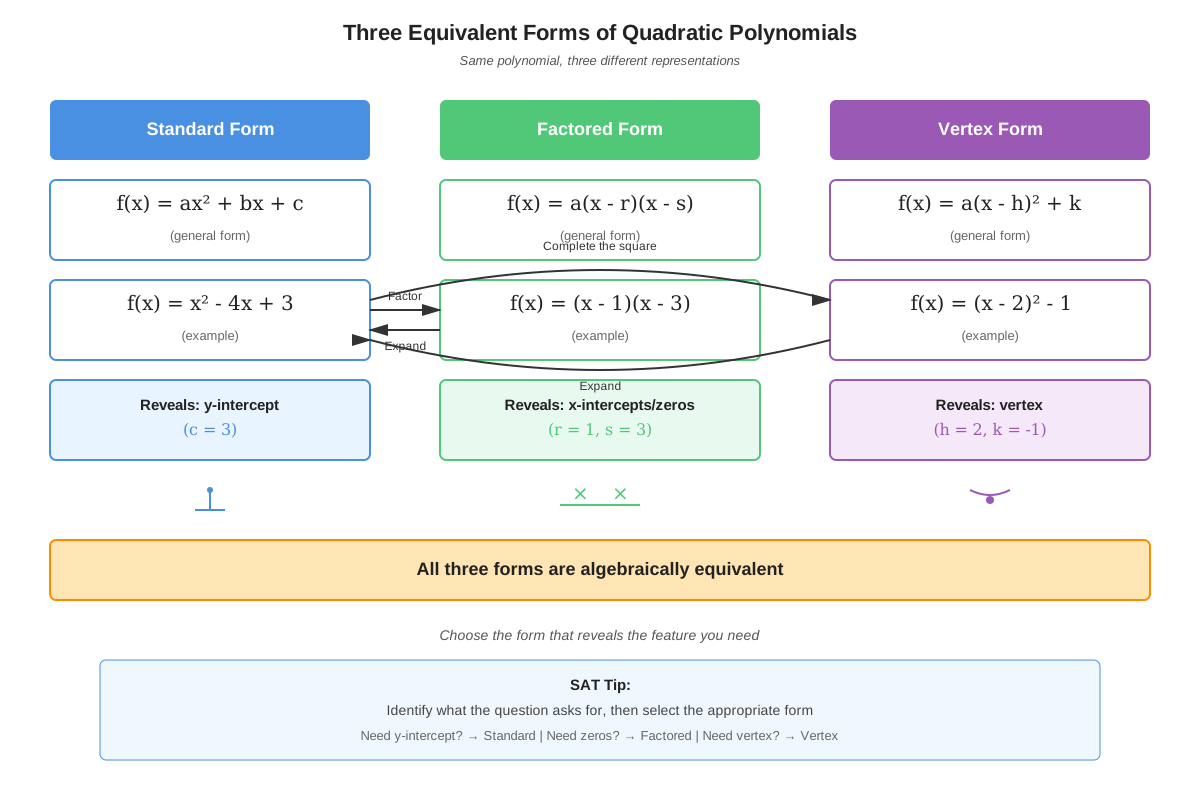
Quadratic polynomials can be expressed in three main equivalent polynomial forms, each optimized for revealing different mathematical features:
Standard Form: f(x) = ax² + bx + c
This form immediately reveals the y-intercept (the value of c) and is the most common form for general algebraic manipulation. The coefficient 'a' determines whether the parabola opens upward (a > 0) or downward (a < 0), while 'b' and 'c' work together to determine the vertex location.
Factored Form: f(x) = a(x - r₁)(x - r₂)
This form directly displays the zeros or x-intercepts of the function (r₁ and r₂). When a polynomial is written in factored form, the solutions to f(x) = 0 are immediately visible. This form is invaluable for quickly identifying where a parabola crosses the x-axis.
Vertex Form: f(x) = a(x - h)² + k
This form explicitly shows the vertex coordinates (h, k), which represent either the maximum or minimum point of the parabola. The value 'a' still indicates the direction of opening and the width of the parabola.
Converting Between Forms
Understanding the conversion process between forms is crucial for SAT success:
Standard to Factored: Requires factoring techniques
- Identify two numbers that multiply to ac and add to b
- Factor by grouping or use the quadratic formula to find zeros
- Express as a(x - r₁)(x - r₂) where r₁ and r₂ are the zeros
Standard to Vertex: Requires completing the square
- Factor out the coefficient of x² from the first two terms
- Take half of the x-coefficient (inside parentheses), square it
- Add and subtract this value inside the parentheses
- Rewrite as a perfect square trinomial
- Simplify to a(x - h)² + k form
Factored to Standard: Requires expansion
- Use FOIL or distributive property to multiply binomials
- Combine like terms
- Distribute the leading coefficient if present
Vertex to Standard: Requires expansion
- Expand the squared binomial: (x - h)² = x² - 2hx + h²
- Distribute the coefficient 'a'
- Combine the constant terms
Identifying Features from Each Form
| Feature | Standard Form | Factored Form | Vertex Form |
|---|---|---|---|
| Y-intercept | c (direct) | a·r₁·r₂ (multiply) | a·h² + k (substitute x=0) |
| X-intercepts | Use quadratic formula | r₁ and r₂ (direct) | Solve (x-h)²=-k/a |
| Vertex | x = -b/(2a), substitute | x = (r₁+r₂)/2, substitute | (h, k) (direct) |
| Axis of symmetry | x = -b/(2a) | x = (r₁+r₂)/2 | x = h (direct) |
| Direction of opening | Sign of a | Sign of a | Sign of a |
Strategic Form Selection
The SAT rewards efficient problem-solving through appropriate form selection:
When to use Standard Form:
- Finding the y-intercept quickly
- Adding or subtracting polynomials
- Taking derivatives (in advanced courses)
- When the problem provides coefficients a, b, and c
When to use Factored Form:
- Identifying zeros or x-intercepts
- Solving equations set equal to zero
- Finding the axis of symmetry (average of zeros)
- Determining the number of real solutions
When to use Vertex Form:
- Finding maximum or minimum values
- Identifying the vertex coordinates directly
- Understanding transformations of parent functions
- Optimization problems
Recognizing Equivalent Expressions
Two polynomial expressions are equivalent if they produce the same output for every input value. The SAT tests this concept by:
- Presenting expanded and factored versions of the same expression
- Asking students to identify which expressions are equivalent
- Testing whether students can verify equivalence through substitution or algebraic manipulation
To verify equivalence:
- Expand or simplify both expressions completely
- Combine all like terms
- Compare coefficients of corresponding terms
- Alternatively, substitute the same x-value into both expressions and verify equal outputs
Higher-Degree Polynomials
While quadratics dominate SAT questions, understanding equivalent forms extends to higher-degree polynomials:
Cubic polynomials may appear in factored form: f(x) = a(x - r₁)(x - r₂)(x - r₃)
The same principle applies: factored form reveals zeros directly, while expanded form shows the y-intercept. The SAT may test whether students can identify the number of x-intercepts from a factored cubic expression or determine the end behavior from the leading coefficient.
Concept Relationships
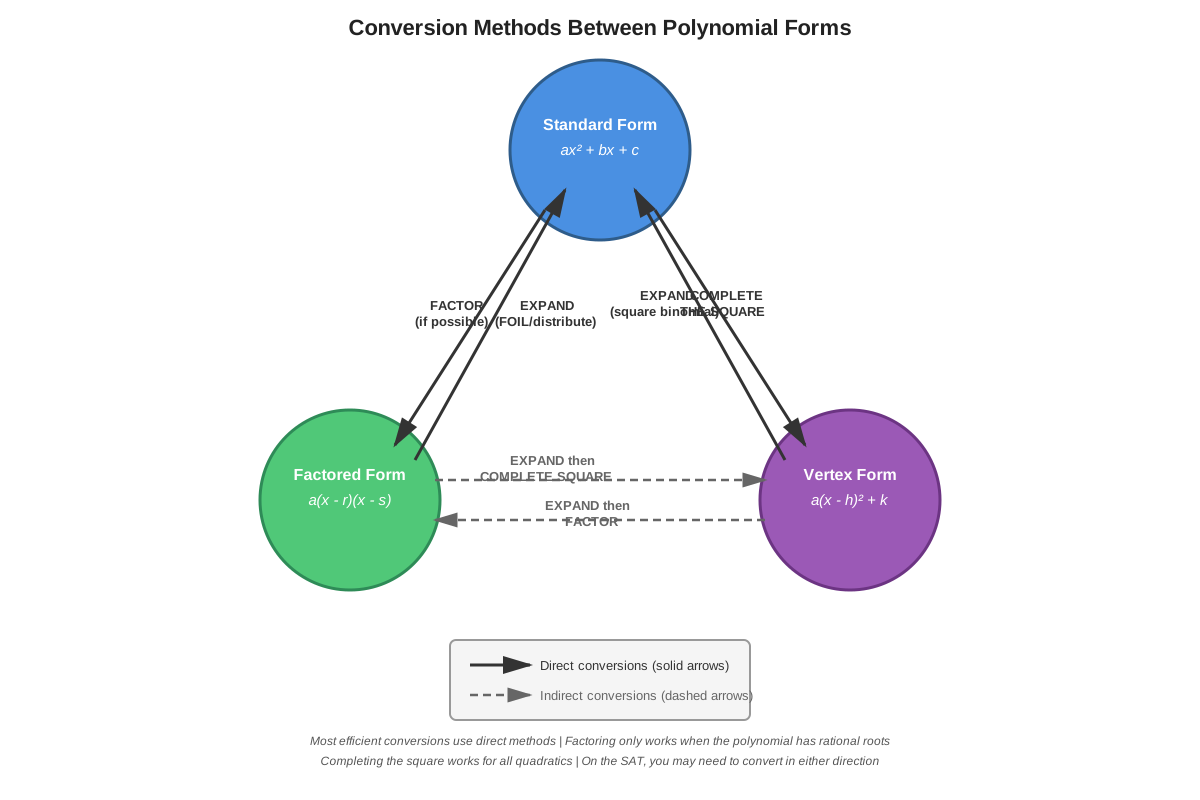
The three primary forms of quadratic polynomials form a triangular relationship where each can be converted to the others through specific algebraic techniques. Standard form serves as the central hub, as it's the most common starting point for conversions. Converting from standard to factored form requires factoring skills or the quadratic formula, while converting to vertex form requires completing the square. Both factored and vertex forms can be converted back to standard form through straightforward expansion.
Within the broader polynomial unit, equivalent forms connect directly to:
- Factoring techniques → enable conversion to factored form
- Graphing quadratics → different forms reveal different graphical features
- Solving quadratic equations → factored form makes solutions immediate
- Function transformations → vertex form shows shifts and stretches explicitly
The relationship map flows as:
Algebraic manipulation skills → Enable form conversions → Reveal specific features → Support efficient problem-solving → Lead to correct SAT answers
Understanding these connections helps students recognize that form selection isn't arbitrary—it's a strategic decision based on what information the question requires.
High-Yield Facts
⭐ Standard form f(x) = ax² + bx + c directly reveals the y-intercept as the value c
⭐ Factored form f(x) = a(x - r₁)(x - r₂) directly reveals the x-intercepts as r₁ and r₂
⭐ Vertex form f(x) = a(x - h)² + k directly reveals the vertex coordinates as (h, k)
⭐ The axis of symmetry in factored form is x = (r₁ + r₂)/2, the average of the zeros
⭐ The sign of the leading coefficient 'a' determines parabola direction in all three forms
- Converting from standard to vertex form requires completing the square
- Two polynomials are equivalent if they produce identical outputs for all input values
- The vertex represents the maximum value when a < 0 and minimum value when a > 0
- Expanding factored form always produces standard form through the distributive property
- The discriminant b² - 4ac determines the number of real zeros but isn't visible in factored or vertex form
- When a quadratic has no real zeros, it cannot be written in factored form using real numbers
- The vertex form constant 'k' represents the maximum or minimum value of the function
Quick check — test yourself on Equivalent polynomial forms so far.
Try Flashcards →Common Misconceptions
Misconception: The numbers in factored form f(x) = (x - 3)(x + 5) are the x-intercepts 3 and 5.
Correction: The x-intercepts are the values that make each factor equal zero, so they are x = 3 and x = -5. The signs are opposite to what appears in the factored form.
Misconception: In vertex form f(x) = 2(x - 4)² + 7, the vertex is at (-4, 7).
Correction: The vertex is at (4, 7). The h-value has the opposite sign from what appears in the expression (x - h)². If the form shows (x - 4), then h = 4, not -4.
Misconception: All quadratic expressions can be factored into integer factors.
Correction: Only quadratics with rational zeros can be factored using integer coefficients. When the discriminant b² - 4ac is not a perfect square, the zeros are irrational, and factoring requires irrational or complex numbers.
Misconception: Two expressions that look different cannot be equivalent.
Correction: Expressions like x² + 6x + 9 and (x + 3)² look completely different but are algebraically equivalent. Appearance doesn't determine equivalence—algebraic manipulation does.
Misconception: The vertex form always has a plus sign: a(x - h)² + k.
Correction: The constant can be negative, giving a(x - h)² - k, which is the same as a(x - h)² + (-k). The vertex would then be at (h, -k).
Misconception: Converting between forms changes the function's graph.
Correction: Equivalent forms represent the same function and produce identical graphs. The form only changes which features are immediately visible, not the mathematical relationship itself.
Worked Examples
Example 1: Form Conversion and Feature Identification
Problem: The function f(x) = x² - 8x + 15 models the height of a projectile. Find the x-intercepts and determine when the projectile reaches its maximum height.
Solution:
Step 1: Identify what information we need
- X-intercepts are most easily found from factored form
- Maximum height requires the vertex, best found from vertex form
Step 2: Convert to factored form to find x-intercepts
- Need two numbers that multiply to 15 and add to -8
- Those numbers are -3 and -5
- f(x) = (x - 3)(x - 5)
- X-intercepts are x = 3 and x = 5
Step 3: Find the axis of symmetry (x-coordinate of vertex)
- In factored form: x = (r₁ + r₂)/2 = (3 + 5)/2 = 4
- Alternatively, from standard form: x = -b/(2a) = -(-8)/(2·1) = 4
Step 4: Find the y-coordinate of the vertex
- Substitute x = 4 into the original equation
- f(4) = (4)² - 8(4) + 15 = 16 - 32 + 15 = -1
Step 5: Interpret the results
- The projectile hits the ground at x = 3 and x = 5 (x-intercepts)
- The maximum height occurs at x = 4 (vertex x-coordinate)
- Since the vertex is at (4, -1) and the parabola opens upward (a = 1 > 0), this actually represents a minimum, not maximum—suggesting the model may represent depth below ground or the problem context needs reconsideration
Connection to Learning Objectives: This example demonstrates applying equivalent polynomial forms to extract multiple features and identifying which form is most efficient for each piece of information.
Example 2: Recognizing Equivalent Expressions
Problem: Which of the following expressions is equivalent to 2x² + 12x + 10?
A) 2(x + 3)² + 8
B) 2(x + 3)² - 8
C) (2x + 2)(x + 5)
D) 2(x + 1)(x + 5)
Solution:
Step 1: Analyze the original expression
- Standard form: 2x² + 12x + 10
- Leading coefficient is 2, so factor it out: 2(x² + 6x + 5)
Step 2: Check option D by factoring
- Factor x² + 6x + 5: need numbers that multiply to 5 and add to 6
- Those are 1 and 5: (x + 1)(x + 5)
- So 2(x + 1)(x + 5) should equal our original expression
- Expand to verify: 2[(x)(x) + (x)(5) + (1)(x) + (1)(5)]
- = 2[x² + 5x + x + 5] = 2[x² + 6x + 5] = 2x² + 12x + 10 ✓
Step 3: Verify option D is correct by checking others
- Option C: (2x + 2)(x + 5) = 2x² + 10x + 2x + 10 = 2x² + 12x + 10 ✓
- Wait—both C and D appear correct. Let's recheck C.
- (2x + 2)(x + 5) = 2x² + 10x + 2x + 10 = 2x² + 12x + 10
- Actually, C is also equivalent! But let's verify by factoring differently.
- (2x + 2)(x + 5) = 2(x + 1)(x + 5), which is option D
- So C and D are the same expression written differently
Step 4: Check the vertex form options (A and B)
- Complete the square on 2(x² + 6x + 5)
- 2[x² + 6x + 9 - 9 + 5] = 2[(x + 3)² - 4]
- = 2(x + 3)² - 8
- This matches option B
Answer: Both B and D are equivalent to the original expression. If the question asks for only one answer, verify the exact wording. Option D (factored form) and Option B (vertex form) are both correct.
Connection to Learning Objectives: This example demonstrates recognizing equivalent expressions across different forms and verifying equivalence through algebraic manipulation.
Exam Strategy
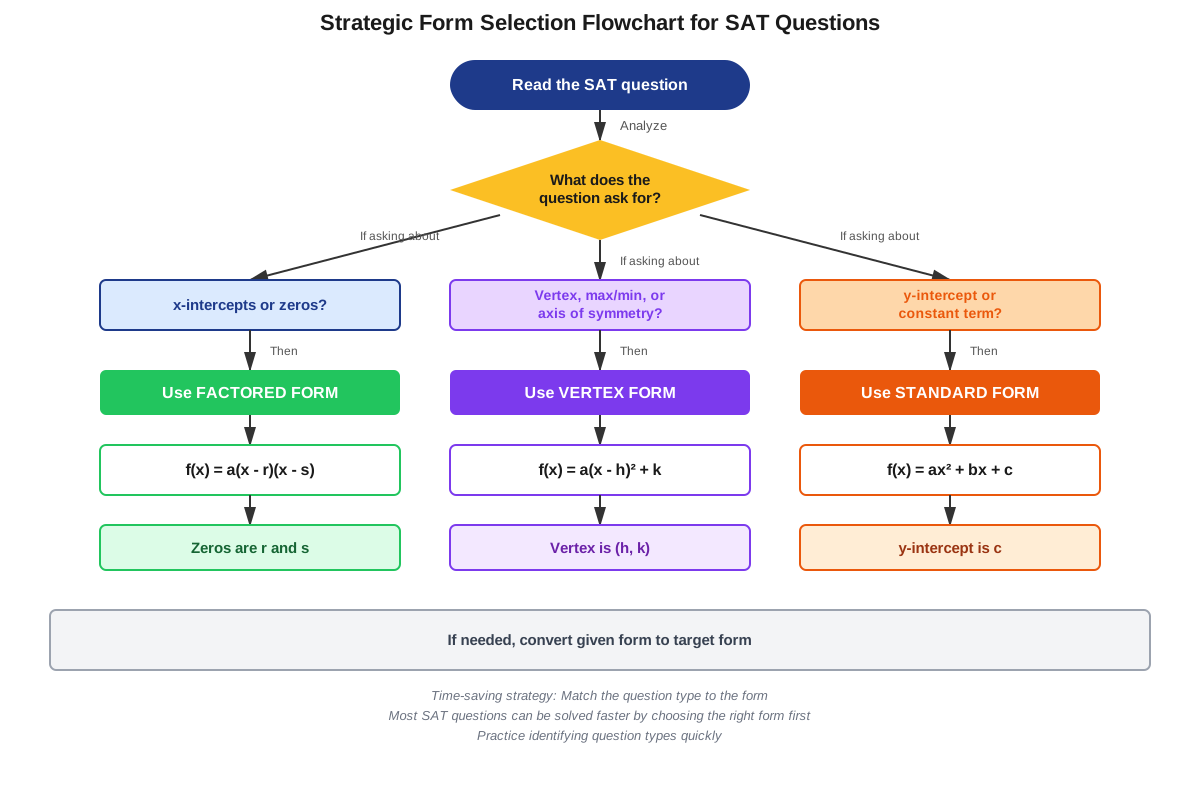
When approaching SAT questions on equivalent polynomial forms, follow this strategic framework:
Step 1: Identify what the question asks for
- Read carefully to determine which feature you need: zeros, vertex, y-intercept, or verification of equivalence
- Underline or circle the specific information requested
Step 2: Determine the optimal form
- If the question asks for x-intercepts or zeros → factored form is most efficient
- If the question asks for maximum/minimum or vertex → vertex form is most efficient
- If the question asks for y-intercept → standard form is most efficient
Step 3: Check the given form
- If the polynomial is already in the optimal form, extract the answer directly
- If not, determine whether conversion is necessary or if there's an alternative approach
Trigger words and phrases to watch for:
- "x-intercepts," "zeros," "roots," "solutions" → think factored form
- "maximum," "minimum," "vertex," "highest point," "lowest point" → think vertex form
- "y-intercept," "initial value," "when x = 0" → think standard form
- "equivalent to," "same as," "can be written as" → prepare to expand or factor
Process-of-elimination tips:
- When verifying equivalent expressions, eliminate options with different leading coefficients first
- Check y-intercepts by substituting x = 0; eliminate options that give different results
- For factored form options, expand the simplest-looking option first
- If two options look similar, identify the single difference and test that specific feature
Time allocation advice:
- Spend 5-10 seconds identifying the optimal form before beginning calculations
- If a conversion requires more than 30 seconds, consider whether there's a shortcut
- On multiple-choice questions, testing answer choices by substitution may be faster than algebraic conversion
- Budget 45-60 seconds for straightforward form identification questions
- Allow 90-120 seconds for questions requiring form conversion and calculation
Exam Tip: If you're stuck on a conversion, substitute x = 0, x = 1, and x = -1 into both the original expression and answer choices. Equivalent expressions must produce identical outputs for all three values.
Memory Techniques
SFV Mnemonic for Form-Feature Matching:
- Standard form shows Starting value (y-intercept)
- Factored form shows Feet on ground (x-intercepts/zeros)
- Vertex form shows Vertex (maximum/minimum point)
The "Opposite Sign Rule" for Vertex and Factored Forms:
Visualize a minus sign as a "sign flipper"
- In f(x) = a(x - h)² + k, if you see (x - 4), the vertex x-coordinate is +4
- In f(x) = a(x - r₁)(x - r₂), if you see (x - 3), the zero is +3
- If you see (x + 5), that's really (x - (-5)), so the value is -5
Conversion Memory Map:
Create a mental triangle with the three forms at each vertex:
- Standard ↔ Factored: "Factor or FOIL"
- Standard ↔ Vertex: "Complete the square or expand"
- Factored ↔ Vertex: "Go through Standard" (no direct conversion)
The "ABC" of Standard Form:
- Affects opening direction and width
- Bridges to the vertex (use -b/2a)
- C is the y-intercept (Crosses the y-axis)
Visualization Strategy:
Picture each form as revealing a different "view" of the same parabola:
- Standard form: looking at where it crosses the y-axis
- Factored form: looking at where it touches the x-axis
- Vertex form: looking at the turning point
Summary
Equivalent polynomial forms represent different algebraic expressions of the same mathematical relationship, each optimized to reveal specific features efficiently. The three primary forms—standard (ax² + bx + c), factored (a(x - r₁)(x - r₂)), and vertex (a(x - h)² + k)—provide immediate access to y-intercepts, x-intercepts, and vertex coordinates respectively. Success on SAT questions requires both the ability to convert between forms through factoring, expansion, and completing the square, and the strategic judgment to select the most efficient form for each question type. Understanding that these forms are mathematically equivalent but strategically different enables students to extract information quickly and accurately, turning potentially time-consuming algebraic manipulations into straightforward feature identification. Mastery of this topic provides a significant competitive advantage on the SAT, as it appears frequently and rewards conceptual understanding over mechanical calculation.
Key Takeaways
- Each polynomial form reveals different features directly: standard shows y-intercept, factored shows zeros, vertex shows maximum/minimum
- Converting between forms requires specific techniques: factoring for standard-to-factored, completing the square for standard-to-vertex, expansion for reverse conversions
- Strategic form selection based on the question's requirements can reduce solution time from 90+ seconds to under 30 seconds
- The signs in factored and vertex forms are opposite to the actual feature values: (x - 3) means the zero or vertex coordinate is +3
- Equivalent expressions produce identical outputs for all inputs, regardless of how different they appear algebraically
- The leading coefficient 'a' determines parabola direction and width in all three forms
- Verification of equivalence can be accomplished through complete algebraic manipulation or strategic substitution of test values
Related Topics
Quadratic Formula and Discriminant: Understanding how b² - 4ac determines the nature and number of solutions connects directly to whether a quadratic can be expressed in factored form with real numbers. This topic extends the concept of zeros beyond what's immediately visible in factored form.
Function Transformations: Vertex form explicitly shows horizontal and vertical shifts, making it the foundation for understanding how transformations affect parent functions. Mastering equivalent forms enables deeper understanding of how algebraic changes produce graphical changes.
Systems of Equations: Solving systems involving quadratic equations often requires strategic form selection to identify intersection points efficiently. The techniques learned here apply directly to finding where two functions have equal values.
Polynomial Division and Remainder Theorem: Higher-degree polynomials extend the concept of equivalent forms, with factored forms revealing all zeros and enabling synthetic division. This topic builds on the factoring skills developed through quadratic equivalence.
Practice CTA
Now that you've mastered the conceptual framework of equivalent polynomial forms, it's time to solidify your understanding through active practice. The practice questions will challenge you to identify optimal forms, convert between representations, and extract features efficiently—exactly as you'll need to do on test day. Each problem you solve strengthens your pattern recognition and builds the automaticity that separates good scores from great scores. Approach the flashcards to reinforce the key form-feature relationships until they become second nature. Remember: understanding the concepts is the first step, but fluent application through practice is what translates to points on the SAT. You've built the foundation—now construct mastery through deliberate practice!
Sign up free to keep reading
Create a free AnvayaPrep account to finish this SAT guide on Equivalent polynomial forms — plus flashcards and practice questions.