Overview
Polynomial basics form one of the most fundamental and frequently tested concepts in SAT math. A polynomial is an algebraic expression consisting of variables and coefficients combined using addition, subtraction, and multiplication, with variables raised to non-negative integer exponents. Understanding polynomials is essential because they appear in approximately 15-20% of SAT Math questions, either directly or as components of more complex problems involving functions, graphs, and algebraic manipulation.
Mastering polynomial basics enables students to tackle a wide range of SAT question types, from straightforward simplification problems to complex word problems involving quadratic relationships. Polynomials serve as the foundation for understanding functions, graphing parabolas, solving systems of equations, and analyzing real-world relationships. The SAT frequently tests polynomial operations (addition, subtraction, multiplication), factoring techniques, evaluation of polynomial expressions, and identification of polynomial characteristics such as degree and leading coefficient.
The relationship between polynomial basics and other SAT Math concepts is extensive and interconnected. Polynomials connect directly to quadratic equations, function notation, coordinate geometry, and even some advanced topics like rational expressions. Students who thoroughly understand polynomial structure and manipulation gain significant advantages in solving complex multi-step problems efficiently, which is crucial for achieving competitive SAT scores under timed conditions.
Learning Objectives
- [ ] Identify key features of Polynomial basics including degree, terms, coefficients, and leading coefficient
- [ ] Explain how Polynomial basics appears on the SAT in various question formats and contexts
- [ ] Apply Polynomial basics to answer SAT-style questions involving operations and simplification
- [ ] Perform addition, subtraction, and multiplication operations on polynomials accurately
- [ ] Classify polynomials by degree and number of terms
- [ ] Evaluate polynomial expressions for given variable values
- [ ] Recognize and apply the distributive property in polynomial multiplication
Prerequisites
- Basic algebraic operations: Understanding how to combine like terms and apply the distributive property is essential for polynomial manipulation
- Exponent rules: Knowledge of how to multiply and divide expressions with exponents enables proper handling of polynomial terms
- Order of operations: Correctly evaluating expressions requires following PEMDAS when working with polynomials
- Variable manipulation: Comfort working with variables and coefficients forms the foundation for all polynomial work
- Integer arithmetic: Proficiency with positive and negative numbers ensures accurate coefficient calculations
Why This Topic Matters
Polynomials represent one of the most practical mathematical tools for modeling real-world phenomena. Engineers use polynomial equations to describe trajectories of projectiles, economists employ them to model cost and revenue functions, and scientists utilize polynomials to approximate complex relationships in nature. The parabolic path of a basketball shot, the profit function of a business, and the growth pattern of certain populations can all be represented using polynomial expressions.
On the SAT, polynomial questions appear in both the calculator and no-calculator sections, accounting for approximately 4-6 questions per test. These questions test polynomial operations (30% of polynomial questions), factoring and solving (40%), and applications in word problems (30%). The College Board consistently includes polynomial questions because they assess fundamental algebraic reasoning skills that predict success in college-level mathematics.
Common SAT question formats include: simplifying polynomial expressions by combining like terms; multiplying binomials and polynomials using the distributive property; identifying equivalent polynomial expressions; evaluating polynomials for specific variable values; determining the degree or number of terms in a polynomial; and solving word problems where relationships are modeled by polynomial expressions. Questions may appear as multiple-choice, grid-in responses, or as part of multi-step problems requiring polynomial manipulation as an intermediate step.
Core Concepts
Definition and Structure of Polynomials
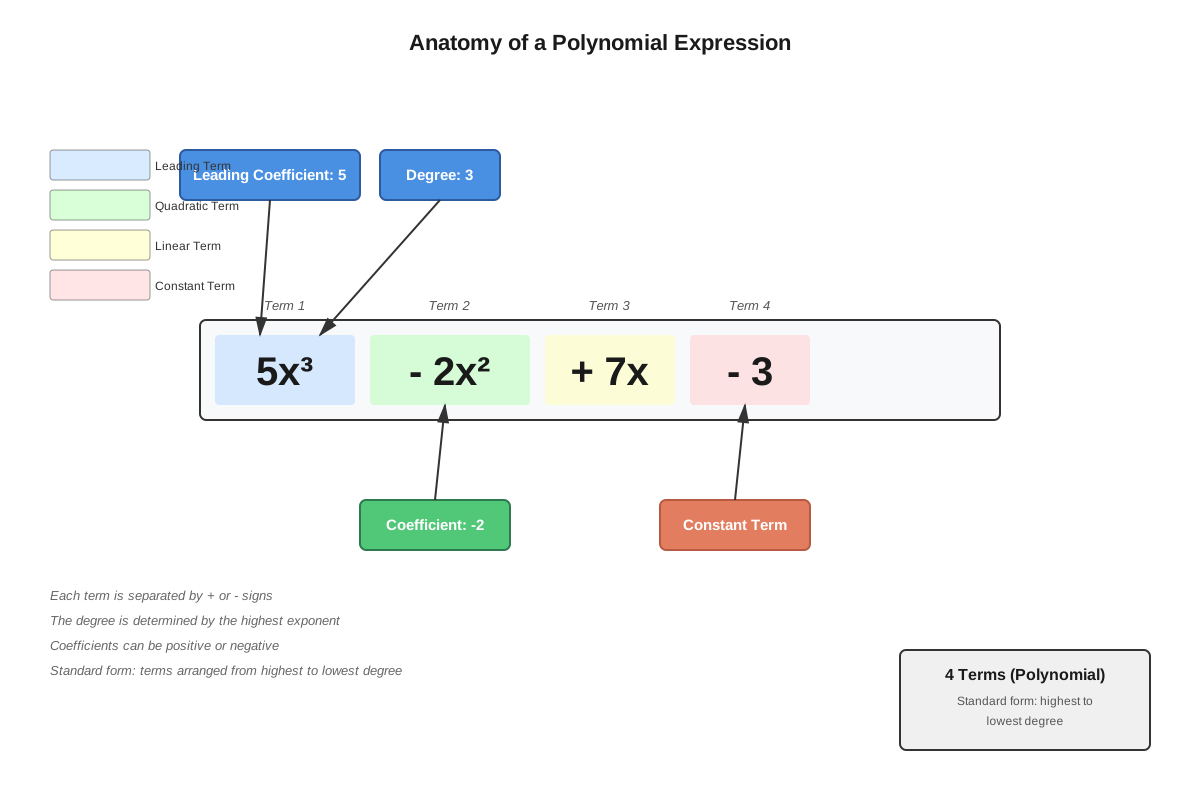
A polynomial is an algebraic expression consisting of one or more terms, where each term is the product of a coefficient (a number) and one or more variables raised to non-negative integer exponents. The general form of a polynomial in one variable x is:
a_n x^n + a_(n-1) x^(n-1) + ... + a_2 x^2 + a_1 x + a_0Each component of a polynomial term has specific terminology. The coefficient is the numerical factor multiplying the variable(s). The degree of a term is the sum of all exponents on variables in that term. The degree of a polynomial is the highest degree among all its terms. The leading coefficient is the coefficient of the term with the highest degree, and the constant term is the term without any variables.
For example, in the polynomial 3x⁴ - 2x² + 7x - 5:
- The degree is 4
- The leading coefficient is 3
- The constant term is -5
- There are 4 terms total
Classification of Polynomials
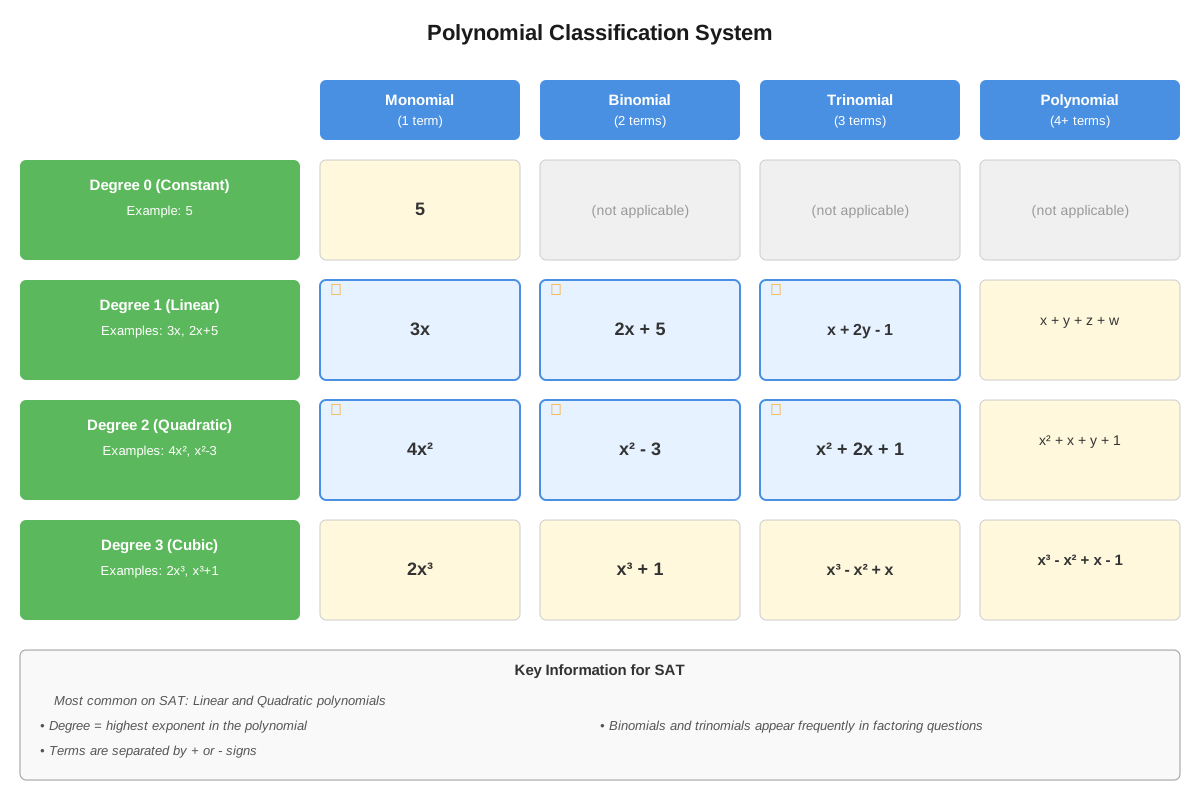
Polynomials can be classified by both their degree and the number of terms they contain. Understanding these classifications helps identify polynomial types quickly on the SAT.
Classification by Number of Terms:
| Name | Number of Terms | Example |
|---|---|---|
| Monomial | 1 | 5x³ |
| Binomial | 2 | 3x² - 7 |
| Trinomial | 3 | x² + 4x - 12 |
| Polynomial | 4 or more | 2x⁴ - x³ + 3x - 8 |
Classification by Degree:
| Degree | Name | Standard Form | Example |
|---|---|---|---|
| 0 | Constant | a | 7 |
| 1 | Linear | ax + b | 3x - 2 |
| 2 | Quadratic | ax² + bx + c | x² + 5x + 6 |
| 3 | Cubic | ax³ + bx² + cx + d | 2x³ - x + 4 |
| 4 | Quartic | ax⁴ + bx³ + cx² + dx + e | x⁴ + 2x² - 1 |
Polynomial Operations: Addition and Subtraction
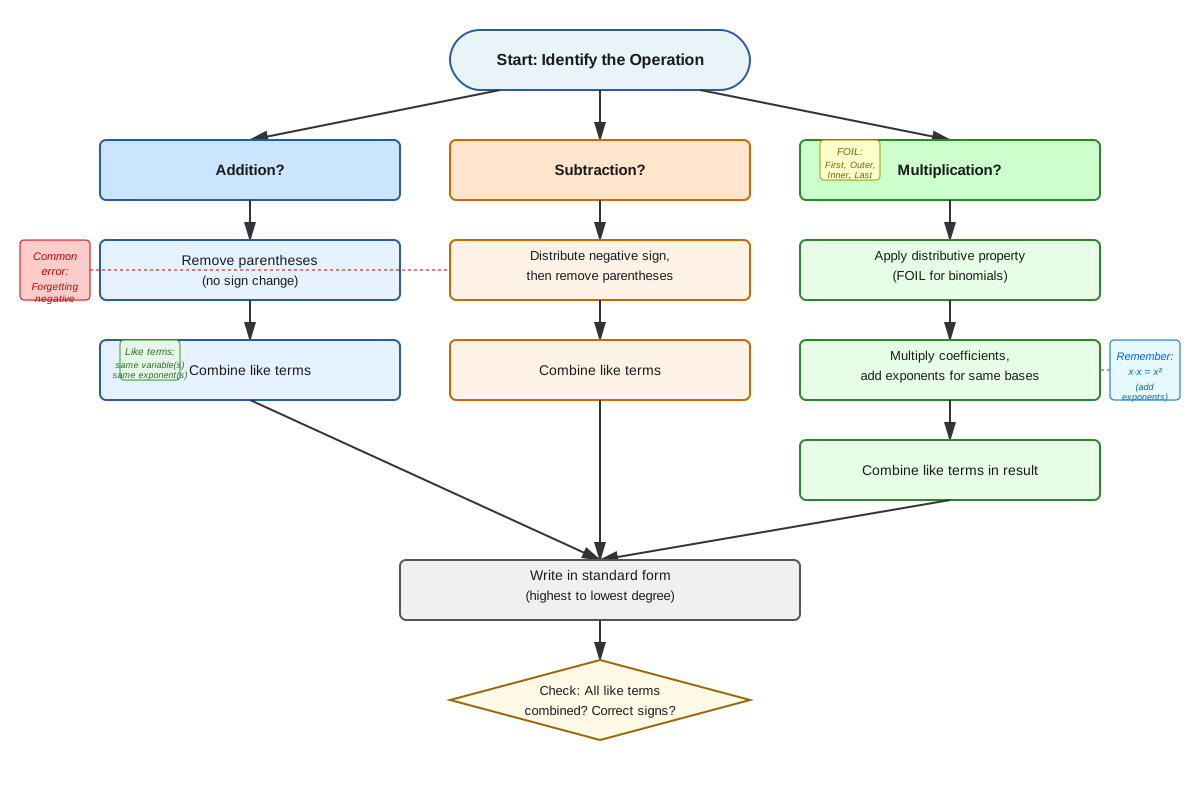
Adding and subtracting polynomials requires combining like terms—terms that have identical variable parts with the same exponents. The process involves:
- Identify like terms (same variables with same exponents)
- Add or subtract the coefficients of like terms
- Keep the variable part unchanged
- Write the result in standard form (descending order of exponents)
Example: Add (3x² + 5x - 2) + (2x² - 3x + 7)
Step 1: Group like terms: (3x² + 2x²) + (5x - 3x) + (-2 + 7)
Step 2: Combine coefficients: 5x² + 2x + 5
When subtracting polynomials, distribute the negative sign to all terms in the second polynomial before combining like terms.
Example: Subtract (4x³ - 2x + 1) - (x³ + 3x - 5)
Step 1: Distribute negative: 4x³ - 2x + 1 - x³ - 3x + 5
Step 2: Combine like terms: 3x³ - 5x + 6
Polynomial Multiplication
Multiplying polynomials requires applying the distributive property systematically. Each term in the first polynomial must multiply every term in the second polynomial.
Multiplying Monomials: Multiply coefficients and add exponents of like bases.
- Example: (3x²)(4x³) = 12x⁵
Multiplying a Monomial by a Polynomial: Distribute the monomial to each term.
- Example: 2x(3x² - 5x + 4) = 6x³ - 10x² + 8x
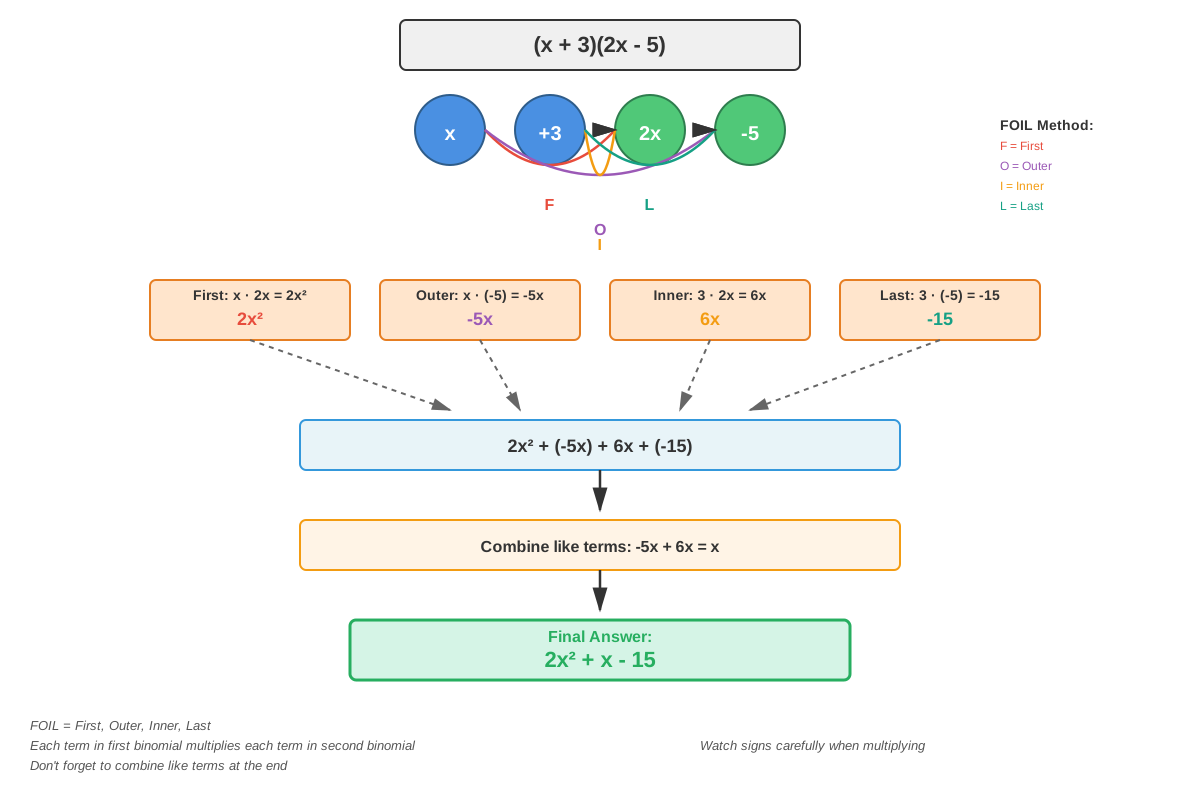
Multiplying Binomials: Use the FOIL method (First, Outer, Inner, Last) or the distributive property.
- Example: (2x + 3)(x - 4)
- First: 2x · x = 2x²
- Outer: 2x · (-4) = -8x
- Inner: 3 · x = 3x
- Last: 3 · (-4) = -12
- Result: 2x² - 5x - 12
Multiplying Larger Polynomials: Apply the distributive property systematically, then combine like terms.
Evaluating Polynomials
Evaluating a polynomial means finding its value when the variable(s) are replaced with specific numbers. This is a common SAT question type that tests both polynomial understanding and careful arithmetic.
Process for evaluation:
- Substitute the given value for each variable
- Calculate exponents first
- Perform multiplication
- Add and subtract from left to right
Example: Evaluate 2x³ - 5x² + 3x - 7 when x = -2
Step 1: 2(-2)³ - 5(-2)² + 3(-2) - 7
Step 2: 2(-8) - 5(4) + 3(-2) - 7
Step 3: -16 - 20 - 6 - 7
Step 4: -49
Standard Form and Descending Order
Polynomials are typically written in standard form, which means arranging terms in descending order of degree (highest exponent first). This convention makes polynomials easier to read and compare.
Non-standard form: 5 + 3x - 2x³ + x²
Standard form: -2x³ + x² + 3x + 5
Writing polynomials in standard form immediately reveals the degree and leading coefficient, both of which are frequently tested on the SAT.
Concept Relationships
The concepts within polynomial basics build upon each other in a logical progression. Understanding the structure of polynomials (terms, coefficients, degree) → enables → classification of polynomials (by degree and number of terms) → which facilitates → recognition of appropriate operations (addition, subtraction, multiplication).
Polynomial operations connect directly to prerequisite knowledge: combining like terms relies on basic algebraic manipulation, while polynomial multiplication extends the distributive property. The ability to evaluate polynomials synthesizes all previous concepts, requiring understanding of structure, order of operations, and exponent rules.
These polynomial basics serve as prerequisites for more advanced SAT topics. Polynomial operations → lead to → factoring polynomials → which enables → solving polynomial equations. Understanding polynomial degree → connects to → graphing polynomial functions and analyzing their behavior. Polynomial evaluation → relates to → function notation where f(x) represents a polynomial expression.
The relationship between polynomial basics and coordinate geometry is particularly important: the degree of a polynomial determines the maximum number of x-intercepts its graph can have, and the leading coefficient affects whether the graph rises or falls on the right side. These connections frequently appear in multi-concept SAT questions.
Quick check — test yourself on Polynomial basics so far.
Try Flashcards →High-Yield Facts
⭐ A polynomial's degree is determined by the term with the highest exponent, not by the number of terms
⭐ When adding or subtracting polynomials, only combine like terms—terms with identical variable parts and exponents
⭐ The product of two binomials always produces at most four terms before combining like terms (FOIL method)
⭐ When multiplying terms with the same base, add the exponents: x^a · x^b = x^(a+b)
⭐ A polynomial in one variable with degree n can have at most n terms when written in standard form
- The leading coefficient is the coefficient of the term with the highest degree
- A constant polynomial (like 5 or -3) has degree 0, not degree 1
- When subtracting polynomials, distribute the negative sign to every term in the second polynomial
- Polynomial multiplication requires every term in the first polynomial to multiply every term in the second
- Standard form arranges polynomial terms in descending order of exponents (highest to lowest)
- The constant term in a polynomial is the term without any variables
- Coefficients can be any real number, including fractions, decimals, and negative numbers
- When evaluating polynomials, always calculate exponents before multiplication
- Like terms must have exactly the same variables raised to exactly the same powers
- A monomial is both a polynomial and a single term
Common Misconceptions
Misconception: The degree of a polynomial equals the number of terms it contains.
Correction: The degree is the highest exponent on any variable in the polynomial, completely independent of how many terms exist. For example, x + x² + x³ has 3 terms but degree 3, while 5x⁷ has 1 term but degree 7.
Misconception: When multiplying (x + 3)², the result is x² + 9.
Correction: Squaring a binomial requires multiplying it by itself completely: (x + 3)² = (x + 3)(x + 3) = x² + 3x + 3x + 9 = x² + 6x + 9. The middle term cannot be omitted.
Misconception: Like terms are any terms that appear in the same polynomial.
Correction: Like terms must have identical variable parts with identical exponents. The terms 3x² and 5x are NOT like terms because the exponents differ. Only 3x² and -7x² would be like terms.
Misconception: When subtracting polynomials, only subtract the first term of the second polynomial.
Correction: The subtraction (negative sign) must distribute to every term in the second polynomial. For (5x - 3) - (2x - 7), the result is 5x - 3 - 2x + 7 = 3x + 4, not 5x - 3 - 2x - 7.
Misconception: The coefficient of x is 0 when x appears alone.
Correction: When a variable appears without a visible coefficient, the coefficient is 1 (or -1 if preceded by a negative sign). The term x is equivalent to 1x, and -x is equivalent to -1x.
Misconception: Polynomial multiplication is commutative, so the order of operations doesn't matter when combining terms.
Correction: While multiplication itself is commutative (ab = ba), the process of distributing and combining like terms must be done carefully. Each term from the first polynomial must multiply each term from the second polynomial—missing any combination leads to incorrect results.
Misconception: A polynomial can have negative or fractional exponents.
Correction: By definition, polynomials can only have non-negative integer exponents (0, 1, 2, 3, ...). Expressions like x^(-2) or x^(1/2) are not polynomials; they are rational expressions or radical expressions.
Worked Examples
Example 1: Polynomial Operations and Simplification
Problem: Simplify the expression 3(2x² - 5x + 1) - 2(x² + 3x - 4) and identify the degree and leading coefficient of the result.
Solution:
Step 1: Distribute the coefficients to each polynomial
- 3(2x² - 5x + 1) = 6x² - 15x + 3
- 2(x² + 3x - 4) = 2x² + 6x - 8
Step 2: Rewrite the expression with distributed terms
- 6x² - 15x + 3 - (2x² + 6x - 8)
Step 3: Distribute the negative sign to the second polynomial
- 6x² - 15x + 3 - 2x² - 6x + 8
Step 4: Group like terms
- (6x² - 2x²) + (-15x - 6x) + (3 + 8)
Step 5: Combine like terms
- 4x² - 21x + 11
Answer: The simplified polynomial is 4x² - 21x + 11, which has degree 2 and leading coefficient 4.
Connection to Learning Objectives: This problem demonstrates the application of polynomial basics to SAT-style questions, requiring both addition/subtraction operations and identification of key polynomial features (degree and leading coefficient).
Example 2: Polynomial Multiplication and Evaluation
Problem: If p(x) = (x - 3)(2x + 5), find p(4).
Solution:
Method 1: Multiply first, then evaluate
Step 1: Multiply the binomials using FOIL
- First: x · 2x = 2x²
- Outer: x · 5 = 5x
- Inner: -3 · 2x = -6x
- Last: -3 · 5 = -15
Step 2: Combine like terms
- p(x) = 2x² + 5x - 6x - 15 = 2x² - x - 15
Step 3: Evaluate at x = 4
- p(4) = 2(4)² - 4 - 15
- p(4) = 2(16) - 4 - 15
- p(4) = 32 - 4 - 15
- p(4) = 13
Method 2: Substitute first, then calculate (often faster)
Step 1: Substitute x = 4 into the original expression
- p(4) = (4 - 3)(2(4) + 5)
Step 2: Simplify inside parentheses
- p(4) = (1)(8 + 5)
- p(4) = (1)(13)
- p(4) = 13
Answer: p(4) = 13
Connection to Learning Objectives: This problem illustrates two valid approaches to evaluating polynomials, demonstrating flexibility in problem-solving. It also shows how polynomial multiplication and evaluation work together, key skills for SAT success.
Exam Strategy
When approaching SAT polynomial questions, begin by identifying what the question asks: simplification, evaluation, identification of features, or solving. Read carefully to determine whether you need to perform operations or simply recognize polynomial characteristics.
Trigger words and phrases to watch for:
- "Simplify" or "combine" → perform operations and combine like terms
- "Equivalent to" → look for expressions that match after simplification
- "Degree of" → identify the highest exponent
- "When x = ..." or "evaluate" → substitute and calculate
- "Leading coefficient" → find the coefficient of the highest-degree term
- "In terms of" → express the answer as a polynomial in the specified variable
Process-of-elimination strategies:
- Quickly check the degree: if the question involves adding two quadratics, eliminate any answer choices that aren't quadratic
- Verify the constant term: this is often the easiest term to calculate and can eliminate wrong answers
- Test with x = 0: substituting zero makes most terms disappear, leaving only the constant term for quick verification
- Check signs: if you're subtracting polynomials, ensure the signs in answer choices reflect proper distribution of the negative
Time allocation advice:
Straightforward polynomial operations (addition, subtraction, simple multiplication) should take 30-60 seconds. More complex problems involving multiple steps or evaluation may require 90-120 seconds. If a polynomial question is taking longer than 2 minutes, mark it and return later—these questions rarely require advanced techniques, so extended time usually indicates a misunderstanding that won't resolve quickly.
Exam Tip: When multiplying polynomials, write out all terms before combining. Trying to combine terms mentally often leads to errors. The few extra seconds spent writing clearly saves time by preventing mistakes.
Memory Techniques
FOIL for Binomial Multiplication: First, Outer, Inner, Last
- Helps remember to multiply all four combinations when multiplying two binomials
- Example: (a + b)(c + d) = ac + ad + bc + bd
"Like Likes Like" for Combining Terms: Only like terms can combine—visualize terms as people who only talk to others exactly like themselves (same variables, same exponents)
LEAD for Polynomial Features:
- Leading coefficient (coefficient of highest-degree term)
- Exponent (highest exponent = degree)
- Arrange in descending order (standard form)
- Degree determines classification (linear, quadratic, cubic, etc.)
Degree Hierarchy Visualization: Picture a staircase where each step represents a degree level:
- Ground floor (0) = Constant
- First floor (1) = Linear
- Second floor (2) = Quadratic
- Third floor (3) = Cubic
- Fourth floor (4) = Quartic
"Distribute or Die" for Subtraction: When subtracting polynomials, imagine the negative sign as a virus that must infect (change the sign of) every term in the second polynomial
Summary
Polynomial basics represent essential algebraic knowledge for SAT success, encompassing the structure, classification, and manipulation of polynomial expressions. A polynomial consists of terms with variables raised to non-negative integer exponents, and understanding its components—coefficients, degree, leading coefficient, and constant term—enables quick identification of polynomial characteristics. The three fundamental operations (addition, subtraction, and multiplication) all rely on systematic application of combining like terms and the distributive property. Classification by degree (constant, linear, quadratic, cubic, quartic) and by number of terms (monomial, binomial, trinomial) provides a framework for recognizing polynomial types instantly. Evaluation requires careful substitution and adherence to order of operations. Success on SAT polynomial questions demands both conceptual understanding and procedural fluency, as questions may test direct operations, identification of equivalent expressions, or evaluation for specific values. Mastery of these basics provides the foundation for more advanced algebraic topics and appears in approximately 15-20% of SAT Math questions.
Key Takeaways
- Polynomials are expressions with variables raised to non-negative integer exponents, combined using addition, subtraction, and multiplication
- The degree of a polynomial is the highest exponent, and the leading coefficient is the coefficient of that highest-degree term
- Adding and subtracting polynomials requires combining like terms—terms with identical variables and exponents
- Multiplying polynomials uses the distributive property: every term in the first polynomial multiplies every term in the second
- Standard form arranges polynomial terms in descending order of exponents, making degree and leading coefficient immediately visible
- Polynomial evaluation requires substituting values for variables and carefully following order of operations
- Classification by degree (linear, quadratic, cubic) and by number of terms (monomial, binomial, trinomial) helps identify polynomial types quickly on the SAT
Related Topics
Factoring Polynomials: Building on polynomial basics, factoring reverses the multiplication process to express polynomials as products of simpler expressions. Mastering polynomial operations makes factoring techniques more intuitive and accessible.
Quadratic Equations and Functions: Quadratic polynomials (degree 2) form a major SAT topic. Understanding polynomial basics provides the foundation for solving quadratic equations, graphing parabolas, and analyzing quadratic functions.
Polynomial Division: Long division and synthetic division of polynomials extend basic operations. These techniques appear less frequently on the SAT but build on the same principles of combining like terms and systematic calculation.
Rational Expressions: Ratios of polynomials create rational expressions. Mastery of polynomial operations is essential for simplifying, adding, subtracting, multiplying, and dividing rational expressions.
Function Notation and Composition: Many functions on the SAT are polynomial functions. Understanding polynomial evaluation directly translates to working with function notation f(x) and composite functions.
Practice CTA
Now that you've mastered the fundamentals of polynomial basics, it's time to solidify your understanding through practice. Attempt the practice questions to test your ability to identify polynomial features, perform operations accurately, and solve SAT-style problems under timed conditions. Use the flashcards to reinforce key terminology and concepts until they become automatic. Remember: polynomial questions appear frequently on the SAT, and consistent practice with these basics will build the confidence and speed you need to excel. Every polynomial problem you solve strengthens your algebraic foundation and brings you closer to your target score!
Sign up free to keep reading
Create a free AnvayaPrep account to finish this SAT guide on Polynomial basics — plus flashcards and practice questions.