Overview
Polynomial word problems represent a critical intersection of algebraic manipulation and real-world application on the SAT math section. These problems require students to translate verbal descriptions into polynomial expressions, equations, or functions, then apply algebraic techniques to solve for unknown quantities. Unlike straightforward computational problems, polynomial word problems test both conceptual understanding and the ability to model situations mathematically—a skill that distinguishes high-scoring students from average performers.
The SAT frequently embeds polynomial concepts within contextual scenarios involving area, volume, revenue, profit, population growth, and physical relationships. Students must recognize when a situation calls for polynomial modeling, set up appropriate equations (often quadratic or cubic), and solve using factoring, the quadratic formula, or graphical analysis. These problems typically appear in both the calculator and no-calculator sections, with 2-4 questions per test directly involving polynomial applications.
Mastering sat polynomial word problems strengthens broader mathematical reasoning skills essential for success across the entire math section. This topic connects polynomial operations, factoring techniques, function analysis, and coordinate geometry into a unified problem-solving framework. Students who excel at polynomial word problems demonstrate the analytical thinking and mathematical maturity that colleges value, making this a high-yield area for focused preparation.
Learning Objectives
- [ ] Identify key features of polynomial word problems, including degree, variables, and contextual constraints
- [ ] Explain how polynomial word problems appears on the SAT, including common scenarios and question formats
- [ ] Apply polynomial word problems to answer SAT-style questions with accuracy and efficiency
- [ ] Translate verbal descriptions into polynomial expressions and equations
- [ ] Determine appropriate solution methods based on polynomial structure and context
- [ ] Interpret polynomial solutions within the constraints of real-world scenarios
- [ ] Recognize when to eliminate extraneous solutions based on contextual reasonableness
Prerequisites
- Basic polynomial operations: Adding, subtracting, multiplying, and dividing polynomials forms the foundation for manipulating expressions in word problems
- Factoring techniques: Factoring quadratics and recognizing special patterns enables solving polynomial equations efficiently
- Quadratic formula: This tool provides a reliable method for solving quadratic equations when factoring proves difficult
- Function notation: Understanding f(x) notation helps interpret polynomial relationships in context
- Area and volume formulas: Geometric applications frequently appear in polynomial word problems, requiring knowledge of basic formulas
Why This Topic Matters
Polynomial word problems appear on every SAT administration, typically comprising 8-12% of the math section's questions. The College Board emphasizes "Problem Solving and Data Analysis" and "Heart of Algebra" domains, both of which heavily feature polynomial applications. These questions often carry medium-to-high difficulty ratings, making them crucial for students targeting scores above 650.
In real-world contexts, polynomial models describe countless phenomena: projectile motion follows quadratic paths, business revenue often exhibits polynomial relationships with price and quantity, and engineering designs frequently involve polynomial constraints. Understanding how to work with these models develops quantitative literacy essential for STEM fields, economics, and data-driven decision-making.
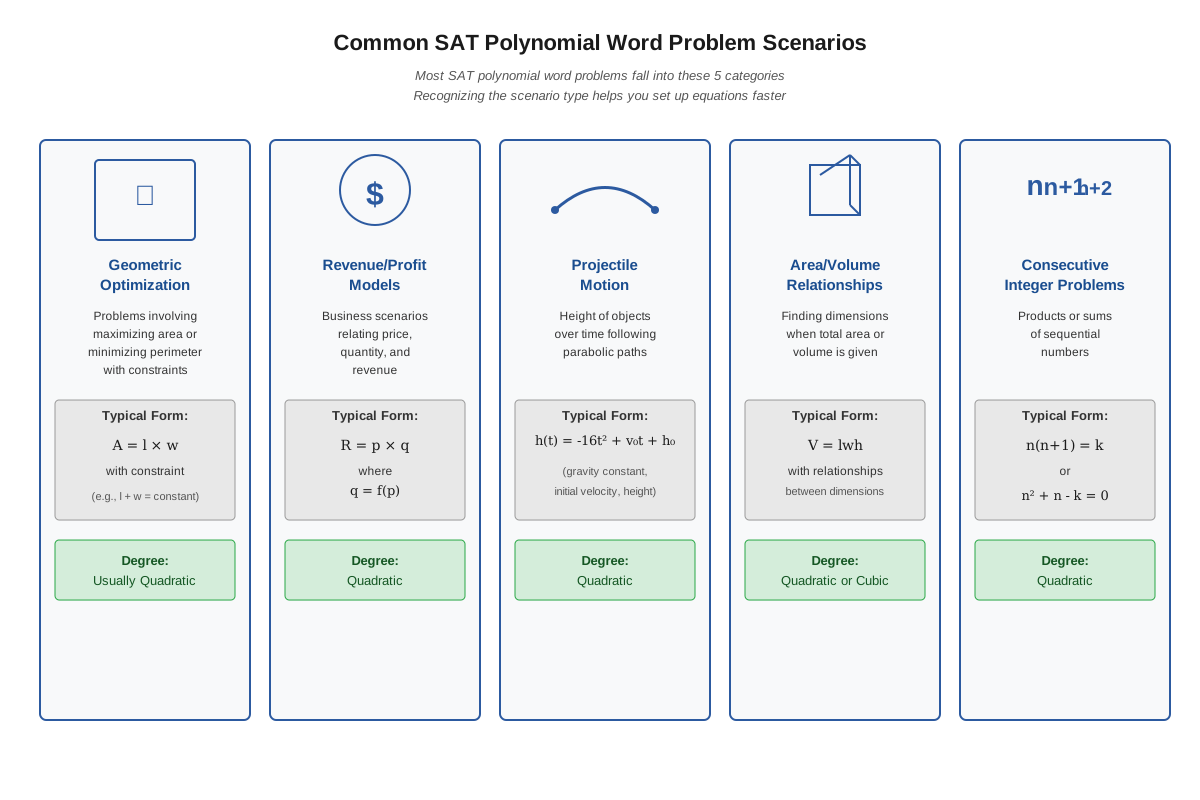
On the SAT, polynomial word problems commonly appear as:
- Geometric optimization: Finding dimensions that maximize area or minimize perimeter
- Revenue and profit scenarios: Modeling business relationships with quadratic functions
- Consecutive integer problems: Using polynomial equations to represent number relationships
- Motion and physics applications: Describing trajectories, distances, or rates
- Growth and decay models: Representing population or quantity changes over time
Core Concepts
Understanding Polynomial Word Problems
A polynomial word problem presents a real-world scenario that requires creating, manipulating, or solving polynomial expressions or equations. The key challenge lies in translation—converting verbal information into mathematical language. Students must identify the unknown quantity (the variable), establish relationships between quantities, and construct an equation that accurately models the situation.
The degree of the polynomial determines solution complexity. Quadratic polynomials (degree 2) appear most frequently on the SAT, followed by linear polynomials (degree 1) and occasionally cubic polynomials (degree 3). Higher-degree polynomials rarely appear due to time constraints and the test's focus on foundational concepts.
Setting Up Polynomial Equations from Context
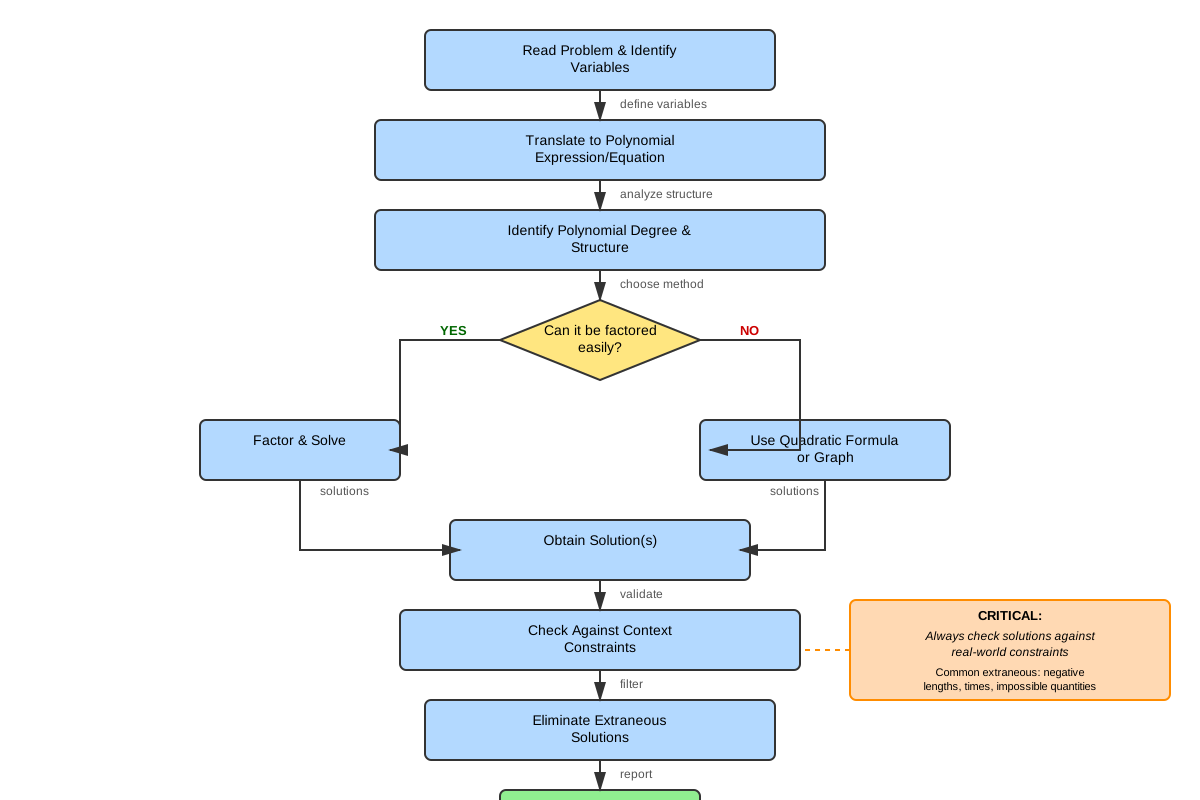
The translation process follows a systematic approach:
- Identify the unknown: Determine what the problem asks you to find and assign a variable
- Express related quantities: Write other quantities in terms of your variable using given relationships
- Establish the equation: Use the problem's constraints to create an equation
- Solve algebraically: Apply appropriate techniques (factoring, quadratic formula, etc.)
- Verify and interpret: Check that solutions make sense within the context
Consider this framework for common scenarios:
| Scenario Type | Typical Variable | Common Relationship | Polynomial Form |
|---|---|---|---|
| Geometric (area) | Length or width | Area = length × width | Quadratic |
| Consecutive integers | First integer | Sum or product of integers | Linear or quadratic |
| Revenue/Profit | Price or quantity | Revenue = price × quantity | Quadratic |
| Projectile motion | Time | Height = -16t² + v₀t + h₀ | Quadratic |
Geometric Applications
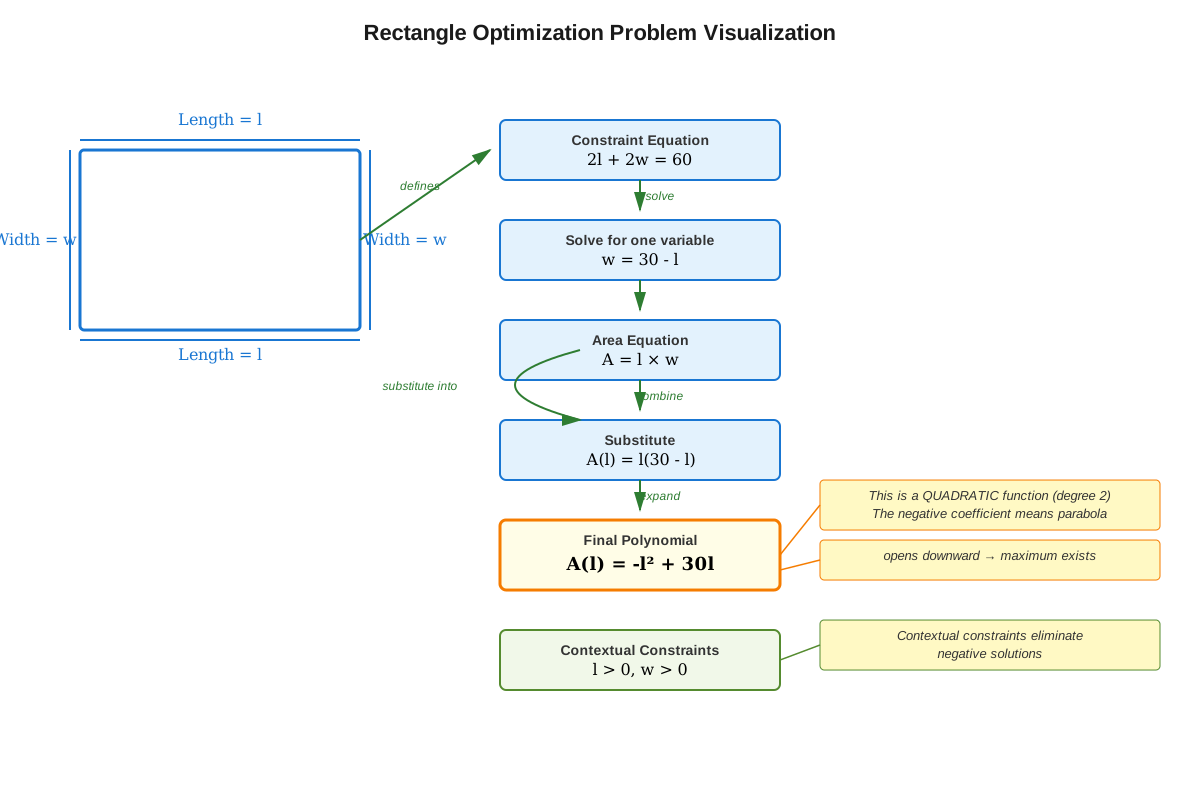
Geometric problems frequently involve rectangles, triangles, or three-dimensional figures where dimensions relate through polynomial expressions. A classic example: "A rectangle's length is 3 feet more than twice its width. If the area is 44 square feet, find the dimensions."
Setting up: Let w = width, then length = 2w + 3. The area equation becomes:
w(2w + 3) = 44
2w² + 3w = 44
2w² + 3w - 44 = 0
This quadratic equation can be solved by factoring or using the quadratic formula. The context requires positive dimensions, eliminating any negative solutions.
Revenue and Business Models
Business scenarios often model revenue as R = (price)(quantity), where price and quantity have an inverse relationship. For example: "A company sells x items at a price of (50 - 0.5x) dollars each. Write an expression for total revenue."
Revenue becomes:
R(x) = x(50 - 0.5x) = 50x - 0.5x²This quadratic function opens downward, indicating a maximum revenue point—a common SAT question asks students to find this optimal value using vertex formulas or completing the square.
Consecutive Integer Problems
These problems involve integers that follow in sequence (n, n+1, n+2) or have specific spacing (even: n, n+2, n+4). The polynomial arises from relationships like sums or products. For instance: "The product of two consecutive even integers is 168. Find the integers."
Let n = first even integer, then n + 2 = second even integer:
n(n + 2) = 168
n² + 2n = 168
n² + 2n - 168 = 0
Factoring yields (n + 14)(n - 12) = 0, giving n = -14 or n = 12. Both solutions are valid even integers, producing pairs (-14, -12) or (12, 14).
Projectile Motion and Physics
The SAT occasionally includes problems involving objects in motion, particularly vertical motion under gravity. The standard form is:
h(t) = -16t² + v₀t + h₀where h is height in feet, t is time in seconds, v₀ is initial velocity, and h₀ is initial height. Questions might ask when the object reaches a certain height, when it hits the ground (h = 0), or its maximum height (vertex of the parabola).
Solving Strategies for Polynomial Equations
Factoring remains the most efficient method when applicable. For quadratics ax² + bx + c = 0:
- Look for common factors first
- Try factoring by grouping or using patterns (difference of squares, perfect square trinomials)
- Use the AC method for trinomials
Quadratic formula provides a reliable alternative:
x = [-b ± √(b² - 4ac)] / (2a)The discriminant (b² - 4ac) reveals solution nature: positive gives two real solutions, zero gives one solution, negative indicates no real solutions.
Graphical analysis helps when questions ask about intersections, maximums, or minimums. Understanding parabola properties (vertex, axis of symmetry, direction of opening) enables quick solution estimation.
Concept Relationships
Polynomial word problems synthesize multiple algebraic concepts into unified problem-solving scenarios. The translation process (verbal → algebraic) relies on understanding polynomial structure and equation-building principles. Once equations are established, factoring techniques and solving methods come into play, drawing on prerequisite knowledge of polynomial operations.
The relationship flow follows this pattern:
Context Recognition → Variable Assignment → Expression Building → Equation Formation → Algebraic Solution → Contextual Interpretation
Geometric applications connect polynomial word problems to coordinate geometry and function analysis, particularly when optimizing area or volume. Business models link to systems of equations when multiple constraints exist simultaneously. Projectile motion problems bridge to quadratic functions and their graphical properties, especially vertex form and transformations.
Understanding these connections allows students to leverage knowledge from one area to strengthen another. For example, recognizing that revenue problems produce downward-opening parabolas immediately suggests using vertex formulas to find maximum values—a technique applicable across multiple problem types.
Quick check — test yourself on Polynomial word problems so far.
Try Flashcards →High-Yield Facts
⭐ Most SAT polynomial word problems involve quadratic equations, requiring factoring or the quadratic formula
⭐ Geometric problems typically set up equations by equating area/volume formulas to given values
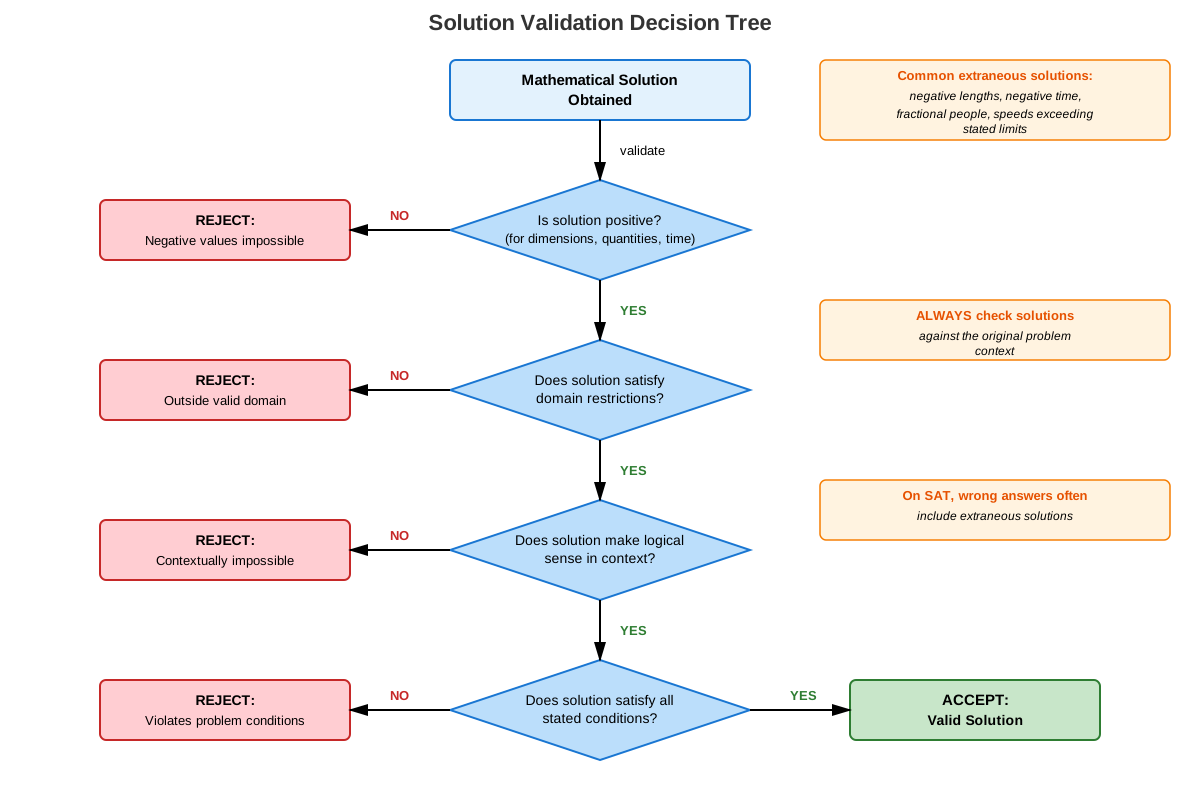
⭐ Always check solutions against contextual constraints (positive dimensions, reasonable values)
⭐ Revenue problems follow the pattern R = (price)(quantity), usually producing quadratic functions
⭐ The vertex of a parabola represents maximum or minimum values in optimization problems
- Consecutive integer problems use n, n+1, n+2 for general integers or n, n+2, n+4 for even/odd integers
- Projectile motion equations on the SAT use h(t) = -16t² + v₀t + h₀ with time in seconds and height in feet
- When a quadratic equation has two solutions, context determines which (if either) is valid
- The discriminant b² - 4ac indicates whether a quadratic has real solutions without fully solving
- Polynomial degree determines the maximum number of solutions: degree n has at most n real solutions
Common Misconceptions
Misconception: All solutions to polynomial equations are valid answers to word problems → Correction: Solutions must satisfy contextual constraints. Negative lengths, non-integer counts when integers are required, or times before the scenario begins are typically invalid. Always verify solutions make sense in context.
Misconception: Polynomial word problems always require solving for x → Correction: Some problems ask for expressions, maximum values, or relationships between variables without requiring explicit solutions. Read questions carefully to determine what's actually being asked.
Misconception: The quadratic formula only works when factoring fails → Correction: The quadratic formula works for all quadratic equations and is often faster than attempting to factor. It's a reliable first choice, especially under time pressure.
Misconception: Revenue is maximized when price or quantity is maximized → Correction: Revenue follows a quadratic relationship with a maximum at the vertex, not at extreme values. Maximum revenue typically occurs at moderate price/quantity combinations, not at the highest possible values.
Misconception: Consecutive integer problems always involve positive integers → Correction: Unless explicitly stated, consecutive integers can be negative. Problems asking for "two consecutive integers whose product is 168" have both positive (12, 14) and negative (-14, -12) solutions.
Misconception: Polynomial word problems require complex algebraic manipulation → Correction: Many SAT polynomial problems can be solved by testing answer choices, especially when answers are simple integers. Strategic answer-checking often saves time compared to full algebraic solutions.
Worked Examples
Example 1: Geometric Application
Problem: A rectangular garden has a length that is 4 meters more than twice its width. If the area of the garden is 96 square meters, what is the width of the garden?
Solution:
Step 1: Identify the unknown and assign a variable.
Let w = width of the garden (in meters)
Step 2: Express related quantities.
Length = 2w + 4 (given: "4 meters more than twice its width")
Step 3: Set up the equation using the area formula.
Area = length × width
96 = (2w + 4)(w)
96 = 2w² + 4w
Step 4: Rearrange to standard form.
2w² + 4w - 96 = 0
Simplify by dividing all terms by 2:
w² + 2w - 48 = 0
Step 5: Solve by factoring.
We need two numbers that multiply to -48 and add to 2: these are 8 and -6.
(w + 8)(w - 6) = 0
This gives w = -8 or w = 6
Step 6: Interpret in context.
Width cannot be negative, so w = 6 meters.
Verification: If width = 6, then length = 2(6) + 4 = 16. Area = 6 × 16 = 96 ✓
Connection to learning objectives: This problem demonstrates identifying key features (quadratic equation from geometric constraint), translating verbal description to algebraic form, and interpreting solutions within contextual constraints.
Example 2: Revenue Optimization
Problem: A theater currently charges $12 per ticket and sells 200 tickets per show. Market research indicates that for each $1 increase in ticket price, 10 fewer tickets will be sold. What ticket price maximizes revenue?
Solution:
Step 1: Define the variable strategically.
Let x = number of $1 increases in ticket price
Step 2: Express price and quantity in terms of x.
- New price = 12 + x dollars
- New quantity = 200 - 10x tickets
Step 3: Write the revenue function.
R(x) = (price)(quantity)
R(x) = (12 + x)(200 - 10x)
R(x) = 2400 - 120x + 200x - 10x²
R(x) = -10x² + 80x + 2400
Step 4: Find the maximum using vertex formula.
For a quadratic ax² + bx + c, the vertex occurs at x = -b/(2a)
x = -80/(2(-10)) = -80/(-20) = 4
Step 5: Interpret the result.
x = 4 means 4 price increases of $1 each.
Optimal price = 12 + 4 = $16
Verification: At $16, tickets sold = 200 - 10(4) = 160
Revenue = 16 × 160 = $2,560
Compare to original: 12 × 200 = $2,400 (lower, as expected)
Connection to learning objectives: This demonstrates recognizing polynomial structure in business contexts, applying optimization techniques through vertex analysis, and interpreting mathematical results in practical terms.
Exam Strategy
Approaching SAT Polynomial Word Problems
Read strategically: Identify what the problem asks for before setting up equations. SAT questions sometimes ask for expressions rather than numerical solutions, or for one quantity when you solve for another.
Trigger words to recognize:
- "Consecutive" → set up variables as n, n+1, n+2
- "Area," "volume," "perimeter" → geometric polynomial setup
- "Revenue," "profit," "cost" → business quadratic model
- "Maximum," "minimum," "optimal" → vertex or optimization problem
- "Product," "sum" → polynomial equation from relationships
Process of Elimination Strategies
When answer choices are provided:
- Test middle values first: If answers are numerical and ordered, start with choice C
- Eliminate based on context: Remove negative values for dimensions, non-integers when integers are required
- Check reasonableness: Extreme values are rarely correct in optimization problems
- Verify with substitution: Plug promising answers back into the original context
Time Management
- Allocate 1.5-2 minutes for standard polynomial word problems
- Spend 30 seconds reading and identifying the problem type
- Choose your method quickly: Factoring if obvious, quadratic formula if not, answer-testing if values are simple
- Skip and return if setup isn't clear within 45 seconds—these problems reward fresh perspective
Common Question Formats
The SAT presents polynomial word problems in several ways:
- Direct solution: "Find the value of x"
- Expression building: "Which expression represents..."
- Interpretation: "What does the coefficient represent in context?"
- Optimization: "What value maximizes/minimizes..."
Recognize the format early to avoid solving for unnecessary quantities.
Memory Techniques
GRIDS for geometric problems:
- Given information (what you know)
- Relationships (how quantities connect)
- Identify variable (what to solve for)
- Draw equation (set up the math)
- Solve and check (find and verify answer)
PRICE for business/revenue problems:
- Price expression (in terms of variable)
- Revenue formula (price × quantity)
- Identify quadratic form
- Calculate vertex (for maximum)
- Evaluate in context (interpret result)
Consecutive Integer Visualization: Picture a number line with evenly spaced points. For consecutive integers, spacing is 1; for consecutive evens/odds, spacing is 2.
Quadratic Formula Mnemonic: "Negative boy, plus or minus the square root of boy squared minus four A C, all over two A" helps recall x = [-b ± √(b² - 4ac)]/(2a)
Context Check Acronym - VALID:
- Values positive when required?
- Answer the actual question?
- Logical in context?
- Integers when needed?
- Dimensions reasonable?
Summary
Polynomial word problems on the SAT require translating real-world scenarios into algebraic equations, solving them using appropriate techniques, and interpreting solutions within contextual constraints. These problems most commonly involve quadratic equations arising from geometric relationships, business models, consecutive integer scenarios, or motion applications. Success depends on systematic translation skills, fluency with factoring and the quadratic formula, and careful attention to what the question actually asks. Students must verify that mathematical solutions make sense in context, eliminating extraneous answers that violate constraints like positive dimensions or integer requirements. The ability to recognize problem types quickly—geometric optimization, revenue maximization, or consecutive integer relationships—enables efficient method selection and accurate solution. Mastering polynomial word problems strengthens overall algebraic reasoning and significantly improves performance on medium-to-high difficulty SAT math questions.
Key Takeaways
- Polynomial word problems require three distinct skills: translation (verbal to algebraic), solution (algebraic techniques), and interpretation (contextual verification)
- Quadratic equations dominate SAT polynomial word problems, appearing in geometric, business, and motion contexts
- Always check solutions against contextual constraints—mathematical solutions may not be contextually valid
- Revenue and optimization problems use vertex formulas to find maximum or minimum values
- Systematic variable assignment and relationship mapping prevent setup errors that waste time
- The quadratic formula provides a reliable solution method when factoring isn't immediately apparent
- Reading carefully to identify what the question asks prevents solving for the wrong quantity
Related Topics
Quadratic Functions and Graphs: Understanding parabola properties, vertex form, and transformations deepens ability to solve optimization problems and interpret polynomial relationships visually.
Systems of Equations: Many complex word problems involve multiple polynomial equations simultaneously, requiring substitution or elimination methods.
Rational Expressions: Word problems involving rates, work, or proportions often combine polynomial and rational expressions, building on polynomial manipulation skills.
Function Notation and Composition: Advanced polynomial problems may involve composite functions or piecewise definitions, extending basic polynomial concepts.
Exponential and Logarithmic Models: While polynomials model many growth scenarios, exponential functions describe others; understanding when each applies strengthens modeling skills.
Practice CTA
Now that you've mastered the core concepts of polynomial word problems, it's time to solidify your understanding through active practice. The practice questions and flashcards designed for this topic will challenge you to apply these strategies under test-like conditions, building the speed and confidence you need for SAT success. Remember: every polynomial word problem you solve strengthens your pattern recognition and problem-solving intuition. Approach each practice question as an opportunity to refine your technique and discover new insights. You've built the foundation—now construct mastery through deliberate practice!
Sign up free to keep reading
Create a free AnvayaPrep account to finish this SAT guide on Polynomial word problems — plus flashcards and practice questions.