Overview
SAT polynomial traps represent one of the most strategically important categories of math questions on the SAT. These are not simply straightforward polynomial problems; rather, they are carefully designed questions that exploit common student errors, misconceptions, and hasty reasoning. The College Board intentionally crafts these questions to separate students who have surface-level understanding from those who possess deep conceptual mastery. Understanding these traps is essential because polynomial questions appear in approximately 15-20% of SAT Math sections, and trap-laden questions often determine score differences in the upper percentile ranges.
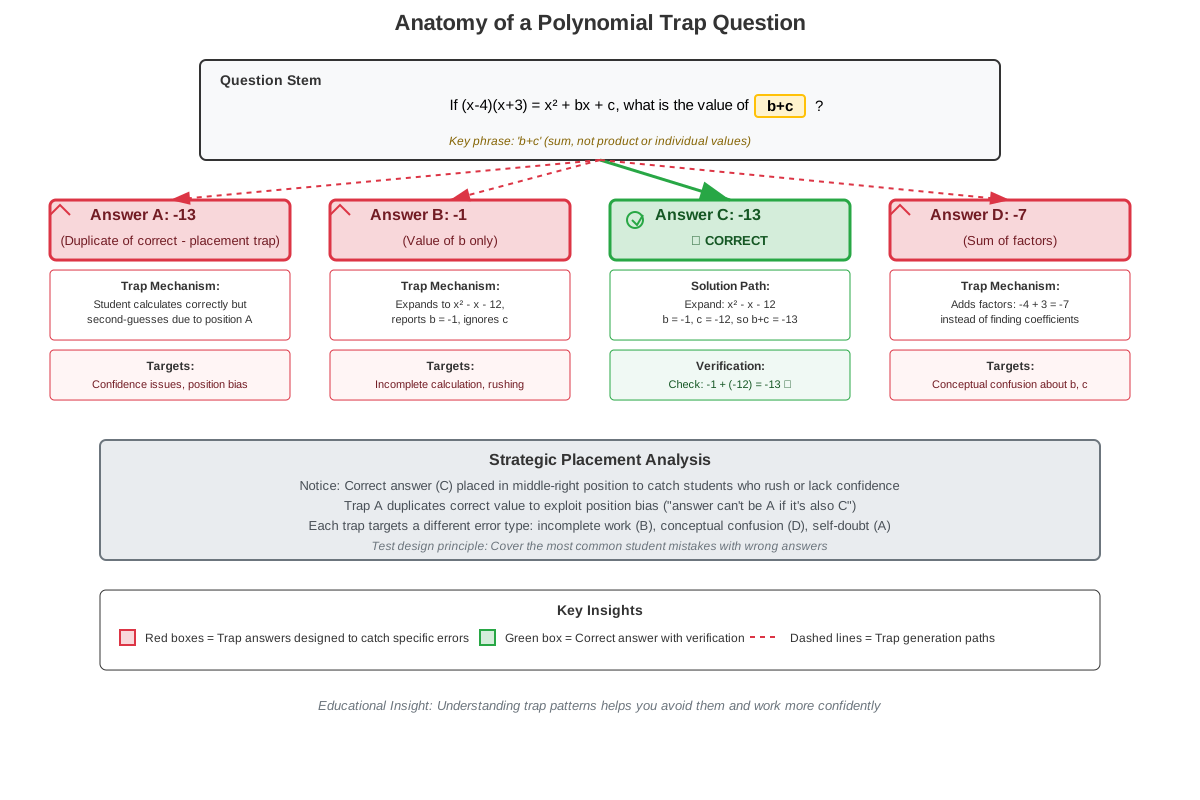
These traps typically involve polynomial operations, factoring, roots, and graphical representations where the "obvious" answer is deliberately placed among the choices to catch students who rush or apply procedures mechanically without understanding. For instance, a question might ask for the sum of roots but present the product as an answer choice, or it might involve expanding expressions where sign errors lead directly to distractor answers. The SAT test writers analyze thousands of student responses to identify the most common errors, then build those errors into wrong answer choices.
Mastering SAT polynomial traps connects directly to broader algebraic reasoning skills tested throughout the exam. Polynomials serve as foundational structures for quadratic functions, systems of equations, and even some trigonometric identities in advanced problems. Students who can navigate polynomial traps demonstrate not just computational accuracy but also conceptual flexibility—the ability to verify answers through multiple methods, recognize when a result seems unreasonable, and avoid cognitive shortcuts that lead to errors. This topic bridges basic algebraic manipulation with higher-order problem-solving skills that the SAT values most.
Learning Objectives
- [ ] Identify key features of SAT polynomial traps
- [ ] Explain how SAT polynomial traps appears on the SAT
- [ ] Apply SAT polynomial traps to answer SAT-style questions
- [ ] Recognize common distractor patterns in polynomial answer choices
- [ ] Verify polynomial solutions using multiple methods to avoid trap answers
- [ ] Distinguish between conceptually similar polynomial operations that test writers exploit
- [ ] Develop systematic checking procedures specific to polynomial questions
Prerequisites
- Basic polynomial operations: Addition, subtraction, multiplication, and division of polynomials form the foundation for recognizing when operations are performed incorrectly in trap answers
- Factoring techniques: Understanding difference of squares, trinomial factoring, and grouping is essential since many traps involve incorrect factoring steps
- FOIL method and distributive property: These fundamental skills are necessary to identify sign errors and coefficient mistakes that create trap answers
- Quadratic formula and Vieta's formulas: Knowledge of relationships between coefficients and roots helps avoid traps involving sum and product of roots
- Function notation and evaluation: Understanding f(x) notation is required since many polynomial traps involve substitution errors
Why This Topic Matters
Polynomial traps appear with remarkable consistency on every SAT administration, making them one of the highest-yield study areas for score improvement. Research on SAT question analytics reveals that polynomial questions with trap answers have among the lowest correct response rates in the 500-650 score range, yet students who master trap recognition see disproportionate score gains. These questions typically appear 3-5 times per test across both calculator and no-calculator sections, accounting for approximately 45-75 points of potential score impact.
In real-world applications, the skills developed through mastering polynomial traps extend far beyond test-taking. The ability to verify algebraic work, recognize when an answer violates mathematical constraints, and systematically check for errors applies directly to fields like engineering, computer science, economics, and data analysis. Professionals in these fields regularly work with polynomial models for optimization, curve fitting, and predictive analytics—contexts where errors can have significant consequences.
On the SAT specifically, polynomial traps appear in multiple question formats: multiple-choice questions where trap answers are strategically placed, grid-in questions where calculation errors lead to specific wrong values, and word problems where misinterpreting the question leads to solving for the wrong quantity. The most common trap scenarios involve sign errors in expansion, confusing sum versus product of roots, misapplying the zero product property, incorrectly simplifying rational expressions with polynomial numerators and denominators, and graphical interpretation errors where students confuse x-intercepts with y-intercepts or mistake the degree of a polynomial from its graph.
Core Concepts
Understanding Polynomial Trap Mechanisms
SAT polynomial traps exploit predictable patterns in student errors. The test writers don't randomly generate wrong answers; they systematically create distractors based on the most common mistakes students make under time pressure. Understanding this deliberate design helps students approach polynomial questions with appropriate skepticism toward "obvious" answers.
The primary trap mechanisms include:
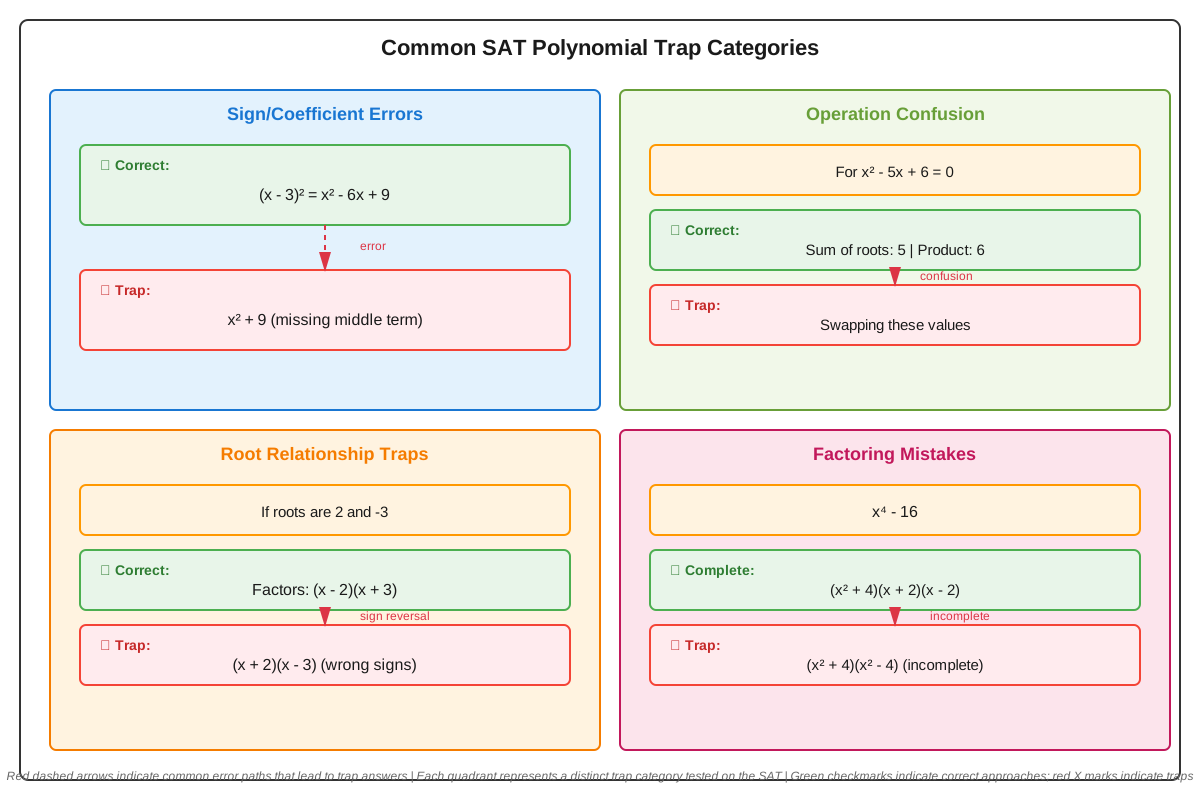
- Sign error traps: Questions designed so that forgetting to distribute a negative sign or making a sign error in FOIL produces an answer choice
- Operation confusion traps: Problems where students might add instead of multiply, or vice versa, leading to specific wrong answers
- Incomplete work traps: Situations where stopping halfway through a problem yields a distractor
- Conceptual confusion traps: Questions exploiting misunderstandings about polynomial properties, such as confusing degree with number of terms
Expansion and Simplification Traps
When expanding polynomial expressions, particularly products like (x + a)(x + b) or (x + a)², the most common traps involve sign errors and coefficient mistakes. Consider the expansion of (x - 3)²: the correct result is x² - 6x + 9, but trap answers typically include x² - 9 (forgetting the middle term), x² + 6x + 9 (sign error on middle term), and x² - 3x + 9 (incorrect coefficient on middle term).
The SAT specifically targets the middle term in squared binomials because students often rush and forget to double the product of the terms. For expressions like (2x - 5)², the correct expansion is 4x² - 20x + 25, but 4x² - 10x + 25 appears as a trap answer for students who forget to multiply the middle term by 2.
Factoring Traps
Factoring questions present numerous trap opportunities. The most prevalent involve:
- Incomplete factoring: Factoring x² - 16 as (x - 4)(x + 4) is correct, but a trap might ask for all factors and include x² - 16 itself as an answer choice, catching students who don't recognize that further factoring is impossible
- Sign pattern errors: When factoring x² - 5x - 6, students might incorrectly write (x - 6)(x + 1) instead of (x - 6)(x + 1), or confuse which factors should be negative
- Difference of squares misapplication: Students sometimes try to factor x² + 16 as (x + 4)(x + 4), not recognizing that sum of squares doesn't factor over real numbers
Root and Zero Traps
Questions involving polynomial roots or zeros create particularly effective traps by exploiting Vieta's formulas. For a quadratic ax² + bx + c = 0 with roots r and s:
- Sum of roots: r + s = -b/a
- Product of roots: rs = c/a
Common traps include:
| What Question Asks For | Trap Answer | Why It's Wrong |
|---|---|---|
| Sum of roots | c/a | This is the product, not sum |
| Product of roots | -b/a | This is the sum, not product |
| Value of one root | The other root | Students solve but report wrong root |
| Sum of roots | -b | Forgot to divide by a |
Degree and Leading Coefficient Traps
Questions about polynomial degree and leading coefficients trap students who confuse these concepts with other polynomial features. The degree is the highest power of the variable, while the leading coefficient is the coefficient of that highest-power term.
Traps include:
- Asking for degree but listing the number of terms as an answer choice
- Asking for leading coefficient but listing the constant term
- Presenting polynomials in non-standard order and expecting students to identify degree without rearranging
Remainder and Factor Theorem Traps
The Remainder Theorem states that when polynomial P(x) is divided by (x - a), the remainder is P(a). The Factor Theorem states that (x - a) is a factor of P(x) if and only if P(a) = 0.
Common traps:
- Asking whether (x - 3) is a factor and providing P(3) as an answer choice rather than stating whether it equals zero
- Confusing the sign: testing (x - 3) but evaluating P(-3) instead of P(3)
- Asking for the remainder when dividing by (x + 2) but providing the value of P(2) instead of P(-2)
Polynomial Division Traps
When performing polynomial long division or synthetic division, traps typically involve:
- Sign errors when subtracting terms
- Forgetting placeholder zeros for missing degree terms
- Misaligning terms by degree
- Confusing quotient with remainder
Graph Interpretation Traps
Graphical polynomial questions create traps through:
- x-intercept vs. y-intercept confusion: Asking for zeros but listing the y-intercept as a choice
- Multiplicity misunderstanding: Not recognizing that a graph touching but not crossing the x-axis indicates even multiplicity
- End behavior errors: Confusing positive and negative leading coefficients or even and odd degrees
- Turning point confusion: Mistaking the number of turning points for the degree (a polynomial of degree n has at most n-1 turning points)
Concept Relationships
The various polynomial trap types interconnect systematically. Expansion traps → lead to → factoring traps because these are inverse operations; students who make expansion errors will make corresponding factoring errors. Factoring traps → connect to → root-finding traps because factoring is the primary method for finding roots of quadratics and higher-degree polynomials.
Root and zero traps → relate to → graph interpretation traps because roots are x-intercepts on graphs. Understanding this connection helps students verify answers: if you find roots algebraically, you can check whether they make sense given a graph, and vice versa.
Remainder and Factor Theorem traps → build upon → polynomial evaluation skills from prerequisites. These theorems provide shortcuts that, when misapplied, lead directly to trap answers. They also connect to root-finding because the Factor Theorem links factors to zeros.
Degree and leading coefficient concepts → determine → end behavior on graphs, creating a bridge between algebraic and graphical representations. This relationship means that traps in one representation often have corresponding traps in the other.
All trap types share a common foundation: they exploit the gap between procedural knowledge (knowing steps) and conceptual understanding (knowing why steps work). Students with only procedural knowledge are vulnerable to all trap types, while those with conceptual understanding can verify answers through multiple methods, making traps ineffective.
High-Yield Facts
⭐ The SAT deliberately places the most common error as an answer choice in polynomial questions—if an answer seems too easy to obtain, verify it through an alternative method.
⭐ Sign errors in expansion and factoring account for approximately 40% of polynomial trap answers—always double-check signs, especially with subtraction and negative coefficients.
⭐ For quadratic ax² + bx + c = 0, sum of roots equals -b/a and product equals c/a—confusing these is one of the top 3 most common polynomial traps.
⭐ When a question asks for one specific root, all roots typically appear as answer choices—make sure you're identifying the correct one based on what the question asks.
⭐ The Remainder Theorem requires evaluating P(a) when dividing by (x - a), not (x + a)—sign confusion here is extremely common.
- Polynomial degree equals the highest exponent, not the number of terms—this distinction appears in 2-3 questions per test.
- When factoring completely, check whether factors can be factored further—incomplete factoring is a deliberate trap.
- A polynomial of degree n has exactly n roots (counting multiplicity) in the complex numbers—questions may trap students who forget about complex or repeated roots.
- The graph of a polynomial touches but doesn't cross the x-axis at roots with even multiplicity—this graphical feature appears in approximately 1-2 questions per test.
- Expanding (x + a)² yields x² + 2ax + a², not x² + a²—the missing middle term trap appears on virtually every SAT.
- When substituting into polynomials, parentheses around negative values are essential—forgetting them causes sign errors in evaluation.
- The y-intercept of polynomial P(x) is always P(0), which equals the constant term—questions may ask for this in disguised ways.
- Polynomial end behavior depends on both degree (even/odd) and leading coefficient (positive/negative)—all four combinations appear as trap scenarios.
Quick check — test yourself on SAT polynomial traps so far.
Try Flashcards →Common Misconceptions
Misconception: When expanding (x - 5)², the result is x² - 25.
Correction: This omits the middle term. The correct expansion is x² - 10x + 25. The formula (a - b)² = a² - 2ab + b² must include all three terms. The trap answer x² - 25 comes from incorrectly applying the difference of squares pattern, which is actually (x - 5)(x + 5) = x² - 25.
Misconception: For the equation x² + 6x + 8 = 0, the sum of the roots is 8.
Correction: The sum of roots equals -b/a = -6/1 = -6, not the constant term. The product of roots equals c/a = 8/1 = 8. This confusion between sum and product formulas is deliberately exploited in trap answers. Students can verify by actually finding the roots (-2 and -4) and confirming their sum is -6.
Misconception: If (x - 3) is a factor of P(x), then P(3) equals 3.
Correction: If (x - 3) is a factor, then P(3) = 0, not 3. The Factor Theorem states that (x - a) is a factor if and only if P(a) = 0. The trap comes from confusing the value you substitute (3) with the result of the substitution (which must be 0 for a factor).
Misconception: A polynomial of degree 4 has 4 turning points.
Correction: A polynomial of degree n has at most n - 1 turning points. Therefore, a degree-4 polynomial has at most 3 turning points. Questions exploit this by offering 4 as a trap answer when asking about possible turning points.
Misconception: The polynomial x³ + 2x² - 5 has degree 2 because there are two terms with variables.
Correction: Degree is determined solely by the highest exponent, which is 3 in this case. The number of terms is irrelevant to degree. This trap appears when questions ask about degree and include the number of terms as a distractor.
Misconception: When dividing P(x) by (x + 4), evaluate P(4) to find the remainder.
Correction: The Remainder Theorem requires evaluating P(-4) when dividing by (x + 4). The sign inside the divisor is opposite to the value you substitute. This sign-flip is one of the most common sources of trap answers in remainder problems.
Misconception: If a polynomial graph crosses the x-axis at x = 2, then (x + 2) is a factor.
Correction: If the graph crosses at x = 2, then (x - 2) is a factor, not (x + 2). The factor corresponding to root r is (x - r). This sign confusion appears frequently in questions connecting graphs to algebraic forms.
Worked Examples
Example 1: Expansion Trap Question
Question: If (2x - 3)² = 4x² + bx + c, what is the value of b + c?
Solution:
Step 1: Recognize this tests expansion of a squared binomial and likely includes trap answers for common errors.
Step 2: Expand (2x - 3)² correctly using the formula (a - b)² = a² - 2ab + b²:
- a = 2x, b = 3
- (2x)² = 4x²
- -2(2x)(3) = -12x
- (3)² = 9
- Result: 4x² - 12x + 9
Step 3: Identify coefficients: b = -12, c = 9
Step 4: Calculate b + c = -12 + 9 = -3
Step 5: Verify by considering trap answers:
- If a student wrote 4x² + 9 (forgetting middle term), they'd get b = 0, c = 9, so b + c = 9 (trap answer)
- If a student made a sign error and wrote 4x² + 12x + 9, they'd get b + c = 21 (trap answer)
- If a student incorrectly used -6x for the middle term, they'd get b + c = 3 (trap answer)
Answer: -3
This example demonstrates how the SAT creates multiple trap answers from predictable errors. The correct answer requires careful expansion with attention to signs and coefficients.
Example 2: Root Relationship Trap Question
Question: The polynomial P(x) = x² + kx - 12 has roots r and s. If r - s = 7, what is the value of k?
Solution:
Step 1: Identify what we know and what traps might exist:
- Product of roots: rs = c/a = -12/1 = -12
- Sum of roots: r + s = -k/1 = -k
- Difference of roots: r - s = 7
- Trap: Students might confuse sum and difference
Step 2: Set up system of equations:
- r + s = -k (from Vieta's formula)
- r - s = 7 (given)
Step 3: Solve for r and s:
- Adding equations: 2r = -k + 7, so r = (-k + 7)/2
- Subtracting: 2s = -k - 7, so s = (-k - 7)/2
Step 4: Use the product relationship:
- rs = -12
- [(-k + 7)/2][(-k - 7)/2] = -12
- [(-k + 7)(-k - 7)]/4 = -12
- (k² - 49)/4 = -12
- k² - 49 = -48
- k² = 1
- k = ±1
Step 5: Determine which value is correct by checking:
- If k = 1: x² + x - 12 = (x + 4)(x - 3), roots are -4 and 3, difference is 7 ✓
- If k = -1: x² - x - 12 = (x - 4)(x + 3), roots are 4 and -3, difference is 7 ✓
Both values work! However, if the question specifies r > s, then we need k = 1 (giving r = 3, s = -4).
Step 6: Identify trap answers:
- k = 7 (confusing difference with sum)
- k = -12 (confusing with product)
- k = 5 (arithmetic error in solving)
Answer: k = 1 or k = -1 (depending on additional constraints)
This example shows how root relationship questions require systematic use of Vieta's formulas and careful algebraic manipulation, with multiple opportunities for trap answers.
Exam Strategy
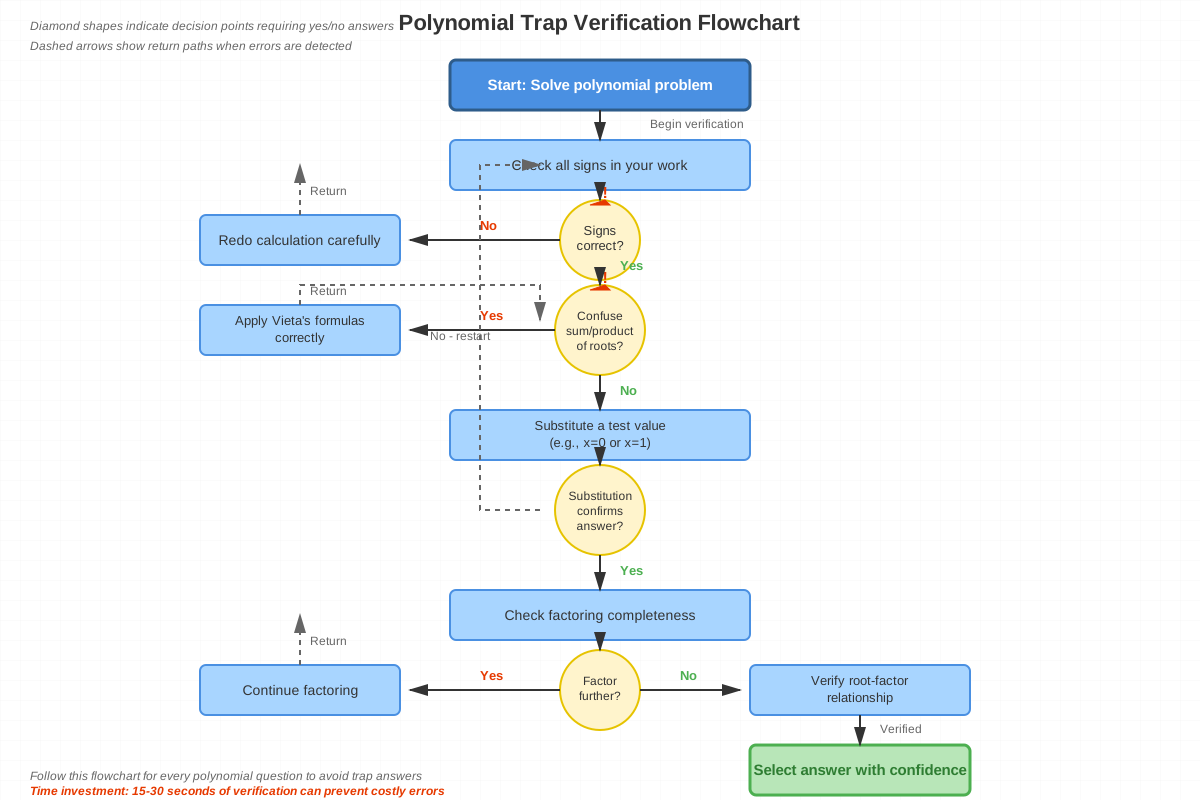
When approaching polynomial questions on the SAT, implement this systematic strategy:
Initial Assessment (5-10 seconds):
- Read the question completely before looking at answer choices
- Identify what the question actually asks for (sum vs. product, one root vs. all roots, degree vs. number of terms)
- Note any graphs, tables, or given information
Trigger Words to Watch:
- "Sum of roots" vs. "product of roots" → immediately recall Vieta's formulas and which is which
- "Factor" vs. "remainder" → Factor Theorem (result is zero) vs. Remainder Theorem (result is P(a))
- "All real roots" vs. "one root" → check whether you need to list all solutions or identify a specific one
- "Completely factored" → verify that no further factoring is possible
- "Degree" → look for highest exponent, not number of terms
- "Leading coefficient" → identify coefficient of highest-degree term, not constant term
Solution Process:
- Solve the problem using your primary method
- Before selecting an answer, ask: "Is this answer suspiciously easy to obtain?"
- If yes, verify using an alternative method:
- For expansion: factor your result to see if you get back the original
- For factoring: expand your factors to verify
- For roots: substitute back into the original equation
- For graph questions: check whether algebraic results match graphical features
Process of Elimination:
- Eliminate answers that violate basic constraints (e.g., degree can't exceed the highest exponent visible)
- Eliminate answers that fail quick checks (e.g., if asking for sum of roots of x² + 6x + 8 = 0, eliminate positive numbers since sum must be -6)
- Be especially suspicious of answers that match common errors (the constant term when asking for sum of roots, the y-intercept when asking for x-intercepts)
Time Allocation:
- Straightforward polynomial questions: 30-60 seconds
- Multi-step polynomial questions: 60-90 seconds
- Complex polynomial questions with graphs: 90-120 seconds
- If you exceed these times, mark for review and move on
Calculator Usage:
- Use calculator to verify expansions by substituting a test value into both original and expanded forms
- Graph polynomials to verify roots and behavior when permitted
- Don't rely solely on calculator for factoring—understand the algebra
Memory Techniques
FOIL Reminder - "First Outside Inside Last": When expanding (a + b)(c + d), multiply First terms (ac), Outside terms (ad), Inside terms (bc), Last terms (bd). Visualize drawing arrows connecting terms to remember all four products.
Sum and Product Mnemonic - "SuNBa, ProCa": For ax² + bx + c = 0:
- Sum = Negative B over a → Sum = -b/a
- Product = C over a → Product = c/a
Remainder Theorem Sign Flip - "Opposite Day": When dividing by (x - a), evaluate P(a). When dividing by (x + a), evaluate P(opposite of what you see) = P(-a). The sign flips.
Degree vs. Terms - "Degree is High, Terms are Many": Degree looks at the highest exponent (vertical thinking), while counting terms looks at how many separate parts exist (horizontal thinking). Don't confuse vertical with horizontal.
Factor Theorem Zero Hero: If (x - a) is a factor, then P(a) = 0. Remember: "Factor makes it zero, zero makes it a factor." The hero (factor) brings everything to zero.
Squared Binomial - "Square First, Square Last, Double the Rest": For (a + b)²:
- Square the first term: a²
- Square the last term: b²
- Double the product of both: 2ab
- Result: a² + 2ab + b²
End Behavior - "PURD":
- Positive leading coefficient, Up on right
- Right side behavior determines left for even degree (same) or odd degree (opposite)
- Degree even = both ends same direction; Degree odd = ends opposite directions
Summary
SAT polynomial traps represent a critical high-yield topic that separates average scorers from top performers. These questions are deliberately designed to exploit common errors in expansion, factoring, root relationships, and graphical interpretation. The key to mastering polynomial traps lies not in memorizing more formulas but in developing systematic verification habits and deep conceptual understanding. Students must recognize that trap answers aren't random—they're the predictable results of specific errors like sign mistakes, operation confusion, and conceptual misunderstandings. Success requires knowing Vieta's formulas for root relationships (sum = -b/a, product = c/a), understanding the Remainder and Factor Theorems with careful attention to signs, and being able to move fluidly between algebraic and graphical representations. The most effective strategy involves solving problems completely, questioning suspiciously easy answers, and verifying results through alternative methods. By understanding how test writers construct traps and implementing systematic checking procedures, students can transform polynomial questions from score-limiting obstacles into reliable point opportunities.
Key Takeaways
- SAT polynomial traps are deliberately constructed from common student errors—recognizing this design principle helps you avoid falling for trap answers
- Sign errors account for the majority of polynomial traps—double-check every negative sign, especially in expansion and factoring
- Vieta's formulas (sum = -b/a, product = c/a) are among the most frequently tested concepts—never confuse sum with product
- Verify answers using alternative methods—expand to check factoring, substitute to check roots, and compare algebraic results with graphs
- The Remainder Theorem requires careful attention to signs—dividing by (x - a) means evaluating P(a), while dividing by (x + a) means evaluating P(-a)
- Distinguish between what questions ask for versus what they provide—if a question asks for one root, all roots typically appear as answer choices
- Systematic checking procedures are more valuable than speed—taking 15 extra seconds to verify can prevent costly errors
Related Topics
Quadratic Functions and Parabolas: Mastering polynomial traps provides the foundation for understanding quadratic function transformations, vertex form, and optimization problems. The root-finding and factoring skills developed here apply directly to analyzing parabolic graphs.
Rational Expressions: Polynomial trap awareness extends naturally to rational expressions, where factoring errors in numerators and denominators create similar trap patterns. Understanding polynomial behavior helps with identifying holes and asymptotes.
Systems of Equations: Many SAT systems involve polynomial equations, and trap answers often come from solving one equation but not checking the solution in the other. The verification habits developed here transfer directly.
Complex Numbers: Higher-level polynomial questions involve complex roots, building on the understanding that polynomials of degree n have exactly n roots when complex numbers are included.
Function Composition and Transformations: Understanding polynomial behavior provides the foundation for more complex function operations, including composition, which often involves polynomial expressions.
Practice CTA
Now that you've mastered the concepts behind SAT polynomial traps, it's time to put your knowledge into action! Attempt the practice questions to test your ability to identify and avoid common traps under timed conditions. Use the flashcards to reinforce key formulas like Vieta's relationships and the Remainder Theorem until they become automatic. Remember: every trap you learn to recognize is a question you'll answer correctly on test day. The difference between a good score and a great score often comes down to avoiding these predictable errors. You've got this—go practice with confidence!
Sign up free to keep reading
Create a free AnvayaPrep account to finish this SAT guide on SAT polynomial traps — plus flashcards and practice questions.