Overview
Special products are algebraic expressions that follow predictable patterns when multiplied together, producing results that can be recognized and applied quickly without performing lengthy multiplication. These patterns represent some of the most powerful shortcuts in algebra and appear with remarkable frequency on the SAT. Understanding special products transforms what could be time-consuming polynomial multiplication into instant recognition and application, giving test-takers a significant advantage in both speed and accuracy.
On the SAT math section, special products appear in multiple question types: simplifying expressions, factoring polynomials, solving equations, and even in word problems where algebraic manipulation is required. The College Board consistently tests whether students can recognize these patterns in both standard and disguised forms. Mastery of special products is not merely about memorizing formulas—it's about developing pattern recognition that allows immediate identification of opportunities to simplify complex expressions. This skill becomes particularly valuable when working under the time pressure of standardized testing.
Special products form a bridge between basic polynomial operations and more advanced algebraic techniques. They connect directly to factoring (the reverse process), quadratic equations, and rational expressions. Students who master special products gain efficiency across numerous SAT math topics, as these patterns recur throughout algebra, coordinate geometry, and even some trigonometric identities. The investment in thoroughly understanding these patterns yields returns far beyond this single topic.
Learning Objectives
- [ ] Identify key features of special products
- [ ] Explain how special products appears on the SAT
- [ ] Apply special products to answer SAT-style questions
- [ ] Recognize special product patterns in non-standard forms and rearranged expressions
- [ ] Convert between factored and expanded forms of special products instantly
- [ ] Combine multiple special product patterns to simplify complex algebraic expressions
- [ ] Identify when NOT to use special products and when standard multiplication is more appropriate
Prerequisites
- Basic polynomial multiplication: Understanding how to multiply binomials using the distributive property or FOIL method is essential, as special products are shortcuts for specific multiplication patterns
- Combining like terms: The ability to simplify expressions by adding and subtracting similar terms is necessary to verify and work with expanded forms
- Exponent rules: Knowledge of how to multiply powers with the same base (x² · x³ = x⁵) and square terms is fundamental to working with special products
- Factoring basics: Understanding what factoring means and how it relates to multiplication helps students see special products as reversible patterns
Why This Topic Matters
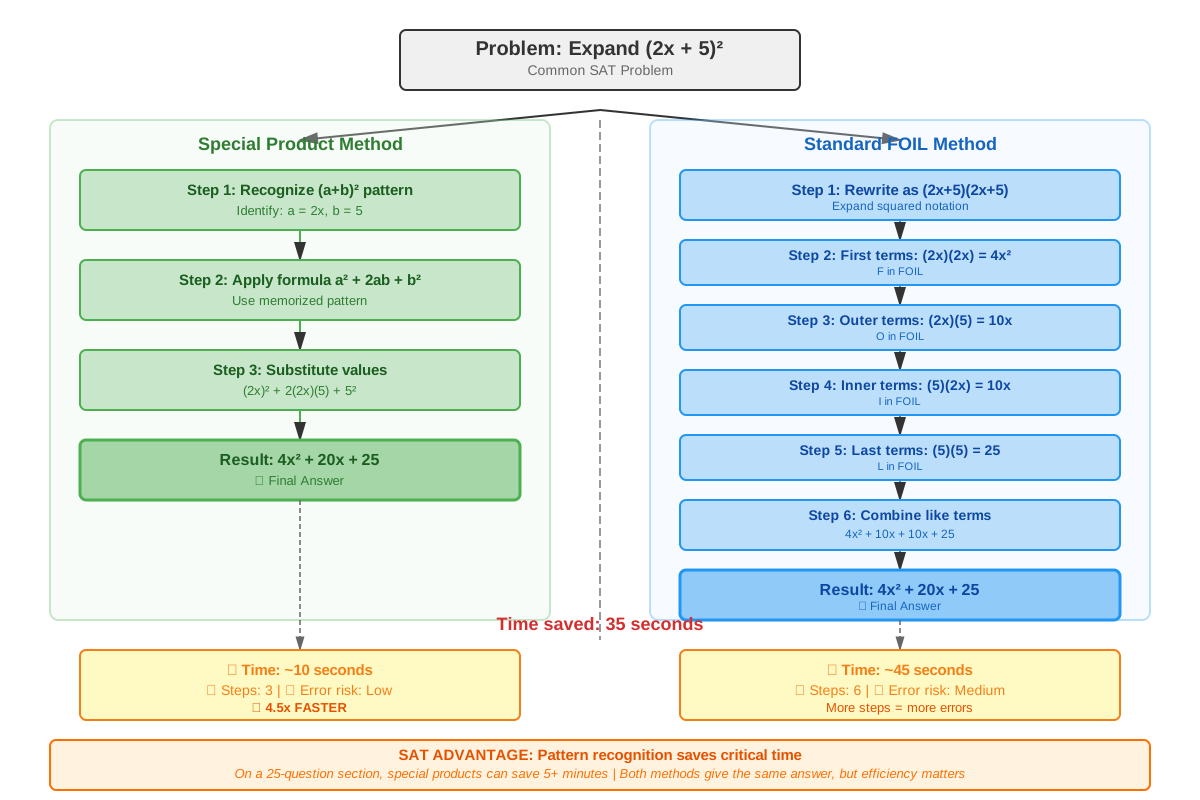
Special products represent one of the highest-yield topics for SAT preparation because they appear in approximately 15-20% of algebra questions on any given test. These patterns save critical time—recognizing a special product can reduce a 60-second problem to a 10-second problem, freeing up time for more challenging questions. In real-world applications, special products appear in physics formulas (kinetic energy differences), financial calculations (compound interest expansions), engineering (stress-strain relationships), and computer science (algorithm optimization).
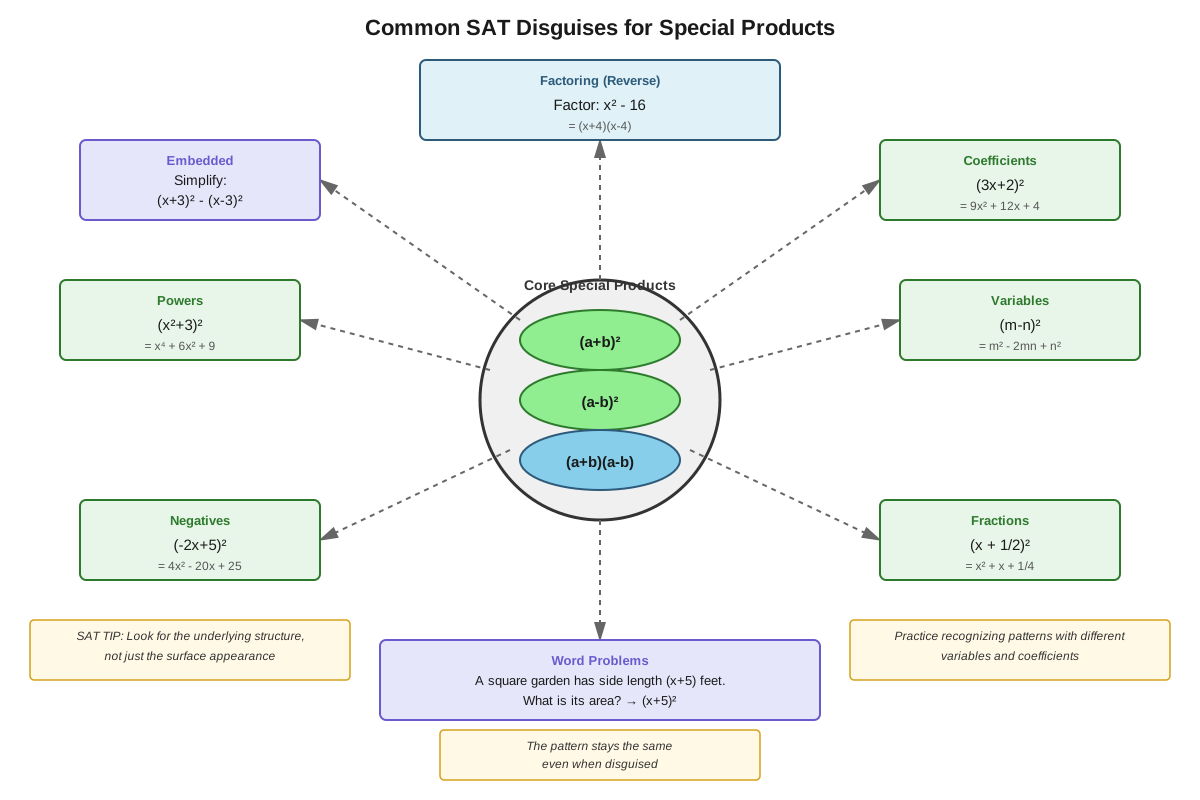
On the SAT, special products most commonly appear in three contexts: (1) simplification problems where students must expand or factor expressions, (2) equation-solving questions where recognizing a pattern leads to faster solutions, and (3) word problems where algebraic modeling requires manipulation of expressions. The test writers frequently disguise special products by using different variables, adding coefficients, or embedding them within larger expressions. Questions might ask students to find the value of an expression without fully solving for individual variables—a scenario where special products shine.
The College Board particularly favors questions that test whether students can work backwards from expanded forms to factored forms, or recognize when an expression can be rewritten using a special product pattern. These questions separate students who have memorized formulas from those who truly understand the underlying structure. Additionally, special products frequently appear in the calculator and no-calculator sections, making them universally important across the entire math test.
Core Concepts
The Square of a Sum
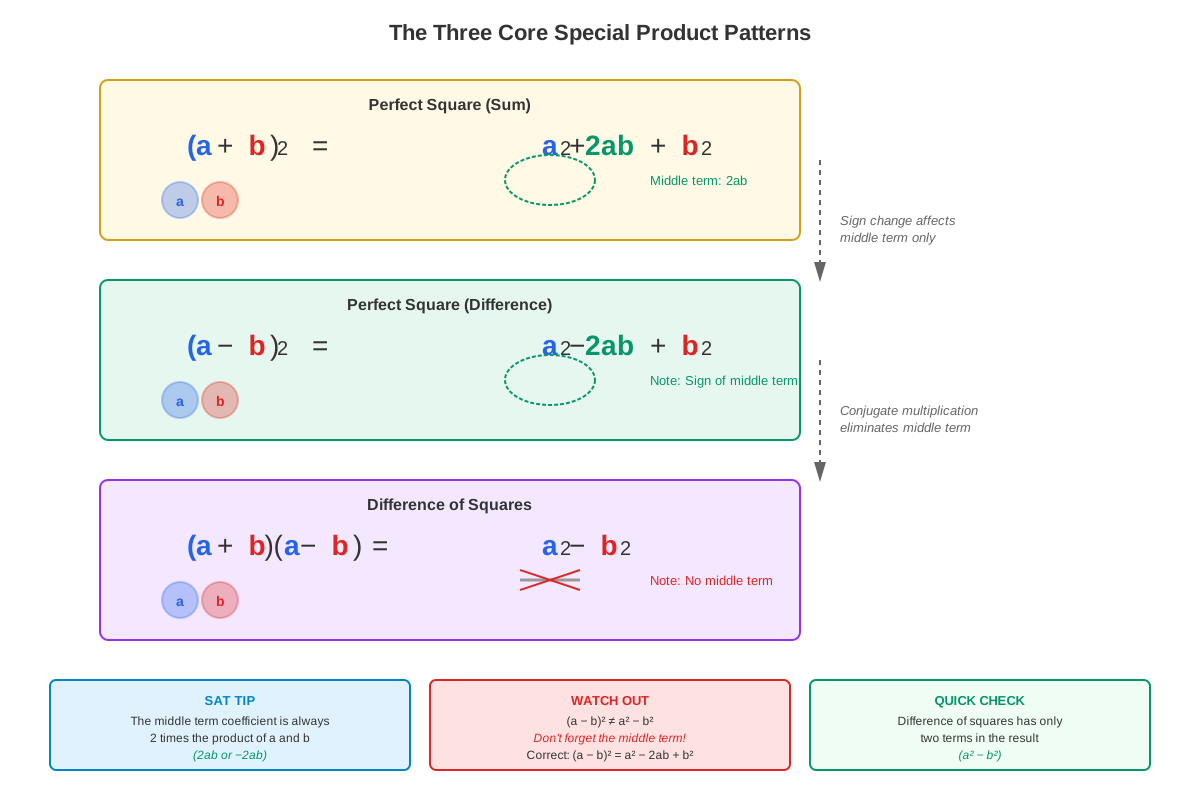
The square of a sum pattern occurs when a binomial (two-term expression) is multiplied by itself: (a + b)². Many students incorrectly believe this equals a² + b², but the correct expansion includes a crucial middle term:
(a + b)² = a² + 2ab + b²The middle term, 2ab, represents the two "cross products" that emerge when multiplying (a + b)(a + b). To understand why, consider the full multiplication: the first a multiplies both a and b, giving a² and ab; the second b multiplies both a and b, giving ba and b². Since ab and ba are identical, they combine to form 2ab.
Example: (x + 5)² = x² + 2(x)(5) + 5² = x² + 10x + 25
This pattern appears frequently when the SAT asks students to expand expressions or when solving equations where both sides are squared. Recognition of this pattern prevents the common error of "distributing" the exponent incorrectly.
The Square of a Difference
The square of a difference follows the same structural pattern as the square of a sum, but with a subtraction sign:
(a - b)² = a² - 2ab + b²Notice that the middle term is negative (because we're multiplying positive a by negative b twice), but the last term remains positive (because negative times negative equals positive). This pattern is particularly important because students often make sign errors when working with differences.
Example: (3x - 4)² = (3x)² - 2(3x)(4) + 4² = 9x² - 24x + 16
The SAT frequently tests whether students can correctly handle the signs in this expansion, especially when the expression appears within a larger problem or equation.
The Difference of Squares
The difference of squares is perhaps the most recognizable and useful special product pattern:
(a + b)(a - b) = a² - b²This pattern shows that when multiplying a sum and difference with the same terms, the middle terms cancel completely, leaving only the difference between the squares of the two terms. This happens because +ab and -ab add to zero.
Example: (x + 7)(x - 7) = x² - 49
This pattern is exceptionally powerful for factoring expressions like x² - 16 or 25y² - 81, which can be instantly recognized as (x + 4)(x - 4) and (5y + 9)(5y - 9) respectively. The SAT uses this pattern extensively in both directions: expanding products and factoring differences.
The Sum of Cubes
While less common than the previous patterns, the sum of cubes occasionally appears on the SAT:
a³ + b³ = (a + b)(a² - ab + b²)This factorization is not intuitive and must be memorized. The pattern shows that a sum of two perfect cubes can be factored into a binomial (the sum of the cube roots) times a trinomial with a specific sign pattern: positive, negative, positive.
Example: x³ + 8 = x³ + 2³ = (x + 2)(x² - 2x + 4)
The Difference of Cubes
Similarly, the difference of cubes follows a parallel pattern:
a³ - b³ = (a - b)(a² + ab + b²)The sign pattern in the trinomial factor differs from the sum of cubes: positive, positive, positive (after the initial subtraction in the binomial factor).
Example: 27y³ - 1 = (3y)³ - 1³ = (3y - 1)(9y² + 3y + 1)
Special Products with Coefficients
Real SAT questions rarely present special products in their simplest form. More commonly, coefficients appear before the variables:
(3x + 4)² = (3x)² + 2(3x)(4) + 4² = 9x² + 24x + 16The key is to treat the entire term (coefficient and variable together) as a single unit when applying the pattern. Students must remember to square both the coefficient and the variable.
| Pattern Type | General Form | Expanded Form | Key Feature |
|---|---|---|---|
| Square of Sum | (a + b)² | a² + 2ab + b² | Positive middle term |
| Square of Difference | (a - b)² | a² - 2ab + b² | Negative middle term, positive last term |
| Difference of Squares | (a + b)(a - b) | a² - b² | No middle term |
| Sum of Cubes | a³ + b³ | (a + b)(a² - ab + b²) | Alternating signs in trinomial |
| Difference of Cubes | a³ - b³ | (a - b)(a² + ab + b²) | All positive in trinomial |
Recognizing Disguised Special Products
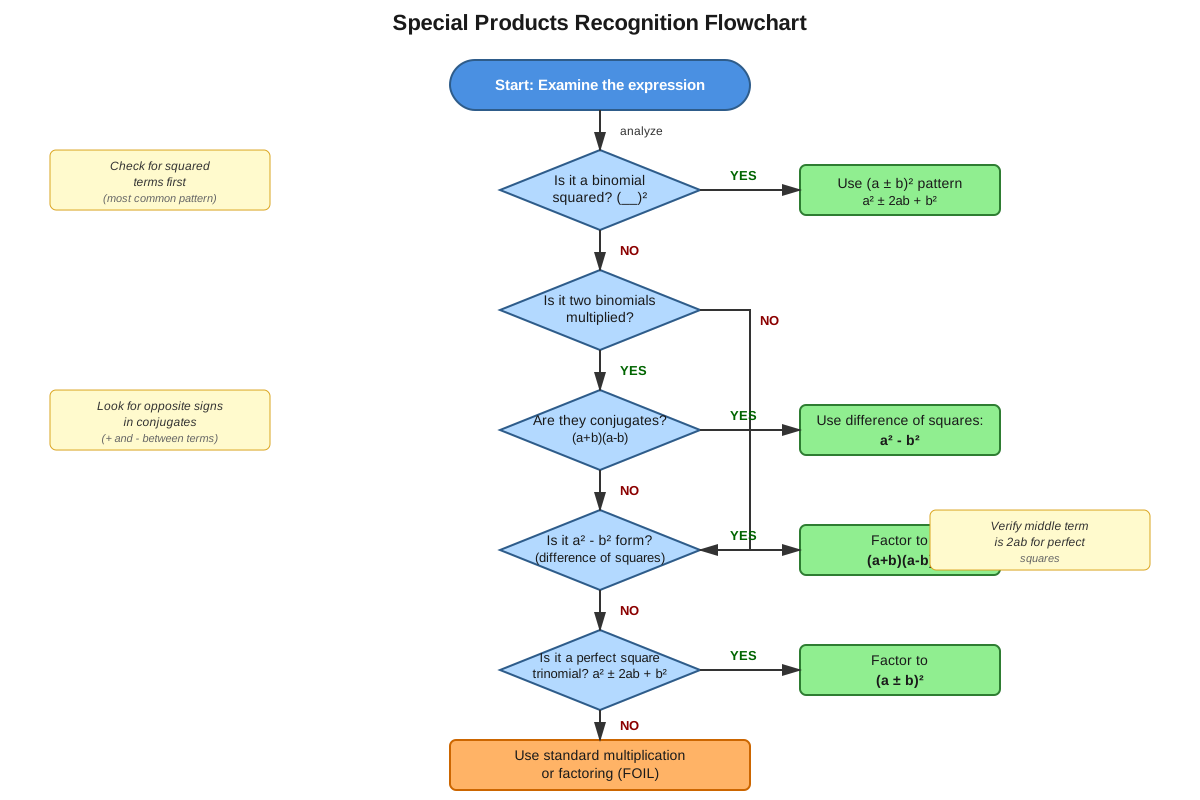
The SAT frequently presents special products in non-obvious forms. For example, x² - 9 might appear as part of a fraction that needs simplification, or (2x + 3)² might be embedded in an equation where recognizing the pattern prevents unnecessary expansion. Developing the ability to spot these patterns requires practice with varied presentations.
Concept Relationships
Special products connect intimately with factoring—they are inverse operations. Recognizing that x² + 6x + 9 is the expanded form of (x + 3)² allows instant factoring, while knowing that (x + 4)(x - 4) expands to x² - 16 enables quick simplification. This bidirectional relationship forms the foundation for solving quadratic equations efficiently.
The relationship map flows as follows: Basic polynomial multiplication → leads to → Recognition of repeated patterns → crystallizes into → Special products formulas → enables → Rapid factoring → facilitates → Equation solving → supports → Advanced algebraic manipulation.
Special products also connect to the prerequisite knowledge of exponent rules. Understanding that (3x)² means 3² · x² = 9x² is essential for correctly applying special product patterns with coefficients. Additionally, the combining like terms skill becomes crucial when verifying special product expansions or when special products appear as components of larger expressions.
The difference of squares pattern particularly connects to rational expressions, where factoring both numerator and denominator using this pattern often reveals common factors that cancel. This connection extends the utility of special products beyond simple expansion and factoring into the realm of simplifying complex fractions.
Quick check — test yourself on Special products so far.
Try Flashcards →High-Yield Facts
⭐ The expansion (a + b)² always equals a² + 2ab + b², never a² + b²—the middle term 2ab is essential and frequently tested
⭐ The difference of squares (a + b)(a - b) = a² - b² is the most commonly tested special product pattern on the SAT
⭐ When squaring a binomial with a coefficient, both the coefficient and variable must be squared: (3x)² = 9x², not 3x²
⭐ The middle term in (a - b)² is negative (-2ab), but the last term is always positive (+b²) because negative times negative equals positive
⭐ Any expression in the form x² - [perfect square] can be factored using difference of squares
- The sum of squares (a² + b²) cannot be factored using real numbers—it is not a special product pattern
- In (a + b)², the coefficient of the middle term is always 2 (from 2ab), making it twice the product of the two terms
- Recognizing special products in reverse (factoring) is just as important as expanding them
- The patterns work with any algebraic expressions, not just simple variables: (x² + 5)² follows the same pattern as (a + b)²
- Special products can be nested: ((x + 2)² - 9) contains both a square of a sum and a difference of squares
- The cube patterns (sum and difference of cubes) have opposite sign patterns in their trinomial factors
- When an SAT question asks for the value of an expression like x² + y² given that x + y = 5 and xy = 6, special products provide the connection: (x + y)² = x² + 2xy + y²
Common Misconceptions
Misconception: (a + b)² = a² + b² → Correction: The correct expansion is (a + b)² = a² + 2ab + b². The middle term 2ab cannot be omitted. This is the single most common error students make with special products, and the SAT specifically designs questions to catch this mistake.
Misconception: (a - b)² = a² - b² → Correction: The correct expansion is (a - b)² = a² - 2ab + b². The last term is positive (b²), not negative, because squaring a negative number yields a positive result. The middle term is negative because it comes from multiplying positive and negative terms.
Misconception: The difference of squares works for sums too, so a² + b² = (a + b)(a - b) → Correction: The difference of squares only applies to subtraction: a² - b² = (a + b)(a - b). The expression a² + b² cannot be factored using real numbers and is not a special product.
Misconception: When squaring (3x + 2), only the x gets squared: (3x + 2)² = 3x² + ... → Correction: The entire first term must be squared: (3x)² = 9x². The coefficient must be squared separately from the variable.
Misconception: In the difference of squares, the order doesn't matter, so (x - 5)(x + 5) = 25 - x² → Correction: While (x - 5)(x + 5) does equal (x + 5)(x - 5) by the commutative property, both equal x² - 25, not 25 - x². The first term in the factored form determines which term is squared first in the result.
Misconception: Special products only work with variables, not with numbers → Correction: Special products work with any expressions, including pure numbers. For example, 99² can be calculated as (100 - 1)² = 10000 - 200 + 1 = 9801, which is often faster than direct multiplication.
Misconception: The 2 in the middle term of (a + b)² = a² + 2ab + b² should be squared too → Correction: The 2 is a coefficient that results from combining like terms (ab + ab = 2ab), not a term that gets squared. It remains 2 regardless of what a and b are.
Worked Examples
Example 1: Expanding and Simplifying
Problem: If x + y = 8 and xy = 15, what is the value of x² + y²?
Solution:
Step 1: Recognize that we need to connect x² + y² to the given information. The square of a sum pattern provides this connection.
Step 2: Write the square of a sum formula:
(x + y)² = x² + 2xy + y²
Step 3: Rearrange to isolate what we're looking for:
x² + y² = (x + y)² - 2xy
Step 4: Substitute the given values:
x² + y² = (8)² - 2(15)
x² + y² = 64 - 30
x² + y² = 34
Key Insight: This problem demonstrates why special products matter on the SAT. Without recognizing the pattern, students might attempt to solve for x and y individually (which would require the quadratic formula), wasting significant time. The special product pattern provides a direct path to the answer.
Example 2: Factoring and Simplifying a Rational Expression
Problem: Simplify: (x² - 16)/(x² + 8x + 16)
Solution:
Step 1: Examine the numerator. Recognize x² - 16 as a difference of squares since 16 = 4².
x² - 16 = (x + 4)(x - 4)
Step 2: Examine the denominator. Recognize x² + 8x + 16 as a perfect square trinomial. Check: does it match a² + 2ab + b²? Here a = x, b = 4, and 2ab = 2(x)(4) = 8x ✓
x² + 8x + 16 = (x + 4)²
Step 3: Rewrite the fraction with factored forms:
(x² - 16)/(x² + 8x + 16) = [(x + 4)(x - 4)]/[(x + 4)(x + 4)]
Step 4: Cancel the common factor (x + 4):
= (x - 4)/(x + 4)
Key Insight: This problem requires recognizing two different special product patterns in the same expression. The numerator uses difference of squares, while the denominator uses square of a sum. This type of multi-pattern recognition is exactly what the SAT tests at the medium-to-hard difficulty level.
Exam Strategy
When approaching SAT questions involving special products, begin by scanning for recognizable patterns before attempting any algebraic manipulation. Look for perfect squares (1, 4, 9, 16, 25, 36, 49, 64, 81, 100, 121, 144...) and perfect cubes (1, 8, 27, 64, 125...) in expressions, as these signal potential special product opportunities.
Trigger words and phrases to watch for include: "expand," "factor completely," "simplify," "find the value of [expression] given that [related expression] equals," and "which of the following is equivalent to." When you see "equivalent to," immediately consider whether a special product transformation might reveal the answer among the choices.
For process of elimination, if answer choices are in expanded form and the question presents a factored expression (or vice versa), use special products to transform the question into the same form as the answers. Eliminate any answer choice that has incorrect signs—sign errors are the most common mistakes in special products, so the test writers include these as distractors.
Time allocation: Questions that can be solved using special products should take 30-45 seconds once the pattern is recognized. If you find yourself spending more than a minute on what appears to be a special products question, step back and look for the pattern again—you may be missing a shortcut. Practice recognition until it becomes automatic.
Exam Tip: When you see x² - [number], immediately check if that number is a perfect square. If yes, factor using difference of squares. This single habit will save time on multiple questions per test.
For questions asking you to find the value of an expression without solving for individual variables (like "find x² + y² given x + y = 5 and xy = 6"), special products are almost always the intended solution method. The test writers design these questions specifically to reward pattern recognition.
Memory Techniques
For the square of a sum and difference, use the mnemonic "FOIL Plus": When squaring a binomial, think FOIL (First, Outer, Inner, Last), but remember that Outer and Inner are identical, so they combine to create the "Plus" middle term that's twice the product.
For difference of squares, visualize a "disappearing middle": Picture (a + b)(a - b) as two terms that want to create four terms, but the middle two cancel each other out like magic, leaving only the squared terms with a minus sign.
For remembering which special products exist, use the acronym "SSDD-C":
- Square of Sum: (a + b)²
- Difference of Difference: (a - b)²
- Difference of squares: (a + b)(a - b)
- Cubes: sum and difference of cubes
For the sign patterns in cubes, remember "SOAP":
- Sum of cubes: Same sign in binomial, Opposite in trinomial, Always Positive last
- Difference of cubes: opposite pattern
Visual memory technique: Draw a square divided into four sections to represent (a + b)². Label the sections a², ab, ab, and b². This visual reinforces why the middle term is 2ab—there are two ab sections.
Summary
Special products are predictable algebraic patterns that emerge when specific types of expressions are multiplied together. The five core patterns—square of a sum, square of a difference, difference of squares, sum of cubes, and difference of cubes—appear frequently on the SAT and provide powerful shortcuts for both expanding and factoring expressions. Mastery requires not just memorizing formulas but developing instant pattern recognition, especially when these patterns appear in disguised or embedded forms. The most critical pattern for SAT success is the difference of squares, followed closely by the squares of sums and differences. Students must avoid the common error of believing (a + b)² equals a² + b², remembering instead that the middle term 2ab is essential. Special products connect directly to factoring, equation solving, and rational expression simplification, making them a high-yield investment of study time. Success with special products on the SAT depends on recognizing when to apply them, executing the patterns accurately with correct signs, and understanding how they provide shortcuts that save valuable test time.
Key Takeaways
- The three most important special product patterns for the SAT are (a + b)² = a² + 2ab + b², (a - b)² = a² - 2ab + b², and (a + b)(a - b) = a² - b²
- The middle term in squared binomials is never zero—(a + b)² ≠ a² + b²—and this is the most commonly tested misconception
- Difference of squares is bidirectional: use it to expand products or factor differences of perfect squares
- When coefficients are present, square them separately: (3x + 2)² requires squaring both 3 and x to get 9x²
- Special products save time by providing direct paths to answers, especially in problems asking for expression values without solving for individual variables
- Pattern recognition is more valuable than formula memorization—practice identifying special products in various forms
- Sign accuracy is critical: the last term in (a - b)² is positive (+b²), not negative
Related Topics
Factoring Quadratic Expressions: Special products provide the foundation for factoring more complex quadratics. Mastering special products makes factoring expressions like x² + 10x + 25 or 4x² - 9 instantaneous, which is essential for solving quadratic equations efficiently.
Completing the Square: This technique for solving quadratic equations relies directly on the square of a sum pattern. Understanding (x + h)² = x² + 2hx + h² is prerequisite knowledge for completing the square.
Rational Expressions: Simplifying complex fractions often requires factoring both numerators and denominators using special products, particularly difference of squares, to reveal common factors that cancel.
Polynomial Division: Recognizing special products can simplify polynomial division problems by allowing factoring before division, reducing the complexity of long division or synthetic division.
Quadratic Formula Applications: While the quadratic formula works for all quadratics, recognizing special product patterns can provide faster solutions for specific types of equations, making it a valuable complement to formula-based approaches.
Practice CTA
Now that you've mastered the patterns and strategies for special products, it's time to cement your understanding through practice. Attempt the practice questions to test your pattern recognition speed and accuracy under test-like conditions. Use the flashcards to drill the formulas until recognition becomes automatic—your goal is to identify these patterns instantly when they appear on test day. Remember, every minute saved by recognizing a special product is a minute you can invest in more challenging problems. Your investment in mastering this high-yield topic will pay dividends across multiple questions on every SAT math section you encounter!
Sign up free to keep reading
Create a free AnvayaPrep account to finish this SAT guide on Special products — plus flashcards and practice questions.