Overview
Intercept form is one of the most powerful representations of quadratic equations on the SAT math section. Also known as factored form, this representation expresses a quadratic function as y = a(x - p)(x - q), where p and q are the x-intercepts (or roots) of the parabola. Understanding intercept form provides immediate visual insight into where a parabola crosses the x-axis, making it invaluable for quickly solving problems involving roots, zeros, and graphical analysis.
The SAT frequently tests intercept form because it connects algebraic manipulation with graphical interpretation—a hallmark of the exam's emphasis on multiple representations of mathematical relationships. Questions may ask students to identify x-intercepts from an equation, write equations given intercepts, or convert between different forms of quadratic equations. Mastery of this topic enables rapid problem-solving on questions that might otherwise require lengthy algebraic processes like completing the square or applying the quadratic formula.
Within the broader landscape of quadratic equations, intercept form serves as a bridge between factoring techniques and graphical analysis. It complements standard form (y = ax² + bx + c) and vertex form (y = a(x - h)² + k), each offering unique advantages for different problem types. Students who can fluently recognize when to use intercept form—and how to convert between forms—gain a significant strategic advantage on the SAT, where time management and efficient problem-solving are crucial for achieving top scores.
Learning Objectives
- [ ] Identify key features of intercept form, including x-intercepts, the axis of symmetry, and the leading coefficient
- [ ] Explain how intercept form appears on the SAT, including common question formats and graphical representations
- [ ] Apply intercept form to answer SAT-style questions involving roots, zeros, and parabola sketching
- [ ] Convert between intercept form and standard form through algebraic expansion
- [ ] Determine the vertex of a parabola using information from intercept form
- [ ] Analyze how the parameter 'a' affects the direction and width of a parabola in intercept form
- [ ] Solve real-world problems modeled by quadratic functions using intercept form
Prerequisites
- Factoring quadratic expressions: Intercept form is essentially the factored version of a quadratic, so recognizing factor pairs is essential
- Understanding of x-intercepts and zeros: These terms are synonymous with the roots that appear explicitly in intercept form
- Basic graphing of parabolas: Visualizing how equations translate to curves helps interpret the meaning of parameters in intercept form
- Distributive property and FOIL: Converting between intercept form and standard form requires expanding binomial products
- Coordinate plane fundamentals: Identifying points where graphs cross axes is central to working with intercept form
Why This Topic Matters
Intercept form represents a critical intersection of algebraic and graphical reasoning that appears throughout higher mathematics and real-world applications. In physics, the x-intercepts of a projectile's path indicate where an object lands; in business, they might represent break-even points where profit equals zero. Engineers use intercept form to model trajectories, while economists apply it to analyze supply and demand equilibrium points.
On the SAT, intercept form appears in approximately 10-15% of algebra questions, making it a high-yield topic for test preparation. The College Board consistently includes 2-4 questions per test that either directly reference intercept form or can be solved most efficiently using it. These questions typically appear in both the calculator and no-calculator sections, with difficulty ranging from medium to hard. The most common question types include: identifying x-intercepts from graphs or equations, writing equations given specific intercepts, determining the axis of symmetry, finding the vertex coordinates, and analyzing how changes to parameters affect the graph.
Sat intercept form questions often integrate multiple concepts, such as asking students to first factor a quadratic in standard form, then identify features of the resulting intercept form. This multi-step approach rewards students who can recognize the most efficient solution path. Additionally, intercept form frequently appears in word problems where the context makes the x-intercepts meaningful (such as "when does the ball hit the ground?" or "at what prices is revenue zero?"), requiring students to translate between mathematical and contextual language.
Core Concepts
Definition and Structure of Intercept Form
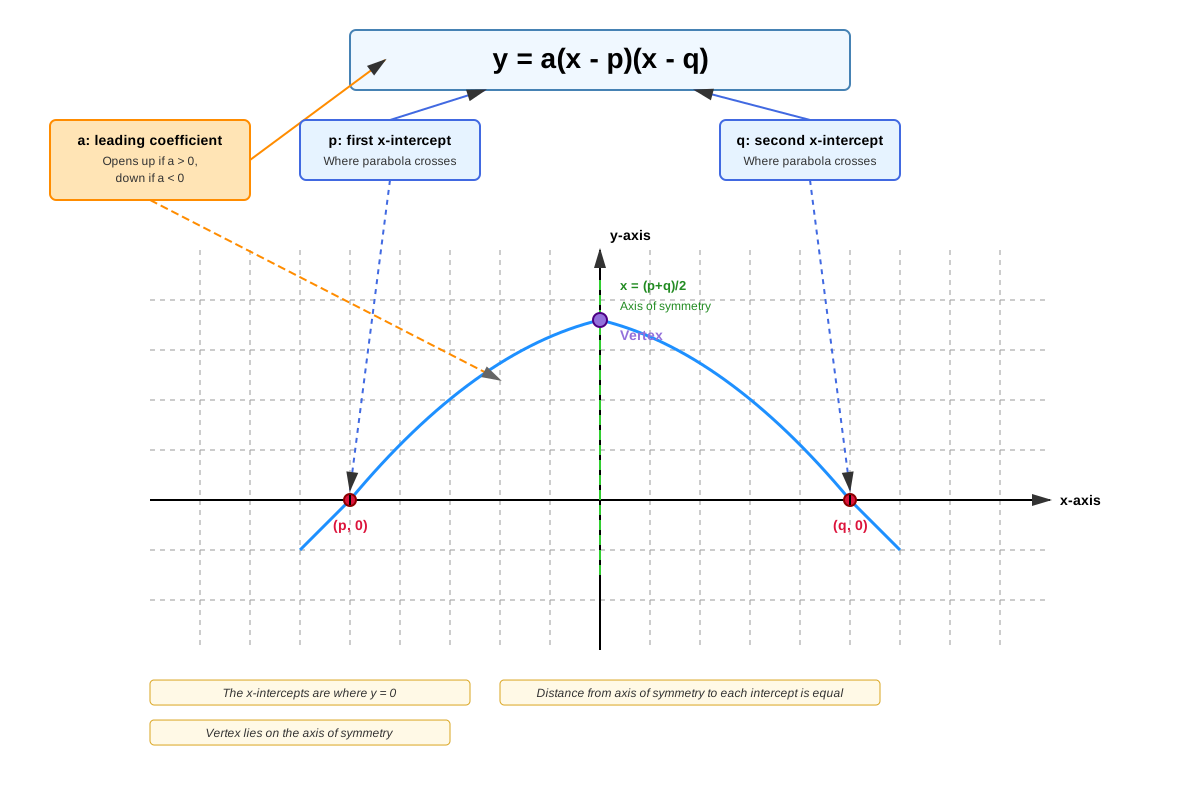
Intercept form of a quadratic function is written as:
y = a(x - p)(x - q)where:
- a is the leading coefficient (determines vertical stretch/compression and direction)
- p and q are the x-intercepts (also called roots, zeros, or solutions)
- The parabola crosses the x-axis at points (p, 0) and (q, 0)
The beauty of this form lies in its transparency: the x-intercepts are immediately visible without any calculation. If you see y = 2(x - 3)(x + 5), you instantly know the parabola crosses the x-axis at x = 3 and x = -5. Note the sign change: (x - 3) gives an intercept at x = 3, while (x + 5) means (x - (-5)), giving an intercept at x = -5.
The Role of Parameter 'a'
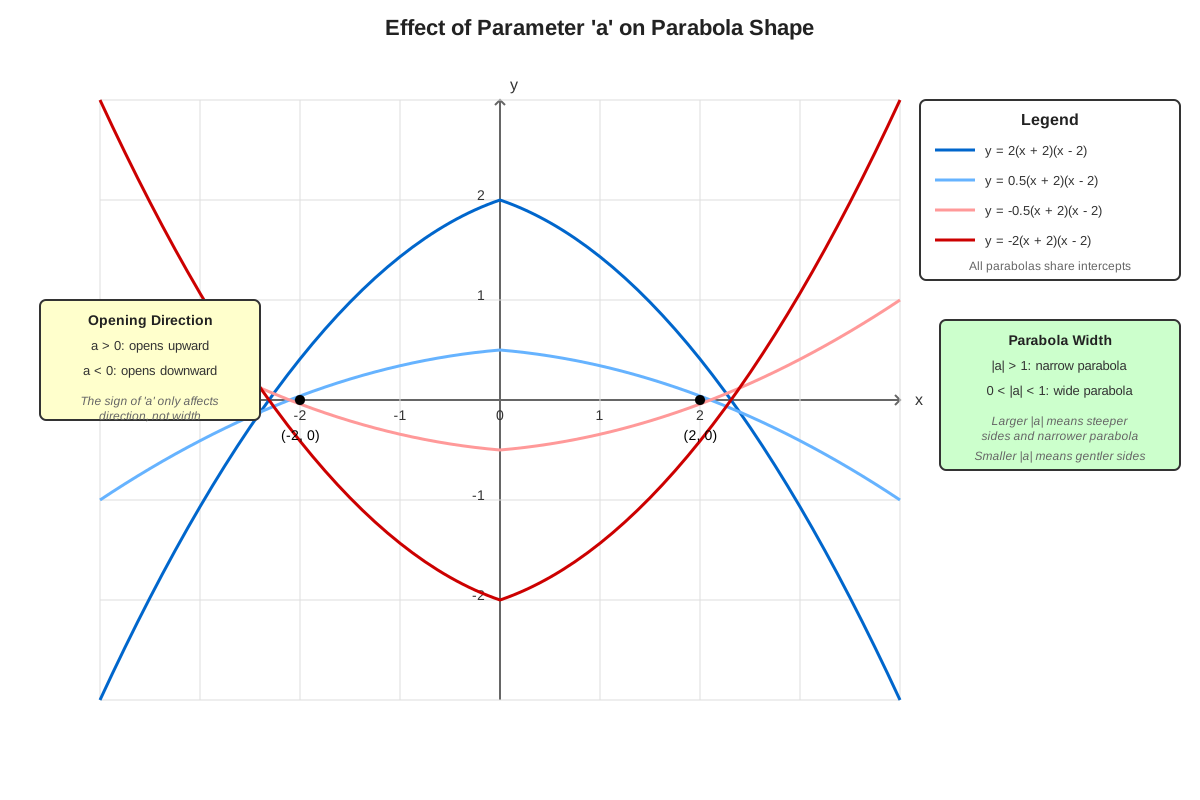
The coefficient a in intercept form serves multiple critical functions:
| Value of a | Direction | Width | Example | ||
|---|---|---|---|---|---|
| a > 0 | Opens upward | Larger | a | = narrower | y = 3(x - 1)(x - 4) |
| a < 0 | Opens downward | Smaller | a | = wider | y = -0.5(x + 2)(x - 6) |
| a = 1 | Standard width upward | Reference width | y = (x - 2)(x - 7) | ||
| a = -1 | Standard width downward | Reference width | y = -(x + 1)(x - 3) |
When |a| > 1, the parabola is narrower (steeper) than the standard parabola y = x². When 0 < |a| < 1, the parabola is wider (more gradual). This parameter does not affect the x-intercepts themselves, only the shape and orientation of the curve between and beyond them.
Finding the Axis of Symmetry
The axis of symmetry is the vertical line that passes through the vertex and divides the parabola into mirror images. For a parabola in intercept form y = a(x - p)(x - q), the axis of symmetry is always located exactly halfway between the two x-intercepts:
x = (p + q)/2This formula emerges from the symmetric nature of parabolas. For example, if a parabola has x-intercepts at x = 2 and x = 8, the axis of symmetry is x = (2 + 8)/2 = 5. This midpoint formula is one of the most frequently tested relationships on the SAT.
Determining the Vertex
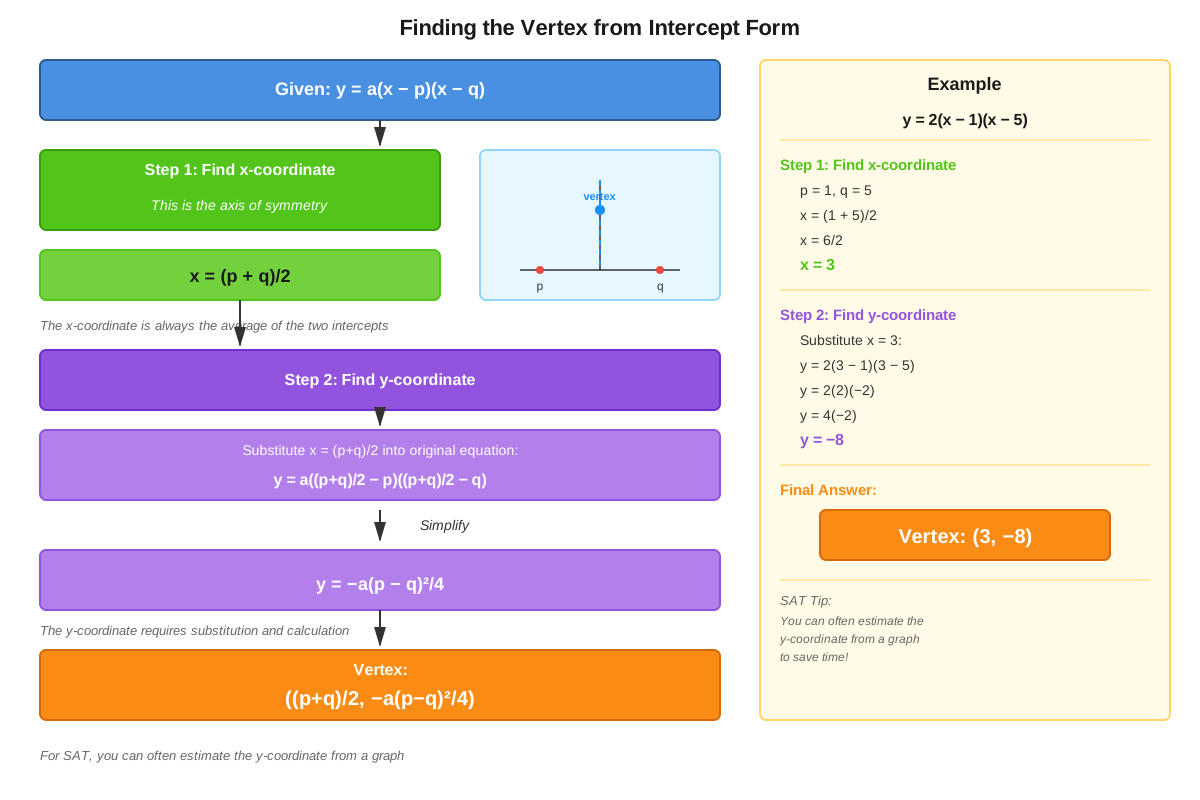
The vertex is the highest or lowest point on the parabola, depending on whether it opens downward or upward. To find the vertex from intercept form:
- Calculate the x-coordinate using the axis of symmetry formula: x = (p + q)/2
- Substitute this x-value back into the original equation to find the y-coordinate
For example, given y = 2(x - 1)(x - 7):
- x-coordinate of vertex: x = (1 + 7)/2 = 4
- y-coordinate: y = 2(4 - 1)(4 - 7) = 2(3)(-3) = -18
- Vertex: (4, -18)
This two-step process is essential for SAT questions asking for vertex coordinates when given intercept form.
Converting Between Forms
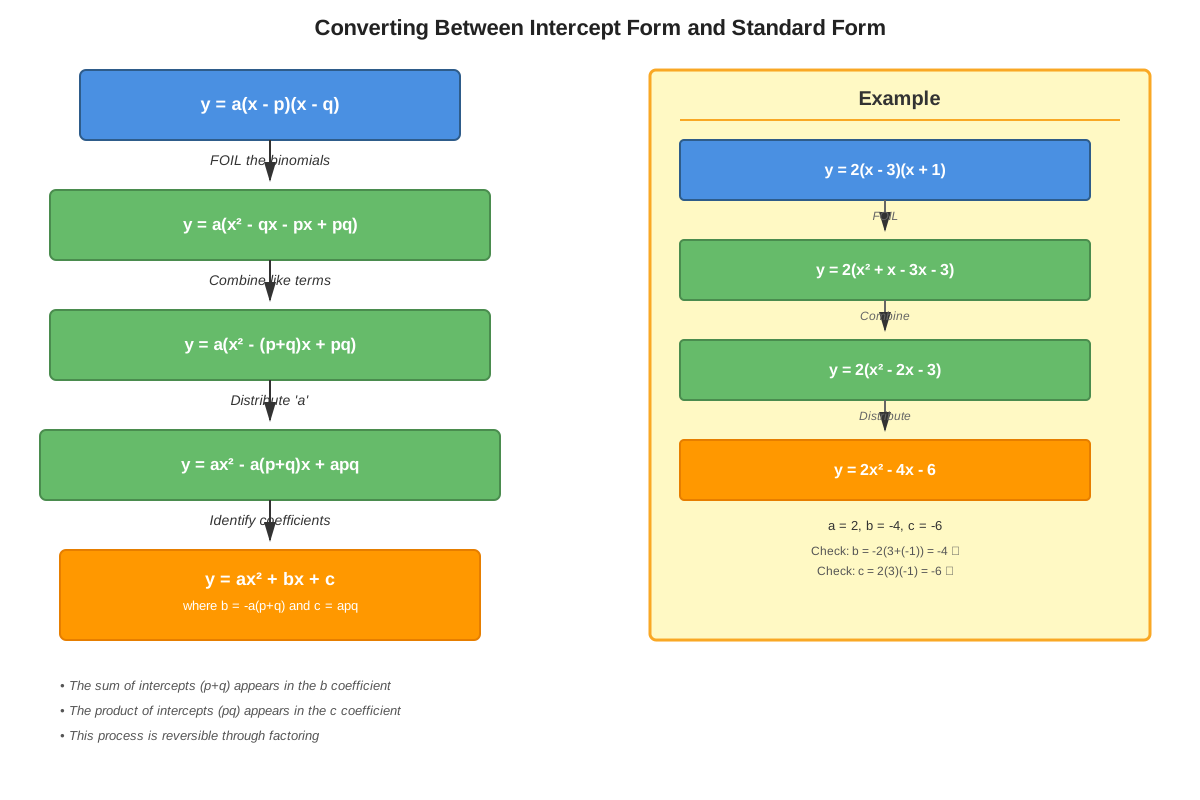
Converting from intercept form to standard form requires expanding the factored expression using the distributive property:
Step-by-step process:
- Multiply the two binomials using FOIL or the distributive property
- Multiply the result by the leading coefficient a
- Combine like terms
Example: Convert y = 3(x - 2)(x + 4) to standard form
- Expand: (x - 2)(x + 4) = x² + 4x - 2x - 8 = x² + 2x - 8
- Multiply by 3: y = 3(x² + 2x - 8) = 3x² + 6x - 24
Converting from standard form to intercept form requires factoring, which may involve:
- Finding the greatest common factor
- Factoring trinomials (finding two numbers that multiply to ac and add to b)
- Using the quadratic formula to find roots, then writing factors as (x - root₁)(x - root₂)
Special Cases
When p = q (repeated root):
If both intercepts are the same, the parabola touches the x-axis at exactly one point (the vertex lies on the x-axis). This is written as y = a(x - p)², which is actually vertex form with k = 0.
Example: y = 2(x - 3)² has a single x-intercept at x = 3, where the parabola just touches the axis.
When intercepts are irrational or complex:
Not all quadratics can be written in intercept form with rational numbers. If a quadratic has irrational roots (like x = 2 ± √3) or complex roots, intercept form is less practical for SAT purposes, though theoretically valid.
Concept Relationships
The concepts within intercept form are deeply interconnected. The x-intercepts (p and q) directly determine the axis of symmetry through their midpoint, which in turn provides the x-coordinate of the vertex. The leading coefficient (a) independently controls the parabola's orientation and width without affecting the intercepts' locations. Together, these three parameters (a, p, and q) completely define the parabola's shape and position.
Intercept form connects to prerequisite knowledge of factoring as its foundation—recognizing that y = a(x - p)(x - q) is simply the factored version of a quadratic in standard form. The relationship flows: Standard Form → Factoring → Intercept Form → Graphical Features. Conversely, expanding intercept form using FOIL and the distributive property returns to standard form, creating a bidirectional relationship.
Within the broader quadratic equations unit, intercept form complements other representations:
- Standard form (y = ax² + bx + c) → best for identifying y-intercept and using quadratic formula
- Intercept form (y = a(x - p)(x - q)) → best for identifying x-intercepts and axis of symmetry
- Vertex form (y = a(x - h)² + k) → best for identifying vertex directly
The relationship map: Factoring Skills → Intercept Form → Axis of Symmetry → Vertex Coordinates → Complete Graph Analysis. Additionally, intercept form enables efficient problem-solving for questions about zeros, roots, and solutions, as these are all synonymous terms for the x-intercepts visible in the form.
High-Yield Facts
⭐ In y = a(x - p)(x - q), the x-intercepts are at x = p and x = q (watch for sign changes: (x + 3) means intercept at x = -3)
⭐ The axis of symmetry is always x = (p + q)/2, exactly halfway between the two x-intercepts
⭐ The vertex x-coordinate equals (p + q)/2; substitute this back into the equation to find the y-coordinate
⭐ If a > 0, the parabola opens upward; if a < 0, it opens downward
⭐ The value of 'a' does not change the x-intercepts, only the shape and direction of the parabola
- When |a| > 1, the parabola is narrower than y = x²; when 0 < |a| < 1, it is wider
- The y-intercept can be found by substituting x = 0 into the intercept form equation: y = a(0 - p)(0 - q) = apq
- If p = q, the parabola has only one x-intercept (a repeated root) and the vertex touches the x-axis
- Converting from intercept form to standard form requires expanding: multiply the binomials, then multiply by 'a'
- The distance between x-intercepts is |p - q|, which relates to the parabola's horizontal span
- On the SAT, intercept form questions often involve word problems where the x-intercepts have contextual meaning (time when height = 0, price when profit = 0, etc.)
- If given a graph showing x-intercepts, you can immediately write the intercept form (except for determining 'a', which requires an additional point)
Quick check — test yourself on Intercept form so far.
Try Flashcards →Common Misconceptions
Misconception: In y = a(x - p)(x - q), the x-intercepts are at x = -p and x = -q
Correction: The x-intercepts are at x = p and x = q. The equation (x - p) = 0 solves to x = p, not x = -p. For example, (x - 5) gives an intercept at x = 5, while (x + 5) means (x - (-5)), giving an intercept at x = -5.
Misconception: The coefficient 'a' affects the location of the x-intercepts
Correction: The value of 'a' only affects the parabola's width and direction (upward or downward). The x-intercepts remain at x = p and x = q regardless of 'a'. Changing 'a' stretches or compresses the parabola vertically but doesn't shift it horizontally.
Misconception: The axis of symmetry is always at x = 0
Correction: The axis of symmetry is at x = (p + q)/2, which equals zero only when p and q are opposites (like -3 and 3). Most parabolas have their axis of symmetry at some other x-value determined by the average of the intercepts.
Misconception: The vertex y-coordinate can be found by averaging the y-values at the intercepts
Correction: The y-values at both intercepts are always zero (that's what makes them intercepts). To find the vertex y-coordinate, you must substitute x = (p + q)/2 into the original equation and calculate the result.
Misconception: Intercept form and factored form are different things
Correction: These are two names for the same representation. "Intercept form" emphasizes what the form reveals (the intercepts), while "factored form" emphasizes how it's structured (as a product of factors). Both refer to y = a(x - p)(x - q).
Misconception: If a quadratic equation cannot be factored with integers, it cannot be written in intercept form
Correction: Any quadratic with real roots can theoretically be written in intercept form, even if the roots are irrational (like 3 ± √2). However, for SAT purposes, most intercept form questions involve rational roots that factor nicely.
Misconception: The y-intercept is visible in intercept form just like the x-intercepts
Correction: The y-intercept is not immediately visible in intercept form. To find it, substitute x = 0 into the equation: y = a(0 - p)(0 - q) = apq. This requires calculation, unlike the x-intercepts which are directly visible.
Worked Examples
Example 1: Identifying Features from Intercept Form
Problem: A parabola is defined by the equation y = -2(x + 3)(x - 5). Determine: (a) the x-intercepts, (b) the axis of symmetry, (c) the vertex, and (d) whether the parabola opens upward or downward.
Solution:
(a) X-intercepts: From y = -2(x + 3)(x - 5), we identify the factors:
- (x + 3) = (x - (-3)) gives x-intercept at x = -3
- (x - 5) gives x-intercept at x = 5
- X-intercepts: (-3, 0) and (5, 0)
(b) Axis of symmetry: Use the formula x = (p + q)/2
- x = (-3 + 5)/2 = 2/2 = 1
- Axis of symmetry: x = 1
(c) Vertex: The x-coordinate is 1 (from part b). Substitute into the equation:
- y = -2(1 + 3)(1 - 5)
- y = -2(4)(-4)
- y = -2(-16)
- y = 32
- Vertex: (1, 32)
(d) Direction: The coefficient a = -2, which is negative
- The parabola opens downward
- Additionally, since |-2| = 2 > 1, the parabola is narrower than the standard parabola y = x²
Connection to learning objectives: This example demonstrates identifying key features of intercept form (objective 1) and applying intercept form to extract multiple pieces of information efficiently (objective 3).
Example 2: Writing an Equation from Given Information
Problem: A parabola crosses the x-axis at x = -4 and x = 6, and passes through the point (2, -24). Write the equation of the parabola in intercept form.
Solution:
Step 1: Set up the basic intercept form using the given x-intercepts
- Since the x-intercepts are -4 and 6, we write: y = a(x - (-4))(x - 6)
- Simplify: y = a(x + 4)(x - 6)
Step 2: Use the additional point (2, -24) to find 'a'
- Substitute x = 2 and y = -24 into the equation:
- -24 = a(2 + 4)(2 - 6)
- -24 = a(6)(-4)
- -24 = -24a
- a = 1
Step 3: Write the final equation
- y = (x + 4)(x - 6) or y = 1(x + 4)(x - 6)
Verification: Check that the point (2, -24) satisfies the equation:
- y = (2 + 4)(2 - 6) = (6)(-4) = -24 ✓
Connection to learning objectives: This example applies intercept form to answer SAT-style questions (objective 3) by working backward from given information to construct an equation. This reverse-engineering approach is common on the SAT and requires deep understanding of what each parameter represents.
Example 3: Converting Forms and Analyzing
Problem: Convert y = (x - 3)(x + 7) to standard form, then find the y-intercept.
Solution:
Step 1: Expand using FOIL
- y = (x - 3)(x + 7)
- First: x · x = x²
- Outer: x · 7 = 7x
- Inner: -3 · x = -3x
- Last: -3 · 7 = -21
- y = x² + 7x - 3x - 21
Step 2: Combine like terms
- y = x² + 4x - 21
- Standard form: y = x² + 4x - 21
Step 3: Find the y-intercept
- Method 1 (from standard form): The y-intercept is the constant term, c = -21
- Method 2 (from intercept form): Substitute x = 0 into y = (x - 3)(x + 7)
- y = (0 - 3)(0 + 7) = (-3)(7) = -21
- Y-intercept: (0, -21)
Connection to learning objectives: This demonstrates converting between intercept form and standard form (objective 4) and shows how different forms reveal different features efficiently.
Exam Strategy
When approaching SAT questions involving intercept form, follow this strategic framework:
Recognition triggers: Watch for these phrases that signal intercept form is useful:
- "x-intercepts," "zeros," "roots," or "solutions"
- "where the graph crosses the x-axis"
- "when y = 0" or "when the value equals zero"
- Graphs showing clear x-intercepts at integer values
- Word problems asking "when does [something] reach the ground/zero/break-even"
Approach sequence:
- Identify what's given and what's asked: If x-intercepts are provided or visible, intercept form is likely the most efficient approach
- Check the form of the equation: If already in intercept form, extract information directly; if in standard form, consider whether factoring would be faster than other methods
- Use the appropriate formula: For axis of symmetry, always use x = (p + q)/2; for vertex, calculate the x-coordinate first, then substitute
- Verify with a quick check: If time permits, substitute one of the x-intercepts back into the equation to confirm it yields y = 0
Process of elimination tips:
- If answer choices give x-intercepts, eliminate any that don't match the factors in the equation (remember sign changes!)
- For questions about direction (upward/downward), eliminate based on the sign of 'a' alone
- If asked for the axis of symmetry, eliminate any answer not between the two x-intercepts
- For vertex questions, eliminate any x-coordinate that isn't the midpoint of the intercepts
Time allocation:
- Simple identification questions (finding intercepts from given equation): 30-45 seconds
- Multi-step problems (finding vertex from intercept form): 60-90 seconds
- Conversion problems (intercept form to standard form): 90-120 seconds
- Complex application problems (writing equations from conditions): 120-180 seconds
Calculator usage: For the calculator section, use your calculator to verify arithmetic (especially when finding vertex y-coordinates or expanding binomials), but don't rely on graphing features unless you're stuck—algebraic methods are typically faster and more reliable.
Exam Tip: If a question provides a graph with clear x-intercepts, immediately write down the intercept form structure y = a(x - p)(x - q) before reading the rest of the question. This primes your brain for the most efficient solution path.
Memory Techniques
Mnemonic for intercept form structure: "A Parrot Quickly" reminds you of the structure a(x - p)(x - q)
- A = the coefficient 'a'
- P = first intercept 'p'
- Q = second intercept 'q'
Sign change reminder: "Minus means the number IS" - When you see (x - 5), the intercept IS at x = 5 (the minus sign means the intercept is the number shown). When you see (x + 5), think of it as (x - (-5)), so the intercept IS at x = -5.
Axis of symmetry visualization: Picture the two x-intercepts as two friends standing on a number line. The axis of symmetry is where you'd stand to be exactly between them—the average of their positions. "Average the intercepts, find the axis".
Vertex finding sequence: "AXE then WHY"
- AX = Find the axis (x-coordinate of vertex) first: x = (p + q)/2
- E = Enter this value
- WHY = Calculate the y-coordinate by substituting back
Direction and width: "Positive Parabolas Point uP" (a > 0 means opens upward)
- For width: "Big 'a' makes it Narrow" (larger |a| creates a narrower parabola)
Form comparison acronym: "SIV" for the three main forms
- Standard form: shows y-intercept easily
- Intercept form: shows x-intercepts easily
- Vertex form: shows vertex easily
Summary
Intercept form, expressed as y = a(x - p)(x - q), is a powerful representation of quadratic functions that immediately reveals the x-intercepts at x = p and x = q. This form is particularly valuable on the SAT because it enables rapid identification of key parabola features: the x-intercepts are visible directly in the factors, the axis of symmetry is calculated as x = (p + q)/2, and the vertex can be found by substituting this x-value back into the equation. The coefficient 'a' determines whether the parabola opens upward (a > 0) or downward (a < 0) and controls its width, but does not affect the intercept locations. Converting between intercept form and standard form requires either expanding binomials (intercept to standard) or factoring (standard to intercept). Mastery of intercept form provides strategic advantages on the SAT, particularly for questions involving roots, zeros, graphical analysis, and real-world applications where the x-intercepts carry contextual meaning. Understanding when to use intercept form versus other quadratic representations is essential for efficient problem-solving under timed conditions.
Key Takeaways
- Intercept form y = a(x - p)(x - q) directly shows x-intercepts at x = p and x = q (watch for sign changes in the factors)
- The axis of symmetry is always x = (p + q)/2, the midpoint between the two x-intercepts
- To find the vertex, calculate x = (p + q)/2, then substitute this value into the equation to find y
- The coefficient 'a' controls direction (positive = upward, negative = downward) and width (larger |a| = narrower), but not intercept location
- Converting to standard form requires expanding the binomials and multiplying by 'a'; converting from standard form requires factoring
- Intercept form is most efficient when x-intercepts are given or asked for, making it a high-yield strategy for many SAT questions
- All three forms (standard, intercept, vertex) represent the same parabola but reveal different features most efficiently
Related Topics
Vertex Form of Quadratics: After mastering intercept form, vertex form y = a(x - h)² + k provides another powerful representation that makes the vertex coordinates (h, k) immediately visible. Understanding both forms enables strategic choice based on what information is given or requested.
Quadratic Formula: When a quadratic cannot be easily factored, the quadratic formula provides the roots, which can then be used to write the intercept form. This connection shows how different solution methods complement each other.
Completing the Square: This technique converts standard form to vertex form and can also be used to find roots, creating another pathway to intercept form. Mastering completing the square deepens understanding of the relationships between all quadratic forms.
Systems of Equations with Quadratics: Intercept form becomes valuable when solving systems involving parabolas and lines, particularly when finding intersection points or analyzing how many solutions exist.
Polynomial Factoring: The factoring skills used in intercept form extend to higher-degree polynomials, where factored form reveals all real roots. This topic builds naturally from quadratic intercept form.
Practice CTA
Now that you've mastered the core concepts of intercept form, it's time to solidify your understanding through active practice. The practice questions and flashcards are specifically designed to mirror SAT question formats and difficulty levels, giving you the repetition needed to build speed and confidence. Remember, understanding the concepts is just the first step—applying them under timed conditions is what translates to points on test day. Challenge yourself with the practice materials, and pay special attention to questions where you need to choose between different solution methods. Each practice problem you complete strengthens your mathematical intuition and brings you closer to your target score. You've got this!
Sign up free to keep reading
Create a free AnvayaPrep account to finish this SAT guide on Intercept form — plus flashcards and practice questions.