Overview
The concept of maximum value is a cornerstone of quadratic equations and represents one of the most frequently tested topics in SAT math. Understanding how to find and interpret the maximum value of a quadratic function enables students to solve optimization problems, analyze parabolic motion, and interpret real-world scenarios involving profit maximization, projectile trajectories, and area optimization. On the SAT, maximum value questions typically appear 2-3 times per test and can be worth 10-15% of the total math score, making this a high-yield topic that demands thorough mastery.
The sat maximum value concept builds directly on foundational knowledge of quadratic functions, parabolas, and coordinate geometry. When a quadratic function opens downward (has a negative leading coefficient), its vertex represents the highest point on the graph—the maximum value. This value has both practical and theoretical significance: it tells us the greatest output the function can produce and the input value at which this occurs. Students must be comfortable working with quadratic functions in multiple forms (standard, vertex, and factored) and understand how to extract maximum value information from each representation.
Mastering maximum value problems requires integrating multiple mathematical skills: algebraic manipulation, graphical interpretation, and analytical reasoning. This topic connects to broader mathematical concepts including function transformations, domain and range restrictions, and systems of equations. The ability to quickly identify whether a quadratic has a maximum or minimum, locate the vertex, and interpret the result in context separates high-scoring students from those who struggle with the SAT math section.
Learning Objectives
- [ ] Identify key features of maximum value in quadratic functions
- [ ] Explain how maximum value appears on the SAT in various question formats
- [ ] Apply maximum value concepts to answer SAT-style questions accurately and efficiently
- [ ] Determine whether a quadratic function has a maximum or minimum value by analyzing its leading coefficient
- [ ] Calculate the maximum value using vertex form, standard form, and graphical representations
- [ ] Interpret maximum value in real-world contexts and word problems
- [ ] Convert between different forms of quadratic equations to facilitate maximum value calculations
Prerequisites
- Quadratic functions in standard form (f(x) = ax² + bx + c): Essential for recognizing when a function can have a maximum value and applying the vertex formula
- Parabola properties and graphing: Necessary to visualize maximum values as the highest point on a downward-opening parabola
- Coordinate plane and ordered pairs: Required to interpret the vertex as a point (h, k) where k represents the maximum value
- Basic algebraic manipulation: Needed to complete the square, factor expressions, and rearrange equations
- Function notation and evaluation: Critical for substituting values and understanding f(x) as the output or y-value
Why This Topic Matters
Maximum value problems appear throughout mathematics, science, engineering, and economics. In real-world applications, businesses use maximum value calculations to determine optimal pricing strategies that maximize profit, engineers analyze projectile motion to find the maximum height of a launched object, and architects optimize dimensions to maximize enclosed area with limited materials. These practical applications make maximum value one of the most relevant mathematical concepts students will encounter beyond the classroom.
On the SAT, maximum value questions appear with remarkable consistency. Approximately 2-3 questions per test directly assess this concept, accounting for roughly 3-5% of the total math score. These questions appear in both the calculator and no-calculator sections, with varying difficulty levels. The College Board frequently embeds maximum value problems within word problems about business scenarios, geometric optimization, or physics contexts, requiring students to translate verbal descriptions into mathematical models before solving.
Common SAT question formats include: identifying the maximum value from a graph, calculating the maximum using the vertex formula, determining which value of a parameter produces a maximum, comparing maximum values of different functions, and interpreting maximum values in context. Questions may present quadratics in standard form, vertex form, or as tables of values, testing whether students can flexibly work across multiple representations. The ability to quickly recognize maximum value questions and apply efficient solution strategies directly impacts both accuracy and time management on test day.
Core Concepts
Understanding Maximum vs. Minimum Values
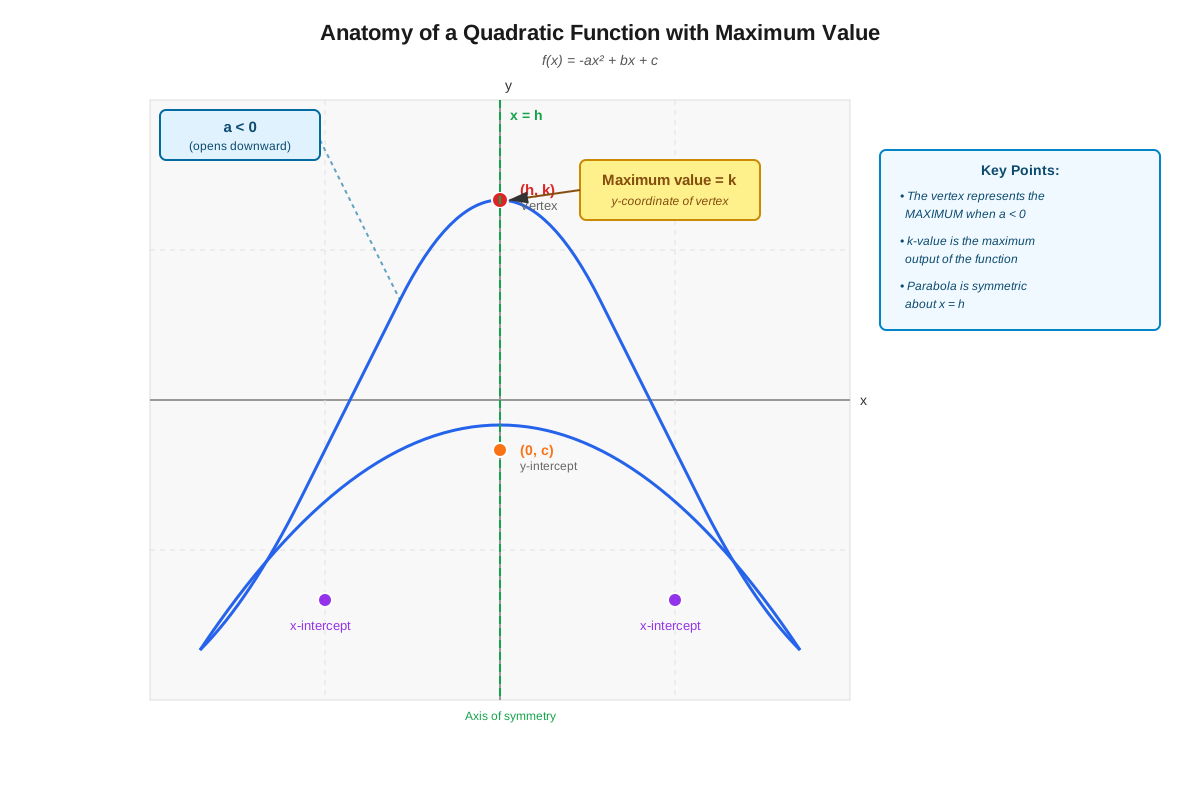
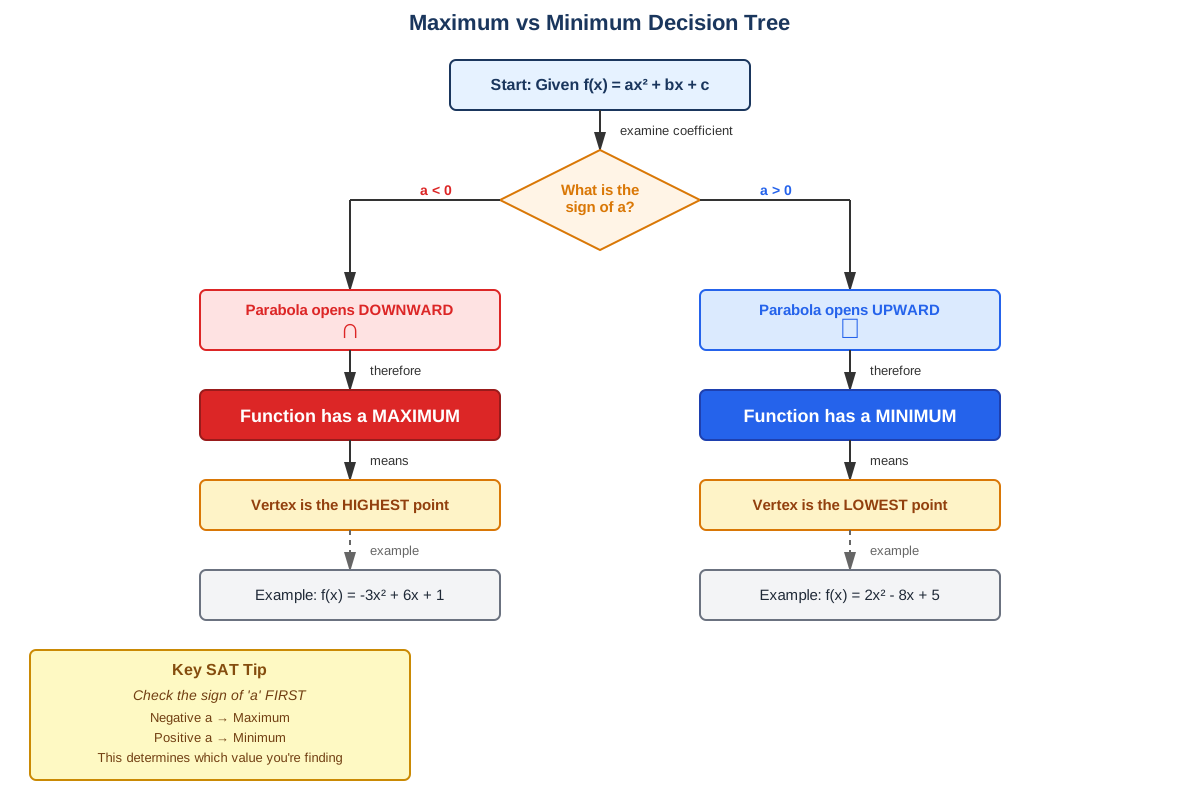
A quadratic function f(x) = ax² + bx + c produces a parabola when graphed. The maximum value occurs when the parabola opens downward (a < 0), making the vertex the highest point on the graph. Conversely, when a > 0, the parabola opens upward and has a minimum value at the vertex. This fundamental distinction is the first step in any maximum value problem: examining the coefficient of the x² term.
The sign of the leading coefficient a determines the parabola's orientation:
- If a < 0 (negative): parabola opens downward → has a maximum value
- If a > 0 (positive): parabola opens upward → has a minimum value
The Vertex as the Location of Maximum Value
The vertex of a parabola represents the point where the function reaches its extreme value (maximum or minimum). For a quadratic with a maximum value, the vertex coordinates (h, k) provide crucial information: h represents the x-value (input) where the maximum occurs, and k represents the actual maximum value (output). Understanding this distinction prevents a common error where students confuse the location of the maximum with the maximum value itself.
Vertex Form and Maximum Value
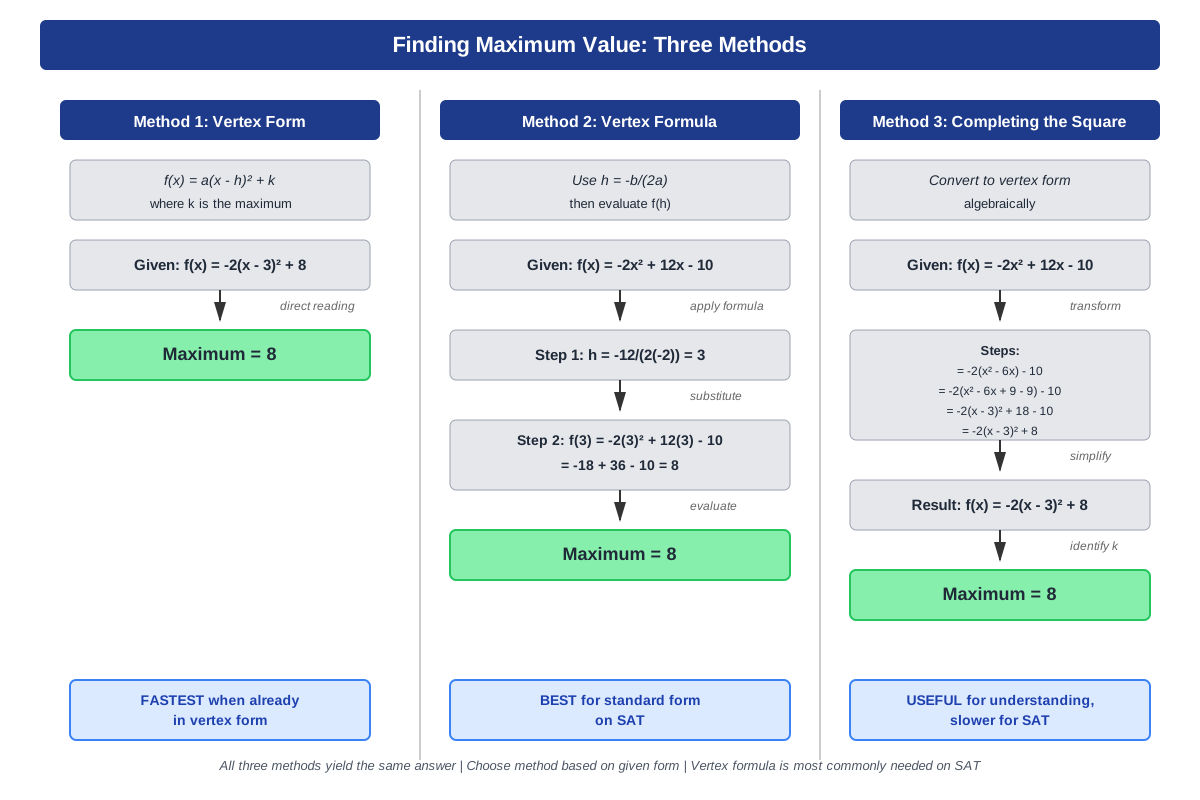
When a quadratic is written in vertex form: f(x) = a(x - h)² + k, identifying the maximum value becomes straightforward. The parameter k directly represents the maximum value (when a < 0), and h indicates where this maximum occurs. This form is particularly valuable on the SAT because it provides immediate access to the vertex coordinates without additional calculation.
For example, if f(x) = -2(x - 3)² + 8:
- The vertex is at (3, 8)
- Since a = -2 < 0, the parabola opens downward
- The maximum value is 8, occurring at x = 3
Standard Form and the Vertex Formula
Most SAT questions present quadratics in standard form: f(x) = ax² + bx + c. To find the maximum value from this form, students must first locate the vertex using the formula:
x-coordinate of vertex: h = -b/(2a)After calculating h, substitute this value back into the original function to find k, the maximum value:
Maximum value: k = f(-b/(2a))This two-step process is essential for SAT success. For example, given f(x) = -x² + 6x - 5:
Step 1: Find h = -6/(2(-1)) = -6/(-2) = 3
Step 2: Find k = f(3) = -(3)² + 6(3) - 5 = -9 + 18 - 5 = 4
Therefore, the maximum value is 4, occurring at x = 3.
Completing the Square Method
An alternative approach involves completing the square to convert standard form into vertex form. This method provides deeper algebraic insight and serves as a backup strategy when the vertex formula is forgotten. The process involves:
- Factor out the leading coefficient from the x² and x terms
- Add and subtract the square of half the x-coefficient inside the parentheses
- Simplify to reveal vertex form
For f(x) = -2x² + 12x - 10:
- Factor: f(x) = -2(x² - 6x) - 10
- Complete the square: f(x) = -2(x² - 6x + 9 - 9) - 10
- Simplify: f(x) = -2(x - 3)² + 18 - 10 = -2(x - 3)² + 8
- Maximum value: 8 at x = 3
Graphical Interpretation
When the SAT provides a graph of a quadratic function, the maximum value can be read directly as the y-coordinate of the highest point. Students should identify the vertex visually and note its coordinates. This approach requires careful attention to scale and grid markings, as misreading the graph is a common source of errors.
Domain Restrictions and Maximum Values
Some SAT problems impose domain restrictions that limit the x-values the function can accept. In these cases, the maximum value may not occur at the vertex if the vertex lies outside the allowed domain. Students must:
- Find the vertex and check if it falls within the restricted domain
- If yes, the maximum value is the y-coordinate of the vertex
- If no, evaluate the function at the domain endpoints and choose the larger value
For example, if f(x) = -x² + 4x + 1 with domain 0 ≤ x ≤ 3:
- Vertex at x = 2 (within domain), f(2) = 5
- Check endpoints: f(0) = 1, f(3) = 4
- Maximum value is 5 (at the vertex)
Contextual Maximum Value Problems
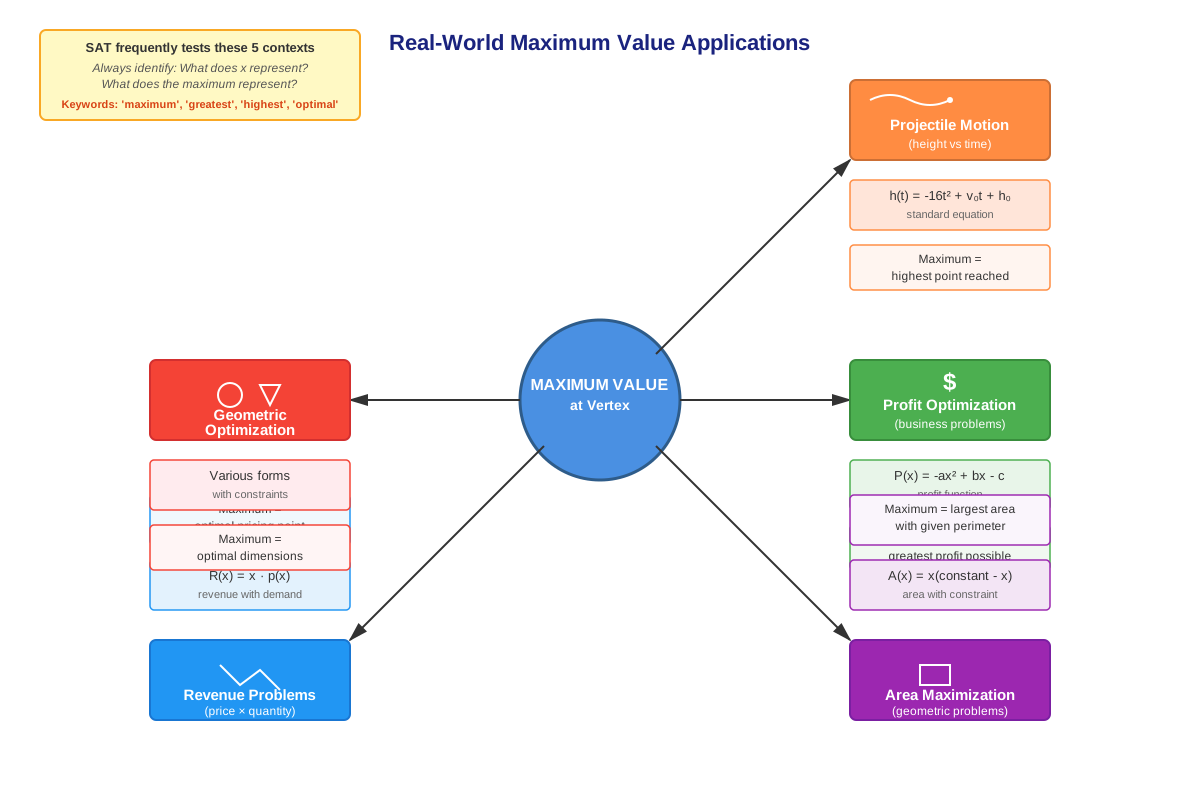
SAT word problems often disguise maximum value questions within real-world scenarios. Common contexts include:
| Context | What's Being Maximized | Typical Variable |
|---|---|---|
| Business | Profit or revenue | Price or quantity |
| Geometry | Area or perimeter | Dimension length |
| Physics | Height or distance | Time |
| Engineering | Efficiency or output | Input parameter |
Solving these problems requires translating the verbal description into a quadratic function, then applying maximum value techniques. The answer must be interpreted in context—stating not just the numerical maximum but what it represents in the problem scenario.
Concept Relationships
The maximum value concept sits at the intersection of multiple mathematical ideas. Quadratic functions provide the foundation → which leads to → parabola properties (shape, orientation, vertex) → which determines → whether a maximum or minimum exists → which requires → vertex calculation methods (vertex formula, completing the square, or vertex form) → which produces → the maximum value and its location.
This topic connects backward to prerequisite knowledge of function notation, coordinate geometry, and algebraic manipulation. It connects forward to more advanced topics including optimization in calculus, quadratic inequalities, and systems of equations. Understanding maximum value also reinforces the relationship between algebraic and graphical representations of functions—a key SAT skill.
Within the topic itself, the three forms of quadratic equations (standard, vertex, and factored) interconnect through algebraic transformations. Each form offers different advantages: vertex form provides immediate access to the maximum, standard form is most common in problems, and factored form reveals x-intercepts that help sketch the parabola. The vertex formula serves as the bridge connecting standard form to vertex information.
Quick check — test yourself on Maximum value so far.
Try Flashcards →High-Yield Facts
⭐ A quadratic function f(x) = ax² + bx + c has a maximum value if and only if a < 0 (the parabola opens downward).
⭐ The x-coordinate of the vertex (where the maximum occurs) is always h = -b/(2a) for standard form.
⭐ In vertex form f(x) = a(x - h)² + k, the maximum value is k when a < 0.
⭐ The maximum value is the y-coordinate of the vertex, not the x-coordinate.
⭐ To find the maximum value from standard form: calculate x = -b/(2a), then substitute this value into the function.
- The vertex represents the turning point of the parabola where the function changes from increasing to decreasing (or vice versa).
- When domain restrictions apply, the maximum value may occur at an endpoint rather than the vertex.
- Completing the square converts any quadratic from standard form to vertex form.
- The axis of symmetry of a parabola passes through the vertex at x = h.
- In real-world problems, the maximum value must be interpreted in context with appropriate units.
- A quadratic function has exactly one maximum value (when a < 0) or one minimum value (when a > 0), never both.
- The distance from the vertex to any point on the parabola equals the distance from the vertex to the corresponding point on the opposite side of the axis of symmetry.
Common Misconceptions
Misconception: The maximum value is the x-coordinate of the vertex. → Correction: The maximum value is the y-coordinate (k) of the vertex (h, k). The x-coordinate tells where the maximum occurs, not what the maximum value is.
Misconception: All quadratic functions have a maximum value. → Correction: Only quadratics with negative leading coefficients (a < 0) have maximum values. When a > 0, the parabola opens upward and has a minimum value instead.
Misconception: In vertex form f(x) = a(x - h)² + k, the maximum value is h. → Correction: The maximum value is k, not h. The parameter h represents the x-coordinate where the maximum occurs.
Misconception: The vertex formula gives the maximum value directly. → Correction: The vertex formula x = -b/(2a) gives only the x-coordinate of the vertex. You must substitute this value back into the function to find the actual maximum value.
Misconception: When a quadratic has domain restrictions, the maximum always occurs at the vertex. → Correction: If the vertex falls outside the restricted domain, the maximum occurs at one of the domain endpoints. Always check whether the vertex is within the allowed x-values.
Misconception: Completing the square changes the function's maximum value. → Correction: Completing the square is an algebraic transformation that rewrites the function in a different form but doesn't change the function itself or its maximum value—it only makes the maximum easier to identify.
Misconception: The maximum value of f(x) = -x² + 4 is -1 because that's the coefficient of x². → Correction: The leading coefficient determines whether a maximum exists and affects the parabola's width, but the maximum value must be calculated using vertex methods. For this function, the maximum value is 4.
Worked Examples
Example 1: Finding Maximum Value from Standard Form
Problem: A company's daily profit P (in dollars) from selling x items is modeled by P(x) = -2x² + 80x - 600. What is the maximum daily profit the company can achieve?
Solution:
Step 1: Identify the form and leading coefficient.
- The function is in standard form: P(x) = ax² + bx + c
- Here, a = -2, b = 80, c = -600
- Since a = -2 < 0, the parabola opens downward and has a maximum value
Step 2: Find the x-coordinate of the vertex using the vertex formula.
x = -b/(2a) = -80/(2(-2)) = -80/(-4) = 20Step 3: Calculate the maximum profit by substituting x = 20 into the profit function.
P(20) = -2(20)² + 80(20) - 600
P(20) = -2(400) + 1600 - 600
P(20) = -800 + 1600 - 600
P(20) = 200Answer: The maximum daily profit is $200, achieved when the company sells 20 items.
Connection to Learning Objectives: This problem demonstrates applying maximum value concepts to SAT-style questions in a real-world business context, requiring identification of key features (the vertex) and interpretation of results.
Example 2: Maximum Value with Domain Restrictions
Problem: The height h(t) in feet of a ball t seconds after being thrown is given by h(t) = -16t² + 48t + 4, where 0 ≤ t ≤ 4. What is the maximum height the ball reaches?
Solution:
Step 1: Determine if a maximum exists.
- Since a = -16 < 0, the function has a maximum value at its vertex
Step 2: Find when the maximum occurs.
t = -b/(2a) = -48/(2(-16)) = -48/(-32) = 1.5 secondsStep 3: Check if t = 1.5 is within the domain [0, 4].
- Yes, 1.5 is between 0 and 4, so the maximum occurs at the vertex
Step 4: Calculate the maximum height.
h(1.5) = -16(1.5)² + 48(1.5) + 4
h(1.5) = -16(2.25) + 72 + 4
h(1.5) = -36 + 72 + 4
h(1.5) = 40 feet
Step 5: Verify by checking endpoints (good practice).
- h(0) = 4 feet
- h(4) = -16(16) + 48(4) + 4 = -256 + 192 + 4 = -60 feet
- The maximum is indeed 40 feet at t = 1.5 seconds
Answer: The maximum height is 40 feet.
Connection to Learning Objectives: This example shows how to apply maximum value techniques to physics contexts while considering domain restrictions, a common SAT question type that tests deeper understanding.
Exam Strategy
When approaching maximum value questions on the SAT, begin by quickly scanning for key indicators: the word "maximum," phrases like "greatest value" or "highest point," or contexts involving optimization (maximizing profit, area, height, etc.). These trigger words signal that you'll need to find the vertex of a quadratic function.
Step-by-step approach:
- Identify the form: Determine whether the quadratic is in standard form, vertex form, or presented graphically
- Check the leading coefficient: Verify that a < 0 to confirm a maximum exists
- Choose your method: Use vertex form directly, apply the vertex formula for standard form, or read from a graph
- Calculate carefully: Show your work to avoid arithmetic errors, especially with negative signs
- Interpret in context: Make sure your answer addresses what the question asks (the maximum value itself, not where it occurs)
Exam Tip: If a question asks for "the value of x at which the maximum occurs," they want h (the x-coordinate). If they ask for "the maximum value," they want k (the y-coordinate). Read carefully to distinguish these.
Process-of-elimination strategies:
- Eliminate answer choices that would represent a minimum value when the question asks for a maximum
- Rule out x-coordinates when the question asks for the maximum value (y-coordinate)
- For word problems, eliminate answers that don't make sense in context (negative heights, impossible quantities)
- If given multiple functions, eliminate those with positive leading coefficients when seeking a maximum
Time allocation: Maximum value questions typically require 1.5-2.5 minutes. If you're spending more than 3 minutes, move on and return later. Practice the vertex formula until it becomes automatic—this saves valuable seconds on test day.
Memory Techniques
Vertex Formula Mnemonic: "Negative Boy Twice Angry" reminds you that the x-coordinate of the vertex is -b divided by 2a.
Maximum vs. Minimum: Remember "Negative = Nice view from the top" (negative leading coefficient means maximum at the top of the parabola). Alternatively, visualize a frown (∩) for negative a and maximum, smile (∪) for positive a and minimum.
Vertex Form Memory Aid: In f(x) = a(x - h)² + k, the k "kicks up" to show the maximum value (or kicks down for minimum). The k is always the vertical position—the actual maximum or minimum value.
Two-Step Process: Use the acronym "FS" for Find x-coordinate, then Substitute to get the maximum value. This reminds you that finding the maximum is always a two-step process when starting from standard form.
Domain Check: "VID" = Vertex In Domain? Always ask this question when domain restrictions appear. If the vertex isn't in the domain, check the endpoints.
Summary
Maximum value problems represent a critical intersection of algebraic manipulation, graphical interpretation, and real-world application on the SAT. The fundamental principle is that quadratic functions with negative leading coefficients (a < 0) produce downward-opening parabolas with maximum values at their vertices. Students must master three approaches: recognizing maximum values directly from vertex form f(x) = a(x - h)² + k where the maximum is k; calculating maximum values from standard form using the vertex formula x = -b/(2a) followed by substitution; and reading maximum values from graphs. The distinction between the location of the maximum (x-coordinate h) and the maximum value itself (y-coordinate k) is crucial and frequently tested. Domain restrictions add complexity, requiring verification that the vertex falls within allowed x-values or evaluation at endpoints when it doesn't. Success on SAT maximum value questions demands fluency with algebraic techniques, careful attention to what the question asks, and the ability to interpret mathematical results within real-world contexts.
Key Takeaways
- A quadratic function has a maximum value if and only if its leading coefficient is negative (a < 0)
- The maximum value is the y-coordinate of the vertex, found using x = -b/(2a) then substituting back into the function
- In vertex form f(x) = a(x - h)² + k, the maximum value is simply k (when a < 0)
- Always distinguish between where the maximum occurs (x-coordinate) and what the maximum value is (y-coordinate)
- Domain restrictions may cause the maximum to occur at an endpoint rather than the vertex
- Real-world maximum value problems require translating verbal descriptions into quadratic functions and interpreting results in context
- The three forms of quadratic equations (standard, vertex, factored) each offer different advantages for finding maximum values
Related Topics
Minimum Value of Quadratic Functions: The complementary concept for upward-opening parabolas (a > 0), using identical techniques but interpreting the vertex as the lowest point rather than highest.
Quadratic Inequalities: Understanding maximum and minimum values helps solve inequalities by identifying where functions are above or below certain thresholds.
Systems of Equations with Quadratics: Finding intersection points between quadratic and linear functions often involves maximum/minimum analysis to determine the number and nature of solutions.
Function Transformations: Mastering how changes to parameters a, h, and k affect the vertex location and maximum value deepens understanding of function behavior.
Optimization in Calculus: Maximum value concepts provide the foundation for derivative-based optimization, making this topic essential preparation for advanced mathematics.
Practice CTA
Now that you've mastered the core concepts of maximum value, it's time to solidify your understanding through practice. Work through the practice questions to test your ability to identify, calculate, and interpret maximum values in various contexts. Use the flashcards to reinforce key formulas and concepts until they become automatic. Remember, the difference between knowing these concepts and scoring points on test day is practice—the more problems you solve, the faster and more confident you'll become. You've built a strong foundation; now apply it to achieve your target score!
Sign up free to keep reading
Create a free AnvayaPrep account to finish this SAT guide on Maximum value — plus flashcards and practice questions.