Overview
The minimum value of a quadratic function is one of the most frequently tested concepts in SAT math, appearing in multiple question formats throughout the exam. Understanding how to find and interpret minimum values is essential for success on problems involving parabolas, optimization scenarios, and real-world applications. A minimum value represents the lowest point on a parabola that opens upward, corresponding to the vertex of the quadratic function. This concept bridges algebraic manipulation, graphical interpretation, and practical problem-solving skills.
On the SAT, minimum value questions test a student's ability to work with quadratic equations in multiple forms—standard form, vertex form, and factored form—and to translate between algebraic expressions and their graphical representations. These questions often appear in both the calculator and no-calculator sections, with point values ranging from 1 to 4 points depending on complexity. Students must be comfortable identifying minimum values from equations, graphs, tables, and word problems that describe real-world scenarios such as projectile motion, profit maximization, or area optimization.
Mastering minimum value concepts strengthens understanding of broader mathematical principles including function transformations, coordinate geometry, and algebraic reasoning. This topic connects directly to vertex form conversions, completing the square, and the discriminant—all critical components of the quadratic equations unit. Students who develop fluency with minimum value problems gain powerful problem-solving tools applicable across multiple SAT math domains, including functions, algebra, and problem-solving with data analysis.
Learning Objectives
- [ ] Identify key features of minimum value in quadratic functions
- [ ] Explain how minimum value appears on the SAT in various question formats
- [ ] Apply minimum value concepts to answer SAT-style questions accurately and efficiently
- [ ] Convert quadratic equations between standard form and vertex form to locate minimum values
- [ ] Determine whether a quadratic function has a minimum or maximum value based on its leading coefficient
- [ ] Interpret minimum values in context of real-world application problems
- [ ] Use multiple methods (graphing, completing the square, vertex formula) to find minimum values
Prerequisites
- Quadratic functions in standard form (y = ax² + bx + c): Understanding the structure and components of quadratic equations is essential for manipulating them to find minimum values
- Parabola properties: Knowledge of how parabolas open (upward or downward) and the significance of the vertex determines whether a function has a minimum or maximum
- Coordinate plane graphing: Ability to plot points and visualize functions helps interpret minimum values as the lowest point on a graph
- Basic algebraic manipulation: Skills in expanding, factoring, and simplifying expressions are necessary for converting between different forms of quadratic equations
- Function notation: Familiarity with f(x) notation and evaluating functions at specific x-values enables proper interpretation of minimum value problems
Why This Topic Matters
Minimum value problems appear with remarkable frequency on the SAT, typically showing up in 3-5 questions per exam across both math sections. These questions test multiple mathematical competencies simultaneously, making them high-value targets for focused study. The College Board consistently includes minimum value questions because they assess conceptual understanding rather than mere procedural knowledge, aligning with the exam's emphasis on problem-solving and analytical reasoning.
In real-world applications, minimum values represent optimal solutions to practical problems. Engineers use minimum value calculations to determine the least amount of material needed for construction projects. Businesses apply these concepts to minimize costs while maintaining production levels. Physicists use minimum values to find the lowest point in a projectile's trajectory. Athletes and coaches analyze minimum values to optimize performance metrics. These applications demonstrate why the SAT emphasizes this topic—it reflects mathematical reasoning used in college coursework and professional contexts.
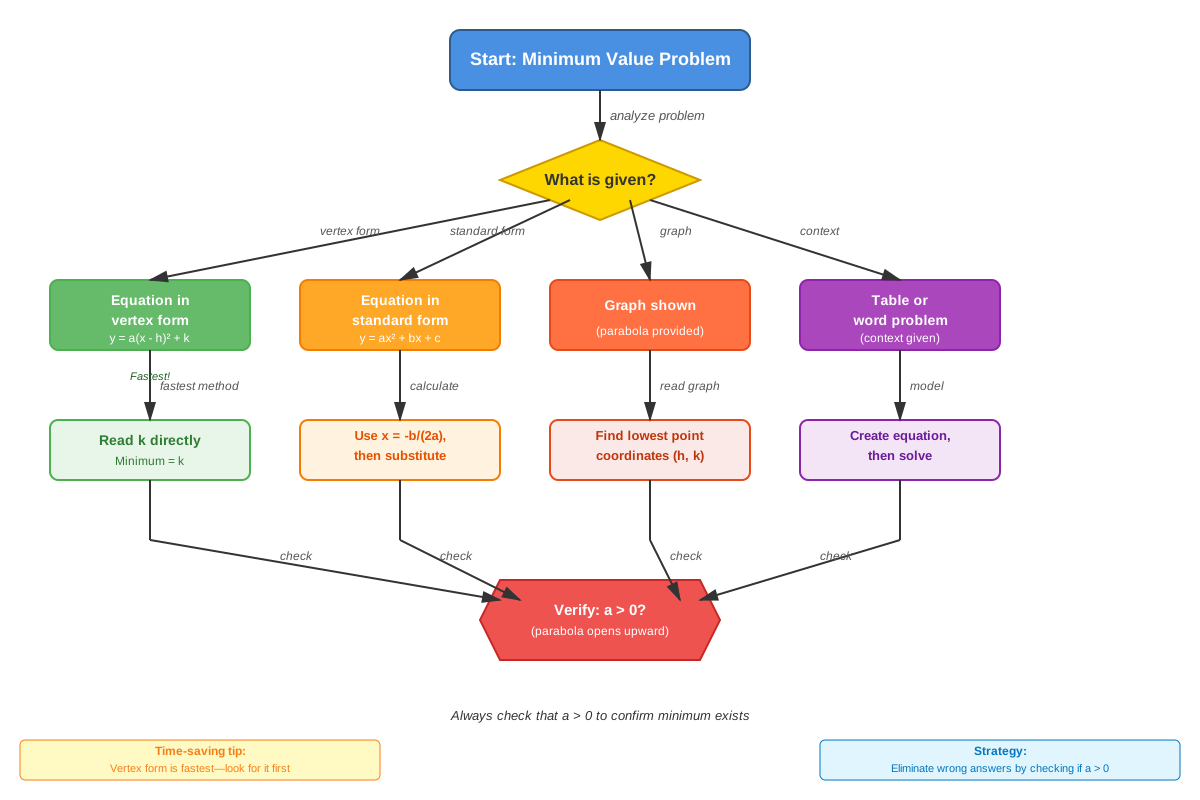
On the exam, minimum value questions appear in multiple formats: direct calculation problems asking for the minimum value of a given function, word problems requiring students to construct and analyze quadratic models, graph interpretation questions where students identify minimum values visually, and multi-step problems combining minimum value concepts with other algebraic skills. Questions may present quadratics in any form and may require students to work backward from a given minimum value to determine unknown coefficients. The versatility of minimum value questions makes them particularly valuable for the test-makers and particularly important for test-takers to master.
Core Concepts
Understanding Minimum Values
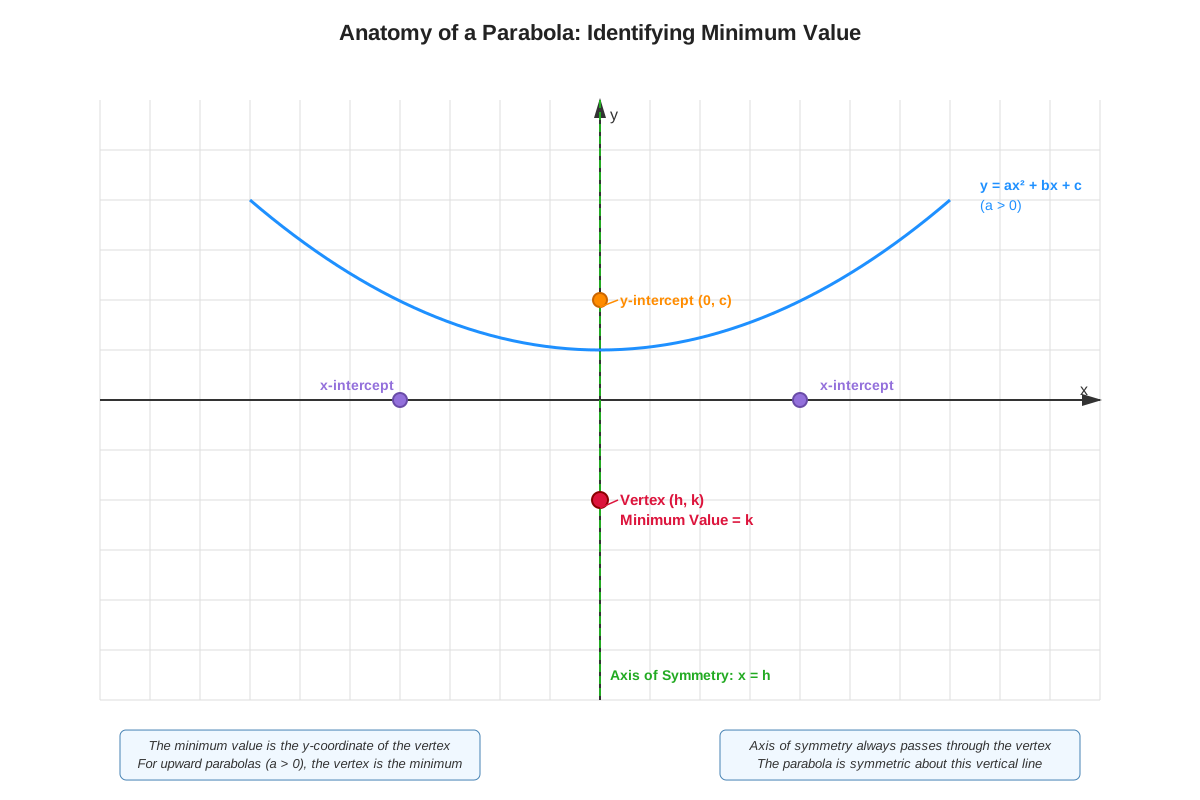
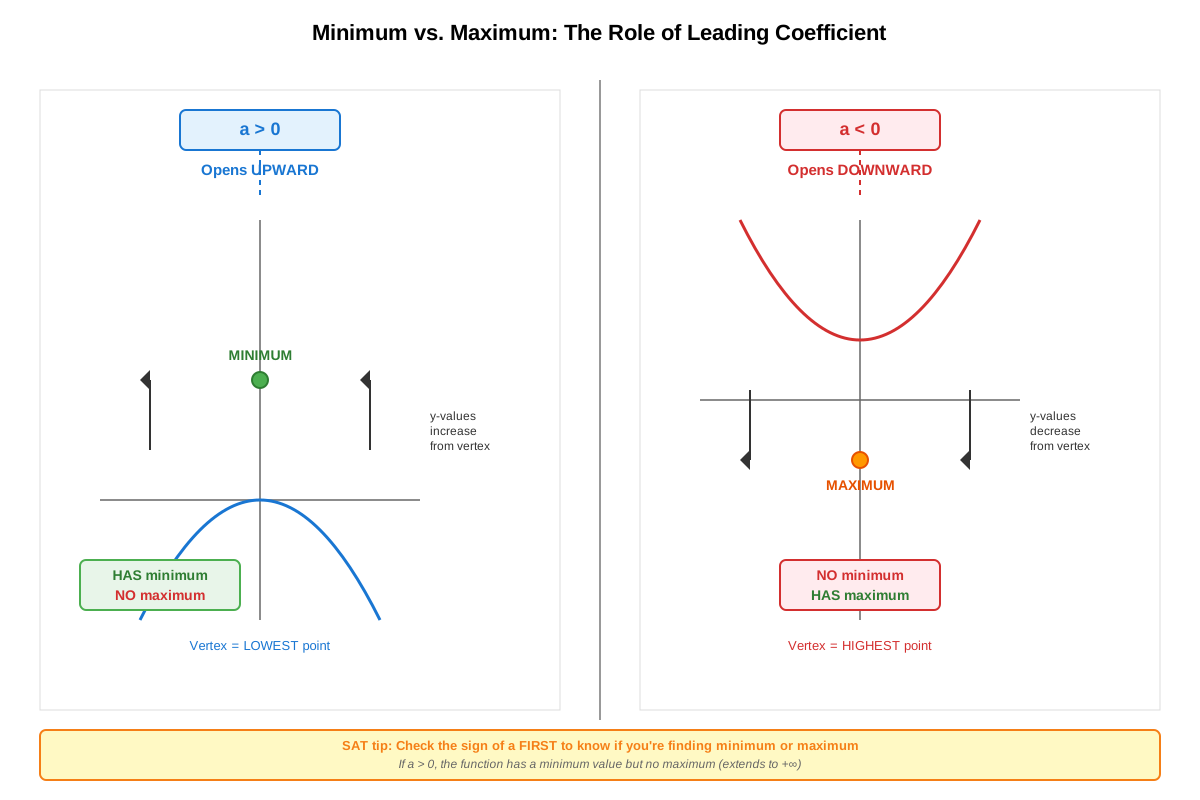
A minimum value is the smallest output (y-value) that a function produces across its domain. For quadratic functions, the minimum value occurs at the vertex when the parabola opens upward. The key to identifying whether a quadratic has a minimum or maximum lies in the leading coefficient (the coefficient of the x² term). When this coefficient is positive (a > 0), the parabola opens upward like a cup, creating a minimum value at the bottom. When the coefficient is negative (a < 0), the parabola opens downward like a frown, creating a maximum value at the top instead.
The minimum value is always the y-coordinate of the vertex, while the x-coordinate of the vertex represents where (at what input value) this minimum occurs. This distinction is crucial for SAT questions, which may ask for either the minimum value itself, the x-value where it occurs, or both. Understanding this relationship between the vertex coordinates and the minimum value prevents common errors on exam questions.
Vertex Form and Minimum Values
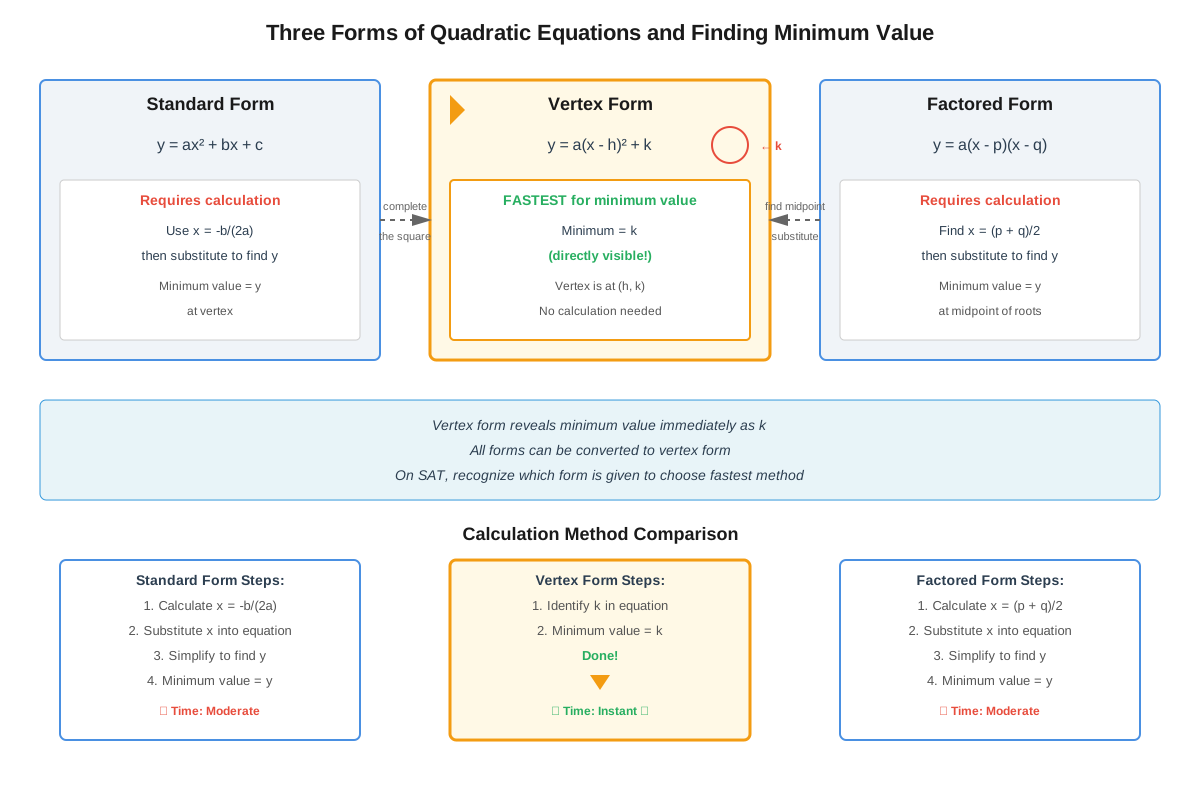
The vertex form of a quadratic equation is y = a(x - h)² + k, where (h, k) represents the vertex coordinates. This form provides immediate access to the minimum value: when a > 0, the minimum value is simply k, occurring at x = h. The vertex form is the most efficient representation for identifying minimum values because it requires no calculation—the minimum value is explicitly stated in the equation.
Converting from standard form (y = ax² + bx + c) to vertex form reveals the minimum value. This conversion can be accomplished through completing the square, a systematic algebraic process. The relationship between forms demonstrates why understanding multiple representations of quadratic functions is essential for SAT success.
The Vertex Formula Method
For a quadratic function in standard form y = ax² + bx + c, the x-coordinate of the vertex can be found using the formula x = -b/(2a). Once this x-value is determined, substituting it back into the original equation yields the y-coordinate, which is the minimum value (when a > 0). This method is particularly efficient for SAT questions because it requires minimal algebraic manipulation and works directly with the given equation.
The vertex formula method follows these steps:
- Identify the coefficients a and b from the standard form equation
- Calculate x = -b/(2a) to find where the minimum occurs
- Substitute this x-value into the original equation to find y
- The resulting y-value is the minimum value
Graphical Interpretation
When presented with a graph of a quadratic function, the minimum value can be identified visually as the y-coordinate of the lowest point on the parabola. SAT questions frequently show graphs with labeled vertices or grid lines that allow students to read the minimum value directly. Understanding the graphical representation reinforces the connection between algebraic and visual reasoning.
Key graphical features to recognize include:
- The vertex as the turning point of the parabola
- The axis of symmetry passing through the vertex
- The direction of opening determined by the leading coefficient
- The relationship between the vertex location and the minimum value
Minimum Values in Context
SAT minimum value problems often embed the mathematical concept within real-world scenarios. These context problems require students to:
- Translate verbal descriptions into quadratic equations
- Identify what quantity the minimum value represents
- Interpret the meaning of the x-coordinate where the minimum occurs
- Apply units correctly to the answer
Common contexts include profit/cost functions (minimum cost), projectile motion (minimum height), area problems (minimum perimeter for given area), and distance problems (minimum distance from a point to a curve). Success with these problems requires both mathematical skill and careful reading comprehension.
Comparing Methods for Finding Minimum Values
| Method | Best Used When | Advantages | Disadvantages |
|---|---|---|---|
| Vertex Form Recognition | Equation given in y = a(x-h)² + k | Immediate answer; no calculation | Requires equation in vertex form |
| Vertex Formula | Equation in standard form | Quick; works with any standard form | Requires substitution step |
| Completing the Square | Need to convert to vertex form | Shows full algebraic process | Time-consuming; error-prone |
| Graphing | Graph provided or calculator allowed | Visual confirmation | Less precise; requires careful reading |
Concept Relationships
The minimum value concept serves as a central hub connecting multiple quadratic function topics. Standard form (ax² + bx + c) → requires transformation → vertex form (a(x-h)² + k) → directly reveals → minimum value (k when a > 0). This transformation pathway represents the most common problem-solving sequence on the SAT.
The relationship extends to graphical analysis: parabola properties → determine → vertex location → corresponds to → minimum value. Understanding that the vertex, axis of symmetry, and minimum value are interconnected features of the same point strengthens conceptual mastery.
Minimum value problems also connect to function transformations: vertical shifts move the minimum value up or down, horizontal shifts move where the minimum occurs, and vertical stretches/compressions change the rate at which the function approaches its minimum. These transformation concepts help students predict how changes to an equation affect the minimum value.
The discriminant (b² - 4ac) connects to minimum values through the relationship between roots and vertex position. When a quadratic has a minimum value above the x-axis, the discriminant is negative (no real roots). When the minimum value equals zero, the discriminant is zero (one repeated root at the vertex). This connection reinforces understanding of how different quadratic features relate to each other.
High-Yield Facts
⭐ The minimum value of y = a(x - h)² + k (when a > 0) is k, occurring at x = h
⭐ For standard form y = ax² + bx + c, the x-coordinate of the vertex is x = -b/(2a)
⭐ A quadratic function has a minimum value if and only if the leading coefficient (a) is positive
⭐ The minimum value is always the y-coordinate of the vertex, never the x-coordinate
⭐ In real-world problems, the minimum value represents the optimal (lowest) quantity being measured
- The axis of symmetry passes through the x-coordinate where the minimum occurs
- Converting to vertex form by completing the square always reveals the minimum value directly
- On a graph, the minimum value can be read as the y-coordinate of the lowest point
- If a quadratic is given in factored form y = a(x - r₁)(x - r₂), the minimum occurs at x = (r₁ + r₂)/2
- The minimum value of y = x² is 0, occurring at x = 0 (the simplest case)
- Vertical translations add or subtract directly from the minimum value
- The minimum value determines whether a quadratic equation has real solutions (if minimum > 0, no real roots)
Quick check — test yourself on Minimum value so far.
Try Flashcards →Common Misconceptions
Misconception: The minimum value is the x-coordinate of the vertex → Correction: The minimum value is always the y-coordinate of the vertex. The x-coordinate tells where the minimum occurs, not what the minimum value is.
Misconception: All quadratic functions have minimum values → Correction: Only quadratics with positive leading coefficients (a > 0) have minimum values. When a < 0, the parabola opens downward and has a maximum value instead.
Misconception: The formula x = -b/(2a) gives the minimum value → Correction: This formula gives the x-coordinate where the minimum occurs. You must substitute this x-value back into the original equation to find the actual minimum value (y-coordinate).
Misconception: In vertex form y = a(x - h)² + k, the minimum value is h → Correction: The minimum value is k (when a > 0). The value h represents the x-coordinate of the vertex, while k represents the y-coordinate, which is the minimum value.
Misconception: Completing the square changes the minimum value of a function → Correction: Completing the square is an algebraic transformation that changes the form of the equation but does not change the function itself or its minimum value. It simply makes the minimum value easier to identify.
Misconception: If a quadratic equation has no real solutions, it has no minimum value → Correction: The existence of real solutions (x-intercepts) is independent of whether a minimum value exists. A parabola opening upward always has a minimum value, regardless of whether it crosses the x-axis.
Misconception: The minimum value must be positive → Correction: Minimum values can be negative, zero, or positive. The minimum value depends on the vertical position of the parabola, which can be anywhere on the coordinate plane.
Worked Examples
Example 1: Finding Minimum Value from Standard Form
Problem: Find the minimum value of the function f(x) = 2x² - 8x + 11.
Solution:
First, identify the coefficients: a = 2, b = -8, c = 11.
Since a = 2 > 0, the parabola opens upward and has a minimum value.
Step 1: Find the x-coordinate of the vertex using x = -b/(2a)
x = -(-8)/(2·2) = 8/4 = 2
Step 2: Substitute x = 2 into the original function to find the minimum value
f(2) = 2(2)² - 8(2) + 11
f(2) = 2(4) - 16 + 11
f(2) = 8 - 16 + 11
f(2) = 3
Answer: The minimum value is 3, occurring at x = 2.
Alternative Method (Completing the Square):
f(x) = 2x² - 8x + 11
f(x) = 2(x² - 4x) + 11
f(x) = 2(x² - 4x + 4 - 4) + 11
f(x) = 2(x² - 4x + 4) - 8 + 11
f(x) = 2(x - 2)² + 3
In vertex form, we can immediately see the minimum value is 3 at x = 2.
This example demonstrates both the vertex formula method and completing the square, showing how different approaches yield the same answer and reinforcing the learning objective of applying multiple methods to find minimum values.
Example 2: Real-World Application Problem
Problem: A farmer wants to create a rectangular garden using 60 feet of fencing. One side of the garden will be against a barn and won't need fencing. What is the minimum area the garden can have?
Solution:
Step 1: Set up the problem with variables
Let x = width of the garden (the two sides perpendicular to the barn)
Let y = length of the garden (the side parallel to the barn)
Step 2: Write the constraint equation
Since only three sides need fencing: 2x + y = 60
Therefore: y = 60 - 2x
Step 3: Write the area function
Area = length × width = xy
A(x) = x(60 - 2x)
A(x) = 60x - 2x²
A(x) = -2x² + 60x
Step 4: Recognize this asks for minimum, but check the leading coefficient
The leading coefficient is a = -2 < 0, so this parabola opens downward and has a maximum, not a minimum.
Step 5: Interpret the question correctly
The question asks for the minimum area. Since the area function has a maximum, the minimum area approaches 0 as x approaches 0 or 30 (the boundaries of the practical domain).
Answer: The minimum area is 0 square feet (when x = 0 or x = 30, meaning no garden is created).
Note: This problem illustrates a critical reading skill—recognizing when a question asks for a minimum but the mathematical model produces a maximum. In practical terms, the farmer would want the maximum area (450 square feet at x = 15), but the question specifically asks for the minimum, testing whether students understand the difference.
This example addresses the learning objective of interpreting minimum values in context and demonstrates the importance of checking whether a quadratic actually has a minimum or maximum based on its leading coefficient.
Exam Strategy
When approaching SAT minimum value questions, begin by identifying what form the quadratic equation is presented in. If the equation is already in vertex form y = a(x - h)² + k, immediately check the sign of a: if positive, the minimum value is k. This recognition can save valuable time and reduce calculation errors.
Trigger words and phrases to watch for include: "minimum value," "lowest point," "smallest value," "least," "optimize," "minimize," and "bottom of the parabola." In word problems, phrases like "minimum cost," "shortest distance," or "least amount" signal minimum value questions. Conversely, be alert for maximum value questions using words like "greatest," "highest," or "maximum"—these require the same techniques but with a < 0.
For process of elimination on multiple-choice questions, use these strategies:
- Eliminate any answer choice that would be a maximum if the question asks for a minimum (check the sign of a)
- If you can quickly evaluate the function at x = 0 or another convenient point, eliminate answers that are less than this value (since the minimum must be less than or equal to any other point on the function)
- For context problems, eliminate answers that don't make sense with the units or practical constraints
- If the vertex form shows k = 5, eliminate any answer other than 5 for the minimum value
Time allocation is crucial: straightforward minimum value questions in vertex form should take 30-45 seconds, while standard form questions requiring the vertex formula should take 60-90 seconds. Complex word problems requiring equation setup may take 2-3 minutes. If a problem requires completing the square and you're in the no-calculator section, consider whether the vertex formula method would be faster. On calculator-allowed sections, graphing the function can provide quick verification of your algebraic answer.
Always verify that your answer makes sense: if you found a minimum value of -100 for a problem about the minimum number of items produced, you've made an error since negative production is impossible. Context clues help catch calculation mistakes.
Memory Techniques
Vertex Form Mnemonic: "Vertex form Keeps the minimum Klear" — In y = a(x - h)² + k, the k value is the minimum (when a > 0).
Leading Coefficient Rule: "Positive Parabolas have Pits (minimums)" — When a > 0, the parabola has a minimum value at the bottom of its pit.
Vertex Formula Acronym: "Negative Before Two Always" — Remember x = Negative B over Two times A (-b/2a).
Visualization Strategy: Picture a quadratic function as a physical cup or bowl. If the cup opens upward (a > 0), it can hold water at the bottom—that's the minimum. If it opens downward (a < 0), water would spill out—no minimum exists, only a maximum at the top.
Coordinate Memory Device: "X marks the spot, Y is the prize" — The x-coordinate tells you where to look (the location), but the y-coordinate is the actual minimum value (the prize you're seeking).
Two-Step Process: "Find where, Then find what" — First find where the minimum occurs (x-coordinate), Then find what the minimum value is (y-coordinate).
Summary
Minimum value problems are essential SAT math questions that test understanding of quadratic functions, vertex properties, and optimization concepts. The minimum value represents the smallest y-coordinate on a parabola that opens upward (when a > 0), occurring at the vertex. Students must master multiple methods for finding minimum values: recognizing them directly in vertex form y = a(x - h)² + k where the minimum is k, using the vertex formula x = -b/(2a) with standard form equations, and completing the square to convert between forms. Critical skills include distinguishing between the x-coordinate where the minimum occurs and the y-coordinate that represents the actual minimum value, determining whether a quadratic has a minimum or maximum based on the leading coefficient, and interpreting minimum values in real-world contexts. Success requires fluency with algebraic manipulation, graphical interpretation, and careful attention to what the question asks—whether it's the minimum value itself, where it occurs, or both. These problems appear frequently on the SAT in various formats, making them high-priority topics for focused study and practice.
Key Takeaways
- The minimum value of a quadratic function is the y-coordinate of the vertex when the parabola opens upward (a > 0)
- In vertex form y = a(x - h)² + k, the minimum value is k (when a > 0), providing the fastest solution method
- For standard form y = ax² + bx + c, use x = -b/(2a) to find where the minimum occurs, then substitute to find the minimum value
- Always verify the leading coefficient is positive before concluding a quadratic has a minimum rather than a maximum
- Context problems require translating real-world scenarios into quadratic equations and interpreting the minimum value with appropriate units
- The x-coordinate tells where the minimum occurs; the y-coordinate is the actual minimum value—don't confuse these
- Multiple solution methods exist (vertex form, vertex formula, completing the square, graphing), and choosing the most efficient method saves time on the exam
Related Topics
Maximum Values of Quadratic Functions: The complementary concept to minimum values, occurring when a < 0 and the parabola opens downward. Mastering minimum values provides the foundation for understanding maximum values through the same techniques with opposite interpretations.
Quadratic Inequalities: Finding minimum values helps solve inequalities like f(x) ≥ k by determining whether the minimum value meets the inequality condition. This extends minimum value concepts to solution sets and interval notation.
Function Transformations: Understanding how vertical and horizontal shifts, stretches, and compressions affect minimum values deepens comprehension of function behavior and prepares students for more advanced function analysis.
Optimization Problems in Calculus: The minimum value concepts learned here provide essential preparation for calculus, where derivatives are used to find minimum and maximum values of more complex functions. SAT minimum value problems build the foundational reasoning for optimization.
Systems of Equations with Quadratics: Finding where a linear function intersects a quadratic at its minimum value combines multiple algebraic skills and appears in advanced SAT problems requiring integrated knowledge.
Practice CTA
Now that you've mastered the core concepts of minimum values in quadratic functions, it's time to solidify your understanding through active practice. Work through the practice questions to apply these techniques to SAT-style problems, and use the flashcards to reinforce key formulas and concepts. Remember, the difference between understanding minimum values and mastering them lies in repeated application—each practice problem strengthens your pattern recognition and problem-solving speed. You've built a strong foundation; now transform that knowledge into exam-day confidence through deliberate practice!
Sign up free to keep reading
Create a free AnvayaPrep account to finish this SAT guide on Minimum value — plus flashcards and practice questions.