Overview
Repeated roots represent a special case in quadratic equations where both solutions to the equation are identical. This occurs when a quadratic expression is a perfect square trinomial, meaning it can be factored as (x - r)² = 0, where r is the repeated root. Understanding this concept is crucial for SAT success because it appears frequently in both multiple-choice and grid-in questions, often disguised within problems about parabolas, factoring, or the discriminant.
On the SAT Math section, repeated roots questions test whether students can recognize when a quadratic has exactly one solution, understand the graphical interpretation (the parabola touches but doesn't cross the x-axis), and manipulate equations to create or identify this special condition. These questions often involve finding unknown coefficients that produce repeated roots or determining relationships between parameters in quadratic expressions. The College Board consistently includes 2-3 questions per test that either directly or indirectly assess understanding of repeated roots.
Mastery of repeated roots connects to broader quadratic equation concepts including factoring, the quadratic formula, discriminant analysis, and parabola graphing. This topic serves as a bridge between algebraic manipulation skills and geometric interpretation of functions, making it essential for both the calculator and no-calculator portions of the SAT Math test. Students who thoroughly understand repeated roots gain significant advantages in solving optimization problems, analyzing vertex form equations, and working with systems of equations involving quadratics.
Learning Objectives
- [ ] Identify key features of repeated roots in quadratic equations
- [ ] Explain how repeated roots appears on the SAT in various question formats
- [ ] Apply repeated roots concepts to answer SAT-style questions efficiently
- [ ] Determine when a quadratic equation has repeated roots using the discriminant
- [ ] Convert between factored form and standard form for perfect square trinomials
- [ ] Solve for unknown coefficients that produce repeated roots in parametric equations
- [ ] Interpret the graphical meaning of repeated roots on coordinate planes
Prerequisites
- Factoring quadratic expressions: Essential for recognizing perfect square trinomials and converting between forms
- The quadratic formula: Necessary to understand how repeated roots emerge when the discriminant equals zero
- Basic parabola properties: Required to visualize how repeated roots correspond to vertex location on the x-axis
- Solving linear equations: Needed to find unknown coefficients when setting up repeated root conditions
- Exponent rules: Important for expanding squared binomials and simplifying expressions
Why This Topic Matters
Repeated roots appear in real-world applications involving optimization, projectile motion at maximum height, and engineering scenarios where objects just touch a boundary without crossing it. In physics, repeated roots describe the critical damping condition in oscillating systems. In business, they represent break-even points where profit functions touch but don't cross the cost line at exactly one production level.
On the SAT, repeated roots questions appear in approximately 10-15% of all quadratic-related problems, making them high-yield content for test preparation. These questions typically appear as:
- Algebraic manipulation problems asking students to find values of k or other parameters
- Graphing questions requiring interpretation of tangent points on the x-axis
- Word problems involving maximum or minimum values where the vertex lies on a boundary
- Multiple representation questions connecting equations, graphs, and tables
The College Board favors repeated roots questions because they efficiently test multiple skills simultaneously: algebraic reasoning, discriminant understanding, and graphical interpretation. Students who master this topic gain 2-3 additional correct answers per test on average, significantly boosting overall Math scores.
Core Concepts
Definition and Fundamental Properties
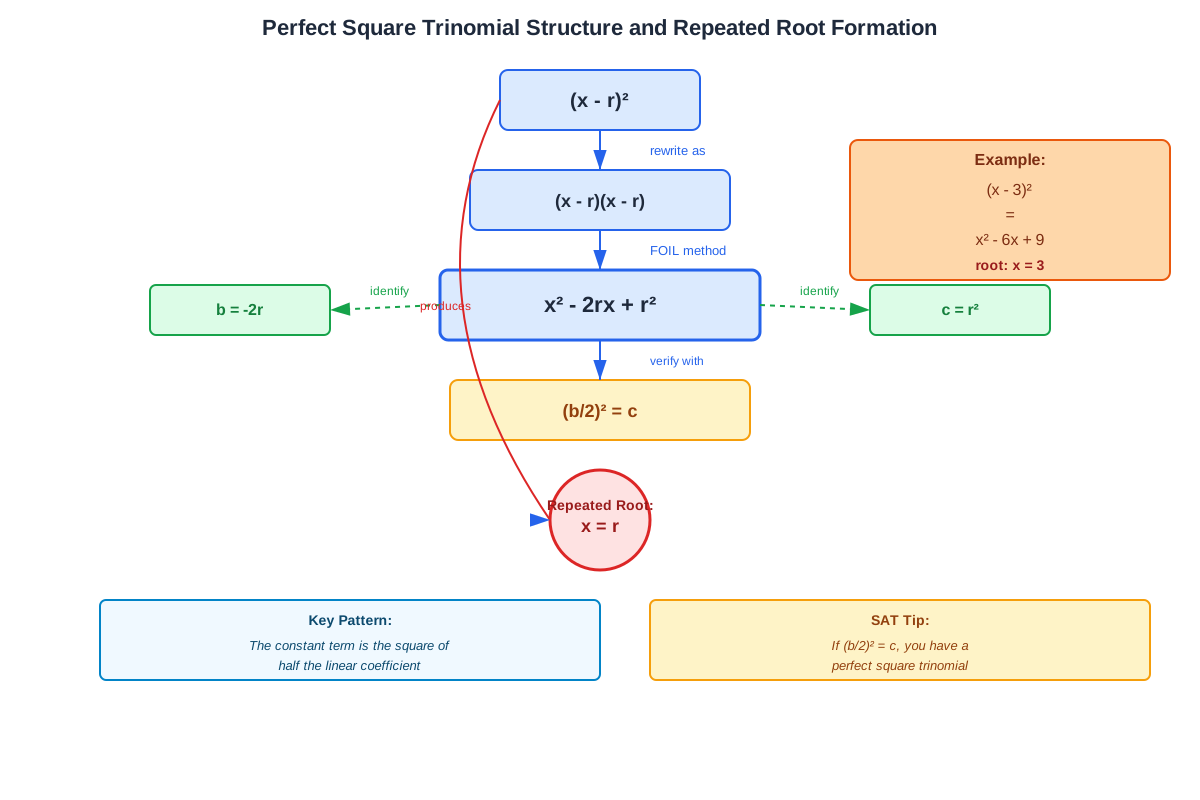
A quadratic equation has repeated roots (also called a double root or equal roots) when both solutions are identical. Algebraically, this occurs when a quadratic expression can be written as (x - r)² = 0, where r is the repeated root. The value r satisfies the equation twice, meaning if you solve the equation, you get x = r as both answers.
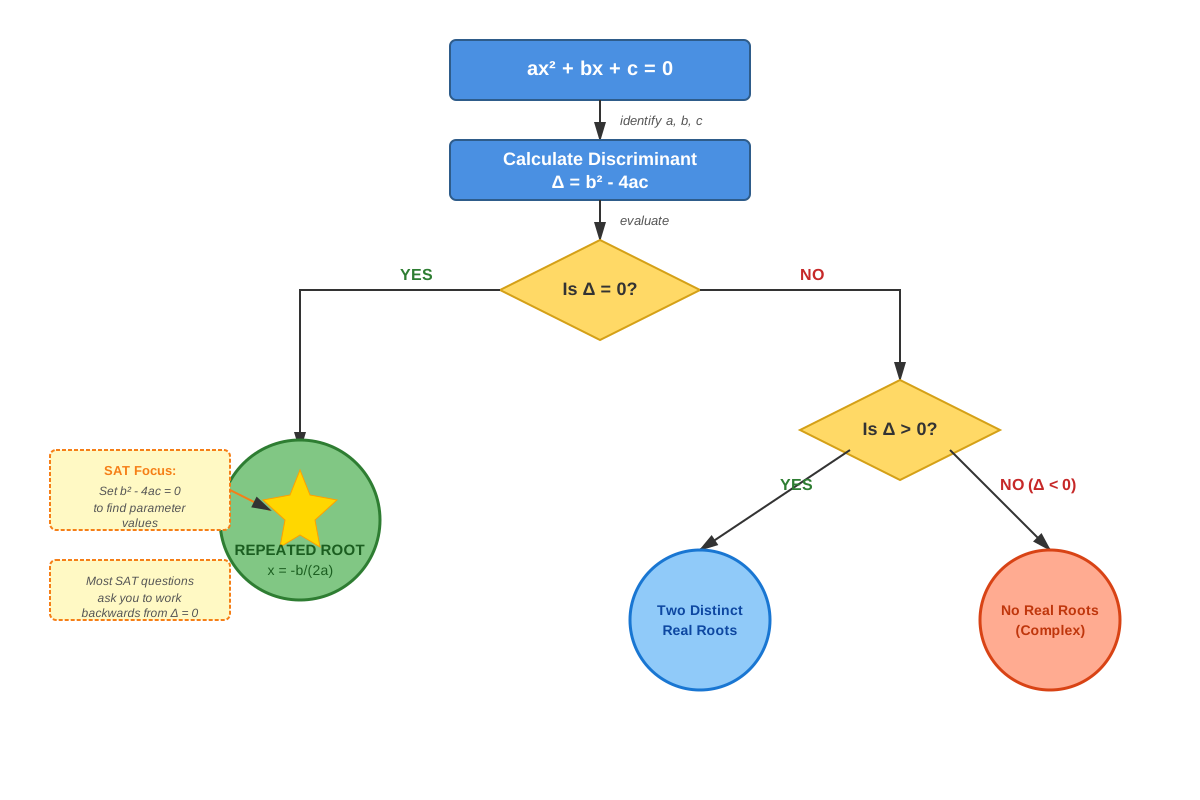
For any quadratic equation in standard form ax² + bx + c = 0 (where a ≠ 0), repeated roots occur if and only if the discriminant equals zero. The discriminant is the expression b² - 4ac from the quadratic formula:
x = (-b ± √(b² - 4ac)) / (2a)When b² - 4ac = 0, the square root term vanishes, leaving only one solution: x = -b/(2a). This single value is the repeated root.
Perfect Square Trinomials
A quadratic expression with repeated roots must be a perfect square trinomial, meaning it factors as the square of a binomial. The standard forms are:
- x² + 2kx + k² = (x + k)²
- x² - 2kx + k² = (x - k)²
- a²x² + 2abx + b² = (ax + b)²
Recognizing these patterns is crucial for SAT questions. The key identifying feature is that the middle term coefficient equals twice the product of the square roots of the first and last terms.
| Standard Form | Factored Form | Repeated Root |
|---|---|---|
| x² + 6x + 9 | (x + 3)² | x = -3 |
| x² - 10x + 25 | (x - 5)² | x = 5 |
| 4x² + 12x + 9 | (2x + 3)² | x = -3/2 |
| 9x² - 24x + 16 | (3x - 4)² | x = 4/3 |
The Discriminant Condition
The most powerful tool for identifying repeated roots is the discriminant condition: b² - 4ac = 0. This equation becomes the foundation for solving SAT problems where you must find unknown coefficients.
Step-by-step process for using the discriminant:
- Write the quadratic in standard form: ax² + bx + c = 0
- Identify coefficients a, b, and c
- Set up the equation: b² - 4ac = 0
- Solve for the unknown parameter
- Verify by factoring or using the quadratic formula
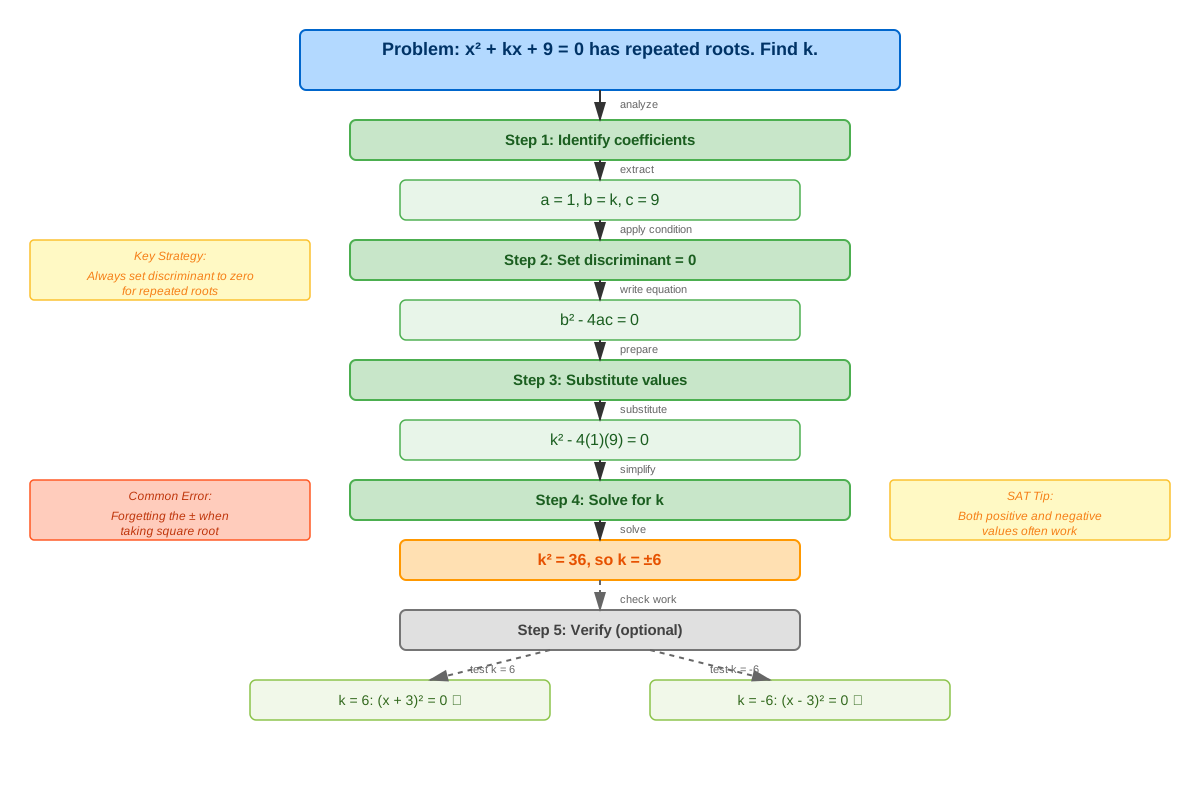
This method is particularly efficient when dealing with parametric equations like x² + kx + 16 = 0, where you need to find the value of k that produces repeated roots.
Graphical Interpretation
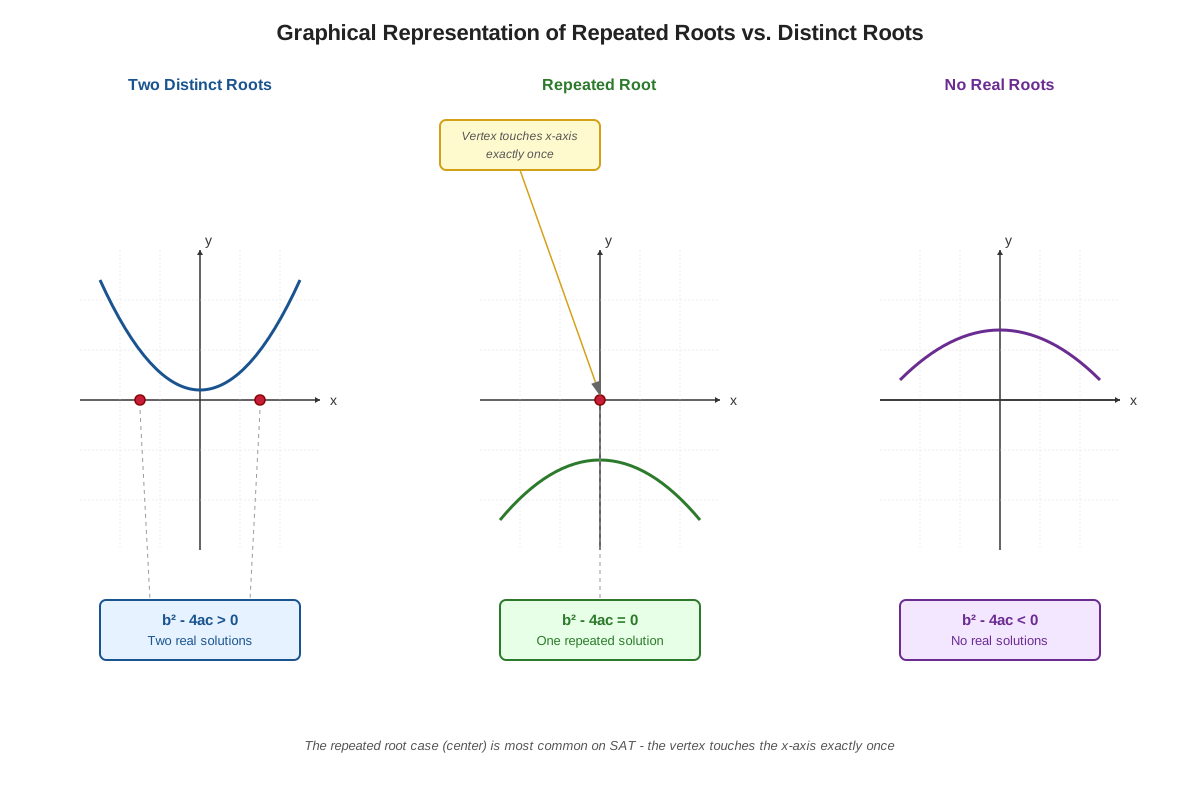
On a coordinate plane, a quadratic function with repeated roots has its vertex exactly on the x-axis. The parabola touches the x-axis at precisely one point without crossing it. This point of tangency represents the repeated root.
Key graphical features:
- The x-coordinate of the vertex equals the repeated root
- The y-coordinate of the vertex equals zero
- The parabola opens upward if a > 0, downward if a < 0
- The axis of symmetry passes through the repeated root
This visual understanding helps with SAT questions that present graphs and ask about the number of solutions or the relationship between coefficients.
Finding Repeated Roots in Different Forms
From Standard Form (ax² + bx + c = 0):
- Use the formula: repeated root = -b/(2a)
- Or solve b² - 4ac = 0 first to verify, then apply the formula
From Factored Form ((x - r)² = 0):
- The repeated root is simply r
- Expand if needed to convert to standard form
From Vertex Form (a(x - h)² + k = 0):
- If k = 0, then h is the repeated root
- If k ≠ 0, there are no repeated roots (either two distinct roots or no real roots)
Creating Equations with Specified Repeated Roots
To construct a quadratic equation with a repeated root at x = r:
- Write the factored form: (x - r)² = 0
- Expand: x² - 2rx + r² = 0
- Multiply by any non-zero constant if needed: a(x² - 2rx + r²) = 0
For example, to create an equation with repeated root at x = 4:
- (x - 4)² = 0
- x² - 8x + 16 = 0
- Or 3x² - 24x + 48 = 0 (multiplied by 3)
Concept Relationships
The concept of repeated roots sits at the intersection of multiple algebraic and geometric ideas. Discriminant analysis → determines → repeated roots condition → implies → perfect square trinomial → factors as → squared binomial → produces → single x-intercept on graph.
Repeated roots connect directly to vertex form of quadratics: when a parabola in vertex form a(x - h)² + k has k = 0, the vertex lies on the x-axis at x = h, which is the repeated root. This relationship links algebraic and geometric representations.
The quadratic formula provides the theoretical foundation: when the discriminant b² - 4ac equals zero, the ± symbol becomes meaningless because we're adding/subtracting zero, yielding one solution. This connects to number of solutions analysis: discriminant > 0 gives two distinct roots, discriminant = 0 gives repeated roots, discriminant < 0 gives no real roots.
Factoring skills enable recognition of perfect square trinomials, which always indicate repeated roots. This connects to polynomial multiplication in reverse: if you can recognize that x² + 10x + 25 equals (x + 5)², you immediately know the repeated root is x = -5.
The concept also relates to function transformations: a parabola with repeated roots is a vertical shift of a basic parabola y = a(x - h)² such that the vertex touches the x-axis. Understanding this connection helps with graphing questions and optimization problems.
Quick check — test yourself on Repeated roots so far.
Try Flashcards →High-Yield Facts
⭐ A quadratic equation has repeated roots if and only if its discriminant b² - 4ac equals zero
⭐ The repeated root of ax² + bx + c = 0 is x = -b/(2a) when b² - 4ac = 0
⭐ Perfect square trinomials always have repeated roots and factor as (x ± k)²
⭐ Graphically, repeated roots mean the parabola's vertex touches the x-axis at exactly one point
⭐ For x² + bx + c to have repeated roots, c must equal (b/2)²
- A quadratic with repeated roots has exactly one x-intercept
- The repeated root is also the x-coordinate of the parabola's vertex
- If (x - r)² = 0, then r is the repeated root regardless of any coefficient multiplying the expression
- For ax² + bx + c = 0 to have repeated roots at x = r, then b = -2ar and c = ar²
- Completing the square always reveals whether a quadratic has repeated roots
- The sum of repeated roots equals 2r, and their product equals r²
- Any quadratic with repeated roots can be written in the form a(x - r)² = 0
Common Misconceptions
Misconception: Repeated roots means the equation has two different solutions that happen to be equal in value. → Correction: Repeated roots means there is fundamentally only one solution, but it has multiplicity 2 (it satisfies the equation twice). The equation touches the x-axis at one point, not two coincident points.
Misconception: If b² - 4ac = 0, the quadratic has no solutions. → Correction: When the discriminant equals zero, the quadratic has exactly one real solution (the repeated root). No real solutions occur only when b² - 4ac < 0.
Misconception: All quadratics with the same repeated root are identical. → Correction: Infinitely many quadratics can share the same repeated root. For example, (x - 3)², 2(x - 3)², and -5(x - 3)² all have repeated root at x = 3 but are different functions with different graphs (different widths and orientations).
Misconception: The repeated root formula x = -b/(2a) only works when the discriminant is zero. → Correction: The formula x = -b/(2a) always gives the x-coordinate of the vertex. It equals the repeated root only when the discriminant is zero; otherwise, it's simply the midpoint between two distinct roots.
Misconception: To have repeated roots, the coefficient a must equal 1. → Correction: Repeated roots can occur with any non-zero value of a. The discriminant condition b² - 4ac = 0 works regardless of a's value. For example, 4x² - 12x + 9 = 0 has repeated roots even though a = 4.
Misconception: If a quadratic factors, it must have repeated roots. → Correction: Factoring only indicates repeated roots if both factors are identical. The quadratic (x - 2)(x + 3) factors but has two distinct roots (x = 2 and x = -3), not repeated roots.
Worked Examples
Example 1: Finding a Parameter for Repeated Roots
Problem: For what value of k does the equation x² + kx + 25 = 0 have repeated roots?
Solution:
Step 1: Identify the coefficients in standard form ax² + bx + c = 0
- a = 1
- b = k
- c = 25
Step 2: Apply the discriminant condition for repeated roots: b² - 4ac = 0
- k² - 4(1)(25) = 0
- k² - 100 = 0
Step 3: Solve for k
- k² = 100
- k = ±10
Step 4: Verify both solutions
- If k = 10: x² + 10x + 25 = (x + 5)² → repeated root at x = -5 ✓
- If k = -10: x² - 10x + 25 = (x - 5)² → repeated root at x = 5 ✓
Answer: k = 10 or k = -10
Connection to learning objectives: This problem directly applies the discriminant condition to identify when repeated roots occur, demonstrating the algebraic manipulation skills essential for SAT success.
Example 2: Graphical Interpretation and Equation Construction
Problem: A parabola has its vertex at the point (3, 0) and passes through the point (5, 8). Write the equation of this parabola in standard form and identify its repeated root.
Solution:
Step 1: Recognize that a vertex on the x-axis indicates repeated roots
- Since the vertex is at (3, 0), the repeated root is x = 3
Step 2: Write the equation in vertex form
- General vertex form: y = a(x - h)² + k
- With vertex (3, 0): y = a(x - 3)²
Step 3: Use the point (5, 8) to find a
- 8 = a(5 - 3)²
- 8 = a(4)
- a = 2
Step 4: Write the complete equation in vertex form
- y = 2(x - 3)²
Step 5: Expand to standard form
- y = 2(x² - 6x + 9)
- y = 2x² - 12x + 18
Step 6: Verify the repeated root using the discriminant
- For 2x² - 12x + 18 = 0: b² - 4ac = (-12)² - 4(2)(18) = 144 - 144 = 0 ✓
Answer: The equation is y = 2x² - 12x + 18, with repeated root at x = 3
Connection to learning objectives: This example integrates graphical interpretation with algebraic manipulation, showing how repeated roots connect vertex location to equation structure—a common SAT question type.
Exam Strategy
When approaching SAT questions about repeated roots, follow this systematic process:
Recognition triggers: Watch for these key phrases and scenarios:
- "exactly one solution"
- "touches the x-axis at one point"
- "vertex on the x-axis"
- "find the value of k" (in parametric equations)
- "perfect square trinomial"
- Questions asking about the discriminant equaling zero
Solution approach hierarchy:
- First, check if the discriminant condition applies (fastest for parametric problems)
- Second, look for perfect square trinomial patterns (efficient for recognition problems)
- Third, use vertex form if graphical information is provided
- Last resort, expand and use the quadratic formula (most time-consuming)
Process of elimination tips:
- If answer choices give values for a parameter, test each by calculating the discriminant
- Eliminate any answer that would make b² - 4ac negative (no real roots) or positive (two distinct roots)
- For graphing questions, eliminate any parabola that crosses the x-axis at two points or doesn't touch it at all
- If the question asks for "all possible values," remember that parameters like k might have two solutions (positive and negative)
Time allocation: Spend no more than 90 seconds on straightforward repeated roots questions. If a problem requires multiple steps (finding a parameter, then finding the root), allocate up to 2 minutes. If you're stuck after 30 seconds, mark it and return later—these questions often become clearer on a second look.
Calculator usage: For calculator-allowed sections, verify discriminant calculations and check factoring by expanding. For no-calculator sections, focus on recognizing perfect square patterns and using the discriminant algebraically.
Memory Techniques
Discriminant Decision Tree (D³ Rule):
- Discriminant Determines Destiny
- D > 0: Two distinct roots (parabola crosses x-axis twice)
- D = 0: Repeated roots (parabola touches x-axis once)
- D < 0: No real roots (parabola doesn't touch x-axis)
Perfect Square Pattern (2-1-1 Rule):
To identify perfect square trinomials, remember: the middle coefficient equals 2 times the product of the 1st term's root and the 1ast term's root.
- x² + 6x + 9 → 6 = 2(√1)(√9) = 2(1)(3) ✓
Repeated Root Formula Mnemonic: "Negative B over Two A" (same as vertex x-coordinate)
- When discriminant = 0, this gives the repeated root directly
Graphical Memory Aid: "Touch but Don't Cross"
- Repeated roots = parabola touches x-axis at exactly one point
- Visualize a ball rolling along a parabola and just kissing the ground at the vertex
Factored Form Recognition: "Same Factor Squared"
- (x - 5)(x - 5) = (x - 5)² → repeated root at x = 5
- If you see identical factors, you've found repeated roots
Summary
Repeated roots represent the special case where a quadratic equation has exactly one solution, occurring when the discriminant b² - 4ac equals zero. This condition produces perfect square trinomials that factor as (x - r)², where r is the repeated root. Graphically, repeated roots correspond to parabolas whose vertices touch the x-axis at precisely one point. The repeated root value can be found using the formula x = -b/(2a), which also gives the x-coordinate of the vertex. SAT questions test this concept through parametric equations requiring students to find unknown coefficients, graphical interpretation problems, and factoring challenges. Mastery requires understanding the discriminant condition, recognizing perfect square trinomial patterns, and connecting algebraic and geometric representations. Students must efficiently apply the discriminant test, factor or expand expressions accurately, and interpret vertex location to solve these high-yield problems within strict time constraints.
Key Takeaways
- A quadratic has repeated roots if and only if its discriminant b² - 4ac equals exactly zero
- Repeated roots always correspond to perfect square trinomials that factor as (x - r)²
- The repeated root equals -b/(2a), which is also the x-coordinate of the parabola's vertex
- Graphically, repeated roots mean the parabola touches but doesn't cross the x-axis at one point
- For parametric equations like x² + kx + c = 0, set b² - 4ac = 0 and solve for the parameter
- Perfect square trinomials follow the pattern: (first term)² ± 2(first)(last) + (last term)²
- Multiple different quadratics can share the same repeated root but have different coefficients
Related Topics
The Discriminant and Nature of Roots: Expands beyond repeated roots to analyze all three cases (two distinct, repeated, and no real roots), providing comprehensive understanding of how b² - 4ac determines solution types.
Vertex Form of Quadratics: Builds on repeated roots by exploring how a(x - h)² + k represents all parabolas, with repeated roots being the special case where k = 0.
Completing the Square: Provides the algebraic technique to convert any quadratic into perfect square form, directly revealing whether repeated roots exist.
Systems of Equations with Quadratics: Applies repeated roots concepts to determine when a line is tangent to a parabola (intersects at exactly one point).
Polynomial Factoring: Extends repeated roots understanding to higher-degree polynomials where roots can have multiplicity greater than 2.
Mastering repeated roots provides the foundation for these advanced topics and strengthens overall quadratic equation proficiency essential for SAT Math success.
Practice CTA
Now that you've mastered the core concepts of repeated roots, it's time to solidify your understanding through active practice. Complete the practice questions to test your ability to identify discriminant conditions, factor perfect square trinomials, and solve parametric equations. Use the flashcards to reinforce key formulas and recognition patterns. Remember: repeated roots questions appear on virtually every SAT, and mastering this topic can directly translate to 2-3 additional correct answers. Your investment in practice now will pay dividends on test day. Challenge yourself to solve each practice problem within 90 seconds to build the speed and confidence you need for SAT success!
Sign up free to keep reading
Create a free AnvayaPrep account to finish this SAT guide on Repeated roots — plus flashcards and practice questions.