Overview
The vertex of a quadratic function represents one of the most critical concepts tested on the SAT math section. As the turning point of a parabola, the vertex provides essential information about the maximum or minimum value of a quadratic function and serves as a cornerstone for understanding quadratic behavior. On the SAT, questions involving the vertex appear frequently in both multiple-choice and grid-in formats, often requiring students to identify coordinates, interpret graphical representations, or manipulate algebraic forms to extract vertex information.
Understanding the vertex goes beyond simple memorization—it requires fluency in multiple representations of quadratic functions and the ability to convert between them efficiently. Students must recognize vertex form, standard form, and how to extract vertex coordinates from each representation. This skill directly connects to broader mathematical reasoning about optimization, function transformations, and real-world modeling scenarios that the SAT frequently tests.
The vertex concept integrates seamlessly with other quadratic topics including axis of symmetry, roots, y-intercepts, and the discriminant. Mastery of vertex-related problems provides a foundation for tackling complex multi-step questions that combine several quadratic properties. Given that quadratic functions appear in approximately 10-15% of SAT math questions, and vertex-specific questions constitute a significant portion of these, investing time to thoroughly understand this topic yields substantial score improvements.
Learning Objectives
- [ ] Identify key features of the vertex including coordinates and significance as maximum or minimum
- [ ] Explain how vertex appears on the SAT in various question formats and contexts
- [ ] Apply vertex concepts to answer SAT-style questions efficiently and accurately
- [ ] Convert between standard form and vertex form of quadratic equations
- [ ] Determine vertex coordinates using multiple methods including completing the square and the vertex formula
- [ ] Interpret the meaning of vertex coordinates in real-world application problems
- [ ] Recognize how transformations affect vertex position on the coordinate plane
Prerequisites
- Basic algebra skills: Ability to manipulate equations, factor expressions, and solve for variables is essential for converting between quadratic forms
- Understanding of parabolas: Knowledge that quadratic functions create U-shaped curves helps visualize vertex as the turning point
- Coordinate plane familiarity: Plotting points and understanding x and y coordinates enables interpretation of vertex location
- Function notation: Recognizing f(x) notation and evaluating functions at specific values supports vertex-related calculations
- Exponent rules: Working with squared terms and expanding binomials is necessary for algebraic manipulations involving vertex form
Why This Topic Matters
The vertex concept appears in numerous real-world applications that the SAT frequently models in word problems. Projectile motion problems use the vertex to represent maximum height, business optimization scenarios use it to find maximum profit or minimum cost, and engineering applications employ vertex calculations for designing parabolic structures. Understanding vertex coordinates allows students to extract meaningful information from mathematical models and make informed decisions based on quadratic relationships.
On the SAT, vertex-related questions appear in approximately 3-5 questions per test, making this a high-yield topic for score improvement. These questions typically fall into several categories: identifying vertex coordinates from graphs, converting equations to vertex form, using vertex information to write equations, and interpreting vertex meaning in context. The College Board particularly favors questions that combine vertex knowledge with other concepts like domain, range, or function transformations, testing deeper conceptual understanding rather than rote memorization.
Common SAT question formats include providing a quadratic function in standard form and asking for the maximum or minimum value, presenting a real-world scenario modeled by a quadratic and requesting the optimal input value, displaying a parabola graph and asking students to identify the vertex coordinates, or giving partial information about a parabola and requiring students to determine the complete vertex form equation. Questions may also ask students to identify how changes to the equation affect vertex position, testing understanding of function transformations.
Core Concepts
Vertex Definition and Significance
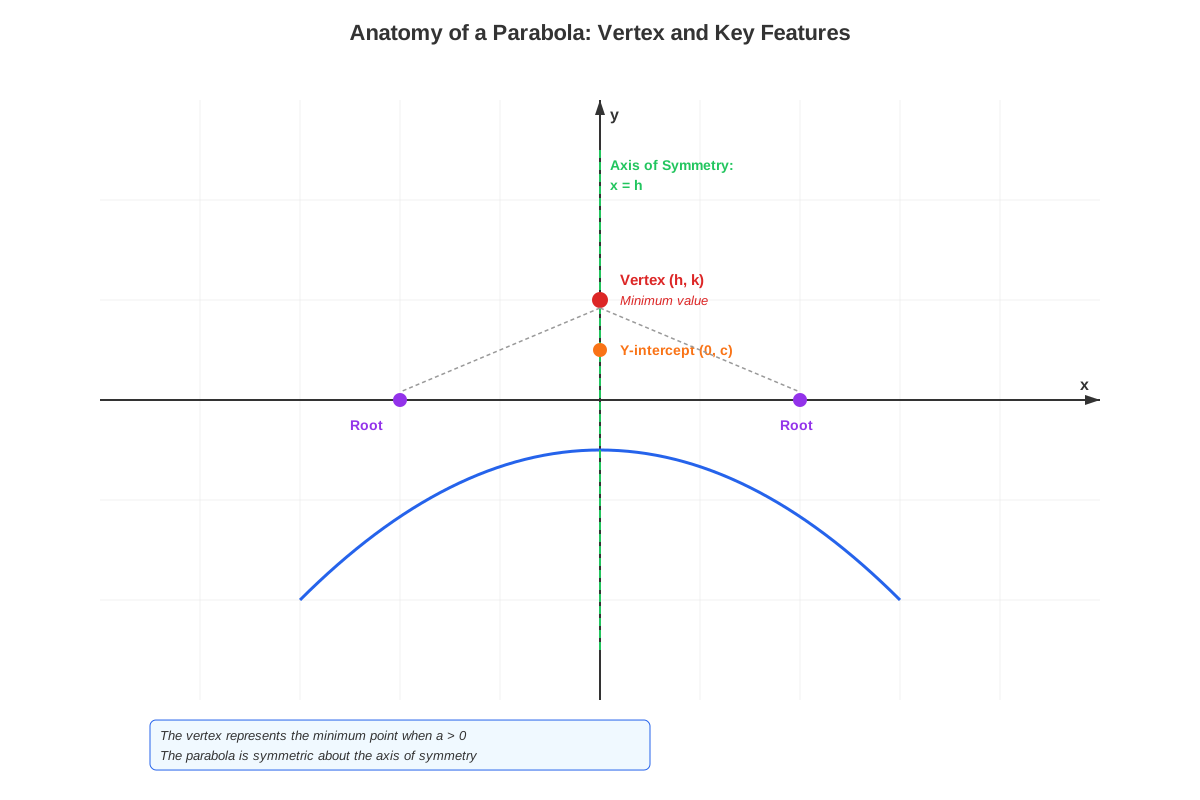
The vertex is the point where a parabola reaches its maximum or minimum value, representing the turning point of the quadratic function. For a parabola that opens upward (positive leading coefficient), the vertex represents the minimum point; for a parabola opening downward (negative leading coefficient), the vertex represents the maximum point. The vertex coordinates are typically written as (h, k), where h represents the x-coordinate (the input value where the extreme occurs) and k represents the y-coordinate (the actual maximum or minimum output value).
The vertex serves multiple mathematical purposes: it defines the axis of symmetry (the vertical line x = h that divides the parabola into mirror images), provides the range of the function (all y-values greater than or equal to k for upward-opening parabolas, or less than or equal to k for downward-opening parabolas), and offers the most efficient point for analyzing parabola behavior. Understanding that the vertex represents an extreme value is crucial for SAT word problems where optimization is required.
Vertex Form of Quadratic Equations
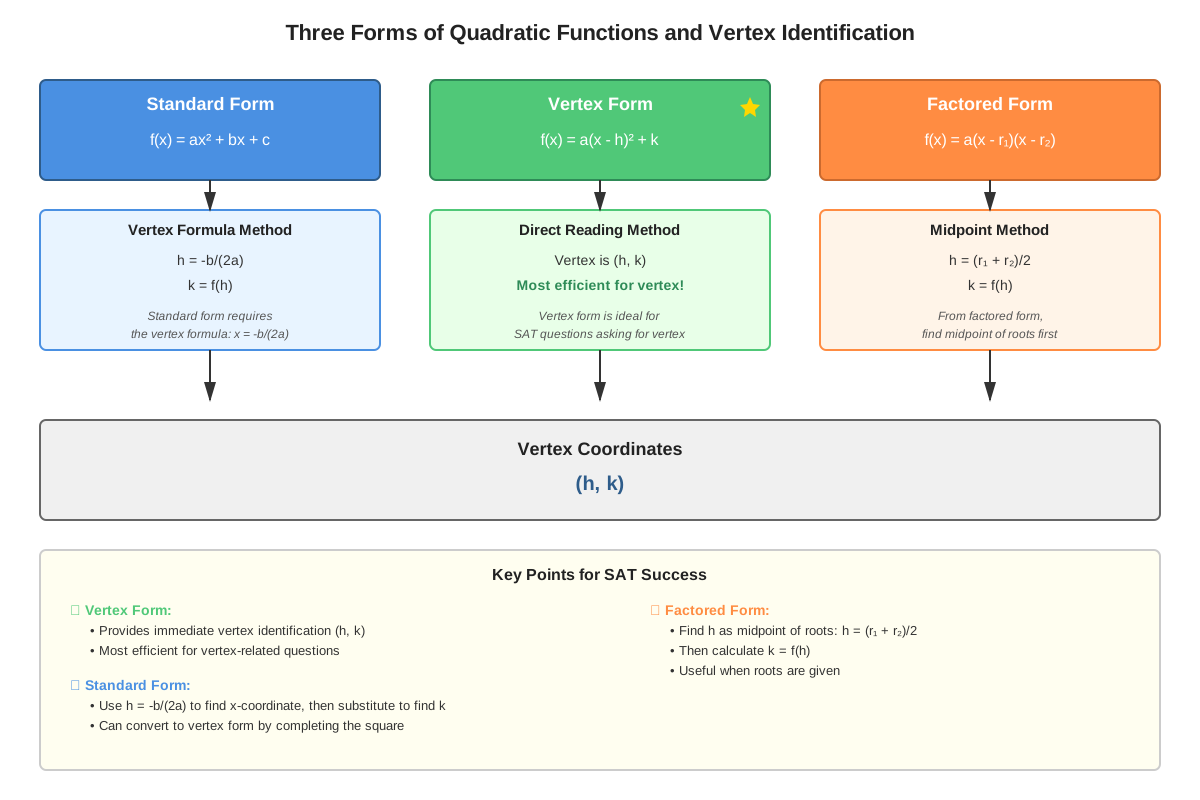
The vertex form of a quadratic equation is written as:
f(x) = a(x - h)² + kIn this form, (h, k) represents the vertex coordinates directly. The parameter a determines the direction and width of the parabola: positive a values create upward-opening parabolas, negative a values create downward-opening parabolas, and the absolute value of a affects the vertical stretch or compression (larger |a| creates narrower parabolas, smaller |a| creates wider parabolas).
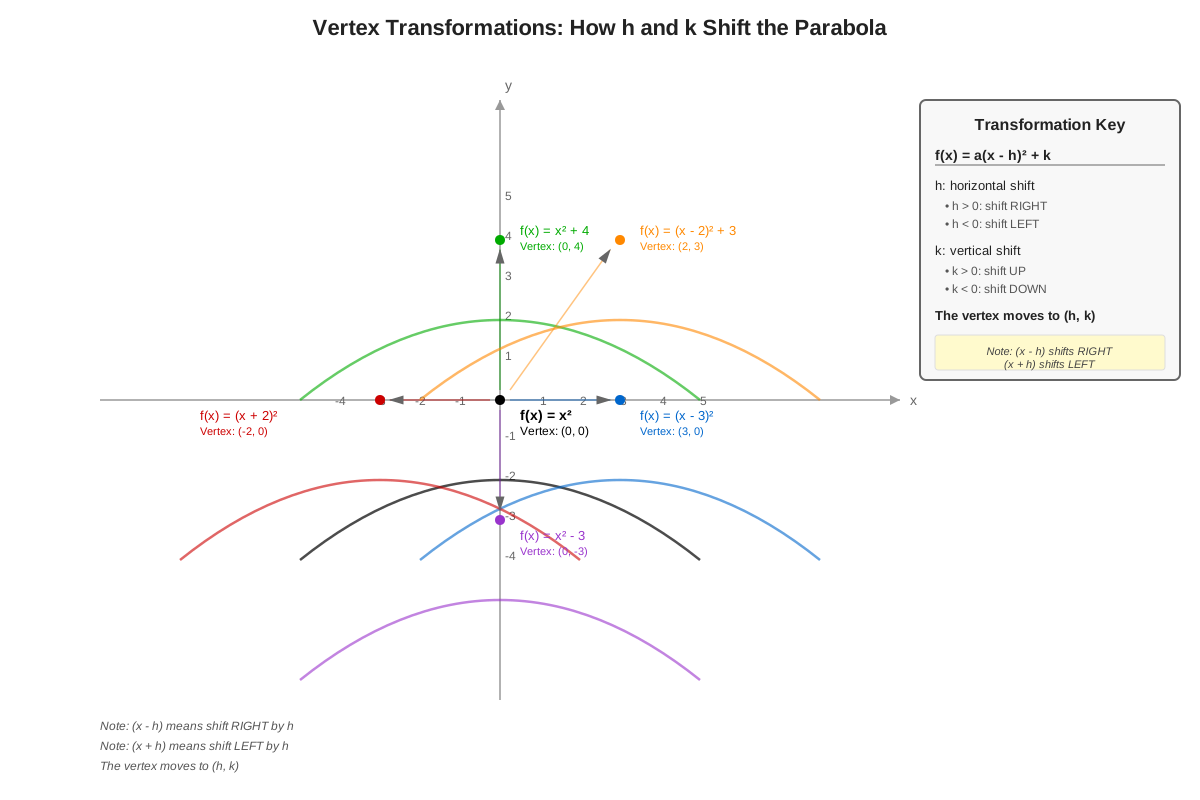
The beauty of vertex form lies in its transparency—the vertex coordinates can be read directly from the equation without additional calculations. However, students must be careful with the sign of h: the vertex form shows (x - h), so if the equation reads (x - 3)², then h = 3, but if it reads (x + 3)², this is equivalent to (x - (-3))², making h = -3. This sign convention frequently trips up students on the SAT.
Standard Form and Vertex Extraction
Quadratic functions often appear in standard form:
f(x) = ax² + bx + cWhen given standard form, students must extract vertex coordinates using the vertex formula. The x-coordinate of the vertex is:
h = -b/(2a)After finding h, substitute this value back into the original function to find k:
k = f(h) = f(-b/(2a))This method provides a quick, reliable way to find vertex coordinates without converting the entire equation to vertex form. The formula h = -b/(2a) derives from the fact that the vertex lies on the axis of symmetry, which is exactly halfway between the two roots of the quadratic (when they exist).
Converting Between Forms
Converting from standard form to vertex form requires completing the square, a multi-step algebraic process:
- Factor out the leading coefficient a from the x² and x terms (if a ≠ 1)
- Take half of the coefficient of x (inside the parentheses), square it, and add/subtract this value
- Rewrite the perfect square trinomial as a binomial squared
- Simplify by distributing and combining constants
For example, converting f(x) = 2x² + 12x + 7:
f(x) = 2x² + 12x + 7
f(x) = 2(x² + 6x) + 7
f(x) = 2(x² + 6x + 9 - 9) + 7
f(x) = 2(x² + 6x + 9) - 18 + 7
f(x) = 2(x + 3)² - 11
The vertex is (-3, -11). This process is essential for SAT questions that provide standard form but require vertex information.
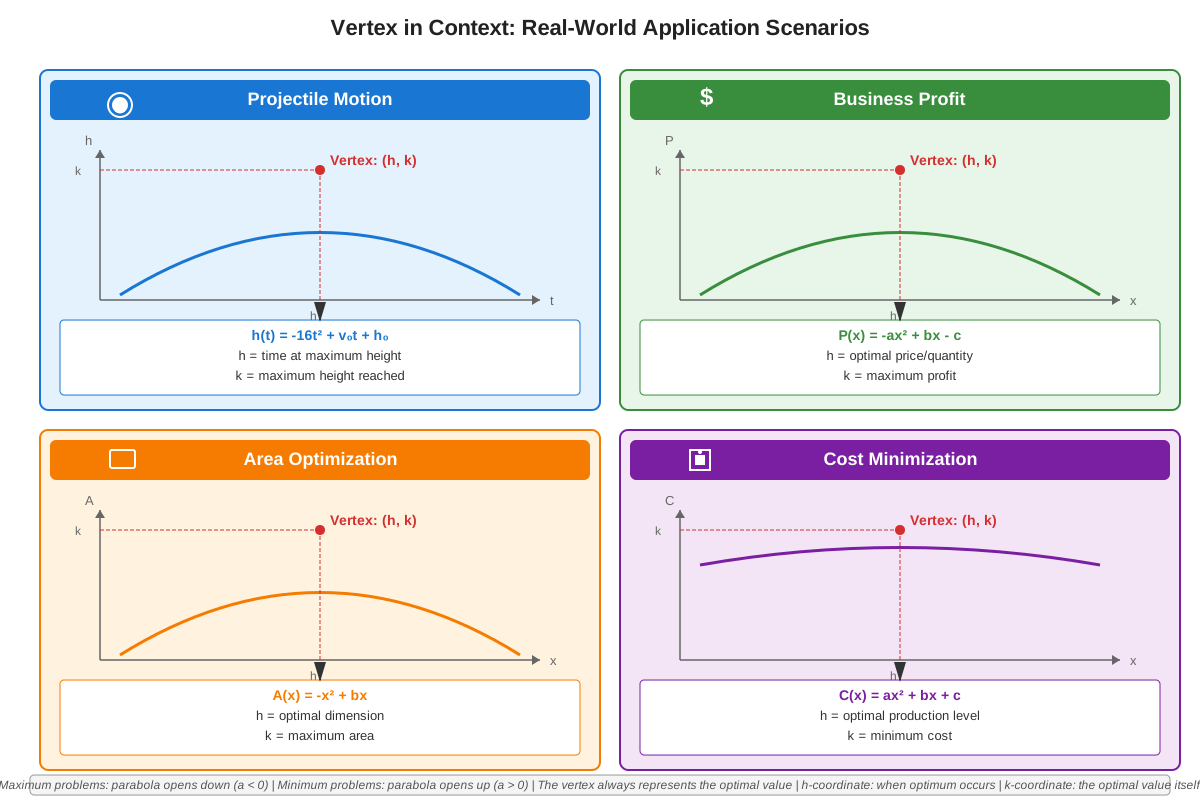
Vertex in Context Problems
SAT questions frequently embed vertex concepts in real-world scenarios. The key to these problems is identifying what the vertex represents in context. Common scenarios include:
| Context | Vertex Meaning |
|---|---|
| Projectile motion | Maximum height (k) occurs at time (h) |
| Business profit | Maximum profit (k) occurs at price/quantity (h) |
| Area optimization | Maximum area (k) occurs at dimension (h) |
| Revenue modeling | Maximum revenue (k) occurs at price point (h) |
Students must translate between mathematical and contextual language, recognizing that "when does the maximum occur" asks for the h-coordinate, while "what is the maximum value" asks for the k-coordinate.
Graphical Interpretation
When the SAT presents a parabola graph, identifying the vertex requires careful reading of coordinate values. The vertex appears as the highest or lowest point on the curve. Students should:
- Identify whether the parabola opens upward (minimum vertex) or downward (maximum vertex)
- Locate the turning point and read both coordinates carefully
- Verify the axis of symmetry aligns with the x-coordinate of the vertex
- Check that the y-coordinate matches the extreme value visible on the graph
Graph-based questions may ask students to write the equation in vertex form given the visual representation, requiring them to identify the vertex coordinates and determine the a value from the parabola's width.
Concept Relationships
The vertex concept connects intimately with multiple quadratic properties. The axis of symmetry (x = h) passes directly through the vertex, dividing the parabola into symmetric halves. This relationship means that any two points equidistant from the axis of symmetry have the same y-value, a property the SAT sometimes tests.
The vertex relates to roots (x-intercepts) through symmetry: if a parabola has two real roots, the vertex x-coordinate lies exactly halfway between them. Mathematically, if roots are r₁ and r₂, then h = (r₁ + r₂)/2. This connection allows students to find the vertex when roots are known, or vice versa.
Function transformations directly affect vertex position. Starting from the parent function f(x) = x² with vertex at (0, 0), horizontal shifts move the vertex left or right (f(x) = (x - h)² has vertex at (h, 0)), vertical shifts move it up or down (f(x) = x² + k has vertex at (0, k)), and combined transformations create vertex at (h, k). Understanding these transformations as vertex movements provides intuitive insight into how equation changes affect graphs.
The relationship flow: Standard Form → Vertex Formula → Vertex Coordinates → Axis of Symmetry → Range → Optimization Applications. Each concept builds on the previous, creating a comprehensive understanding of quadratic behavior centered on the vertex.
Quick check — test yourself on Vertex so far.
Try Flashcards →High-Yield Facts
⭐ The vertex form of a quadratic is f(x) = a(x - h)² + k, where (h, k) is the vertex
⭐ For standard form f(x) = ax² + bx + c, the vertex x-coordinate is h = -b/(2a)
⭐ When a > 0, the parabola opens upward and the vertex is a minimum; when a < 0, it opens downward and the vertex is a maximum
⭐ The axis of symmetry always passes through the vertex at x = h
⭐ In vertex form (x - h)², a positive value inside the parentheses means h is negative, and vice versa
- The y-coordinate of the vertex (k) represents the actual maximum or minimum value of the function
- To convert from standard to vertex form, complete the square
- The vertex lies exactly halfway between the two x-intercepts (if they exist)
- In real-world problems, the vertex typically represents an optimal value (maximum profit, minimum cost, maximum height)
- The range of a quadratic function is determined by the vertex: [k, ∞) for upward-opening parabolas or (-∞, k] for downward-opening parabolas
- Changing the value of a in vertex form affects the width and direction but not the vertex location
- The vertex can be found graphically as the turning point of the parabola
Common Misconceptions
Misconception: In vertex form f(x) = a(x - h)² + k, if the equation shows (x + 3)², then h = 3.
Correction: The vertex form specifically shows (x - h), so (x + 3)² must be rewritten as (x - (-3))², making h = -3. Always factor out the negative to identify h correctly.
Misconception: The vertex formula h = -b/(2a) gives both coordinates of the vertex.
Correction: The formula h = -b/(2a) only provides the x-coordinate. To find the y-coordinate k, you must substitute h back into the original function: k = f(h).
Misconception: The vertex is always the minimum value of a quadratic function.
Correction: The vertex is the minimum only when the parabola opens upward (a > 0). When the parabola opens downward (a < 0), the vertex represents the maximum value.
Misconception: Completing the square always requires adding the same value inside and outside parentheses.
Correction: When a leading coefficient is factored out, the value added inside parentheses gets multiplied by that coefficient when moved outside. For example, in 2(x² + 6x + 9), the 9 inside becomes 2(9) = 18 outside.
Misconception: The vertex x-coordinate represents the maximum or minimum value.
Correction: The x-coordinate (h) represents when the maximum or minimum occurs (the input value). The y-coordinate (k) represents the actual maximum or minimum value (the output).
Misconception: All parabolas have vertices on the y-axis.
Correction: Only parabolas with equations where b = 0 in standard form (or h = 0 in vertex form) have vertices on the y-axis. Most parabolas have vertices at other x-coordinates.
Misconception: The vertex and y-intercept are the same point.
Correction: The y-intercept occurs at x = 0 and equals c in standard form. The vertex occurs at x = -b/(2a), which only equals 0 when b = 0. These are generally different points.
Worked Examples
Example 1: Finding Vertex from Standard Form
Problem: A quadratic function is given by f(x) = -2x² + 8x + 3. What is the maximum value of this function?
Solution:
Step 1: Identify that we need the y-coordinate (k) of the vertex since the question asks for the maximum value.
Step 2: Recognize that a = -2 (negative), so the parabola opens downward and the vertex represents a maximum.
Step 3: Find the x-coordinate of the vertex using h = -b/(2a):
- a = -2, b = 8, c = 3
- h = -8/(2(-2)) = -8/(-4) = 2
Step 4: Substitute x = 2 into the original function to find k:
- f(2) = -2(2)² + 8(2) + 3
- f(2) = -2(4) + 16 + 3
- f(2) = -8 + 16 + 3
- f(2) = 11
Step 5: The vertex is (2, 11), and since the parabola opens downward, the maximum value is 11.
Answer: The maximum value is 11.
Connection to Learning Objectives: This problem demonstrates identifying the vertex as a key feature (maximum), applying the vertex formula method, and interpreting the result correctly based on parabola direction.
Example 2: Real-World Application with Vertex
Problem: A company's daily profit P (in dollars) from selling x items is modeled by P(x) = -5x² + 200x - 1500. How many items should the company sell to maximize profit, and what is the maximum profit?
Solution:
Step 1: Recognize this as a vertex problem where we need both coordinates—h tells us how many items, k tells us the maximum profit.
Step 2: Identify a = -5, b = 200, c = -1500. Since a < 0, the parabola opens downward and has a maximum at the vertex.
Step 3: Calculate the x-coordinate (number of items):
- h = -b/(2a) = -200/(2(-5)) = -200/(-10) = 20
Step 4: Calculate the y-coordinate (maximum profit):
- P(20) = -5(20)² + 200(20) - 1500
- P(20) = -5(400) + 4000 - 1500
- P(20) = -2000 + 4000 - 1500
- P(20) = 500
Step 5: Interpret in context: The company should sell 20 items to achieve maximum profit of $500.
Answer: The company should sell 20 items for a maximum profit of $500.
Connection to Learning Objectives: This example shows how vertex appears in SAT context problems, demonstrates the application of vertex concepts to real-world scenarios, and requires interpretation of both vertex coordinates in meaningful terms.
Example 3: Converting to Vertex Form
Problem: Write f(x) = x² - 6x + 11 in vertex form and identify the vertex.
Solution:
Step 1: Complete the square. Since a = 1, no factoring is needed initially.
Step 2: Focus on the x² and x terms: x² - 6x
Step 3: Take half of the x coefficient: -6/2 = -3
Step 4: Square this value: (-3)² = 9
Step 5: Add and subtract 9:
- f(x) = x² - 6x + 9 - 9 + 11
- f(x) = (x² - 6x + 9) + 2
- f(x) = (x - 3)² + 2
Step 6: Identify the vertex from vertex form: h = 3, k = 2, so vertex is (3, 2).
Answer: Vertex form is f(x) = (x - 3)² + 2; vertex is (3, 2).
Connection to Learning Objectives: This demonstrates converting between forms, a critical skill for SAT questions that provide one form but require information more easily extracted from another form.
Exam Strategy
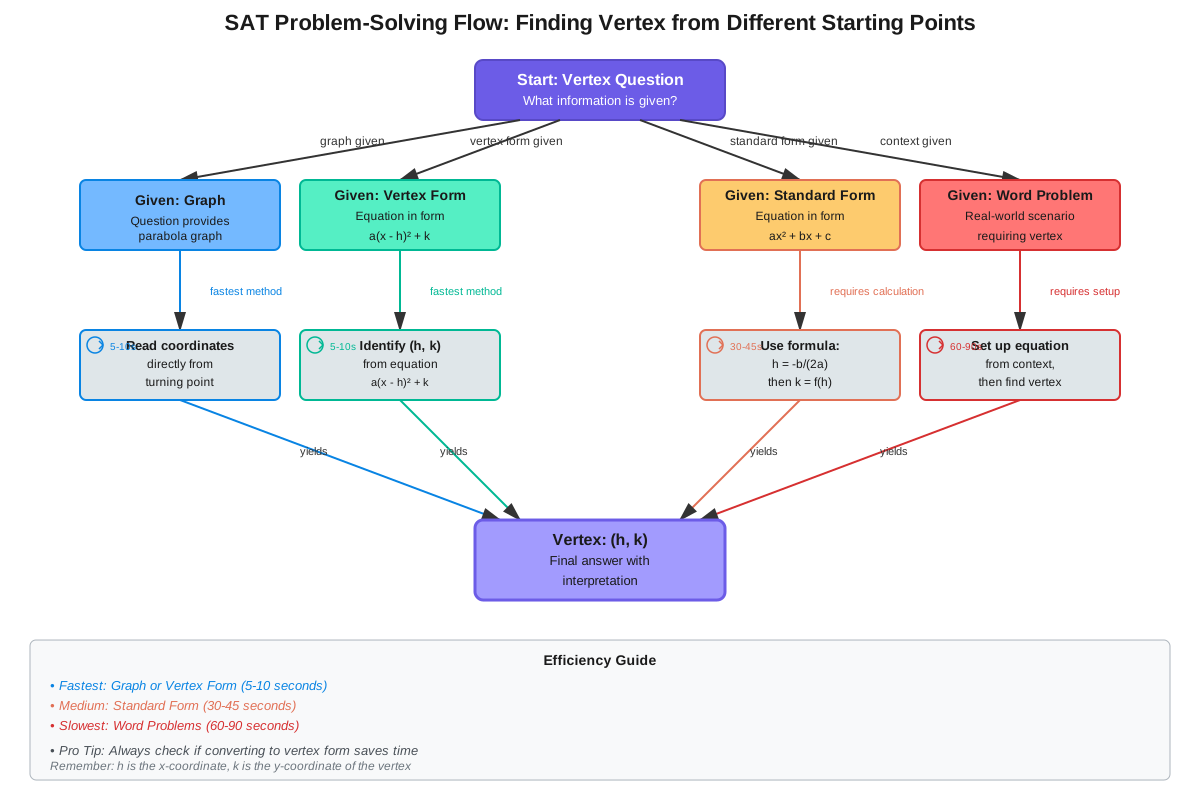
When approaching SAT vertex questions, first identify what the question is actually asking: vertex coordinates, maximum/minimum value, or the input where the extreme occurs. Many students lose points by providing h when k is requested, or vice versa. Underline or circle key phrases like "maximum value" (asking for k) versus "when does the maximum occur" (asking for h).
Trigger words and phrases to watch for include: "turning point" (vertex), "maximum/minimum value" (k-coordinate), "optimal" (vertex context), "highest/lowest point" (vertex), "axis of symmetry" (x = h), and "vertex form" (signals conversion may be needed). When you see these terms, immediately think about vertex-related concepts and formulas.
For multiple-choice questions, use process of elimination strategically. If a parabola opens upward, eliminate any answer choices suggesting a maximum exists. If the vertex x-coordinate must be positive based on the graph or equation, eliminate negative h values. When converting to vertex form, you can verify your answer by expanding it back to standard form—if it doesn't match the original, eliminate that choice.
Time allocation is crucial: simple vertex identification from vertex form should take 15-30 seconds, using the vertex formula on standard form should take 45-60 seconds, and completing the square might require 90-120 seconds. If a problem requires completing the square and you're running short on time, consider using the vertex formula instead for a quicker solution, or skip and return if time permits.
Exam Tip: Always check the sign of a to determine if you're finding a maximum or minimum. The SAT frequently includes trap answers that provide the correct coordinate value but misidentify it as a maximum when it's actually a minimum, or vice versa.
Memory Techniques
Vertex Formula Mnemonic: "Negative Boy Two Apples" helps remember h = -b/2a. The negative comes first, then b, then 2, then a.
Vertex Form Sign Memory: Think "Subtract Happy" to remember that vertex form shows (x - h), so you subtract h. If you see addition, the actual h value is negative: (x + 3) means h = -3 because you're subtracting a negative.
Maximum vs. Minimum: Visualize the letter A for the parameter a. When A is positive, it looks like an upward-pointing arrow (minimum at vertex). When you flip A upside down (negative a), it points downward (maximum at vertex).
Completing the Square Steps: Use the acronym FHSA - Factor out a (if needed), take Half of b, Square it, Add and subtract. This sequence ensures you don't skip steps.
Context Problem Strategy: Remember "When What" - When asks for h (the x-coordinate), What asks for k (the y-coordinate). "When does maximum occur?" = h. "What is the maximum?" = k.
Summary
The vertex represents the turning point of a parabola and serves as a cornerstone concept for SAT quadratic questions. Students must master multiple representations: recognizing vertex coordinates (h, k) directly from vertex form f(x) = a(x - h)² + k, extracting them from standard form using h = -b/(2a) and k = f(h), and identifying them graphically. The vertex indicates either a maximum (when a < 0) or minimum (when a > 0), with the x-coordinate showing when the extreme occurs and the y-coordinate showing the actual extreme value. Converting between standard and vertex form through completing the square enables flexible problem-solving. Context problems require translating mathematical vertex coordinates into meaningful real-world interpretations about optimization. The vertex connects to other quadratic properties including axis of symmetry, range, and roots, forming an integrated understanding of parabola behavior essential for SAT success.
Key Takeaways
- The vertex (h, k) is the turning point of a parabola, representing either a maximum or minimum value depending on whether a is negative or positive
- Vertex form f(x) = a(x - h)² + k displays vertex coordinates directly, but watch for sign conventions: (x - h) means the vertex x-coordinate is h
- For standard form f(x) = ax² + bx + c, calculate vertex using h = -b/(2a) for the x-coordinate, then substitute to find k = f(h)
- The vertex x-coordinate (h) tells when an extreme occurs; the y-coordinate (k) tells what the extreme value is—crucial distinction for context problems
- Converting between forms via completing the square is essential when the question format requires vertex form but provides standard form
- The axis of symmetry x = h always passes through the vertex, and the vertex determines the function's range
- SAT vertex questions appear frequently in optimization contexts, graphical interpretation, and form conversion scenarios
Related Topics
Axis of Symmetry: The vertical line x = h that passes through the vertex and divides the parabola into mirror images. Mastering vertex concepts provides the foundation for understanding symmetry properties and using them to find additional points on the parabola.
Quadratic Roots and Factoring: The relationship between vertex and roots (x-intercepts) enables solving complex problems. Understanding that the vertex lies halfway between roots connects these concepts and provides alternative solution methods.
Function Transformations: Vertex form directly reveals how transformations affect parabola position. Mastering vertex concepts enables prediction of how equation changes shift, stretch, or reflect the graph.
Domain and Range: The vertex determines the range of quadratic functions. Understanding vertex as a maximum or minimum allows immediate identification of range restrictions.
Systems of Equations: Finding intersection points between quadratic and linear functions often requires vertex knowledge to determine the number and nature of solutions.
Practice CTA
Now that you've mastered the core concepts of vertex in quadratic functions, it's time to solidify your understanding through active practice. Attempt the practice questions to test your ability to identify vertices, convert between forms, and apply these concepts to SAT-style problems. Use the flashcards to reinforce key formulas and relationships until they become automatic. Remember, vertex questions appear on virtually every SAT, making this practice time a high-yield investment in your score. The difference between knowing the concepts and applying them fluently under test conditions comes from deliberate practice—start now and watch your confidence soar!
Sign up free to keep reading
Create a free AnvayaPrep account to finish this SAT guide on Vertex — plus flashcards and practice questions.