Overview
The axis of symmetry is a fundamental concept in quadratic functions that represents a vertical line dividing a parabola into two mirror-image halves. This line passes through the vertex of the parabola and serves as a critical reference point for understanding the behavior and properties of quadratic equations. On the SAT, questions involving the axis of symmetry frequently appear in both the calculator and no-calculator sections, making this topic essential for achieving a competitive math score.
Understanding the axis of symmetry provides students with powerful problem-solving tools for analyzing parabolas, finding vertices, determining maximum or minimum values, and solving real-world optimization problems. The concept bridges algebraic manipulation with geometric visualization, allowing test-takers to approach quadratic problems from multiple angles. Mastery of this topic enables students to quickly identify key features of parabolas without extensive calculation, a crucial time-saving skill on the SAT.
The axis of symmetry connects directly to broader mathematical concepts including quadratic functions, vertex form, standard form equations, and coordinate geometry. It serves as a gateway to understanding transformations of functions, optimization problems, and the relationship between algebraic expressions and their graphical representations. Students who thoroughly understand the axis of symmetry gain confidence in tackling complex multi-step problems that integrate multiple aspects of quadratic equations, positioning them for success on high-difficulty SAT questions worth valuable points.
Learning Objectives
- [ ] Identify key features of axis of symmetry in various representations of quadratic functions
- [ ] Explain how axis of symmetry appears on the SAT in both graphical and algebraic contexts
- [ ] Apply axis of symmetry to answer SAT-style questions efficiently and accurately
- [ ] Calculate the equation of the axis of symmetry from standard form, vertex form, and factored form
- [ ] Use the axis of symmetry to determine the x-coordinate of the vertex and solve optimization problems
- [ ] Recognize the relationship between the axis of symmetry and the roots of a quadratic equation
- [ ] Apply symmetry properties to verify solutions and eliminate incorrect answer choices
Prerequisites
- Quadratic functions in standard form (y = ax² + bx + c): Essential for applying the axis of symmetry formula and understanding coefficient relationships
- Coordinate plane and graphing: Necessary for visualizing parabolas and interpreting the geometric meaning of the axis of symmetry
- Basic algebraic manipulation: Required for rearranging equations and solving for variables when working with symmetry properties
- Understanding of parabolas: Fundamental for recognizing how the axis of symmetry relates to the shape and orientation of quadratic graphs
- Vertex concept: Critical for connecting the axis of symmetry to the maximum or minimum point of a parabola
Why This Topic Matters
The axis of symmetry appears in approximately 3-5 questions per SAT exam, making it one of the most frequently tested concepts within quadratic equations. These questions often carry medium to high difficulty ratings and can significantly impact overall math scores. Understanding this topic enables students to solve problems involving projectile motion, profit maximization, area optimization, and other real-world applications that the SAT commonly features.
In practical applications, the axis of symmetry helps engineers design parabolic reflectors for satellite dishes, assists architects in creating symmetric structures, and enables physicists to analyze projectile trajectories. Business analysts use this concept to determine optimal pricing strategies that maximize revenue, while environmental scientists apply it to model pollution dispersion patterns. These real-world connections frequently inspire SAT problem contexts, making the topic both practically relevant and exam-critical.
On the SAT, axis of symmetry questions typically appear in several formats: identifying the equation from a graph, calculating it from a given quadratic equation, using it to find the vertex coordinates, or applying it to solve word problems involving optimization. Questions may present quadratics in standard form, vertex form, or factored form, requiring students to adapt their approach accordingly. The College Board particularly favors multi-step problems where finding the axis of symmetry serves as an intermediate step toward the final answer, testing both conceptual understanding and procedural fluency.
Core Concepts
Definition and Geometric Meaning
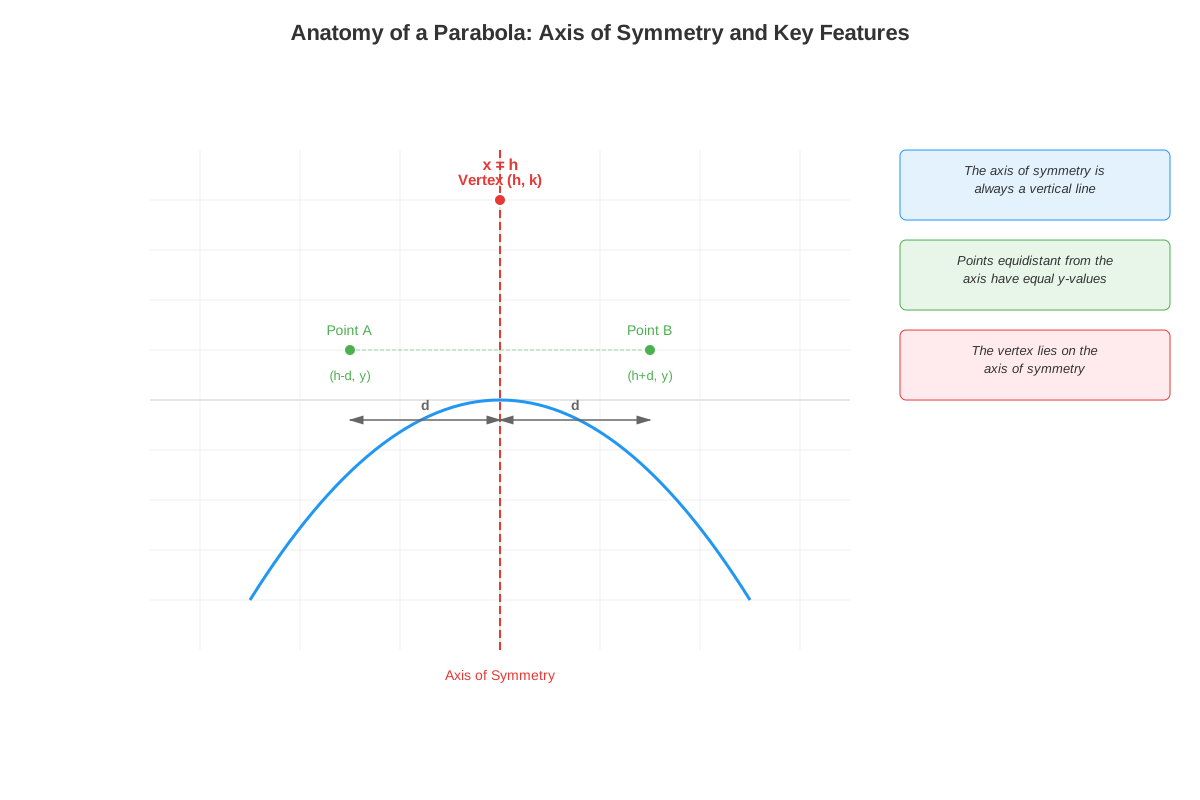
The axis of symmetry is a vertical line that divides a parabola into two congruent halves that are mirror images of each other. Every point on one side of this line has a corresponding point on the other side at an equal horizontal distance. For any quadratic function, the axis of symmetry always passes through the vertex—the highest or lowest point on the parabola—making it an invaluable tool for locating this critical feature.
Geometrically, if you were to fold the graph of a parabola along its axis of symmetry, both halves would align perfectly. This property means that for any y-value on the parabola (except the vertex), there exist exactly two x-values that produce that y-value, and these x-values are equidistant from the axis of symmetry. This symmetry property provides a powerful verification tool when solving quadratic equations and analyzing parabolic graphs.
Formula for Axis of Symmetry
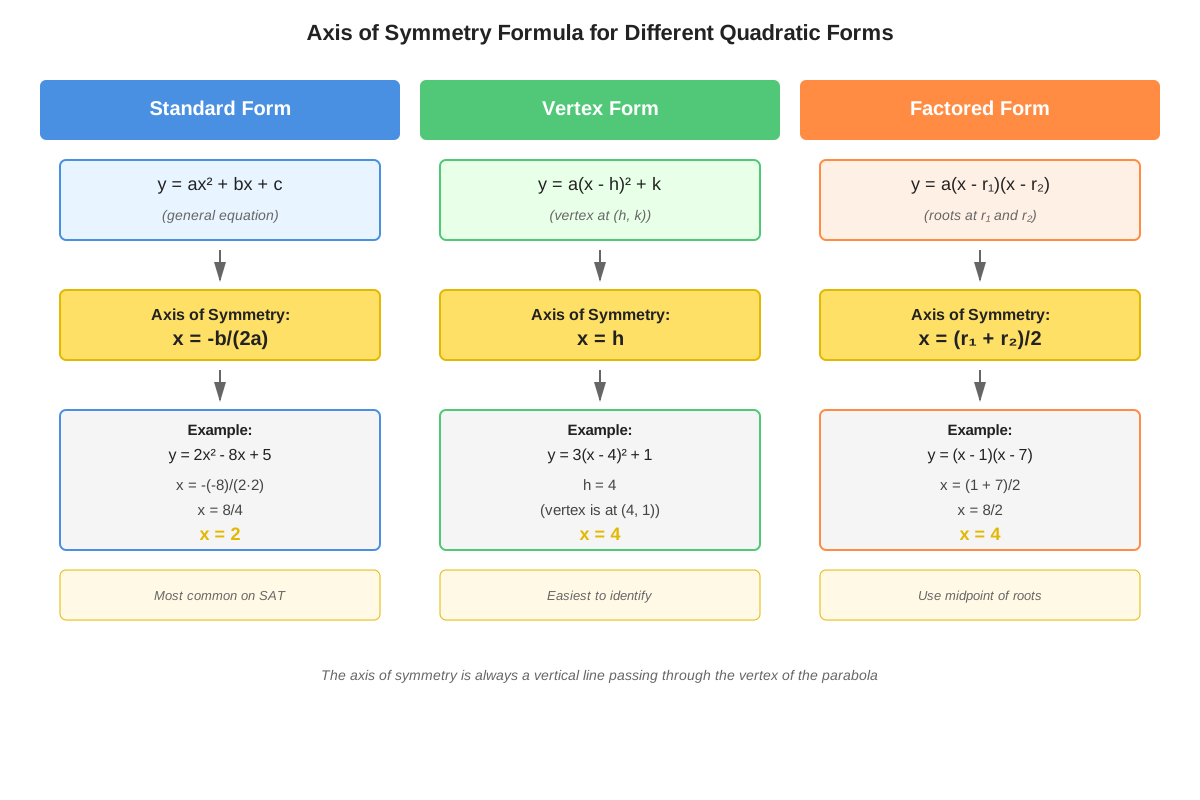
For a quadratic function in standard form y = ax² + bx + c, the equation of the axis of symmetry is:
x = -b/(2a)This formula derives from completing the square or using calculus to find where the derivative equals zero. The negative sign and the factor of 2 in the denominator are crucial—forgetting either component is a common error that leads to incorrect answers on the SAT.
When a quadratic is presented in vertex form y = a(x - h)² + k, the axis of symmetry is simply:
x = hThis direct relationship makes vertex form particularly convenient for identifying the axis of symmetry immediately. The value h represents the horizontal shift of the parabola from the origin, which coincides exactly with the axis of symmetry.
For quadratics in factored form y = a(x - r₁)(x - r₂), where r₁ and r₂ are the roots (x-intercepts), the axis of symmetry lies exactly halfway between the two roots:
x = (r₁ + r₂)/2This formula reflects the symmetric positioning of roots about the axis of symmetry—a property frequently tested on the SAT through questions asking students to find the axis given two x-intercepts.
Relationship to the Vertex
The axis of symmetry provides the x-coordinate of the vertex directly. Once you determine that x = h is the axis of symmetry, the vertex has coordinates (h, k) where k is found by substituting h back into the original quadratic equation. This two-step process—finding the axis of symmetry first, then calculating the corresponding y-value—is a standard SAT problem-solving sequence.
For parabolas opening upward (a > 0), the vertex represents the minimum point, and the axis of symmetry passes through this minimum. For parabolas opening downward (a < 0), the vertex represents the maximum point. This connection between the axis of symmetry and optimization makes the concept essential for word problems involving maximum height, minimum cost, or optimal dimensions.
Properties and Characteristics
| Property | Description | SAT Application |
|---|---|---|
| Always vertical | The axis of symmetry is always a vertical line (x = constant) | Eliminates horizontal or diagonal lines as answer choices |
| Passes through vertex | The line always intersects the parabola at exactly one point | Helps verify correct identification of the axis |
| Equidistant points | Points on the parabola equidistant from the axis have equal y-values | Useful for finding unknown coordinates or verifying solutions |
| Independent of vertical shift | Adding or subtracting a constant doesn't change the axis | Simplifies analysis when comparing related functions |
| Depends on a and b only | In standard form, only coefficients a and b affect the axis position | Allows quick calculation without considering c |
Using Symmetry to Solve Problems
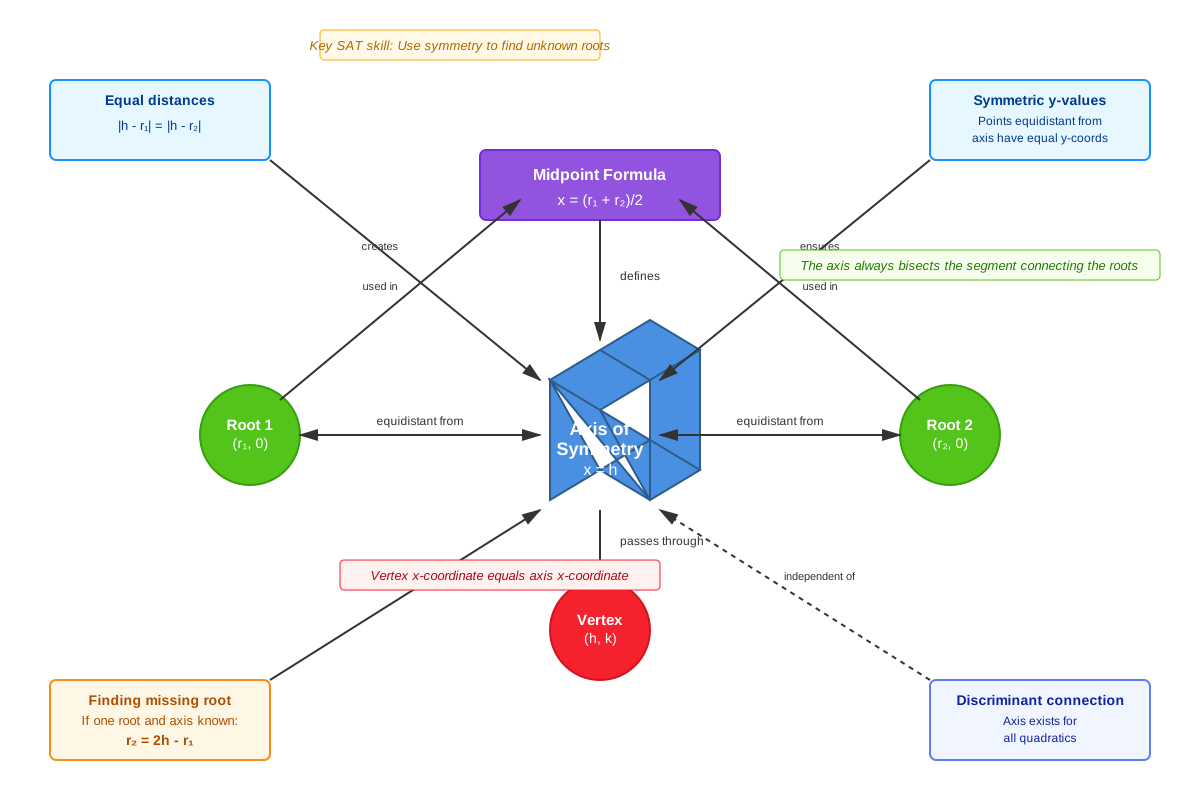
The symmetry property enables efficient problem-solving strategies. If you know one x-intercept of a parabola and the axis of symmetry, you can immediately determine the other x-intercept by reflecting across the axis. For example, if a parabola has an x-intercept at x = 2 and an axis of symmetry at x = 5, the other x-intercept must be at x = 8 (since 5 is the midpoint between 2 and 8).
Similarly, if a problem provides a point on the parabola and asks for another point with the same y-value, the axis of symmetry allows you to find this reflected point instantly. This technique frequently appears in SAT questions that test understanding of parabolic symmetry without requiring extensive calculation.
Multiple Representations
Understanding how the axis of symmetry appears across different representations strengthens problem-solving flexibility:
- Graphically: A vertical dashed line through the vertex, dividing the parabola into mirror images
- Algebraically: The equation x = -b/(2a) or x = h depending on the form
- Numerically: In a table of values, the axis occurs where the pattern of y-values reverses direction
- Verbally: Described as "the line of symmetry," "the vertical line through the vertex," or "halfway between the roots"
SAT questions may present information in any of these forms and expect students to translate between representations, making multi-representational fluency essential.
Concept Relationships
The axis of symmetry serves as a central connecting concept within quadratic equations. It directly determines the vertex coordinates by providing the x-value, which then allows calculation of the y-value through substitution. This relationship flows as: axis of symmetry equation → x-coordinate of vertex → y-coordinate of vertex (through substitution) → complete vertex coordinates.
The axis of symmetry also connects intimately with the roots or zeros of a quadratic function. When a parabola has two real roots, the axis of symmetry lies exactly at their midpoint, creating the relationship: roots → average of roots → axis of symmetry. Conversely, knowing the axis of symmetry and one root immediately reveals the other root through reflection.
Within the broader context of function transformations, the axis of symmetry shifts horizontally when the function undergoes horizontal translations. The transformation y = a(x - h)² + k moves the axis of symmetry to x = h, demonstrating how: horizontal shift parameter → axis of symmetry location → vertex position.
The concept extends to optimization problems through this pathway: quadratic model → axis of symmetry → vertex x-coordinate → maximum or minimum value. This sequence appears frequently in SAT word problems involving projectile motion, business applications, or geometric optimization.
Understanding the axis of symmetry also enhances comprehension of completing the square, as the process of converting standard form to vertex form explicitly reveals the axis of symmetry: standard form → completing the square → vertex form → axis of symmetry directly visible as x = h.
High-Yield Facts
⭐ The axis of symmetry for y = ax² + bx + c is always x = -b/(2a)
⭐ The axis of symmetry passes through the vertex of the parabola
⭐ For a quadratic with roots r₁ and r₂, the axis of symmetry is x = (r₁ + r₂)/2
⭐ The axis of symmetry is always a vertical line (never horizontal or diagonal)
⭐ In vertex form y = a(x - h)² + k, the axis of symmetry is x = h
- The coefficient c in standard form does not affect the axis of symmetry position
- Points equidistant from the axis of symmetry have identical y-values on the parabola
- The axis of symmetry divides the parabola into two congruent halves
- If a parabola has only one x-intercept, the axis of symmetry passes through that intercept
- The axis of symmetry remains unchanged when a parabola is vertically stretched or compressed
- For any quadratic function, there is exactly one axis of symmetry
- The distance from the axis of symmetry to each root is equal in magnitude but opposite in direction
Quick check — test yourself on Axis of symmetry so far.
Try Flashcards →Common Misconceptions
Misconception: The axis of symmetry is x = b/(2a) (forgetting the negative sign)
Correction: The correct formula is x = -b/(2a). The negative sign is essential because it accounts for the direction of the parabola's horizontal shift. Always include the negative sign when applying this formula.
Misconception: The axis of symmetry can be horizontal or diagonal depending on the parabola's orientation
Correction: The axis of symmetry for quadratic functions is always a vertical line with equation x = constant. While parabolas can open upward or downward, their axis of symmetry remains vertical. Horizontal parabolas (x as a function of y) have horizontal axes of symmetry, but these are not standard quadratic functions.
Misconception: The axis of symmetry is the same as the y-axis
Correction: The axis of symmetry only coincides with the y-axis (x = 0) when b = 0 in standard form. Most parabolas have axes of symmetry at other x-values. The y-axis is just one possible location for an axis of symmetry, not a general rule.
Misconception: Changing the value of c in y = ax² + bx + c changes the axis of symmetry
Correction: The axis of symmetry depends only on coefficients a and b. The constant term c shifts the parabola vertically but does not affect the horizontal position of the axis of symmetry. You can verify this by noting that c does not appear in the formula x = -b/(2a).
Misconception: The axis of symmetry is a point rather than a line
Correction: The axis of symmetry is an infinite vertical line, not a single point. While it passes through the vertex (which is a point), the axis itself extends infinitely in both vertical directions. The equation x = h represents all points with x-coordinate h, forming a complete vertical line.
Misconception: If a parabola has no real roots, it has no axis of symmetry
Correction: Every quadratic function has an axis of symmetry regardless of whether it has real roots, one real root, or no real roots. The axis of symmetry is determined by the coefficients of the quadratic expression, not by the existence of x-intercepts. A parabola that doesn't cross the x-axis still has perfect bilateral symmetry.
Worked Examples
Example 1: Finding Axis of Symmetry from Standard Form
Problem: Find the axis of symmetry for the quadratic function f(x) = 2x² - 8x + 5.
Solution:
Step 1: Identify the coefficients in standard form y = ax² + bx + c
- a = 2
- b = -8
- c = 5
Step 2: Apply the axis of symmetry formula x = -b/(2a)
- x = -(-8)/(2·2)
- x = 8/4
- x = 2
Step 3: Verify the answer makes sense
The axis of symmetry is x = 2. This is a vertical line passing through x = 2 on the coordinate plane.
Connection to Learning Objectives: This example demonstrates the direct application of the axis of symmetry formula to standard form quadratics, addressing the objective of calculating the axis from different representations. The systematic identification of coefficients and careful attention to signs (particularly the negative b) models the procedural fluency required for SAT success.
Example 2: Using Axis of Symmetry to Find the Vertex and Solve an Optimization Problem
Problem: A ball is thrown upward, and its height h (in feet) after t seconds is given by h(t) = -16t² + 32t + 48. At what time does the ball reach its maximum height, and what is that maximum height?
Solution:
Step 1: Recognize this is an optimization problem requiring the vertex
The maximum height occurs at the vertex of this downward-opening parabola (a = -16 < 0).
Step 2: Find the axis of symmetry to get the t-coordinate of the vertex
- a = -16, b = 32, c = 48
- t = -b/(2a) = -32/(2·(-16)) = -32/(-32) = 1
The ball reaches maximum height at t = 1 second.
Step 3: Find the maximum height by substituting t = 1 into the original equation
- h(1) = -16(1)² + 32(1) + 48
- h(1) = -16 + 32 + 48
- h(1) = 64 feet
Step 4: State the complete answer
The ball reaches its maximum height of 64 feet at t = 1 second.
Connection to Learning Objectives: This example illustrates how the axis of symmetry appears in real-world SAT contexts and demonstrates the multi-step process of using the axis to find the vertex and solve optimization problems. It shows how the axis of symmetry serves as an intermediate step in more complex problem-solving, a common SAT question structure.
Example 3: Finding the Axis of Symmetry from Roots
Problem: A parabola has x-intercepts at x = -3 and x = 7. What is the equation of its axis of symmetry?
Solution:
Step 1: Recognize that the axis of symmetry lies halfway between the roots
When a parabola has two x-intercepts, the axis of symmetry is located at their midpoint.
Step 2: Calculate the average of the two roots
- x = (r₁ + r₂)/2
- x = (-3 + 7)/2
- x = 4/2
- x = 2
Step 3: Write the equation of the axis of symmetry
The axis of symmetry is x = 2.
Step 4: Verify using the symmetry property
The distance from x = 2 to x = -3 is 5 units (left).
The distance from x = 2 to x = 7 is 5 units (right).
The equal distances confirm x = 2 is the correct axis of symmetry.
Connection to Learning Objectives: This example demonstrates an alternative method for finding the axis of symmetry when roots are given, reinforcing the relationship between roots and symmetry. It also models the verification strategy of checking equal distances, a useful technique for confirming answers on the SAT.
Exam Strategy
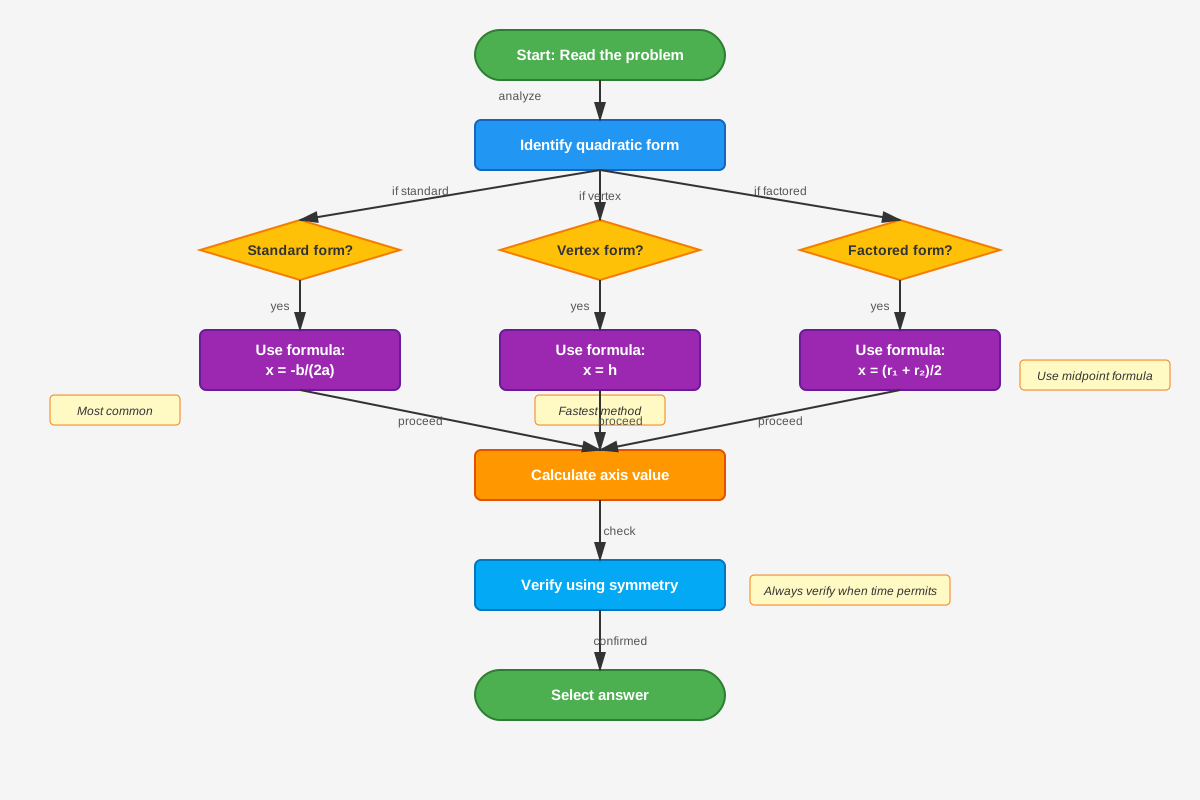
When approaching SAT axis of symmetry questions, begin by identifying which form the quadratic is presented in—standard, vertex, or factored. This immediate classification determines which formula or method to apply most efficiently. For standard form, automatically write down x = -b/(2a) and identify coefficients carefully, paying special attention to negative signs. For vertex form, simply extract the h-value. For factored form or when roots are given, average the roots.
Watch for trigger phrases that signal axis of symmetry questions: "line of symmetry," "vertical line through the vertex," "x-coordinate of the maximum/minimum," "halfway between the roots," or "where the function reaches its highest/lowest point." These phrases indicate that finding the axis of symmetry is either the final answer or a crucial intermediate step.
Exam Tip: If a question asks for the vertex and you're given standard form, always find the axis of symmetry first. This gives you the x-coordinate immediately, then substitute to find y. Never try to find both coordinates simultaneously—it's inefficient and error-prone.
Use process of elimination strategically. The axis of symmetry must be a vertical line (x = constant), so eliminate any answer choices with y-variables, inequalities, or non-vertical lines. If the parabola opens upward or downward (which is typical), the axis must be vertical—this eliminates 75% of distractors in poorly constructed questions.
For time management, allocate approximately 30-45 seconds to identify the axis of symmetry from a given equation, and 60-90 seconds for multi-step problems requiring you to use the axis to find other features. If a problem requires graphing or extensive calculation beyond finding the axis, consider marking it for review and returning after completing quicker questions.
When graphs are provided, use them to verify algebraic calculations. If you calculate x = 3 as the axis of symmetry but the graph clearly shows the vertex near x = -2, recheck your work immediately. Visual verification catches sign errors and calculation mistakes that might otherwise go unnoticed.
Memory Techniques
Formula Mnemonic: Remember "Negative Boy Two Apples" for x = -b/2a. The negative boy (negative b) is divided by two apples (2a). This mnemonic helps recall both the negative sign and the denominator structure.
Vertex Form Visualization: Picture the letter H in vertex form y = a(x - h)² + k. The H stands for "Horizontal shift" and gives you the axis of symmetry directly: x = h. The visual connection between the letter and its meaning strengthens recall.
Root Reflection Acronym: MARS - Midpoint Axis Reflects Symmetrically. When you have roots, find their midpoint to get the axis, which reflects the roots symmetrically. This acronym captures the entire process in four letters.
Coefficient Memory Aid: "A and B determine where the axis will be" reminds you that only coefficients a and b affect the axis of symmetry position, while c does not. The rhyme makes it memorable during high-pressure testing.
Vertical Line Reminder: Visualize a mirror standing vertically on the coordinate plane. Just as a mirror creates reflections, the axis of symmetry creates reflected points on the parabola. This image reinforces that the axis is always vertical and creates symmetric reflections.
Summary
The axis of symmetry is a vertical line that divides a parabola into two mirror-image halves and passes through the vertex, making it essential for analyzing quadratic functions on the SAT. For quadratics in standard form y = ax² + bx + c, the axis is found using x = -b/(2a), while vertex form y = a(x - h)² + k directly reveals it as x = h. When roots are known, the axis lies at their midpoint: x = (r₁ + r₂)/2. This concept appears frequently on the SAT in various contexts including optimization problems, vertex identification, and symmetry applications. Mastering the axis of symmetry enables efficient problem-solving by providing the x-coordinate of the vertex, revealing relationships between roots, and allowing quick verification of solutions through symmetry properties. Students must recognize that the axis depends only on coefficients a and b, remains vertical regardless of parabola orientation, and serves as a critical bridge between algebraic and geometric representations of quadratic functions.
Key Takeaways
- The axis of symmetry formula x = -b/(2a) applies to any quadratic in standard form—memorize it with the negative sign
- The axis of symmetry is always a vertical line passing through the vertex, never horizontal or diagonal
- Finding the axis of symmetry provides the x-coordinate of the vertex immediately, enabling quick optimization problem solutions
- When two roots are known, the axis of symmetry is simply their average: x = (r₁ + r₂)/2
- The coefficient c does not affect the axis of symmetry position—only a and b matter
- Points equidistant from the axis of symmetry have equal y-values, a property useful for verification and problem-solving
- The axis of symmetry appears in 3-5 SAT questions per exam, making it a high-yield topic worth thorough mastery
Related Topics
Vertex Form of Quadratic Equations: Understanding how to convert between standard and vertex form deepens comprehension of the axis of symmetry and enables more flexible problem-solving approaches. Mastering the axis of symmetry provides the foundation for working fluently with vertex form.
Completing the Square: This algebraic technique explicitly reveals the axis of symmetry by transforming standard form into vertex form. Students who understand the axis of symmetry find completing the square more intuitive and purposeful.
Quadratic Formula and Discriminant: The relationship between roots and the axis of symmetry connects to the quadratic formula, as the axis lies at the average of the two solutions. Understanding symmetry enhances interpretation of quadratic formula results.
Function Transformations: The axis of symmetry shifts predictably under horizontal translations, making it a key feature for understanding how transformations affect quadratic functions. This topic extends symmetry concepts to broader function analysis.
Optimization and Maximum/Minimum Problems: The axis of symmetry is the primary tool for finding optimal values in quadratic models, making it essential for real-world application problems that frequently appear on the SAT.
Practice CTA
Now that you've mastered the axis of symmetry, it's time to solidify your understanding through active practice. Work through the practice questions to apply these concepts in SAT-style contexts, and use the flashcards to reinforce key formulas and properties. Remember, the axis of symmetry appears on virtually every SAT exam—your investment in mastering this topic will pay dividends on test day. Approach each practice problem systematically, verify your answers using symmetry properties, and build the confidence that comes from true understanding. You've got this!
Sign up free to keep reading
Create a free AnvayaPrep account to finish this SAT guide on Axis of symmetry — plus flashcards and practice questions.