Overview
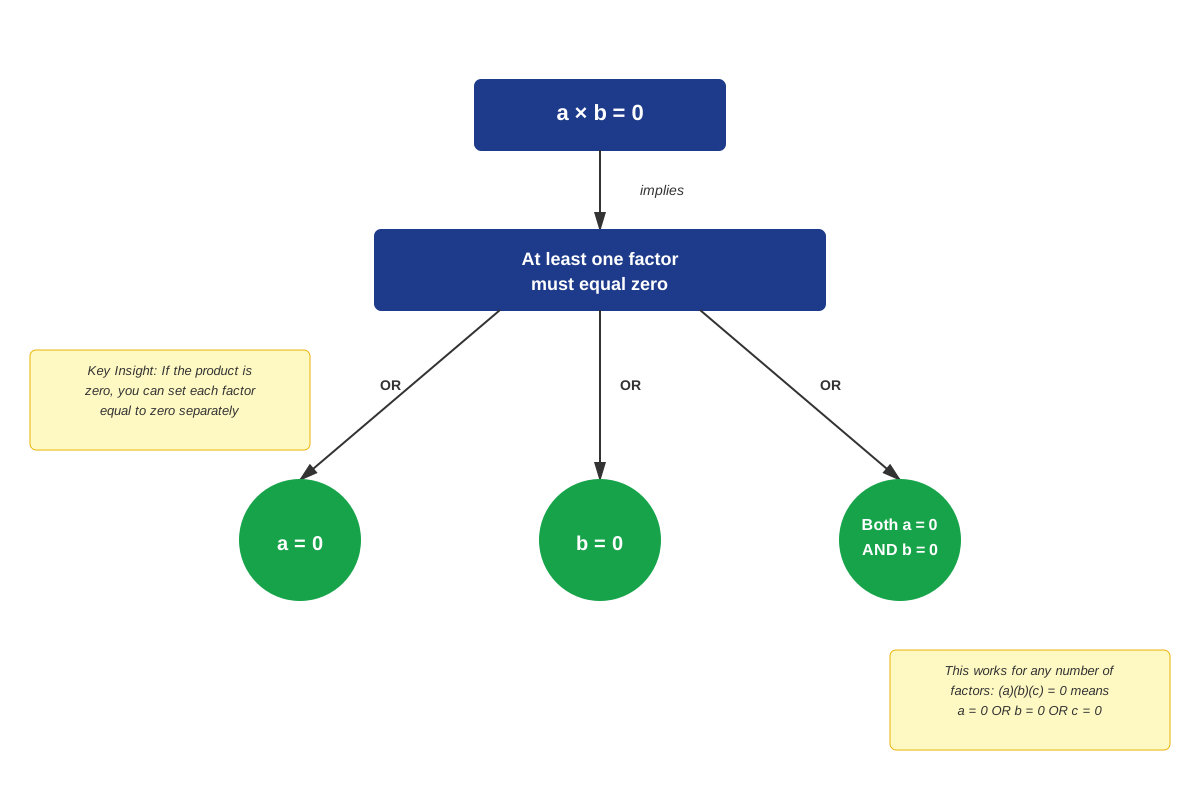
The zero product property is one of the most fundamental and powerful tools in algebra, particularly when solving quadratic equations on the SAT. This property states that if the product of two or more factors equals zero, then at least one of those factors must equal zero. In mathematical notation: if a × b = 0, then a = 0 or b = 0 (or both). While this concept may seem simple at first glance, it serves as the cornerstone for solving countless SAT problems involving quadratic equations, polynomial equations, and even more complex algebraic expressions.
Understanding the sat zero product property is essential because it provides a systematic method for finding solutions to equations that would otherwise be difficult or impossible to solve through basic algebraic manipulation. On the SAT, this property appears frequently in both multiple-choice and grid-in questions, often disguised within word problems, geometric contexts, or multi-step algebraic challenges. The College Board consistently tests students' ability to recognize when an equation can be factored and then apply the zero product property to find solutions efficiently.
The zero product property connects directly to broader math concepts including factoring techniques, the structure of quadratic equations, the relationship between roots and factors, and graphical interpretations of functions. Mastering this topic enables students to solve quadratic equations quickly, verify solutions, understand the behavior of parabolas, and tackle more advanced topics like polynomial functions and systems of equations. The property also reinforces logical reasoning skills that extend beyond mathematics into analytical thinking required throughout the SAT.
Learning Objectives
- [ ] Identify key features of Zero product property
- [ ] Explain how Zero product property appears on the SAT
- [ ] Apply Zero product property to answer SAT-style questions
- [ ] Factor quadratic expressions correctly to prepare them for zero product property application
- [ ] Determine all solutions to equations involving products of multiple factors
- [ ] Recognize when the zero product property is the most efficient solution method
- [ ] Verify solutions obtained through the zero product property by substitution
Prerequisites
- Basic algebraic manipulation: Students must be able to combine like terms, distribute, and isolate variables, as these skills are necessary before applying the zero product property.
- Factoring techniques: Understanding how to factor quadratic expressions (including greatest common factors, difference of squares, and trinomial factoring) is essential since the zero product property requires equations in factored form.
- Understanding of equality: Students should recognize that equations represent balanced statements and that operations performed on one side must be performed on the other.
- Concept of solutions/roots: Familiarity with what it means for a value to "satisfy" or "solve" an equation is necessary to understand what the zero product property accomplishes.
Why This Topic Matters
The zero product property represents a critical bridge between algebraic manipulation and problem-solving in real-world contexts. In practical applications, this property helps solve problems involving area, projectile motion, optimization, and any scenario where relationships can be modeled by polynomial equations. Engineers use it to find critical points in design specifications, economists apply it to break-even analysis, and physicists rely on it when analyzing motion and forces.
On the SAT, the zero product property appears in approximately 3-5 questions per test, making it a high-yield topic that directly impacts scores. Questions involving this property typically appear in both the calculator and no-calculator sections, with difficulty levels ranging from medium to hard. The College Board tests this concept through various question types: direct algebraic equations requiring factoring and solving, word problems that must be translated into quadratic equations, questions about the x-intercepts of parabolas, and multi-step problems where finding zeros is one component of a larger solution.
Common SAT question formats include: asking for the sum or product of solutions, requesting the positive solution only, presenting equations in non-standard forms that must be rearranged, embedding the property within geometry problems (such as finding dimensions when area is given), and testing whether students can recognize that zero is itself a valid solution. The property also appears in questions about function behavior, particularly when identifying where graphs cross the x-axis.
Core Concepts
The Zero Product Property Defined
The zero product property is a fundamental principle stating that if the product of two or more factors equals zero, then at least one of the factors must equal zero. Mathematically expressed: if ab = 0, then a = 0 or b = 0. This property extends to any number of factors: if abc = 0, then a = 0 or b = 0 or c = 0. The property is unique to zero—no other number has this characteristic. For example, if ab = 6, we cannot conclude anything definite about the individual values of a or b.
The logical foundation of this property rests on the multiplicative nature of zero. Since zero times any number equals zero, the only way a product can equal zero is if at least one factor is zero. This property only works when one side of the equation equals zero; if an equation reads ab = 5, the zero product property cannot be applied until the equation is rearranged to standard form.
Standard Form and Preparation
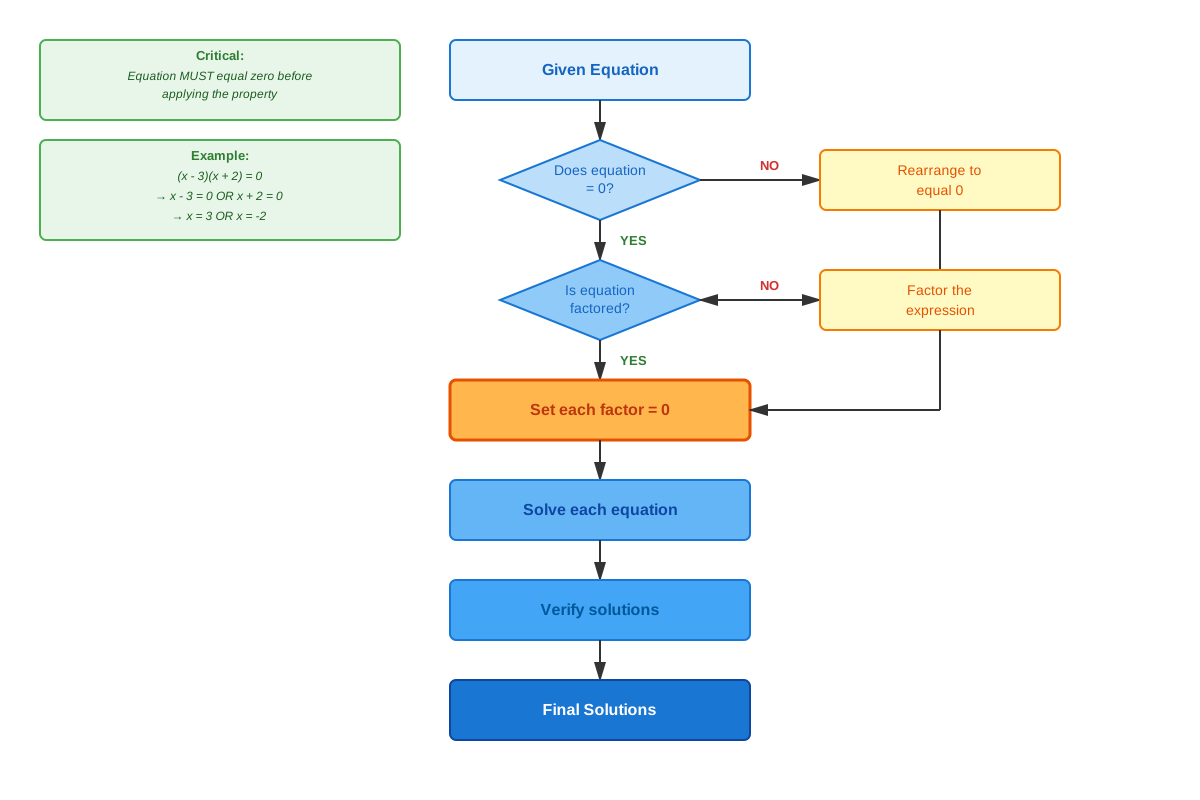
Before applying the zero product property, equations must be in standard form: all terms on one side of the equation with zero on the other side. For quadratic equations, this typically means ax² + bx + c = 0. The process of preparing an equation involves:
- Moving all terms to one side of the equation
- Combining like terms
- Factoring the expression completely
- Setting each factor equal to zero
- Solving each resulting equation
Consider the equation x² + 5x = 14. This cannot be solved using the zero product property in its current form. First, subtract 14 from both sides: x² + 5x - 14 = 0. Now the equation is ready for factoring and application of the property.
Factoring and the Zero Product Property
Factoring is the process of rewriting an expression as a product of simpler expressions. The zero product property requires equations to be in factored form. Common factoring patterns include:
| Factoring Type | General Form | Example |
|---|---|---|
| Greatest Common Factor | ab + ac = a(b + c) | 3x² + 6x = 3x(x + 2) |
| Difference of Squares | a² - b² = (a + b)(a - b) | x² - 9 = (x + 3)(x - 3) |
| Perfect Square Trinomial | a² + 2ab + b² = (a + b)² | x² + 6x + 9 = (x + 3)² |
| General Trinomial | x² + bx + c = (x + m)(x + n) | x² + 7x + 12 = (x + 3)(x + 4) |
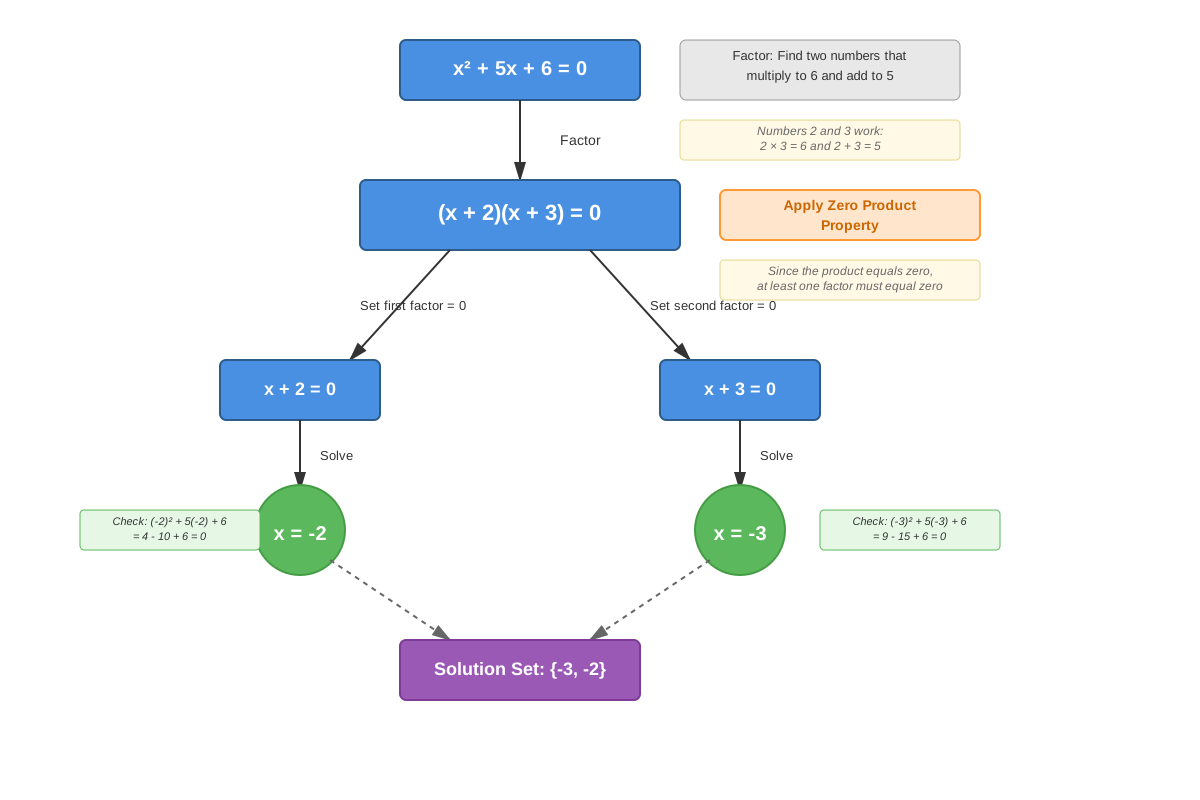
After factoring, each factor is set equal to zero. For example, if (x + 3)(x - 5) = 0, then either x + 3 = 0 or x - 5 = 0, yielding solutions x = -3 or x = 5.
Multiple Solutions and Solution Sets
Quadratic equations typically have two solutions (though they may be identical in the case of a perfect square). Each factor that can equal zero produces one solution. The solution set includes all values that satisfy the original equation. When (x - 2)(x + 7) = 0, the solution set is {2, -7}.
It's crucial to recognize that both solutions are valid unless the problem context restricts the domain. For instance, if x represents a physical length, negative solutions may not make sense in context, but they are still mathematically valid solutions to the equation.
Zero as a Solution
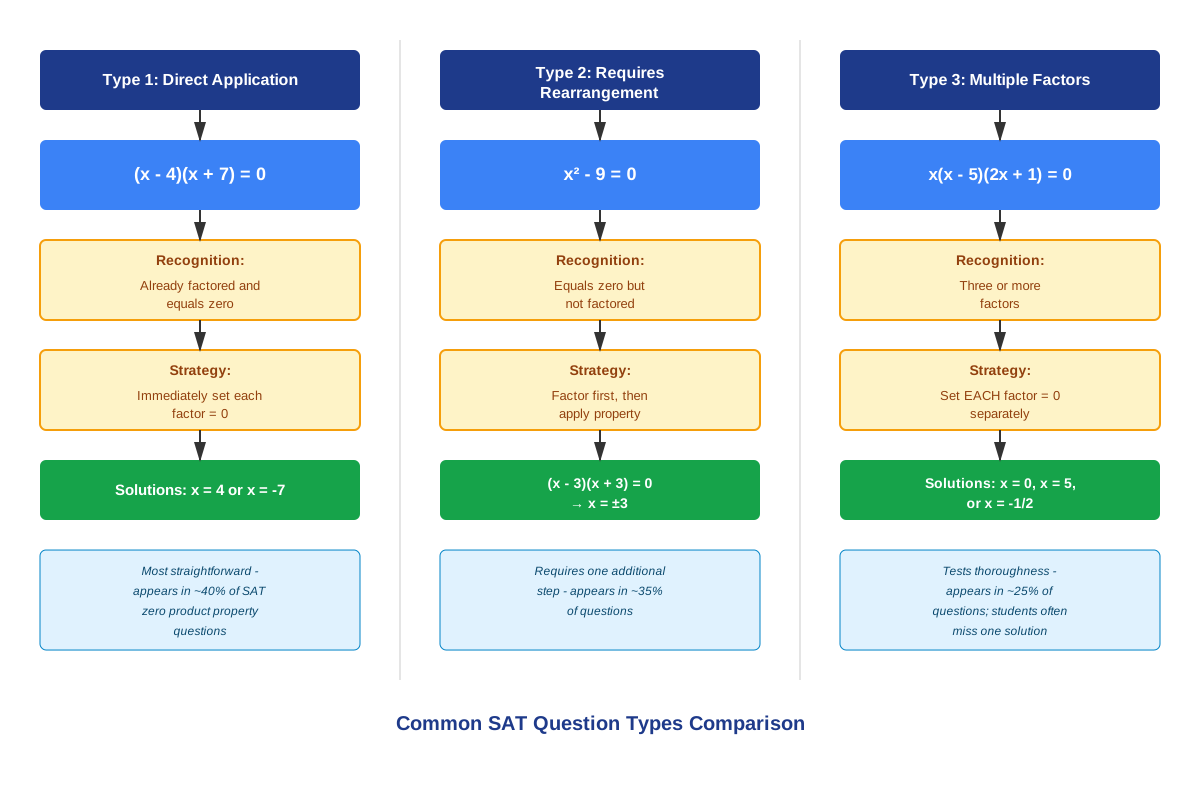
A common oversight is forgetting that zero itself can be a solution. When an equation factors to include x as a factor, such as x(x - 4) = 0, the solutions are x = 0 and x = 4. Students sometimes incorrectly ignore the zero solution, but it is equally valid and frequently tested on the SAT.
Equations with More Than Two Factors
The zero product property extends beyond quadratic equations to any polynomial equation in factored form. For example, x(x - 2)(x + 5) = 0 has three solutions: x = 0, x = 2, and x = -5. Each factor independently can equal zero, and each produces a distinct solution.
Verification of Solutions
After finding solutions using the zero product property, verification involves substituting each solution back into the original equation to confirm it produces a true statement. This step catches algebraic errors and ensures solutions are valid, particularly important when equations have been manipulated through multiple steps.
Concept Relationships
The zero product property serves as the central hub connecting several algebraic concepts. Factoring techniques → enable application of → zero product property → produces → solutions to equations → which represent → x-intercepts on graphs.
The property depends fundamentally on understanding equality and equation structure. Before the zero product property can be applied, students must use algebraic manipulation to achieve standard form (expression = 0). The factoring step requires knowledge of polynomial structure, multiplication patterns, and number relationships.
Solutions obtained through the zero product property directly connect to graphical representations: each solution represents an x-intercept of the corresponding function. For f(x) = (x - 3)(x + 2), the solutions x = 3 and x = -2 are precisely where the graph crosses the x-axis.
The property also relates to the quadratic formula and completing the square—these are alternative methods for solving quadratic equations. While the zero product property is often the fastest method when equations factor easily, the quadratic formula works for all quadratic equations, including those that don't factor neatly.
Understanding the zero product property prepares students for polynomial functions, rational expressions (where finding zeros of numerators and denominators is essential), and systems of equations where one equation might be solved using this property.
High-Yield Facts
⭐ The zero product property states that if ab = 0, then a = 0 or b = 0 (or both).
⭐ Before applying the zero product property, one side of the equation must equal zero.
⭐ Each factor set equal to zero produces one solution to the equation.
⭐ Zero itself is a valid solution when x appears as a factor.
⭐ Quadratic equations typically have two solutions, which may be equal (repeated roots).
- The zero product property only works with zero; if ab = 5, no similar conclusion can be drawn about a or b.
- Solutions found using the zero product property represent x-intercepts of the corresponding function's graph.
- The sum of solutions to x² + bx + c = 0 equals -b, and their product equals c.
- When a quadratic factors to (x - p)(x - q) = 0, the solutions are x = p and x = q.
- Perfect square trinomials like (x + 3)² = 0 produce one repeated solution (x = -3 with multiplicity 2).
- The zero product property extends to products of three or more factors.
- Factoring out a greatest common factor should always be the first step in the factoring process.
Quick check — test yourself on Zero product property so far.
Try Flashcards →Common Misconceptions
Misconception: The zero product property can be applied when the product equals any number, not just zero.
Correction: The property is unique to zero. If (x + 2)(x - 3) = 10, you cannot conclude that x + 2 = 10 or x - 3 = 10. The equation must first be rearranged so one side equals zero.
Misconception: When (x + 5)(x - 2) = 0, the solutions are x = 5 and x = 2.
Correction: Each factor is set equal to zero and then solved. If x + 5 = 0, then x = -5. If x - 2 = 0, then x = 2. The solutions are x = -5 and x = 2, not the numbers appearing in the factors.
Misconception: Zero is not a valid solution to an equation.
Correction: Zero is as valid as any other number. When x(x - 7) = 0, both x = 0 and x = 7 are correct solutions. Students often overlook zero, but SAT questions frequently test this.
Misconception: If an equation doesn't factor easily, the zero product property cannot be used.
Correction: While the zero product property requires factored form, not all quadratic equations factor with integer coefficients. In such cases, other methods (quadratic formula, completing the square) are more appropriate. However, on the SAT, equations that require the zero product property typically factor cleanly.
Misconception: After factoring, only one solution needs to be found.
Correction: Each factor that can equal zero must be considered. A quadratic equation in factored form with two distinct linear factors produces two solutions, and both should be identified unless the question specifically asks for only one (such as "the positive solution").
Misconception: The solutions to (x - 3)² = 0 are x = 3 and x = -3.
Correction: This factors to (x - 3)(x - 3) = 0, which gives x - 3 = 0 twice, producing only one solution: x = 3 (a repeated root). The presence of a square doesn't automatically create two different solutions.
Worked Examples
Example 1: Standard Quadratic Equation
Problem: Solve for x: x² - 2x - 15 = 0
Solution:
Step 1: Verify the equation is in standard form (all terms on one side, zero on the other).
The equation x² - 2x - 15 = 0 is already in standard form.
Step 2: Factor the quadratic expression.
We need two numbers that multiply to -15 and add to -2. These numbers are -5 and 3.
x² - 2x - 15 = (x - 5)(x + 3)
Step 3: Apply the zero product property.
If (x - 5)(x + 3) = 0, then either x - 5 = 0 or x + 3 = 0.
Step 4: Solve each equation.
x - 5 = 0 → x = 5
x + 3 = 0 → x = -3
Step 5: Verify solutions.
For x = 5: (5)² - 2(5) - 15 = 25 - 10 - 15 = 0 ✓
For x = -3: (-3)² - 2(-3) - 15 = 9 + 6 - 15 = 0 ✓
Answer: x = 5 or x = -3
This example demonstrates the complete process: recognizing standard form, factoring, applying the zero product property, and verifying solutions. This directly addresses the learning objective of applying the zero product property to solve equations.
Example 2: Equation Requiring Rearrangement
Problem: If x² + 8x = 20, what are all possible values of x?
Solution:
Step 1: Rearrange to standard form.
The equation must have zero on one side. Subtract 20 from both sides:
x² + 8x - 20 = 0
Step 2: Factor the quadratic expression.
We need two numbers that multiply to -20 and add to 8. These numbers are 10 and -2.
x² + 8x - 20 = (x + 10)(x - 2)
Step 3: Apply the zero product property.
If (x + 10)(x - 2) = 0, then either x + 10 = 0 or x - 2 = 0.
Step 4: Solve each equation.
x + 10 = 0 → x = -10
x - 2 = 0 → x = 2
Step 5: Verify solutions in the original equation.
For x = -10: (-10)² + 8(-10) = 100 - 80 = 20 ✓
For x = 2: (2)² + 8(2) = 4 + 16 = 20 ✓
Answer: x = -10 or x = 2
This example emphasizes the critical step of rearranging equations to standard form before applying the zero product property, a common SAT test point. Students must recognize that the property only works when one side equals zero.
Example 3: Equation with Zero as a Solution
Problem: Solve: 3x² = 12x
Solution:
Step 1: Rearrange to standard form.
Subtract 12x from both sides:
3x² - 12x = 0
Step 2: Factor out the greatest common factor.
Both terms contain 3x:
3x(x - 4) = 0
Step 3: Apply the zero product property.
If 3x(x - 4) = 0, then either 3x = 0 or x - 4 = 0.
Step 4: Solve each equation.
3x = 0 → x = 0
x - 4 = 0 → x = 4
Step 5: Verify solutions.
For x = 0: 3(0)² = 0 and 12(0) = 0, so 0 = 0 ✓
For x = 4: 3(4)² = 48 and 12(4) = 48, so 48 = 48 ✓
Answer: x = 0 or x = 4
This example highlights that zero is a valid solution, addressing a common misconception. Many students incorrectly divide both sides by x, which eliminates the zero solution—a frequent SAT trap.
Exam Strategy
When approaching SAT questions involving the zero product property, follow this systematic approach:
Recognition Phase: Identify trigger words and formats that signal the zero product property is needed. Look for phrases like "solve for x," "find all values," "what are the solutions," or "where does the graph cross the x-axis." Equations containing x² or products of expressions are prime candidates.
Preparation Phase: Before attempting to factor, ensure the equation is in standard form with zero on one side. This is the most critical step—many students waste time trying to factor equations that aren't properly arranged. If the equation reads something like x² + 5x = 6, immediately subtract 6 from both sides.
Execution Phase: Factor systematically. Start by checking for a greatest common factor, then look for special patterns (difference of squares, perfect square trinomials), and finally attempt general trinomial factoring. On the SAT, if an equation is meant to be solved by factoring, it will factor cleanly with integer coefficients.
Solution Phase: Set each factor equal to zero separately and solve. Write out each step to avoid sign errors. Remember that (x + 3) = 0 gives x = -3, not x = 3.
Verification Strategy: If time permits, substitute solutions back into the original equation. More importantly, use answer choices strategically—if the question is multiple choice, you can test the given options directly in the equation.
Exam Tip: When a question asks for "the positive solution" or "the negative solution," you still need to find both solutions first, then select the appropriate one. Don't stop after finding just one solution.
Time Management: Straightforward zero product property questions should take 30-60 seconds. If you're spending more than 90 seconds, consider whether you've missed a simpler approach or if you should mark the question and return to it later.
Process of Elimination: In multiple-choice questions, eliminate answers that don't make mathematical sense. If you've factored to (x - 7)(x + 2) = 0, you can immediately eliminate any answer choice that doesn't include 7 or -2. For questions asking about the sum or product of solutions, calculate these values from your solutions and eliminate incompatible answers.
Common Traps to Avoid: Watch for equations where dividing by a variable would eliminate a solution (particularly zero). Be cautious with questions that present equations not in standard form—the SAT intentionally tests whether you recognize the need to rearrange. Don't confuse the numbers in the factors with the solutions themselves.
Memory Techniques
ZPP Mnemonic: Zero Product Property = "Zero Produces Possibilities"—when a product equals zero, each factor is a possibility for being zero.
FAZE Method for solving:
- Form: Get equation in standard form (= 0)
- Analyze: Factor the expression completely
- Zero: Set each factor equal to zero
- Evaluate: Solve each equation for the variable
The "Only Zero" Rule: Visualize a multiplication table—zero is the only number that, when multiplied by anything, always gives zero. This unique property is why the zero product property works exclusively with zero.
Sign Flip Visualization: When you see (x + 5) = 0, visualize the 5 "flipping" to the other side and changing sign: x = -5. When you see (x - 3) = 0, the -3 flips to become +3: x = 3. This mental shortcut helps avoid sign errors.
Factor-Solution Connection: Create a visual pattern: (x - [number]) = 0 means x = [same number]. (x + [number]) = 0 means x = [opposite number]. The minus sign in the factor means the solution keeps the sign; the plus sign means the solution flips the sign.
"Both Sides Zero" Reminder: Before factoring, both sides of your equation should look like: [expression] = 0. If you don't see zero on one side, you're not ready for the zero product property yet.
Summary
The zero product property is an essential algebraic principle stating that if a product of factors equals zero, at least one factor must equal zero. This property provides the foundation for solving quadratic equations and appears frequently on the SAT in various contexts. To apply the property successfully, students must first ensure equations are in standard form (with zero on one side), factor the expression completely, set each factor equal to zero, and solve the resulting equations. Common SAT applications include direct algebraic equations, word problems requiring translation to quadratic form, and questions about x-intercepts of parabolas. Critical skills include recognizing when the property applies, avoiding the trap of dividing by variables (which can eliminate zero as a solution), correctly interpreting the relationship between factors and solutions (remembering that signs flip), and verifying that all solutions are found. Mastery of this topic requires proficiency in factoring techniques and careful attention to algebraic manipulation, but once mastered, the zero product property becomes one of the fastest and most reliable methods for solving quadratic equations on the SAT.
Key Takeaways
- The zero product property works exclusively when a product equals zero: if ab = 0, then a = 0 or b = 0
- Equations must be in standard form (expression = 0) before applying the property
- Each factor set equal to zero produces one solution; quadratic equations typically yield two solutions
- Zero itself is a valid and frequently tested solution—never eliminate it by dividing by a variable
- Solutions to (x - p)(x - q) = 0 are x = p and x = q; watch for sign changes when solving
- The zero product property connects directly to x-intercepts on graphs and appears in 3-5 SAT questions per test
- Always verify solutions by substituting back into the original equation when time permits
Related Topics
Quadratic Formula: An alternative method for solving quadratic equations that works even when expressions don't factor easily; understanding when to use the zero product property versus the quadratic formula improves efficiency.
Completing the Square: Another technique for solving quadratic equations that also reveals the vertex form of a parabola; mastering multiple solution methods provides flexibility on the SAT.
Graphing Quadratic Functions: The solutions found using the zero product property represent x-intercepts of parabolas; understanding this connection helps with questions about function behavior and graph interpretation.
Polynomial Functions: The zero product property extends to higher-degree polynomials; mastering it with quadratics prepares students for more complex polynomial equations.
Factoring Techniques: Advanced factoring methods (grouping, sum/difference of cubes) build on the foundation established by the zero product property and expand problem-solving capabilities.
Systems of Equations: Some systems include a quadratic equation that must be solved using the zero product property before finding the complete solution set.
Practice CTA
Now that you've mastered the zero product property, it's time to solidify your understanding through practice! Attempt the practice questions to test your ability to recognize when to apply the property, factor correctly, and find all solutions efficiently. Use the flashcards to reinforce key concepts and common patterns. Remember, the zero product property appears on virtually every SAT, making it one of the highest-yield topics you can master. Each practice problem you complete builds the speed and confidence you'll need on test day. You've got this!
Sign up free to keep reading
Create a free AnvayaPrep account to finish this SAT guide on Zero product property — plus flashcards and practice questions.