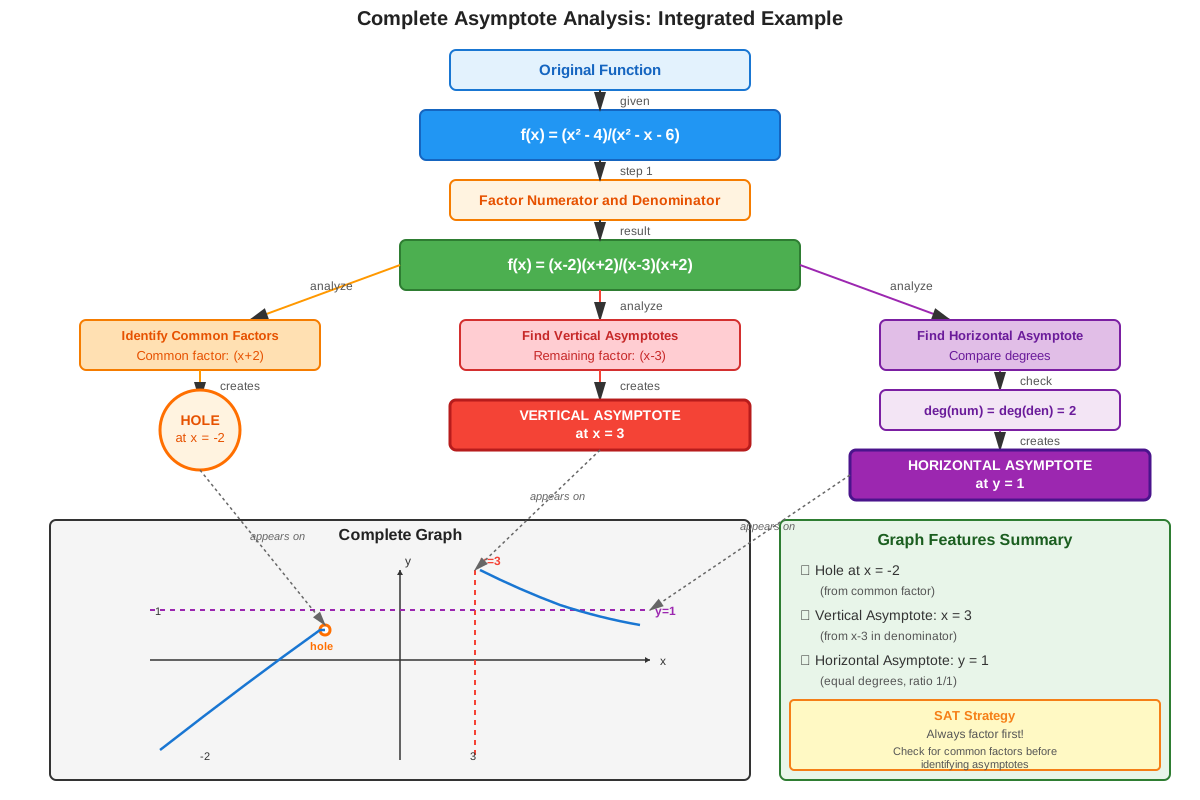
Overview
Asymptotes represent one of the most visually intuitive yet mathematically significant concepts tested on the SAT Math section. An asymptote is a line that a graph approaches but never actually touches or crosses (with rare exceptions in advanced cases beyond SAT scope). Understanding asymptotes basics is crucial for analyzing rational functions, which appear regularly on the SAT in both calculator and no-calculator sections. These invisible boundary lines reveal the behavior of functions at extreme values and help students predict graph behavior without plotting dozens of points.
On the SAT, asymptote questions typically involve identifying vertical and horizontal asymptotes from equations, matching graphs to functions based on asymptotic behavior, or determining function values near asymptotes. The College Board frequently tests whether students can recognize that vertical asymptotes occur where denominators equal zero (and numerators don't), while horizontal asymptotes describe end behavior as x approaches infinity. These questions often appear in Problem Solving and Data Analysis or Passport to Advanced Math sections, accounting for approximately 2-4 questions per test.
Mastering sat asymptotes basics connects directly to broader math concepts including limits, rational expressions, function behavior, and graph analysis. This topic builds upon understanding of fractions, factoring, and function notation while preparing students for more advanced calculus concepts. The ability to quickly identify asymptotes allows students to eliminate incorrect answer choices, verify calculator results, and solve complex problems involving rational equations with confidence and speed.
Learning Objectives
- [ ] Identify key features of asymptotes basics, including vertical and horizontal asymptotes from equations and graphs
- [ ] Explain how asymptotes basics appears on the SAT, including question formats and common testing scenarios
- [ ] Apply asymptotes basics to answer SAT-style questions involving rational functions and graph analysis
- [ ] Determine vertical asymptotes by finding values that make denominators zero while numerators remain non-zero
- [ ] Calculate horizontal asymptotes by comparing degrees of numerator and denominator polynomials
- [ ] Distinguish between removable discontinuities (holes) and non-removable discontinuities (vertical asymptotes)
- [ ] Use asymptotic behavior to eliminate incorrect answer choices and verify solutions
Prerequisites
- Rational expressions and fractions: Understanding numerators and denominators is essential since asymptotes occur based on these components' behavior
- Solving linear and quadratic equations: Finding asymptotes requires setting expressions equal to zero and solving for x
- Function notation and evaluation: Asymptote analysis depends on understanding f(x) notation and substituting values
- Polynomial degree identification: Horizontal asymptotes are determined by comparing polynomial degrees in numerator and denominator
- Basic graphing skills: Visualizing asymptotes requires familiarity with coordinate planes and function behavior
Why This Topic Matters
Asymptotes appear in numerous real-world applications that make them relevant beyond standardized testing. In physics, asymptotic behavior models phenomena like terminal velocity, where falling objects approach but never exceed a maximum speed. In economics, asymptotes represent production capacity limits or market saturation points. In medicine, drug concentration curves approach zero asymptotically as medications are metabolized. Understanding asymptotic behavior helps predict system limits and boundary conditions across scientific disciplines.
On the SAT, asymptote questions appear with high frequency—typically 2-4 questions per test administration. These questions most commonly appear in the Passport to Advanced Math category, which comprises 16 of the 58 total math questions. Asymptote problems may ask students to identify asymptotes from equations, match functions to graphs based on asymptotic behavior, determine function domains, or solve equations involving rational expressions. The College Board particularly favors questions that combine asymptote identification with other skills like function transformation or algebraic manipulation.
Common SAT question formats include: presenting a rational function and asking for the equation of a vertical asymptote; showing a graph and asking which function could produce it based on asymptotic behavior; providing a context problem where asymptotic behavior represents a real-world limit; or asking students to identify how many vertical asymptotes exist for a given function. These questions typically appear in both multiple-choice and student-produced response formats, with medium to high difficulty ratings.
Core Concepts
What Are Asymptotes?
An asymptote is a line that a function's graph approaches infinitely closely but typically never reaches. Think of asymptotes as invisible barriers or guides that constrain a function's behavior. There are three main types of asymptotes: vertical asymptotes, horizontal asymptotes, and oblique (slant) asymptotes. For SAT purposes, focus primarily on vertical and horizontal asymptotes, as oblique asymptotes rarely appear on the exam.
Asymptotes reveal critical information about function behavior at extreme values. Vertical asymptotes show where functions become undefined and shoot toward positive or negative infinity. Horizontal asymptotes describe what happens to function values as x becomes extremely large (positive or negative). Understanding these boundaries allows students to sketch accurate graphs and predict function behavior without extensive calculation.
Vertical Asymptotes
Vertical asymptotes occur at x-values where a rational function becomes undefined because the denominator equals zero while the numerator does not equal zero at that same point. The general form of a rational function is:
f(x) = P(x)/Q(x)where P(x) is the numerator polynomial and Q(x) is the denominator polynomial.
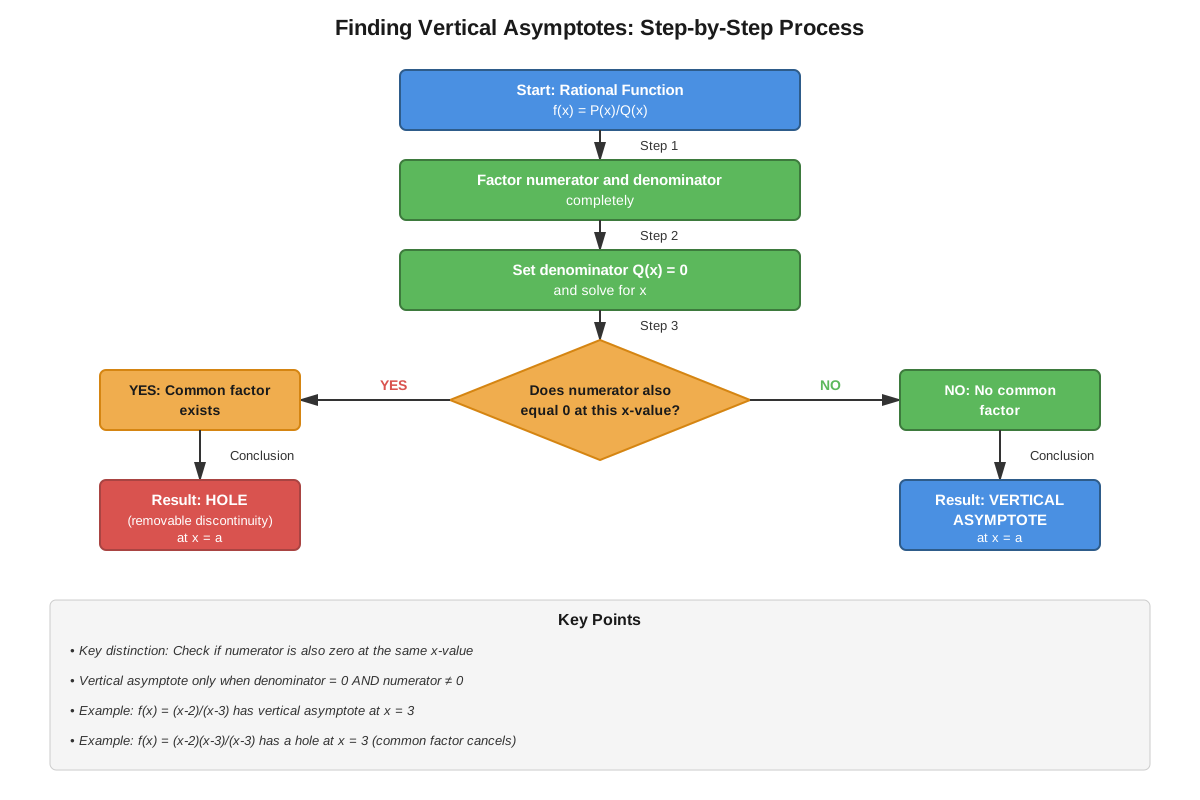
To find vertical asymptotes, follow these steps:
- Set the denominator Q(x) equal to zero
- Solve for all x-values that make Q(x) = 0
- Check each x-value in the numerator P(x)
- If P(x) ≠ 0 at that x-value, a vertical asymptote exists at x = that value
- If P(x) = 0 at that x-value, a hole (removable discontinuity) exists instead
For example, consider f(x) = (x + 2)/(x - 3). Setting the denominator equal to zero: x - 3 = 0, so x = 3. Checking the numerator at x = 3: (3 + 2) = 5 ≠ 0. Therefore, a vertical asymptote exists at x = 3.
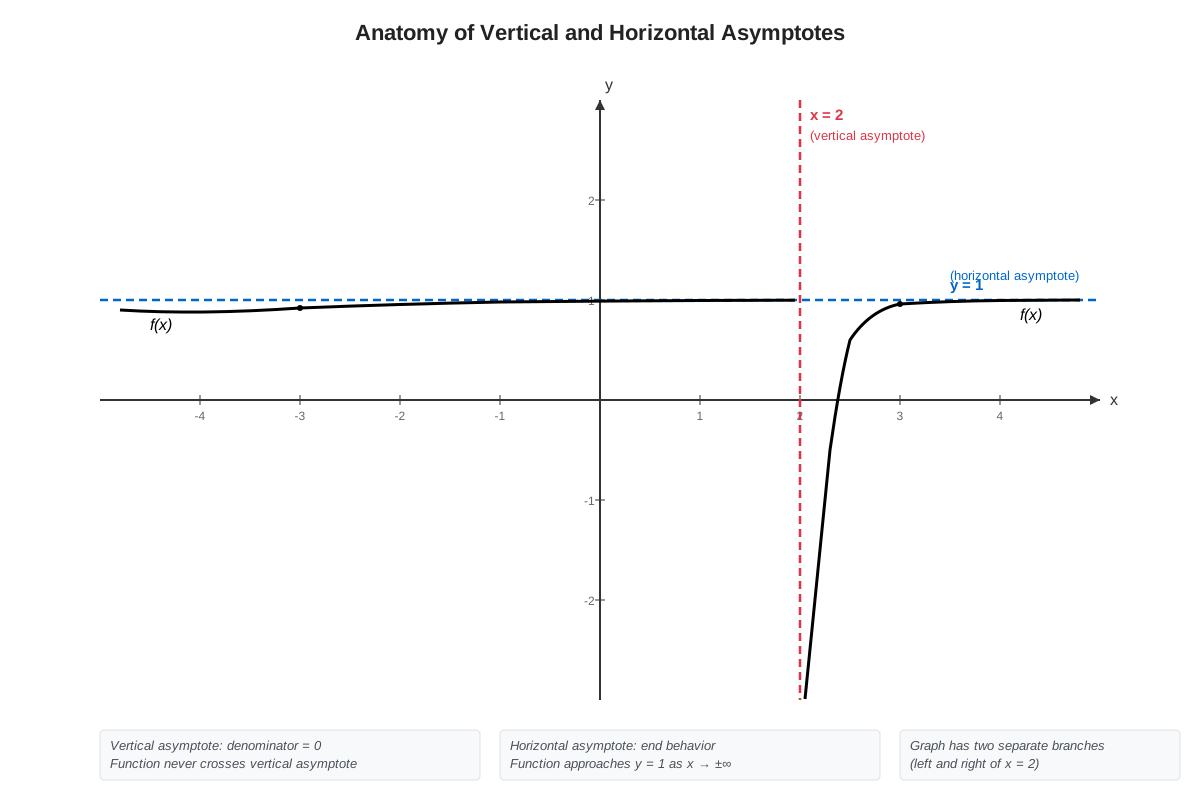
Near vertical asymptotes, function values approach positive or negative infinity. The graph shoots upward or downward, never crossing the vertical line. This behavior is crucial for matching functions to graphs on the SAT.
Horizontal Asymptotes
Horizontal asymptotes describe the end behavior of rational functions—what y-value the function approaches as x approaches positive or negative infinity. Unlike vertical asymptotes, functions can cross horizontal asymptotes in the middle of their domain; horizontal asymptotes only describe behavior at extreme x-values.
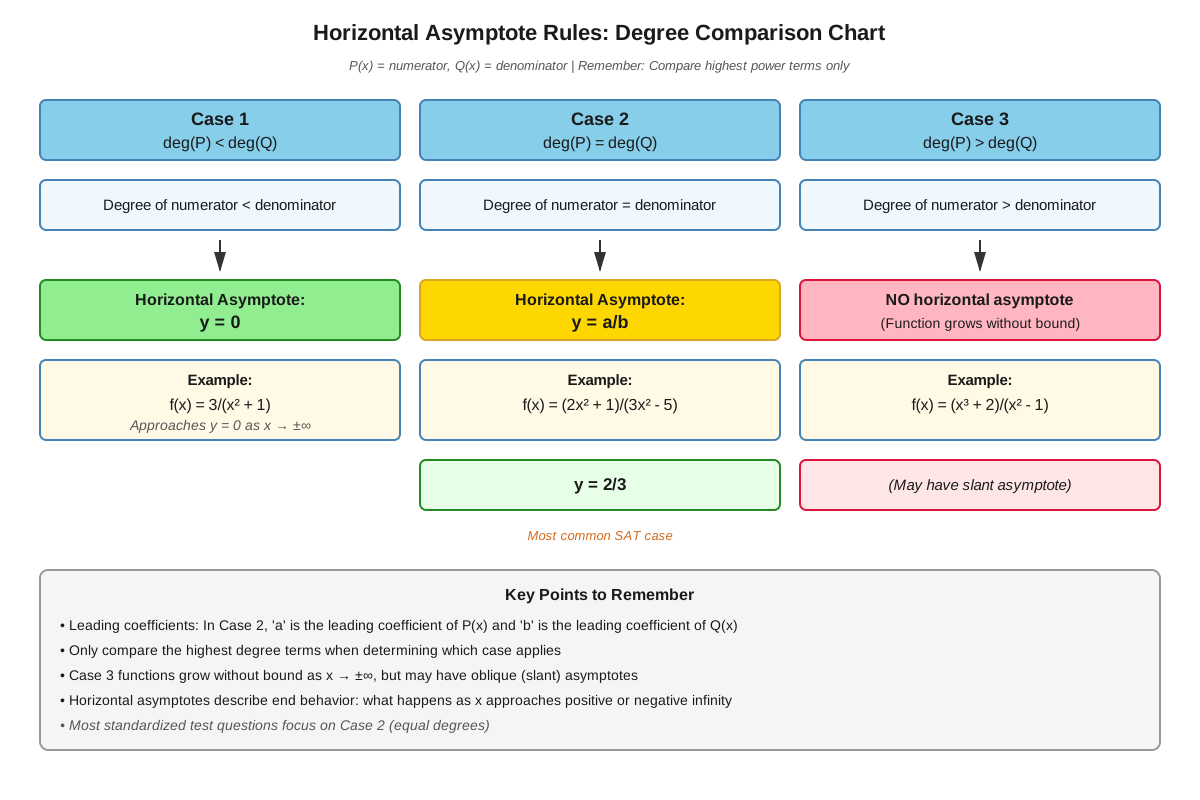
To determine horizontal asymptotes, compare the degrees of the numerator and denominator polynomials:
| Degree Comparison | Horizontal Asymptote | Rule |
|---|---|---|
| Degree of numerator < Degree of denominator | y = 0 | The x-axis is the horizontal asymptote |
| Degree of numerator = Degree of denominator | y = ratio of leading coefficients | Divide the leading coefficient of numerator by leading coefficient of denominator |
| Degree of numerator > Degree of denominator | No horizontal asymptote | Function grows without bound (may have oblique asymptote) |
For example, in f(x) = (3x² + 2x - 1)/(x² - 4), both numerator and denominator have degree 2. The leading coefficient of the numerator is 3, and the leading coefficient of the denominator is 1. Therefore, the horizontal asymptote is y = 3/1 = 3.
In g(x) = (2x + 5)/(x² - 1), the numerator has degree 1 and the denominator has degree 2. Since the numerator's degree is less than the denominator's degree, the horizontal asymptote is y = 0.
Holes vs. Vertical Asymptotes
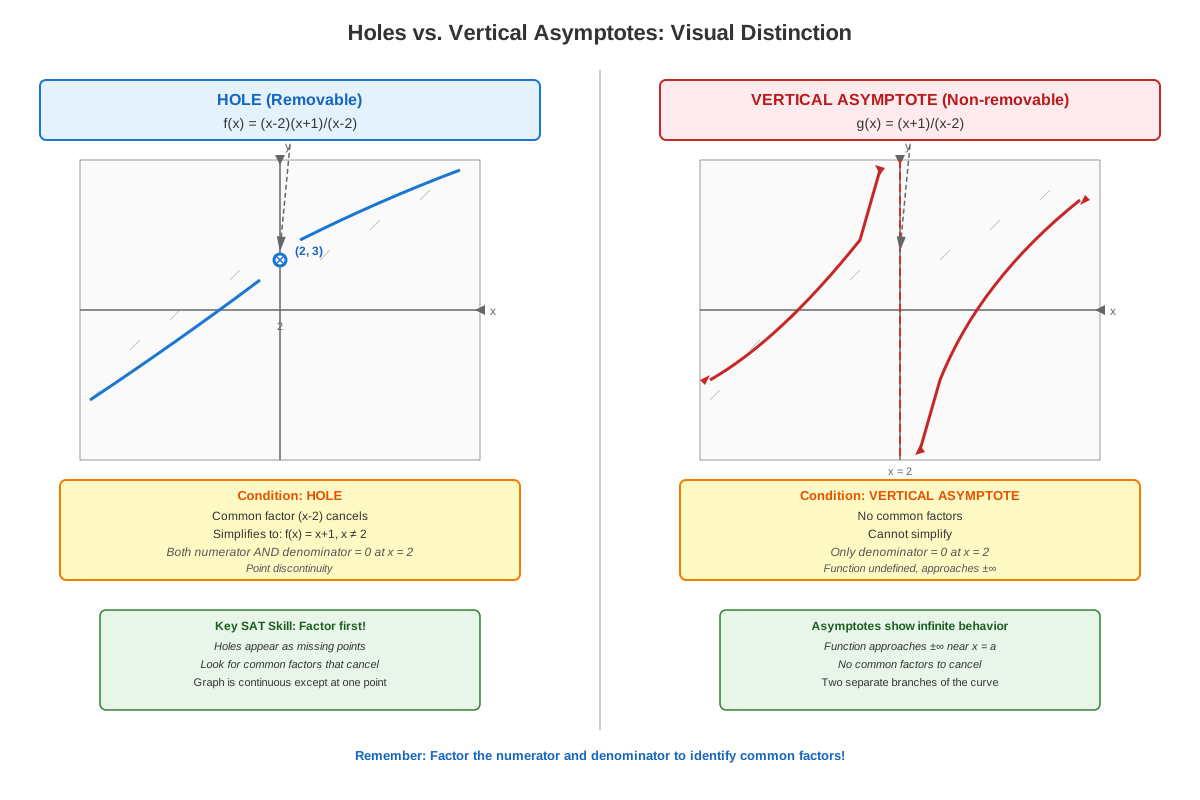
A critical distinction for SAT success involves recognizing holes (removable discontinuities) versus vertical asymptotes. Both occur where denominators equal zero, but they behave differently.
A hole occurs when both the numerator and denominator equal zero at the same x-value. This indicates a common factor that can be canceled. For example:
f(x) = (x² - 4)/(x - 2) = (x + 2)(x - 2)/(x - 2)At x = 2, both numerator and denominator equal zero. After canceling the common factor (x - 2), we get f(x) = x + 2, which is defined everywhere except x = 2. The graph looks like the line y = x + 2 with a single point missing at (2, 4)—this is a hole, not a vertical asymptote.
A vertical asymptote occurs when only the denominator equals zero. For example:
f(x) = (x + 3)/(x - 2)At x = 2, the denominator equals zero but the numerator equals 5. This creates a vertical asymptote at x = 2, where the function shoots toward infinity.
Graphical Behavior Near Asymptotes
Understanding how graphs behave near asymptotes helps with SAT graph-matching questions. Near vertical asymptotes, graphs exhibit one of four behaviors:
- Approach +∞ from the left and +∞ from the right
- Approach -∞ from the left and -∞ from the right
- Approach +∞ from the left and -∞ from the right
- Approach -∞ from the left and +∞ from the right
Near horizontal asymptotes, graphs approach the asymptote line from above or below as x approaches ±∞. The function may cross the horizontal asymptote multiple times in the middle of its domain, but eventually settles toward the asymptote at extreme values.
Concept Relationships
The concepts within asymptotes basics form a logical progression: understanding rational function structure → identifying where denominators equal zero → distinguishing holes from vertical asymptotes → determining horizontal asymptotes through degree comparison → predicting overall graph behavior.
Vertical asymptotes connect directly to the prerequisite topic of solving equations, since finding asymptotes requires solving Q(x) = 0. Horizontal asymptotes connect to polynomial degree identification and coefficient comparison. Both types of asymptotes relate to function domain and range concepts, as vertical asymptotes create domain restrictions while horizontal asymptotes suggest range boundaries.
The relationship map flows as follows:
Rational Function Structure → leads to → Denominator Analysis → produces → Vertical Asymptotes (when numerator ≠ 0) or Holes (when numerator = 0)
Polynomial Degree Comparison → determines → Horizontal Asymptote Type → predicts → End Behavior
Vertical Asymptotes + Horizontal Asymptotes → combine to create → Complete Graph Behavior Understanding → enables → Graph Matching and Function Analysis
This topic connects forward to limits in calculus, where asymptotic behavior is formalized through limit notation. It also relates to rational equation solving, function transformation, and advanced graphing techniques tested in higher-level SAT questions.
Quick check — test yourself on Asymptotes basics so far.
Try Flashcards →High-Yield Facts
⭐ Vertical asymptotes occur at x-values where the denominator equals zero AND the numerator does not equal zero at that same point
⭐ When numerator degree < denominator degree, the horizontal asymptote is always y = 0
⭐ When numerator degree = denominator degree, the horizontal asymptote is y = (leading coefficient of numerator)/(leading coefficient of denominator)
⭐ A hole (removable discontinuity) occurs when both numerator and denominator equal zero at the same x-value, indicating a common factor
⭐ Functions can cross horizontal asymptotes in the middle of their domain but approach them at extreme x-values
- When numerator degree > denominator degree, no horizontal asymptote exists (the function grows without bound)
- Vertical asymptotes create domain restrictions—the function is undefined at these x-values
- To find vertical asymptotes, factor both numerator and denominator completely, cancel common factors, then set remaining denominator factors equal to zero
- The number of vertical asymptotes equals the number of distinct x-values that make the simplified denominator zero
- Horizontal asymptotes describe end behavior only; they don't restrict where the function can go in the middle of its domain
- Rational functions can have multiple vertical asymptotes but at most one horizontal asymptote
- If a rational function has a common factor in numerator and denominator, always cancel it before identifying asymptotes
Common Misconceptions
Misconception: Vertical asymptotes occur wherever the denominator equals zero, regardless of the numerator.
Correction: Vertical asymptotes only occur where the denominator equals zero AND the numerator does not equal zero at that point. If both equal zero, a hole exists instead.
Misconception: Functions can never cross their asymptotes.
Correction: Functions cannot cross vertical asymptotes, but they can cross horizontal asymptotes in the middle of their domain. Horizontal asymptotes only describe behavior as x approaches ±∞.
Misconception: To find horizontal asymptotes, substitute very large numbers for x.
Correction: While this can provide insight, the formal method compares polynomial degrees. Substitution can be misleading and time-consuming on the SAT.
Misconception: If a function has a hole at x = 2, then x = 2 is a vertical asymptote.
Correction: Holes and vertical asymptotes are different. A hole is a single missing point where the graph would otherwise be continuous. A vertical asymptote causes the function to approach infinity.
Misconception: The horizontal asymptote is always y = 0.
Correction: The horizontal asymptote is y = 0 only when the numerator's degree is less than the denominator's degree. When degrees are equal, the horizontal asymptote is the ratio of leading coefficients.
Misconception: Canceling factors changes the function completely.
Correction: Canceling common factors simplifies the function but creates a hole at the x-value where the canceled factor equals zero. The simplified function is equivalent everywhere except at that point.
Misconception: Every rational function has both a vertical and horizontal asymptote.
Correction: Some rational functions have no vertical asymptotes (if the denominator never equals zero for real numbers), and some have no horizontal asymptote (if numerator degree exceeds denominator degree).
Worked Examples
Example 1: Identifying All Asymptotes
Problem: Find all vertical and horizontal asymptotes of f(x) = (2x² - 8)/(x² + x - 6).
Solution:
Step 1: Factor both numerator and denominator completely.
- Numerator: 2x² - 8 = 2(x² - 4) = 2(x + 2)(x - 2)
- Denominator: x² + x - 6 = (x + 3)(x - 2)
Step 2: Identify and cancel common factors.
- Common factor: (x - 2)
- Simplified: f(x) = 2(x + 2)/(x + 3), with a hole at x = 2
Step 3: Find vertical asymptotes from the simplified denominator.
- Set x + 3 = 0
- x = -3
- Check numerator at x = -3: 2(-3 + 2) = 2(-1) = -2 ≠ 0
- Vertical asymptote: x = -3
Step 4: Find the y-coordinate of the hole.
- Substitute x = 2 into simplified function: f(2) = 2(2 + 2)/(2 + 3) = 2(4)/5 = 8/5
- Hole at (2, 8/5)
Step 5: Find horizontal asymptote by comparing degrees.
- Original numerator degree: 2
- Original denominator degree: 2
- Degrees are equal, so horizontal asymptote = (leading coefficient of numerator)/(leading coefficient of denominator)
- Horizontal asymptote: y = 2/1 = 2
Answer: Vertical asymptote at x = -3, horizontal asymptote at y = 2, and a hole at (2, 8/5).
This example demonstrates the complete process and connects to the learning objective of identifying key features of asymptotes.
Example 2: SAT-Style Graph Matching
Problem: Which of the following functions has a vertical asymptote at x = 3 and a horizontal asymptote at y = 0?
A) f(x) = (x + 3)/(x - 3)
B) f(x) = (2x - 1)/(x² - 9)
C) f(x) = (x² + 1)/(x - 3)
D) f(x) = (5x + 2)/(x² - 6x + 9)
Solution:
Step 1: Identify the requirements.
- Need vertical asymptote at x = 3: denominator must equal zero at x = 3, numerator must not
- Need horizontal asymptote at y = 0: numerator degree must be less than denominator degree
Step 2: Check each option for vertical asymptote at x = 3.
Option A: Denominator x - 3 = 0 when x = 3 ✓, numerator x + 3 = 6 ≠ 0 ✓
- Has vertical asymptote at x = 3
Option B: Denominator x² - 9 = (x + 3)(x - 3) = 0 when x = 3 or x = -3
- Has vertical asymptotes at both x = 3 and x = -3
Option C: Denominator x - 3 = 0 when x = 3 ✓, numerator x² + 1 = 10 ≠ 0 ✓
- Has vertical asymptote at x = 3
Option D: Denominator x² - 6x + 9 = (x - 3)² = 0 when x = 3 ✓, numerator 5(3) + 2 = 17 ≠ 0 ✓
- Has vertical asymptote at x = 3
Step 3: Check remaining options (A, C, D) for horizontal asymptote at y = 0.
Option A: Numerator degree = 1, denominator degree = 1 (equal degrees)
- Horizontal asymptote: y = 1/1 = 1 ✗
Option C: Numerator degree = 2, denominator degree = 1 (numerator > denominator)
- No horizontal asymptote ✗
Option D: Numerator degree = 1, denominator degree = 2 (numerator < denominator)
- Horizontal asymptote: y = 0 ✓
Answer: D
This example applies asymptotes basics to answer an SAT-style question using process of elimination, connecting to multiple learning objectives.
Exam Strategy
When approaching SAT asymptote questions, follow this systematic process:
1. Identify the question type: Is it asking for asymptote equations, graph matching, or function behavior? This determines your approach.
2. For vertical asymptotes: Immediately factor the denominator completely. Set each factor equal to zero. Before confirming asymptotes, check if the numerator also equals zero at those points (which would indicate holes instead).
3. For horizontal asymptotes: Don't waste time substituting large numbers. Quickly identify the degree of the numerator and denominator polynomials by finding the highest power of x in each. Apply the three-rule system based on degree comparison.
4. Watch for trigger words and phrases:
- "As x approaches infinity" → horizontal asymptote question
- "Undefined at x = ..." → likely vertical asymptote
- "The graph approaches but never touches" → asymptote definition
- "End behavior" → horizontal asymptote
- "Domain restriction" → vertical asymptote or hole
5. Use process of elimination effectively: If a question shows graphs, eliminate options with wrong numbers of vertical asymptotes first (easiest to spot), then check horizontal asymptotes, then verify specific locations.
6. Time allocation: Asymptote questions typically require 60-90 seconds. If you're spending more than 2 minutes, you may be overcomplicating. Factor, simplify, apply rules, and move on.
7. Calculator tips: For calculator-allowed sections, you can verify asymptotes by graphing the function and using trace or table features. However, understanding the algebraic method is faster and more reliable.
8. Common trap answers: The SAT often includes answer choices with x and y swapped (vertical asymptote equation given as horizontal), or equations of holes presented as asymptotes. Always verify your answer addresses what the question asks.
Memory Techniques
VAN mnemonic for Vertical Asymptotes: Vertical Asymptotes from Numerator ≠ 0
- Remember: Set denominator to zero, but verify numerator is NOT zero
"Degree Detective" for Horizontal Asymptotes:
- Less than → Zero (numerator degree less than denominator → y = 0)
- Equal → Ratio (degrees equal → y = ratio of leading coefficients)
- Greater → Gone (numerator degree greater → no horizontal asymptote)
HEND acronym: Horizontal asymptotes describe END behavior
- Reminds you that horizontal asymptotes only matter at extreme x-values
Visualization strategy: Picture vertical asymptotes as electric fences the graph cannot touch, and horizontal asymptotes as magnetic lines the graph is attracted to at the edges but can cross in the middle.
"Factor First" rule: Always factor completely before identifying any asymptotes. Make this your automatic first step to avoid missing holes.
The "Zero-Zero Hole" reminder: If both numerator and denominator equal zero at the same x-value, you have a hole (both zero = hole).
Summary
Asymptotes represent boundary lines that rational functions approach but typically never reach, revealing critical information about function behavior. Vertical asymptotes occur at x-values where denominators equal zero while numerators remain non-zero, creating domain restrictions where functions shoot toward infinity. Horizontal asymptotes describe end behavior as x approaches extreme values, determined by comparing polynomial degrees: when numerator degree is less than denominator degree, y = 0; when degrees are equal, y equals the ratio of leading coefficients; when numerator degree exceeds denominator degree, no horizontal asymptote exists. The crucial distinction between holes and vertical asymptotes depends on whether both numerator and denominator equal zero at the same point (hole) or only the denominator equals zero (vertical asymptote). On the SAT, asymptote questions test the ability to identify asymptotes from equations, match functions to graphs based on asymptotic behavior, and understand domain restrictions. Mastering the systematic approach of factoring completely, checking for common factors, and applying degree-comparison rules enables students to solve asymptote problems efficiently and accurately.
Key Takeaways
- Vertical asymptotes occur where denominators equal zero and numerators do not; always factor completely and cancel common factors first to avoid confusing holes with asymptotes
- Horizontal asymptotes depend solely on polynomial degree comparison: numerator < denominator gives y = 0, equal degrees give y = ratio of leading coefficients, numerator > denominator means no horizontal asymptote
- Holes (removable discontinuities) occur when both numerator and denominator equal zero at the same x-value, indicating a common factor that cancels
- Functions cannot cross vertical asymptotes but can cross horizontal asymptotes in the middle of their domain
- The systematic approach—factor, simplify, identify vertical asymptotes from simplified denominator, determine horizontal asymptotes from degree comparison—solves virtually all SAT asymptote questions
- Asymptote questions appear 2-4 times per SAT, primarily in Passport to Advanced Math, making this a high-yield topic for score improvement
- Understanding asymptotic behavior enables quick elimination of incorrect graph-matching answers and verification of algebraic solutions
Related Topics
Rational Equations: Building on asymptote knowledge, rational equations involve solving for x when rational expressions equal specific values, requiring awareness of domain restrictions created by vertical asymptotes.
Function Transformations: Understanding how translations, reflections, and stretches affect asymptote locations extends asymptote basics to more complex SAT questions involving transformed rational functions.
Limits and Continuity: Though primarily a calculus topic, basic limit concepts formalize asymptotic behavior and appear in advanced SAT questions about function behavior near undefined points.
Polynomial Long Division: When numerator degree exceeds denominator degree, polynomial division reveals oblique asymptotes and helps analyze end behavior beyond basic horizontal asymptotes.
Domain and Range: Asymptotes directly determine domain restrictions (vertical asymptotes) and suggest range limitations (horizontal asymptotes), connecting to broader function analysis skills.
Practice CTA
Now that you've mastered the fundamentals of asymptotes, it's time to cement your understanding through active practice. Attempt the practice questions to apply these concepts to SAT-style problems, and use the flashcards to reinforce key definitions and rules. Remember, asymptote questions are high-yield—appearing multiple times on every SAT—so the time you invest in practice directly translates to points on test day. You've built the foundation; now strengthen it through repetition and application. Your ability to quickly identify vertical and horizontal asymptotes will give you a significant advantage in the Passport to Advanced Math section!
Sign up free to keep reading
Create a free AnvayaPrep account to finish this SAT guide on Asymptotes basics — plus flashcards and practice questions.