Overview
Dividing rational expressions is a fundamental algebraic skill that appears regularly on the SAT Math section, testing students' ability to manipulate complex fractions and apply the rules of division to algebraic expressions. A rational expression is simply a fraction where both the numerator and denominator are polynomials, and dividing these expressions requires understanding the relationship between division and multiplication, along with factoring techniques and simplification strategies.
This topic is essential for SAT success because it combines multiple algebraic concepts into single problems, requiring students to demonstrate mastery of factoring, fraction operations, and algebraic manipulation simultaneously. Questions involving sat dividing rational expressions often appear in both the calculator and no-calculator sections, typically worth 1-2 questions per test, and frequently serve as components of more complex multi-step problems. The College Board uses these questions to assess mathematical reasoning and procedural fluency at the intermediate algebra level.
Understanding how to divide rational expressions connects directly to broader math concepts including polynomial operations, equation solving, and function analysis. This skill builds upon basic fraction arithmetic while preparing students for more advanced topics like rational equations and complex fractions. Mastery of this topic demonstrates the algebraic maturity that colleges seek, as it requires both mechanical proficiency and conceptual understanding of how algebraic structures behave under various operations.
Learning Objectives
- [ ] Identify key features of dividing rational expressions
- [ ] Explain how dividing rational expressions appears on the SAT
- [ ] Apply dividing rational expressions to answer SAT-style questions
- [ ] Convert division problems into equivalent multiplication problems using reciprocals
- [ ] Factor polynomials within rational expressions to identify common factors for cancellation
- [ ] Simplify complex rational expressions by identifying and eliminating common factors
- [ ] Recognize and avoid common errors such as incorrect cancellation and sign mistakes
Prerequisites
- Fraction arithmetic: Understanding how to divide numerical fractions is essential because dividing rational expressions follows the same fundamental rule of multiplying by the reciprocal
- Factoring polynomials: The ability to factor quadratics, difference of squares, and common factors is necessary for simplifying rational expressions before and after division
- Polynomial operations: Basic understanding of multiplying and dividing polynomials helps recognize equivalent forms and simplify results
- Algebraic manipulation: Comfort with rearranging expressions and identifying equivalent forms enables efficient problem-solving
- Domain restrictions: Knowledge that denominators cannot equal zero is crucial for understanding when rational expressions are undefined
Why This Topic Matters
In real-world applications, dividing rational expressions models situations involving rates, proportions, and scaling relationships. Engineers use these concepts when calculating gear ratios, physicists apply them in lens equations and electrical resistance problems, and economists employ them in marginal analysis and productivity calculations. The ability to manipulate complex fractions appears in fields ranging from chemistry (concentration calculations) to computer science (algorithm complexity analysis).
On the SAT, dividing rational expressions appears in approximately 1-3 questions per test, representing roughly 2-5% of the Math section. These questions typically appear as medium to medium-hard difficulty problems, often in questions 10-18 of the 22-question sections. The College Board tests this concept through direct simplification problems, equation-solving questions that require division as an intermediate step, and word problems involving rates or proportions that translate into rational expression division.
Common SAT question formats include: asking students to simplify a division expression completely, identifying equivalent expressions after division, solving equations that require dividing both sides by a rational expression, and application problems where division of rational expressions represents a real-world relationship. The topic frequently appears combined with other algebraic concepts, making it a high-yield area for comprehensive review.
Core Concepts
The Fundamental Rule: Multiply by the Reciprocal
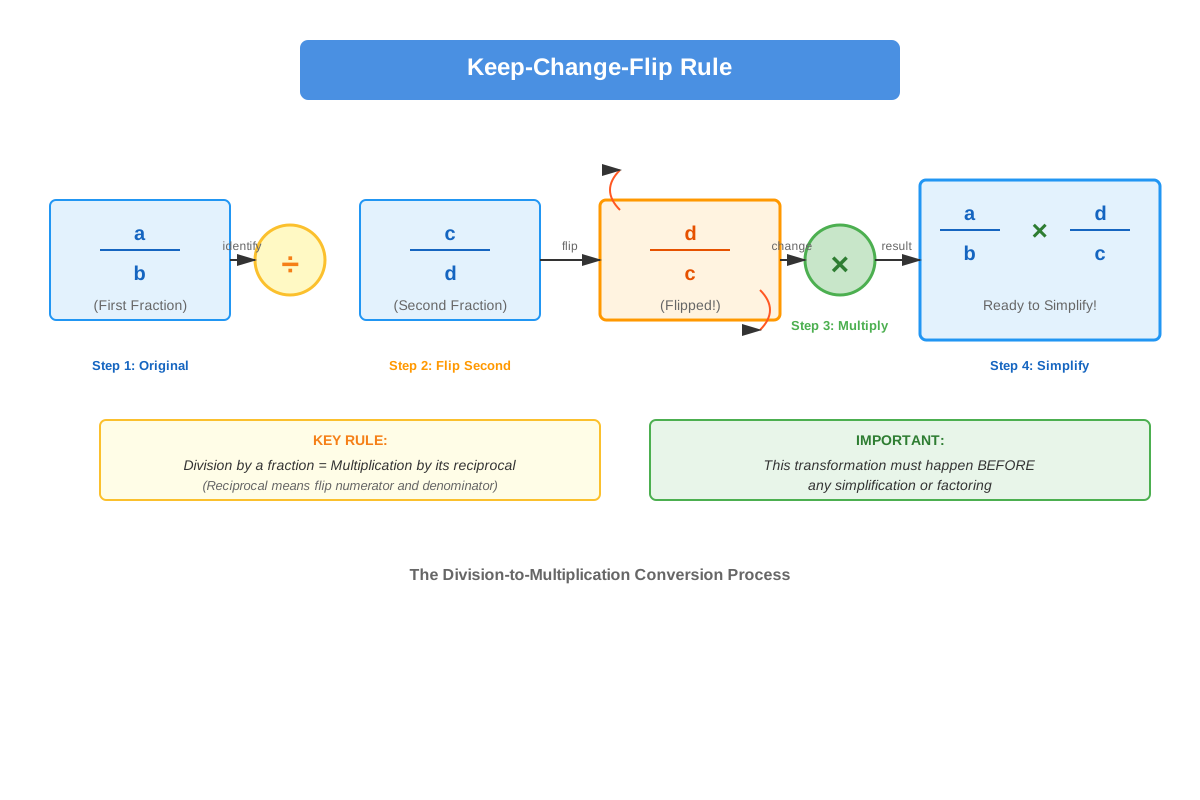
The cornerstone of dividing rational expressions is the same rule used for dividing numerical fractions: division by a fraction equals multiplication by its reciprocal. For any rational expressions where the divisor is non-zero:
(A/B) ÷ (C/D) = (A/B) × (D/C)This transformation converts every division problem into a multiplication problem, which is generally easier to execute. The reciprocal (also called the multiplicative inverse) of a fraction is obtained by swapping the numerator and denominator. For example, the reciprocal of (x+2)/(x-3) is (x-3)/(x+2).
When applying this rule, students must remember to flip only the second fraction (the divisor), not the first. A common error is flipping both fractions or flipping the wrong one. The mnemonic "keep, change, flip" helps: keep the first fraction unchanged, change division to multiplication, and flip the second fraction.
Factoring Before Simplifying
Before performing the multiplication step, always factor all polynomials completely. This critical step reveals common factors that can be cancelled, dramatically simplifying the work. Consider the expression:
(x² - 4)/(x + 3) ÷ (x - 2)/(x² - 9)Factoring first yields:
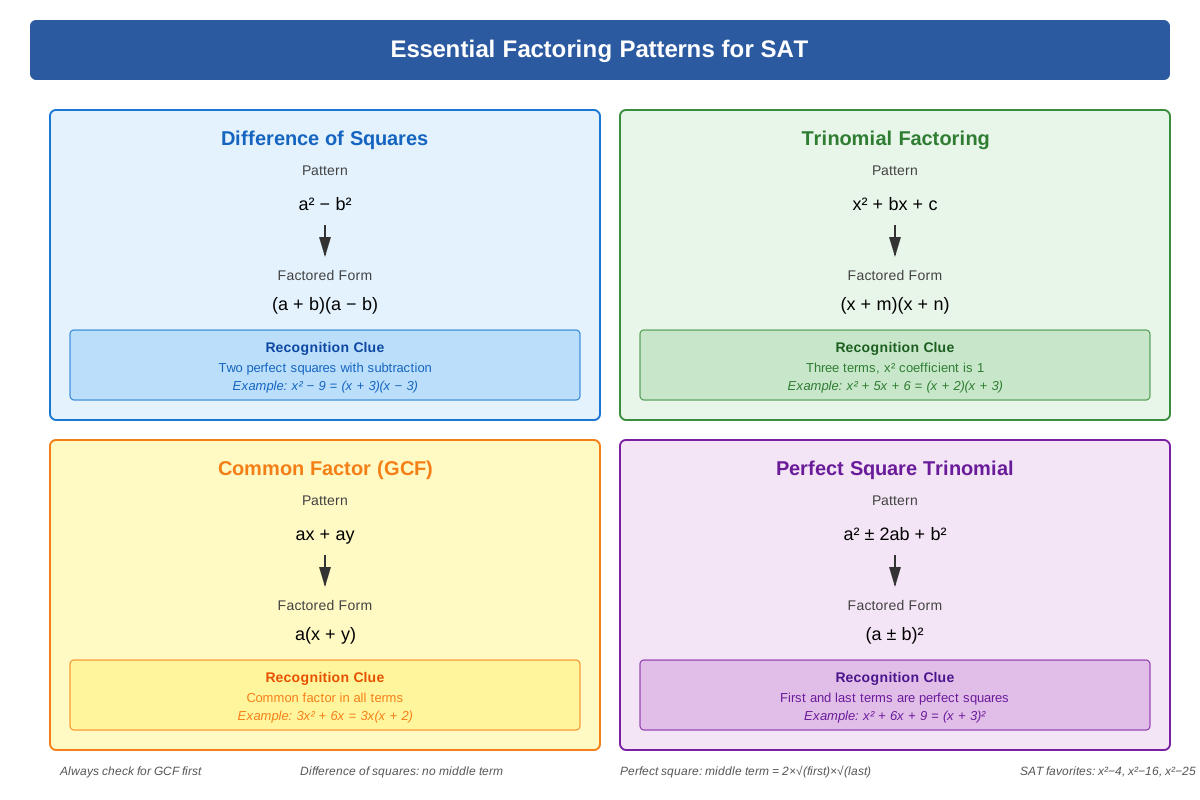
[(x + 2)(x - 2)]/(x + 3) ÷ (x - 2)/[(x + 3)(x - 3)]Common factoring patterns to recognize include:
- Difference of squares: a² - b² = (a + b)(a - b)
- Perfect square trinomials: a² + 2ab + b² = (a + b)²
- Common factor extraction: ax + ay = a(x + y)
- Trinomial factoring: x² + bx + c = (x + m)(x + n) where m + n = b and mn = c
The Multiplication and Cancellation Process
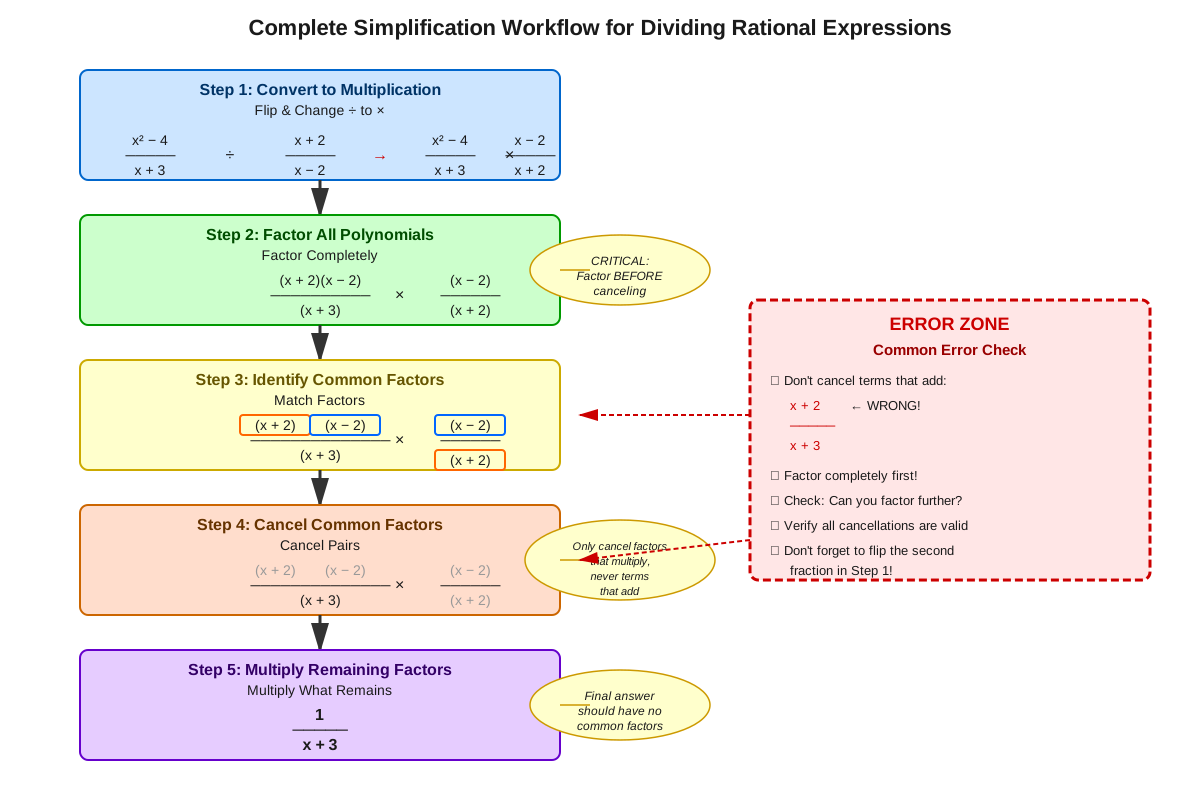
After converting to multiplication and factoring, multiply the numerators together and the denominators together, then cancel common factors:
| Step | Action | Example |
|---|---|---|
| 1 | Convert to multiplication | (A/B) ÷ (C/D) → (A/B) × (D/C) |
| 2 | Factor all polynomials | Factor A, B, C, and D completely |
| 3 | Rewrite as single fraction | (A × D)/(B × C) |
| 4 | Cancel common factors | Eliminate matching factors from numerator and denominator |
| 5 | Multiply remaining factors | Simplify to final form |
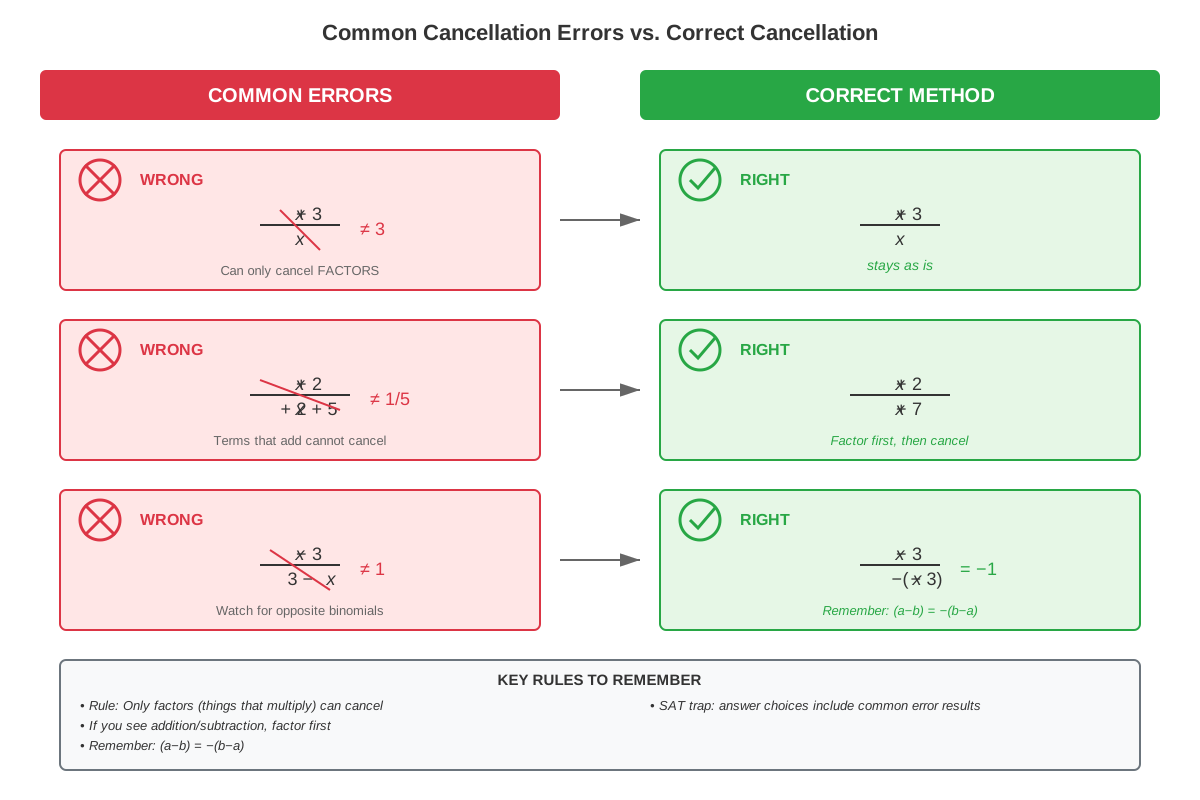
Cancellation can only occur between factors in the numerator and factors in the denominator—never between terms that are added or subtracted. For instance, in (x + 2)/(x + 3), the x's cannot cancel because they are terms, not factors.
Domain Restrictions and Excluded Values
When dividing rational expressions, certain values of the variable make the expression undefined. These excluded values occur when:
- Any denominator in the original problem equals zero
- The numerator of the divisor (which becomes a denominator after flipping) equals zero
For the expression (x² - 1)/(x + 2) ÷ (x - 1)/(x - 3), the excluded values are:
- x ≠ -2 (makes first denominator zero)
- x ≠ 1 (makes divisor numerator zero, creating division by zero after flipping)
- x ≠ 3 (makes divisor denominator zero)
Even if a factor cancels during simplification, the original restriction remains. If (x - 1) cancels from both numerator and denominator, x = 1 is still an excluded value because it made the original expression undefined.
Simplifying Complex Results
After cancellation, the final answer should be expressed in simplest form with:
- All common factors removed
- Polynomials in standard form (descending powers)
- No negative exponents
- Factored form if specified, expanded form otherwise
Sometimes the final result is a polynomial rather than a rational expression, occurring when all denominator factors cancel. For example:
(x² - 4)/(x - 2) ÷ (x + 2)/(x² + 3x + 2)After factoring and simplifying, this might reduce to (x + 1), a simple polynomial.
Special Cases and Patterns
Certain patterns appear frequently on the SAT:
Opposite factors: (a - b) and (b - a) are opposites, related by: (a - b) = -(b - a). When these appear in numerator and denominator, they cancel to -1, not 1.
Monomial divisors: When dividing by a monomial, distribute the division to each term or convert to multiplication by the reciprocal.
Compound fractions: Sometimes division problems appear as complex fractions (fractions within fractions), which are solved by multiplying the main numerator by the reciprocal of the main denominator.
Concept Relationships
The process of dividing rational expressions integrates multiple algebraic concepts in a hierarchical structure. Factoring polynomials serves as the foundation → enabling identification of common factors → which allows cancellation → leading to simplified expressions. This linear progression means weakness in factoring directly impairs the ability to simplify divisions effectively.
The relationship between division and multiplication through reciprocals connects this topic to basic fraction arithmetic, demonstrating how elementary concepts scale to more complex algebraic situations. Understanding domain restrictions links to the broader concept of function domains and the fundamental principle that division by zero is undefined, connecting rational expressions to function analysis and graphing.
Within the unit on Rational Expressions and Equations, dividing rational expressions builds directly on multiplying rational expressions (the same process after the reciprocal flip) and prepares students for solving rational equations (which often requires dividing both sides by a rational expression). The topic also connects forward to partial fraction decomposition in advanced algebra and calculus, where complex rational expressions are broken into simpler components.
The cancellation process in rational expression division mirrors the cancellation used in dimensional analysis in science, reinforcing the cross-disciplinary nature of this mathematical skill. Additionally, the concept of excluded values connects to the idea of asymptotes in rational function graphs, showing how algebraic manipulation relates to graphical behavior.
High-Yield Facts
⭐ To divide rational expressions, multiply the first expression by the reciprocal of the second expression
⭐ Always factor all polynomials completely before attempting to cancel common factors
⭐ Cancellation can only occur between factors (things being multiplied), never between terms (things being added or subtracted)
⭐ Excluded values include any value that makes any original denominator zero or the divisor's numerator zero
⭐ The factors (a - b) and (b - a) are opposites: (a - b) = -(b - a), so they cancel to -1, not 1
- The reciprocal of a/b is b/a, obtained by swapping numerator and denominator
- After canceling a factor, the restriction it created still applies to the domain
- The final answer should have no common factors between numerator and denominator
- When all denominator factors cancel, the result is a polynomial, not a rational expression
- Complex fractions are simplified by multiplying the main numerator by the reciprocal of the main denominator
- The difference of squares pattern (a² - b²) appears frequently in SAT rational expression problems
Quick check — test yourself on Dividing rational expressions so far.
Try Flashcards →Common Misconceptions
Misconception: Students can cancel terms that are added or subtracted, such as canceling x from (x + 2)/x to get 2.
Correction: Cancellation only applies to factors (expressions being multiplied). The expression (x + 2)/x cannot be simplified by canceling because x is a term in the numerator, not a factor. To cancel, the entire numerator would need to be x times something.
Misconception: When dividing rational expressions, students flip both fractions instead of just the divisor.
Correction: Only the second fraction (the divisor) gets flipped. The rule is (A/B) ÷ (C/D) = (A/B) × (D/C), not (B/A) × (D/C). The first fraction remains unchanged.
Misconception: After a factor cancels during simplification, the restriction it created no longer applies.
Correction: Excluded values from the original expression remain excluded even after simplification. If (x - 2) appears in a denominator and later cancels, x = 2 is still not in the domain because the original expression was undefined there.
Misconception: The factors (x - 3) and (3 - x) are the same and cancel to 1.
Correction: These factors are opposites, not identical. Since (x - 3) = -(3 - x), when they cancel, the result is -1, not 1. This sign error is one of the most common mistakes on SAT problems.
Misconception: Students multiply denominators and numerators straight across without factoring first, missing opportunities for cancellation.
Correction: Always factor completely before multiplying. Factoring first reveals common factors that cancel, dramatically simplifying the work and reducing the chance of arithmetic errors in the final multiplication.
Misconception: When the final result is a polynomial, students still write it as a fraction with denominator 1.
Correction: If all denominator factors cancel, express the answer as a polynomial without a denominator. Writing x + 3 is preferable to (x + 3)/1 unless the problem specifically requests fractional form.
Worked Examples
Example 1: Standard Division with Factoring
Problem: Simplify (x² - 9)/(x² + 5x + 6) ÷ (x - 3)/(x + 2)
Solution:
Step 1: Convert division to multiplication by the reciprocal.
(x² - 9)/(x² + 5x + 6) × (x + 2)/(x - 3)Step 2: Factor all polynomials completely.
- x² - 9 = (x + 3)(x - 3) [difference of squares]
- x² + 5x + 6 = (x + 2)(x + 3) [trinomial factoring: factors of 6 that add to 5]
- x + 2 is already factored
- x - 3 is already factored
Step 3: Rewrite with factored forms.
[(x + 3)(x - 3)]/[(x + 2)(x + 3)] × (x + 2)/(x - 3)Step 4: Write as a single fraction.
[(x + 3)(x - 3)(x + 2)]/[(x + 2)(x + 3)(x - 3)]Step 5: Cancel common factors.
- (x + 3) appears in both numerator and denominator → cancel
- (x - 3) appears in both numerator and denominator → cancel
- (x + 2) appears in both numerator and denominator → cancel
Step 6: Write the simplified result.
1Step 7: State domain restrictions.
From the original expression:
- x ≠ -2 (from x + 2 in first denominator)
- x ≠ -3 (from x + 3 in first denominator)
- x ≠ 3 (from x - 3 in divisor numerator and denominator)
Final Answer: 1, where x ≠ -3, -2, 3
This example demonstrates Learning Objective 3 (applying division to SAT-style questions) and Learning Objective 4 (converting division to multiplication using reciprocals).
Example 2: Division with Opposite Factors
Problem: Simplify (2x² - 8)/(3x - 6) ÷ (4 - 2x)/(x² - 4)
Solution:
Step 1: Convert to multiplication by reciprocal.
(2x² - 8)/(3x - 6) × (x² - 4)/(4 - 2x)Step 2: Factor all polynomials.
- 2x² - 8 = 2(x² - 4) = 2(x + 2)(x - 2)
- 3x - 6 = 3(x - 2)
- x² - 4 = (x + 2)(x - 2)
- 4 - 2x = -2(x - 2) or 2(2 - x) [factor out -2 to match other factors]
Step 3: Rewrite with factored forms.
[2(x + 2)(x - 2)]/[3(x - 2)] × [(x + 2)(x - 2)]/[-2(x - 2)]Step 4: Combine into single fraction.
[2(x + 2)(x - 2)(x + 2)(x - 2)]/[3(x - 2)(-2)(x - 2)]Step 5: Simplify the numerical coefficients.
[2(x + 2)²(x - 2)²]/[-6(x - 2)²]Step 6: Cancel common factors.
- (x - 2)² cancels completely
- 2 and -6 simplify to -1/3
Step 7: Write simplified result.
-(x + 2)²/3 or -(x² + 4x + 4)/3Step 8: Identify domain restrictions.
- x ≠ 2 (from multiple denominators and the divisor numerator)
- x ≠ -2 (from x² - 4 in divisor denominator)
Final Answer: -(x + 2)²/3, where x ≠ -2, 2
This example illustrates the importance of recognizing opposite factors and handling negative signs correctly, addressing Learning Objective 5 (factoring to identify common factors) and Common Misconception 4.
Exam Strategy
When approaching SAT questions on dividing rational expressions, follow this systematic process:
Step 1: Identify the operation. Look for division symbols (÷), the word "divided by," or complex fractions where one rational expression appears over another. SAT questions sometimes disguise division within word problems about rates or proportions.
Step 2: Immediately convert to multiplication. Before doing anything else, rewrite the problem as multiplication by the reciprocal. This single transformation eliminates the division operation and standardizes the approach.
Step 3: Factor aggressively. Spend time factoring completely before attempting any cancellation. The SAT rewards students who factor first, as this reveals the simplifications that make problems manageable. Look specifically for difference of squares, perfect square trinomials, and common factors.
Trigger words and phrases that signal dividing rational expressions:
- "Simplify the quotient"
- "Which expression is equivalent to [division problem]"
- "Divide and simplify"
- "The ratio of [expression A] to [expression B]"
- Complex fractions with algebraic expressions in numerator and denominator
Process of elimination tips:
- Eliminate answer choices with different domain restrictions than the original expression
- Rule out answers that don't match when you substitute a simple value like x = 0 or x = 1
- Eliminate choices that have the wrong sign (positive vs. negative)
- Discard answers with factors that should have cancelled
Time allocation: Allocate 1.5-2 minutes for straightforward division problems and up to 3 minutes for complex problems involving multiple factoring steps. If factoring isn't immediately apparent after 30 seconds, try substituting a simple number to eliminate wrong answers, then return to algebraic simplification.
Common SAT tricks: The test makers often include answer choices that represent common errors—the result if you flip the wrong fraction, the result if you cancel terms instead of factors, or the result if you forget the negative sign from opposite factors. Recognizing these traps helps you avoid them and use process of elimination effectively.
Memory Techniques
KCF Method: Remember "Keep, Change, Flip" for division of fractions:
- Keep the first fraction as is
- Change division to multiplication
- Flip the second fraction (take its reciprocal)
FACTOR Acronym for the simplification process:
- Flip the divisor (take reciprocal)
- Analyze all polynomials for factoring opportunities
- Cancel common factors between numerator and denominator
- Track domain restrictions from original denominators
- Opposite factors create negative signs
- Rewrite in simplest form
Visualization Strategy: Picture rational expressions as fraction bars stacked vertically. When dividing, imagine physically flipping the bottom fraction upside down and placing it next to the top fraction with a multiplication sign between them. This mental image reinforces the reciprocal concept.
The "No Naked Terms" Rule: Remember that you can only cancel factors, not terms. Visualize factors as "dressed" in multiplication, while terms are "naked" in addition/subtraction. Only "dressed" factors can be cancelled.
Domain Restriction Checklist: Create a mental checklist: "Original denominators? Check. Divisor numerator? Check." This ensures you identify all excluded values before simplifying.
Summary
Dividing rational expressions is a high-yield SAT Math topic that combines factoring, fraction operations, and algebraic manipulation into a single skill. The fundamental approach involves converting division into multiplication by taking the reciprocal of the divisor, then factoring all polynomials completely to reveal common factors that can be cancelled. Success requires recognizing standard factoring patterns (especially difference of squares and trinomial factoring), understanding that cancellation applies only to factors rather than terms, and carefully tracking domain restrictions throughout the simplification process. The most common errors involve flipping the wrong fraction, attempting to cancel terms instead of factors, and mishandling opposite factors like (a - b) and (b - a), which cancel to -1 rather than 1. SAT questions on this topic typically appear as medium-difficulty problems requiring 1.5-3 minutes to solve, often combining multiple algebraic concepts in a single question. Mastery demands both procedural fluency in executing the steps and conceptual understanding of why the reciprocal method works and how domain restrictions arise from undefined expressions.
Key Takeaways
- Division of rational expressions is converted to multiplication by the reciprocal: (A/B) ÷ (C/D) = (A/B) × (D/C)
- Always factor all polynomials completely before attempting any cancellation or multiplication
- Cancellation only works with factors (expressions being multiplied), never with terms (expressions being added or subtracted)
- Domain restrictions include values that make any original denominator zero or the divisor's numerator zero, and these restrictions persist even after simplification
- Opposite factors like (a - b) and (b - a) cancel to -1, not 1, because they differ by a negative sign
- The final simplified expression should have no common factors between numerator and denominator and should be expressed in standard form
- SAT questions on this topic reward systematic factoring and careful attention to signs and domain restrictions
Related Topics
Multiplying Rational Expressions: The direct prerequisite to division, this topic covers combining rational expressions through multiplication and provides the foundation for understanding why the reciprocal method works for division.
Solving Rational Equations: Building on division skills, this topic involves equations where the variable appears in denominators, often requiring division of both sides by a rational expression as a solution step.
Complex Fractions: An extension of dividing rational expressions, complex fractions involve rational expressions within rational expressions, requiring multiple applications of the division process.
Rational Functions and Their Graphs: Understanding how to simplify rational expressions through division helps identify holes and asymptotes in the graphs of rational functions, connecting algebraic manipulation to graphical analysis.
Partial Fraction Decomposition: An advanced topic in precalculus and calculus, this technique reverses the process of adding rational expressions and relies heavily on factoring and simplification skills developed through division practice.
Practice CTA
Now that you've mastered the concepts and strategies for dividing rational expressions, it's time to solidify your understanding through active practice. Work through the practice questions to apply these techniques to SAT-style problems, and use the flashcards to reinforce the key facts and procedures until they become automatic. Remember, the SAT rewards both speed and accuracy—consistent practice with these problems will build the confidence and fluency you need to tackle any rational expression division question on test day. Every problem you solve strengthens your algebraic foundation and brings you closer to your target score!
Sign up free to keep reading
Create a free AnvayaPrep account to finish this SAT guide on Dividing rational expressions — plus flashcards and practice questions.