Overview
Multiplying rational expressions is a fundamental algebraic skill that appears frequently on the SAT Math section. A rational expression is simply a fraction where both the numerator and denominator are polynomials. Just as students learned to multiply simple fractions in earlier grades, multiplying rational expressions follows the same basic principle: multiply the numerators together and multiply the denominators together. However, the SAT elevates this concept by incorporating polynomial factoring, simplification, and the identification of restrictions on variable values.
This topic is essential for SAT success because it tests multiple algebraic competencies simultaneously. Questions involving sat multiplying rational expressions require students to factor polynomials, identify common factors, cancel appropriately, and recognize when expressions are undefined. These questions typically appear in both the calculator and no-calculator sections, often embedded within more complex problems involving equations, functions, or real-world scenarios. Mastery of this topic directly impacts performance on approximately 2-4 questions per test, which can significantly influence overall scores.
Understanding rational expression multiplication connects to broader math concepts including polynomial operations, equation solving, and function analysis. This topic serves as a bridge between basic fraction arithmetic and advanced algebraic manipulation. Students who master multiplying rational expressions develop stronger pattern recognition skills and algebraic fluency, which proves invaluable for tackling higher-difficulty SAT questions involving rational equations, asymptotes, and complex fraction simplification.
Learning Objectives
- [ ] Identify key features of multiplying rational expressions
- [ ] Explain how multiplying rational expressions appears on the SAT
- [ ] Apply multiplying rational expressions to answer SAT-style questions
- [ ] Factor polynomials within rational expressions to identify common factors before multiplication
- [ ] Determine domain restrictions by identifying values that make denominators equal to zero
- [ ] Simplify products of rational expressions to their lowest terms efficiently
- [ ] Recognize equivalent forms of rational expressions after multiplication
Prerequisites
- Fraction multiplication: Understanding that multiplying fractions involves multiplying numerators and denominators separately is the foundation for rational expression multiplication
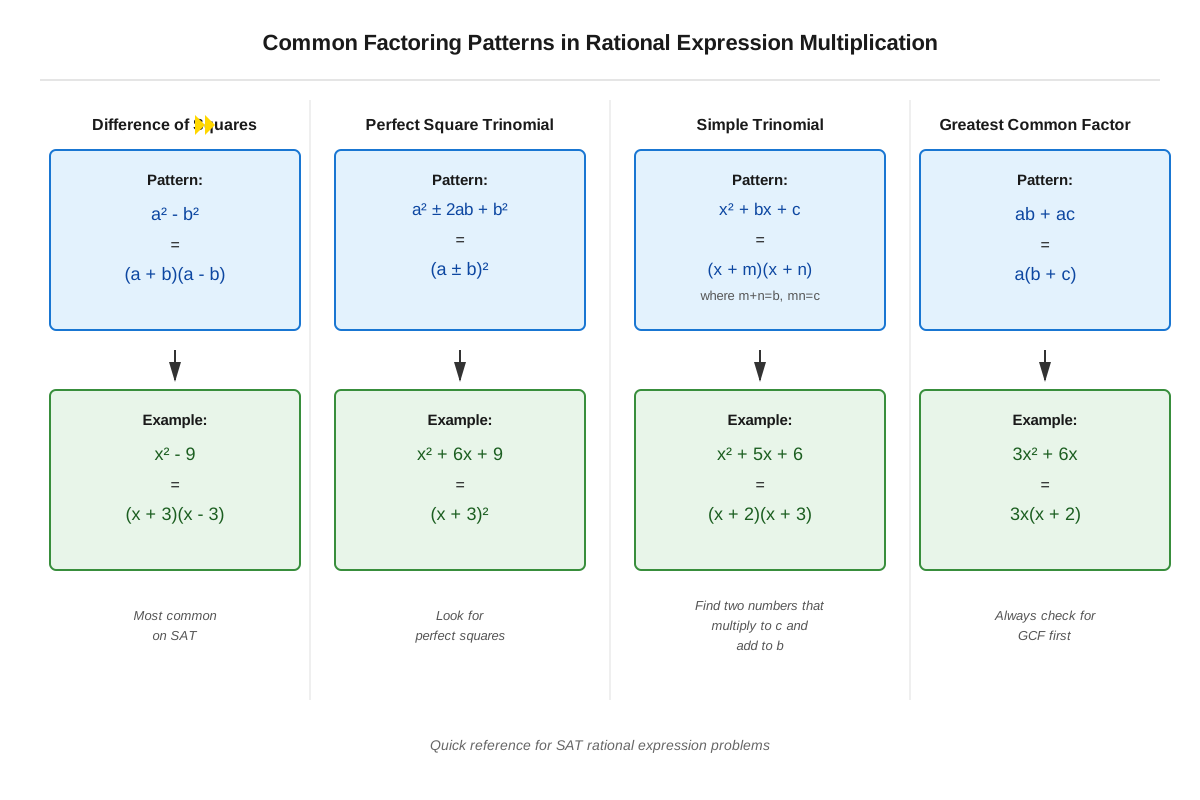
- Polynomial factoring: Factoring quadratics, difference of squares, and greatest common factors is essential for simplifying rational expressions before and after multiplication
- Canceling common factors: Recognizing that identical factors in numerators and denominators can be eliminated (when not equal to zero) prevents unnecessary computation
- Domain restrictions: Understanding that division by zero is undefined helps identify excluded values in rational expressions
Why This Topic Matters
Multiplying rational expressions appears in real-world contexts involving rates, proportions, and combined relationships. Engineers use rational expressions when calculating compound gear ratios, economists apply them in marginal cost analysis, and scientists employ them in chemical concentration calculations. The ability to manipulate these expressions efficiently translates to practical problem-solving across STEM fields.
On the SAT, multiplying rational expressions typically appears in 2-4 questions per test administration. These questions most commonly appear as:
- Direct multiplication problems requiring simplification
- Multi-step algebra problems where rational expression multiplication is one component
- Word problems involving combined rates or proportional relationships
- Questions asking students to identify equivalent expressions
The College Board frequently embeds rational expression multiplication within more complex scenarios to test algebraic fluency. Students might encounter these concepts in questions about function composition, inverse variation, or optimization problems. Approximately 60% of rational expression questions on the SAT involve some form of multiplication or division (which is multiplication by a reciprocal), making this a high-yield topic for focused study.
Core Concepts
The Fundamental Multiplication Rule
The core principle of multiplying rational expressions mirrors basic fraction multiplication: multiply numerators together and multiply denominators together. For rational expressions A/B and C/D, the product is (A·C)/(B·D), where B ≠ 0 and D ≠ 0.
However, the SAT rarely presents problems in this straightforward form. Instead, questions require factoring and simplification before or after multiplication to arrive at the correct answer choice. This strategic approach prevents arithmetic errors and saves valuable test time.
Factoring Before Multiplication
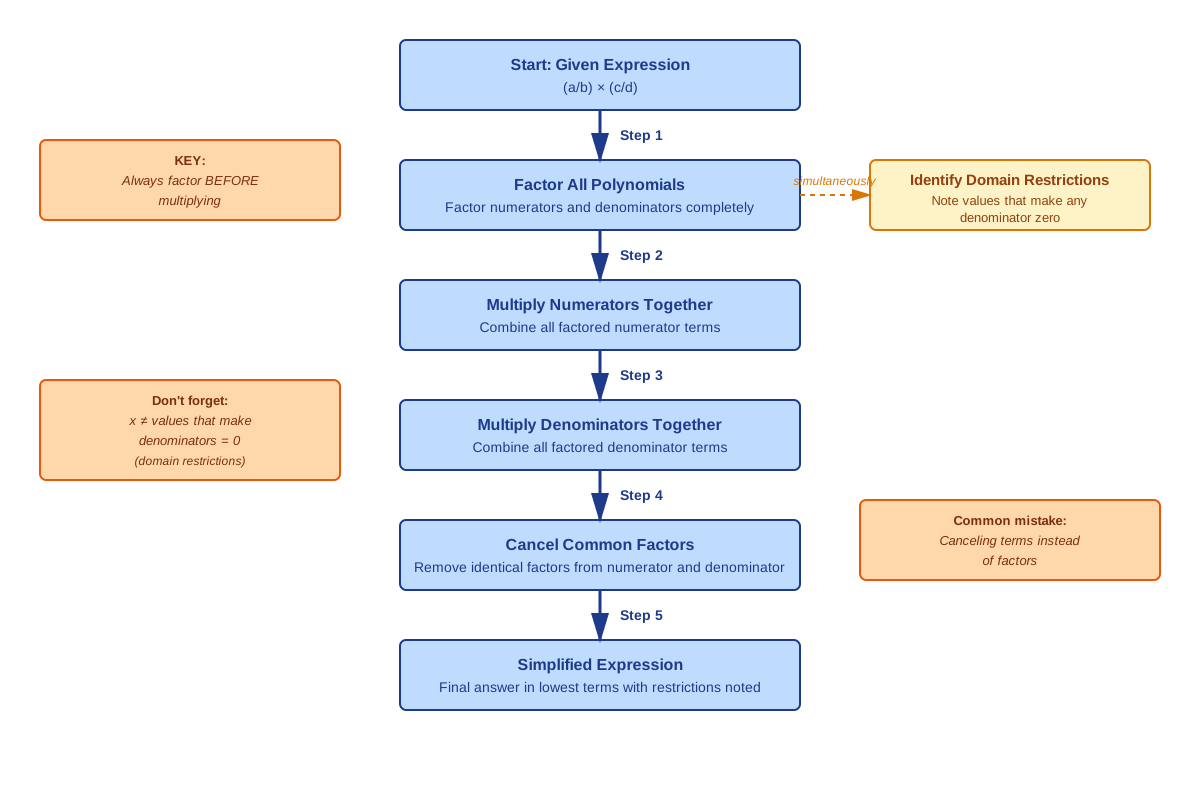
The most efficient strategy involves factoring all polynomials completely before performing multiplication. This allows students to identify and cancel common factors early, dramatically simplifying calculations.
Consider the general process:
- Factor all numerators completely
- Factor all denominators completely
- Identify common factors between any numerator and any denominator
- Cancel common factors (noting restrictions)
- Multiply remaining factors
- Expand if necessary (though simplified factored form is often preferred)
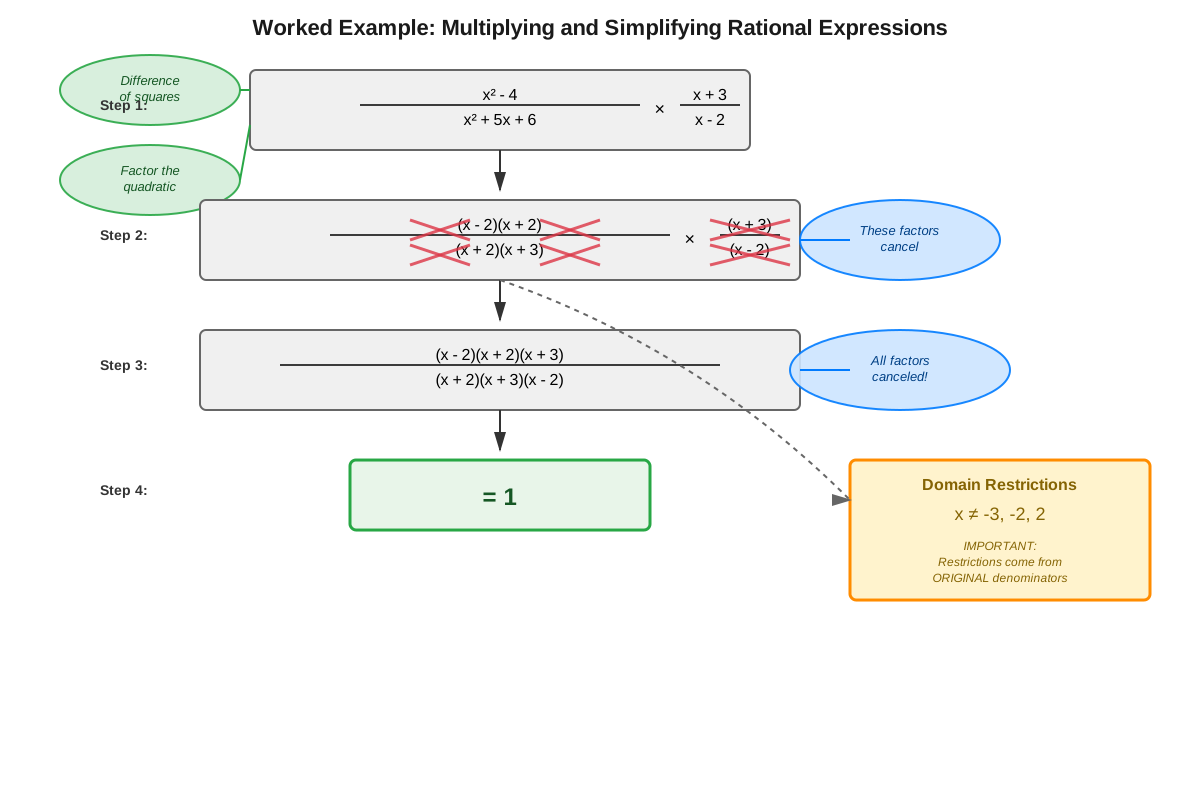
Example structure:
(x² - 4)/(x² + 5x + 6) · (x + 3)/(x - 2)Factor each component:
- x² - 4 = (x + 2)(x - 2)
- x² + 5x + 6 = (x + 2)(x + 3)
- x + 3 remains as is
- x - 2 remains as is
This becomes:
[(x + 2)(x - 2)]/[(x + 2)(x + 3)] · (x + 3)/(x - 2)Canceling Common Factors
After factoring, common factors appearing in both a numerator and a denominator can be canceled. This critical step must be performed carefully, with attention to domain restrictions.
In the example above, we can cancel:
- (x + 2) appears in both the first numerator and first denominator
- (x - 2) appears in the first numerator and second denominator
- (x + 3) appears in the first denominator and second numerator
After canceling all common factors, only 1/1 remains, which equals 1.
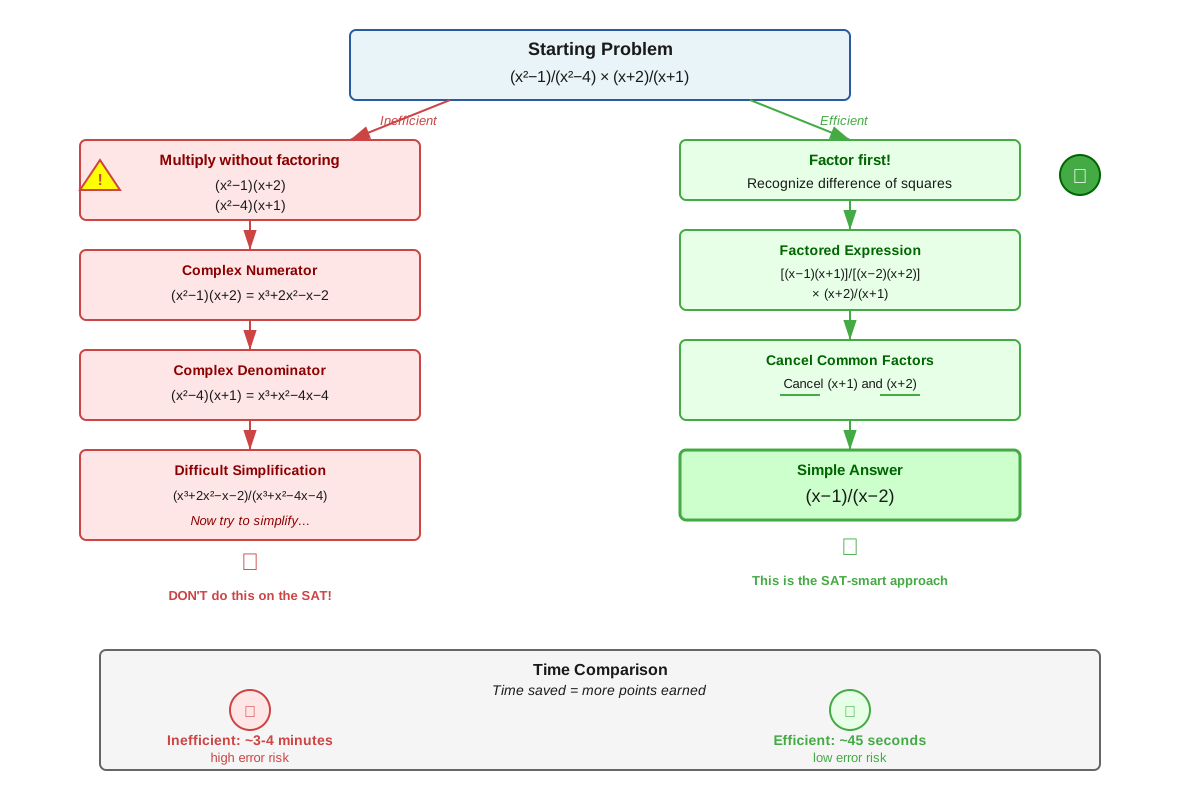
Exam Tip: Always cancel before multiplying. Multiplying first creates unnecessarily large polynomials that are difficult to factor and prone to arithmetic errors.
Domain Restrictions
A crucial aspect often tested on the SAT involves identifying values that make the original expression undefined. Even after canceling factors, the domain restrictions from the original denominators remain.
For the expression above, restrictions come from:
- x² + 5x + 6 ≠ 0, so x ≠ -2 and x ≠ -3
- x - 2 ≠ 0, so x ≠ 2
Therefore, the simplified answer of 1 is valid for all real numbers except x = -3, x = -2, and x = 2.
| Original Factor | Restriction | Reason |
|---|---|---|
| x + 2 | x ≠ -2 | Makes first denominator zero |
| x + 3 | x ≠ -3 | Makes first denominator zero |
| x - 2 | x ≠ 2 | Makes second denominator zero |
Multiplication with Monomials
When multiplying a rational expression by a monomial or polynomial, treat the monomial as a fraction with denominator 1:
(x² - 9)/(x + 1) · (2x) = (x² - 9)/(x + 1) · (2x)/1Factor and simplify:
[(x + 3)(x - 3)]/(x + 1) · (2x)/1 = [2x(x + 3)(x - 3)]/(x + 1)This can be left in factored form or expanded to 2x(x² - 9)/(x + 1) or (2x³ - 18x)/(x + 1), depending on the question requirements.
Multiple Rational Expressions
When multiplying three or more rational expressions, the same principles apply. Factor everything, cancel all common factors across all numerators and denominators, then multiply what remains.
(x - 5)/(x² - 25) · (x + 5)/(x - 3) · (x² - 9)/(x - 5)Factor completely:
(x - 5)/[(x - 5)(x + 5)] · (x + 5)/(x - 3) · [(x - 3)(x + 3)]/(x - 5)Cancel common factors:
- (x - 5) appears twice in numerators and twice in denominators
- (x + 5) appears once in numerator and once in denominator
- (x - 3) appears once in numerator and once in denominator
Result: (x + 3)/1 = x + 3, with restrictions x ≠ 5, x ≠ -5, and x ≠ 3.
Concept Relationships
The process of multiplying rational expressions integrates several interconnected algebraic skills. Polynomial factoring serves as the foundation → enabling identification of common factors → which allows strategic cancellation → leading to simplified products. Each step depends on the previous one, creating a sequential relationship.
Domain restrictions connect to the concept of undefined expressions, which relates back to the fundamental principle that division by zero is impossible. This connection extends to rational equations and function analysis, where identifying excluded values becomes critical for determining solution sets and function domains.
The relationship between multiplying and dividing rational expressions is particularly important: division by a rational expression equals multiplication by its reciprocal. This means mastering multiplication automatically provides the foundation for division problems.
Furthermore, multiplying rational expressions connects forward to complex fractions (fractions containing fractions), rational equations (equations containing rational expressions), and function operations (particularly composition and multiplication of rational functions). The simplification techniques learned here apply directly to these advanced topics.
Quick check — test yourself on Multiplying rational expressions so far.
Try Flashcards →High-Yield Facts
⭐ Multiplying rational expressions follows the same rule as multiplying numerical fractions: multiply numerators together and multiply denominators together
⭐ Always factor completely before multiplying to identify common factors that can be canceled
⭐ Common factors can be canceled only when they appear in both a numerator (anywhere) and a denominator (anywhere)
⭐ Domain restrictions come from all original denominators, even after factors are canceled
⭐ The simplified form of a rational expression product may equal 1 or a constant, but restrictions still apply
- Factoring techniques include greatest common factor, difference of squares, trinomial factoring, and grouping
- A rational expression is undefined when any denominator equals zero
- Canceling is only valid for multiplication factors, never for addition or subtraction terms
- The expression (x - a)/(a - x) simplifies to -1 (when x ≠ a) because a - x = -(x - a)
- Leaving answers in factored form often matches SAT answer choices better than expanded form
- When multiplying three or more rational expressions, cancel all common factors before performing any multiplication
Common Misconceptions
Misconception: Students can cancel terms that are added or subtracted within polynomials.
Correction: Canceling only applies to factors (terms connected by multiplication), never to terms connected by addition or subtraction. For example, in (x + 3)/(x + 5), the x's cannot be canceled because they are terms, not factors.
Misconception: After canceling all common factors, domain restrictions no longer apply.
Correction: Domain restrictions from the original expression remain valid even after simplification. If x = 2 made the original denominator zero, then x = 2 is still excluded from the domain of the simplified expression.
Misconception: The expressions (x - 5) and (5 - x) are the same and cancel to 1.
Correction: These expressions are opposites, not identical. (5 - x) = -(x - 5), so (x - 5)/(5 - x) = (x - 5)/[-(x - 5)] = -1, not 1.
Misconception: Multiplying rational expressions always results in a more complex expression.
Correction: Strategic factoring and canceling often produces a simpler result than either original expression. The product might even simplify to a constant or monomial.
Misconception: It's faster to multiply first and then simplify.
Correction: Multiplying before canceling creates large polynomials that are difficult to factor and prone to errors. Factoring and canceling first is always more efficient and accurate.
Worked Examples
Example 1: Standard Multiplication with Factoring
Problem: Simplify (x² + 7x + 12)/(x² - 16) · (x² - 4x)/(x + 3)
Solution:
Step 1: Factor all polynomials
- x² + 7x + 12 = (x + 3)(x + 4)
- x² - 16 = (x + 4)(x - 4) [difference of squares]
- x² - 4x = x(x - 4)
- x + 3 remains as is
Step 2: Rewrite with factored forms
[(x + 3)(x + 4)]/[(x + 4)(x - 4)] · [x(x - 4)]/(x + 3)Step 3: Identify common factors
- (x + 3) appears in first numerator and second denominator → cancel
- (x + 4) appears in first numerator and first denominator → cancel
- (x - 4) appears in first denominator and second numerator → cancel
Step 4: Cancel and multiply remaining factors
After canceling: x/1 = x
Step 5: State domain restrictions
From x² - 16 ≠ 0: x ≠ 4 and x ≠ -4
From x + 3 ≠ 0: x ≠ -3
Final Answer: x, where x ≠ -4, x ≠ -3, and x ≠ 4
This example demonstrates the complete process and connects to the learning objective of applying rational expression multiplication to solve SAT-style problems.
Example 2: Three-Expression Multiplication
Problem: Simplify (2x² - 8)/(x² + x - 6) · (x - 2)/(4x) · (8x²)/(x² - 4)
Solution:
Step 1: Factor all polynomials
- 2x² - 8 = 2(x² - 4) = 2(x + 2)(x - 2)
- x² + x - 6 = (x + 3)(x - 2)
- x - 2 remains as is
- 4x = 4x
- 8x² = 8x²
- x² - 4 = (x + 2)(x - 2)
Step 2: Rewrite completely factored
[2(x + 2)(x - 2)]/[(x + 3)(x - 2)] · (x - 2)/(4x) · (8x²)/[(x + 2)(x - 2)]Step 3: Identify all common factors
- (x - 2) appears three times in numerators and three times in denominators
- (x + 2) appears once in numerator and once in denominator
- Numerical factors: 2 · 8 = 16 in numerators, 4 in denominator
Step 4: Cancel and simplify
After canceling (x - 2) three times and (x + 2) once:
(2 · 8x²)/(4x · (x + 3)) = (16x²)/(4x(x + 3)) = (4x)/(x + 3)Step 5: State restrictions
From (x + 3)(x - 2) ≠ 0: x ≠ -3 and x ≠ 2
From 4x ≠ 0: x ≠ 0
From (x + 2)(x - 2) ≠ 0: x ≠ -2 and x ≠ 2 (already noted)
Final Answer: 4x/(x + 3), where x ≠ -3, x ≠ -2, x ≠ 0, and x ≠ 2
This example illustrates handling multiple expressions and numerical coefficients, reinforcing the systematic approach needed for SAT success.
Exam Strategy
When approaching SAT questions on multiplying rational expressions, follow this strategic sequence:
Recognition Phase: Identify trigger words and formats. Look for phrases like "simplify the product," "which expression is equivalent to," or "for all values of x except." The presence of fractions with polynomial numerators and denominators signals a rational expression problem.
Planning Phase: Before writing anything, scan all expressions to identify factoring opportunities. Look for:
- Greatest common factors
- Difference of squares (a² - b²)
- Perfect square trinomials
- Factorable quadratics
- Common binomial factors across expressions
Execution Phase:
- Factor everything completely (30-40% of your time)
- Cancel common factors systematically (20-30% of your time)
- Multiply remaining factors (10-20% of your time)
- Check answer choices for matching form (20-30% of your time)
Time Management: Allocate 90-120 seconds for standard rational expression multiplication problems. If factoring takes longer than 45 seconds, consider whether you've missed a pattern or should try a different approach.
Process of Elimination Tips:
- Eliminate answers with different domain restrictions than the original expression
- Eliminate answers that don't equal the original expression at test values (try x = 0, x = 1, or x = -1)
- Eliminate answers in expanded form if the question asks for simplified form (SAT typically prefers factored form)
- If two answers differ only by a sign, check for opposite factors like (x - a) versus (a - x)
Common Trap Answers:
- Answers that result from canceling terms instead of factors
- Answers missing domain restrictions
- Answers with sign errors from mishandling opposite binomials
- Answers from multiplying without canceling first
Memory Techniques
FACTOR Mnemonic for the multiplication process:
- Factor all polynomials completely
- Arrange expressions to see common factors clearly
- Cancel common factors between numerators and denominators
- Track domain restrictions from original denominators
- Organize remaining factors
- Report answer in simplest form
The "Opposite Factor Rule": Remember that (a - b) = -(b - a). Visualize a number line: going from a to b is the opposite direction of going from b to a. When you see (x - 5)/(5 - x), think "opposite directions = -1."
Domain Restriction Visualization: Picture denominators as "danger zones." Any value that makes a denominator zero is permanently excluded, even if that denominator disappears during simplification. Think of it like an allergy—once identified, always avoided.
Canceling Checklist Rhyme: "Factors can go, terms must stay; multiply connects, plus keeps away." This reminds students that only multiplication factors can be canceled, not addition/subtraction terms.
The Three-Step Chant: "Factor, Cancel, Multiply" - repeat this sequence before starting any problem to internalize the correct order of operations.
Summary
Multiplying rational expressions on the SAT requires systematic application of factoring, canceling, and multiplication principles. The fundamental rule—multiply numerators together and denominators together—becomes practical only after complete factoring reveals common factors that can be canceled. Success depends on recognizing that efficiency comes from factoring first, not multiplying first. Domain restrictions must be identified from all original denominators and remain valid even after simplification reduces the expression to a simpler form. The SAT tests this topic through direct multiplication problems, equivalent expression questions, and multi-step algebra scenarios. Students who master the FACTOR sequence (Factor, Arrange, Cancel, Track restrictions, Organize, Report) and understand that canceling applies only to multiplication factors will efficiently handle these high-yield questions. The connection between this topic and broader algebraic concepts—including rational equations, function operations, and complex fractions—makes it essential for achieving competitive SAT Math scores.
Key Takeaways
- Always factor all polynomials completely before attempting to multiply rational expressions
- Common factors can be canceled only when they appear as multiplication factors, never as addition or subtraction terms
- Domain restrictions come from all original denominators and remain valid after simplification
- The expressions (a - b) and (b - a) are opposites, not identical; their quotient equals -1
- Factoring before multiplying prevents arithmetic errors and saves significant time on the SAT
- Test answer choices by substituting simple values like x = 0 or x = 1 when uncertain
- Simplified rational expressions may reduce to constants, monomials, or simpler rational expressions
Related Topics
Dividing Rational Expressions: Division of rational expressions is performed by multiplying by the reciprocal, making multiplication mastery essential for division problems.
Simplifying Complex Fractions: Complex fractions (fractions within fractions) require multiplying by strategic forms of 1, building directly on rational expression multiplication skills.
Solving Rational Equations: Equations containing rational expressions often require multiplication by common denominators, applying the same factoring and domain restriction principles.
Rational Function Analysis: Understanding rational functions, including asymptotes and discontinuities, depends on recognizing factored forms and domain restrictions from rational expressions.
Polynomial Long Division: When rational expressions cannot be simplified through factoring, long division provides an alternative approach, extending multiplication concepts.
Practice CTA
Now that you've mastered the core concepts of multiplying rational expressions, it's time to solidify your understanding through active practice. The practice questions and flashcards designed for this topic will challenge you to apply the FACTOR sequence, identify domain restrictions, and recognize common SAT trap answers. Each practice problem you complete strengthens your pattern recognition and builds the automaticity needed for test-day success. Remember: understanding the concepts is the first step, but fluency comes through deliberate practice. Approach each practice question strategically, and review any mistakes to identify gaps in your process. Your investment in focused practice now will translate directly to points on test day!
Sign up free to keep reading
Create a free AnvayaPrep account to finish this SAT guide on Multiplying rational expressions — plus flashcards and practice questions.