Overview
Proportion equations are fundamental mathematical relationships that express the equality of two ratios. On the SAT, these equations appear frequently across multiple question types, testing a student's ability to set up, manipulate, and solve problems involving equivalent ratios. A proportion takes the form a/b = c/d, where the product of the means equals the product of the extremes (ad = bc). This cross-multiplication property serves as the primary tool for solving proportion problems efficiently.
Understanding proportion equations is essential for SAT success because they form the foundation for numerous math concepts tested on the exam, including percent problems, scale factor questions, rate calculations, and direct/inverse variation. The College Board consistently includes 3-5 questions per test that either directly test proportional reasoning or require it as an intermediate step in multi-step problems. These questions appear in both the calculator and no-calculator sections, making fluency with proportions non-negotiable for achieving a competitive score.
Beyond their standalone importance, sat proportion equations connect to broader mathematical thinking required throughout the exam. They bridge arithmetic and algebra, provide a framework for understanding linear relationships, and serve as building blocks for more complex rational expressions. Mastering proportions enables students to tackle word problems more systematically, recognize structural patterns in seemingly different questions, and develop the algebraic manipulation skills that underpin success across the entire Math section.
Learning Objectives
- [ ] Identify key features of proportion equations
- [ ] Explain how proportion equations appears on the SAT
- [ ] Apply proportion equations to answer SAT-style questions
- [ ] Set up proportion equations from word problems and real-world scenarios
- [ ] Solve proportion equations using cross-multiplication and algebraic manipulation
- [ ] Distinguish between direct and inverse proportional relationships
- [ ] Recognize when proportion equations are the most efficient solution method
Prerequisites
- Basic fraction operations: Understanding how to multiply, divide, and simplify fractions is essential for manipulating proportion equations and reducing answers to simplest form
- One-variable linear equations: Solving proportions requires isolating variables using the same algebraic techniques used in simple linear equations
- Ratio concepts: Proportions are built on ratios, so understanding how to express and interpret comparative relationships between quantities is foundational
- Unit conversion: Many proportion problems involve converting between different units, requiring familiarity with dimensional analysis
Why This Topic Matters
Proportion equations represent one of the most practical mathematical tools students will use both on the SAT and in real life. From adjusting recipe quantities and calculating medication dosages to understanding map scales and financial ratios, proportional reasoning pervades everyday decision-making. In professional contexts, proportions underpin fields as diverse as architecture (scale drawings), finance (interest calculations), chemistry (solution concentrations), and engineering (gear ratios).
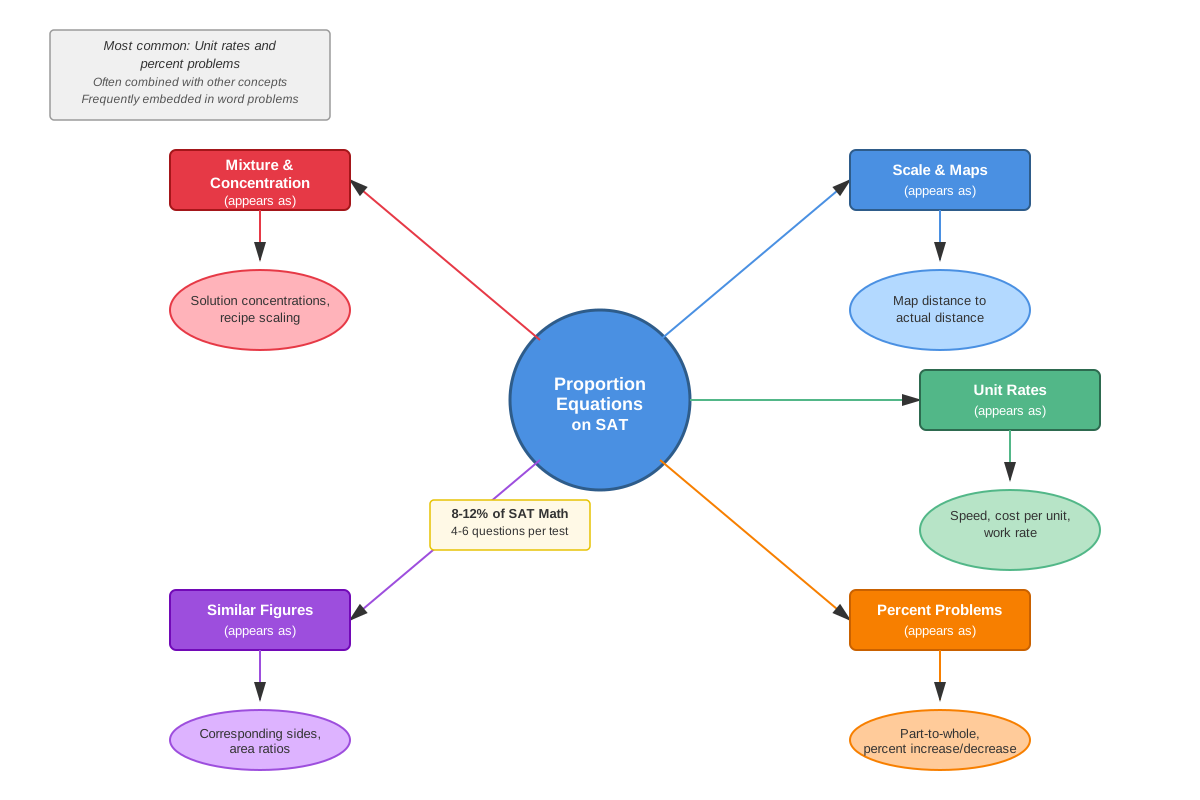
On the SAT specifically, proportion equations appear with remarkable consistency. Statistical analysis of released SAT exams reveals that proportional reasoning questions constitute approximately 8-12% of the Math section, translating to 4-6 questions per test. These questions appear in multiple formats: straightforward proportion setup problems, word problems requiring proportion identification, geometry questions involving similar figures, and data interpretation problems requiring rate calculations. The College Board particularly favors embedding proportion concepts within real-world contexts, such as population density, fuel efficiency, currency conversion, and recipe scaling.
Common SAT question formats include: direct proportion word problems ("If 3 widgets cost $12, how much do 7 widgets cost?"), scale factor problems in geometry, unit rate calculations, percent problems disguised as proportions, mixture problems, and work-rate problems involving multiple workers or machines. The exam also tests whether students can recognize when quantities are NOT proportional, requiring careful analysis of the relationship between variables. Understanding these patterns allows students to quickly identify proportion questions and apply the appropriate solution strategy.
Core Concepts
Definition and Structure of Proportion Equations
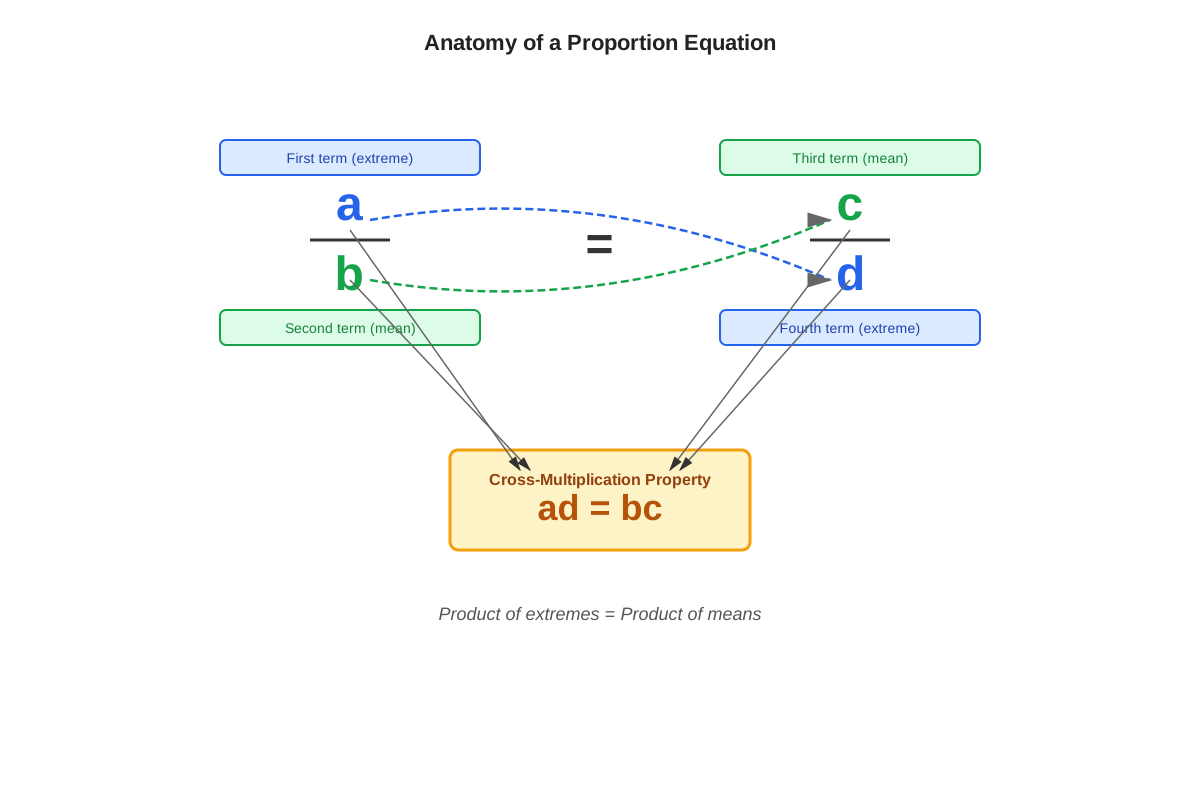
A proportion equation is a mathematical statement asserting that two ratios are equal. The standard form is a/b = c/d, where a, b, c, and d represent numbers or algebraic expressions, and b ≠ 0 and d ≠ 0 (to avoid division by zero). In this proportion, a and d are called the extremes (outer terms), while b and c are called the means (inner terms). The fundamental property of proportions states that the product of the means equals the product of the extremes: bc = ad.
This cross-multiplication property provides the primary method for solving proportion equations. When faced with a/b = c/d, multiplying both sides by bd yields ad = bc, eliminating fractions and creating a simpler equation to solve. For example, if x/5 = 12/20, cross-multiplying gives 20x = 60, so x = 3. This technique works universally for proportion problems and should become automatic through practice.
Setting Up Proportions from Word Problems
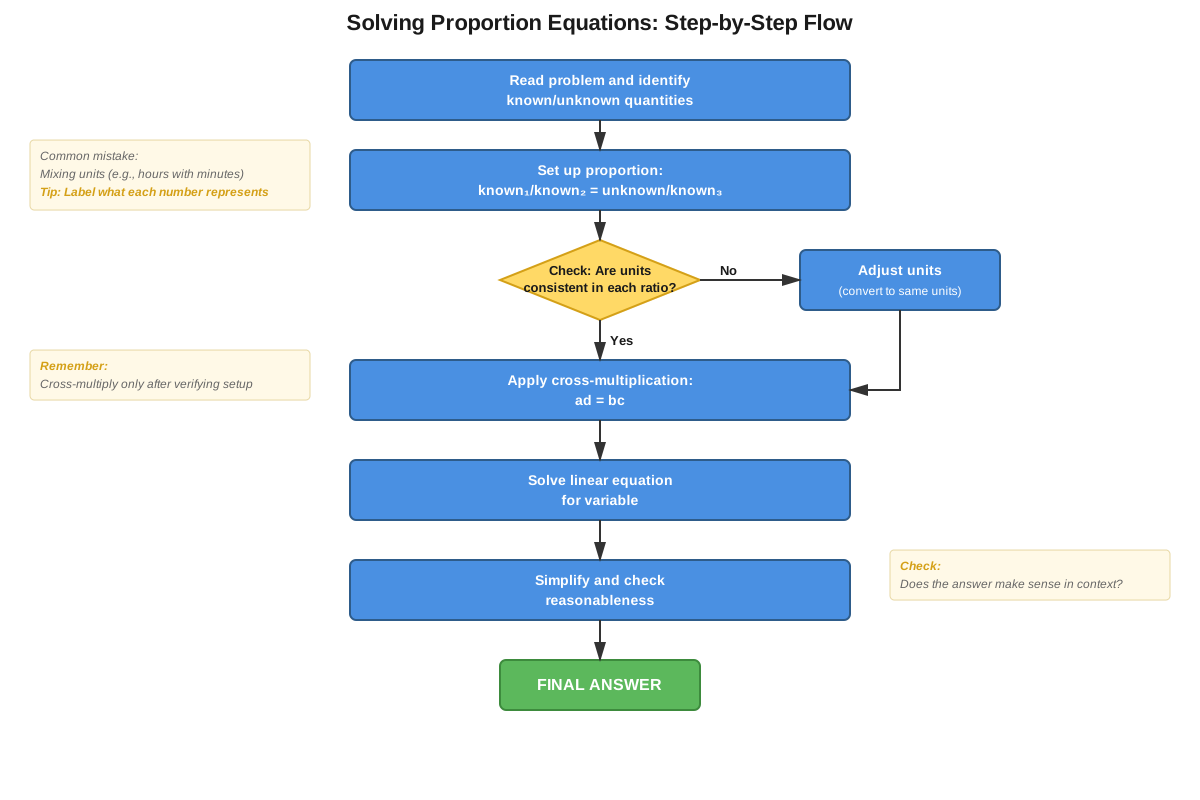
The most challenging aspect of proportion problems on the SAT is translating verbal descriptions into mathematical equations. The key strategy involves identifying the two ratios being compared and ensuring consistent units and positioning. When setting up a proportion, the numerators must represent the same type of quantity, and the denominators must represent the same type of quantity.
Consider this example: "If 5 pounds of apples cost $8, how much will 12 pounds cost?" The two ratios are pounds-to-dollars. Setting up the proportion requires consistency:
pounds/dollars = pounds/dollars
5/8 = 12/x
Alternatively, the proportion could be written as:
dollars/pounds = dollars/pounds
8/5 = x/12
Both setups are valid and will yield the same answer (x = 19.20), but mixing the structure (such as 5/8 = x/12) will produce an incorrect result. The SAT frequently tests whether students maintain this consistency.
Cross-Multiplication Method
Cross-multiplication is the most efficient technique for solving proportion equations. Given a/b = c/d, the cross-multiplication process involves:
- Multiply the numerator of the left fraction by the denominator of the right fraction
- Multiply the denominator of the left fraction by the numerator of the right fraction
- Set these products equal: ad = bc
- Solve the resulting linear equation for the unknown variable
Example: Solve 7/x = 21/15
- Cross-multiply: 7(15) = 21x
- Simplify: 105 = 21x
- Divide both sides by 21: x = 5
This method eliminates fractions immediately, reducing computational errors and saving time on the SAT.
Direct Proportions
A direct proportion (or direct variation) exists when two quantities increase or decrease together at a constant rate. If y is directly proportional to x, then y = kx for some constant k, or equivalently, y/x = k. In direct proportions, as one variable doubles, the other doubles; as one triples, the other triples.
Common SAT scenarios involving direct proportions include:
- Cost and quantity (more items cost more money)
- Distance and time at constant speed (longer time means greater distance)
- Ingredient amounts in recipes (doubling a recipe doubles each ingredient)
The key identifier for direct proportions is that the ratio between the two quantities remains constant. If y₁/x₁ = y₂/x₂, then y and x are directly proportional.
Inverse Proportions
An inverse proportion (or inverse variation) exists when one quantity increases as the other decreases, such that their product remains constant. If y is inversely proportional to x, then y = k/x or xy = k for some constant k. In inverse proportions, as one variable doubles, the other is halved; as one triples, the other becomes one-third.
Common SAT scenarios involving inverse proportions include:
- Speed and time for a fixed distance (faster speed means less time)
- Number of workers and time to complete a job (more workers means less time)
- Pressure and volume of a gas at constant temperature
The key identifier for inverse proportions is that the product of the two quantities remains constant. If x₁y₁ = x₂y₂, then y and x are inversely proportional.
Proportion Equations in Geometry
Proportions appear extensively in SAT geometry questions, particularly those involving similar figures. Two figures are similar if their corresponding angles are equal and their corresponding sides are proportional. When triangles ABC and DEF are similar, the proportion of corresponding sides is:
AB/DE = BC/EF = AC/DFThis relationship allows students to find unknown side lengths when given partial information about similar figures. The SAT frequently presents problems involving shadows, scale drawings, or nested triangles where recognizing similarity and setting up proportions is essential.
Unit Rates and Proportions
A unit rate expresses a ratio with a denominator of 1 (such as miles per hour or dollars per pound). Many SAT proportion problems can be solved by first finding the unit rate, then multiplying to find the desired quantity. This approach is particularly useful when the proportion setup is unclear.
Example: If 3 notebooks cost $4.50, how much do 8 notebooks cost?
- Unit rate: $4.50 ÷ 3 = $1.50 per notebook
- Total cost: $1.50 × 8 = $12.00
This method provides an alternative to formal proportion setup and can be faster for certain problem types.
Concept Relationships
Proportion equations serve as a central hub connecting multiple mathematical concepts tested on the SAT. At the foundational level, proportions build directly on ratio concepts and fraction operations—understanding that a proportion is simply two equal ratios requires fluency with fraction equivalence and simplification. The cross-multiplication technique used to solve proportions relies on algebraic manipulation skills developed through solving linear equations, creating a bidirectional relationship where practice with proportions reinforces general equation-solving abilities.
Moving outward, proportion equations enable understanding of percent problems, which can always be reframed as proportions (part/whole = percent/100). This connection means that mastering proportions provides an alternative solution method for the entire category of percent questions on the SAT. Similarly, rate problems involving distance, speed, and time are fundamentally proportion problems, as are work-rate problems involving multiple workers or machines completing tasks.
In geometry, proportions form the mathematical foundation for similar figures, scale factors, and trigonometric ratios. The relationship flows as: understanding proportions → recognizing proportional sides in similar triangles → applying scale factors → solving complex geometry problems. Additionally, proportion concepts underpin slope calculations in coordinate geometry, where slope represents the constant ratio of vertical change to horizontal change.
The relationship map can be visualized as: Basic Ratios → Proportion Equations → {Percent Problems, Rate Problems, Similar Figures, Direct/Inverse Variation} → Complex Multi-Step SAT Problems. Each arrow represents a dependency where mastery of the earlier concept is necessary for success with the later concept.
Quick check — test yourself on Proportion equations so far.
Try Flashcards →High-Yield Facts
⭐ The cross-multiplication property (a/b = c/d means ad = bc) is the fastest method for solving proportion equations on the SAT
⭐ When setting up proportions from word problems, maintaining consistent units in numerators and denominators is critical for correct answers
⭐ Direct proportions have the form y/x = k (constant ratio), while inverse proportions have the form xy = k (constant product)
⭐ Similar figures have proportional corresponding sides, allowing unknown lengths to be found through proportion equations
⭐ Any percent problem can be solved using the proportion: part/whole = percent/100
- Proportion equations appear in approximately 8-12% of SAT Math questions, making them one of the highest-yield topics to master
- The SAT frequently disguises proportion problems within real-world contexts like recipe scaling, map distances, and currency conversion
- When three values in a proportion are known, the fourth can always be found through cross-multiplication
- Unit rate problems (finding cost per item, speed per hour, etc.) are a special case of proportion problems where one denominator equals 1
- Proportion problems can appear in both calculator and no-calculator sections, so mental math strategies for simple proportions are valuable
- The SAT tests whether students can recognize when quantities are NOT proportional, requiring analysis of whether ratios remain constant
- Compound proportions involving three or more related quantities occasionally appear in higher-difficulty SAT questions
- Proportion equations preserve equality under multiplication and division, but not under addition and subtraction of the same value to both sides
Common Misconceptions
Misconception: When setting up a proportion, the order of terms doesn't matter as long as all four values are included.
Correction: The structure of a proportion is critical. The numerators must represent the same type of quantity, and the denominators must represent the same type of quantity. Writing 5 apples/8 dollars = x dollars/12 apples will produce an incorrect answer because the structure is inconsistent.
Misconception: All relationships between two quantities can be expressed as proportions.
Correction: Only relationships where the ratio (or product, for inverse proportions) remains constant are proportional. Linear relationships with non-zero y-intercepts (like y = 2x + 3) are NOT proportional because the ratio y/x changes as x changes. The SAT specifically tests this distinction.
Misconception: Cross-multiplication can be used on any equation involving fractions.
Correction: Cross-multiplication is valid only when two fractions are set equal to each other (a proportion). For equations like x/3 + x/5 = 8, cross-multiplication doesn't apply; instead, finding a common denominator or multiplying through by the LCD is required.
Misconception: In inverse proportions, as one quantity increases, the other decreases by the same amount.
Correction: In inverse proportions, the product remains constant, not the difference. If x doubles, y is halved (not decreased by the same amount x increased). For example, if xy = 12 and x increases from 2 to 4, y decreases from 6 to 3 (halved), not from 6 to 4.
Misconception: Proportions always involve exactly four numbers.
Correction: While the standard form a/b = c/d involves four values, proportion problems can involve more complex expressions, variables in multiple positions, or compound proportions relating three or more quantities. The fundamental principle (equal ratios) remains the same regardless of complexity.
Misconception: The fastest way to solve proportion problems is always to cross-multiply.
Correction: While cross-multiplication is generally efficient, some problems are faster to solve using unit rates, especially when finding multiple values or when the numbers are particularly simple. Flexibility in approach is more valuable than rigid adherence to a single method.
Worked Examples
Example 1: Classic Proportion Word Problem
Problem: A recipe for 6 servings requires 2.5 cups of flour. How many cups of flour are needed for 15 servings?
Solution:
Step 1: Identify the two ratios being compared. We're comparing servings to cups of flour.
Step 2: Set up the proportion with consistent structure:
servings/cups = servings/cups
6/2.5 = 15/x
Step 3: Cross-multiply:
6x = 2.5(15)
6x = 37.5
Step 4: Solve for x:
x = 37.5/6
x = 6.25Answer: 6.25 cups of flour are needed.
Alternative approach using unit rate:
- Cups per serving: 2.5 ÷ 6 = 0.4167 cups per serving
- For 15 servings: 0.4167 × 15 = 6.25 cups
This example demonstrates the core learning objective of applying proportion equations to SAT-style questions. The problem requires translating a word problem into a mathematical proportion, maintaining structural consistency, and executing cross-multiplication accurately.
Example 2: Similar Triangles and Proportions
Problem: Triangle ABC is similar to triangle DEF. If AB = 8, BC = 12, AC = 10, and DE = 6, find the length of EF.
Solution:
Step 1: Recognize that similar triangles have proportional corresponding sides. The correspondence is AB↔DE, BC↔EF, and AC↔DF.
Step 2: Set up a proportion using corresponding sides:
AB/DE = BC/EF
8/6 = 12/EF
Step 3: Cross-multiply:
8(EF) = 6(12)
8(EF) = 72
Step 4: Solve for EF:
EF = 72/8
EF = 9Answer: EF = 9
Verification: Check that all ratios are equal:
- AB/DE = 8/6 = 4/3
- BC/EF = 12/9 = 4/3 ✓
This example illustrates how proportion equations appear in geometry contexts on the SAT. Recognizing the similar triangle relationship and correctly identifying corresponding sides are crucial skills that connect geometric reasoning with proportional thinking. This type of problem frequently appears in the calculator section and may be worth 2-3 points depending on whether it's multiple-choice or grid-in format.
Exam Strategy
When approaching proportion questions on the SAT, begin by identifying trigger words and phrases that signal proportional relationships: "at this rate," "per," "for every," "if...then how many," "scale of," "similar figures," and "directly/inversely proportional to." These phrases indicate that setting up a proportion equation is likely the intended solution path.
The systematic approach to proportion problems involves four steps: (1) identify what quantities are being compared, (2) set up the proportion with consistent structure, (3) cross-multiply to eliminate fractions, and (4) solve the resulting linear equation. Before cross-multiplying, quickly check whether the numbers allow for mental math shortcuts—if one ratio simplifies easily or if you can spot the scale factor immediately, direct calculation may be faster than formal algebraic manipulation.
For process-of-elimination strategies, use dimensional analysis to eliminate answer choices. If the problem asks for a cost and one answer choice has units of time, eliminate it immediately. Additionally, use estimation to eliminate unreasonable answers: if you're scaling up (increasing quantity), the answer must be larger than the original value; if scaling down, it must be smaller. This simple check eliminates 2-3 answer choices in many problems.
Time allocation for proportion problems should average 45-60 seconds for straightforward setup-and-solve questions, and 90-120 seconds for multi-step problems involving similar figures or inverse proportions. If a proportion problem is taking longer than two minutes, mark it for review and move on—these problems rarely require complex mathematics, so extended time usually indicates a setup error rather than computational difficulty.
Be alert for inverse proportion traps where the SAT presents a scenario where one quantity increases while another decreases, but the relationship is NOT inversely proportional. For example, "If 3 workers complete a job in 8 hours, how long will it take 5 workers?" is inversely proportional (more workers means less time), but "If a car travels 120 miles in 2 hours, how far will it travel in 5 hours?" is directly proportional (more time means more distance). Carefully analyze whether the ratio or the product should remain constant.
Memory Techniques
CROSS Mnemonic for solving proportions:
- Check structure (consistent units in numerators and denominators)
- Rewrite as a/b = c/d
- Opposite corners multiply (cross-multiplication)
- Solve the resulting equation
- Substitute back to verify
Visualization Strategy: Picture a proportion as a balanced scale. The left ratio and right ratio must balance perfectly. When you cross-multiply, you're finding the "weight" on each side—if they're equal, the proportion is true. This mental image helps students remember that proportions represent equality and that cross-multiplication preserves this balance.
Direct vs. Inverse Acronym - DIP:
- Direct: Increase together (both go up or both go down)
- Inverse: Product stays constant (one up, one down)
The "Same Over Same" Rule: When setting up proportions from word problems, keep "same over same"—same units in numerators, same units in denominators. Visualize writing the units in your proportion: if you see "apples/dollars = dollars/apples," you know the setup is wrong.
Finger Trick for Cross-Multiplication: When looking at a/b = c/d written on paper, use your fingers to trace the cross pattern: touch 'a' and 'd' together (these multiply), then touch 'b' and 'c' together (these multiply). The physical motion reinforces the cross-multiplication pattern and reduces errors during high-pressure testing.
Summary
Proportion equations represent one of the most fundamental and frequently tested concepts on the SAT Math section, appearing in 8-12% of questions across diverse contexts including word problems, geometry, and data interpretation. A proportion is an equation stating that two ratios are equal (a/b = c/d), and the cross-multiplication property (ad = bc) provides the primary solution method. Success with proportion problems requires three core competencies: correctly translating word problems into mathematical proportions while maintaining structural consistency, distinguishing between direct proportions (constant ratio) and inverse proportions (constant product), and executing cross-multiplication efficiently. These equations connect to numerous other SAT topics including percent problems, rate calculations, similar figures, and scale factors, making them a high-leverage area for focused study. Students who master proportion setup, recognize proportional relationships in various contexts, and avoid common structural errors will find themselves equipped to handle a significant portion of SAT Math questions with confidence and speed.
Key Takeaways
- Proportion equations express the equality of two ratios and are solved most efficiently through cross-multiplication (a/b = c/d → ad = bc)
- Maintaining consistent structure when setting up proportions is critical: numerators must represent the same type of quantity, as must denominators
- Direct proportions have constant ratios (y/x = k), while inverse proportions have constant products (xy = k)
- Proportion problems appear in approximately 8-12% of SAT Math questions across multiple contexts including word problems, geometry, and rate calculations
- Similar figures in geometry have proportional corresponding sides, making proportion equations essential for finding unknown lengths
- Recognizing trigger words like "at this rate," "per," and "for every" helps identify when proportion setup is the intended solution path
- Verification through dimensional analysis and reasonableness checks eliminates answer choices and catches setup errors
Related Topics
Percent Problems: Mastering proportion equations provides an alternative framework for solving all percent problems using the proportion part/whole = percent/100, offering a systematic approach when the standard percent formula feels unclear.
Similar Figures and Scale Factors: Understanding proportions is prerequisite knowledge for all similarity problems in geometry, where corresponding sides of similar figures maintain constant ratios that can be expressed as proportions.
Rate Problems (Distance-Speed-Time): These problems are special cases of proportion equations where distance/time ratios remain constant at fixed speeds, and mastering proportions enables efficient solution of this common SAT question type.
Direct and Inverse Variation: These algebraic concepts formalize the proportional relationships introduced here, extending proportion thinking to function notation and graphical representations.
Rational Expressions and Equations: Proportion equations serve as an introduction to the broader category of rational equations, where more complex algebraic fractions are set equal and solved using similar techniques.
Practice CTA
Now that you've mastered the core concepts of proportion equations, it's time to solidify your understanding through active practice. The practice questions and flashcards designed for this topic will challenge you to apply these principles in varied contexts, mimicking the diverse ways the SAT tests proportional reasoning. Remember that proportion problems reward systematic thinking and careful setup more than computational complexity—focus on translating problems accurately into mathematical form, and the algebra will follow naturally. Each practice problem you complete builds the pattern recognition and procedural fluency that transforms proportion questions from time-consuming challenges into quick points on test day. Commit to working through the practice materials, and you'll find yourself recognizing proportion opportunities throughout the Math section, giving you a significant competitive advantage.
Sign up free to keep reading
Create a free AnvayaPrep account to finish this SAT guide on Proportion equations — plus flashcards and practice questions.