Overview
The constant of proportionality is a fundamental concept in algebra that describes the relationship between two quantities that change at a consistent rate relative to each other. When two variables are directly proportional, their ratio remains constant—this unchanging ratio is the constant of proportionality. For example, if a car travels at a steady speed, the relationship between time and distance traveled maintains a constant ratio, which represents the speed itself. This concept appears throughout math problems on the SAT, from simple ratio questions to complex word problems involving rates, unit conversions, and linear relationships.
Understanding the constant of proportionality is essential for SAT success because it forms the foundation for interpreting proportional relationships in multiple formats: tables, graphs, equations, and word problems. The SAT frequently tests whether students can identify this constant from different representations and apply it to solve real-world scenarios. Questions might ask students to find the constant from a graph's slope, extract it from a table of values, or use it to make predictions about proportional relationships.
This topic connects directly to broader mathematical concepts including linear functions, slope, unit rates, and direct variation. Mastering the constant of proportionality enables students to tackle questions about speed, density, unit pricing, scale factors, and conversion rates—all high-frequency topics on the SAT Math section. The ability to recognize and work with proportional relationships efficiently can save valuable time on test day and unlock points across multiple question types.
Learning Objectives
- [ ] Identify key features of constant of proportionality in tables, graphs, and equations
- [ ] Explain how constant of proportionality appears on the SAT in various question formats
- [ ] Apply constant of proportionality to answer SAT-style questions involving real-world scenarios
- [ ] Calculate the constant of proportionality from different representations of proportional relationships
- [ ] Distinguish between proportional and non-proportional relationships using the constant
- [ ] Use the constant of proportionality to write equations in the form y = kx
- [ ] Solve multi-step problems requiring manipulation of proportional relationships
Prerequisites
- Basic ratio and proportion concepts: Understanding equivalent ratios is essential because the constant of proportionality represents a specific ratio that remains unchanged
- Linear equation fundamentals: Familiarity with y = mx + b helps students recognize y = kx as a special case where b = 0
- Coordinate plane interpretation: Reading points and understanding slope is necessary for identifying the constant from graphs
- Unit rate calculations: Computing rates like miles per hour provides the foundation for understanding constants as rates
- Algebraic manipulation: Solving for variables and substituting values enables students to work with proportionality equations
Why This Topic Matters
The sat constant of proportionality appears in real-world contexts that students encounter daily: calculating gas mileage, comparing unit prices at stores, converting currencies, determining recipe scaling, and analyzing speed-distance-time relationships. These practical applications make the concept both testable and relevant, as the SAT emphasizes mathematical modeling of authentic situations.
On the SAT Math section, constant of proportionality questions appear with high frequency—typically 2-4 questions per test across both calculator and no-calculator portions. These questions account for approximately 5-8% of the total math score, making this a high-yield topic for focused study. The concept appears in multiple question formats: multiple-choice problems requiring calculation of the constant, grid-in questions asking for specific values, and word problems embedded in real-world contexts.
Common SAT question patterns include: identifying the constant from a table of proportional values, determining the constant from a linear graph passing through the origin, writing equations using the constant, using the constant to make predictions, and comparing different proportional relationships by their constants. The College Board frequently embeds these questions in scenarios involving unit conversions, rates of change, scaling, and direct variation, making recognition of proportional relationships a critical skill for test success.
Core Concepts
Definition and Mathematical Representation
The constant of proportionality (denoted as k) is the fixed value that relates two directly proportional quantities. When two variables x and y are proportional, their relationship can be expressed as:
y = kxwhere k is the constant of proportionality. This equation indicates that y is always k times as large as x. Alternatively, the constant can be found by dividing y by x:
k = y/xFor any proportional relationship, this ratio remains constant for all corresponding pairs of values. The constant of proportionality is also called the unit rate or rate of change in many contexts, and it represents the amount y changes for every one-unit increase in x.
Identifying Proportional Relationships
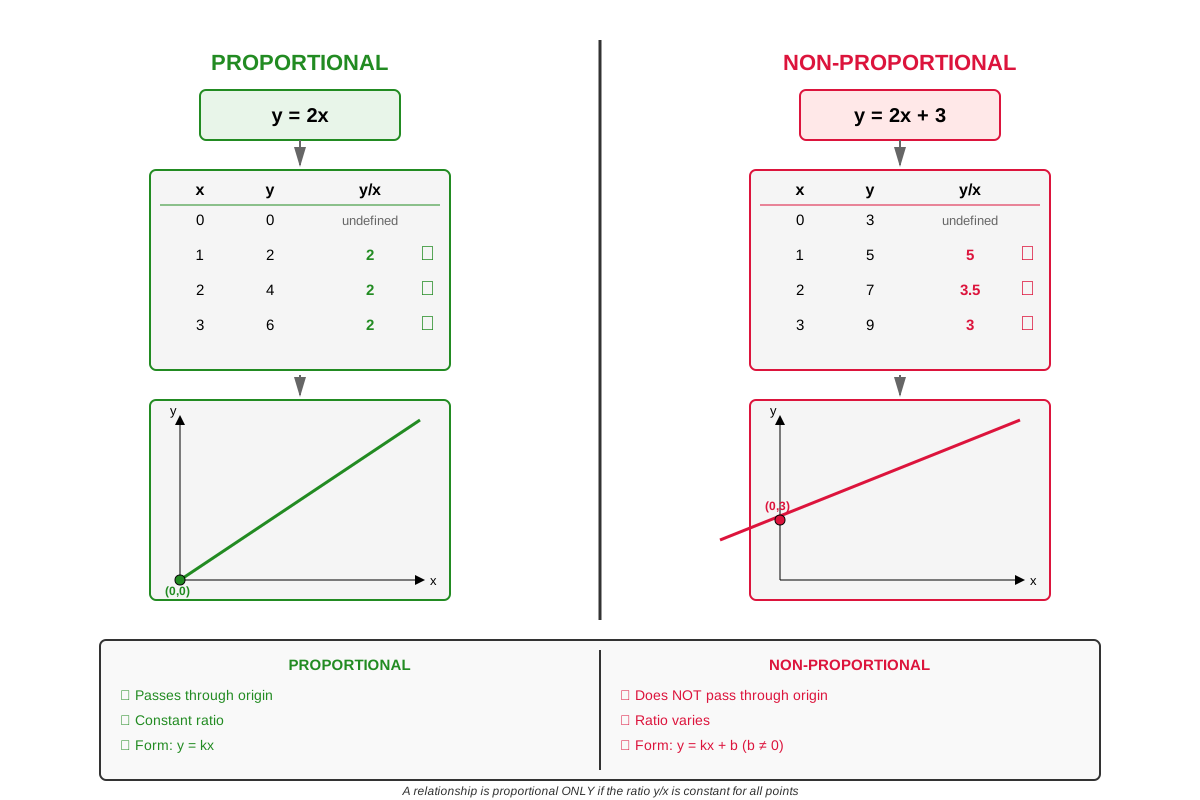
Not all relationships between variables are proportional. A relationship is proportional if and only if:
- The ratio y/x is constant for all pairs of values
- The graph of the relationship is a straight line passing through the origin (0, 0)
- The equation can be written in the form y = kx with no additional constant term
- When one variable is zero, the other variable must also be zero
Non-proportional relationships include those with y-intercepts other than zero (y = mx + b where b ≠ 0), exponential relationships, or situations where the ratio changes as the variables change.
Finding the Constant from Tables
When given a table of values, calculate the constant of proportionality by dividing any y-value by its corresponding x-value. For a valid proportional relationship, this calculation should yield the same result for every pair.
| x | y | y/x |
|---|---|---|
| 2 | 6 | 3 |
| 4 | 12 | 3 |
| 5 | 15 | 3 |
| 10 | 30 | 3 |
In this table, k = 3 because every ratio equals 3. The equation representing this relationship is y = 3x.
Exam Tip: Always verify the constant using multiple pairs from the table. If the ratios differ, the relationship is not proportional.
Finding the Constant from Graphs
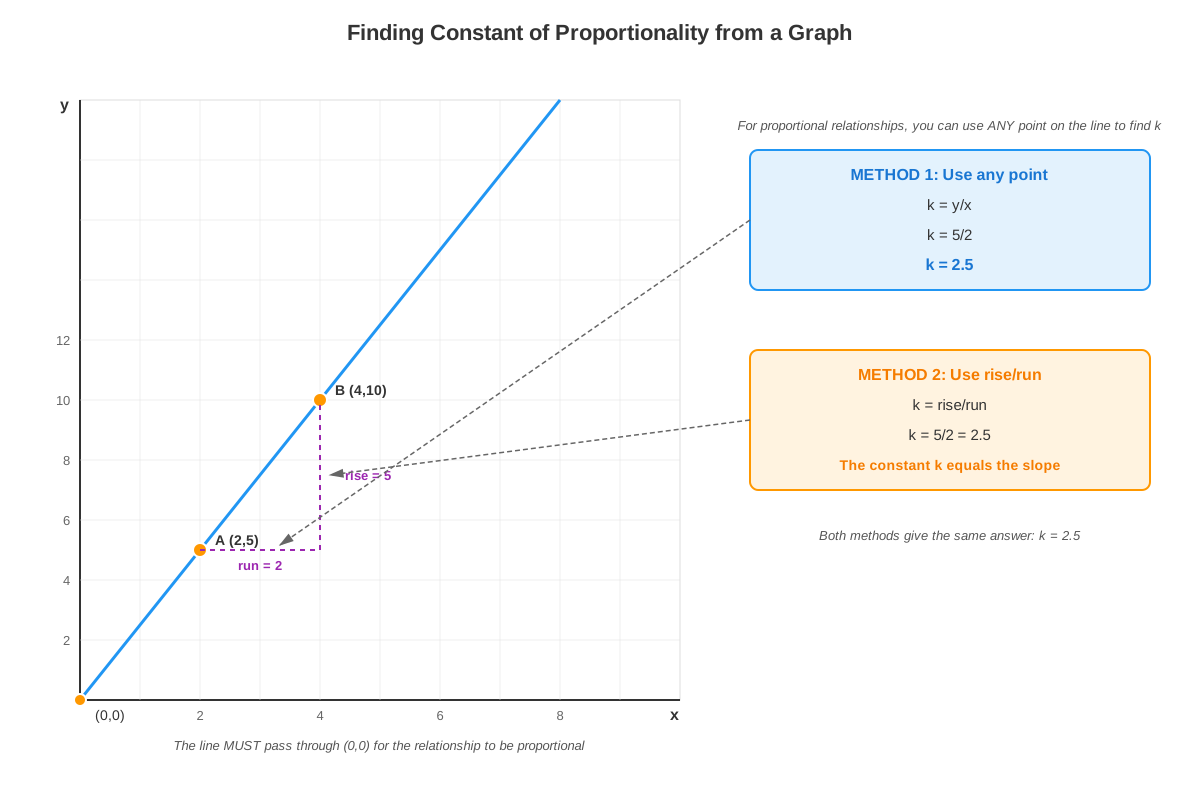
On a coordinate plane, the constant of proportionality equals the slope of the line for any proportional relationship. Since proportional relationships must pass through the origin, you can find k by:
- Selecting any point (x, y) on the line
- Calculating k = y/x
- Alternatively, using the slope formula with the origin: k = (y₂ - 0)/(x₂ - 0) = y₂/x₂
The constant represents the steepness of the line—larger constants produce steeper lines, while smaller constants (between 0 and 1) produce flatter lines. A constant of 1 produces a 45-degree line through the origin.
Finding the Constant from Word Problems
SAT word problems often describe proportional relationships without explicitly stating "proportional." Key phrases that signal proportional relationships include:
- "per" (miles per hour, dollars per pound)
- "each" (cost per item)
- "rate of" (rate of growth)
- "directly proportional to"
- "varies directly with"
- "constant rate"
To extract the constant from word problems:
- Identify the two quantities that vary together
- Determine which quantity depends on the other (dependent vs. independent variable)
- Find or calculate a specific pair of values
- Divide the dependent variable by the independent variable
Using the Constant to Make Predictions
Once the constant of proportionality is known, it can be used to find unknown values in the relationship. Given k and either x or y, solve for the missing variable:
- If k and x are known: y = kx
- If k and y are known: x = y/k
This predictive capability makes the constant of proportionality powerful for SAT problem-solving, especially in multi-step questions where students must first find k, then use it to calculate a requested value.
Units and Interpretation
The constant of proportionality carries units that combine the units of both variables. For example:
- If y is in miles and x is in hours, k has units of miles/hour (speed)
- If y is in dollars and x is in pounds, k has units of dollars/pound (unit price)
- If y is in meters and x is in seconds, k has units of meters/second (velocity)
Understanding these units helps verify calculations and interpret the meaning of k in context. The SAT often asks students to identify what the constant represents in a real-world scenario.
Concept Relationships
The constant of proportionality serves as a bridge between multiple mathematical concepts. Ratios and proportions → provide the foundation → constant of proportionality → which is a special case of → slope in linear functions → which generalizes to → rate of change.
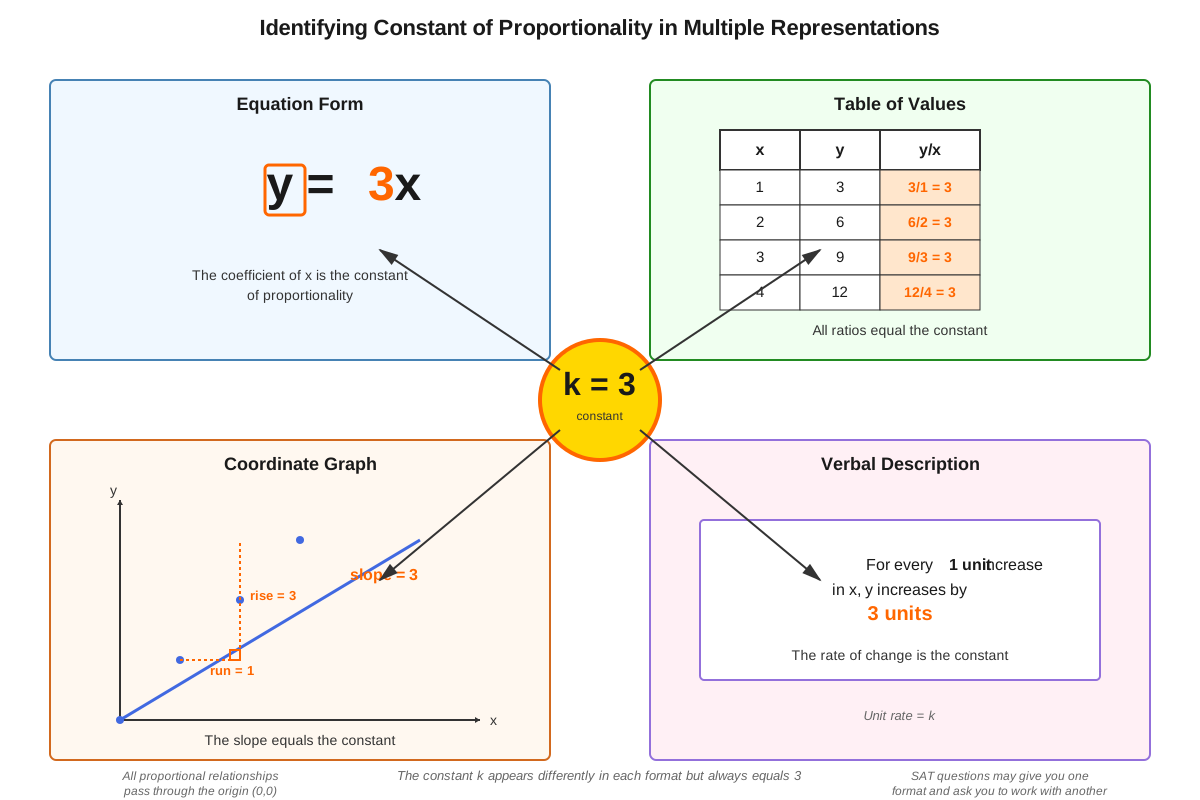
Within proportional relationships, the constant connects different representations: tables → reveal the constant through consistent ratios → equations → express the constant as the coefficient of x → graphs → display the constant as the slope of a line through the origin → word problems → describe the constant as a unit rate or conversion factor.
The concept also relates to prerequisite knowledge: unit rates are specific examples of constants of proportionality, direct variation is another name for proportional relationships with a constant, and linear equations in the form y = kx represent proportional relationships where k is the constant.
Understanding these connections enables students to translate between representations—a critical SAT skill. A question might provide information in a table and ask for the equation, or present a graph and ask for the meaning of the constant in context. Recognizing that all these representations describe the same underlying relationship through the constant of proportionality allows flexible problem-solving.
Quick check — test yourself on Constant of proportionality so far.
Try Flashcards →High-Yield Facts
⭐ The constant of proportionality k equals y/x for any pair of corresponding values in a proportional relationship
⭐ Proportional relationships always graph as straight lines passing through the origin (0, 0)
⭐ The equation of a proportional relationship is always y = kx, never y = kx + b where b ≠ 0
⭐ The constant of proportionality equals the slope of the line representing the relationship
⭐ To verify a proportional relationship from a table, check that y/x is identical for all pairs
- The constant of proportionality can be a whole number, fraction, or decimal
- Larger constants produce steeper lines on a graph
- The constant has units that are the units of y divided by the units of x
- If x doubles, y must also double in a proportional relationship
- The constant represents the unit rate (the value of y when x = 1)
- Proportional relationships are symmetric: if y = kx, then x = (1/k)y
- The constant can be found from a single point on a proportional graph (other than the origin)
- Non-proportional relationships have changing ratios between variables
- The SAT often asks what the constant represents in real-world contexts
- Zero is always part of a proportional relationship: when x = 0, y = 0
Common Misconceptions
Misconception: All linear relationships are proportional. → Correction: Only linear relationships passing through the origin are proportional. Lines with y-intercepts other than zero (y = mx + b where b ≠ 0) are linear but not proportional because the ratio y/x changes as x changes.
Misconception: The constant of proportionality is always greater than 1. → Correction: The constant can be any positive or negative number, including fractions and decimals less than 1. For example, if y = 0.5x, the constant is 0.5, meaning y is half of x.
Misconception: You need multiple points to find the constant of proportionality from a graph. → Correction: A single point (other than the origin) is sufficient because you can calculate k = y/x using that point's coordinates. However, using multiple points helps verify the relationship is truly proportional.
Misconception: The constant of proportionality and slope are different concepts. → Correction: For proportional relationships, the constant of proportionality and slope are identical. Both represent the rate of change of y with respect to x, and both equal y/x.
Misconception: If a table shows that y increases as x increases, the relationship must be proportional. → Correction: Many non-proportional relationships also increase together. A relationship is proportional only if the ratio y/x remains constant and the relationship passes through the origin. For example, y = 2x + 3 increases as x increases, but it's not proportional.
Misconception: The constant of proportionality is always the larger number in the relationship. → Correction: The constant is specifically y divided by x, regardless of which value is larger. The constant represents how many units of y correspond to one unit of x.
Misconception: Proportional relationships can have a starting value. → Correction: True proportional relationships always start at zero. If there's an initial value or starting amount (like a membership fee plus a per-item cost), the relationship is linear but not proportional.
Worked Examples
Example 1: Finding and Applying the Constant from a Table
Problem: A bakery's flour usage is shown in the table below. If the relationship is proportional, what is the constant of proportionality, and how much flour is needed for 15 batches of bread?
| Batches (x) | Flour in cups (y) |
|---|---|
| 3 | 12 |
| 5 | 20 |
| 8 | 32 |
Solution:
Step 1: Verify the relationship is proportional by checking if y/x is constant.
- For (3, 12): k = 12/3 = 4
- For (5, 20): k = 20/5 = 4
- For (8, 32): k = 32/8 = 4
Since all ratios equal 4, the relationship is proportional with k = 4.
Step 2: Interpret the constant. The constant of proportionality is 4 cups per batch, meaning each batch requires 4 cups of flour.
Step 3: Write the equation: y = 4x, where y is cups of flour and x is number of batches.
Step 4: Find flour needed for 15 batches.
y = 4(15) = 60 cups
Answer: The constant of proportionality is 4 cups per batch, and 15 batches require 60 cups of flour.
Connection to Learning Objectives: This example demonstrates identifying the constant from a table, writing the proportional equation, and applying the constant to make predictions—all essential SAT skills.
Example 2: Identifying the Constant from a Graph and Context
Problem: The graph below shows the relationship between time in hours (x) and distance traveled in miles (y) for a cyclist riding at constant speed. The line passes through the origin and the point (2.5, 40).
a) What is the constant of proportionality?
b) What does this constant represent in context?
c) Write an equation for the relationship.
d) How far will the cyclist travel in 6 hours?
Solution:
Step 1: Find the constant using the given point (2.5, 40).
k = y/x = 40/2.5 = 16
Step 2: Interpret the constant in context. Since y is in miles and x is in hours, k = 16 miles/hour. This represents the cyclist's speed—they travel 16 miles every hour.
Step 3: Write the equation using y = kx.
y = 16x, where y is distance in miles and x is time in hours.
Step 4: Calculate distance for 6 hours.
y = 16(6) = 96 miles
Answers:
a) The constant of proportionality is 16
b) It represents the cyclist's speed of 16 miles per hour
c) y = 16x
d) The cyclist will travel 96 miles in 6 hours
Connection to Learning Objectives: This example shows how to extract the constant from a graph, interpret its real-world meaning, write the proportional equation, and use it for predictions—all high-frequency SAT question types.
Exam Strategy
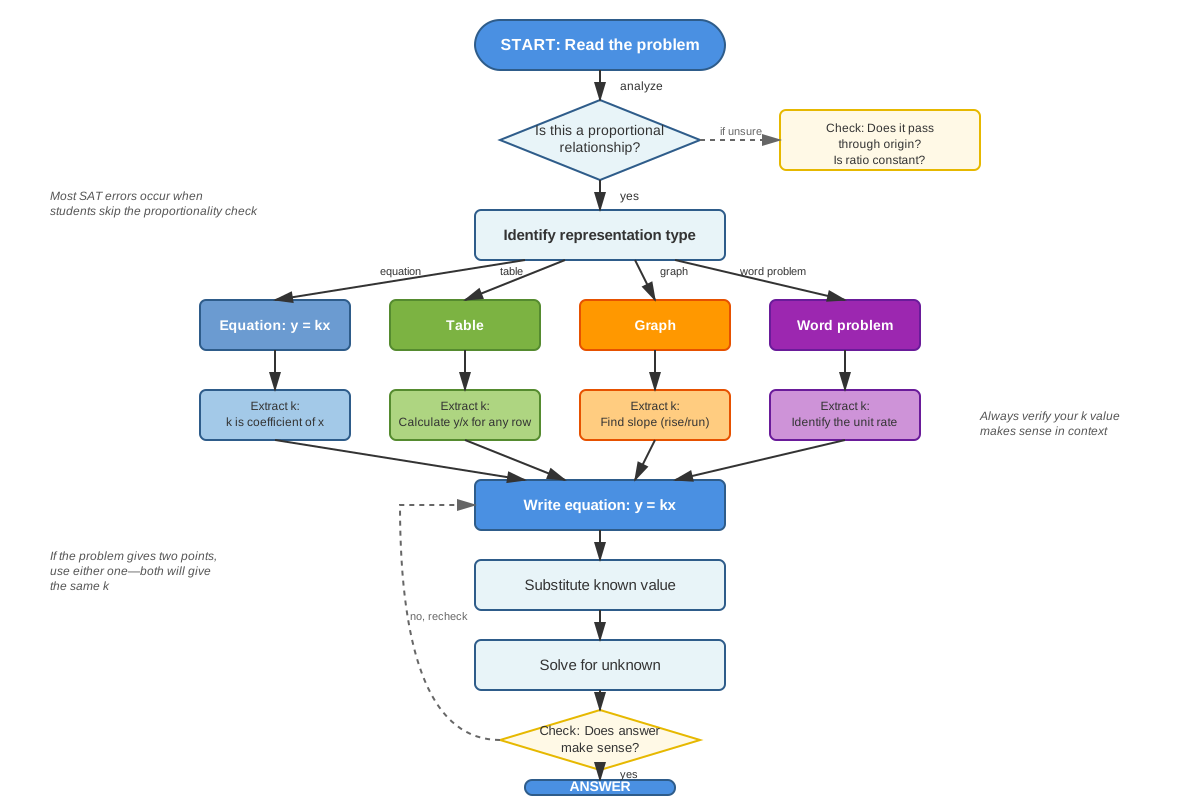
When approaching sat constant of proportionality questions, follow this systematic process:
Step 1: Identify the Question Type
Determine whether the question asks you to:
- Find the constant itself
- Use the constant to calculate an unknown value
- Interpret what the constant means in context
- Verify whether a relationship is proportional
Step 2: Recognize Trigger Words
Watch for phrases that signal proportional relationships:
- "directly proportional"
- "varies directly"
- "constant rate"
- "per" (miles per gallon, cost per item)
- "for every" (for every 3 cups of flour, 2 cups of sugar)
- "unit rate"
Step 3: Choose Your Representation
Decide which format makes the problem easiest:
- If given a table, calculate y/x for verification
- If given a graph, identify a clear point and divide coordinates
- If given a word problem, extract a specific numerical example
- If given an equation, identify the coefficient of x
Step 4: Verify Proportionality
Before assuming a relationship is proportional, check:
- Does the graph pass through (0, 0)?
- Is the ratio y/x constant across all data points?
- Is there any initial value or starting amount? (If yes, it's not proportional)
Time Management Tips:
- Spend 15-20 seconds identifying whether the relationship is proportional before calculating
- Use the simplest pair of values from a table to find k (avoid decimals when possible)
- On graph questions, look for points with integer coordinates
- If the question asks for interpretation, eliminate answers with wrong units first
Process of Elimination Strategies:
- Eliminate any equation with a constant term (y = kx + b where b ≠ 0)
- Eliminate constants with incorrect units
- For "what does k represent" questions, eliminate answers that don't match the units of y/x
- If calculating a prediction, eliminate answers that don't follow the proportional pattern
Critical Exam Tip: The SAT loves to test whether students can distinguish proportional from non-proportional relationships. Always verify that the relationship passes through the origin before applying proportionality formulas.
Memory Techniques
Mnemonic for Proportional Relationship Requirements: "ZERO SLOPE"
- Zero must be included (passes through origin)
- Equation form is y = kx
- Ratio y/x is constant
- Only straight lines qualify
- Slope equals the constant
- Linear relationship required
- Origin is always a point
- Predictions use multiplication
- Every pair has the same ratio
Visualization Strategy: Picture a proportional relationship as a "spoke" radiating from the origin. The constant determines the spoke's angle—steeper spokes have larger constants. This image reinforces that proportional relationships must pass through (0, 0).
Acronym for Finding k: "DIVE"
- Divide y by x
- Identify the units
- Verify with multiple points
- Express as y = kx
Memory Hook for Units: "The constant's units are Your answer Over X-actly what you started with" (y-units over x-units).
Summary
The constant of proportionality is the fixed ratio between two directly proportional quantities, expressed mathematically as k in the equation y = kx. This constant can be found by dividing any y-value by its corresponding x-value (k = y/x), and it remains the same for all pairs in a proportional relationship. On the SAT, students must identify this constant from tables, graphs, equations, and word problems, then use it to make predictions or interpret real-world contexts. Proportional relationships always graph as straight lines through the origin, and the constant equals the slope of this line. The constant carries units (y-units/x-units) and often represents meaningful rates like speed, unit price, or conversion factors. Distinguishing proportional relationships (y = kx) from non-proportional linear relationships (y = mx + b where b ≠ 0) is critical for SAT success. Mastery requires recognizing proportional patterns across multiple representations and applying the constant efficiently to solve multi-step problems.
Key Takeaways
- The constant of proportionality k is calculated as y/x and remains constant for all pairs in a proportional relationship
- Proportional relationships always pass through the origin (0, 0) and have equations in the form y = kx
- The constant equals the slope of the line and represents the unit rate or rate of change
- To verify proportionality from a table, check that y/x yields the same value for every pair of coordinates
- The constant's units are always y-units divided by x-units, which helps interpret its real-world meaning
- SAT questions frequently ask students to find k, use k to make predictions, or explain what k represents in context
- Non-proportional relationships have y-intercepts other than zero or changing ratios between variables
Related Topics
Linear Functions and Slope: Understanding y = mx + b as a generalization of proportional relationships helps students see how proportional relationships are special cases where b = 0. Mastering constants of proportionality provides the foundation for analyzing all linear functions.
Direct and Inverse Variation: While constant of proportionality describes direct variation (y = kx), inverse variation (y = k/x) uses a similar constant concept. Understanding the difference between these relationship types is essential for advanced SAT problems.
Systems of Equations: Proportional relationships often appear in systems where students must work with multiple constants simultaneously, such as comparing rates or mixing problems.
Unit Conversions and Dimensional Analysis: The constant of proportionality underlies all conversion factors (1 inch = 2.54 cm means k = 2.54). Mastering this topic enables efficient unit conversion problems.
Scaling and Similar Figures: In geometry, scale factors are constants of proportionality between corresponding dimensions of similar figures, connecting algebraic and geometric reasoning.
Practice CTA
Now that you've mastered the constant of proportionality, it's time to solidify your understanding through practice! Work through the practice questions to test your ability to identify constants from different representations, apply them to solve problems, and interpret their meaning in context. Use the flashcards to reinforce key definitions and formulas until they become automatic. Remember, the SAT rewards both accuracy and speed—consistent practice with these high-yield concepts will help you recognize proportional relationships instantly on test day. You've built a strong foundation; now apply it with confidence!
Sign up free to keep reading
Create a free AnvayaPrep account to finish this SAT guide on Constant of proportionality — plus flashcards and practice questions.