Overview
Currency conversions represent a fundamental application of ratios, rates, and proportions that appears regularly on the SAT Math section. This topic tests a student's ability to work with exchange rates between different monetary systems, requiring both conceptual understanding and computational accuracy. Currency conversion problems involve converting amounts from one currency to another using given exchange rates, often requiring multi-step calculations and careful attention to units.
On the SAT, currency conversions questions typically appear as word problems that assess proportional reasoning skills. These problems may involve direct conversions, inverse calculations to find original amounts, or more complex scenarios involving multiple currencies or changing exchange rates. The SAT tests not just mechanical calculation ability but also conceptual understanding of how exchange rates function as multiplicative relationships. Students must demonstrate facility with setting up proportions, working with decimals and fractions, and interpreting real-world contexts mathematically.
Understanding currency conversions connects directly to broader math concepts including unit conversions, dimensional analysis, and proportional relationships. This topic reinforces the fundamental principle that ratios and rates serve as conversion factors, allowing transformation between different measurement systems. Mastery of currency conversions strengthens overall proportional reasoning skills that appear throughout the SAT Math section, from geometry problems involving scale factors to scientific notation and unit analysis in data interpretation questions.
Learning Objectives
- [ ] Identify key features of currency conversions including exchange rates, base currencies, and conversion factors
- [ ] Explain how currency conversions appears on the SAT in word problems, multi-step calculations, and real-world contexts
- [ ] Apply currency conversions to answer SAT-style questions with accuracy and efficiency
- [ ] Set up and solve proportions correctly for both direct and inverse currency conversion problems
- [ ] Interpret exchange rate information presented in various formats including tables, text, and equations
- [ ] Recognize when to multiply versus divide by exchange rates based on the direction of conversion
- [ ] Solve multi-step problems involving sequential conversions through multiple currencies
Prerequisites
- Ratios and proportions: Understanding equivalent ratios forms the foundation for all conversion calculations
- Multiplication and division with decimals: Exchange rates frequently involve decimal values requiring precise computation
- Unit analysis: Tracking which currency units appear in numerators and denominators prevents directional errors
- Basic algebraic manipulation: Solving for unknown values in proportion equations is essential for inverse problems
- Fraction operations: Some exchange rates are expressed as fractions requiring simplification and calculation
Why This Topic Matters
Currency conversions represent one of the most practical mathematical applications students encounter in real life. International travel, online shopping from foreign retailers, global business transactions, and investment portfolios all require understanding exchange rates. This real-world relevance makes currency conversion problems particularly accessible while still testing sophisticated mathematical reasoning.
On the SAT, currency conversion questions appear with moderate frequency, typically 1-2 questions per test administration. These problems most commonly appear in the calculator-permitted section as word problems requiring multi-step solutions. The College Board favors currency conversions because they assess multiple competencies simultaneously: reading comprehension, proportional reasoning, unit tracking, and computational accuracy. Questions may appear as standalone problems or as part of extended thinking questions worth multiple points.
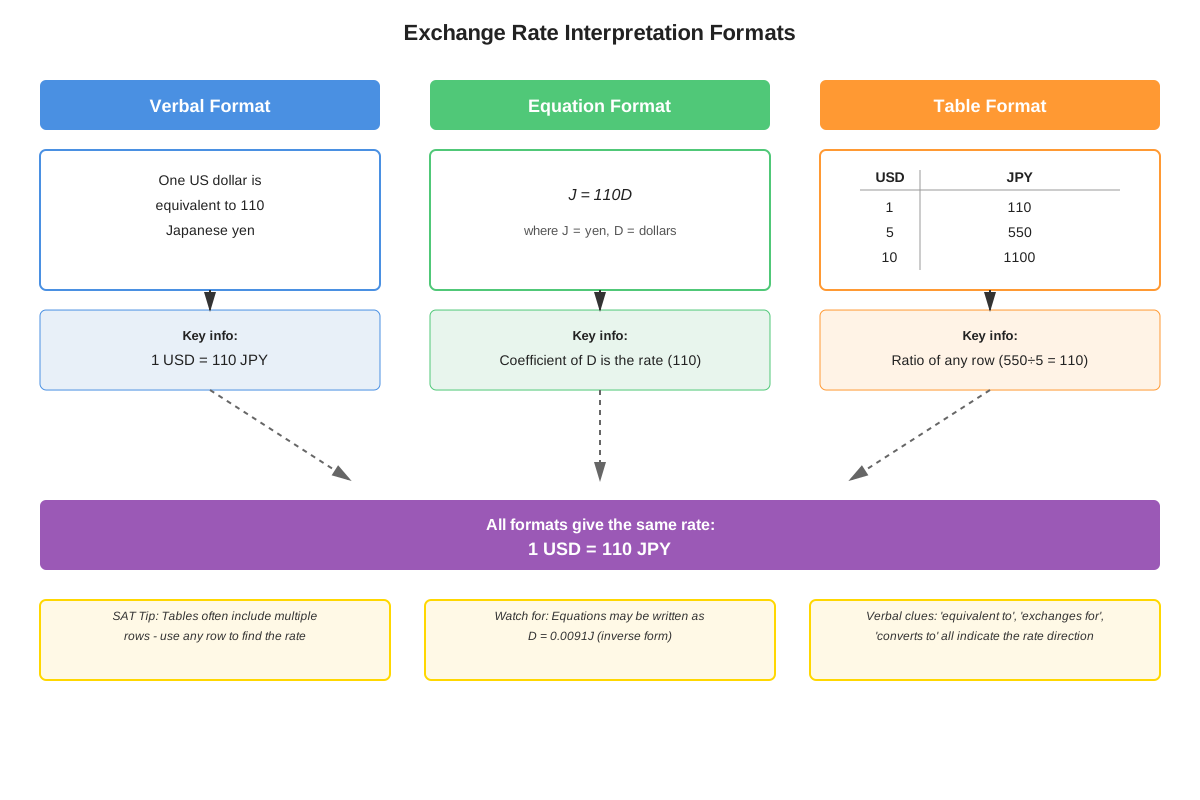
Currency conversion problems on the SAT typically present in three formats: (1) direct conversion problems providing an exchange rate and asking for an equivalent amount, (2) inverse problems where students must work backward from a converted amount to find the original, and (3) multi-currency problems requiring sequential conversions through an intermediate currency. The exam may present exchange rates in various forms—as equations, in tables, or embedded in word problem text—testing students' ability to extract and apply mathematical information from diverse formats.
Core Concepts
Understanding Exchange Rates
An exchange rate represents the value of one currency expressed in terms of another currency. Exchange rates function as conversion factors or multiplicative relationships between monetary systems. For example, if 1 US dollar equals 0.85 euros, the exchange rate is 0.85 euros per dollar. This rate tells us that each dollar can be exchanged for 0.85 euros.
Exchange rates can be expressed in two reciprocal forms. Using the example above, we can state either "1 USD = 0.85 EUR" or equivalently "1 EUR = 1.18 USD" (approximately). These represent the same relationship viewed from different perspectives. Understanding this reciprocal nature is crucial for determining whether to multiply or divide in conversion problems.
The base currency is the currency being expressed as one unit, while the quote currency is the currency expressing the value. In "1 USD = 0.85 EUR," USD is the base currency and EUR is the quote currency. Identifying which currency serves as the base helps determine the correct mathematical operation.
Direct Currency Conversions
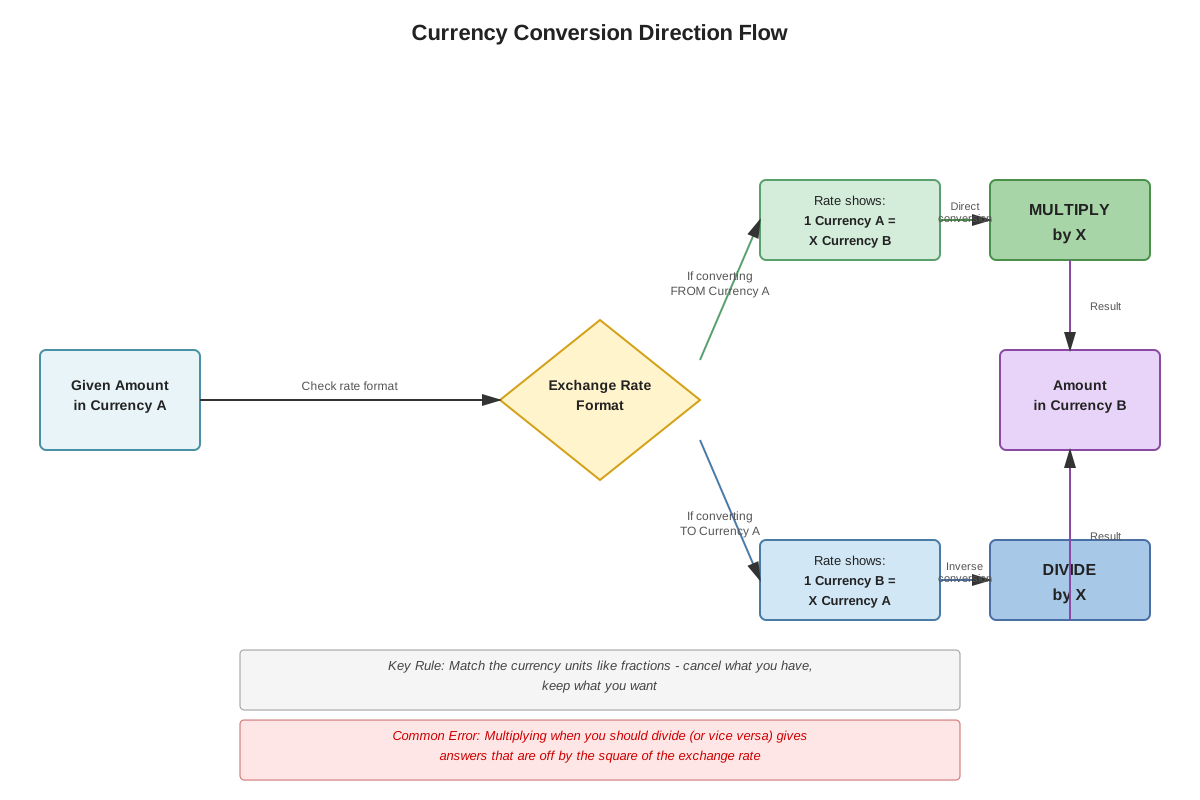
Direct conversions involve converting from a base currency to a quote currency using a given exchange rate. The fundamental principle is to multiply the amount in the base currency by the exchange rate to obtain the equivalent amount in the quote currency.
Formula for direct conversion:
Amount in Quote Currency = Amount in Base Currency × Exchange RateFor example, if the exchange rate is 1 USD = 110 Japanese yen (JPY), and you want to convert $50 USD to yen:
50 USD × 110 JPY/USD = 5,500 JPYNotice how the USD units cancel, leaving only JPY. This dimensional analysis approach ensures correct setup and helps catch errors.
Inverse Currency Conversions
Inverse conversions require working backward from a converted amount to find the original amount. These problems provide the result of a conversion and ask for the starting value. The key operation is division rather than multiplication.
Formula for inverse conversion:
Amount in Base Currency = Amount in Quote Currency ÷ Exchange RateFor example, if someone has 850 euros and the exchange rate is 1 USD = 0.85 EUR, to find the equivalent in dollars:
850 EUR ÷ 0.85 EUR/USD = 1,000 USDAlternatively, students can multiply by the reciprocal exchange rate: 850 EUR × (1 USD / 0.85 EUR) = 1,000 USD.
Multi-Step and Multi-Currency Conversions
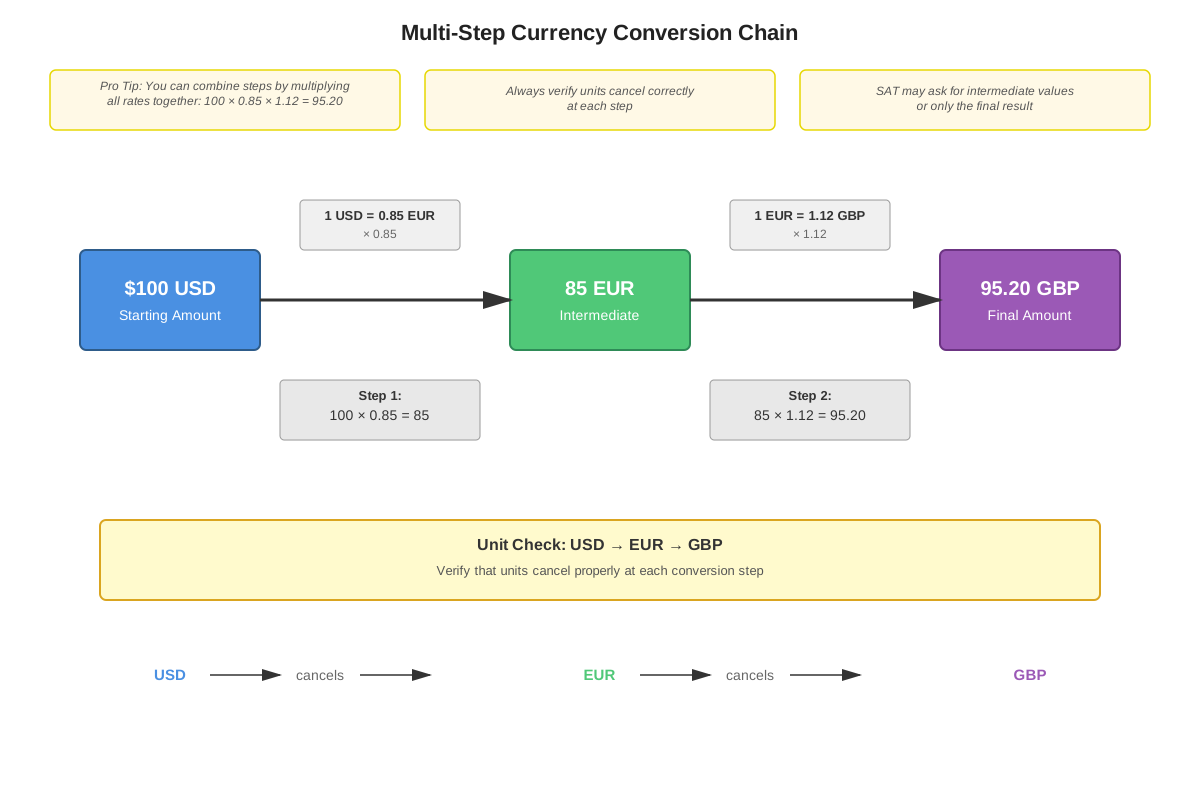
Some SAT problems require converting through an intermediate currency when a direct exchange rate isn't provided. For example, converting from Canadian dollars (CAD) to British pounds (GBP) when only CAD-to-USD and USD-to-GBP rates are given.
The approach involves:
- Convert from the starting currency to the intermediate currency
- Convert from the intermediate currency to the target currency
- Combine the steps by multiplying the amounts sequentially
Example: Convert 500 CAD to GBP given:
- 1 CAD = 0.75 USD
- 1 USD = 0.80 GBP
500 CAD × 0.75 USD/CAD × 0.80 GBP/USD = 300 GBPSetting Up Proportions
Currency conversion problems can always be solved using proportional reasoning. Setting up a proportion ensures accuracy, especially in complex problems.
Standard proportion format:
Currency A₁ / Currency B₁ = Currency A₂ / Currency B₂For example, if 1 USD = 1.35 CAD, and you want to find how many CAD equals 75 USD:
1 USD / 1.35 CAD = 75 USD / x CADCross-multiply and solve: x = 75 × 1.35 = 101.25 CAD
Exchange Rate Tables and Data Interpretation
The SAT often presents exchange rates in table format, requiring students to extract relevant information before calculating. Tables may show multiple currencies with rates relative to a single base currency or show conversion factors between various currency pairs.
| Currency | Value in USD |
|---|---|
| 1 Euro (EUR) | 1.10 |
| 1 British Pound (GBP) | 1.25 |
| 1 Japanese Yen (JPY) | 0.0091 |
| 1 Canadian Dollar (CAD) | 0.75 |
From this table, students must recognize that to convert from USD to any currency, they divide by the given value, while converting to USD requires multiplication.
Concept Relationships
Currency conversions build directly upon fundamental ratio and proportion concepts. The exchange rate itself is a ratio expressing the relationship between two currencies. This ratio serves as a conversion factor, functioning identically to unit conversion factors in physics or chemistry (like converting inches to centimeters).
The relationship flow follows this pattern: Basic Ratios → Rates and Unit Rates → Conversion Factors → Currency Exchange Rates → Multi-Step Conversions. Each level adds complexity while maintaining the same underlying proportional reasoning structure.
Within currency conversions, direct conversions form the foundation for understanding inverse conversions. Once students grasp that multiplying by an exchange rate converts from base to quote currency, they can understand that dividing (or multiplying by the reciprocal) reverses the process. Multi-currency conversions then extend this principle by chaining multiple direct conversions together.
Currency conversions connect to other SAT Math topics including percent change (exchange rates fluctuate), linear relationships (exchange rates can be graphed), and algebraic problem-solving (finding unknown amounts). The dimensional analysis technique used in currency conversions applies equally to rate problems involving distance, time, and speed, as well as density, concentration, and other scientific applications.
High-Yield Facts
- ⭐ Exchange rates function as multiplicative conversion factors between currencies
- ⭐ To convert from base currency to quote currency, multiply by the exchange rate
- ⭐ To convert from quote currency to base currency, divide by the exchange rate (or multiply by the reciprocal)
- ⭐ Units must cancel correctly in dimensional analysis—this confirms proper setup
- ⭐ Multi-currency conversions require multiplying sequential exchange rates together
- Exchange rates can be expressed reciprocally (1 USD = 0.85 EUR is equivalent to 1 EUR = 1.18 USD)
- The base currency is the currency expressed as "1" in the exchange rate statement
- Proportion setup ensures accuracy: maintain consistent currency positions in numerators and denominators
- Exchange rate tables typically show values relative to a single reference currency
- When an exchange rate is given as "Currency A per Currency B," divide amount in A by the rate to get B
- SAT problems may require working backward from a final amount to find the original amount
- Rounding should only occur in the final answer unless otherwise specified
- Exchange rates greater than 1 indicate the quote currency has lower value than the base currency
- Calculator use is essential for complex decimal multiplication and division in these problems
Quick check — test yourself on Currency conversions so far.
Try Flashcards →Common Misconceptions
Misconception: Always multiply the amount by the exchange rate regardless of conversion direction.
Correction: The operation depends on conversion direction. Multiply when converting from base to quote currency; divide when converting from quote to base currency. Check that units cancel properly to verify correct setup.
Misconception: An exchange rate of "1 USD = 110 JPY" means dollars are worth less than yen.
Correction: The numerical value of an exchange rate doesn't indicate relative currency strength. Since 1 dollar equals 110 yen, the dollar is actually worth more—it takes 110 yen to equal one dollar's value.
Misconception: In multi-currency conversions, you can add the exchange rates together.
Correction: Exchange rates must be multiplied sequentially, not added. Each conversion is a multiplicative transformation, and combining them requires multiplication to maintain proper dimensional relationships.
Misconception: The exchange rate "0.85 EUR per USD" is the same as "0.85 USD per EUR."
Correction: These are reciprocals, not equivalents. "0.85 EUR per USD" means each dollar equals 0.85 euros, while "0.85 USD per EUR" would mean each euro equals 0.85 dollars—completely different relationships.
Misconception: When given a table showing "Value in USD," you multiply by that value to convert from USD to the other currency.
Correction: A table showing "Value in USD" indicates how much one unit of each currency is worth in dollars. To convert from USD to another currency, divide by the table value; to convert to USD, multiply by it.
Misconception: Exchange rates remain constant over time.
Correction: While SAT problems treat exchange rates as fixed values within a single problem, real exchange rates fluctuate continuously. The problem will provide the rate to use for that specific scenario.
Worked Examples
Example 1: Direct Conversion with Table Interpretation
Problem: The table below shows exchange rates for various currencies relative to the US dollar. If Maria has $240 USD, how many British pounds (GBP) can she exchange this for?
| Currency | Exchange Rate |
|---|---|
| 1 USD | 0.82 EUR |
| 1 USD | 0.78 GBP |
| 1 USD | 1.32 CAD |
Solution:
Step 1: Identify the relevant exchange rate.
The table shows 1 USD = 0.78 GBP. This means each US dollar can be exchanged for 0.78 British pounds.
Step 2: Determine the operation.
We're converting from the base currency (USD) to the quote currency (GBP), so we multiply by the exchange rate.
Step 3: Set up the calculation with dimensional analysis.
240 USD × (0.78 GBP / 1 USD) = 240 × 0.78 GBPStep 4: Calculate.
240 × 0.78 = 187.2 GBPStep 5: Verify units cancel correctly.
USD in the numerator cancels with USD in the denominator, leaving only GBP.
Answer: Maria can exchange $240 USD for 187.2 GBP (or £187.20).
Connection to Learning Objectives: This problem demonstrates identifying key features (exchange rate in table format), interpreting how the information is presented, and applying the conversion correctly using multiplication.
Example 2: Multi-Step Inverse Conversion
Problem: Kenji traveled to Mexico and spent 3,400 Mexican pesos (MXN) on souvenirs. When he returned home to Japan, he wanted to know how much he spent in Japanese yen (JPY). The exchange rates are:
- 1 USD = 20 MXN
- 1 USD = 110 JPY
How much did Kenji spend in Japanese yen?
Solution:
Step 1: Recognize this requires multi-currency conversion.
We need to convert MXN → USD → JPY because no direct MXN-to-JPY rate is given.
Step 2: Convert Mexican pesos to US dollars.
Since 1 USD = 20 MXN, we need to divide to convert from MXN to USD (inverse conversion):
3,400 MXN ÷ (20 MXN / 1 USD) = 3,400 ÷ 20 = 170 USDAlternatively, using dimensional analysis:
3,400 MXN × (1 USD / 20 MXN) = 170 USDStep 3: Convert US dollars to Japanese yen.
Since 1 USD = 110 JPY, we multiply to convert from USD to JPY (direct conversion):
170 USD × (110 JPY / 1 USD) = 170 × 110 = 18,700 JPYStep 4: Verify the complete conversion chain.
3,400 MXN × (1 USD / 20 MXN) × (110 JPY / 1 USD) = 18,700 JPYNotice how MXN cancels, then USD cancels, leaving only JPY.
Answer: Kenji spent 18,700 Japanese yen on souvenirs.
Connection to Learning Objectives: This problem requires recognizing when sequential conversions are necessary, correctly applying both inverse and direct conversions, and maintaining accurate unit tracking through multiple steps—all essential SAT skills for currency conversion problems.
Exam Strategy
When approaching SAT currency conversions questions, begin by carefully identifying what currency you're starting with and what currency you need to end with. Circle or underline these in the problem to maintain focus. Next, locate the exchange rate information, which may appear in text, tables, or equations. Write down the exchange rate in standard form (1 Currency A = x Currency B) even if it's presented differently.
Trigger words and phrases to watch for include: "exchange rate," "convert," "equivalent to," "worth," "per," and "in terms of." The phrase "Currency A per Currency B" indicates B is the base currency. Questions asking "how many" or "what is the value" signal you need to perform a conversion calculation. Words like "originally" or "before" often indicate inverse conversion problems.
For process of elimination, check whether answer choices are reasonable in magnitude. If converting from a currency with higher value to one with lower value, the numerical amount should increase (e.g., dollars to yen). Conversely, converting from lower to higher value currencies should decrease the numerical amount. Eliminate answers that violate this principle. Also eliminate answers with incorrect units or those that result from adding/subtracting exchange rates instead of multiplying/dividing.
Time allocation for currency conversion problems should be approximately 1-2 minutes for straightforward single-step conversions and 2-3 minutes for multi-step or inverse problems. If a problem requires more than three minutes, mark it for review and move on. These problems reward careful setup more than lengthy calculation—spending 30 seconds organizing the problem saves time and prevents errors.
Always use dimensional analysis by writing out units and ensuring they cancel properly. This technique catches setup errors before calculation. For multi-step problems, solve one conversion at a time rather than trying to combine everything mentally. Write intermediate results to maintain accuracy and allow for checking work if time permits.
Memory Techniques
Mnemonic for conversion direction: "Base to Quote: Multiply the Route" — When converting from the base currency (the "1" in the exchange rate) to the quote currency, multiply by the exchange rate.
Mnemonic for inverse conversions: "Going Back? Divide the Stack" — When working backward from a converted amount to find the original, divide by the exchange rate.
Visualization strategy: Picture exchange rates as bridges between currencies. The exchange rate number tells you how many steps across the bridge. Going from base to quote, you multiply (take more steps). Going from quote to base, you divide (take fewer steps back).
Acronym for multi-currency problems: "CITE" — Chain the conversions, Identify intermediate currency, Track units carefully, Execute sequentially.
Memory aid for table interpretation: When a table shows "Value in Currency X," remember "TO X multiply, FROM X divide" — to convert to Currency X, multiply by the table value; to convert from Currency X, divide by it.
Dimensional analysis reminder: "Units Cancel Like Fractions" — Write exchange rates as fractions and cancel units exactly as you would cancel numbers in fraction multiplication. If units don't cancel to leave only your target currency, the setup is wrong.
Summary
Currency conversions on the SAT test proportional reasoning through real-world applications of exchange rates. The fundamental principle is that exchange rates function as multiplicative conversion factors between monetary systems. Direct conversions from base to quote currency require multiplication by the exchange rate, while inverse conversions require division. Multi-currency problems extend this principle by chaining sequential conversions through intermediate currencies. Success requires identifying which currency is the base, determining the correct operation based on conversion direction, and maintaining careful unit tracking through dimensional analysis. Exchange rate information may appear in various formats including text, tables, and equations, requiring flexible interpretation skills. The SAT favors these problems because they simultaneously assess reading comprehension, proportional reasoning, computational accuracy, and real-world mathematical application. Mastery comes from understanding the conceptual relationship between currencies rather than memorizing procedures, allowing students to adapt to novel problem presentations.
Key Takeaways
- Exchange rates are conversion factors that relate two currencies through multiplication or division
- Multiply by the exchange rate when converting from base currency to quote currency; divide when converting in the opposite direction
- Dimensional analysis with units ensures correct problem setup and catches directional errors
- Multi-currency conversions require sequential application of exchange rates, multiplying each rate in the chain
- Exchange rate tables require careful interpretation—understand whether values represent "per unit" or "value in" relationships
- Inverse problems work backward from converted amounts using division or reciprocal multiplication
- Always verify that units cancel properly, leaving only the target currency in your final answer
Related Topics
Percent Change and Exchange Rate Fluctuations: Understanding how exchange rates change over time connects currency conversions to percent increase/decrease problems, allowing analysis of currency appreciation and depreciation.
Unit Conversions in Science: The dimensional analysis techniques used in currency conversions apply directly to converting between measurement systems (metric to imperial, etc.), reinforcing proportional reasoning across contexts.
Rate Problems: Currency conversions share structural similarity with distance-rate-time problems and other rate calculations, strengthening overall facility with rates and proportions.
Scale Factors in Geometry: Exchange rates function analogously to scale factors in similar figures, both representing multiplicative relationships between corresponding measurements.
Linear Functions and Graphing: Exchange rates can be represented as linear functions where one currency is graphed against another, connecting algebraic and graphical representations of proportional relationships.
Practice CTA
Now that you've mastered the concepts, strategies, and techniques for currency conversions, it's time to solidify your understanding through practice. Attempt the practice questions to apply these principles to SAT-style problems, and use the flashcards to reinforce key facts and formulas. Remember, currency conversion problems reward careful setup and systematic thinking—skills that improve rapidly with focused practice. Each problem you solve strengthens your proportional reasoning abilities and builds confidence for test day. You've got this!
Sign up free to keep reading
Create a free AnvayaPrep account to finish this SAT guide on Currency conversions — plus flashcards and practice questions.